
Cell potentials and Reduction potentials Answers 1 5

- Slides: 5
Cell potentials and Reduction potentials
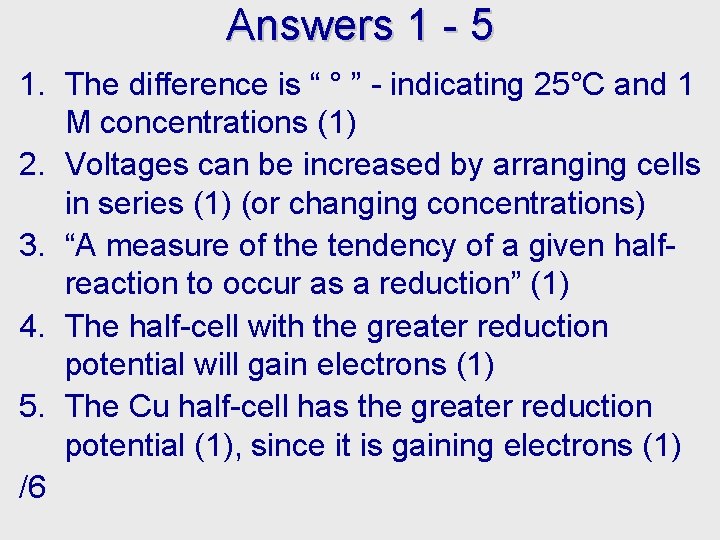
Answers 1 - 5 1. The difference is “ ° ” - indicating 25°C and 1 M concentrations (1) 2. Voltages can be increased by arranging cells in series (1) (or changing concentrations) 3. “A measure of the tendency of a given halfreaction to occur as a reduction” (1) 4. The half-cell with the greater reduction potential will gain electrons (1) 5. The Cu half-cell has the greater reduction potential (1), since it is gaining electrons (1) /6
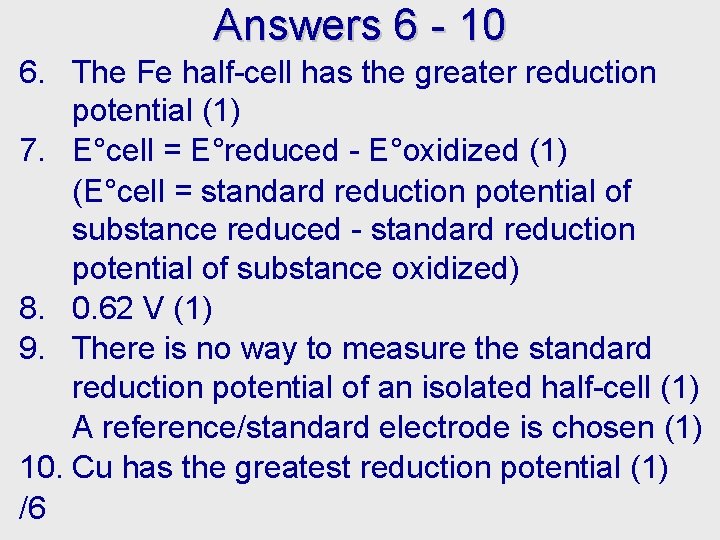
Answers 6 - 10 6. The Fe half-cell has the greater reduction potential (1) 7. E°cell = E°reduced - E°oxidized (1) (E°cell = standard reduction potential of substance reduced - standard reduction potential of substance oxidized) 8. 0. 62 V (1) 9. There is no way to measure the standard reduction potential of an isolated half-cell (1) A reference/standard electrode is chosen (1) 10. Cu has the greatest reduction potential (1) /6
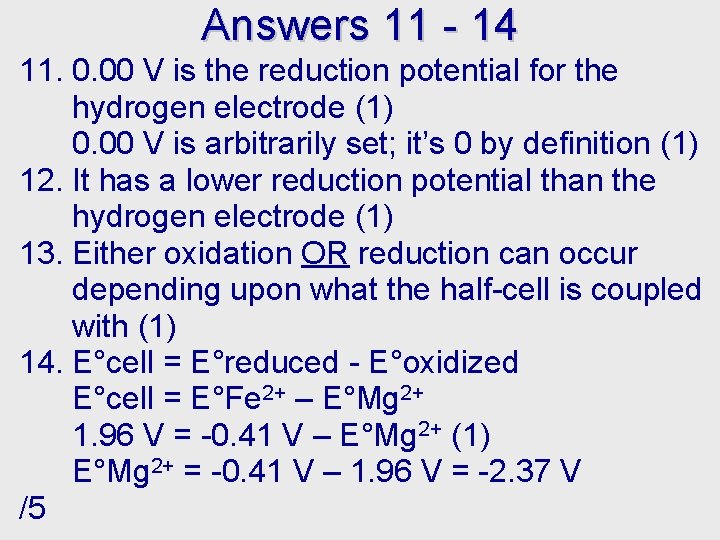
Answers 11 - 14 11. 0. 00 V is the reduction potential for the hydrogen electrode (1) 0. 00 V is arbitrarily set; it’s 0 by definition (1) 12. It has a lower reduction potential than the hydrogen electrode (1) 13. Either oxidation OR reduction can occur depending upon what the half-cell is coupled with (1) 14. E°cell = E°reduced - E°oxidized E°cell = E°Fe 2+ – E°Mg 2+ 1. 96 V = -0. 41 V – E°Mg 2+ (1) E°Mg 2+ = -0. 41 V – 1. 96 V = -2. 37 V /5
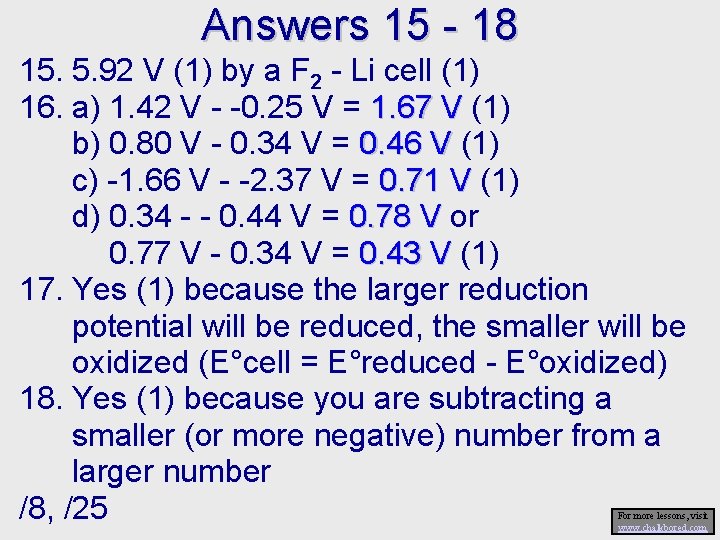
Answers 15 - 18 15. 5. 92 V (1) by a F 2 - Li cell (1) 16. a) 1. 42 V - -0. 25 V = 1. 67 V (1) b) 0. 80 V - 0. 34 V = 0. 46 V (1) c) -1. 66 V - -2. 37 V = 0. 71 V (1) d) 0. 34 - - 0. 44 V = 0. 78 V or 0. 77 V - 0. 34 V = 0. 43 V (1) 17. Yes (1) because the larger reduction potential will be reduced, the smaller will be oxidized (E°cell = E°reduced - E°oxidized) 18. Yes (1) because you are subtracting a smaller (or more negative) number from a larger number /8, /25 For more lessons, visit www. chalkbored. com