
Cell PhoneBased Remote Home Control System Abstract This
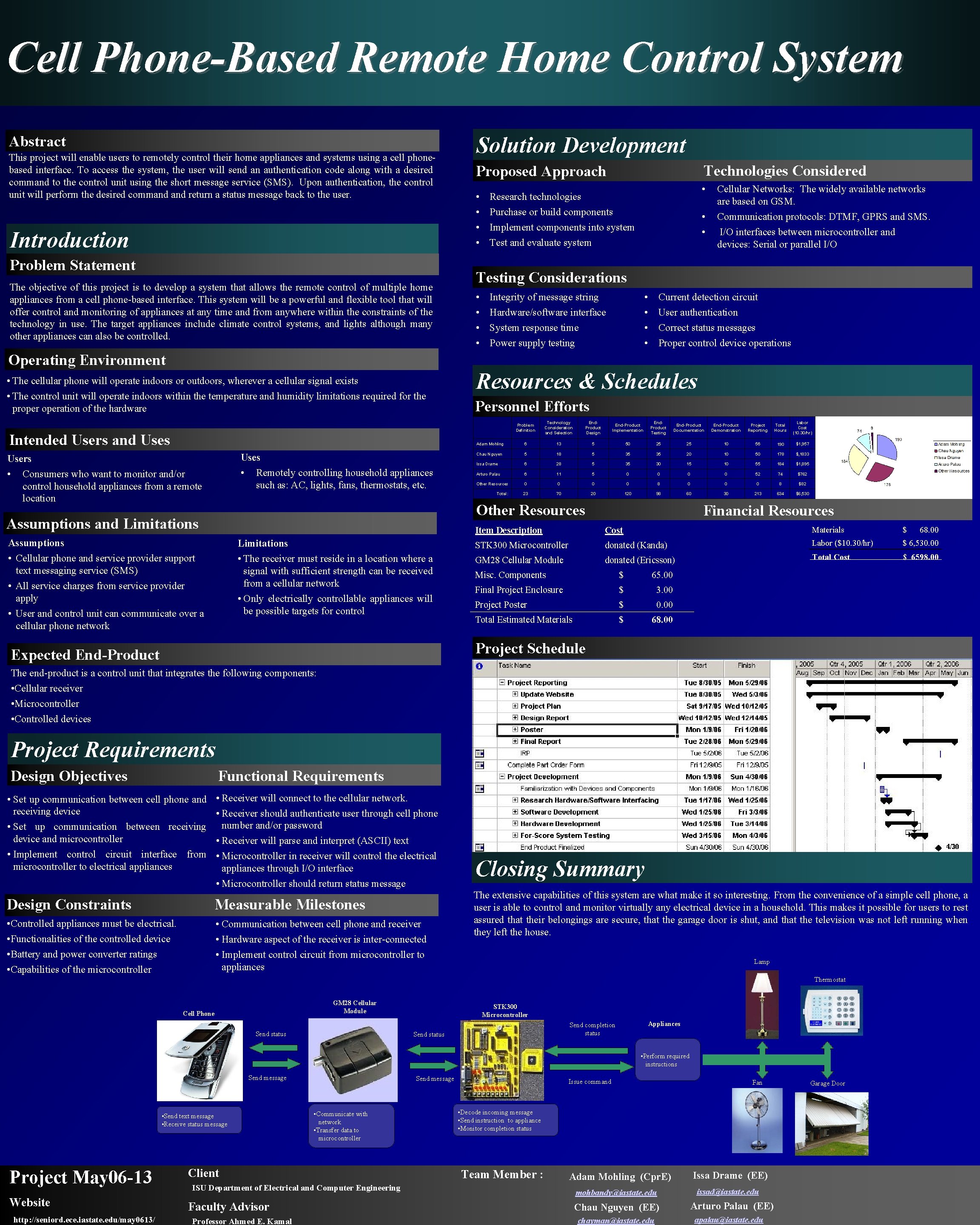
Cell Phone-Based Remote Home Control System Abstract This project will enable users to remotely control their home appliances and systems using a cell phonebased interface. To access the system, the user will send an authentication code along with a desired command to the control unit using the short message service (SMS). Upon authentication, the control unit will perform the desired command return a status message back to the user. Introduction Problem Statement The objective of this project is to develop a system that allows the remote control of multiple home appliances from a cell phone-based interface. This system will be a powerful and flexible tool that will offer control and monitoring of appliances at any time and from anywhere within the constraints of the technology in use. The target appliances include climate control systems, and lights although many other appliances can also be controlled. Solution Development Technologies Considered Proposed Approach • • • Research technologies Purchase or build components Implement components into system Test and evaluate system • • Cellular Networks: The widely available networks are based on GSM. Communication protocols: DTMF, GPRS and SMS. I/O interfaces between microcontroller and devices: Serial or parallel I/O Testing Considerations • • Integrity of message string Hardware/software interface System response time Power supply testing Current detection circuit User authentication Correct status messages Proper control device operations Operating Environment • The cellular phone will operate indoors or outdoors, wherever a cellular signal exists • The control unit will operate indoors within the temperature and humidity limitations required for the properation of the hardware Intended Users and Uses Users Uses • • Consumers who want to monitor and/or control household appliances from a remote location Remotely controlling household appliances such as: AC, lights, fans, thermostats, etc. Resources & Schedules Personnel Efforts Problem Definition Technology Consideration and Selection End. Product Design End-Product Implementation End. Product Testing End-Product Documentation End-Product Demonstration Project Reporting Total Hours Labor Cost (10. 30/hr) Adam Mohling 6 13 5 50 25 25 10 56 190 $1, 957 Chau Nguyen 5 18 5 35 35 20 10 50 178 $, 1833 Issa Drame 6 28 5 35 30 15 10 55 184 $1, 895 Arturo Palau 6 11 5 0 0 52 74 $762 Other Resources 0 0 8 0 0 0 8 $82 Total: 23 70 20 120 98 60 30 213 634 $6, 530 Other Resources Assumptions and Limitations Financial Resources Item Description Cost Materials $ 68. 00 Assumptions Limitations STK 300 Microcontroller donated (Kanda) Labor ($10. 30/hr) $ 6, 530. 00 • Cellular phone and service provider support text messaging service (SMS) • All service charges from service provider apply • User and control unit can communicate over a cellular phone network • The receiver must reside in a location where a signal with sufficient strength can be received from a cellular network • Only electrically controllable appliances will be possible targets for control GM 28 Cellular Module donated (Ericsson) Total Cost $ 6598. 00 Misc. Components $ 65. 00 Final Project Enclosure $ 3. 00 Project Poster $ 0. 00 Total Estimated Materials $ 68. 00 Project Schedule Expected End-Product The end-product is a control unit that integrates the following components: • Cellular receiver • Microcontroller • Controlled devices Project Requirements Design Objectives Functional Requirements • Receiver will connect to the cellular network. • Receiver should authenticate user through cell phone number and/or password • Receiver will parse and interpret (ASCII) text • Microcontroller in receiver will control the electrical appliances through I/O interface • Microcontroller should return status message • Set up communication between cell phone and receiving device • Set up communication between receiving device and microcontroller • Implement control circuit interface from microcontroller to electrical appliances Design Constraints Measurable Milestones • Controlled appliances must be electrical. • Functionalities of the controlled device • Battery and power converter ratings • Capabilities of the microcontroller • Communication between cell phone and receiver • Hardware aspect of the receiver is inter-connected • Implement control circuit from microcontroller to appliances Closing Summary The extensive capabilities of this system are what make it so interesting. From the convenience of a simple cell phone, a user is able to control and monitor virtually any electrical device in a household. This makes it possible for users to rest assured that their belongings are secure, that the garage door is shut, and that the television was not left running when they left the house. Lamp Thermostat GM 28 Cellular Module Cell Phone Send status STK 300 Microcontroller Send completion status Send status Appliances • Perform required instructions Send message • Send text message • Receive status message Project May 06 -13 Website http: //seniord. ece. iastate. edu/may 0613/ Send message • Communicate with network • Transfer data to microcontroller Client ISU Department of Electrical and Computer Engineering Faculty Advisor Professor Ahmed E. Kamal Issue command Fan • Decode incoming message • Send instruction to appliance • Monitor completion status Team Member : Adam Mohling (Cpr. E) mohbandy@iastate. edu Chau Nguyen (EE) chayman@iastate. edu Issa Drame (EE) issad@iastate. edu Arturo Palau (EE) apalau@iastate. edu Garage Door
- Slides: 1