
Cell Phone Spectroscopy App for Beers Law Analysis
Cell Phone Spectroscopy App for Beer’s Law Analysis Dr. Joshua Sokoloski Chemistry
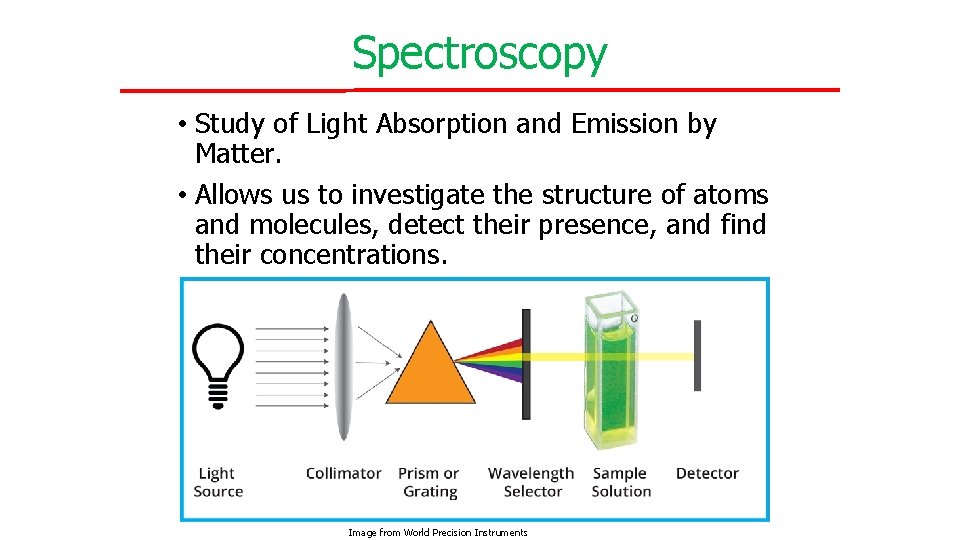
Spectroscopy • Study of Light Absorption and Emission by Matter. • Allows us to investigate the structure of atoms and molecules, detect their presence, and find their concentrations. Image from World Precision Instruments
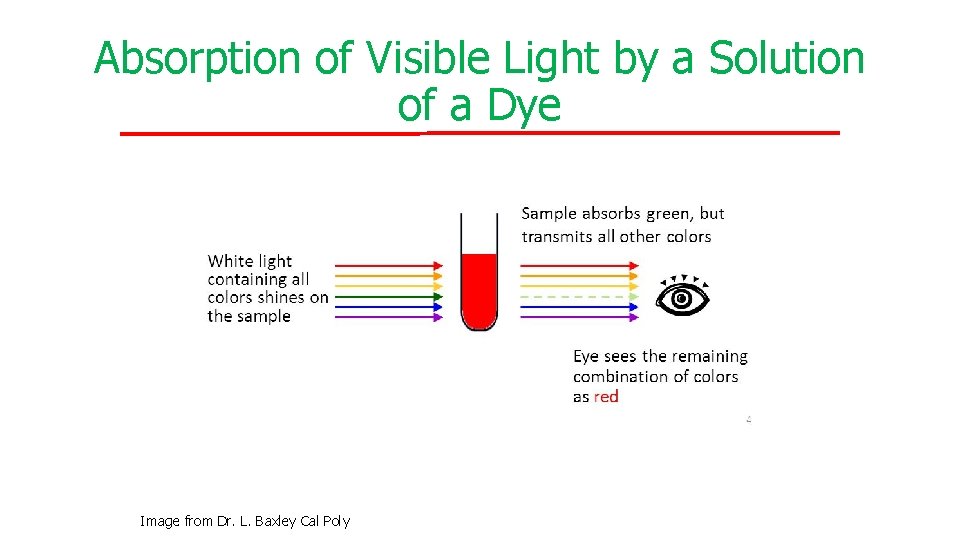
Absorption of Visible Light by a Solution of a Dye Image from Dr. L. Baxley Cal Poly
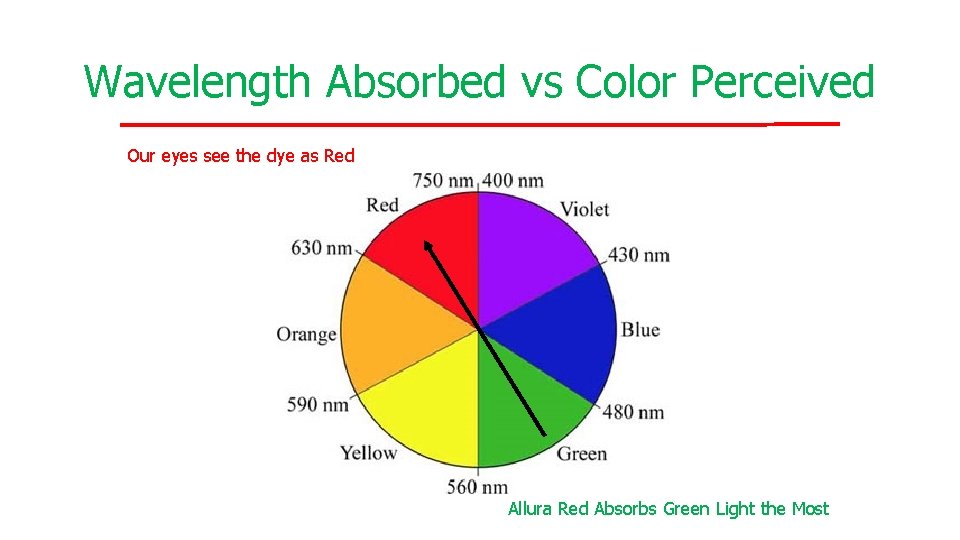
Wavelength Absorbed vs Color Perceived Our eyes see the dye as Red Allura Red Absorbs Green Light the Most

Beer-Lambert Law Image from UNC Pharmacy
What We Need • Spectroscopy and its use to determine concentration of dissolved molecules in solution is a key learning objective in general chemistry lab. • There is a lack of an affordable, practical product to incorporate spectroscopy into remote and online teaching modalities. • A cell-phone based spectrometer approach would be highly useful to general chemistry instruction both here at SU and at other universities. • The pandemic has expanded the demand for remote and online learning so this need will persist post-pandemic.
What is currently available • The optics of modern cell phone cameras rival those of detectors I used in grad school on 100 k instruments. The physical capabilities are there, we just have to convert the data into a form useful for chemistry and biology. • Plenty of color analyzer apps available, but they only give out color information and not absorbance of a certain wavelength. • A 2016 J Chem Ed paper outlines how a color wheel approximation to absorbance is feasible for Beer’s Law Analysis: https: //pubs. acs. org/doi/full/10. 1021/acs. jchemed. 5 b 00844 • Carolina Biological Supply sells a cell phone spectrometer kit but requires the use of color analyzer apps.
Goals Overall goal – convert the color signal from a cell phone camera into an absorbance value for use in Beer’s Law. Need to be both for i. Phones and Android devices. How ideally it would work: 1. Aim camera at sample. 2. Color of sample is translated to an Absorbance of a different color by the program and estimates the wavelength of maximum absorbance. 3. Create a standard curve: Store A signals for a series of known concentrations. 4. Plot curve and fit to a linear regression. 5. Aim camera at unknown sample and estimate the concentration.
Division of Labor and Future Applications • Not a physical chemistry project! The science is well understood and I would handle all aspects of the physics of light absorption and color to Abs conversion information. • The project team would handle the programming for camera data processing, GUI, data storage, etc. . • I am teaching CHEM 122 labs this semester and in the summer so I can have my students test out any early versions. • Future applications could include: 1. 2. 3. 4. 3 D printing devices to better focus light or develop a cuvette holder. Could be used for field work in environmental sciences Could be further expanded into fluorescence or luminescence techniques. I have 3 D printed a small microscope. Using a cell phone as the camera would be ideal.
- Slides: 9