
Cell organelles Mitochondrion Two centrioles Lysosome Golgi vesicle







- Slides: 23
Cell organelles Mitochondrion Two centrioles Lysosome Golgi vesicle Golgi apparatus Ribosomes Rough endoplasmic reticulum Nucleus Nucleolus Chromatin Nuclear pore Nuclear envelope • A ‘generalised’ animal cell showing organelles • Some organelles are not found in every animal cell Plasma membrane Smooth endoplasmic reticulum Cytoplasm • Some organelles occur in greater numbers in certain cells
Nucleus Nucleolus Chromatin Nuclear pore Nuclear envelope • Largest cell organelle • Surrounded by a nuclear envelope • Nuclear pores allow exchange of material between cytoplasm and nucleus. • Contains chromatin (DNA), which form chromosomes during nuclear division. • Chromosomes have genes that control cell activities, such as protein synthesis. • Nucleolus manufactures ribosomes.
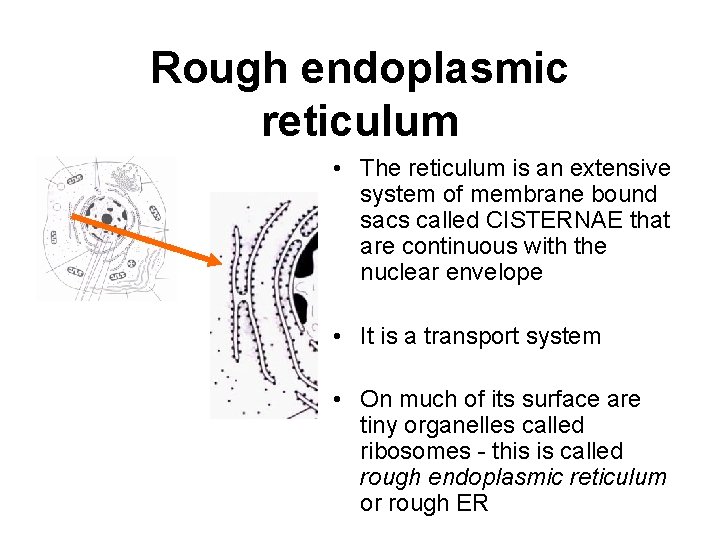
Rough endoplasmic reticulum • The reticulum is an extensive system of membrane bound sacs called CISTERNAE that are continuous with the nuclear envelope • It is a transport system • On much of its surface are tiny organelles called ribosomes - this is called rough endoplasmic reticulum or rough ER
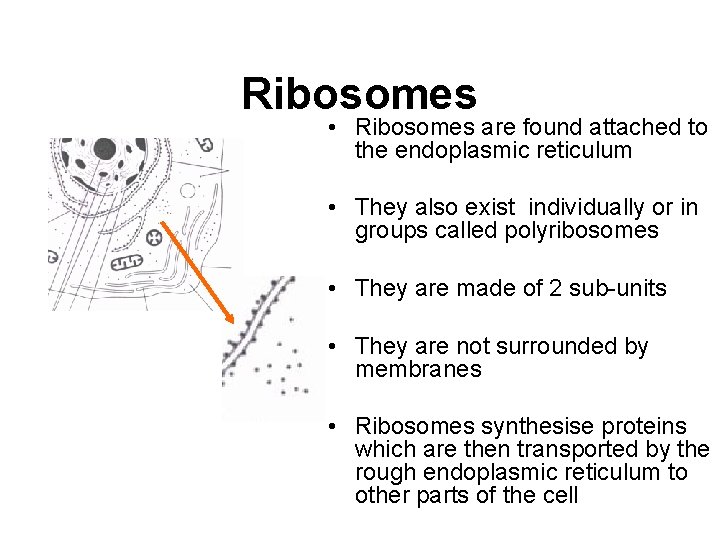
Ribosomes • Ribosomes are found attached to the endoplasmic reticulum • They also exist individually or in groups called polyribosomes • They are made of 2 sub-units • They are not surrounded by membranes • Ribosomes synthesise proteins which are then transported by the rough endoplasmic reticulum to other parts of the cell
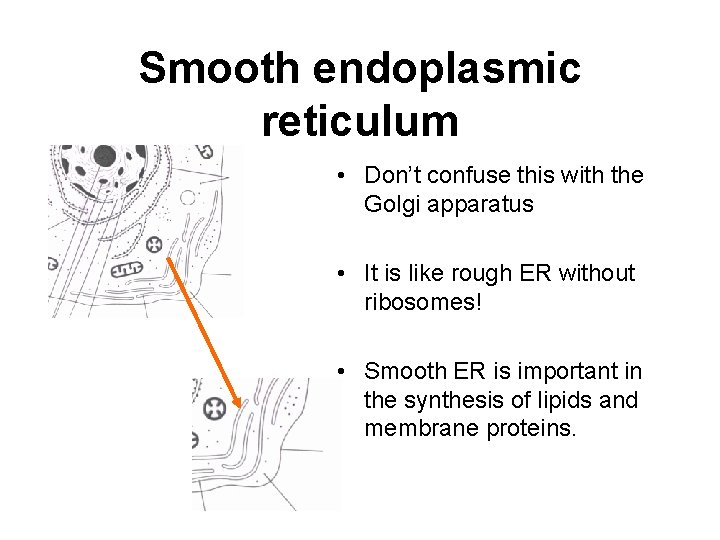
Smooth endoplasmic reticulum • Don’t confuse this with the Golgi apparatus • It is like rough ER without ribosomes! • Smooth ER is important in the synthesis of lipids and membrane proteins.
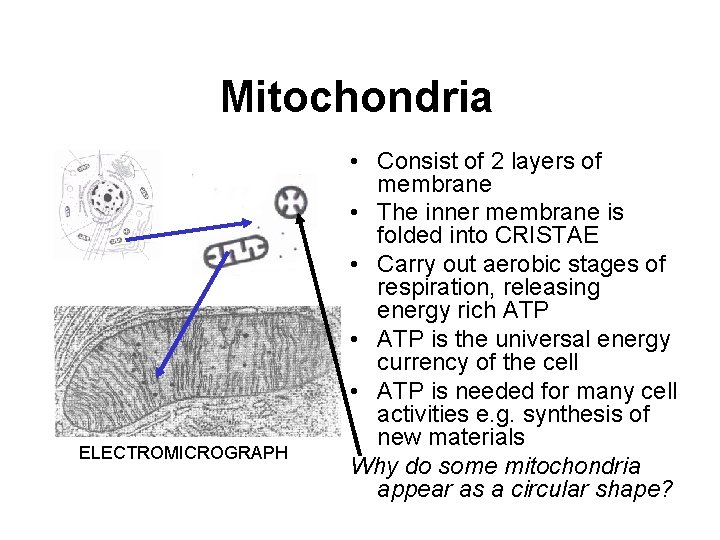
Mitochondria ELECTROMICROGRAPH • Consist of 2 layers of membrane • The inner membrane is folded into CRISTAE • Carry out aerobic stages of respiration, releasing energy rich ATP • ATP is the universal energy currency of the cell • ATP is needed for many cell activities e. g. synthesis of new materials Why do some mitochondria appear as a circular shape?
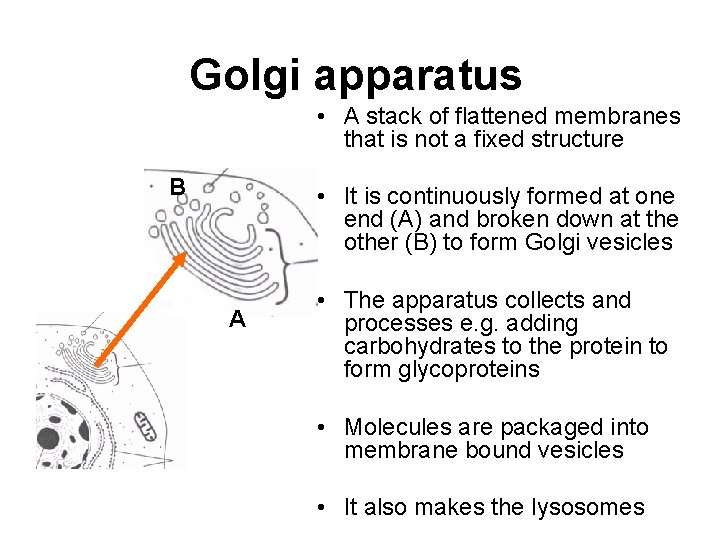
Golgi apparatus • A stack of flattened membranes that is not a fixed structure B • It is continuously formed at one end (A) and broken down at the other (B) to form Golgi vesicles A • The apparatus collects and processes e. g. adding carbohydrates to the protein to form glycoproteins • Molecules are packaged into membrane bound vesicles • It also makes the lysosomes
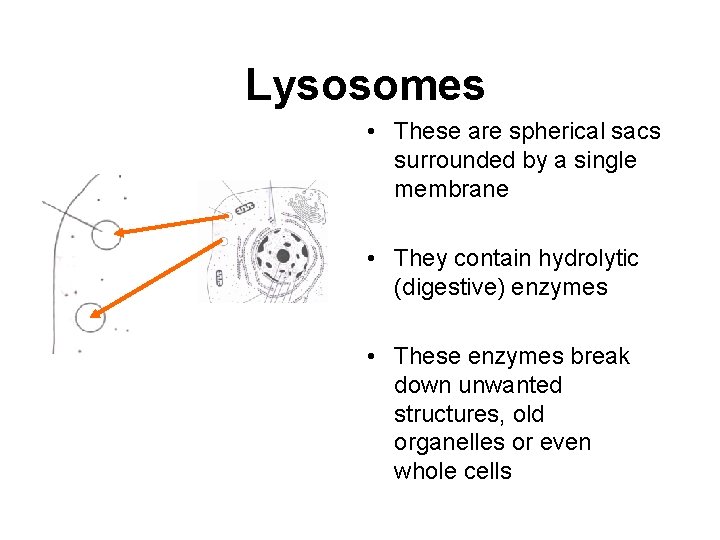
Lysosomes • These are spherical sacs surrounded by a single membrane • They contain hydrolytic (digestive) enzymes • These enzymes break down unwanted structures, old organelles or even whole cells
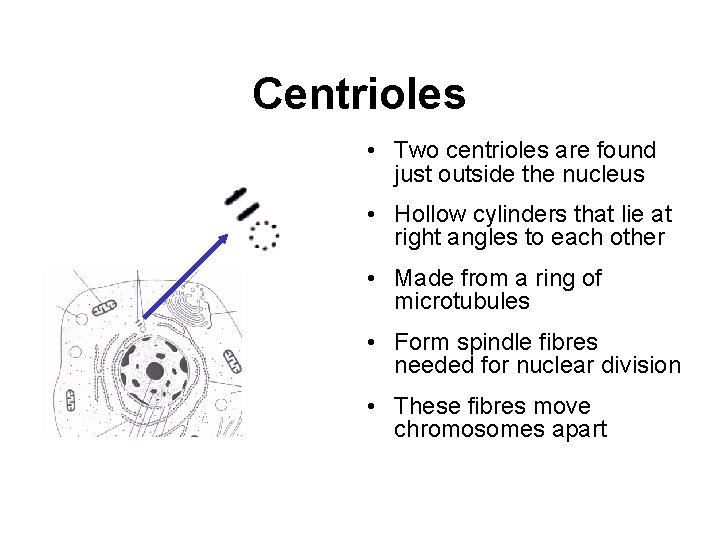
Centrioles • Two centrioles are found just outside the nucleus • Hollow cylinders that lie at right angles to each other • Made from a ring of microtubules • Form spindle fibres needed for nuclear division • These fibres move chromosomes apart
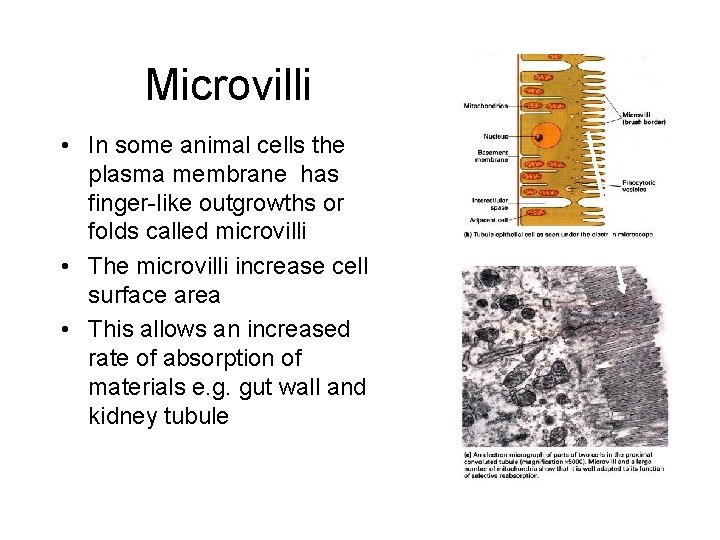
Microvilli • In some animal cells the plasma membrane has finger-like outgrowths or folds called microvilli • The microvilli increase cell surface area • This allows an increased rate of absorption of materials e. g. gut wall and kidney tubule
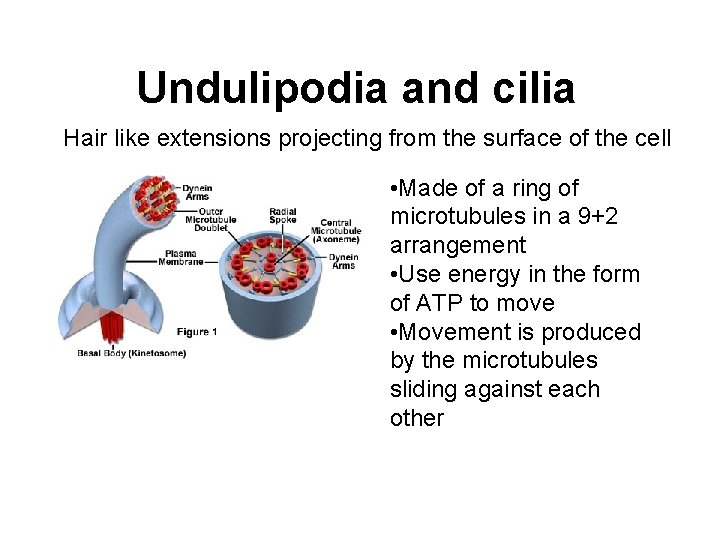
Undulipodia and cilia Hair like extensions projecting from the surface of the cell • Made of a ring of microtubules in a 9+2 arrangement • Use energy in the form of ATP to move • Movement is produced by the microtubules sliding against each other
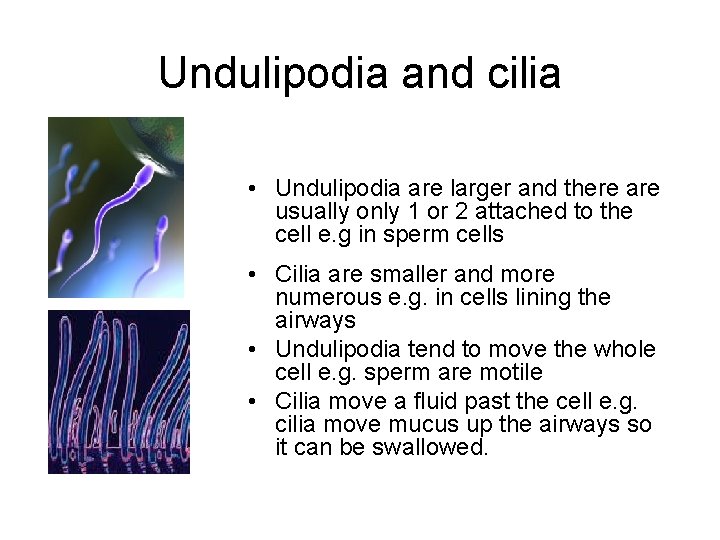
Undulipodia and cilia • Undulipodia are larger and there are usually only 1 or 2 attached to the cell e. g in sperm cells • Cilia are smaller and more numerous e. g. in cells lining the airways • Undulipodia tend to move the whole cell e. g. sperm are motile • Cilia move a fluid past the cell e. g. cilia move mucus up the airways so it can be swallowed.
Cell ultrastructure Plant cell
Plant cell Chloroplast Cytoplasm Golgi apparatus Golgi vesicle Middle lamella Plasmodesmata Cell walls Tonoplast Cell sap Mitochondrion Smooth ER Grana Envelope Plasma membrane Ribosomes Chloroplast Nucleolus Chromatin Envelope Nucleus Rough ER • Plant cells have many structures also found in animal cells • They do NOT usually have microvilli or centrioles • Only plant gametes have undulipodia. • They have other organelles that are not found in animal cells
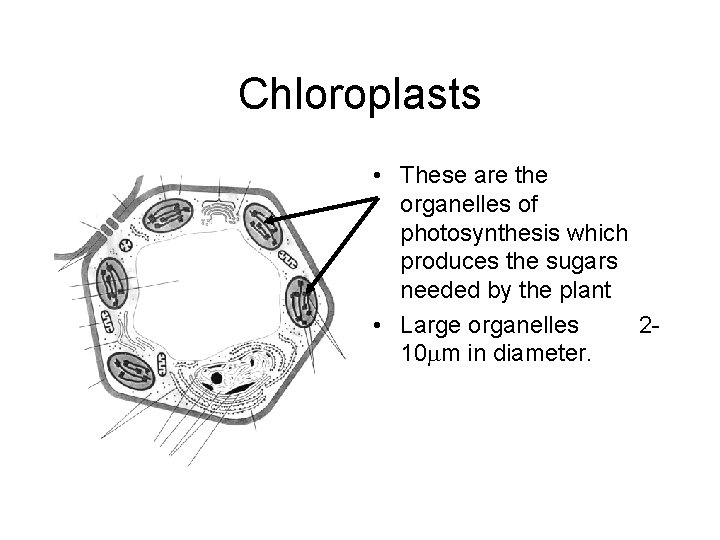
Chloroplasts • These are the organelles of photosynthesis which produces the sugars needed by the plant • Large organelles 210 mm in diameter.
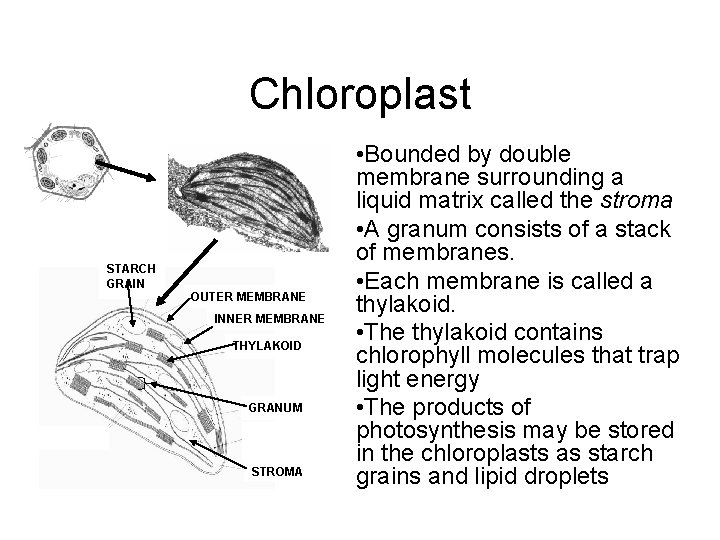
Chloroplast STARCH GRAIN OUTER MEMBRANE INNER MEMBRANE THYLAKOID GRANUM STROMA • Bounded by double membrane surrounding a liquid matrix called the stroma • A granum consists of a stack of membranes. • Each membrane is called a thylakoid. • The thylakoid contains chlorophyll molecules that trap light energy • The products of photosynthesis may be stored in the chloroplasts as starch grains and lipid droplets
Amyloplasts Starch Grains in Banana Cells • Amyloplasts are full of starch grains • Plant cells use starch grains to store energy rich carbohydrate in an insoluble form
Central vacuole VACUOLE TONOPLAST • There is a large central vacuole containing cell sap -a solution of solutes such as sugars and ions. • It is enclosed by a plasma membrane called the tonoplast • When the vacuole is full, it pushes the cytoplasm against the cell wall
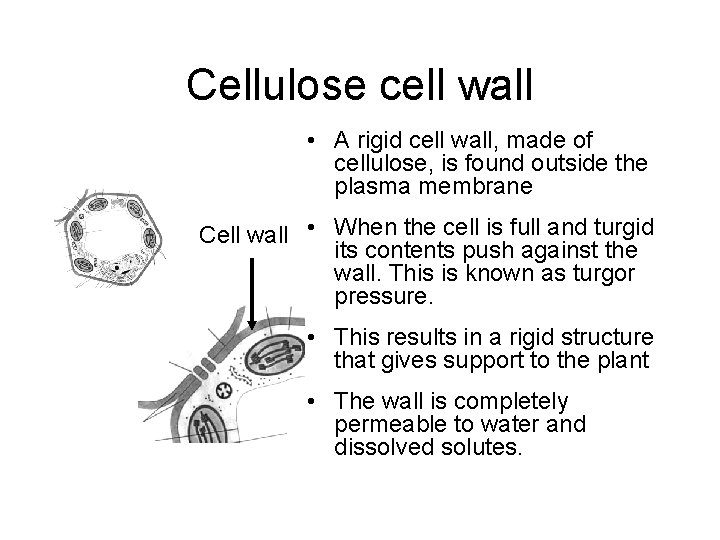
Cellulose cell wall • A rigid cell wall, made of cellulose, is found outside the plasma membrane Cell wall • When the cell is full and turgid its contents push against the wall. This is known as turgor pressure. • This results in a rigid structure that gives support to the plant • The wall is completely permeable to water and dissolved solutes.
Plasmodesmata and cell wall MIDDLE LAMELLA PLASMODESMATA CELL WALL • Plasmodesmata are living strands of cytoplasm that pass through pores in the cell walls between neighbouring cells
Summary Match the cell structure to its function A. Mitochondria B. Chloroplast C. Lysosome D. Ribosome E. Nucleus F. Centriole G. Golgi apparatus H. Rough ER I. Microvilli J. Nucleolus K. Cell wall - makes proteins - contains DNA codes for proteins - packages proteins for export from cell - digests unwanted cell parts - provide plant with support - produces ribosomes - produces spindles for nuclear division - site of photosynthesis - site of aerobic respiration - transport of synthesised proteins - increases plasma membrane surface area
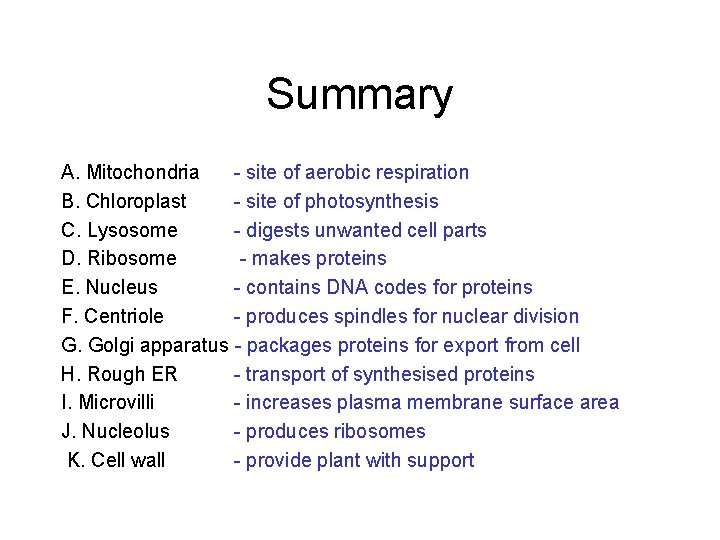
Summary A. Mitochondria - site of aerobic respiration B. Chloroplast - site of photosynthesis C. Lysosome - digests unwanted cell parts D. Ribosome - makes proteins E. Nucleus - contains DNA codes for proteins F. Centriole - produces spindles for nuclear division G. Golgi apparatus - packages proteins for export from cell H. Rough ER - transport of synthesised proteins I. Microvilli - increases plasma membrane surface area J. Nucleolus - produces ribosomes K. Cell wall - provide plant with support
Summary • • • A. Mitochondria B. Chloroplast C. Lysosome D. Ribosome E. Nucleus F. Centriole G. Golgi apparatus H. Rough ER I. Microvilli J. Nucleolus K. Cell wall -