
Cell observation tools and methods Cell biology tools
Cell observation tools and methods
Cell biology tools and methods importance • As in all experimental sciences, research in cell biology depends on the laboratory methods that can be used to study cell structure and function. • Many important advances in understanding cells have directly followed the development of new methods that have opened novel avenues of investigation. • An appreciation of the experimental tools available to the cell biologist is thus critical to understanding both the current status and future directions of this rapidly moving area of science.
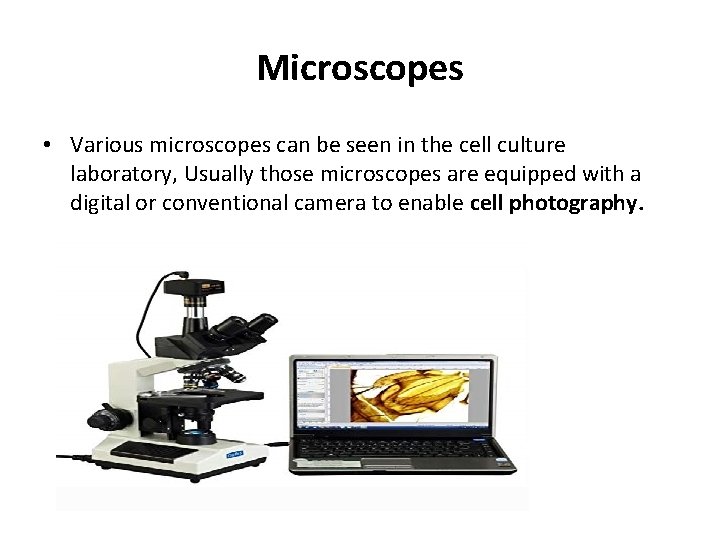
Microscopes • Various microscopes can be seen in the cell culture laboratory, Usually those microscopes are equipped with a digital or conventional camera to enable cell photography.
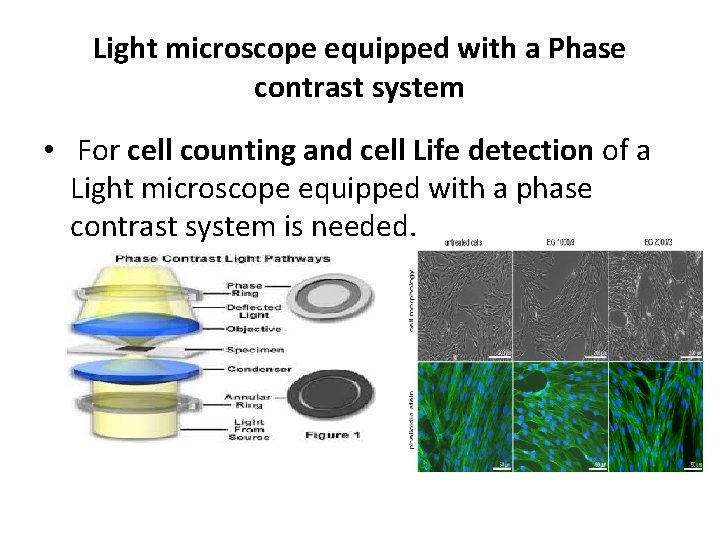
Light microscope equipped with a Phase contrast system • For cell counting and cell Life detection of a Light microscope equipped with a phase contrast system is needed.
Phase contrast microscope properties • Probably the most important breakthrough in microscopic technique in the pre-1960 s was the development of contrast phase microscopes. In this type of microscope, living tissue is unstained, with good contrast and resolution. To make the visible details of an object. • If the object is unstained, it may be possible to refract multiple parts of the object less or more than the material in which located without interfering with its building or life.
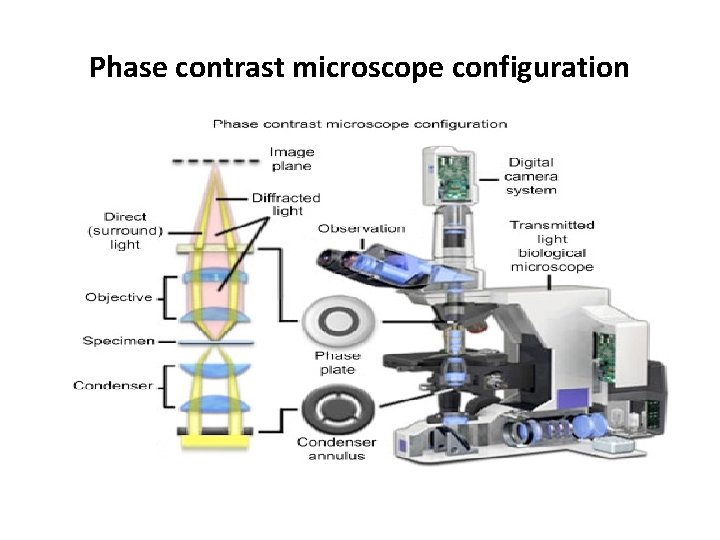
Phase contrast microscope configuration

Light microscope and Phase contrast microscope difference
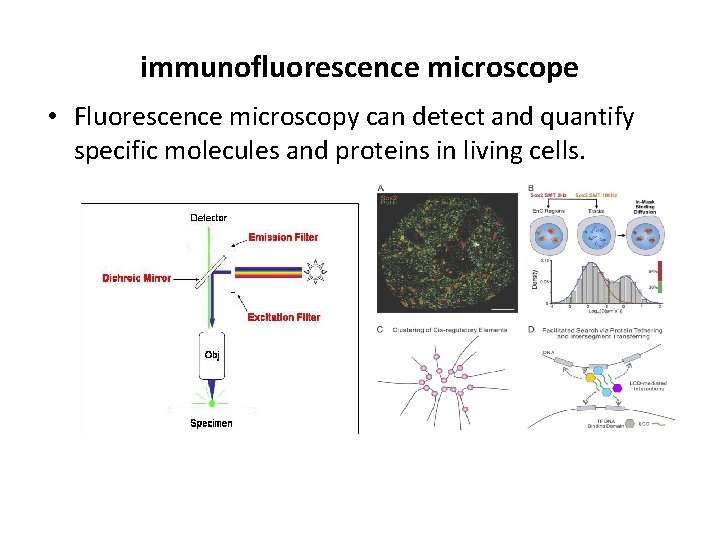
immunofluorescence microscope • Fluorescence microscopy can detect and quantify specific molecules and proteins in living cells.
Fluorescence microscopy technique • Fluorescence microscopy is a widely used technique for studying the location and amount of certain components on or within cells. • Specific cellular components can be visualized by linking fluorescent dyes to exogenous macromolecules such as antibodies (immunofluorescence) and ligands, or by producing fluorescent analogs of small molecules normally found within cells.
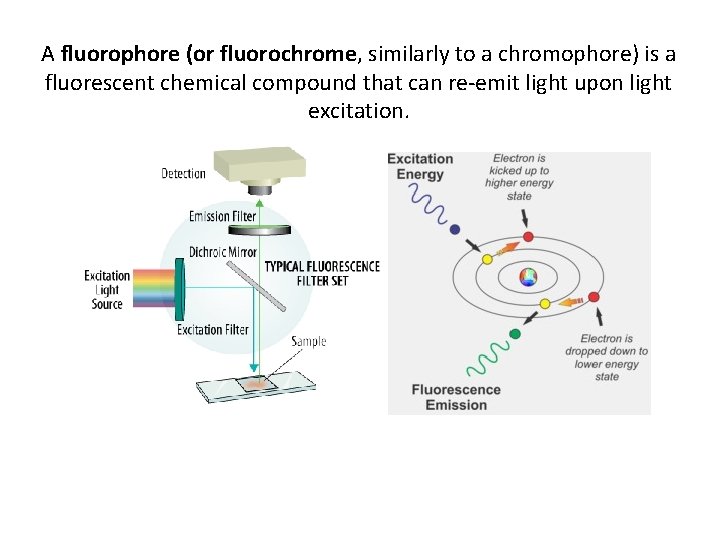
A fluorophore (or fluorochrome, similarly to a chromophore) is a fluorescent chemical compound that can re-emit light upon light excitation.
digitized fluorescence microscopy ( (DFM • The current and growing appeal of digitized fluorescence microscopy (DFM) in cell biology lies in its ability to quantitatively image the distribution of single classes of macromolecules, molecules and ions in single living cells.
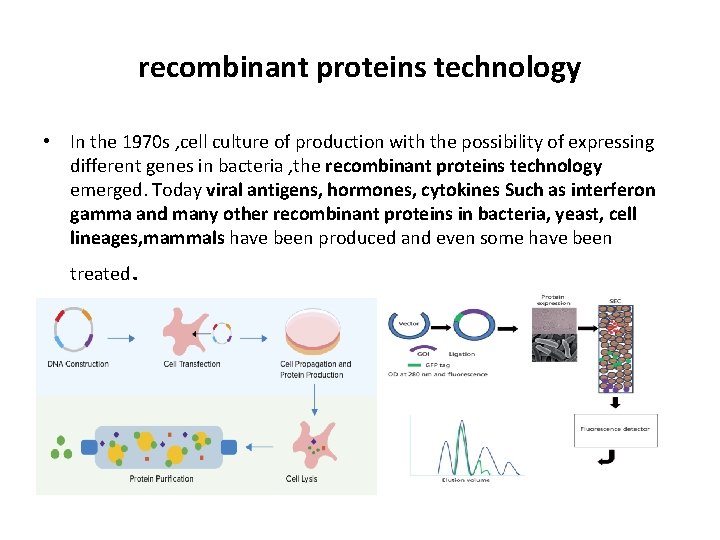
recombinant proteins technology • In the 1970 s , cell culture of production with the possibility of expressing different genes in bacteria , the recombinant proteins technology emerged. Today viral antigens, hormones, cytokines Such as interferon gamma and many other recombinant proteins in bacteria, yeast, cell lineages, mammals have been produced and even some have been treated .
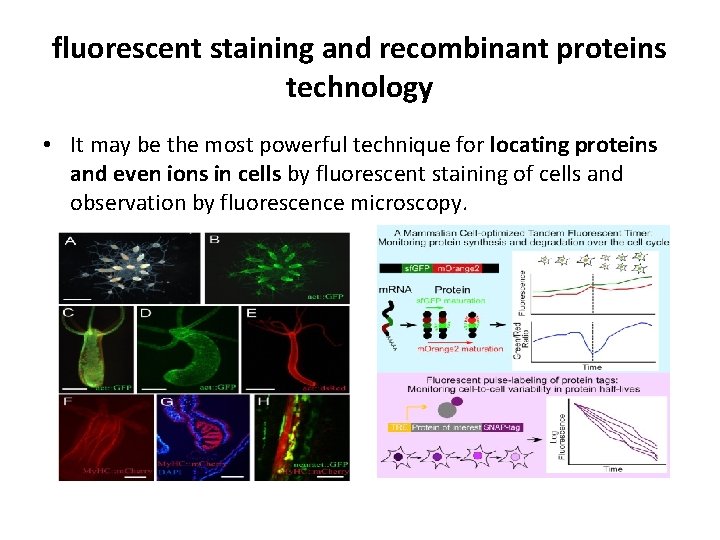
fluorescent staining and recombinant proteins technology • It may be the most powerful technique for locating proteins and even ions in cells by fluorescent staining of cells and observation by fluorescence microscopy.
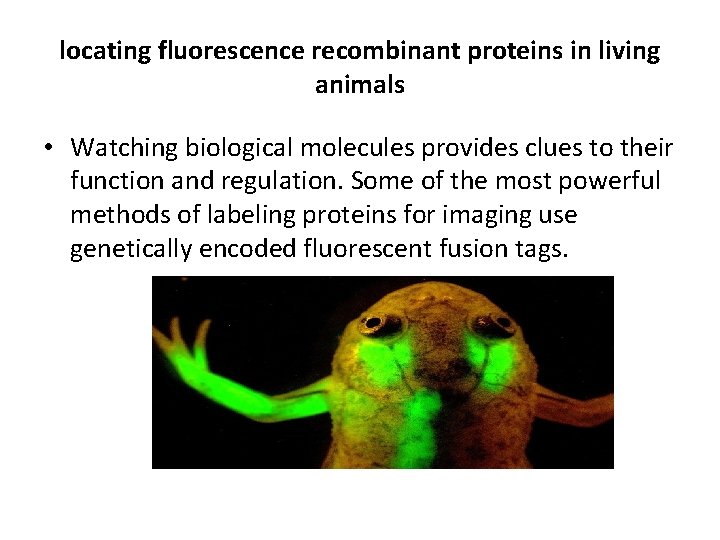
locating fluorescence recombinant proteins in living animals • Watching biological molecules provides clues to their function and regulation. Some of the most powerful methods of labeling proteins for imaging use genetically encoded fluorescent fusion tags.
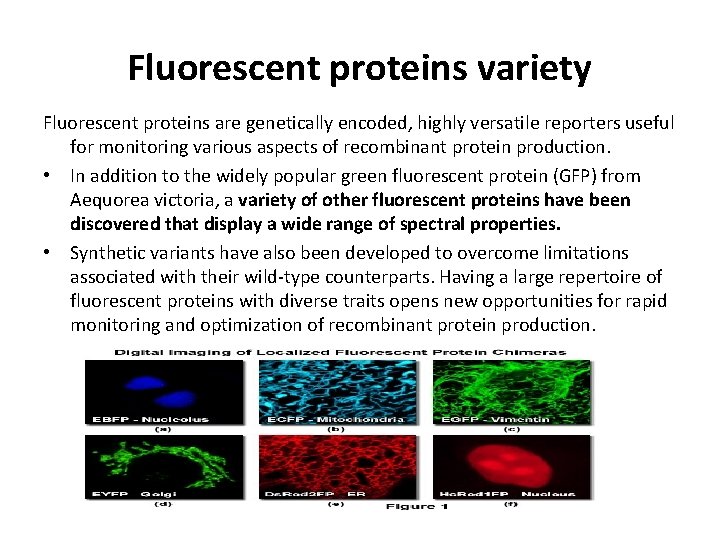
Fluorescent proteins variety Fluorescent proteins are genetically encoded, highly versatile reporters useful for monitoring various aspects of recombinant protein production. • In addition to the widely popular green fluorescent protein (GFP) from Aequorea victoria, a variety of other fluorescent proteins have been discovered that display a wide range of spectral properties. • Synthetic variants have also been developed to overcome limitations associated with their wild-type counterparts. Having a large repertoire of fluorescent proteins with diverse traits opens new opportunities for rapid monitoring and optimization of recombinant protein production.
- Slides: 15