
Cell Net QL IMAGE SEGMENTATION WITHOUT FEATURE DEFINITION

- Slides: 7
Cell. Net. QL IMAGE SEGMENTATION WITHOUT FEATURE DEFINITION THE BRIEFEST PRESENTATION BY N. KHARMA & A. MAZHURIN
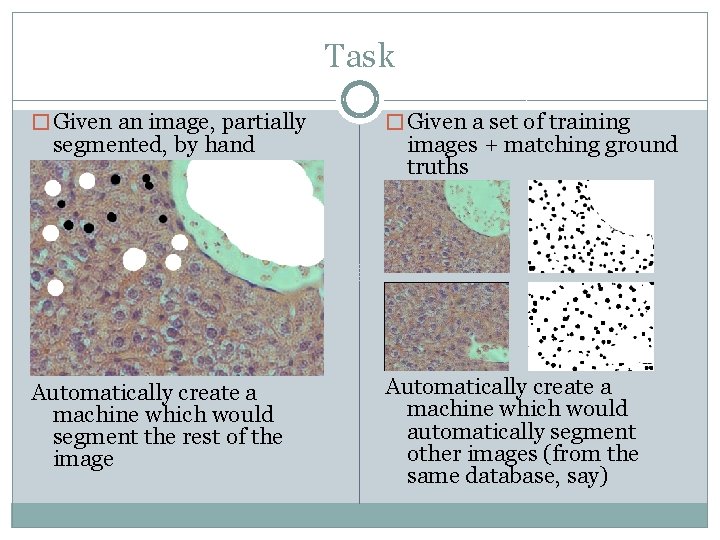
Task � Given an image, partially segmented, by hand � Given a set of training images + matching ground truths � 1 Automatically create a machine which would segment the rest of the image Automatically create a machine which would automatically segment other images (from the same database, say)
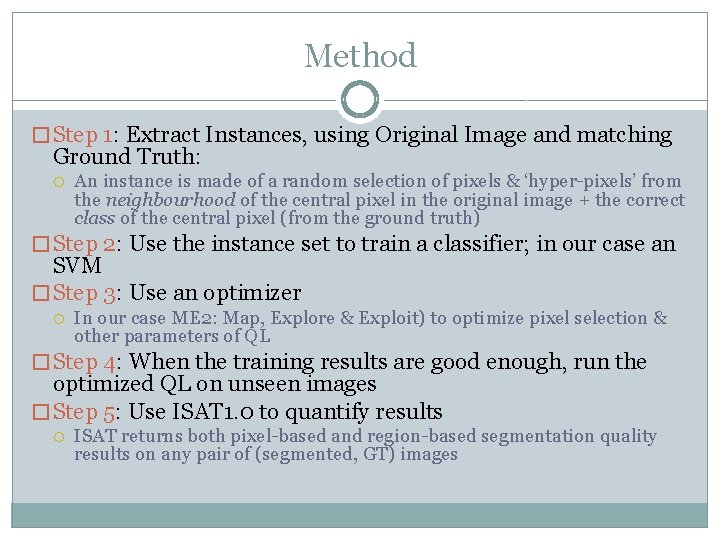
Method � Step 1: Extract Instances, using Original Image and matching Ground Truth: An instance is made of a random selection of pixels & ‘hyper-pixels’ from the neighbourhood of the central pixel in the original image + the correct class of the central pixel (from the ground truth) � Step 2: Use the instance set to train a classifier; in our case an SVM � Step 3: Use an optimizer In our case ME 2: Map, Explore & Exploit) to optimize pixel selection & other parameters of QL � Step 4: When the training results are good enough, run the optimized QL on unseen images � Step 5: Use ISAT 1. 0 to quantify results ISAT returns both pixel-based and region-based segmentation quality results on any pair of (segmented, GT) images
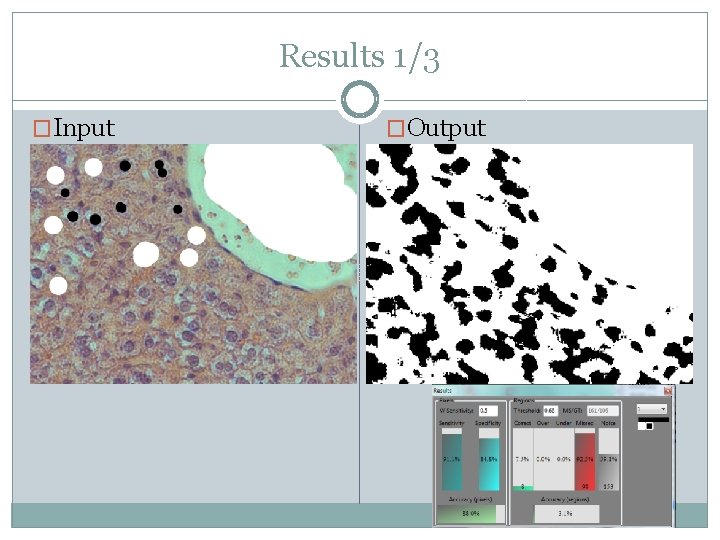
Results 1/3 �Input �Output
Results 2/3 �Input < A different Original Image + Ground Truth > �Output Sensitivity – 95. 0% Specificity – 99. 5% Accuracy – 95. 0% Sensitivity – 96. 5% Specificity – 99. 7% Accuracy – 98. 1% Sensitivity – 88. 5% Specificity – 99. 9% Accuracy – 94. 2% Sensitivity – 94. 9% Specificity – 98. 8% Accuracy – 96. 9%
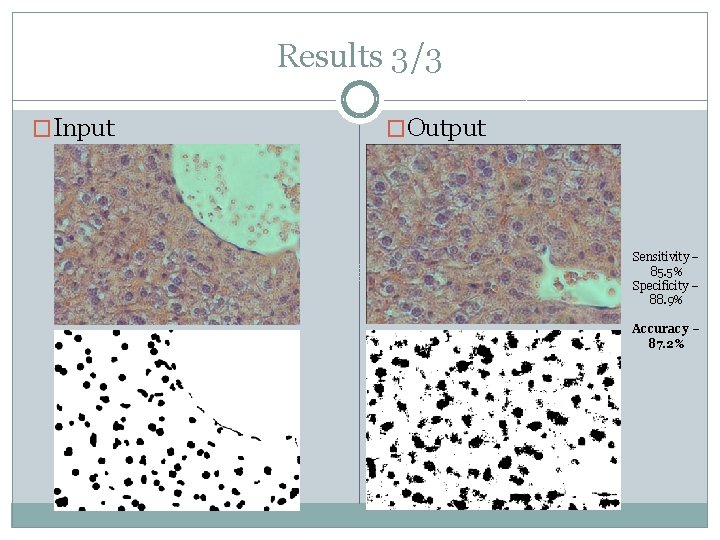
Results 3/3 �Input �Output Sensitivity – 85. 5% Specificity – 88. 9% Accuracy – 87. 2%
�Cell. Net. QL, embodies a method that Conclusion Qualifications + Future can uses supervised learning to segment any image, as long as local information appears adequate �Cell. Net. QL does not require continuous expert update, to improve the quality of features for particular applications �Cell. Net. QL is being tested on all kinds of images and against the strongest commercial competitor, GENIEPro �Optimization & results generation is in progress