
Cell Membrane Cytoplasm Nucleus Nucleolus Mitochondria Endoplasmic Reticulum
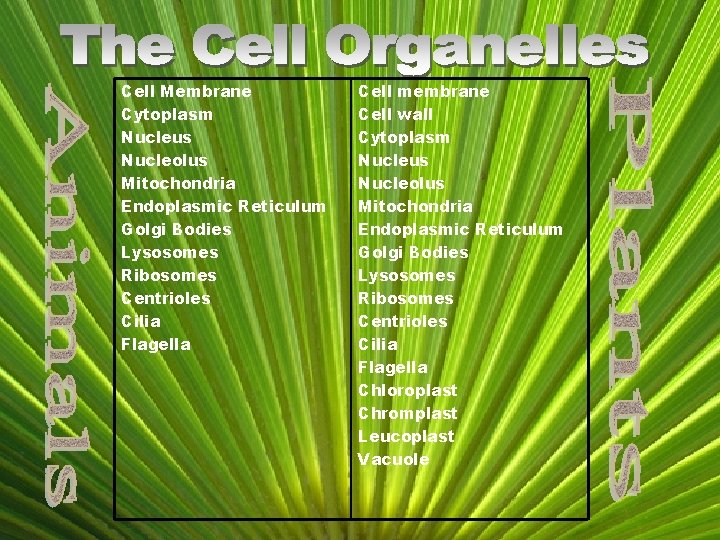
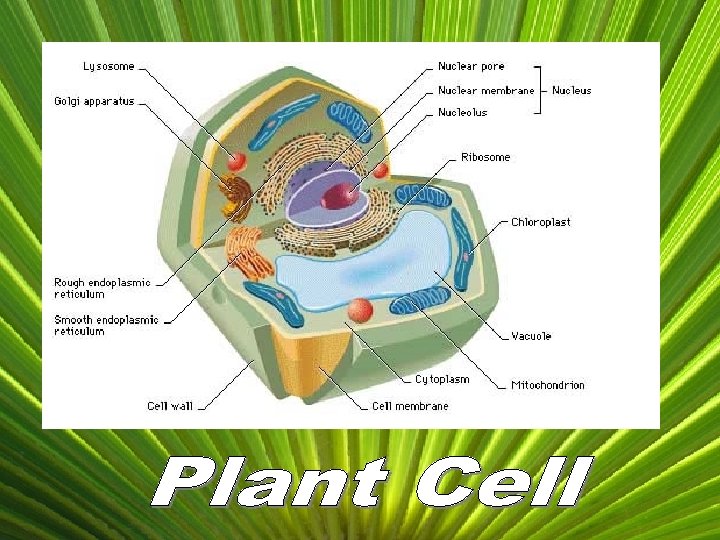
Cell Membrane Cytoplasm Nucleus Nucleolus Mitochondria Endoplasmic Reticulum Golgi Bodies Lysosomes Ribosomes Centrioles Cilia Flagella Cell membrane Cell wall Cytoplasm Nucleus Nucleolus Mitochondria Endoplasmic Reticulum Golgi Bodies Lysosomes Ribosomes Centrioles Cilia Flagella Chloroplast Chromplast Leucoplast Vacuole


Organelle: The Cell Membrane Two Word Definition a. Selectively permeable Function a. an outer membrane perimeter of the cell that acts as a fence with gates which allow certain materials to pass in and out of the cell

Organelle: The Cell Membrane 3. Structure a. the structure is a complex structure known as a lipid bi-layer. The concept of the structure is called the “fluid mosaic model” Lipid bi-layer Individual phospholipid Protein gate

Organelle: The Cell Membrane TEM
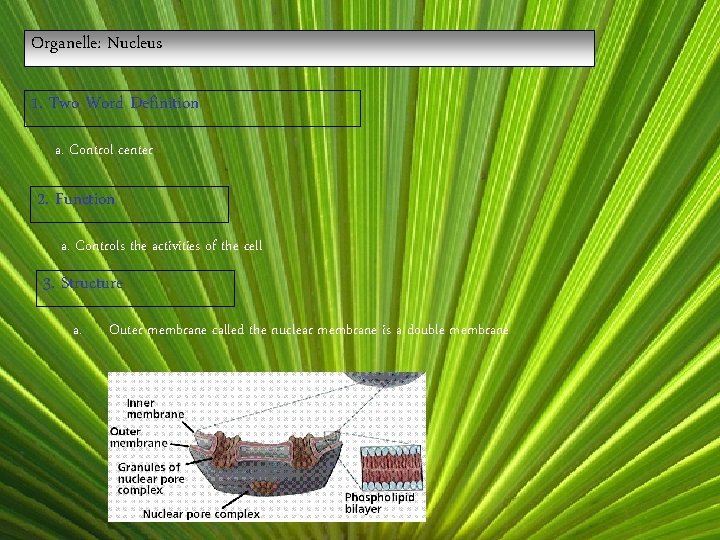
Organelle: Nucleus 1. Two Word Definition a. Control center 2. Function a. Controls the activities of the cell 3. Structure a. Outer membrane called the nuclear membrane is a double membrane
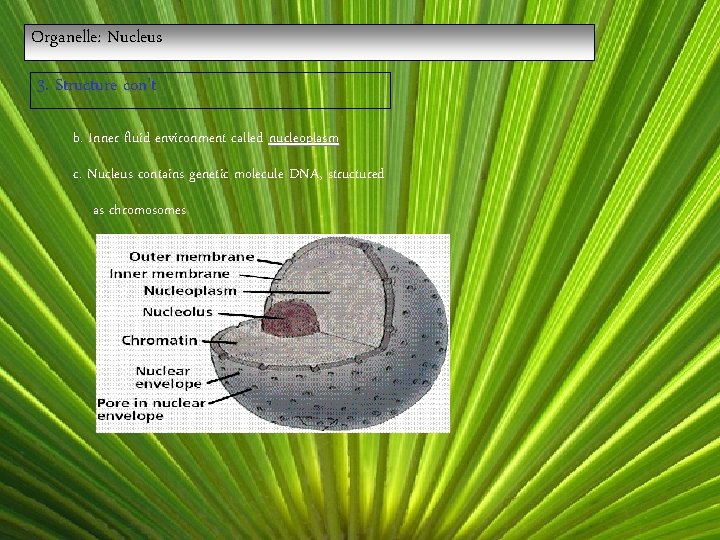
Organelle: Nucleus 3. Structure con’t b. Inner fluid environment called nucleoplasm c. Nucleus contains genetic molecule DNA, structured as chromosomes
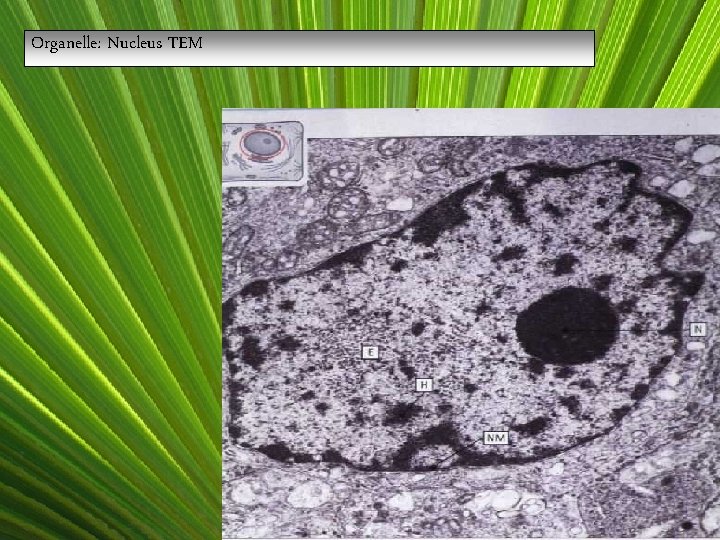
Organelle: Nucleus TEM
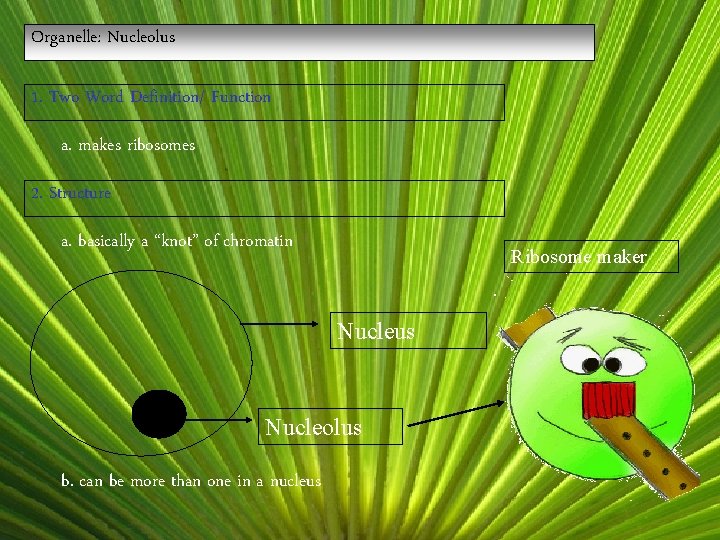
Organelle: Nucleolus 1. Two Word Definition/ Function a. makes ribosomes 2. Structure a. basically a “knot” of chromatin Ribosome maker Nucleus Nucleolus b. can be more than one in a nucleus
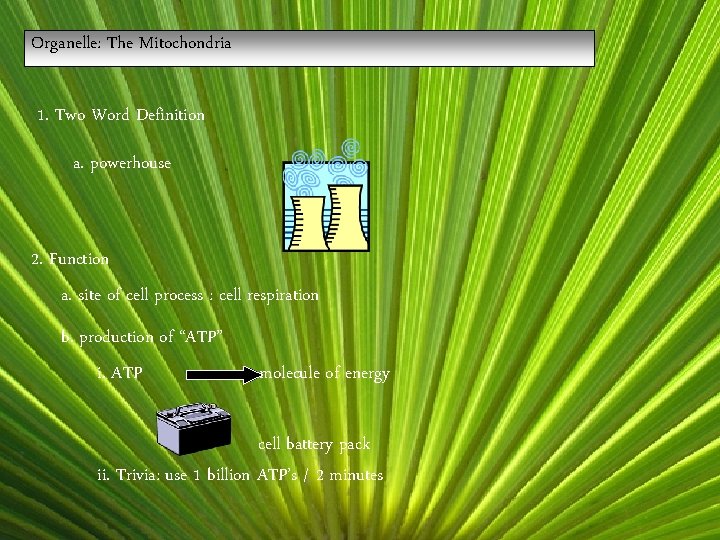
Organelle: The Mitochondria 1. Two Word Definition a. powerhouse 2. Function a. site of cell process : cell respiration b. production of “ATP” i. ATP molecule of energy cell battery pack ii. Trivia: use 1 billion ATP’s / 2 minutes
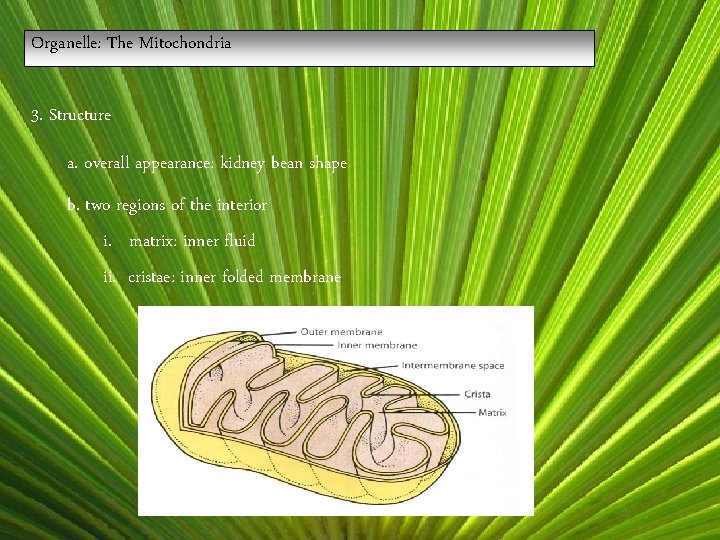
Organelle: The Mitochondria 3. Structure a. overall appearance: kidney bean shape b. two regions of the interior i. matrix: inner fluid ii. cristae: inner folded membrane
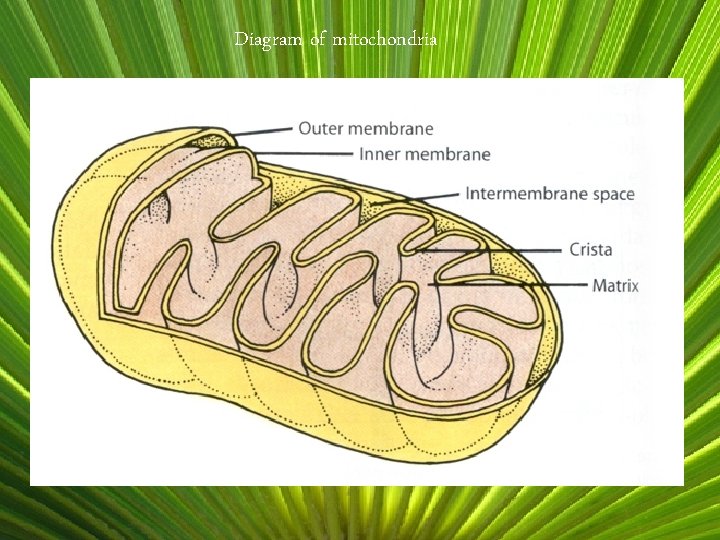
Diagram of mitochondria
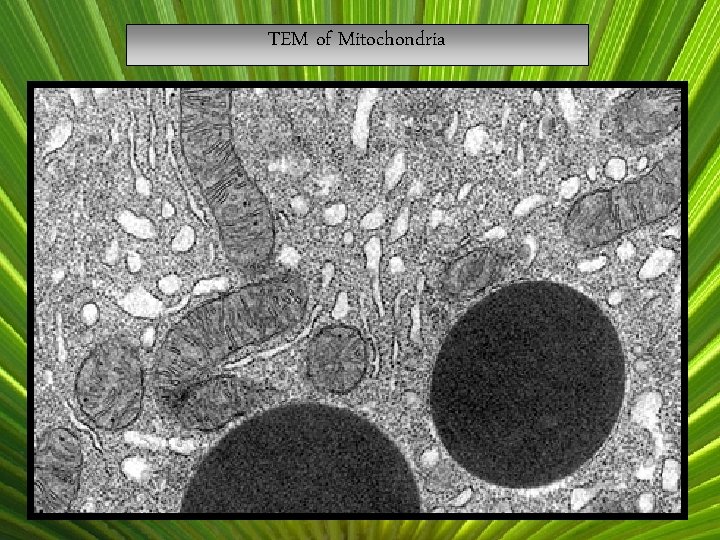
TEM of Mitochondria
Organelle: Endoplasmic Reticulum 1. Prefix / Suffix Time a. endo means: inside b. plasma means: fluid c. reticulate means: repeated patterns 2. Two word definition a. transport and storage 3. Function a. transports and stores proteins b. divides cell into compartments
Organelle: Endoplasmic Reticulum 4. Two kinds of “ER” a. rough “ER”: has ribosomes b. smooth “ER”: has no ribosomes 5. Structure of “ER” a. network of channel like membranes b. connectd to the nuclear membrane

Diagram of Endoplasmic Reticulum
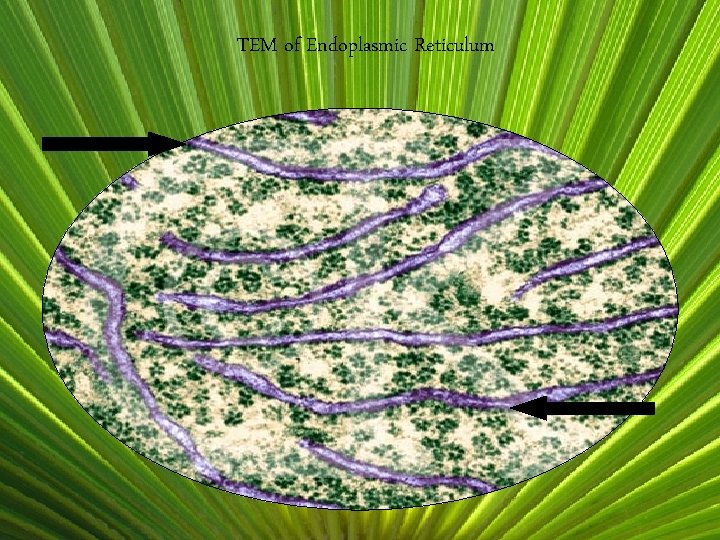
TEM of Endoplasmic Reticulum
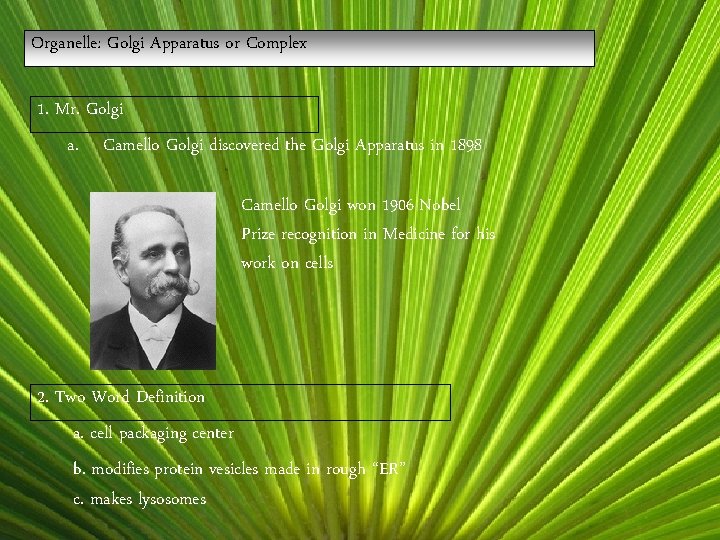
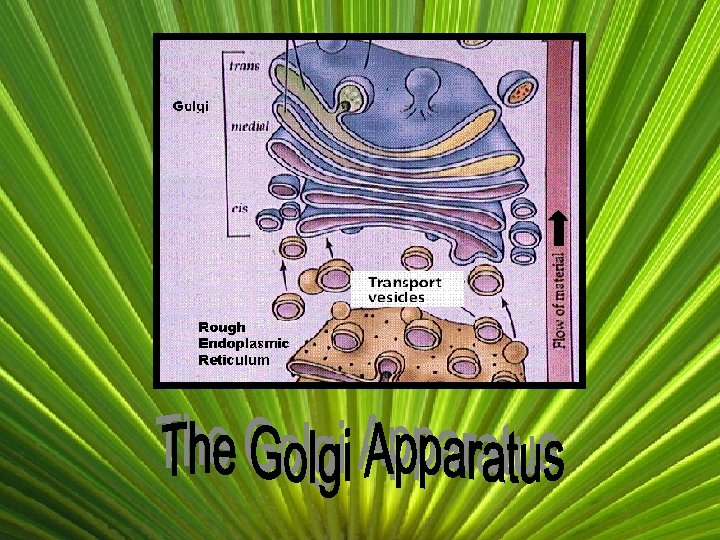
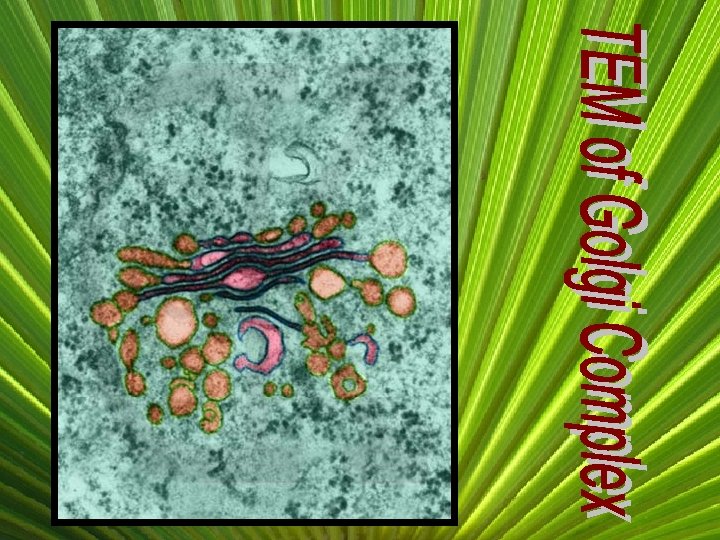
Organelle: Golgi Apparatus or Complex 1. Mr. Golgi a. Camello Golgi discovered the Golgi Apparatus in 1898 Camello Golgi won 1906 Nobel Prize recognition in Medicine for his work on cells 2. Two Word Definition a. cell packaging center b. modifies protein vesicles made in rough “ER” c. makes lysosomes
Organelle: Golgi Apparatus or Complex 3. Function a. modifies protein vesicles made in rough “ER” these vesicles will leave the cell b. makes lysosomes 4. Structure a. Flattened stack of membranes “ a pancake stack”
Organelle: Lysosomes 1. Two Word Definition a. ”suicide sacs” 2. Function a. contain enzymes used to destroy material inside and outside the cell 3. Structure a. membrane sack filled with hydrolytic enzymes b. made by the Golgi Complex
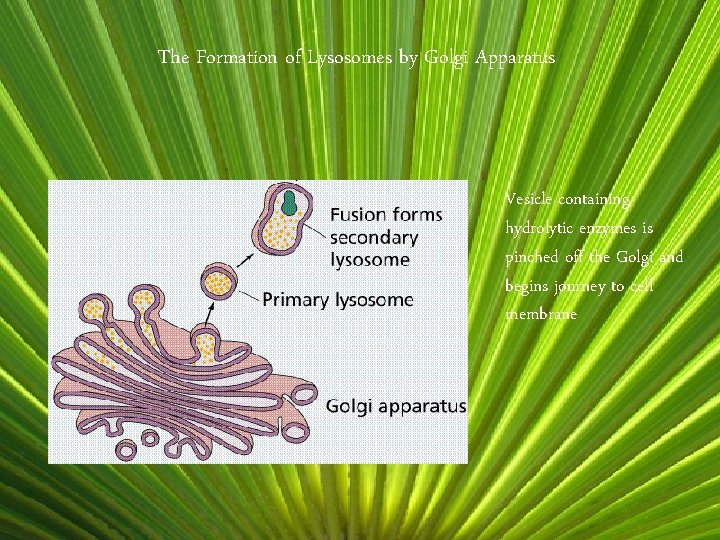
The Formation of Lysosomes by Golgi Apparatus Vesicle containing hydrolytic enzymes is pinched off the Golgi and begins journey to cell membrane
Organelle: Ribosomes 1. Two Word Definition a. protein synthesis 2. Function a. site of the construction of proteins 3. Structure a. made of ribosomal RNA ( nucleic acid ) b. two locations i. free ribosomes or “floaters” ii. ribosomes connected to rough “ER”
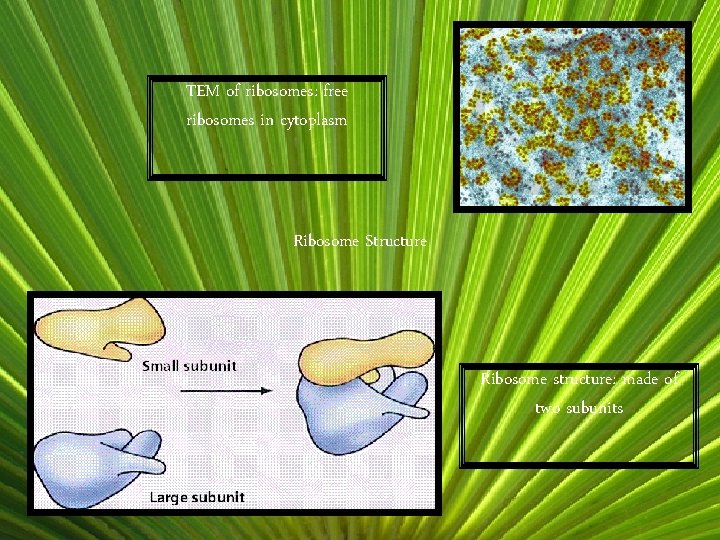
TEM of ribosomes: free ribosomes in cytoplasm Ribosome Structure Ribosome structure: made of two subunits
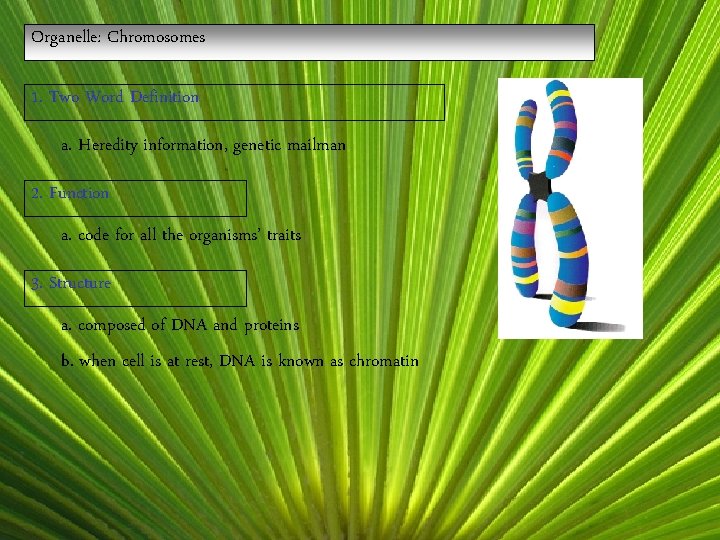
Organelle: Chromosomes 1. Two Word Definition a. Heredity information, genetic mailman 2. Function a. code for all the organisms’ traits 3. Structure a. composed of DNA and proteins b. when cell is at rest, DNA is known as chromatin

Organelle: Chromosomes TEM
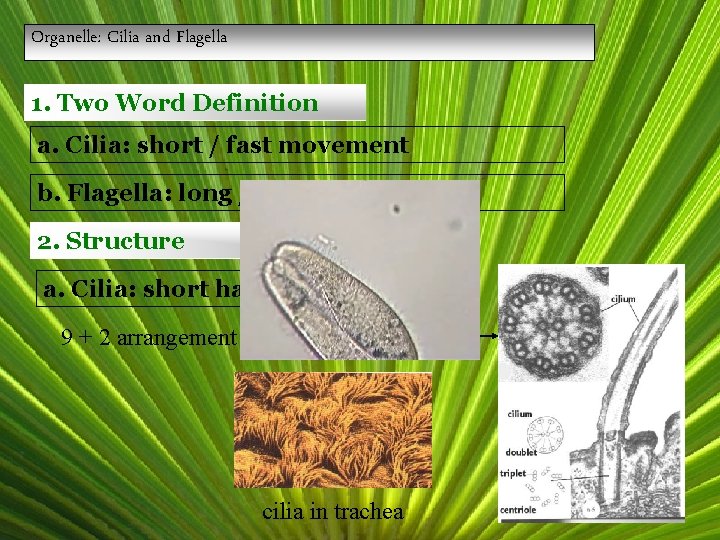
Organelle: Cilia and Flagella 1. Two Word Definition a. Cilia: short / fast movement b. Flagella: long / slow movement 2. Structure a. Cilia: short hair-like structures 9 + 2 arrangement of microtubules cilia in trachea
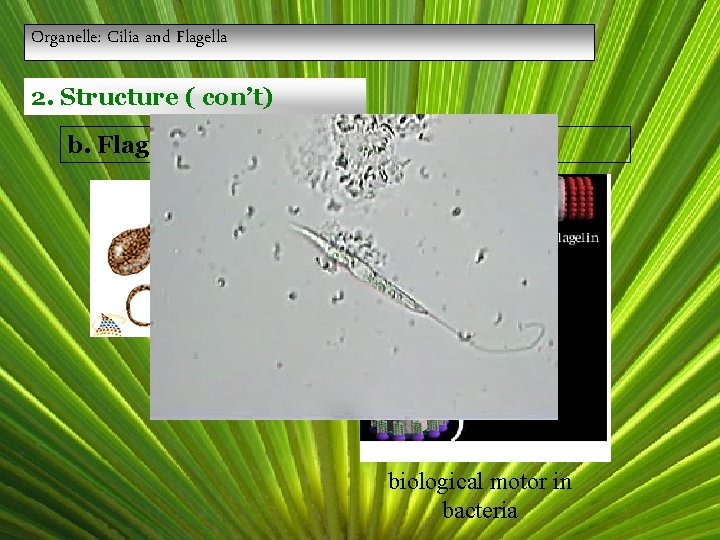
Organelle: Cilia and Flagella 2. Structure ( con’t) b. Flagella: long hair-like structures biological motor in bacteria
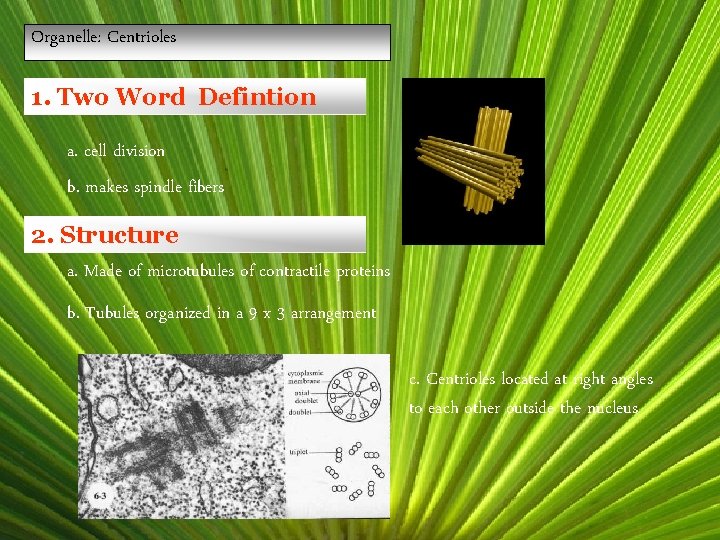
Organelle: Centrioles 1. Two Word Defintion a. cell division b. makes spindle fibers 2. Structure a. Made of microtubules of contractile proteins b. Tubules organized in a 9 x 3 arrangement c. Centrioles located at right angles to each other outside the nucleus
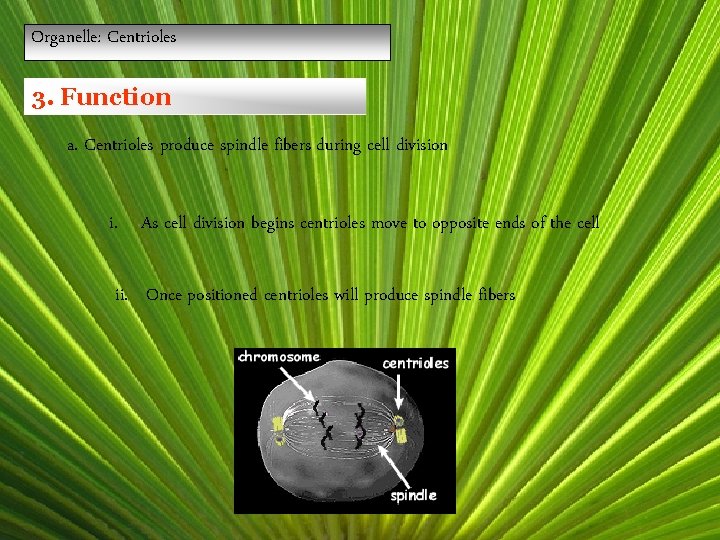
Organelle: Centrioles 3. Function a. Centrioles produce spindle fibers during cell division i. As cell division begins centrioles move to opposite ends of the cell ii. Once positioned centrioles will produce spindle fibers
Organelle: Chloroplast 1. Two Word Defintion a. Photosynthesis 2. Function a. Site of photosynthetic reactions b. Conversion of light energy into chemical energy 3. Structure a. similar appearance to mitochondria b. two main regions i. stroma: fluid ii. grana: stacks of chlorophyll discs
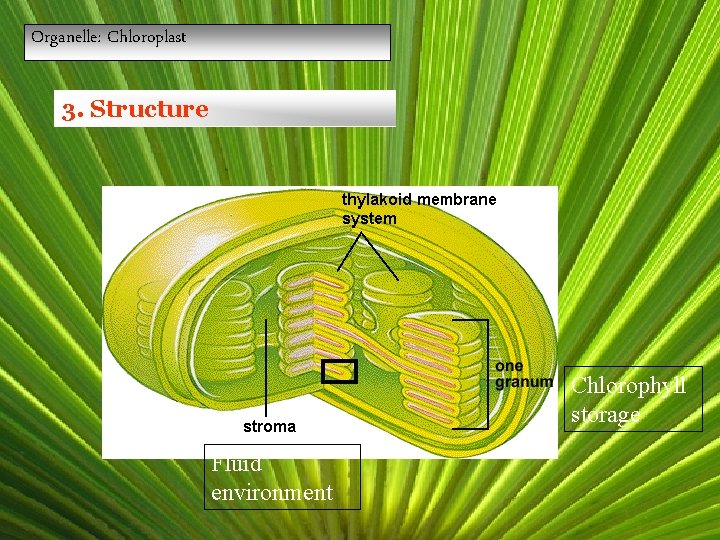
Organelle: Chloroplast 3. Structure Chlorophyll storage Fluid environment
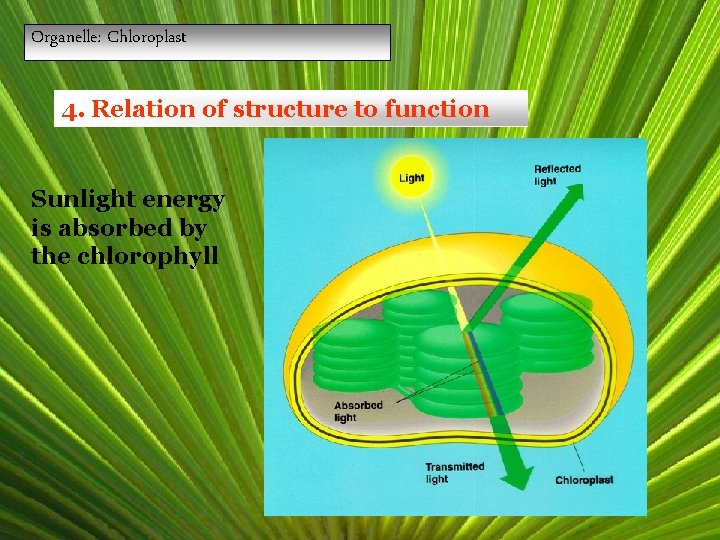
Organelle: Chloroplast 4. Relation of structure to function Sunlight energy is absorbed by the chlorophyll
Organelle: Plastids / chromoplast, leucoplast, chloroplast A. Chromoplast (plants only) 1. Two word definition: color storage or color bodies 2. Structure a. Membrane sacks filled with non-green pigments in plants 3. Function a. Coloration of flowers, fruit and leaves B. Leucoplast (plants only) 1. Two word definition: starch storage (function) 2. Structure: membrane sack filled with starch
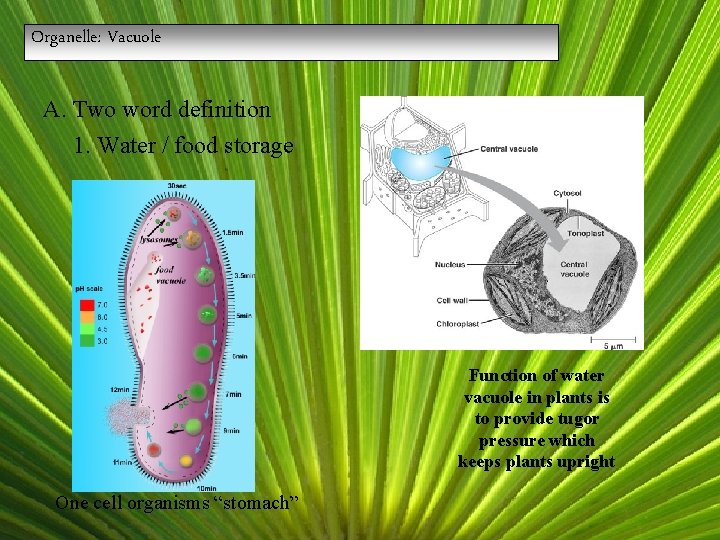
Organelle: Vacuole A. Two word definition 1. Water / food storage Function of water vacuole in plants is to provide tugor pressure which keeps plants upright One cell organisms “stomach”
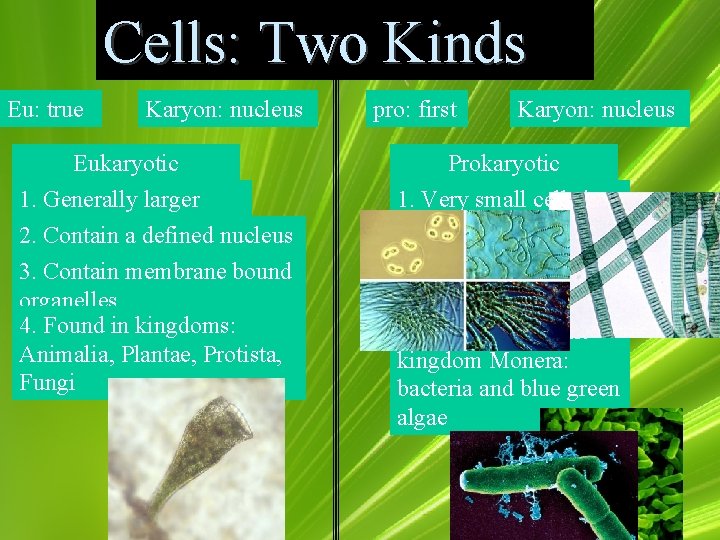
Cells: Two Kinds Eu: true Karyon: nucleus Eukaryotic 1. Generally larger 2. Contain a defined nucleus 3. Contain membrane bound organelles 4. Found in kingdoms: Animalia, Plantae, Protista, Fungi pro: first Karyon: nucleus Prokaryotic 1. Very small cell size 2. No defined nucleus 3. No membrane bound organelles 4. Found only in the kingdom Monera: bacteria and blue green algae
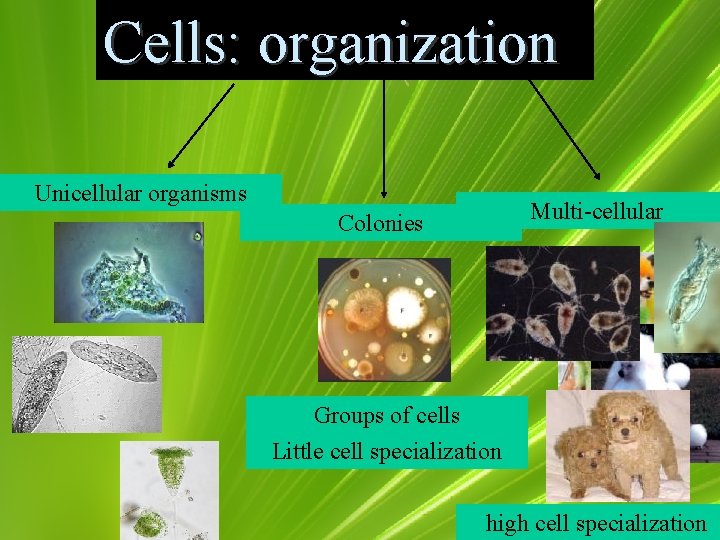
Cells: organization Unicellular organisms Multi-cellular Colonies Groups of cells Little cell specialization high cell specialization
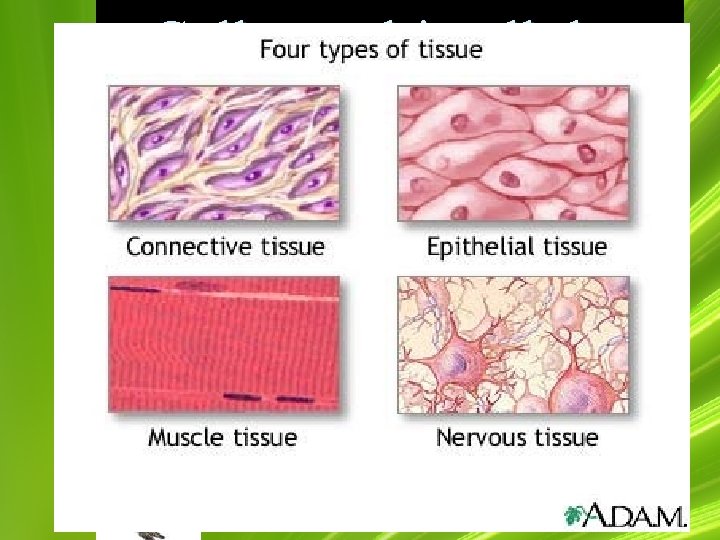
Cells: multi-cellular organization cells tissues organs systems
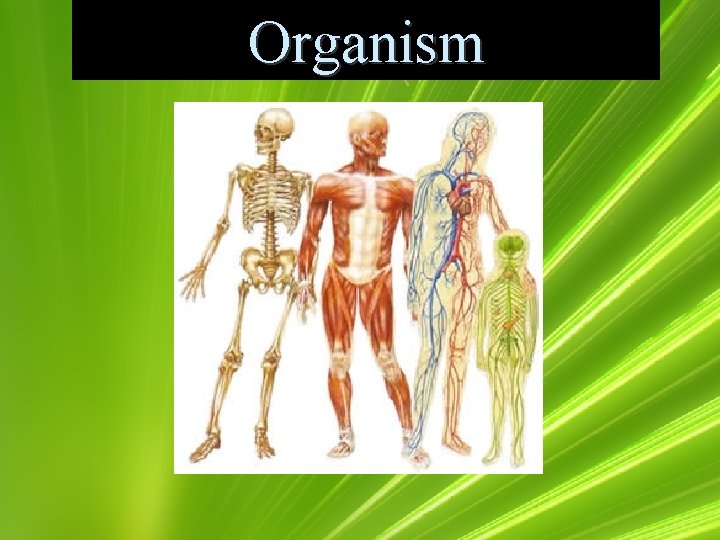
Organism

- Slides: 42