
Cell Membrane by Dr Vani Gupta Cell Membrane
Cell Membrane by Dr. Vani Gupta
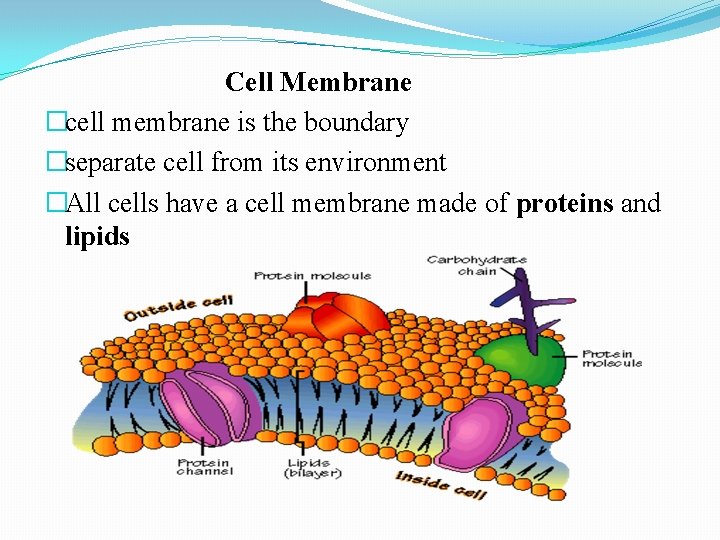
Cell Membrane �cell membrane is the boundary �separate cell from its environment �All cells have a cell membrane made of proteins and lipids

DIFFERENT MODEL �Overton(1902) postulated that the plasma membrane is composed of a thin layer of lipid. �Danielli and Davson(1935) proposed the trilamillar model. �Robertson(1959)proposed the Unit membrane concept. �Singer and Nicolson(1972) put farward the fluid mosaic of membrane structure. it is the most widely accepted model.
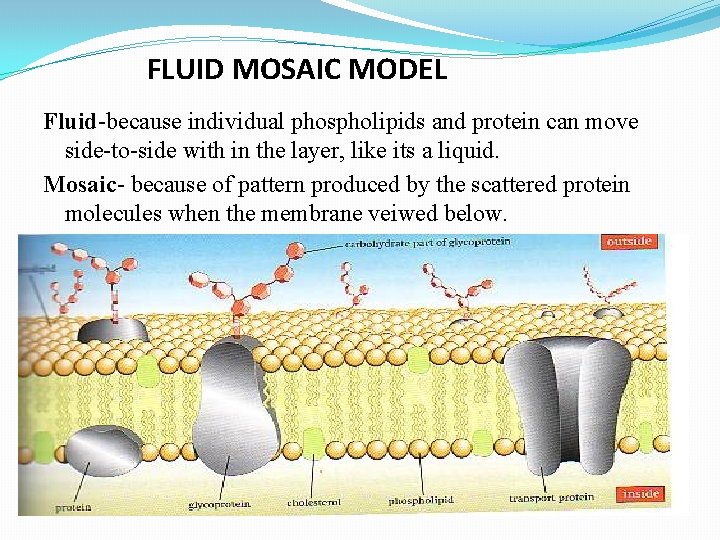
FLUID MOSAIC MODEL Fluid-because individual phospholipids and protein can move side-to-side with in the layer, like its a liquid. Mosaic- because of pattern produced by the scattered protein molecules when the membrane veiwed below.
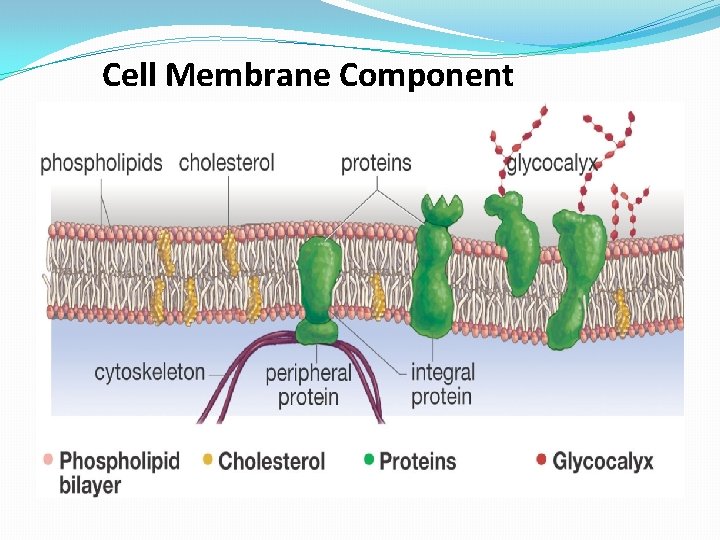
Cell Membrane Component
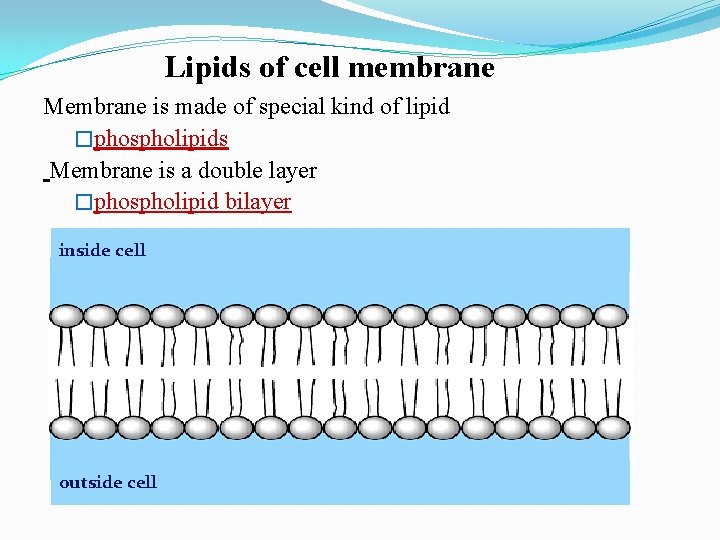
Lipids of cell membrane Membrane is made of special kind of lipid �phospholipids Membrane is a double layer �phospholipid bilayer inside cell outside cell
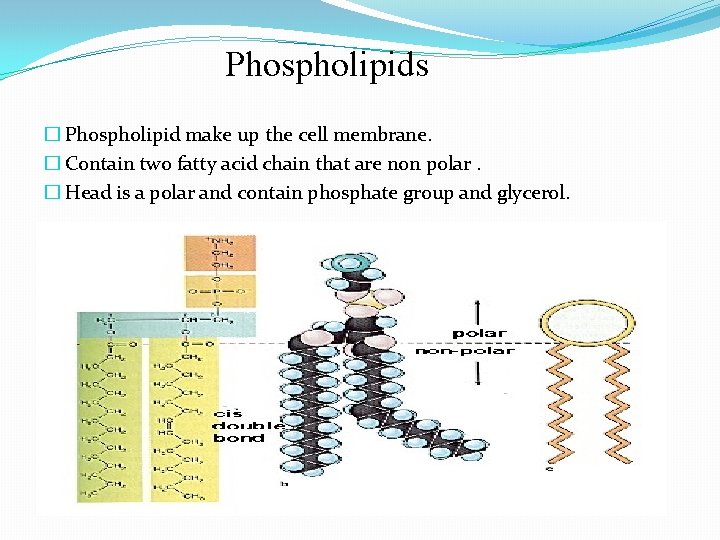
Phospholipids � Phospholipid make up the cell membrane. � Contain two fatty acid chain that are non polar. � Head is a polar and contain phosphate group and glycerol.
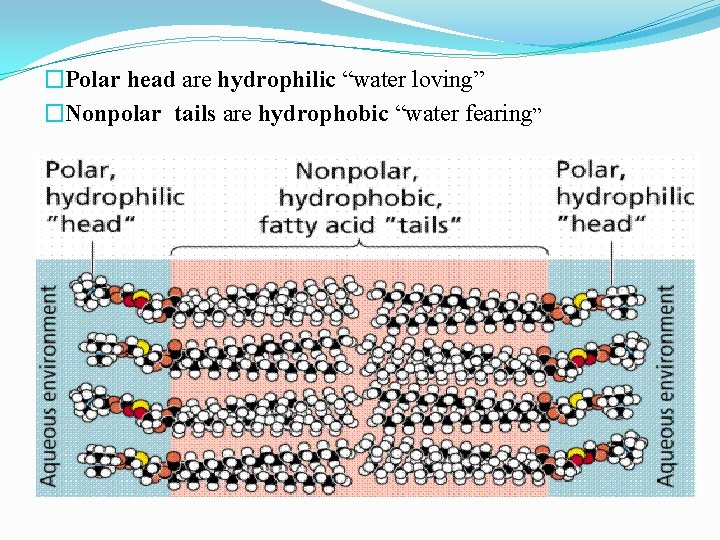
�Polar head are hydrophilic “water loving” �Nonpolar tails are hydrophobic “water fearing”
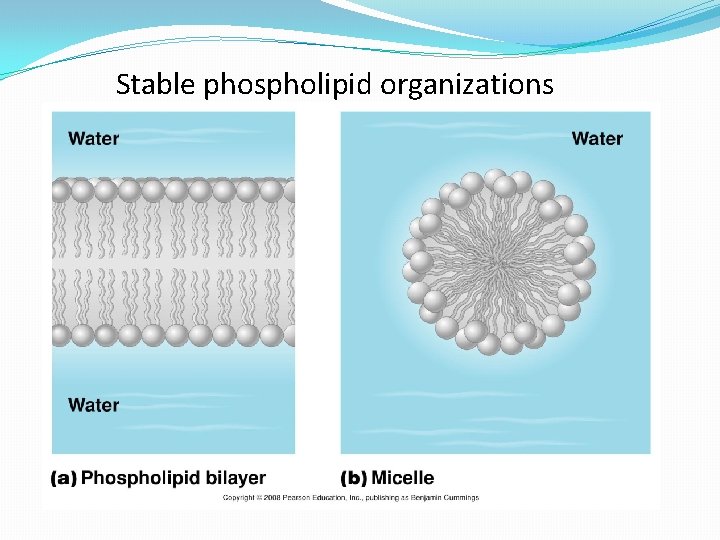
Stable phospholipid organizations
Membrane fluidity Two factors that are determine fluidity are � 1 -The length of fatty acid chain. � 2 -The degree of un-saturation (simply number of double bond)
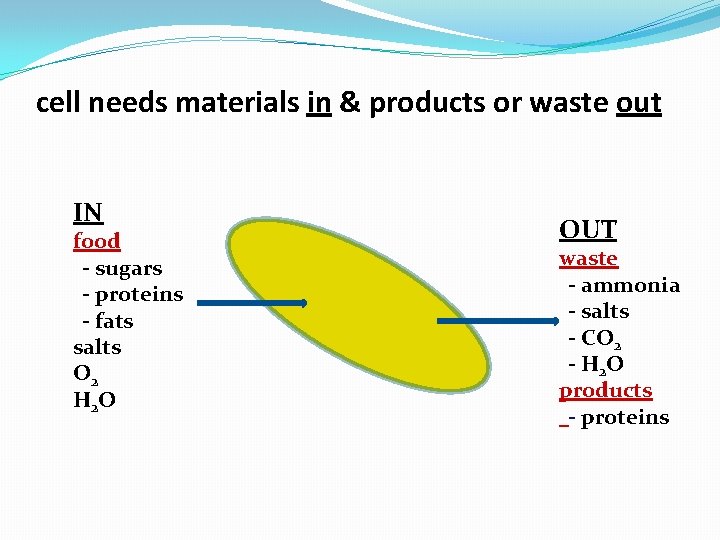
cell needs materials in & products or waste out IN food - sugars - proteins - fats salts O 2 H 2 O OUT waste - ammonia - salts - CO 2 - H 2 O products - proteins
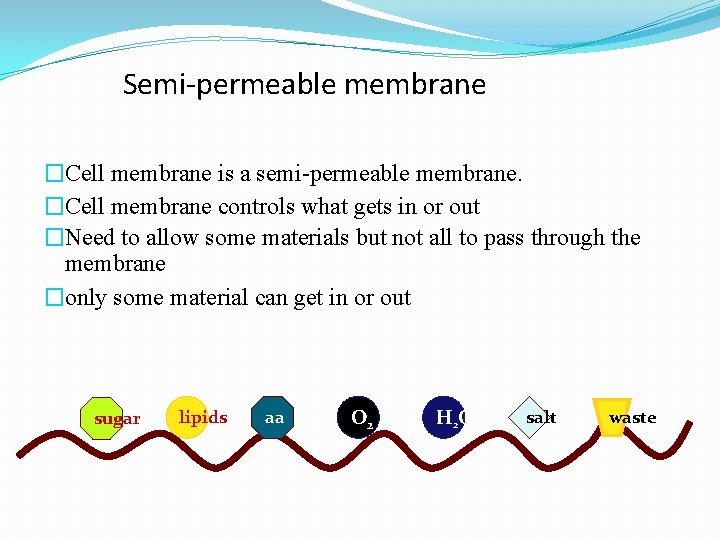
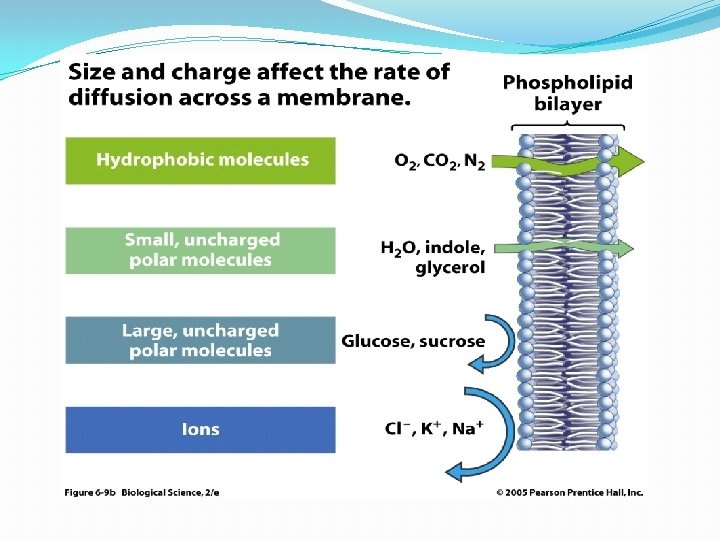
Semi-permeable membrane �Cell membrane is a semi-permeable membrane. �Cell membrane controls what gets in or out �Need to allow some materials but not all to pass through the membrane �only some material can get in or out sugar lipids aa O 2 H 2 O salt waste
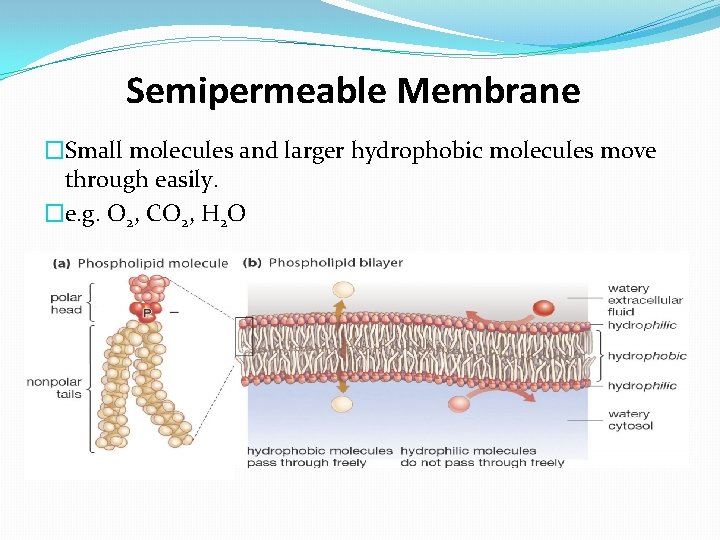
Semipermeable Membrane �Small molecules and larger hydrophobic molecules move through easily. �e. g. O 2, CO 2, H 2 O
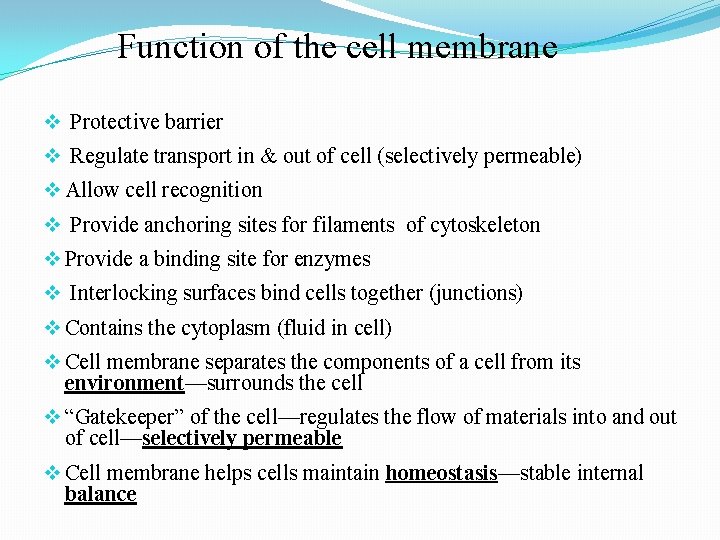
Function of the cell membrane v Protective barrier v Regulate transport in & out of cell (selectively permeable) v Allow cell recognition v Provide anchoring sites for filaments of cytoskeleton v Provide a binding site for enzymes v Interlocking surfaces bind cells together (junctions) v Contains the cytoplasm (fluid in cell) v Cell membrane separates the components of a cell from its environment—surrounds the cell v “Gatekeeper” of the cell—regulates the flow of materials into and out of cell—selectively permeable v Cell membrane helps cells maintain homeostasis—stable internal balance
�Q-1 which one of the following is not amembranelipid �a-cholestrol �b-phosphoglyceride �c-cerebroside �d-choline
�Q-2 in plasma membrane , carbohydrate present on the �a-both layer �b-only on cytoplasmic side of lipid bilayer �c-only on non cytoplasmic side of lipid bilayer �d-none Ans-c
�Q-3 carbohydrate present on the plasma membrane �a-have structural role �b-forms channel �c-act as carrier �d-help in molecular recognization Ans-d
�Q-4 Generally accepted features of biological membrane include all of the following except �asymmetric arrangement of lipid �b-rapid diffusion of inorganic ions across lipid bilayer �lateral diffusion of lipid �d-lateral diffusion of integral and peripheral proteins. Ans-b
Q 5 -The plasma membrane is impermeable to all molecule except. �a-glucose �b-ATP �c-urea �d-K �Ans-c
�Q 6 -Which of the following statements best describes the fluid mosaic model of the plasma membrane? a-A single layer of lipids surrounding a layer of proteins. b- A single layer of proteins surrounding a single layer of lipids. c- A lipid bilayer with protein molecules dispersed within it. d-A single layer of proteins with lipid molecules dispersed within. e- A protein bilayer sandwiching a layer of lipids. Ans-c
Q 7 -Which item below is NOT a function performed by proteins found in the plasma membrane? a-Receptor for chemical messenger molecules b-Joining of adjacent cells c-Transport of solutes. d-Attachment site for cytoskeleton e-Synthesis of proteins. Ans-e
Q 8 -Which of the following molecular components of the lipid bilayer of the plasma membrane possesses a charged polar "head" and an uncharged non-polar "tail"? � a- Integralprotein �b-Glycolipid �c- Cholesterol �d-Phospholipid �e-Glycoprotein Ans-d
Q 9 - Selectively permeable membrane means a-only certain substances can pass through the membrane b-all substances can pass through the membrane c- the membrane forms a seal keeping all materials contained at all times Ans-a
Q 10 -A substance can cross the cell membrane when it is aided by one of these a-transport protein b- isotonic solution c- lipid bilayer Ans-a
- Slides: 25