
Cell Membrane Advanced Biology Models of the Cell
Cell Membrane Advanced Biology
Models of the Cell Membrane l In 1925, E. Gorter and G. Grendel proposed that the cell membrane was made of phospholipids (bilayer) l l Noticed non-polar molecules entered cells quicker than polar molecules In the 1940’s, J. Danielli and H. Davson proposed a sandwich model that included proteins l Phospholipids on inside with two layers of proteins on the outside
Models of the Cell Membrane l In early 1970 s, S. Singer and G. Nicolson proposed the Fluid Mosaic Model l Membrane has fluid consistency and a mosaic pattern of embedded proteins (scattered throughout layer)
Functions of Cell Membrane l Encloses material in cell l Regulates what moves in and out of the cell l Separates internal environment of the cell from its surroundings
Cells and their Environments l Membrane is “liquid-like” Allows phospholipids to move around l Gives you ability to move as well l l Cells l Water is constantly moving in and out l Cell l live in fluid environments membrane is selectively permeable Some things can pass through easily, others cannot
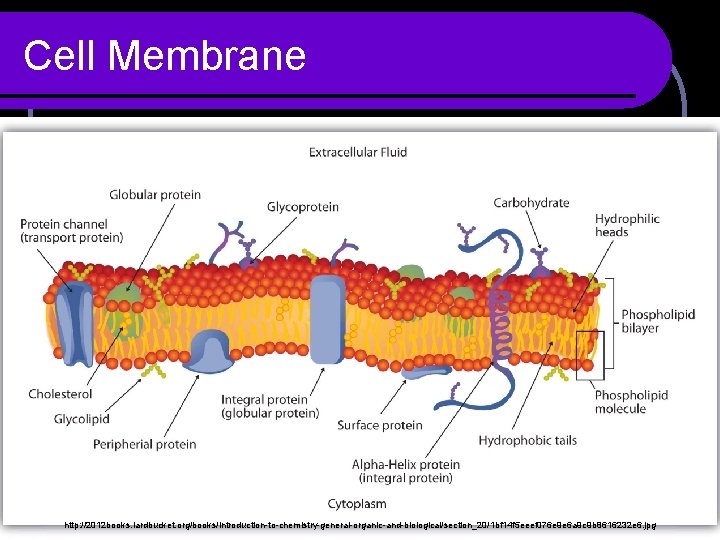
Cell Membrane Components l Phospholipids l l l Proteins l l Make up most of the cell membrane Heads face outward and the tails face inward Membrane proteins help with chemical reactions and with membrane transport (molecules that can’t diffuse naturally across the membrane) Cholesterol l l Helps with membrane stiffness and strength Also aids with cell to cell communication
Cell Membrane Components l Glycoproteins and glycolipids l Chains of carbohydrates attached to proteins and phospholipids l Glycolipids serve as cell markers or cell identifiers l Glycoproteins aid with hormones; they serve as a binding site for hormones l Give the cell membrane a “sugar coat” called the glycocalyx (cell’s “fingerprint”) l Chains of carbohydrates l Facilitate cell adhesion and cell to cell recognition, and help cells receive signal molecules
Membrane Proteins l Can be peripheral proteins or integral proteins Peripheral proteins: proteins embedded on one layer of the membrane (usually held in place by cytoskeleton) l Integral proteins: proteins embedded throughout both layers of the membrane l
Peripheral Proteins l Cell recognition proteins (glycoproteins): markers, allows WBC to recognize what cells belong in the body l Enzymatic proteins: assist with chemical reactions inside the cell
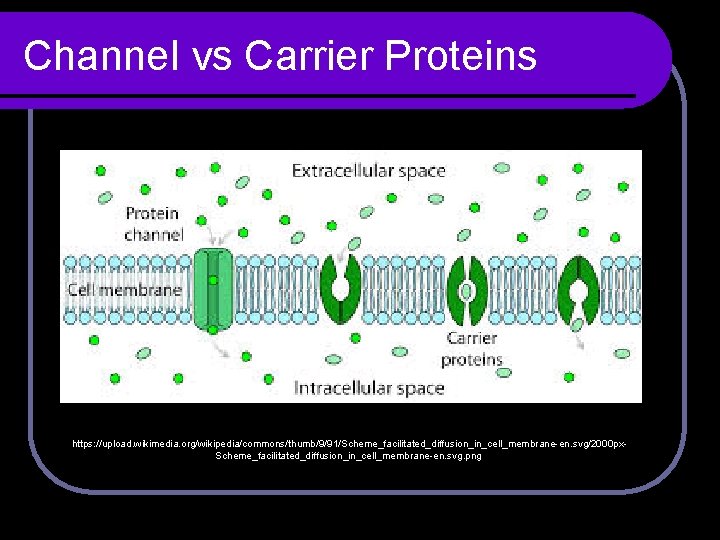
Integral Proteins l Receptor proteins: recognize and binds to substances outside the cell l l Carrier/Transport Proteins: Allow for larger molecules to get in/out of the cell; specific to the molecule that they transport l l When protein changes shape, it signals for a cellular response Does react with the molecules Channel Proteins: Allow for larger molecules to get in/out of the cell; also specific to the molecule that they transport l l Does not react with the molecules; always open Much faster than the carrier proteins
Cell Membrane http: //2012 books. lardbucket. org/books/introduction-to-chemistry-general-organic-and-biological/section_20/1 bf 14 f 5 eeef 076 e 9 e 6 a 9 c 9 b 8616232 e 6. jpg
Channel vs Carrier Proteins https: //upload. wikimedia. org/wikipedia/commons/thumb/9/91/Scheme_facilitated_diffusion_in_cell_membrane-en. svg/2000 px. Scheme_facilitated_diffusion_in_cell_membrane-en. svg. png
Class Level Expectations l CLEs l 3. 2. F. a (DOK 2)
- Slides: 13