
Cell Growth and Reproduction Binary Fission Mitosis and
Cell Growth and Reproduction Binary Fission, Mitosis and Meiosis How does the cell grow and divide?
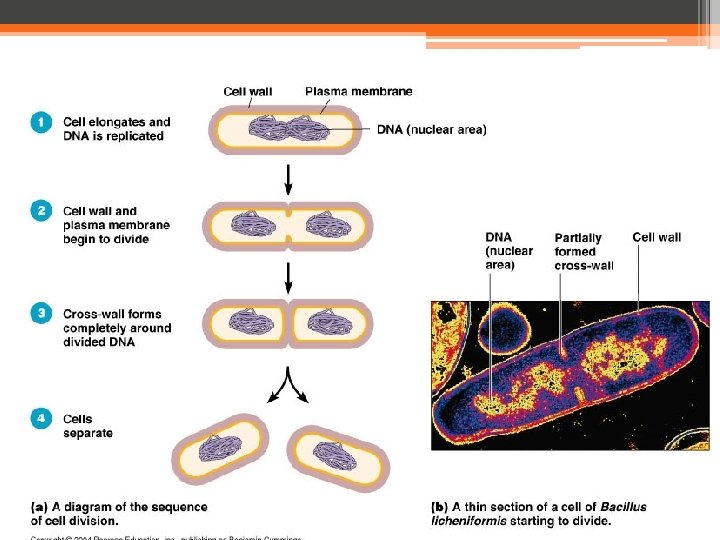
Prokaryotes: Binary Fission • Remember, prokaryotes are single cell organisms • 3 stages to binary fission: ▫ DNA is copied and cell continues to grow �Cell grows to be 2 x original size ▫ Cell wall forms and cells begins to divide ▫ Two identical haploid cells result • Same genetic information = clones
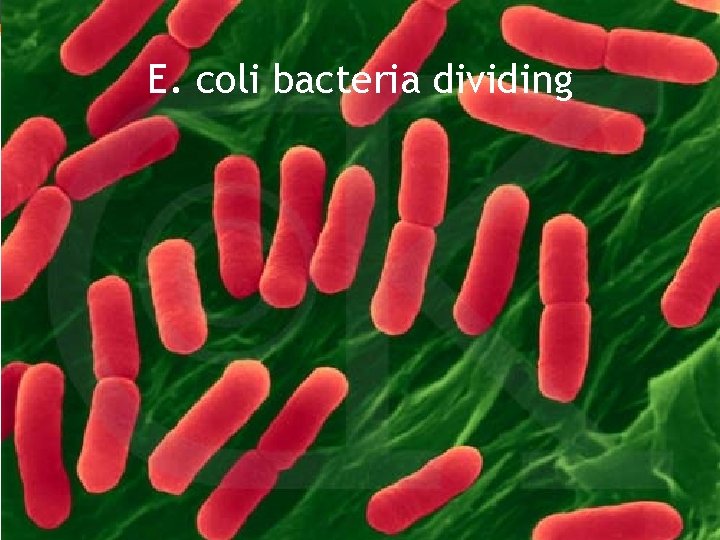
E. coli bacteria dividing
Now on to Eukaryotes Mitosis and Meiosis
Mitosis vs. Meiosis • Mitosis – new cells having genetic information identical to that of the original cell ▫ Occurs in: �Reproduction of unicellular organisms �Addition of cells to tissue/organ in multicellular organisms • Meiosis – results in genetic variation ▫ More details later!
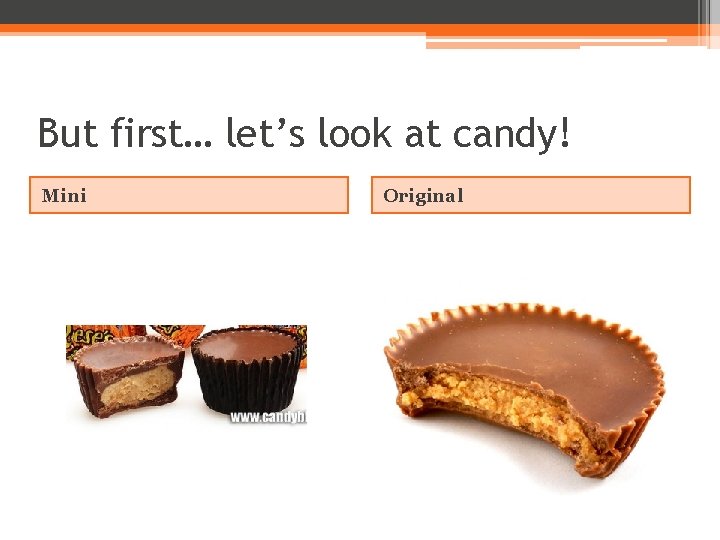
But first… let’s look at candy! Mini Original
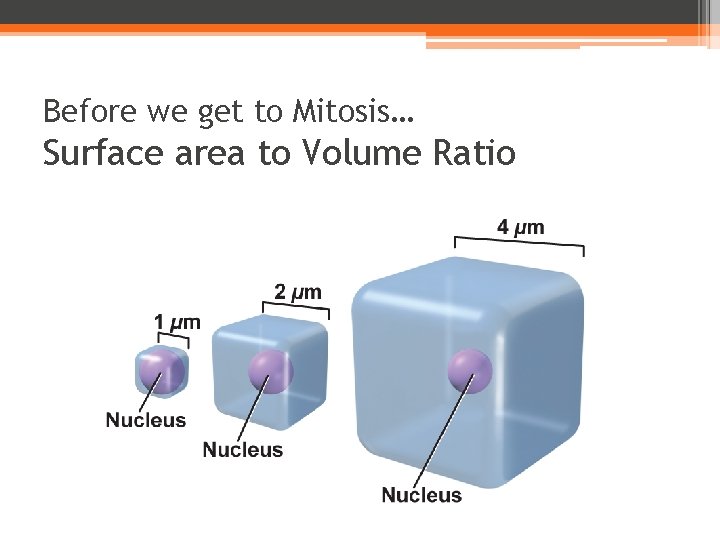
Before we get to Mitosis… Surface area to Volume Ratio
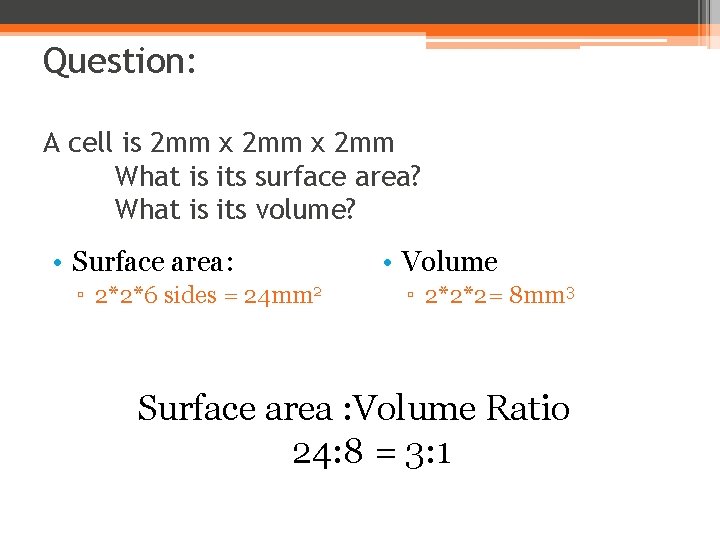
Question: A cell is 2 mm x 2 mm What is its surface area? What is its volume? • Surface area: ▫ 2*2*6 sides = 24 mm 2 • Volume ▫ 2*2*2= 8 mm 3 Surface area : Volume Ratio 24: 8 = 3: 1
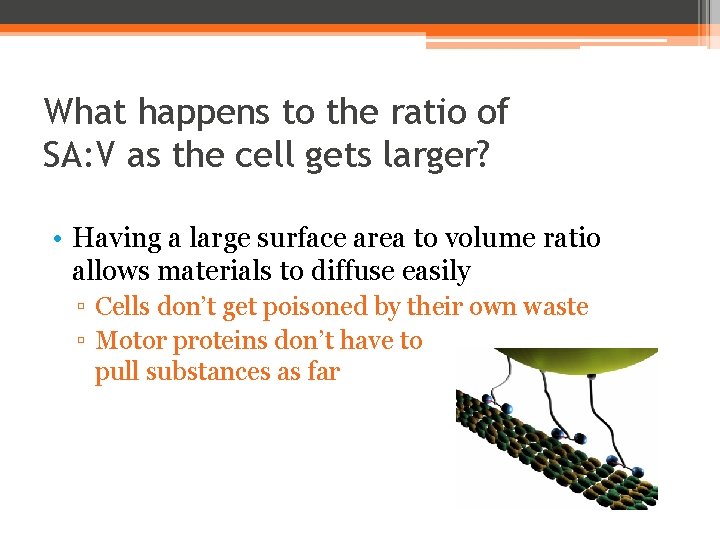
What happens to the ratio of SA: V as the cell gets larger? • Having a large surface area to volume ratio allows materials to diffuse easily ▫ Cells don’t get poisoned by their own waste ▫ Motor proteins don’t have to pull substances as far
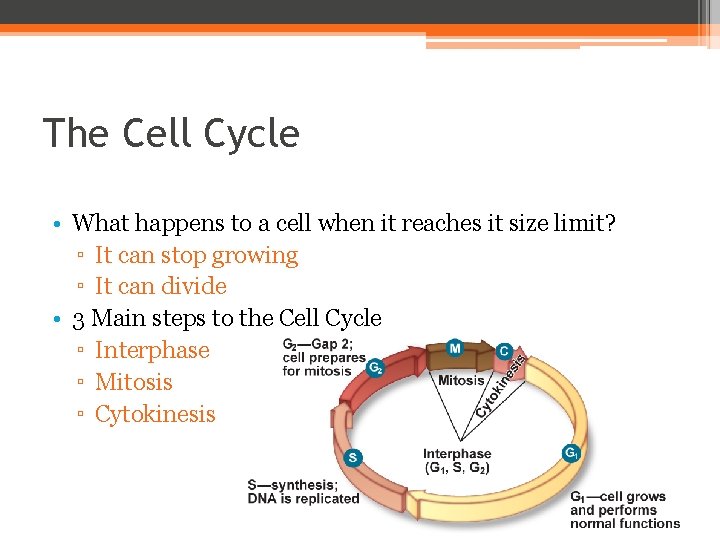
The Cell Cycle • What happens to a cell when it reaches it size limit? ▫ It can stop growing ▫ It can divide • 3 Main steps to the Cell Cycle ▫ Interphase ▫ Mitosis ▫ Cytokinesis
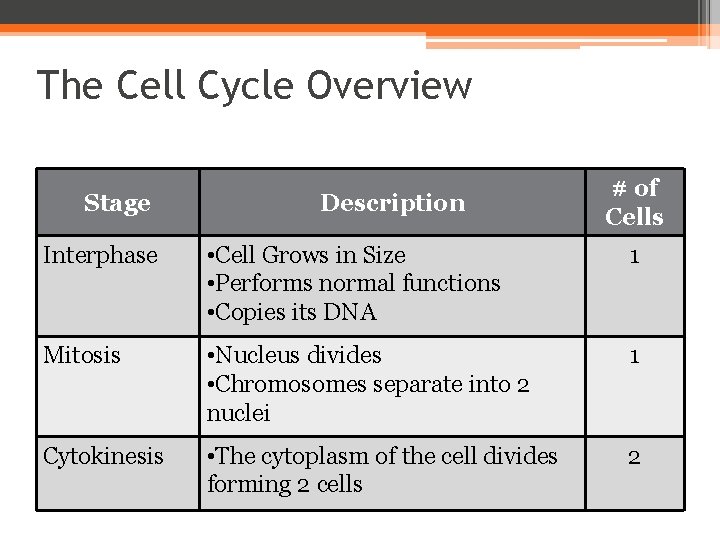
The Cell Cycle Overview Stage Description # of Cells Interphase • Cell Grows in Size • Performs normal functions • Copies its DNA 1 Mitosis • Nucleus divides • Chromosomes separate into 2 nuclei 1 Cytokinesis • The cytoplasm of the cell divides forming 2 cells 2
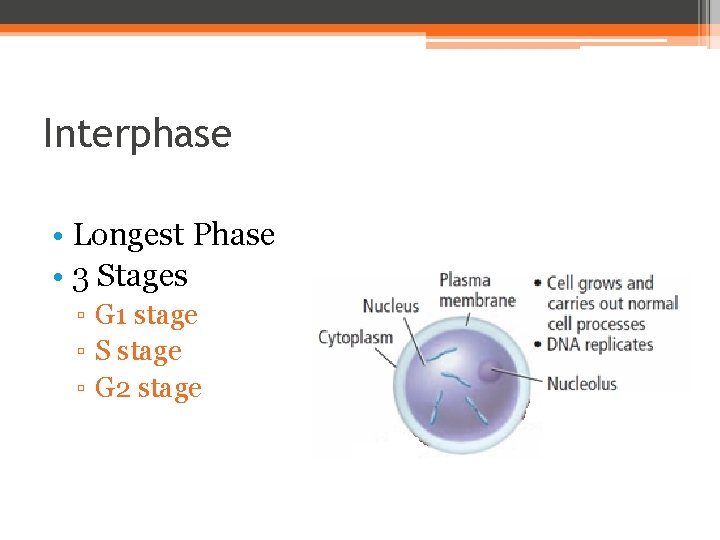
Interphase • Longest Phase • 3 Stages ▫ G 1 stage ▫ S stage ▫ G 2 stage
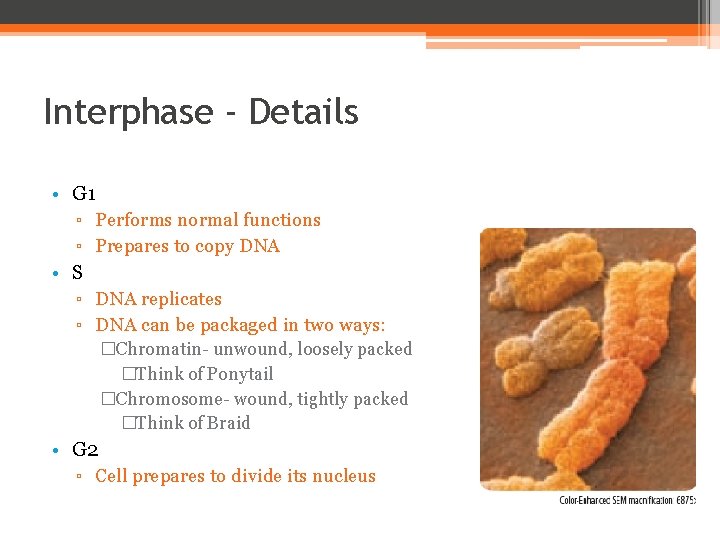
Interphase - Details • G 1 ▫ Performs normal functions ▫ Prepares to copy DNA • S ▫ DNA replicates ▫ DNA can be packaged in two ways: �Chromatin- unwound, loosely packed �Think of Ponytail �Chromosome- wound, tightly packed �Think of Braid • G 2 ▫ Cell prepares to divide its nucleus
Mitosis • Why do cell need to reproduce? ▫ Growth ▫ Repair • Two identical copies of DNA split to form two identical cells ▫ Both daughter cells are completely identical ▫ They have the same DNA • Several Phases ▫ ▫ Prophase Metaphase Anaphase Telophase • Remember: PMAT

Mitosis Prophase • 1 st phase • Nuclear membrane disintegrates • Nucleolus disappears • Chromatin condenses to form chromosomes • Mitotic spindle forms between poles

Mitosis: Metaphase • 2 nd phase • Chromosomes easily seen under light microscope ▫ Karyotypes made • Chromosomes attach to mitotic spindle and align along the equator of the cell ▫ Protein fibers from spindle come from cell cytoskeleton �Then return to cytoskeleton function

Mitosis: Anaphase • 3 rd phase • Microtubules shorten separating chromatids of each chromosome ▫ Move to opposite poles ▫ When chromatids separate, they are considered to be individual chromosomes
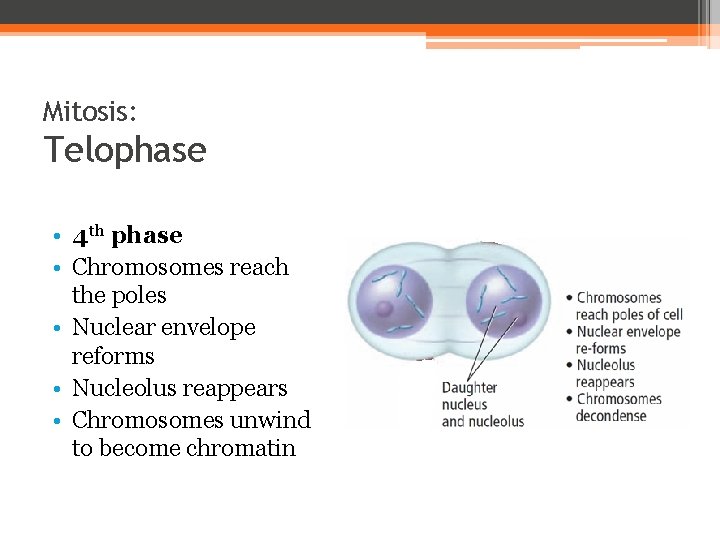
Mitosis: Telophase • 4 th phase • Chromosomes reach the poles • Nuclear envelope reforms • Nucleolus reappears • Chromosomes unwind to become chromatin
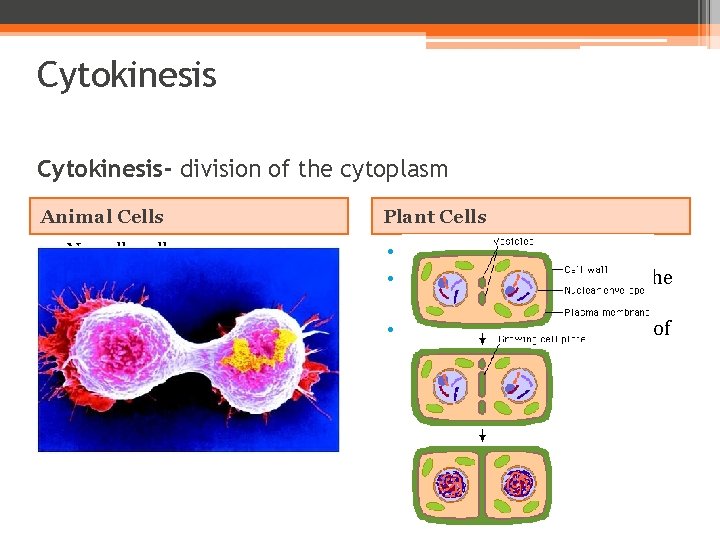
Cytokinesis- division of the cytoplasm Animal Cells Plant Cells • No cell wall • Microtubules constrict and pinch off • Has a cells wall • A cell plate forms between the two daughter nuclei • Cell walls form on the sides of the plate
Result of Cell Cycle – Two New Cells • In both plants and animals, offspring (daughter) cells: ▫ Are the same size ▫ Have identical copy of original cell’s chromosomes �Ie. in humans – have 46 to start; after mitosis each new cell has 46 ▫ Have ½ of the cell’s cytoplasm and organelles
Cell Check Points • Check points – quality control mechanisms ▫ End of G 1 - DNA Damage check ▫ Many others • If there is a problem the cell cycle stops and the cell goes through apoptosis
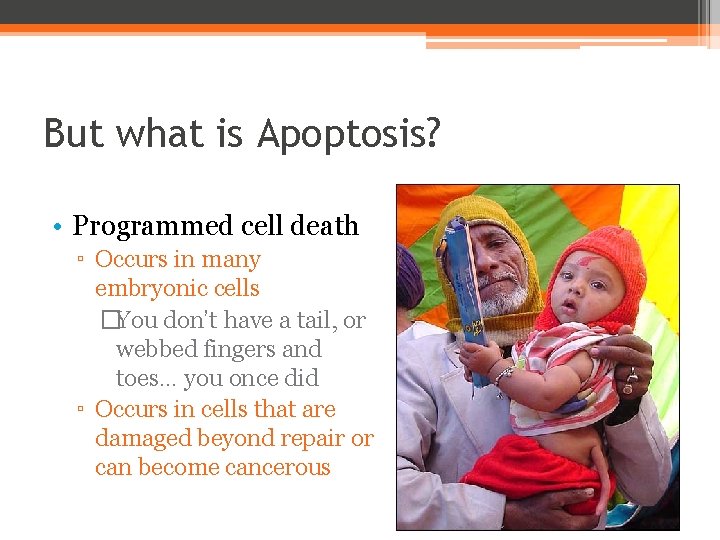
But what is Apoptosis? • Programmed cell death ▫ Occurs in many embryonic cells �You don’t have a tail, or webbed fingers and toes… you once did ▫ Occurs in cells that are damaged beyond repair or can become cancerous
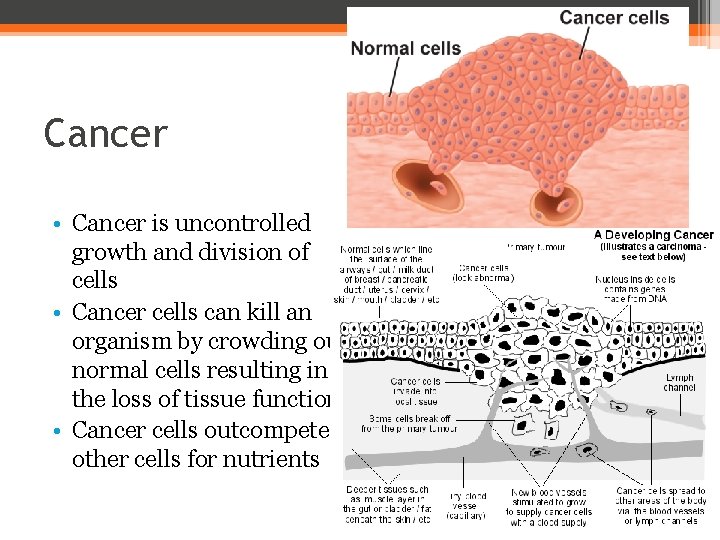
Cancer • Cancer is uncontrolled growth and division of cells • Cancer cells can kill an organism by crowding out normal cells resulting in the loss of tissue function • Cancer cells outcompete other cells for nutrients
Causes of Cancer • Cancer is caused by mutations ▫ Environmental Factors ▫ Carcinogens- substances know to cause cancer • Age ▫ Older people’s cells have divided for a longer period of time ▫ more chances of mutation • Genetics ▫ Inheriting a mutated gene from a parent �p 53 gene
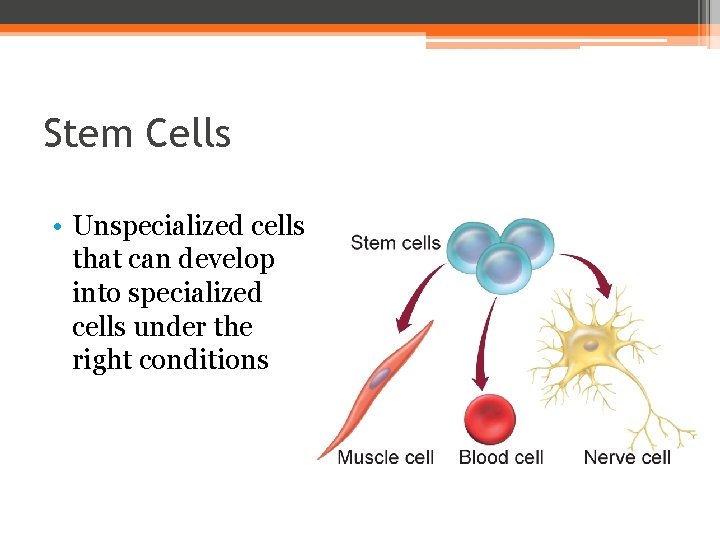
Stem Cells • Unspecialized cells that can develop into specialized cells under the right conditions
Types of Stem Cells Embryonic Stem Cells Adult Stem Cells • After fertilization – resulting mass of cells divides repeatedly until there about 100 -150 cells • Cells have not become specialized ▫ Can become any cell in body • Found in various tissues in body (bone marrow/other tissues) • May be used to maintain and repair the same kind of tissue • Less controversial because adult stem cells obtained with consent of donor
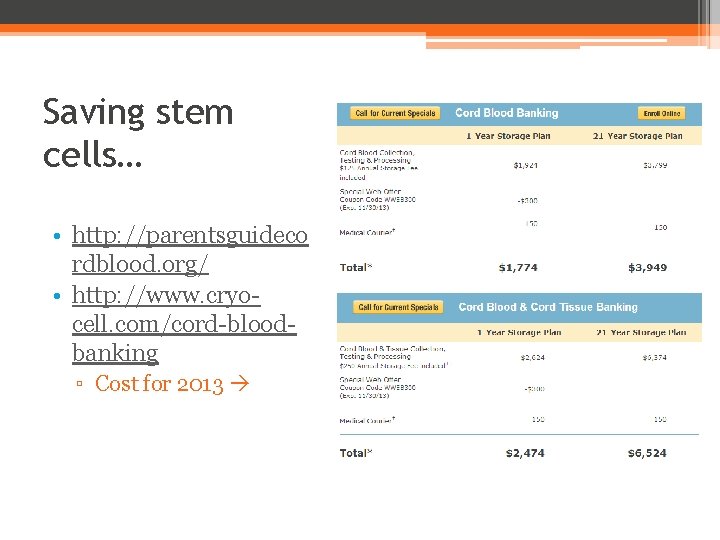
Saving stem cells… • http: //parentsguideco rdblood. org/ • http: //www. cryocell. com/cord-bloodbanking ▫ Cost for 2013
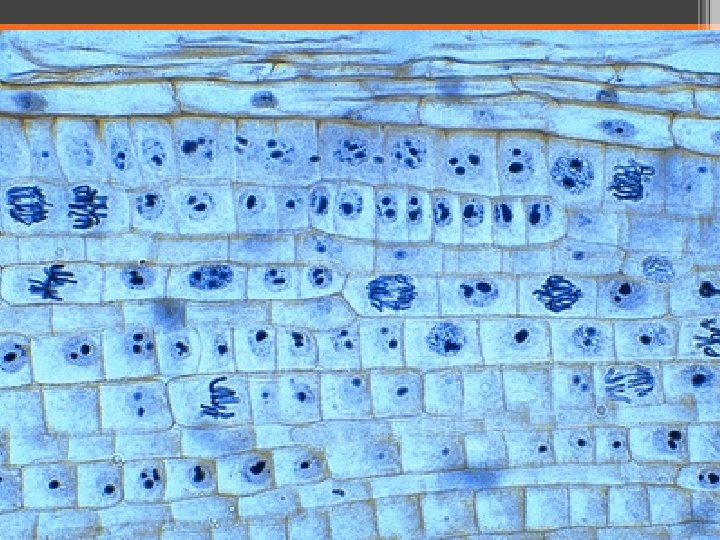
Some Slide Practice Let’s look at some slides and identify some stages of the cell cycle
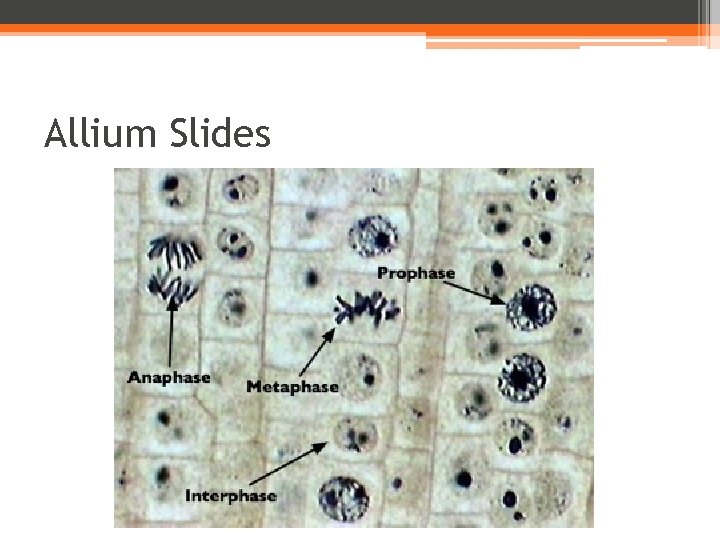
Allium Slides
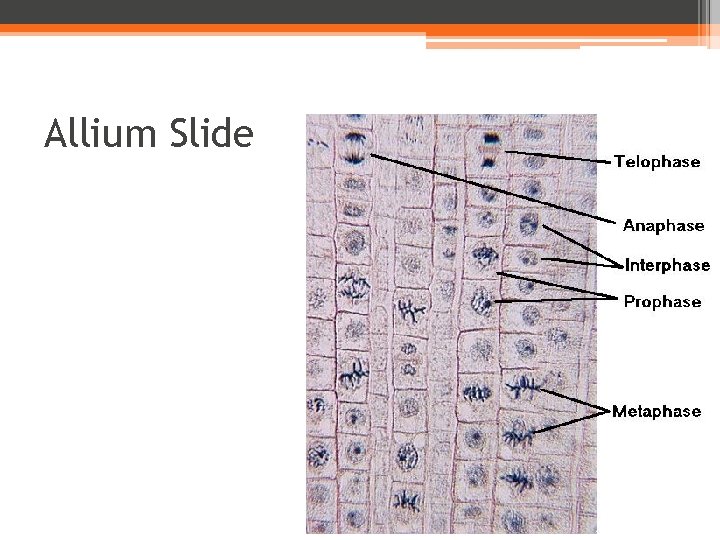
Allium Slide
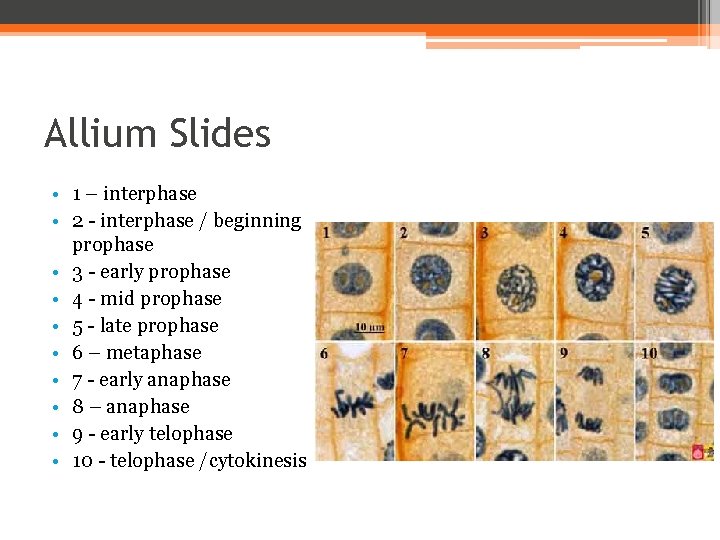
Allium Slides • 1 – interphase • 2 - interphase / beginning prophase • 3 - early prophase • 4 - mid prophase • 5 - late prophase • 6 – metaphase • 7 - early anaphase • 8 – anaphase • 9 - early telophase • 10 - telophase /cytokinesis

Meiosis Why can’t a sexual organism produce offspring through mitosis? Hint- think chromosome number…
Meiosis • Chromosome and Chromosome Number ▫ Human body cells have 46 chromosomes �Skin �Muscle ▫ Each Parent contributes 23 chromosomes ▫ Homologous chromosomes 1 of 2 paired chromosomes, one from each parent ▫ You have 2 genes for each trait
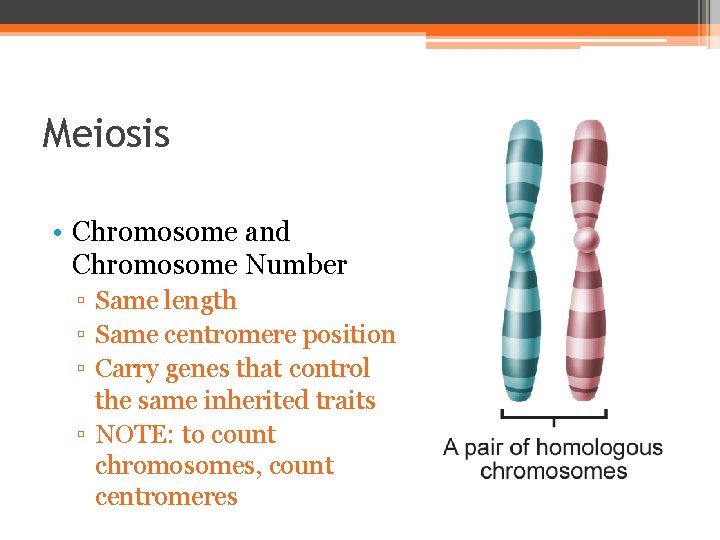
Meiosis • Chromosome and Chromosome Number ▫ Same length ▫ Same centromere position ▫ Carry genes that control the same inherited traits ▫ NOTE: to count chromosomes, count centromeres
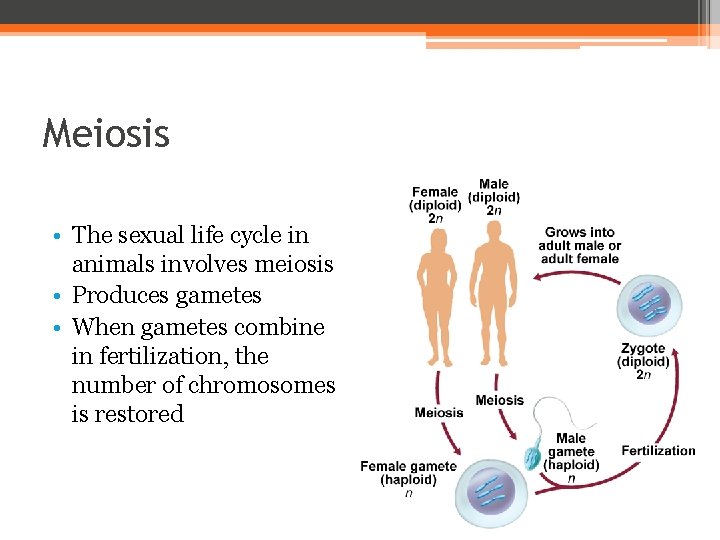
Meiosis • The sexual life cycle in animals involves meiosis • Produces gametes • When gametes combine in fertilization, the number of chromosomes is restored
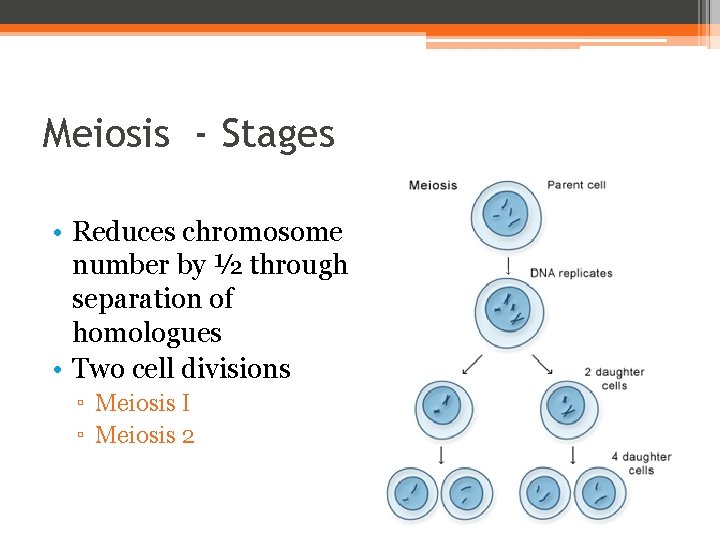
Meiosis - Stages • Reduces chromosome number by ½ through separation of homologues • Two cell divisions ▫ Meiosis I ▫ Meiosis 2
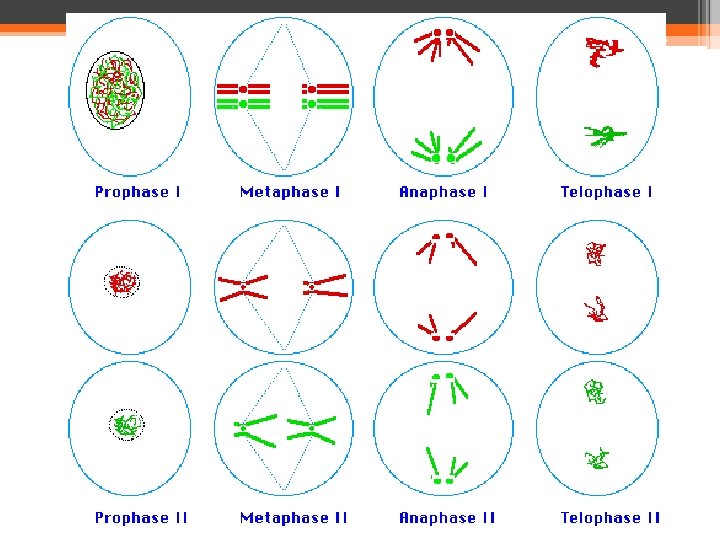
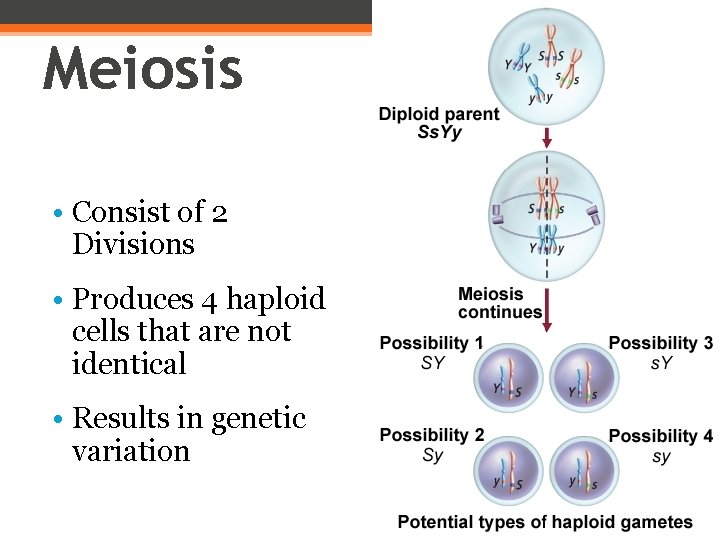
Meiosis • Consist of 2 Divisions • Produces 4 haploid cells that are not identical • Results in genetic variation
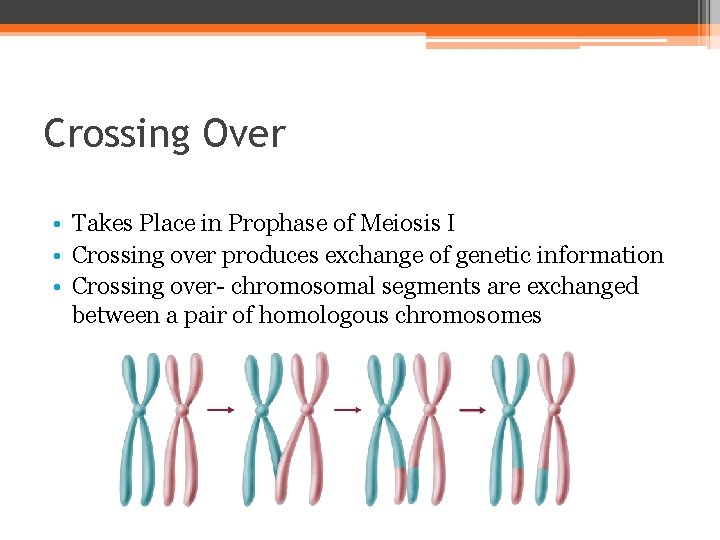
Crossing Over • Takes Place in Prophase of Meiosis I • Crossing over produces exchange of genetic information • Crossing over- chromosomal segments are exchanged between a pair of homologous chromosomes
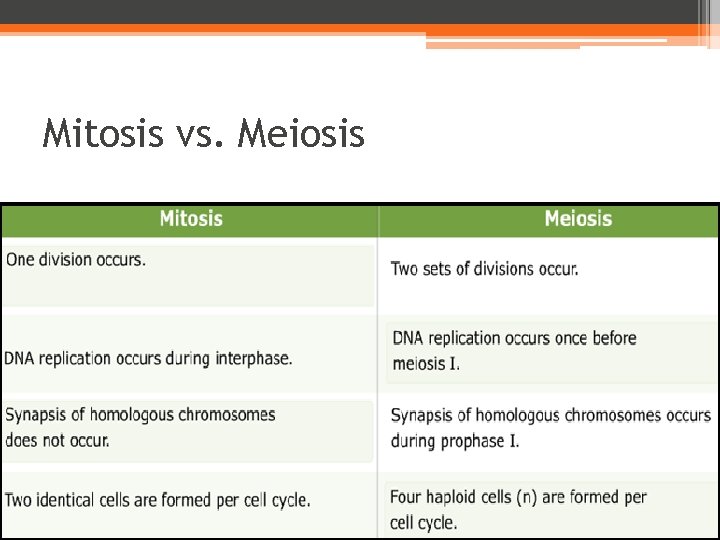
Mitosis vs. Meiosis
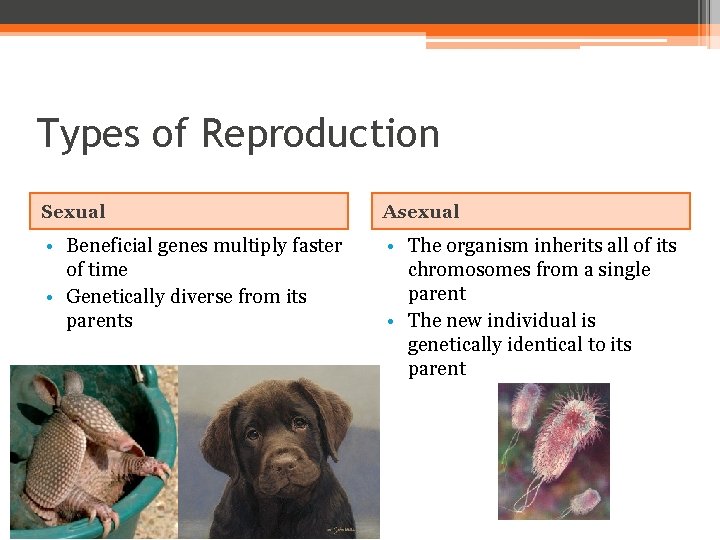
Types of Reproduction Sexual Asexual • Beneficial genes multiply faster of time • Genetically diverse from its parents • The organism inherits all of its chromosomes from a single parent • The new individual is genetically identical to its parent
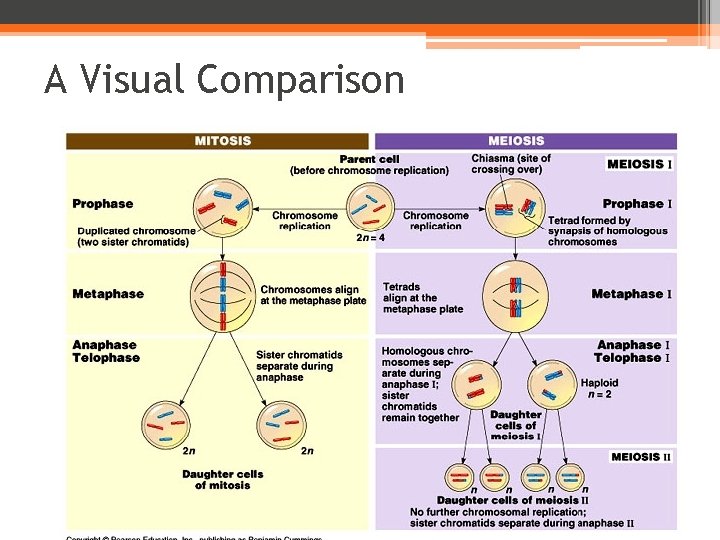
A Visual Comparison
- Slides: 45