
Cell Growth and Division Section 1 Why Cells

- Slides: 15
Cell Growth and Division Section 1 Why Cells Reproduce • https: //www. youtube. com/watch? v=ts. VHWb. Xqum 8
Cell Growth and Division Section 1 Why Cells Reproduce 1) As the body of a multicellular organism grows larger, its cells do not also grow as large. Instead, the body grows by producing more cells. 2) New cells are 1. needed to help tissues and organs grow, 2. to replace damaged cells, and 3. take the place of dead cells. 3) A cell grows larger by building more cell products. To do this, the cell must take in more nutrients, process them, and get rid of wastes.
Cell Growth and Division Cell Size Section 1 Why Cells Reproduce, continued 4) A cell’s ability to exchange substances is limited by its surface area–to-volume ratio. As a cell gets larger, substances must travel farther to reach where they are needed. • Surface area is the overall amount of space (2 -D) something takes up. So for instance in a cube if a side length is doubled, surface area is squared 2 to 4, but volume is cubed 2 to 8. So as the cell gets larger in size, there is more volume in it to have to cover. • Volume is the amount of 3 -D space something can fill.
Cell Growth and Division Section 1 Why Cells Reproduce, continued Cell Maintenance 5) The work of cells is done by proteins. As a cell gets larger, more proteins are required to maintain its function. 6) If the cell gets too large, DNA instructions cannot be copied quickly enough to make the proteins that the cell needs to support itself. 7) Cell size is also limited by the cell’s DNA. • Because larger cells are more difficult to maintain, cells divide when they grow to a certain size.
Cell Growth and Division Section 1 Making New Cells 8) Each “daughter” cell: • 1) has a higher surface area–to-volume ratio than its parent does. (less overall volume to cover inside) • 2) gets an entire copy of the cell’s DNA and equal numbers of needed organelles (mitochondria, chloroplasts, nucleus, etc). Chromosomes 9) The large molecule of DNA is organized into hereditary units called genes. A gene is a segment of DNA that codes for RNA and protein. 10) DNA is organized and packaged into structures called chromosomes.
Cell Growth and Division Section 1 Chromosomes, continued 11) Prokaryotic Chromosomes • A prokaryotic cell has a single circular molecule of DNA. • This loop of DNA contains thousands of genes. • A prokaryotic chromosome is condensed through repeated twisting or winding, like a rubber band twisted upon itself many times.
Cell Growth and Division Section 1 Chromosomes, continued Eukaryotic Chromosomes 12) Eukaryotic cells contain many more genes arranged on several linear DNA molecules. 13) The DNA and proteins make up a substance called chromatin. 14) The first level of packaging is done by a class of proteins called histones. A group of eight histones come together to form a disc-shaped histone core. https: //www. youtube. com/watch? v=9 k. Qp. Yd. Cn. U 14
Cell Growth and Division Eukaryotic Chromosomes Section 1 Chromosomes, continued 15) The long DNA molecule is wound around a series of histone cores and is called a nucleosome. Under an electron microscope, this level of packaging resembles beads on a string. 16) The string of nucleosomes line up in a spiral to form a cord that is 30 nm in diameter. • 17. As the cell prepares to divide, the chromosomes condense even further ensuring that the extremely long DNA molecules do not get tangled up during cell division.
Cell Growth and Division Section 1 Chromosomes, continued Eukaryotic Chromosomes • Many dense loops of chromatin form the rod-shaped structures that can be seen in regular light microscopes. 18) Each of the two thick strands of a fully condensed, duplicated chromosome are called a chromatid. 19) Each chromatid is made of a single, long molecule of DNA.
Cell Growth and Division Section 1 Chromosomes, continued Eukaryotic Chromosomes 20) Identical pairs, called sister chromatids, are held together at a region called the centromere. 21) During cell division, the sister chromatids are separated at the centromere, and one ends up in each daughter cell. 22) Each new cell has the same genetic information as the parent cell.
Cell Growth and Division Section 1 Preparing for Cell Division • 23. All new cells are produced by the division of preexisting cells. (Remember cell theory? ) • 24. The process of cell division involves more than cutting a cell into two pieces. Each new cell must have all of the equipment needed to stay alive. • All newly-formed cells require DNA, so before a cell divides, a copy of DNA is made for each daughter cell. • Each new cells will function in the same way as the cells that they replace.
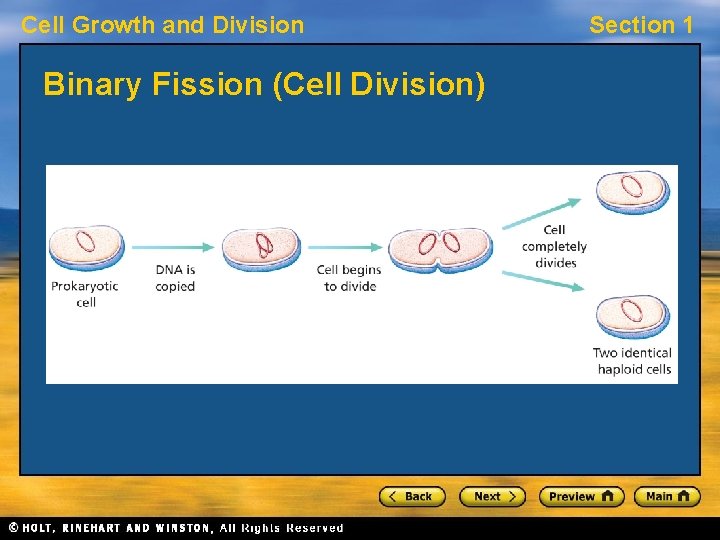
Cell Growth and Division Section 1 Prokaryotes Preparing for Cell Division, continued • In prokaryotic cells, the circular DNA molecule is attached to the inner cell membrane. • 25) The cytoplasm is divided when a new cell membrane forms between the two DNA copies. Meanwhile the cell continues to grow until it nearly doubles in size. • 26) The cell is constricted in the middle, like a long balloon being squeezed near the center. • Eventually the dividing prokaryote is pinched into two independent daughter cells, each of which has its own circular DNA molecule.
Cell Growth and Division Binary Fission (Cell Division) Section 1
Cell Growth and Division Section 1 Preparing for Cell Division, continued Eukaryotes • The reproduction eukaryotic cells is more complex than that of prokaryotic cells. 27) 1) ☺Eukaryotic cells have many organelles. In order to form two living cells, each daughter cell must contain enough of each organelle to carry out its functions. 2) ☺The DNA within the nucleus must also be copied, sorted, and separated.
Cell Growth and Division Section 1 Summary • Because larger cells are more difficult to maintain, cells divide when they grow to a certain size. • Many proteins help package eukaryotic DNA into highly condensed chromosome structures. • All newly-formed cells require DNA, so before a cell divides, a copy of its DNA is made for each daughter cell.