
Cell Growth and Development Cell Lifespan The average
- Slides: 13
Cell Growth and Development
Cell Lifespan • The average lifespan of a cell depends on the type of cell it is. – There approximately 10 trillion cells and 200 different types of cells in an average human body. • Some cells are short lived and some around from birth until death. • Every minute, an average of 300 million of the body's cells die. – In the vast majority of cases, these cells are quickly replaced by new cells through a process called cell division.
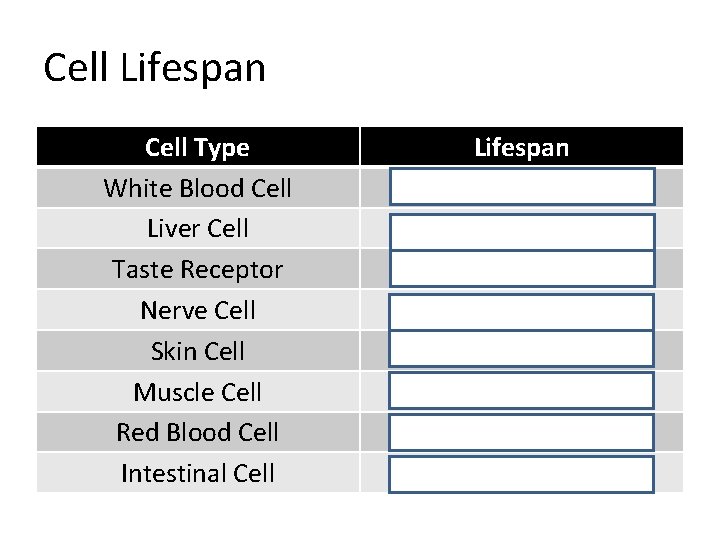
Cell Lifespan Cell Type White Blood Cell Liver Cell Taste Receptor Nerve Cell Skin Cell Muscle Cell Red Blood Cell Intestinal Cell Lifespan Few hours to a day 8 -16 months 10 days Lifetime 1 month 15 years 3 months 2 -3 days
Cell Division The formation of new cells is essential for an organism to grow, develop and repair damaged cells and create new organisms. • The process by which one cell divides into two cells = cell division. • 2 Types of cell division: 1. Mitosis – “My toes” cell division is body cells. 2. Meiosis – “Me” cell division in sex cells.
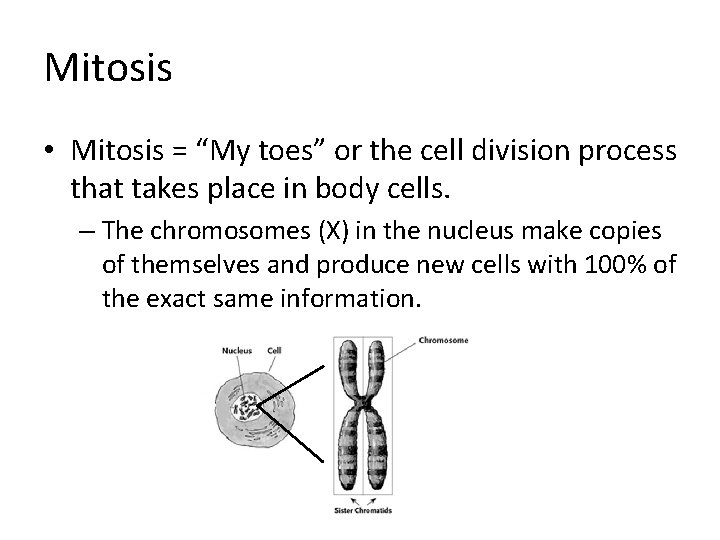
Mitosis • Mitosis = “My toes” or the cell division process that takes place in body cells. – The chromosomes (X) in the nucleus make copies of themselves and produce new cells with 100% of the exact same information.
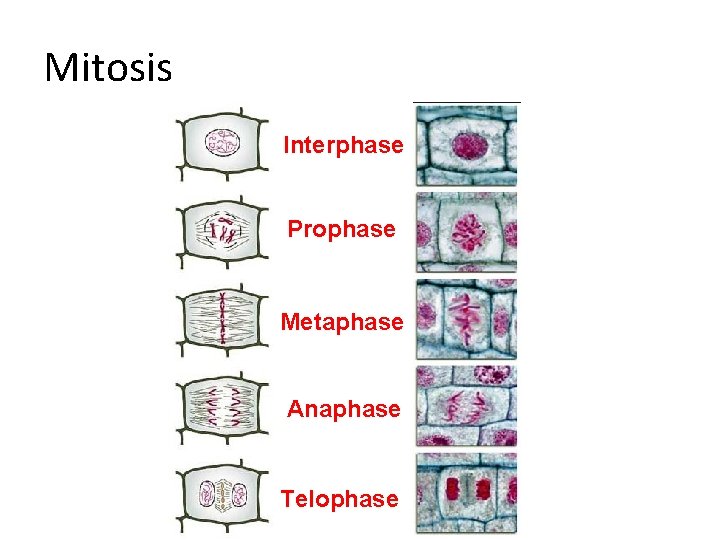
Mitosis Interphase Prophase Metaphase Anaphase Telophase
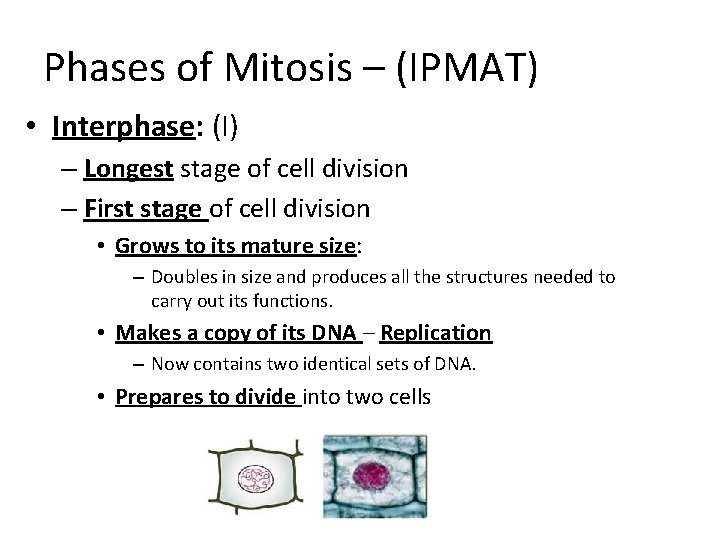
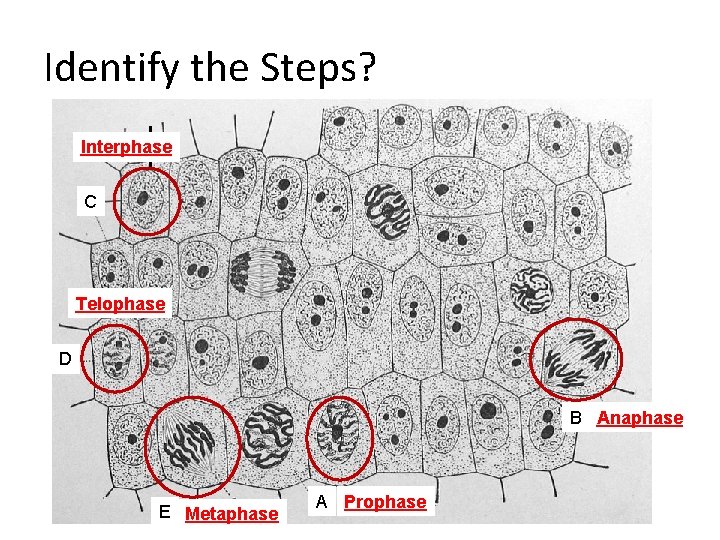
Phases of Mitosis – (IPMAT) • Interphase: (I) – Longest stage of cell division – First stage of cell division • Grows to its mature size: – Doubles in size and produces all the structures needed to carry out its functions. • Makes a copy of its DNA – Replication – Now contains two identical sets of DNA. • Prepares to divide into two cells
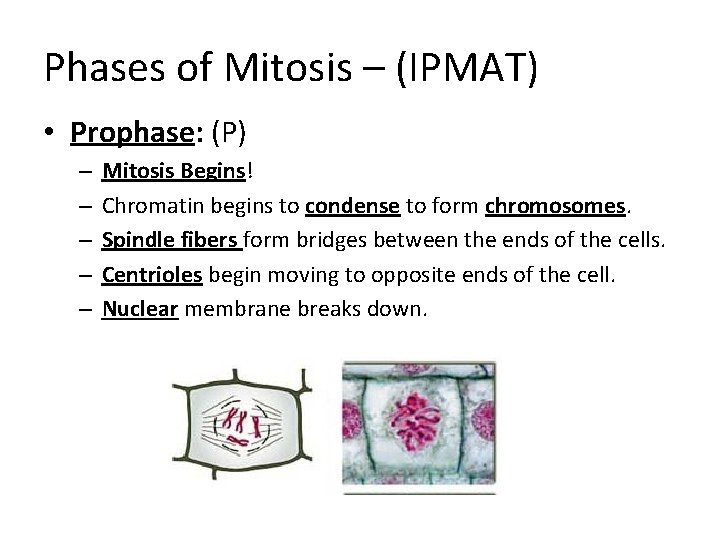
Phases of Mitosis – (IPMAT) • Prophase: (P) – – – Mitosis Begins! Chromatin begins to condense to form chromosomes. Spindle fibers form bridges between the ends of the cells. Centrioles begin moving to opposite ends of the cell. Nuclear membrane breaks down.
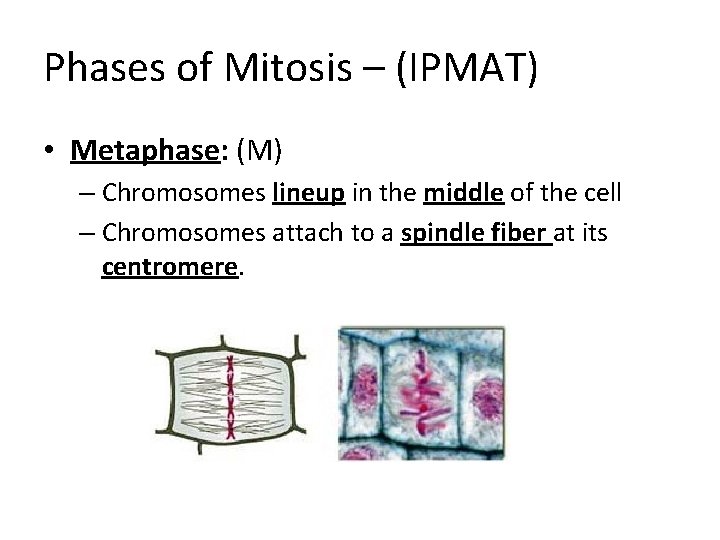
Phases of Mitosis – (IPMAT) • Metaphase: (M) – Chromosomes lineup in the middle of the cell – Chromosomes attach to a spindle fiber at its centromere.
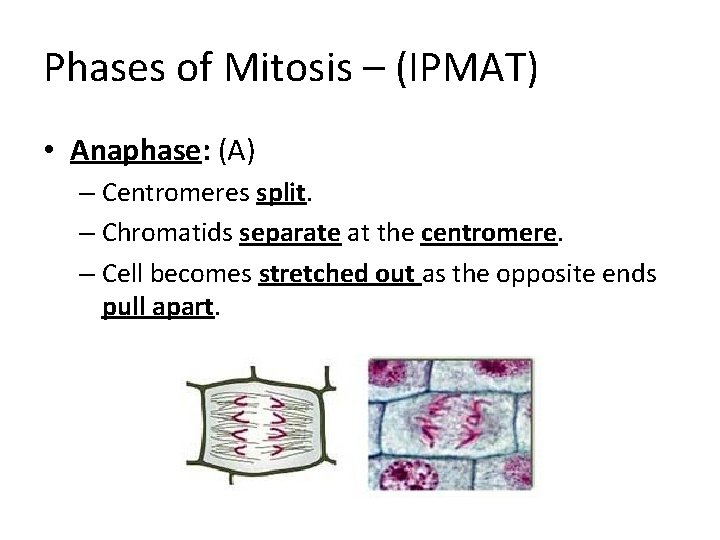
Phases of Mitosis – (IPMAT) • Anaphase: (A) – Centromeres split. – Chromatids separate at the centromere. – Cell becomes stretched out as the opposite ends pull apart.
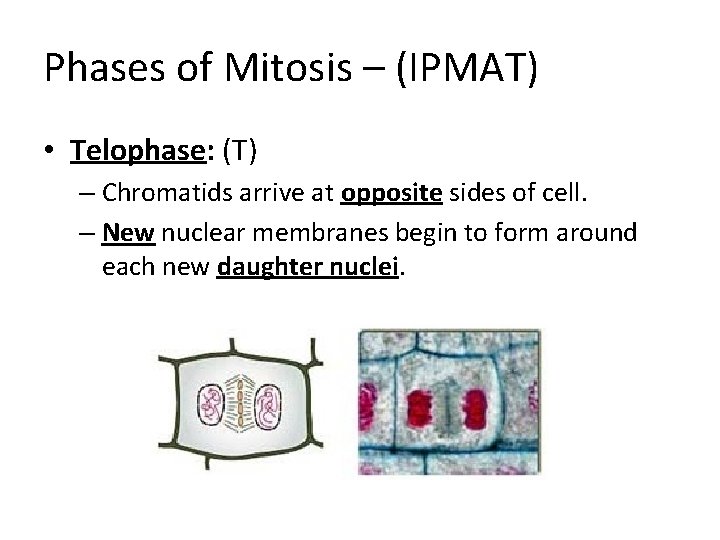
Phases of Mitosis – (IPMAT) • Telophase: (T) – Chromatids arrive at opposite sides of cell. – New nuclear membranes begin to form around each new daughter nuclei.
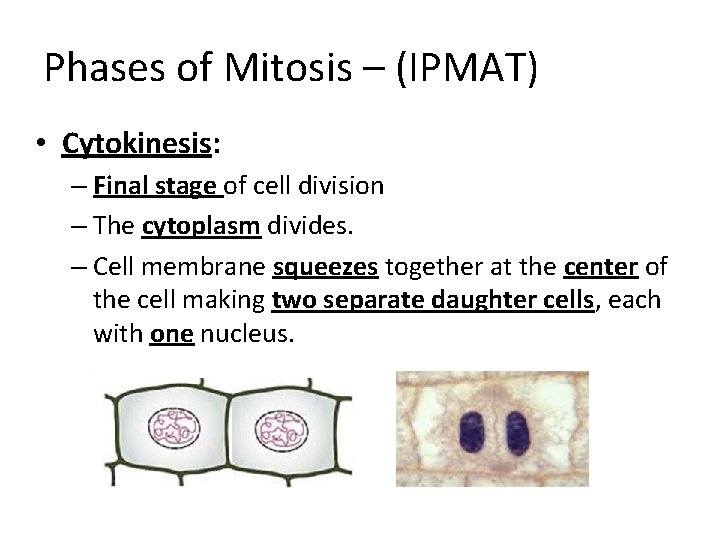
Phases of Mitosis – (IPMAT) • Cytokinesis: – Final stage of cell division – The cytoplasm divides. – Cell membrane squeezes together at the center of the cell making two separate daughter cells, each with one nucleus.
Identify the Steps? Interphase C Telophase D B Anaphase E Metaphase A Prophase