
Cell expansion plays a major role in growth

- Slides: 57
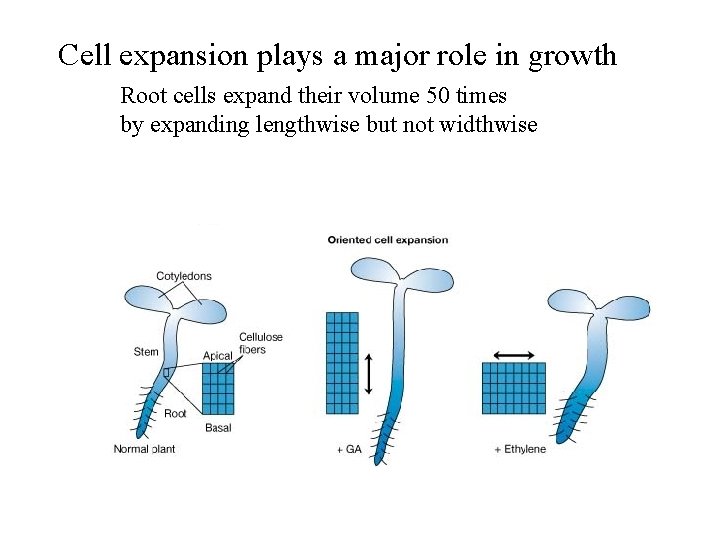
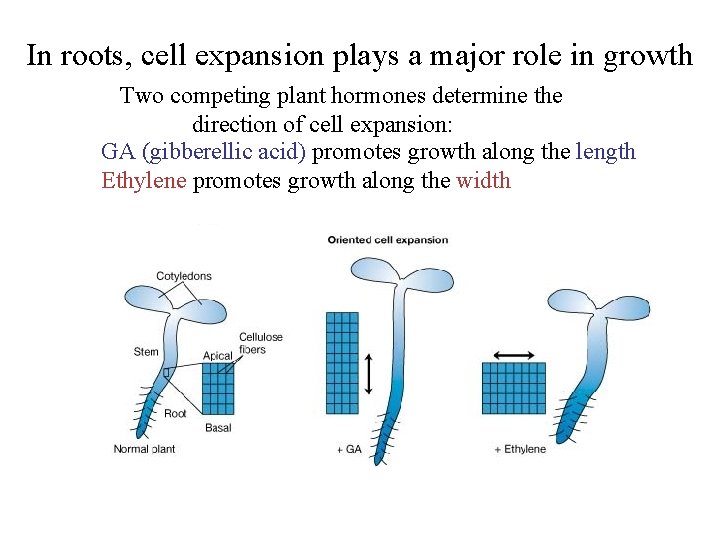
Cell expansion plays a major role in growth Root cells expand their volume 50 times by expanding lengthwise but not widthwise
In roots, cell expansion plays a major role in growth Two competing plant hormones determine the direction of cell expansion: GA (gibberellic acid) promotes growth along the length Ethylene promotes growth along the width
Auxin and Cytokinin control shoot and root growth High levels of Cytokinin and low levels of Auxin promote shoot development (stems with leaves) High levels of Auxin and low levels of Cytokinin promote root development
The Miller-Skoog Experiment: Cloning 1. Place single cell on medium with high levels of Cytokinin and low levels of Auxin to promote shoot development (stems with leaves) 2. Place shoots on medium with high levels of Auxin and low levels of Cytokinin to promote root development at the base of the shoot 3. Transfer rooted shoots to soil and grow plants to maturity
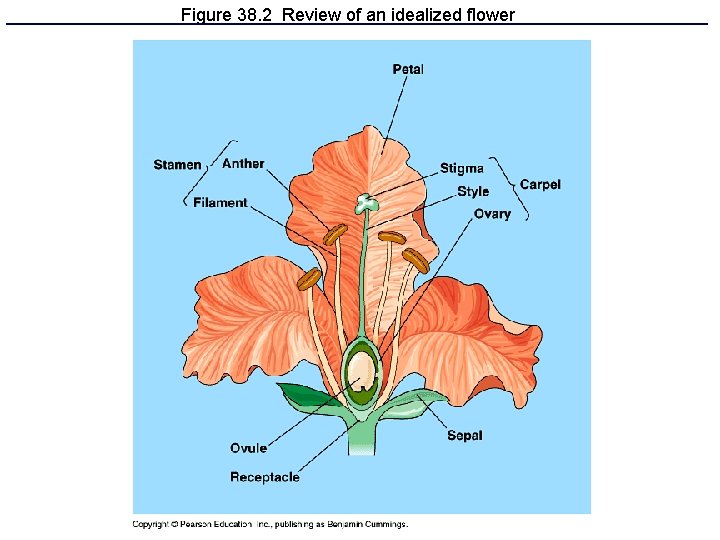
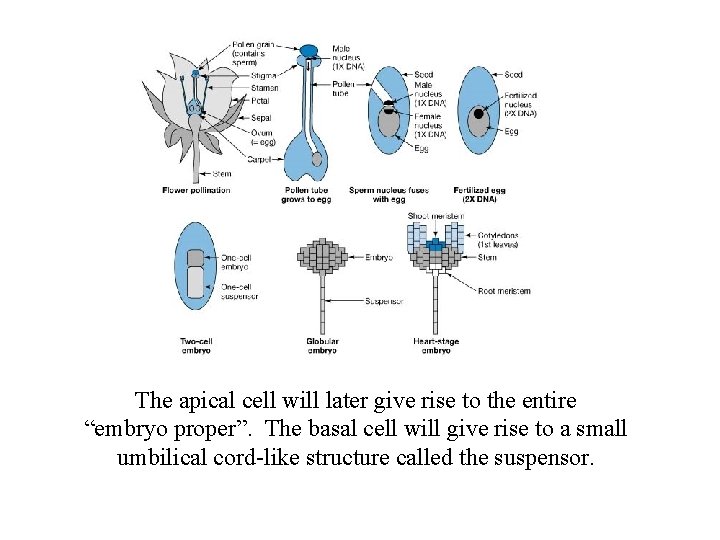
Figure 38. 2 Review of an idealized flower
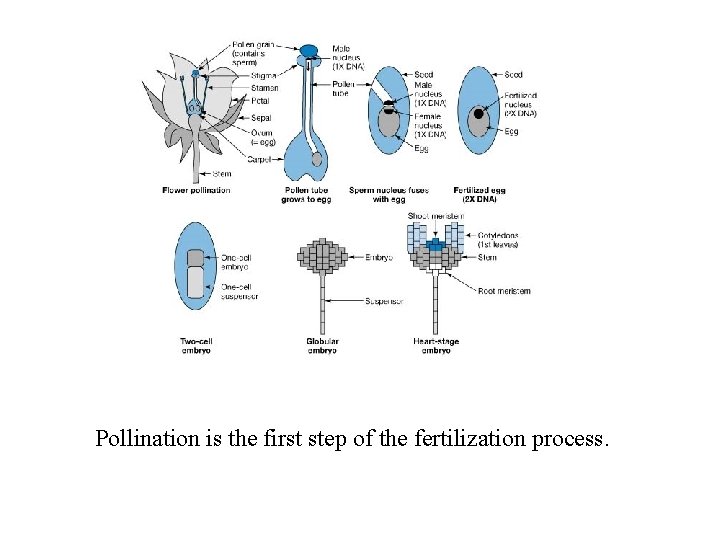
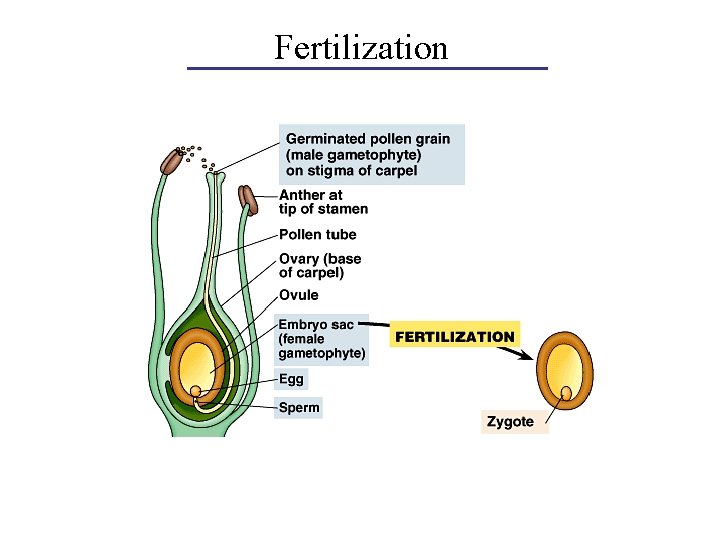
Pollination is the first step of the fertilization process.
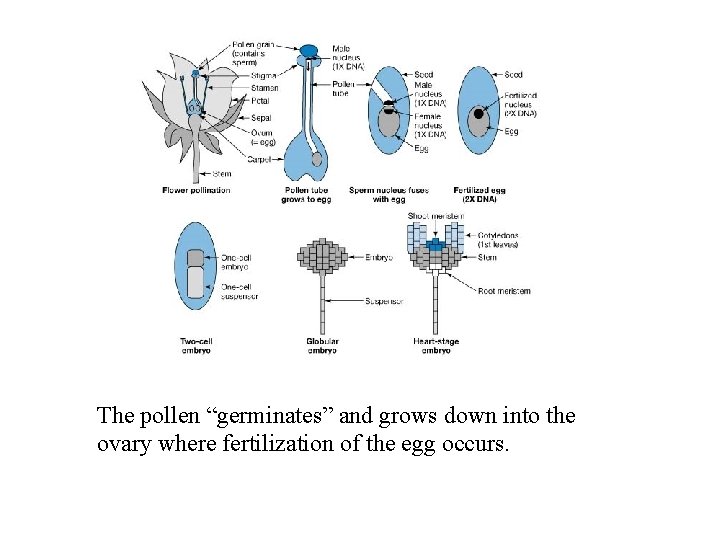
The pollen “germinates” and grows down into the ovary where fertilization of the egg occurs.
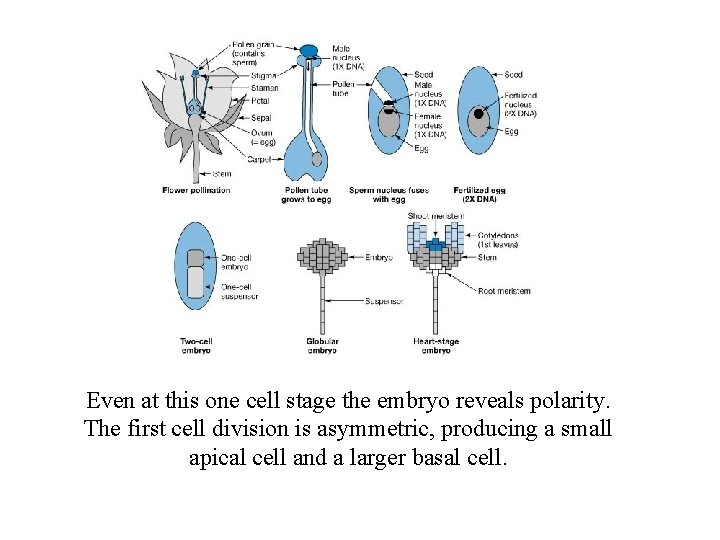
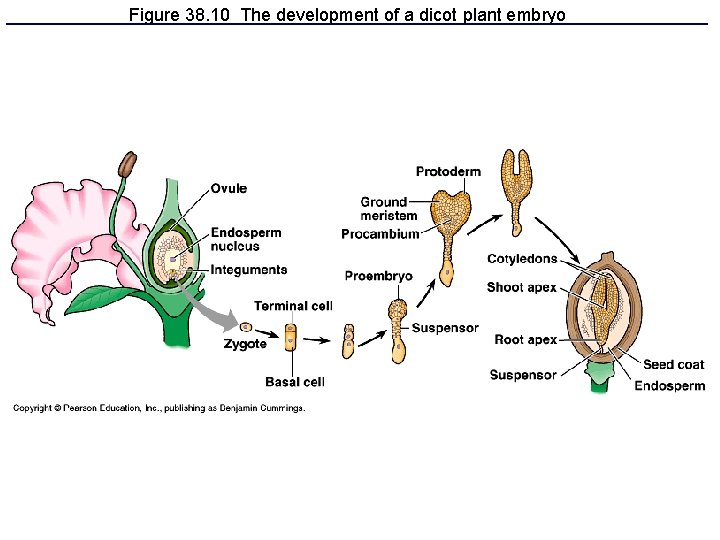
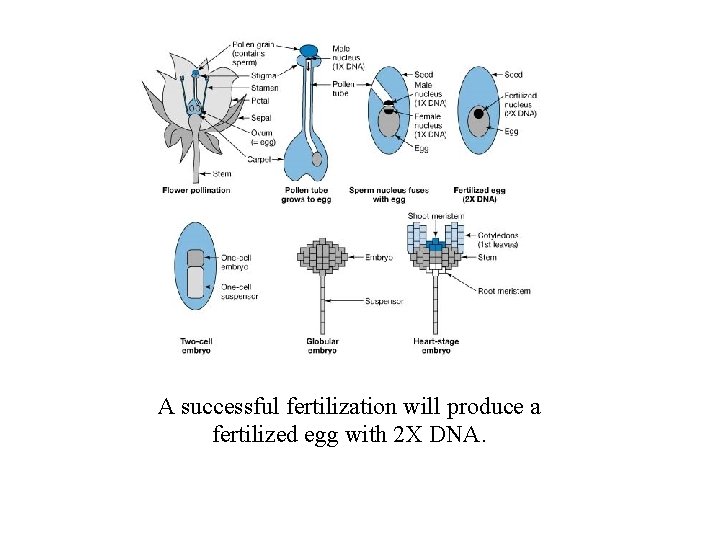
Even at this one cell stage the embryo reveals polarity. The first cell division is asymmetric, producing a small apical cell and a larger basal cell.
The apical cell will later give rise to the entire “embryo proper”. The basal cell will give rise to a small umbilical cord-like structure called the suspensor.
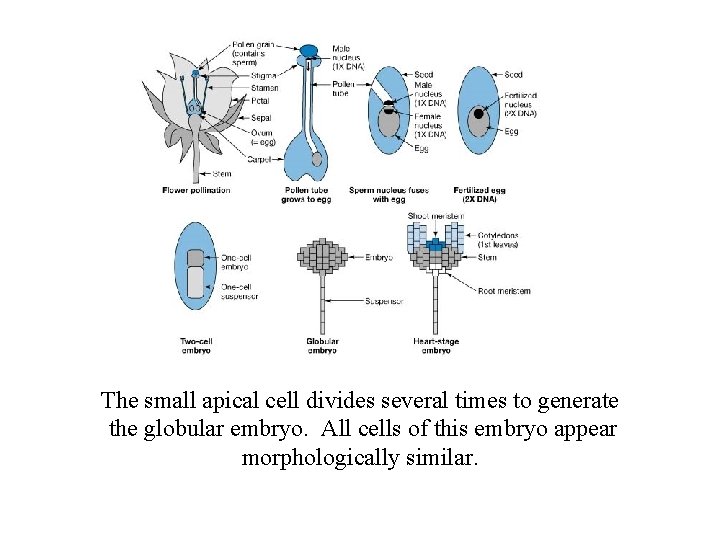
The small apical cell divides several times to generate the globular embryo. All cells of this embryo appear morphologically similar.
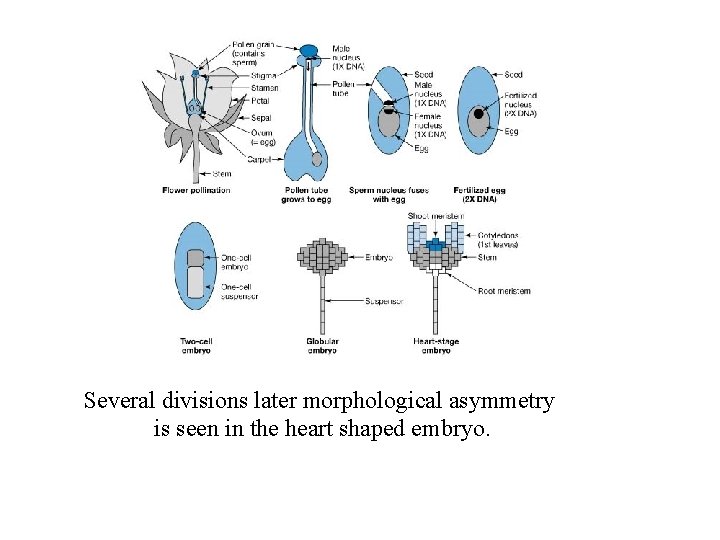
Several divisions later morphological asymmetry is seen in the heart shaped embryo.
Arabidopsis embryogenesis
Arabidopsis embryogenesis
Cotyledons (seed leaves) Shoot Apical Meristem Hypocotyl (seedling stem) Root Apical Meristem
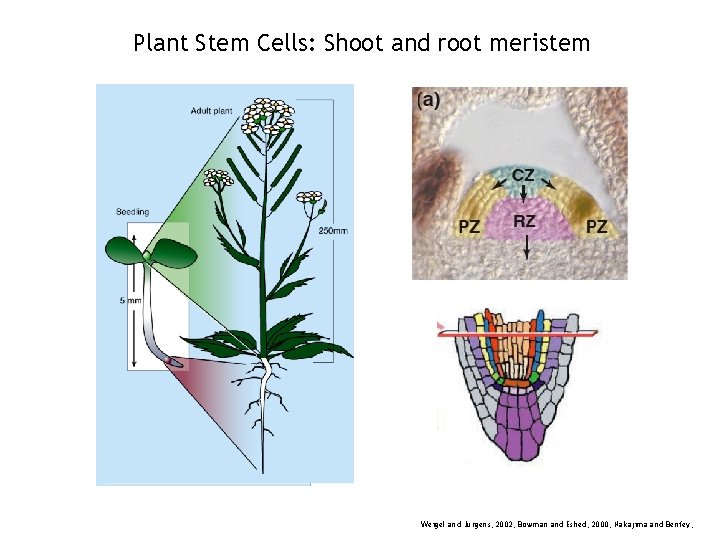
Plant Stem Cells: Shoot and root meristem Weigel and Jürgens, 2002; Bowman and Eshed, 2000; Nakajima and Benfey, 2002
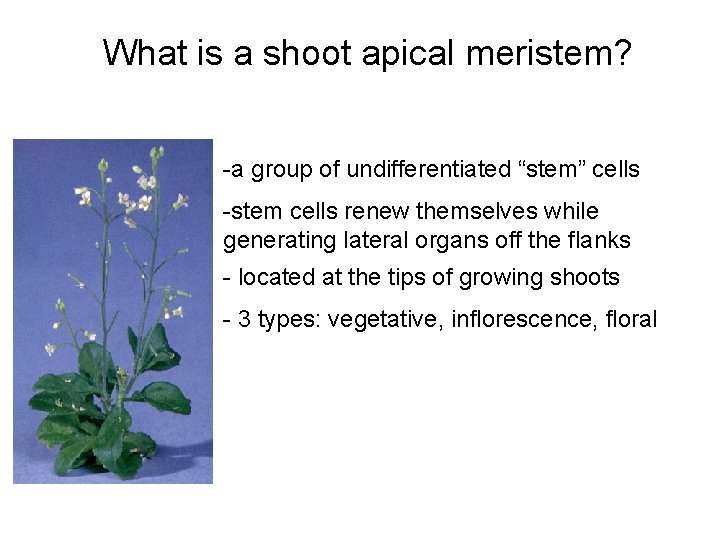
What is a shoot apical meristem? -a group of undifferentiated “stem” cells -stem cells renew themselves while generating lateral organs off the flanks - located at the tips of growing shoots - 3 types: vegetative, inflorescence, floral
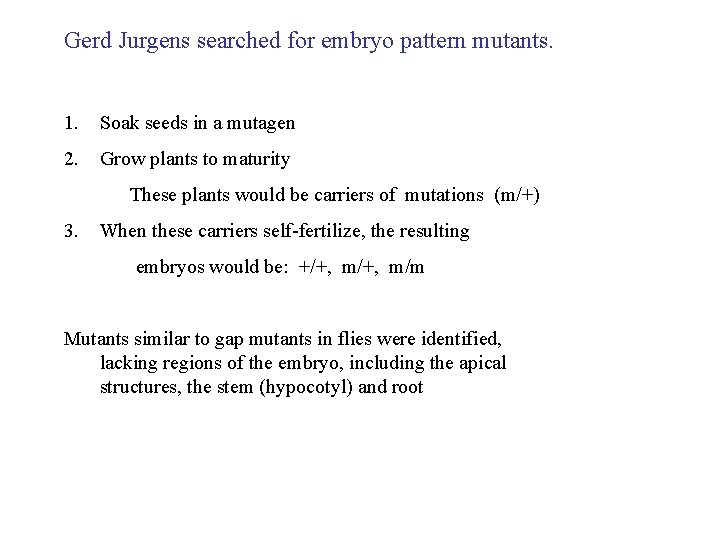
Gerd Jurgens searched for embryo pattern mutants. 1. Soak seeds in a mutagen 2. Grow plants to maturity These plants would be carriers of mutations (m/+) 3. When these carriers self-fertilize, the resulting embryos would be: +/+, m/m Mutants similar to gap mutants in flies were identified, lacking regions of the embryo, including the apical structures, the stem (hypocotyl) and root
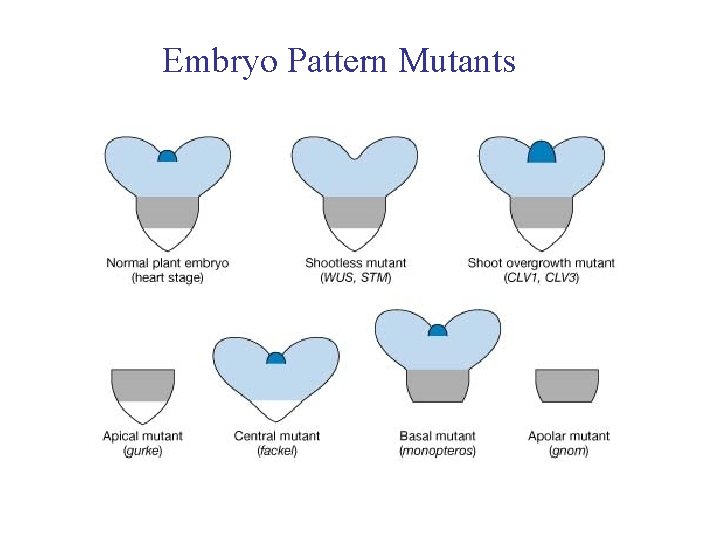
Embryo Pattern Mutants
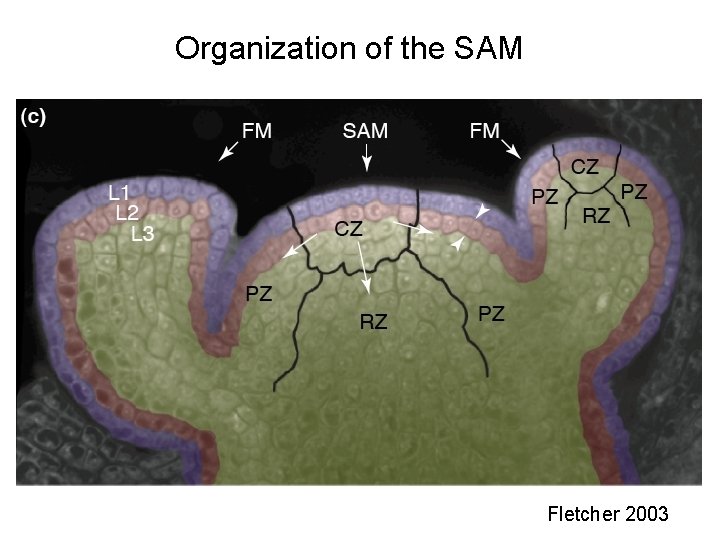
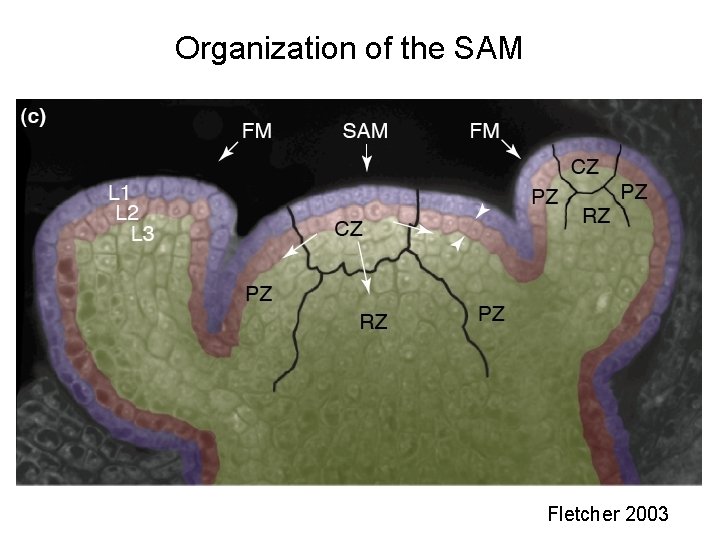
Organization of the SAM Fletcher 2003
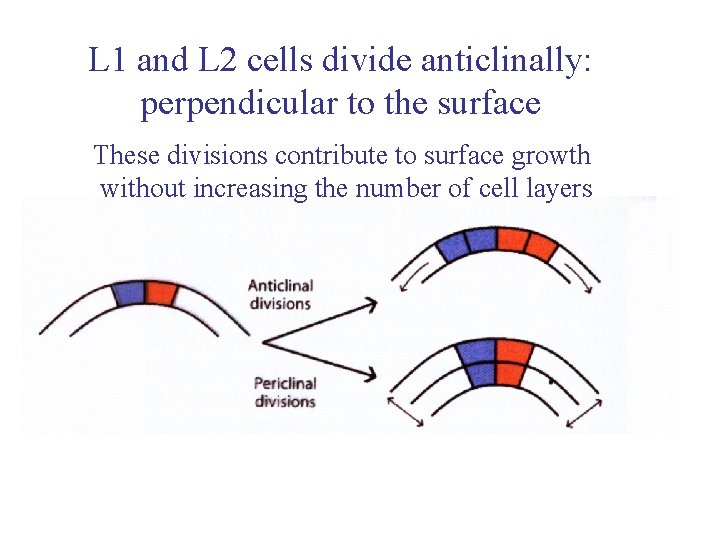
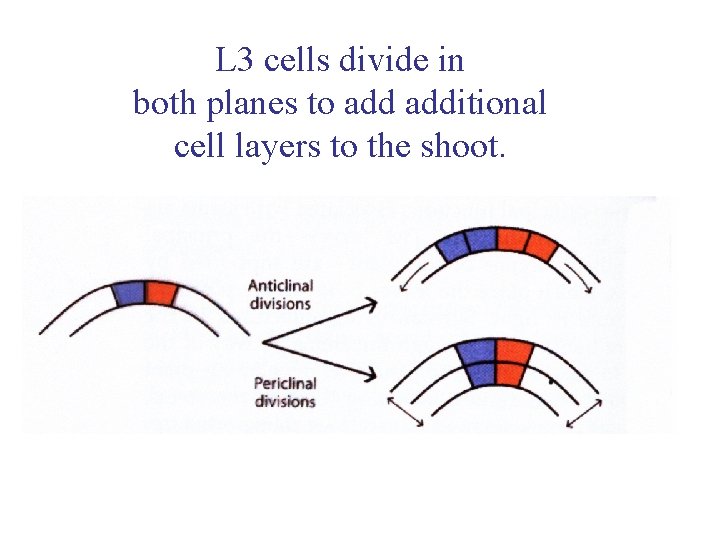
L 1 and L 2 cells divide anticlinally: perpendicular to the surface These divisions contribute to surface growth without increasing the number of cell layers
L 3 cells divide in both planes to additional cell layers to the shoot.
Organization of the SAM Fletcher 2003
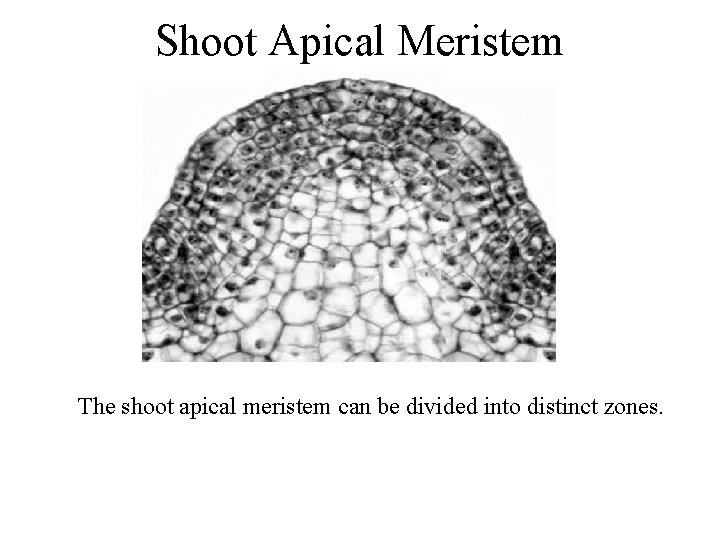
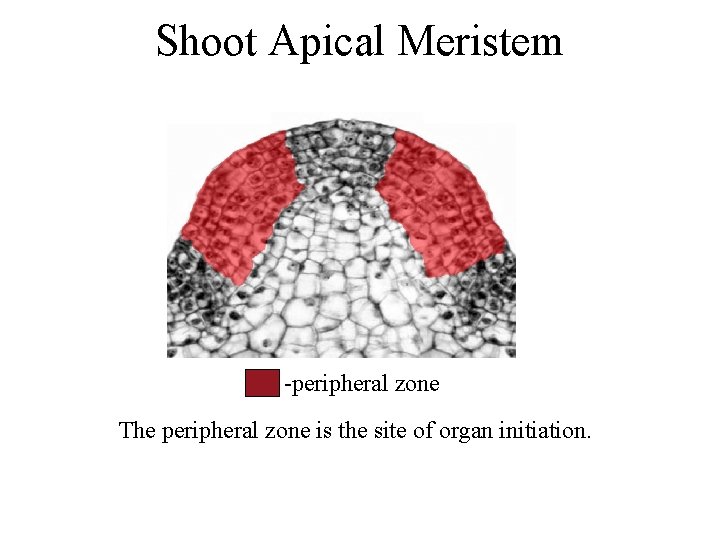
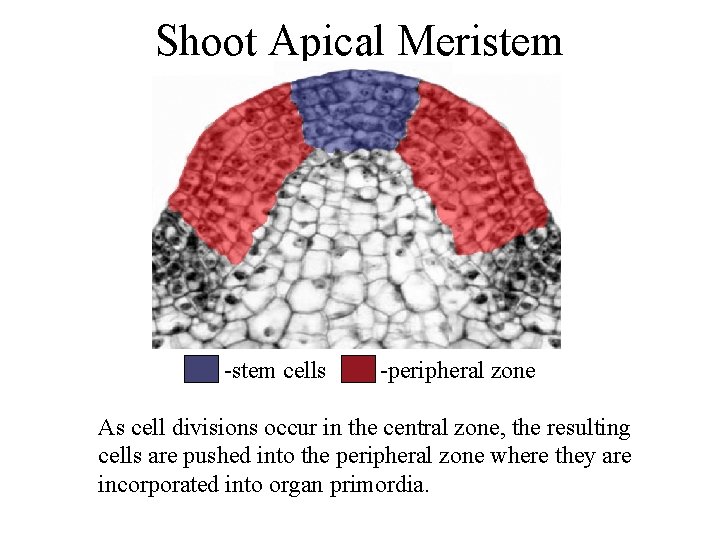
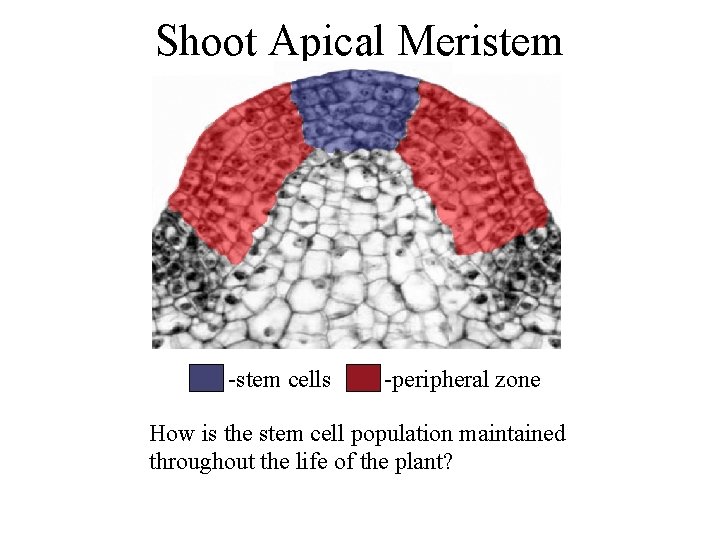
Shoot Apical Meristem The shoot apical meristem can be divided into distinct zones.
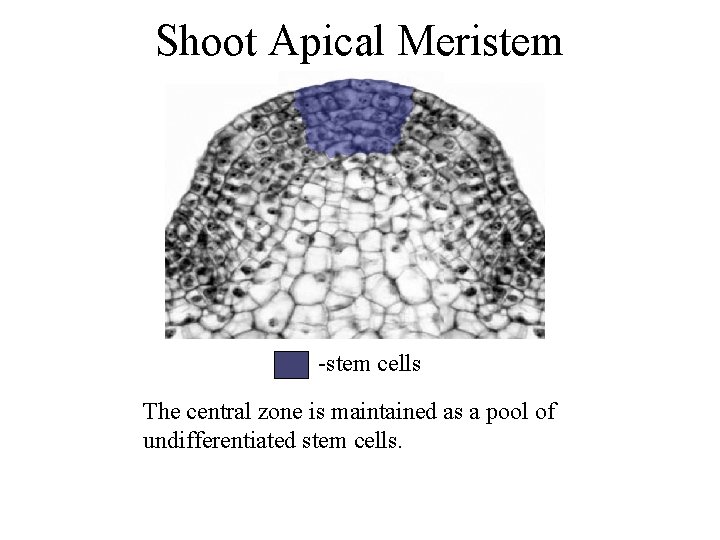
Shoot Apical Meristem -stem cells The central zone is maintained as a pool of undifferentiated stem cells.
Shoot Apical Meristem -peripheral zone The peripheral zone is the site of organ initiation.
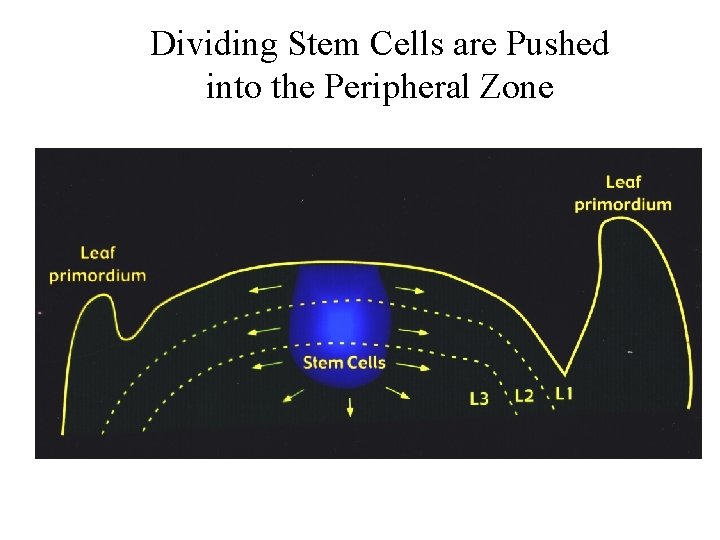
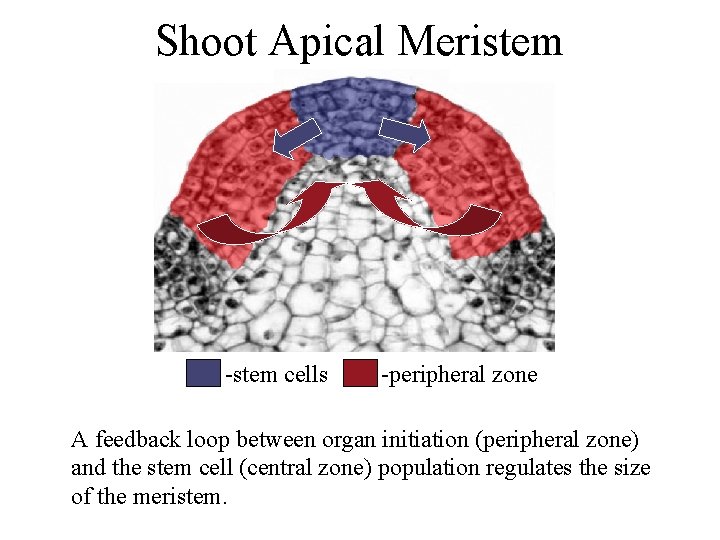
Shoot Apical Meristem -stem cells -peripheral zone As cell divisions occur in the central zone, the resulting cells are pushed into the peripheral zone where they are incorporated into organ primordia.
Dividing Stem Cells are Pushed into the Peripheral Zone
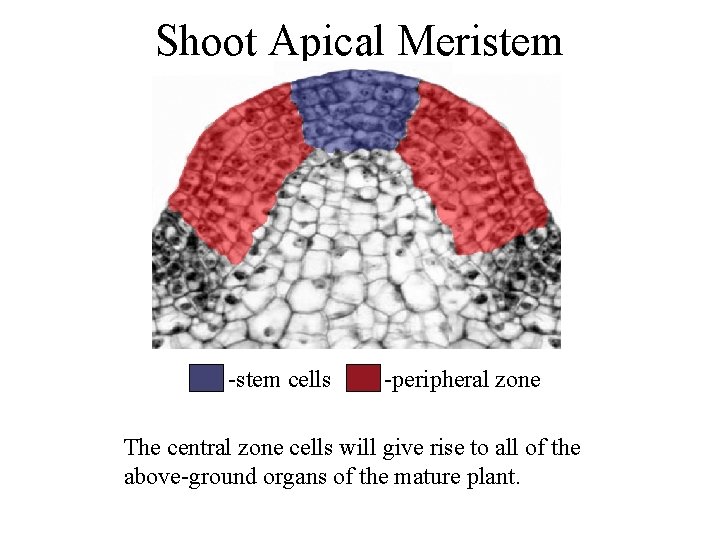
Shoot Apical Meristem -stem cells -peripheral zone The central zone cells will give rise to all of the above-ground organs of the mature plant.
Shoot Apical Meristem -stem cells -peripheral zone How is the stem cell population maintained throughout the life of the plant?
Shoot Apical Meristem -stem cells -peripheral zone A feedback loop between organ initiation (peripheral zone) and the stem cell (central zone) population regulates the size of the meristem.
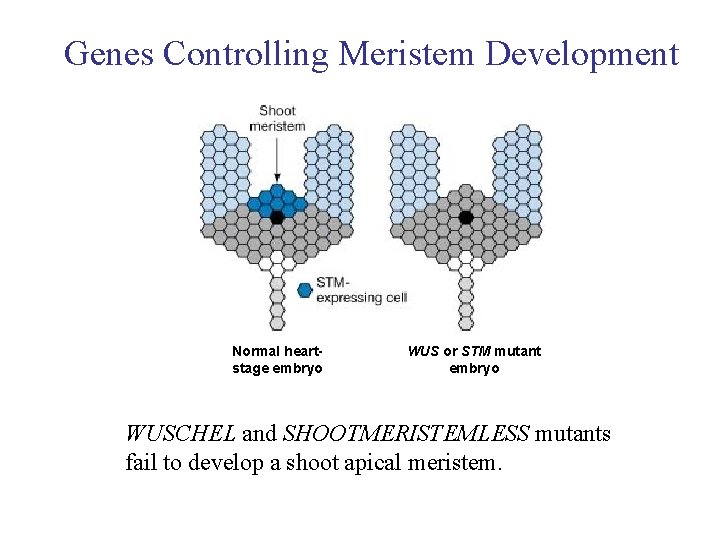
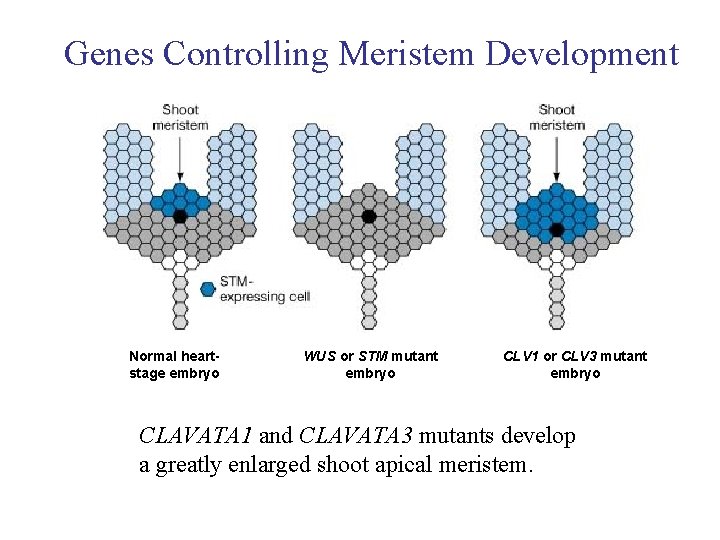
Genes Controlling Meristem Development Normal heartstage embryo WUS or STM mutant embryo WUSCHEL and SHOOTMERISTEMLESS mutants fail to develop a shoot apical meristem.
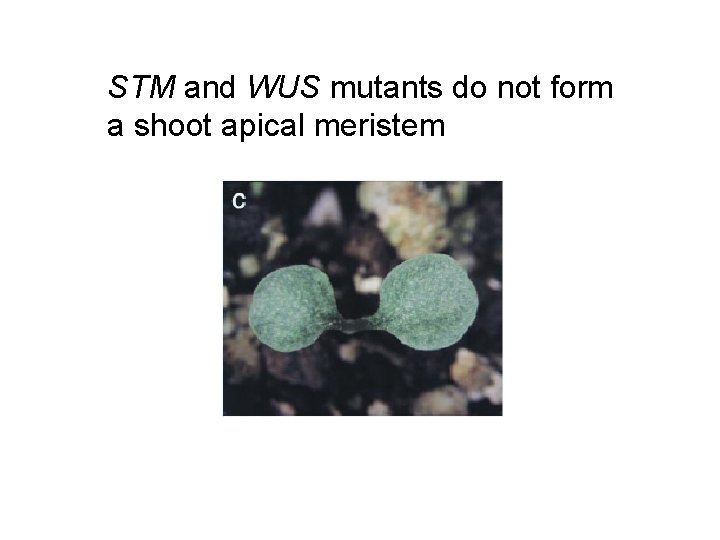
STM and WUS mutants do not form a shoot apical meristem
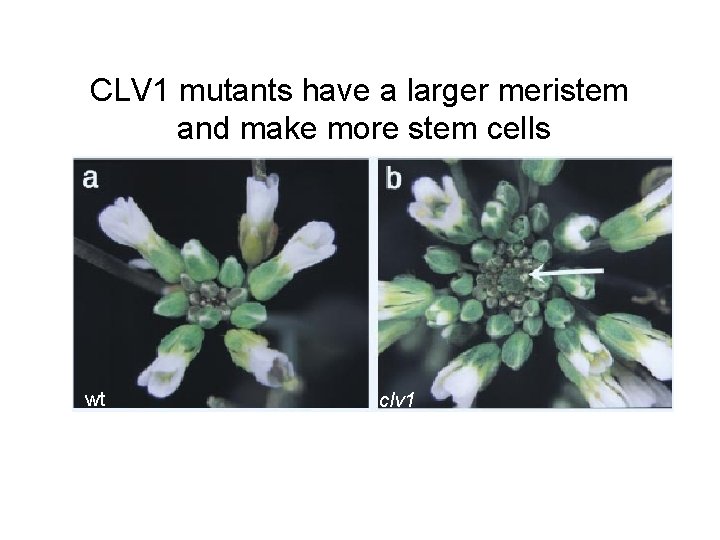
Genes Controlling Meristem Development Normal heartstage embryo WUS or STM mutant embryo CLV 1 or CLV 3 mutant embryo CLAVATA 1 and CLAVATA 3 mutants develop a greatly enlarged shoot apical meristem.
CLV 1 mutants have a larger meristem and make more stem cells wt clv 1
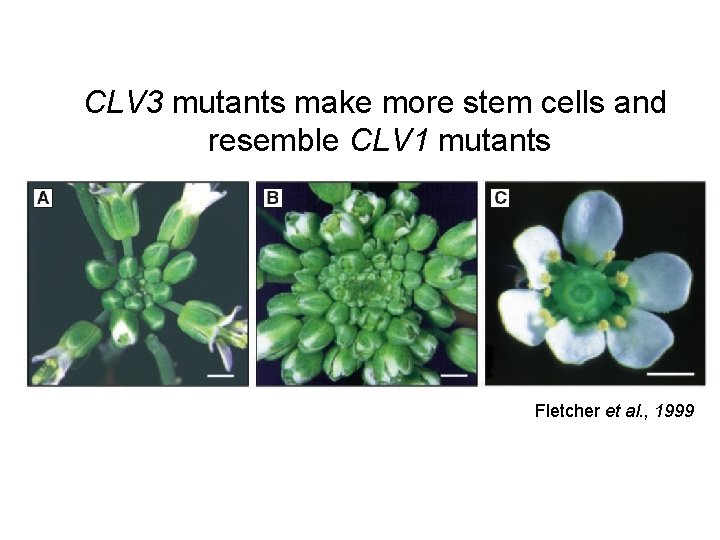
CLV 3 mutants make more stem cells and resemble CLV 1 mutants Fletcher et al. , 1999
Genes Controlling Meristem Development • STM and WUS are required to form and maintain the stem cell population
Genes Controlling Meristem Development • STM and WUS are required to form and maintain the stem cell population • CLV 1 and CLV 3 are required to prevent the overproliferation of the undifferentiated stem cell population
Genes Controlling Meristem Development • STM and WUS are homeobox genes and encode proteins that function as transcription factors
Genes Controlling Meristem Development • STM and WUS are homeobox genes and encode proteins that function as transcription factors • CLV 1 encodes a receptor protein
Genes Controlling Meristem Development • STM and WUS are homeobox genes and encode proteins that function as transcription factors • CLV 1 encodes a receptor protein • CLV 3 encodes a small protein that functions as a signaling molecule that binds to the CLV 1 receptor
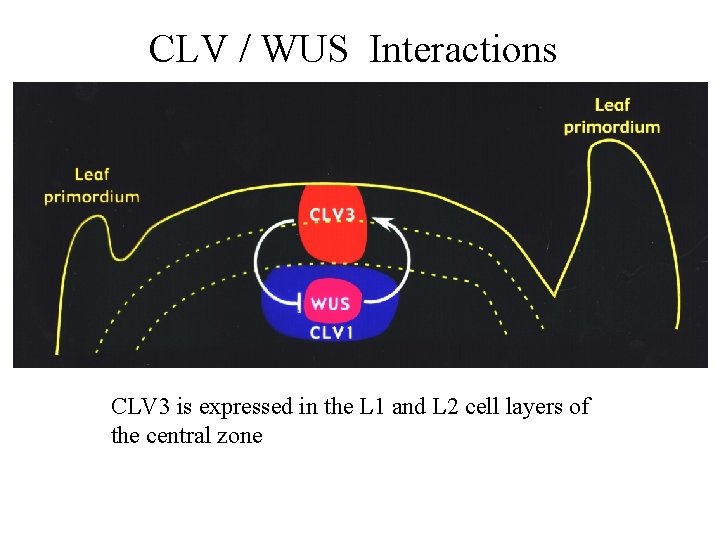
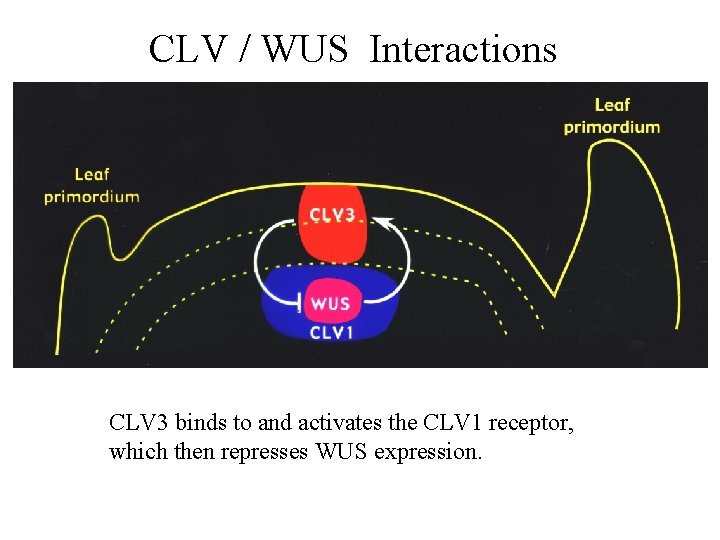
CLV / WUS Interactions CLV 3 is expressed in the L 1 and L 2 cell layers of the central zone
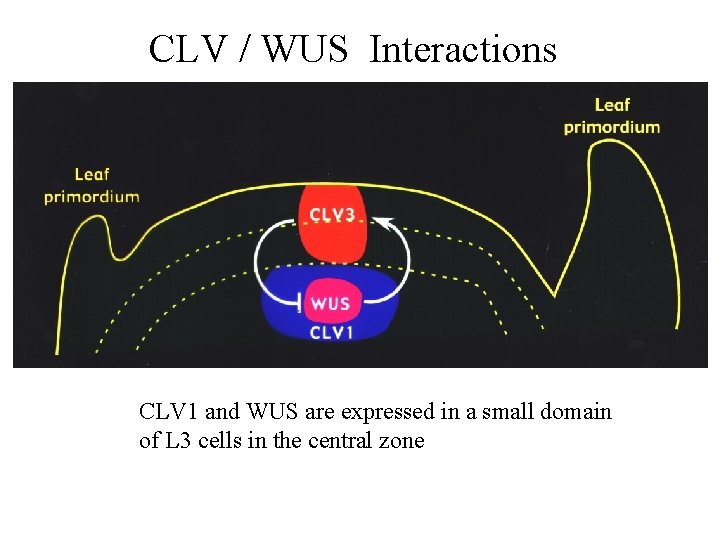
CLV / WUS Interactions CLV 1 and WUS are expressed in a small domain of L 3 cells in the central zone
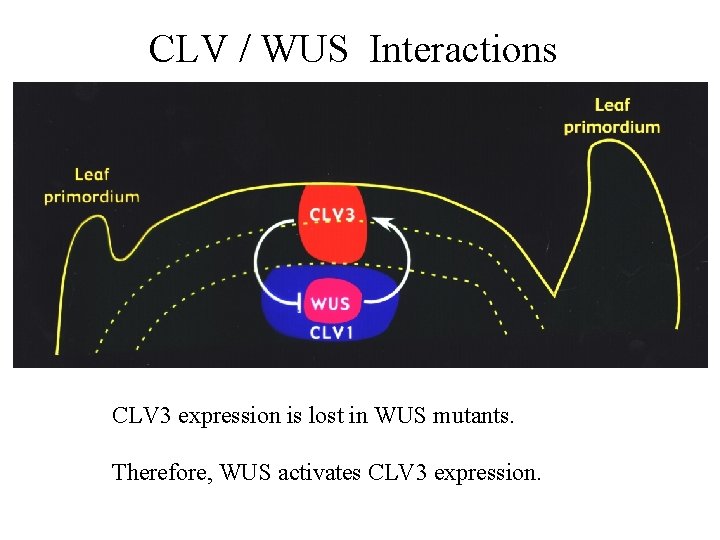
CLV / WUS Interactions CLV 3 expression is lost in WUS mutants. Therefore, WUS activates CLV 3 expression.
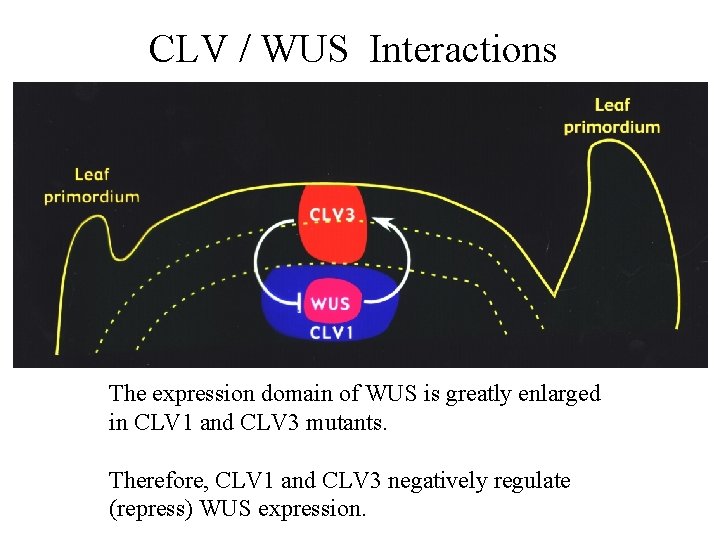
CLV / WUS Interactions The expression domain of WUS is greatly enlarged in CLV 1 and CLV 3 mutants. Therefore, CLV 1 and CLV 3 negatively regulate (repress) WUS expression.
CLV / WUS Interactions CLV 3 binds to and activates the CLV 1 receptor, which then represses WUS expression.
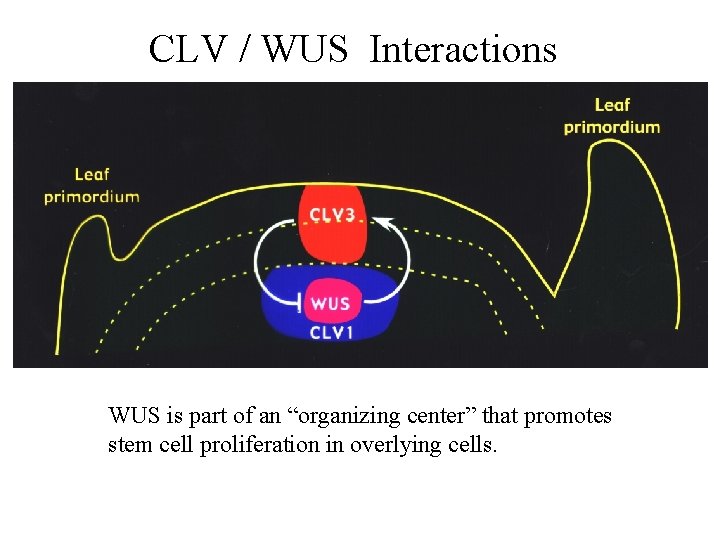
CLV / WUS Interactions WUS is part of an “organizing center” that promotes stem cell proliferation in overlying cells.
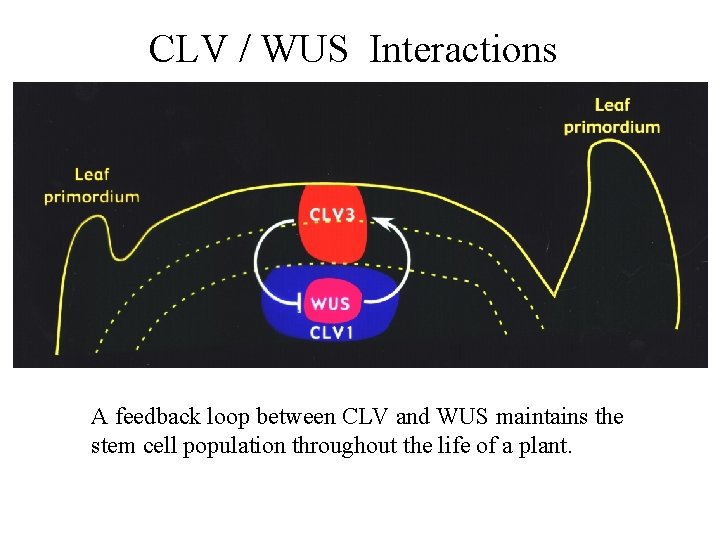
CLV / WUS Interactions A feedback loop between CLV and WUS maintains the stem cell population throughout the life of a plant.
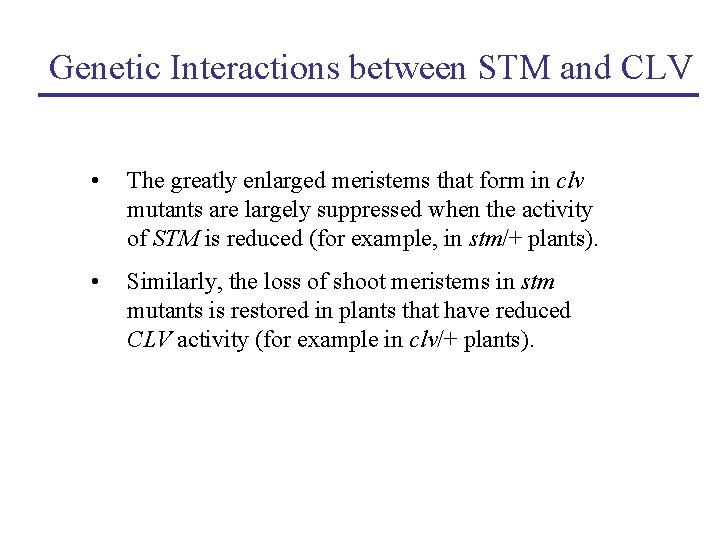
Genetic Interactions between STM and CLV • The greatly enlarged meristems that form in clv mutants are largely suppressed when the activity of STM is reduced (for example, in stm/+ plants).
Genetic Interactions between STM and CLV • The greatly enlarged meristems that form in clv mutants are largely suppressed when the activity of STM is reduced (for example, in stm/+ plants). • Similarly, the loss of shoot meristems in stm mutants is restored in plants that have reduced CLV activity (for example in clv/+ plants).
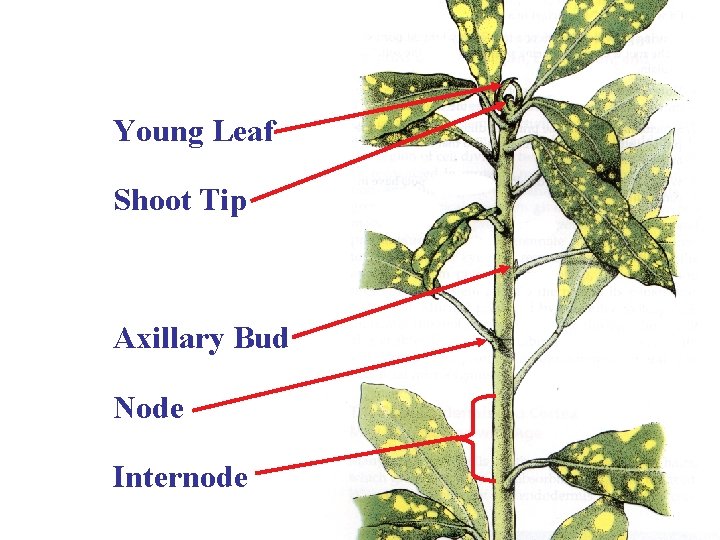
Young Leaf Shoot Tip Axillary Bud Node Internode
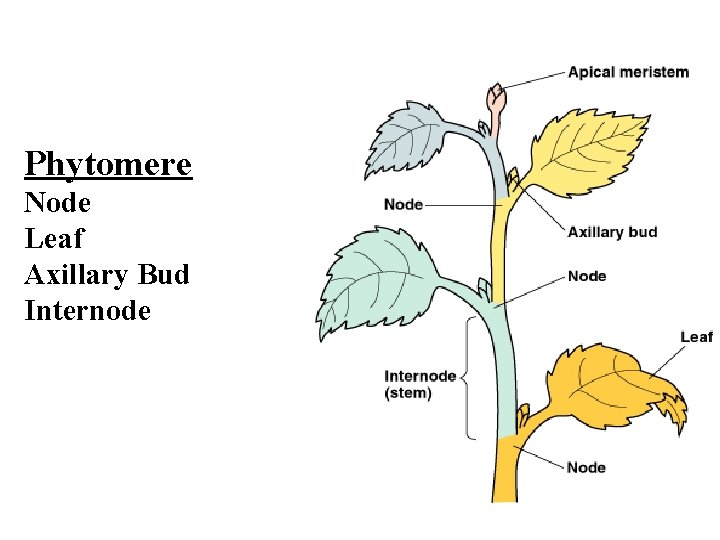
Phytomere Node Leaf Axillary Bud Internode
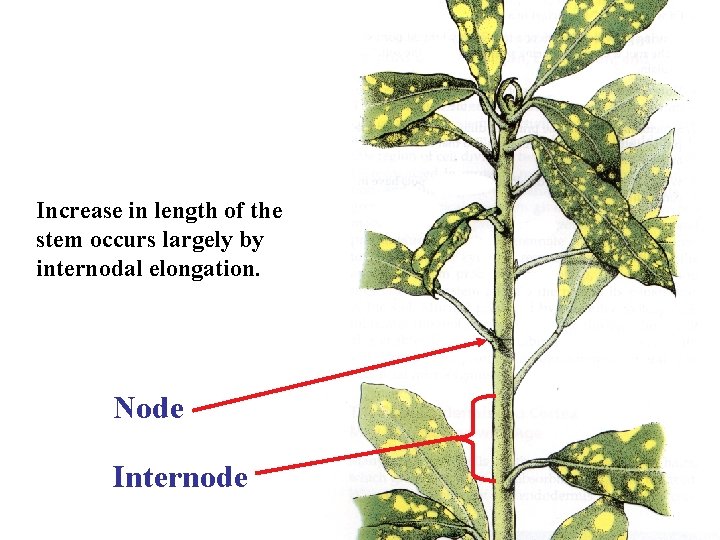
Increase in length of the stem occurs largely by internodal elongation. Node Internode
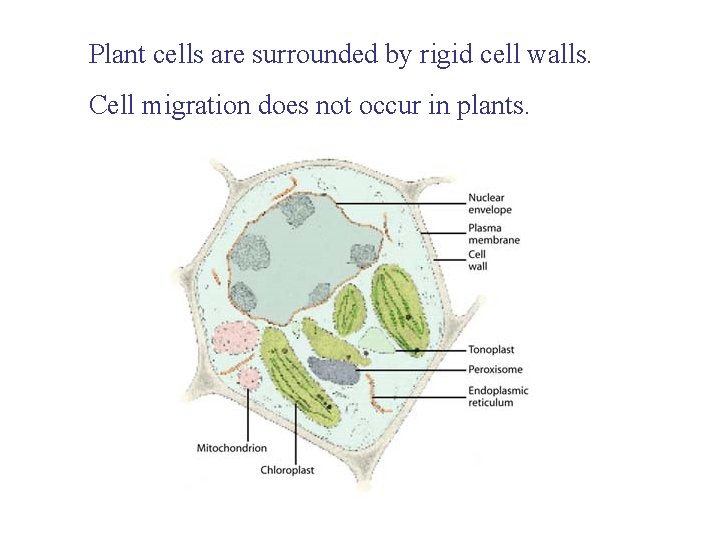
Plant cells are surrounded by rigid cell walls. Cell migration does not occur in plants.
Fertilization
Figure 38. 10 The development of a dicot plant embryo
A successful fertilization will produce a fertilized egg with 2 X DNA.