
Cell Division Meiosis Pink notes are my comments
- Slides: 31
Cell Division - Meiosis Pink notes are my comments I would make in lecture
I. Who Does Meiosis and Why? A. Who: All Multicellular Eukaryotes Animals, Plants, Fungi, some algae(protists) good for things different kingdoms have in common FRQ or for differences between domains FRQ since Bacteria and Archaea do NOT do meiosis B. Why: Meiosis is needed for sexual reproduction C. Why do Sexual Reproduction ? 1. It allows genetic recombination (increased genetic variation) 2. New combinations of genes may. . a. better suit environments b. allow offspring to survive radical environmental change c. allow offspring to survive a disease outbreak
II. Vocab A. Cells produced by meiosis = Gametes (1 n) B. Sex Chromosomes = determine sex (in humans XX = female, Xy = male) C. Autosomes = any chromosome not used to determine sex of offspring
. D. Gametes = haploid (1 n)cells made by meiosis E. Haploid cells have 1 of each pair of chromosomes…. . (1 of each kind) 1. called 1 n cells 2. mathematical representation 3. n = number of different C types
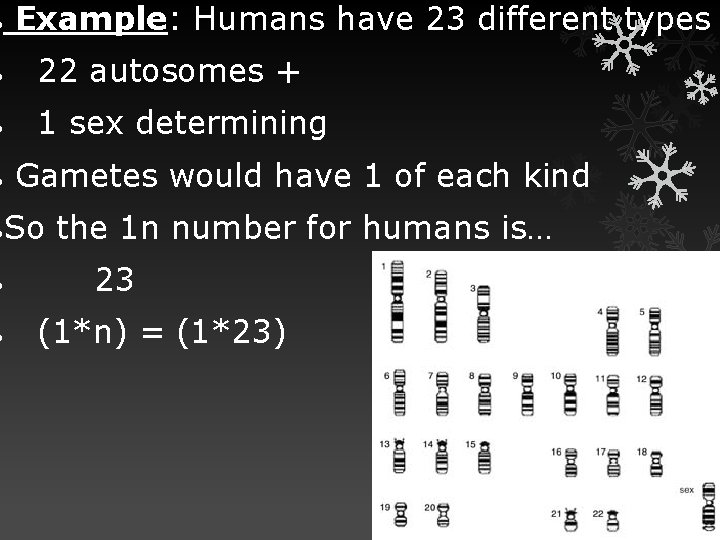
Example: Humans have 23 different types 22 autosomes + 1 sex determining Gametes would have 1 of each kind So the 1 n number for humans is… 23 (1*n) = (1*23)
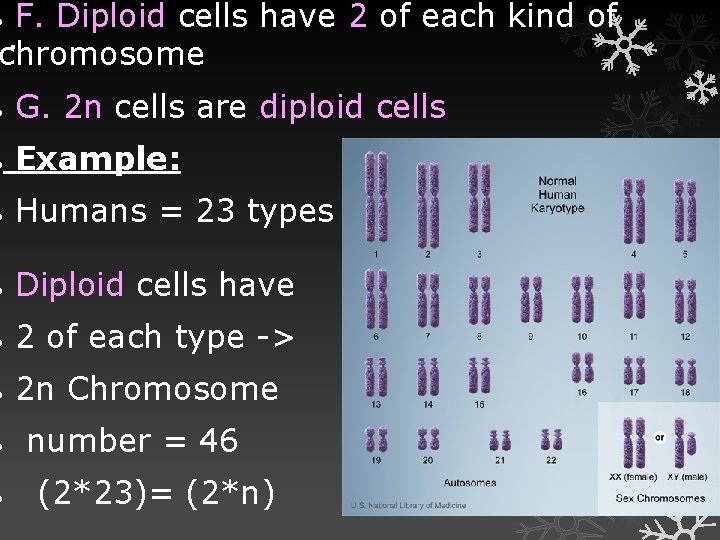
F. Diploid cells have 2 of each kind of. chromosome G. 2 n cells are diploid cells Example: Humans = 23 types Diploid cells have 2 of each type -> 2 n Chromosome number = 46 (2*23)= (2*n)
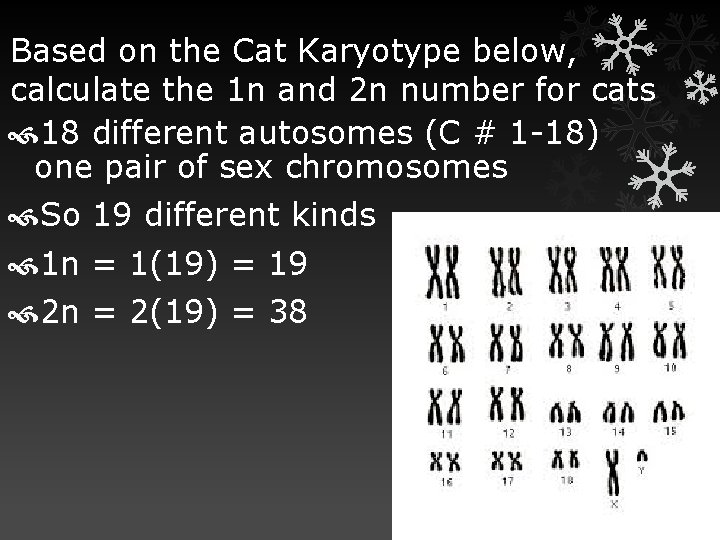
Based on the Cat Karyotype below, calculate the 1 n and 2 n number for cats 18 different autosomes (C # 1 -18) one pair of sex chromosomes So 19 different kinds 1 n = 1(19) = 19 2 n = 2(19) = 38
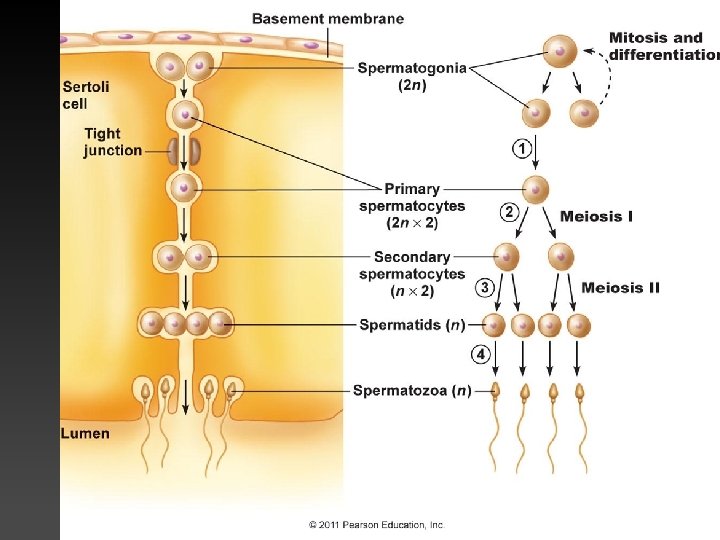
III. How/Where Haploid Cells are produced A. Where: Animals: Meiosis only in gonads 1. Gonads = reproductive organs a. testis b. ovary 2. Only Specialized cells in gonad do meiosis a. spermatocytes Cyte = cell b. oocytes oo = egg 3. Spermatocytes and oocytes are constantly replaced by specialized Spermatogonia cells & oogonia cells these spermatocytes and oocytes are the stem cells we called generative cells or germ cells in previous power points
Look back at the previous picture. The lumen is the hollow center of a little tube in the testis where mature sperm are collected and sent to a storage space. The big orange sertoli cells line the walls of this tube. The spermatogoia cells are wedged between two sertoli cells at the outer edge of the tubule. Spermatogonia are stem cells (generative cells) that are constantly doing mitosis. Each time they do mitosis one of the daughter cells stays in place and the other daughter cell migrates deeper into the wall of the tube. Note the tight junction? That keeps everything other than the daughter cells from entering the lumen Once past the tight junction the daughter cell is considered a primary spermatocyte because it will then begin meiosis I As meiosis proceeds the cells continue to migrate toward the lumen. By the time they reach the lume nthey are fully differentiated sperm
IV. Spermatogenesis A. Spermatogonia cells do Mitosis to make 2 daughter cells 1. one daughter cell becomes a 1◦ spermatocyte as it migrates toward the lumen 2. the other daughter cell stays in place as a spermatogonia B. The 1◦ spermatocyte does meiosis to make 4 spermatids
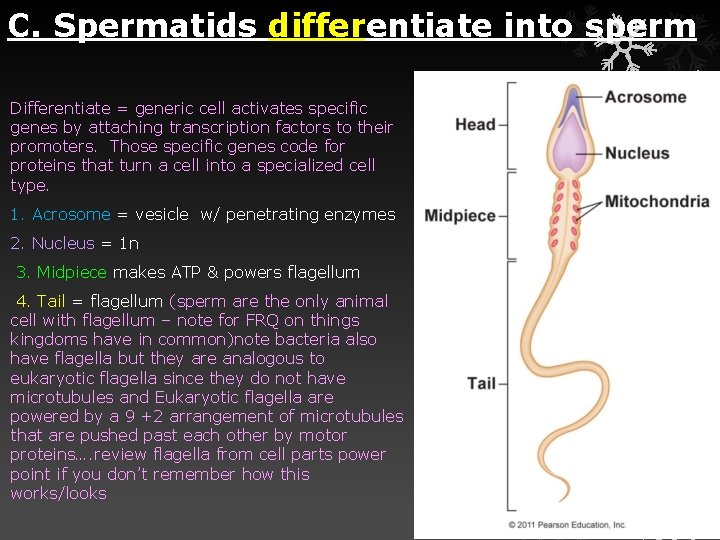
C. Spermatids differentiate into sperm Differentiate = generic cell activates specific genes by attaching transcription factors to their promoters. Those specific genes code for proteins that turn a cell into a specialized cell type. 1. Acrosome = vesicle w/ penetrating enzymes 2. Nucleus = 1 n 3. Midpiece makes ATP & powers flagellum 4. Tail = flagellum (sperm are the only animal cell with flagellum – note for FRQ on things kingdoms have in common)note bacteria also have flagella but they are analogous to eukaryotic flagella since they do not have microtubules and Eukaryotic flagella are powered by a 9 +2 arrangement of microtubules that are pushed past each other by motor proteins…. review flagella from cell parts power point if you don’t remember how this works/looks
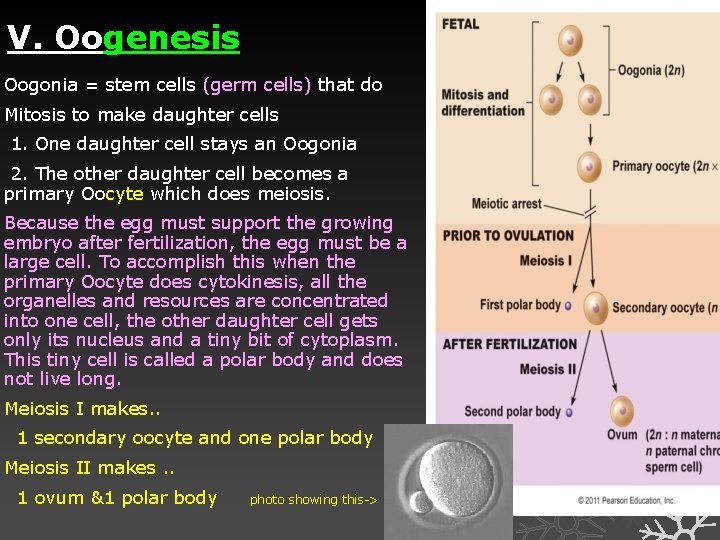
V. Oogenesis Oogonia = stem cells (germ cells) that do Mitosis to make daughter cells 1. One daughter cell stays an Oogonia 2. The other daughter cell becomes a primary Oocyte which does meiosis. Because the egg must support the growing embryo after fertilization, the egg must be a large cell. To accomplish this when the primary Oocyte does cytokinesis, all the organelles and resources are concentrated into one cell, the other daughter cell gets only its nucleus and a tiny bit of cytoplasm. This tiny cell is called a polar body and does not live long. Meiosis I makes. . 1 secondary oocyte and one polar body Meiosis II makes. . 1 ovum &1 polar body photo showing this->
Homologous Chromosomes are same C type same length code for same genes (but can be different versions) Unless they are X and y which are the only pair of Homologues that do not look alike
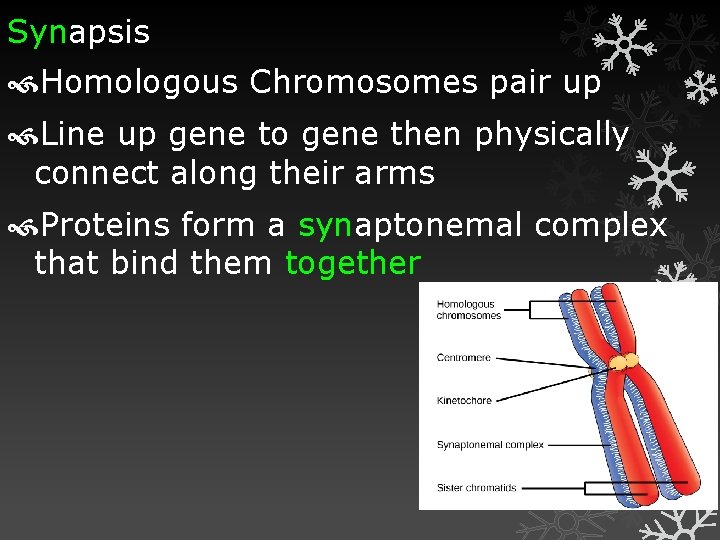
Synapsis Homologous Chromosomes pair up Line up gene to gene then physically connect along their arms Proteins form a synaptonemal complex that bind them together
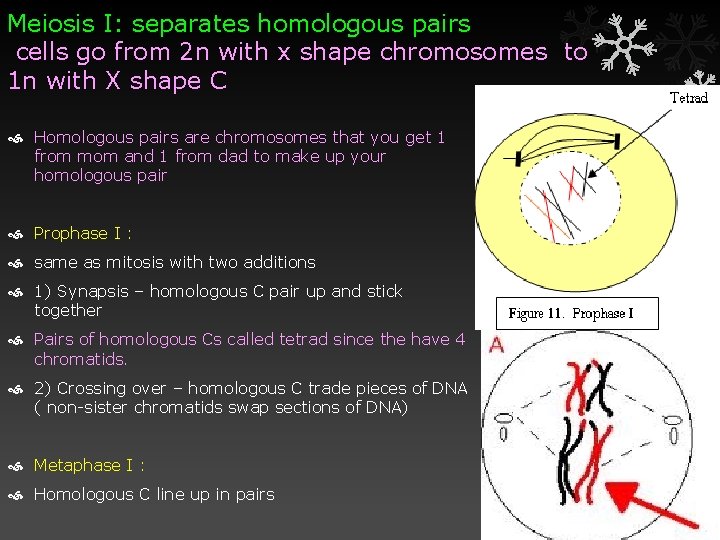
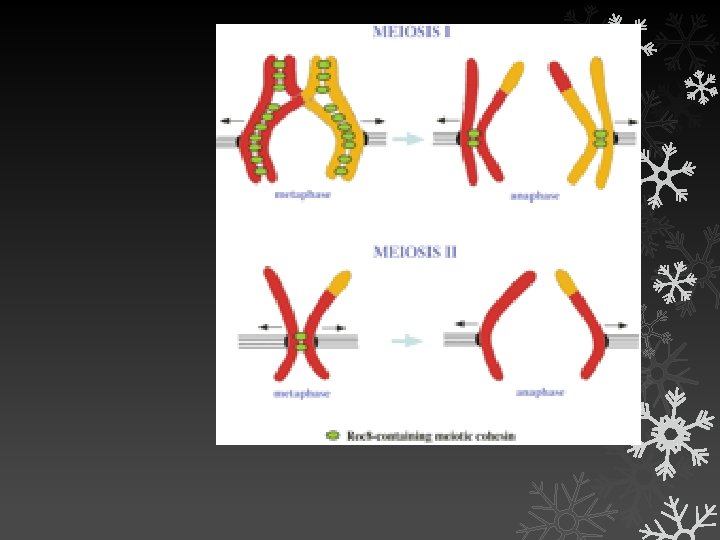
Meiosis I: separates homologous pairs cells go from 2 n with x shape chromosomes to 1 n with X shape C Homologous pairs are chromosomes that you get 1 from mom and 1 from dad to make up your homologous pair Prophase I : same as mitosis with two additions 1) Synapsis – homologous C pair up and stick together Pairs of homologous Cs called tetrad since the have 4 chromatids. 2) Crossing over – homologous C trade pieces of DNA ( non-sister chromatids swap sections of DNA) Metaphase I : Homologous C line up in pairs
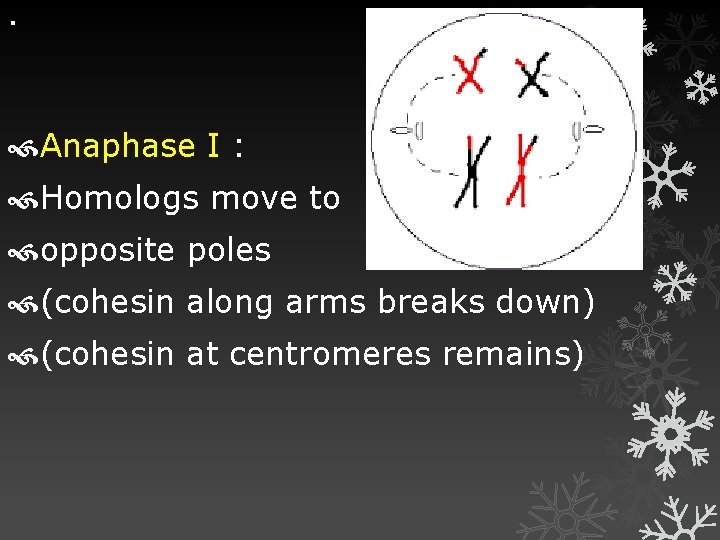
. Anaphase I : Homologs move to opposite poles (cohesin along arms breaks down) (cohesin at centromeres remains)
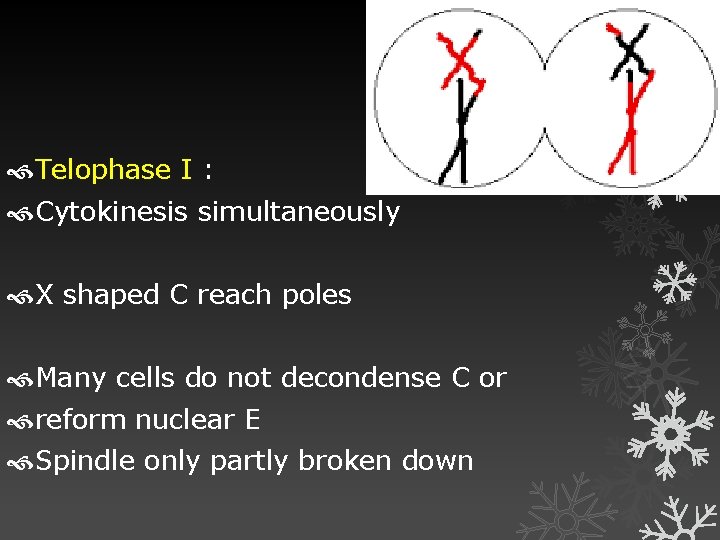
Telophase I : Cytokinesis simultaneously X shaped C reach poles Many cells do not decondense C or reform nuclear E Spindle only partly broken down
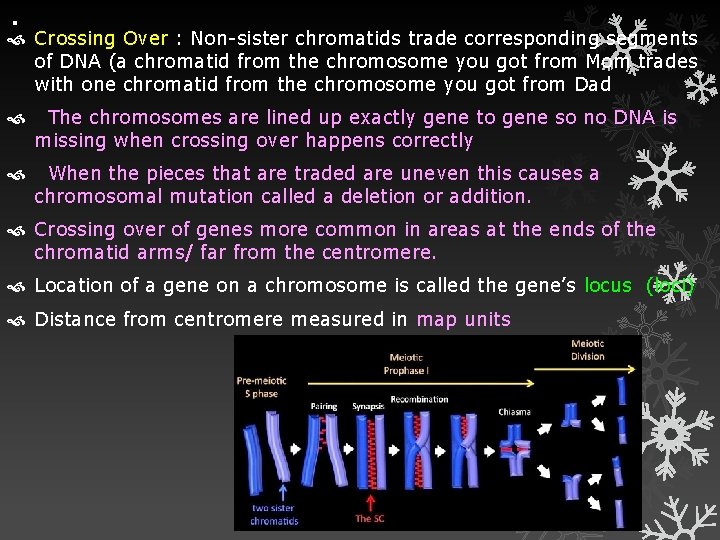
. Crossing Over : Non-sister chromatids trade corresponding segments of DNA (a chromatid from the chromosome you got from Mom trades with one chromatid from the chromosome you got from Dad The chromosomes are lined up exactly gene to gene so no DNA is missing when crossing over happens correctly When the pieces that are traded are uneven this causes a chromosomal mutation called a deletion or addition. Crossing over of genes more common in areas at the ends of the chromatid arms/ far from the centromere. Location of a gene on a chromosome is called the gene’s locus (loci) Distance from centromere measured in map units
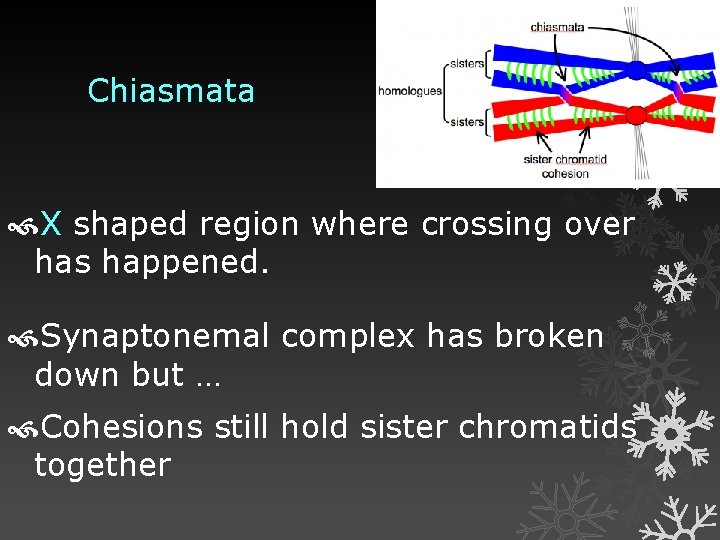
Chiasmata X shaped region where crossing over has happened. Synaptonemal complex has broken down but … Cohesions still hold sister chromatids together
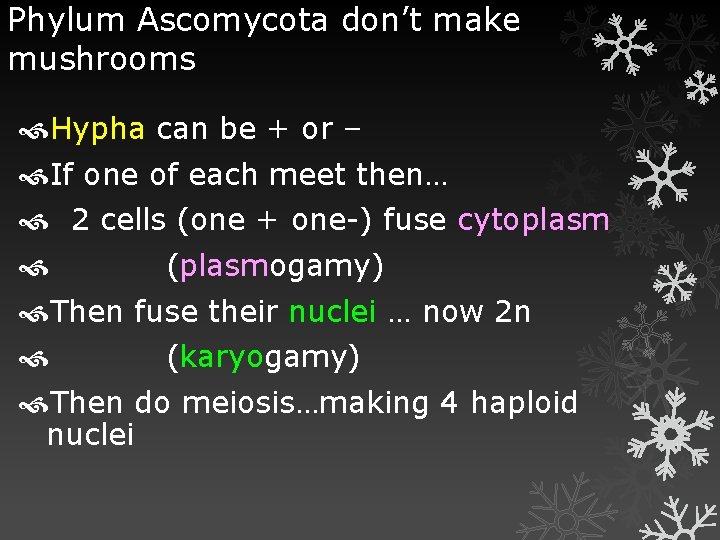
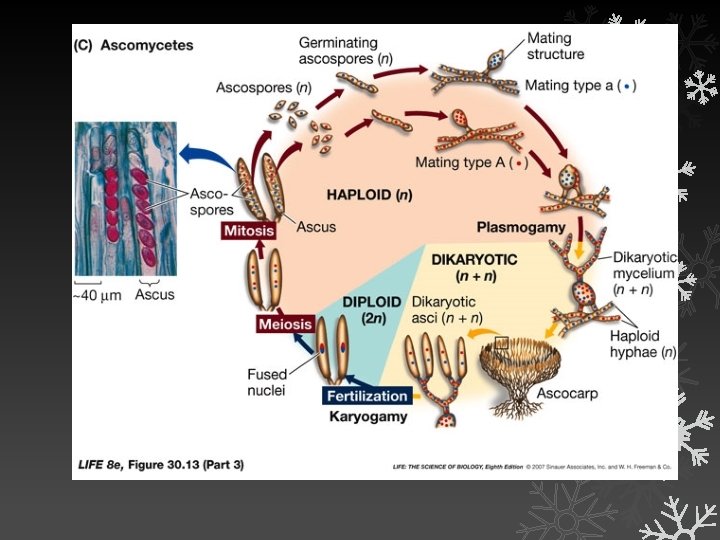
Phylum Ascomycota don’t make mushrooms Hypha can be + or – If one of each meet then… 2 cells (one + one-) fuse cytoplasm (plasmogamy) Then fuse their nuclei … now 2 n (karyogamy) Then do meiosis…making 4 haploid nuclei
Fungus INFO not required this year We will do a lab using fungus spores to measure map units determined by rate of crossing over. Just read over the fungus slides but don’t need to copy down or memorize them ; )
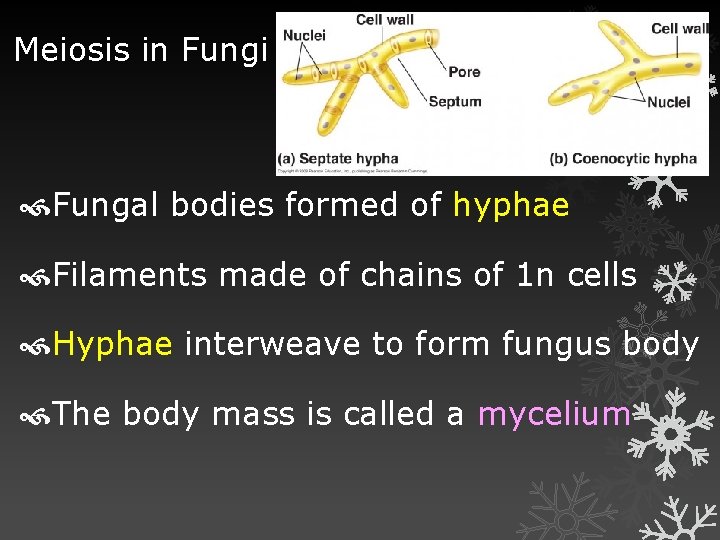
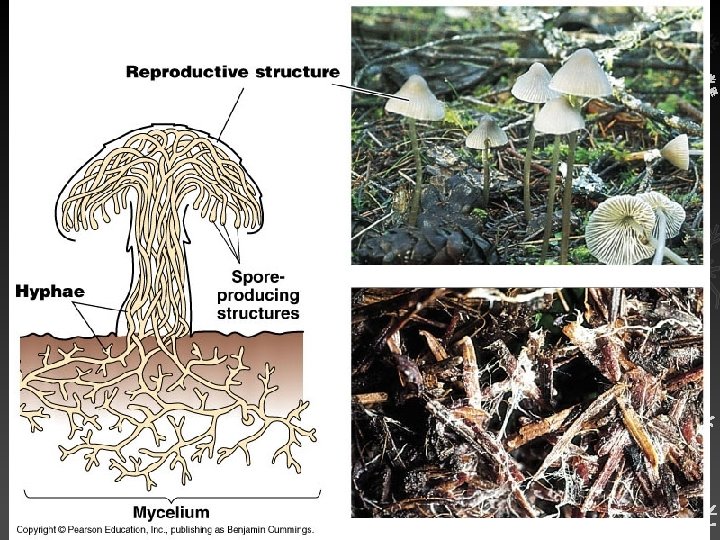
Meiosis in Fungi Fungal bodies formed of hyphae Filaments made of chains of 1 n cells Hyphae interweave to form fungus body The body mass is called a mycelium
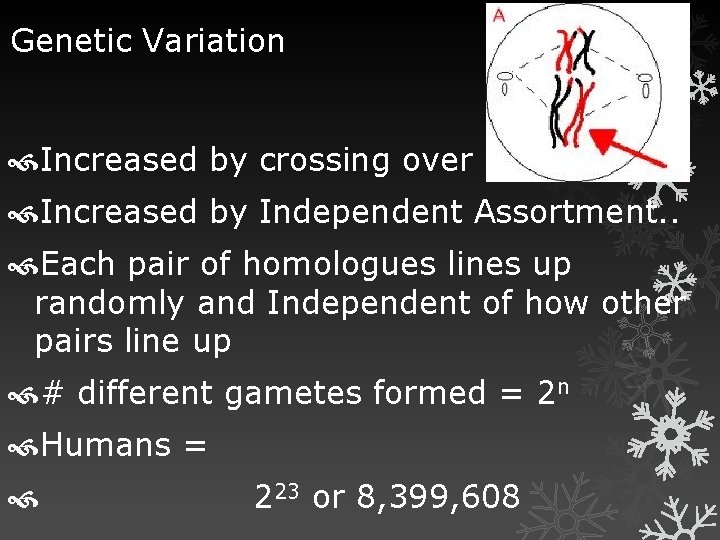
Genetic Variation Increased by crossing over Increased by Independent Assortment. . Each pair of homologues lines up randomly and Independent of how other pairs line up # different gametes formed = 2 n Humans = 223 or 8, 399, 608
. Each 1 n nucleus does mitosis So now 8 nuclei in the cell Each nucleus grows a tough casing around it and becomes a Spore (ascospore) Spores disperse on wind Germinate to make new 1 n hyphae
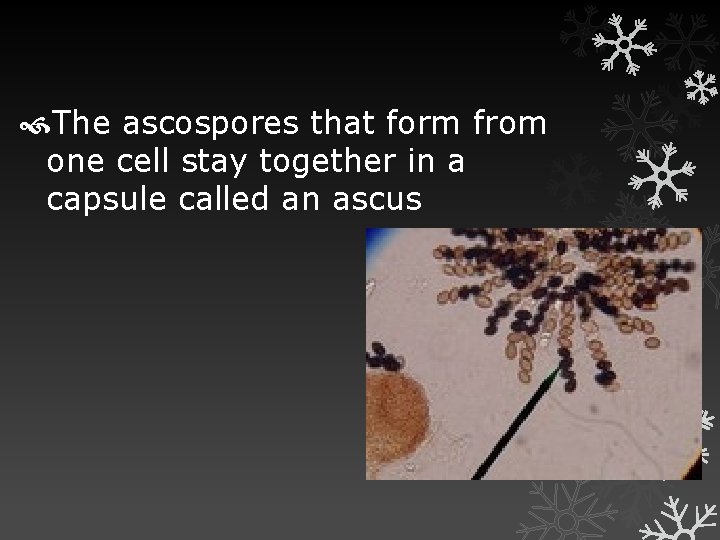
The ascospores that form from one cell stay together in a capsule called an ascus
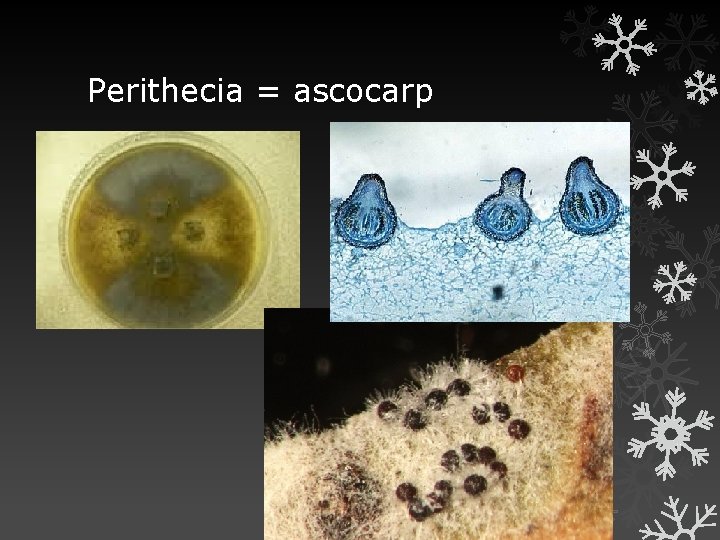
Perithecia = ascocarp
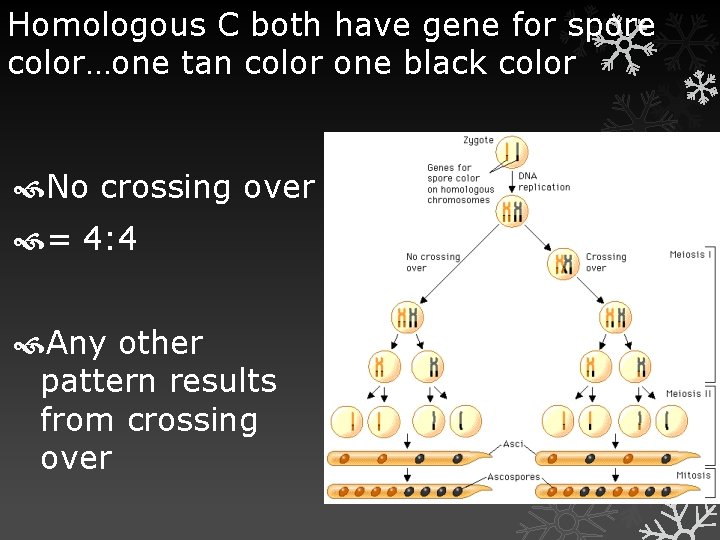
Homologous C both have gene for spore color…one tan color one black color No crossing over = 4: 4 Any other pattern results from crossing over