
Cell division Chapter 10 Genes and Development Fig
- Slides: 44
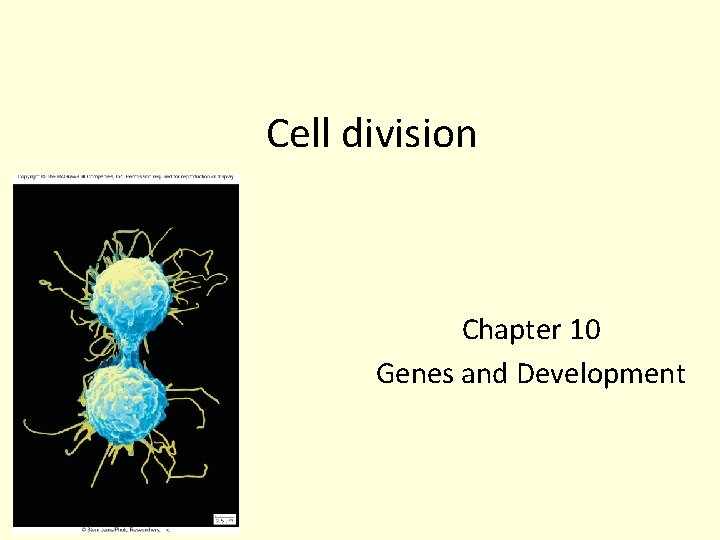
Cell division Chapter 10 Genes and Development
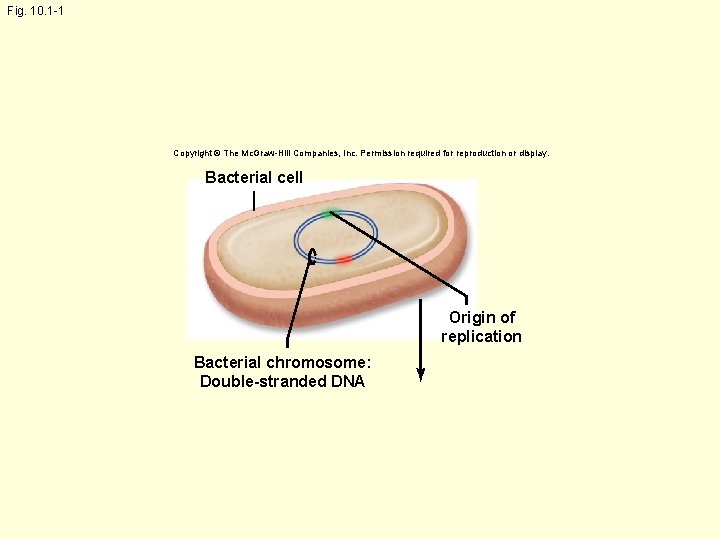
Fig. 10. 1 -1 Copyright © The Mc. Graw-Hill Companies, Inc. Permission required for reproduction or display. Bacterial cell Origin of replication Bacterial chromosome: Double-stranded DNA
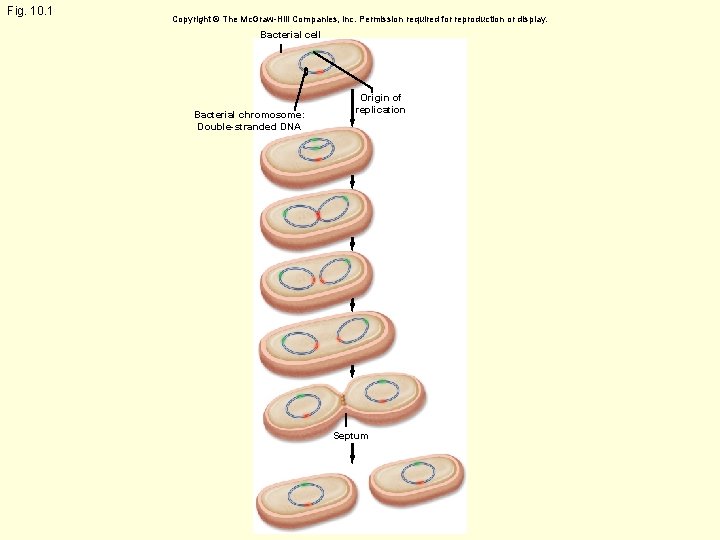
Fig. 10. 1 Copyright © The Mc. Graw-Hill Companies, Inc. Permission required for reproduction or display. Bacterial cell Bacterial chromosome: Double-stranded DNA Origin of replication Septum
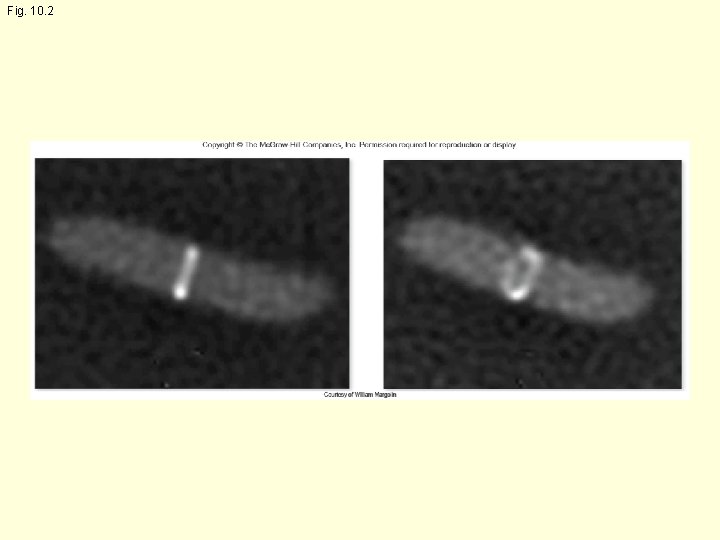
Fig. 10. 2
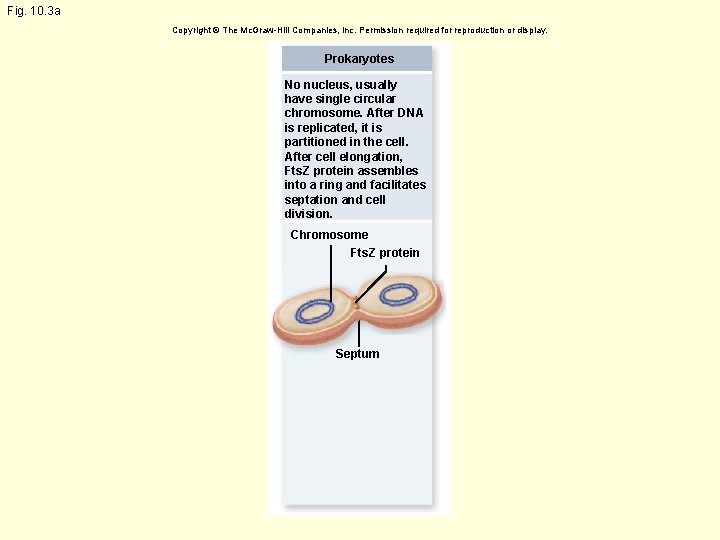
Fig. 10. 3 a Copyright © The Mc. Graw-Hill Companies, Inc. Permission required for reproduction or display. Prokaryotes No nucleus, usually have single circular chromosome. After DNA is replicated, it is partitioned in the cell. After cell elongation, Fts. Z protein assembles into a ring and facilitates septation and cell division. Chromosome Fts. Z protein Septum
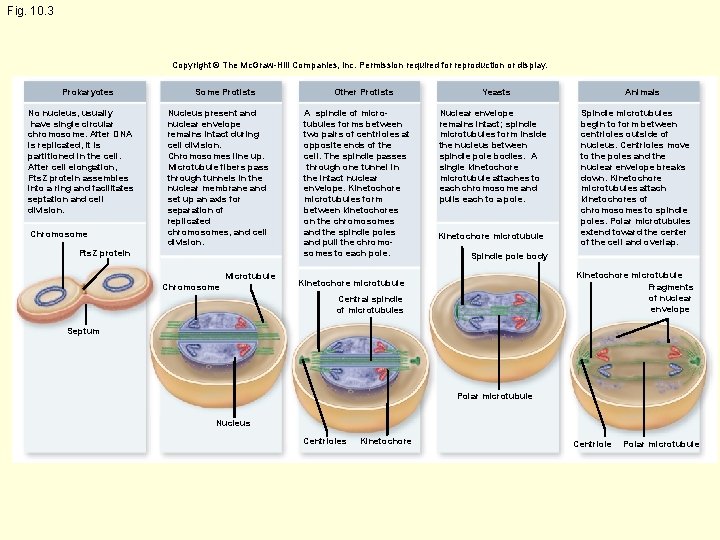
Fig. 10. 3 Copyright © The Mc. Graw-Hill Companies, Inc. Permission required for reproduction or display. Prokaryotes No nucleus, usually have single circular chromosome. After DNA is replicated, it is partitioned in the cell. After cell elongation, Fts. Z protein assembles into a ring and facilitates septation and cell division. Chromosome Some Protists Nucleus present and nuclear envelope remains intact during cell division. Chromosomes line up. Microtubule fibers pass through tunnels in the nuclear membrane and set up an axis for separation of replicated chromosomes, and cell division. Fts. Z protein Microtubule Chromosome Other Protists A spindle of microtubules forms between two pairs of centrioles at opposite ends of the cell. The spindle passes through one tunnel in the intact nuclear envelope. Kinetochore microtubules form between kinetochores on the chromosomes and the spindle poles and pull the chromosomes to each pole. Yeasts Nuclear envelope remains intact; spindle microtubules form inside the nucleus between spindle pole bodies. A single kinetochore microtubule attaches to each chromosome and pulls each to a pole. Kinetochore microtubule Animals Spindle microtubules begin to form between centrioles outside of nucleus. Centrioles move to the poles and the nuclear envelope breaks down. Kinetochore microtubules attach kinetochores of chromosomes to spindle poles. Polar microtubules extend toward the center of the cell and overlap. Spindle pole body Kinetochore microtubule Fragments of nuclear envelope Kinetochore microtubule Central spindle of microtubules Septum Polar microtubule Nucleus Centrioles Kinetochore Centriole Polar microtubule
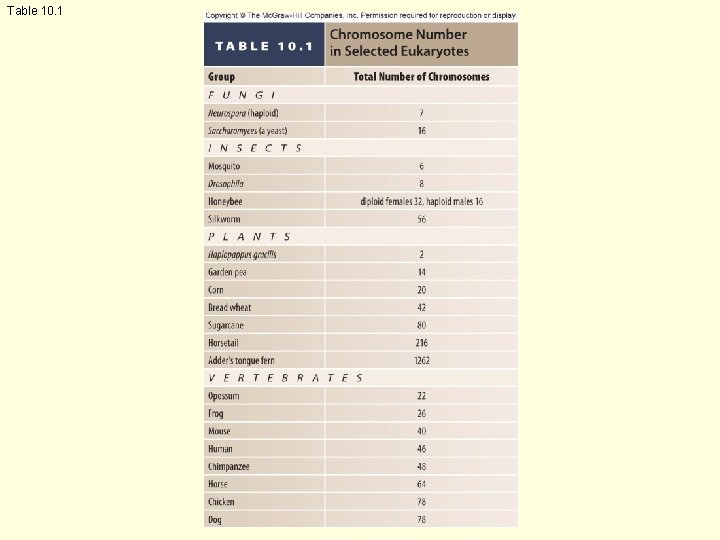
Table 10. 1
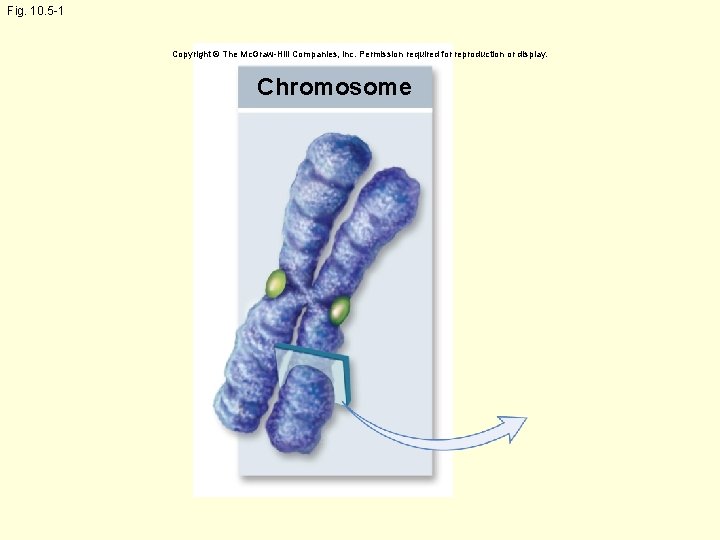
Fig. 10. 5 -1 Copyright © The Mc. Graw-Hill Companies, Inc. Permission required for reproduction or display. Chromosome
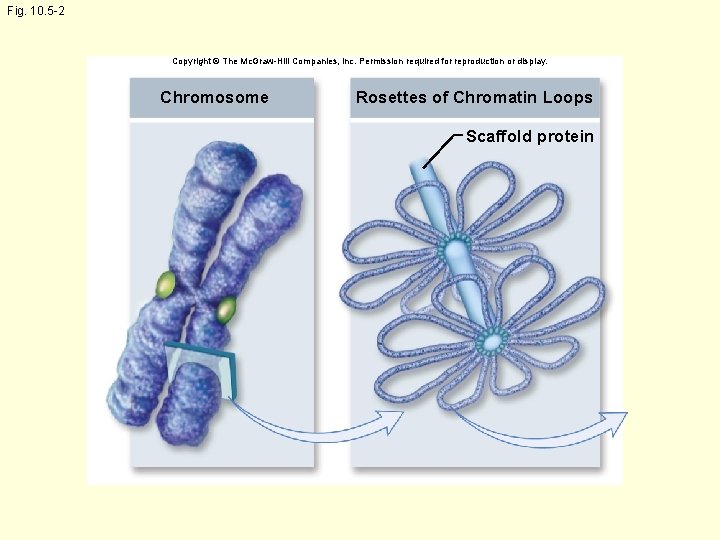
Fig. 10. 5 -2 Copyright © The Mc. Graw-Hill Companies, Inc. Permission required for reproduction or display. Chromosome Rosettes of Chromatin Loops Scaffold protein
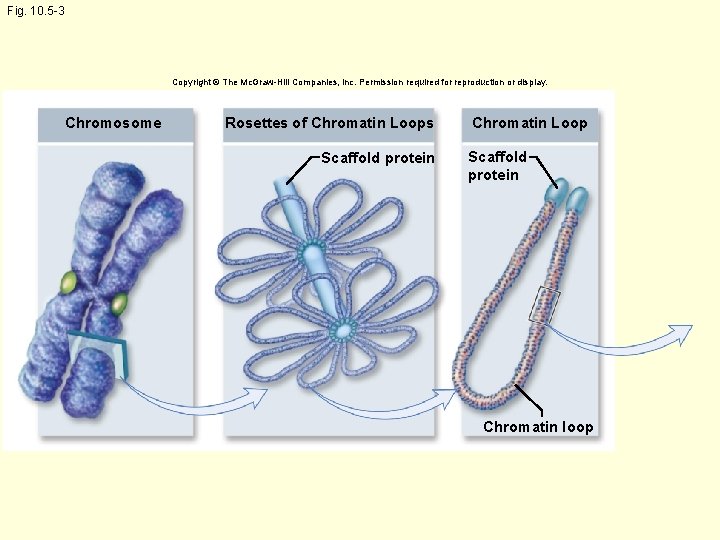
Fig. 10. 5 -3 Copyright © The Mc. Graw-Hill Companies, Inc. Permission required for reproduction or display. Chromosome Rosettes of Chromatin Loops Scaffold protein Chromatin Loop Scaffold protein Chromatin loop
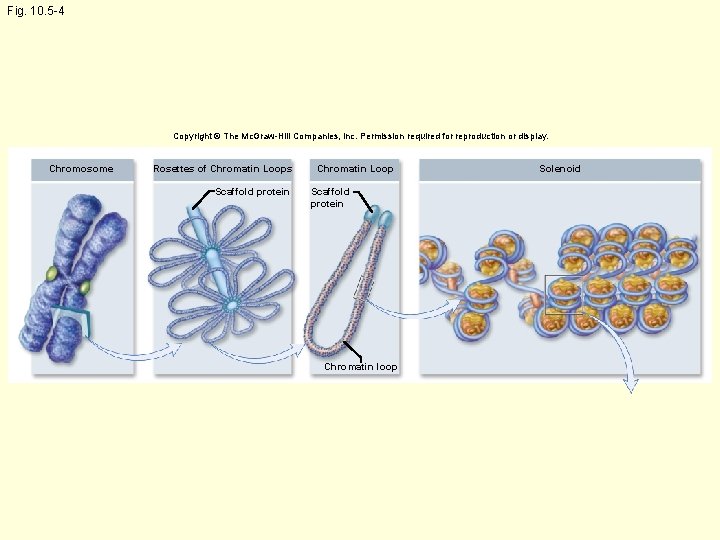
Fig. 10. 5 -4 Copyright © The Mc. Graw-Hill Companies, Inc. Permission required for reproduction or display. Chromosome Rosettes of Chromatin Loops Scaffold protein Chromatin Loop Scaffold protein Chromatin loop Solenoid
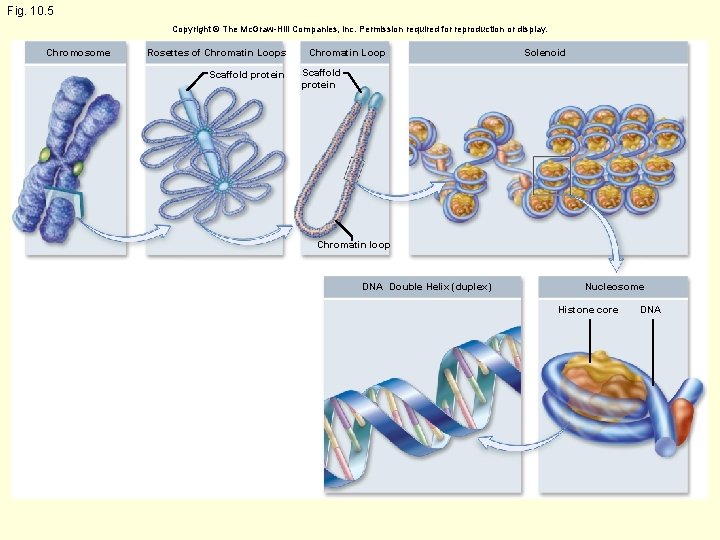
Fig. 10. 5 Copyright © The Mc. Graw-Hill Companies, Inc. Permission required for reproduction or display. Chromosome Rosettes of Chromatin Loops Scaffold protein Chromatin Loop Solenoid Scaffold protein Chromatin loop DNA Double Helix (duplex) Nucleosome Histone core DNA
Animation of DNA coiling and cells dividing
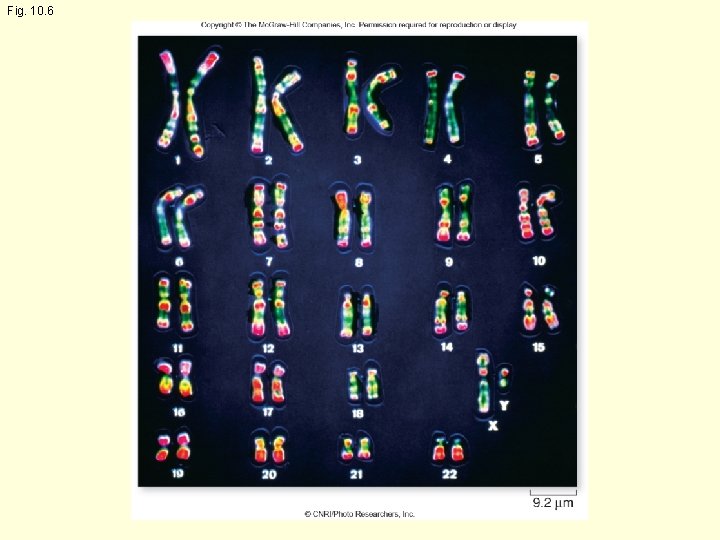
Fig. 10. 6
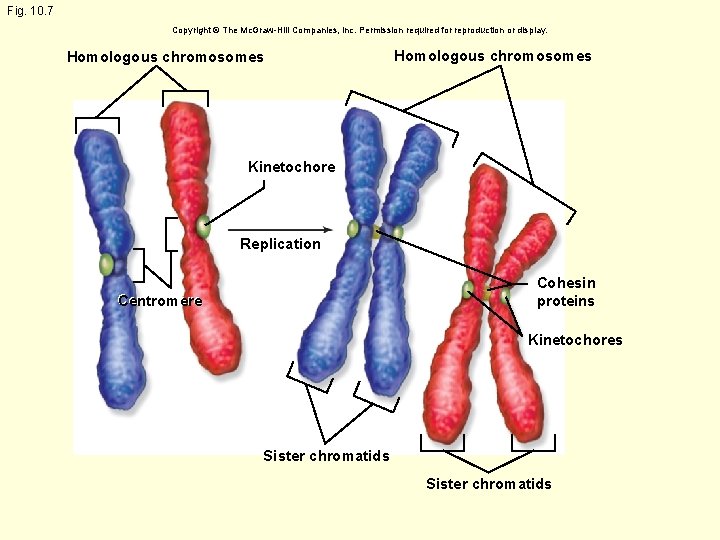
Fig. 10. 7 Copyright © The Mc. Graw-Hill Companies, Inc. Permission required for reproduction or display. Homologous chromosomes Kinetochore Replication Cohesin proteins Centromere Kinetochores Sister chromatids
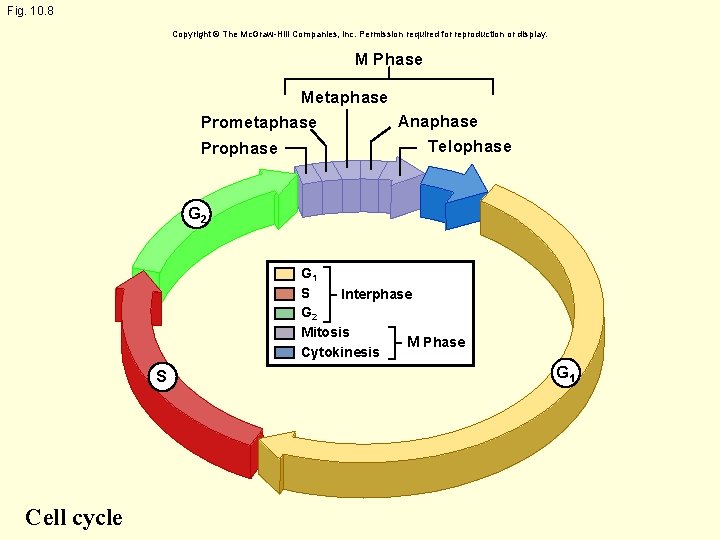
Fig. 10. 8 Copyright © The Mc. Graw-Hill Companies, Inc. Permission required for reproduction or display. M Phase Metaphase Anaphase Prometaphase Telophase Prophase G 2 G 1 S Interphase G 2 Mitosis M Phase Cytokinesis S Cell cycle G 1
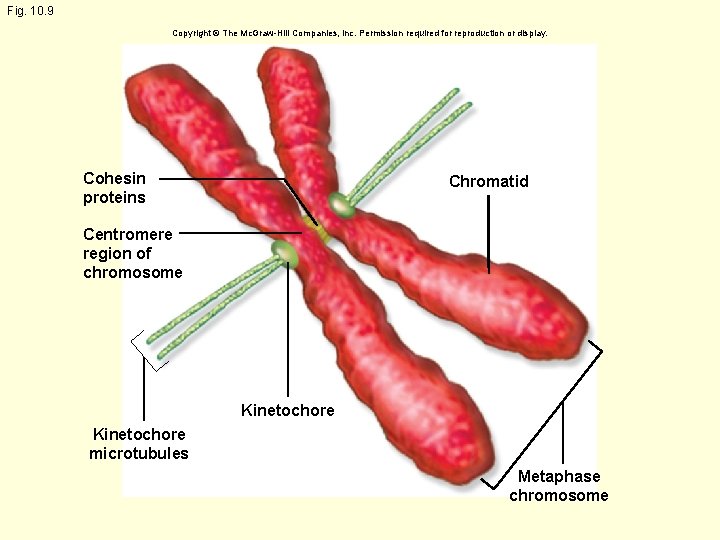
Fig. 10. 9 Copyright © The Mc. Graw-Hill Companies, Inc. Permission required for reproduction or display. Cohesin proteins Chromatid Centromere region of chromosome Kinetochore microtubules Metaphase chromosome
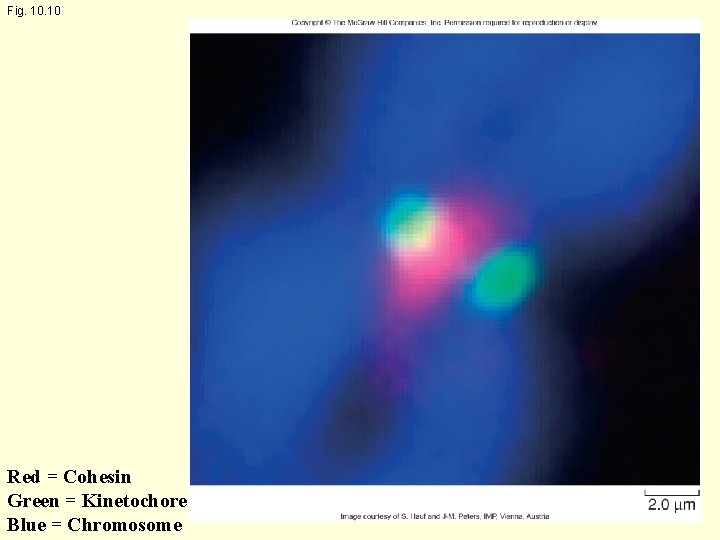
Fig. 10 Red = Cohesin Green = Kinetochore Blue = Chromosome
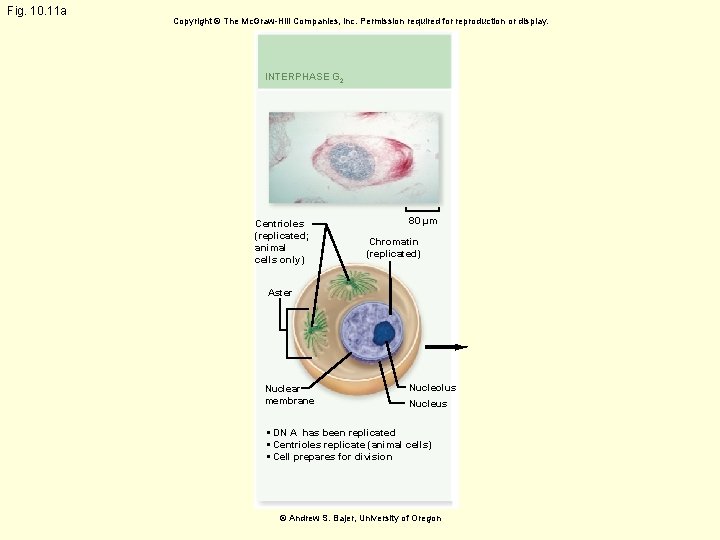
Fig. 10. 11 a Copyright © The Mc. Graw-Hill Companies, Inc. Permission required for reproduction or display. INTERPHASE G 2 Centrioles (replicated; animal cells only) 80 µm Chromatin (replicated) Aster Nuclear membrane Nucleolus Nucleus • DN A has been replicated • Centrioles replicate (animal cells) • Cell prepares for division © Andrew S. Bajer, University of Oregon
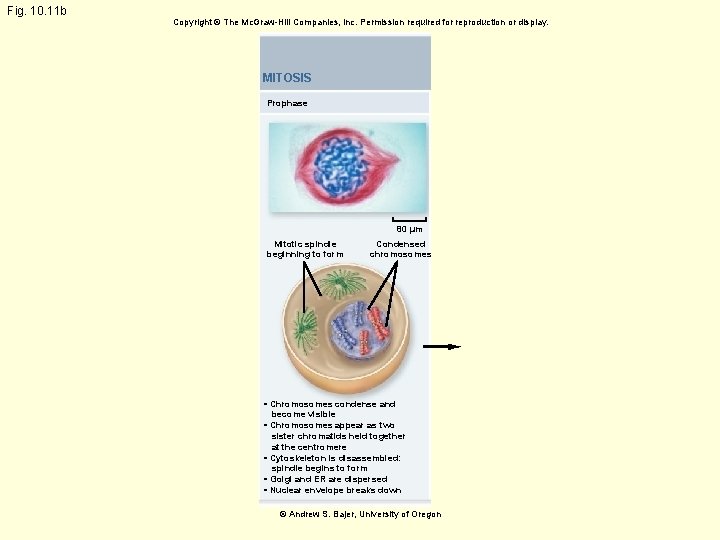
Fig. 10. 11 b Copyright © The Mc. Graw-Hill Companies, Inc. Permission required for reproduction or display. MITOSIS Prophase 80 µm Mitotic spindle beginning to form Condensed chromosomes • Chromosomes condense and become visible • Chromosomes appear as two sister chromatids held together at the centromere • Cytoskeleton is disassembled: spindle begins to form • Golgi and ER are dispersed • Nuclear envelope breaks down © Andrew S. Bajer, University of Oregon
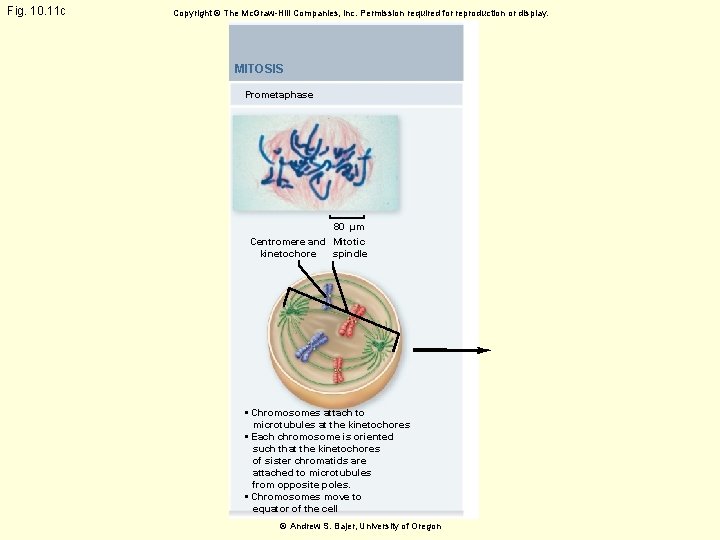
Fig. 10. 11 c Copyright © The Mc. Graw-Hill Companies, Inc. Permission required for reproduction or display. MITOSIS Prometaphase 80 µm Centromere and Mitotic kinetochore spindle • Chromosomes attach to microtubules at the kinetochores • Each chromosome is oriented such that the kinetochores of sister chromatids are attached to microtubules from opposite poles. • Chromosomes move to equator of the cell © Andrew S. Bajer, University of Oregon
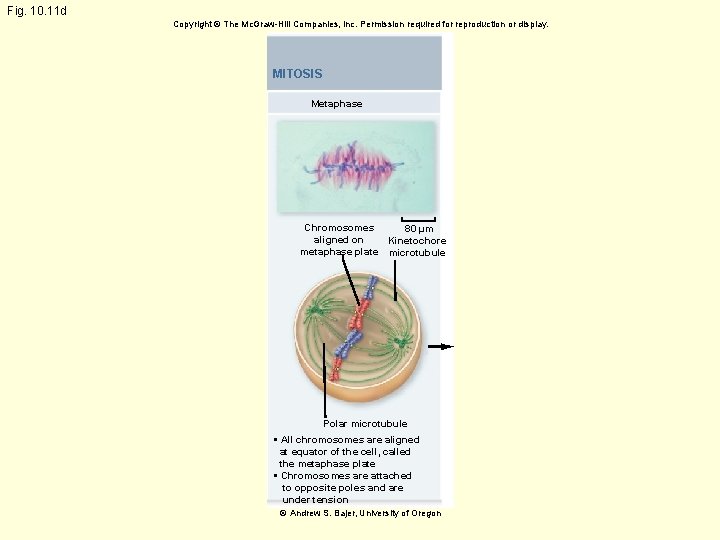
Fig. 10. 11 d Copyright © The Mc. Graw-Hill Companies, Inc. Permission required for reproduction or display. MITOSIS Metaphase Chromosomes 80 µm aligned on Kinetochore metaphase plate microtubule Polar microtubule • All chromosomes are aligned at equator of the cell, called the metaphase plate • Chromosomes are attached to opposite poles and are under tension © Andrew S. Bajer, University of Oregon
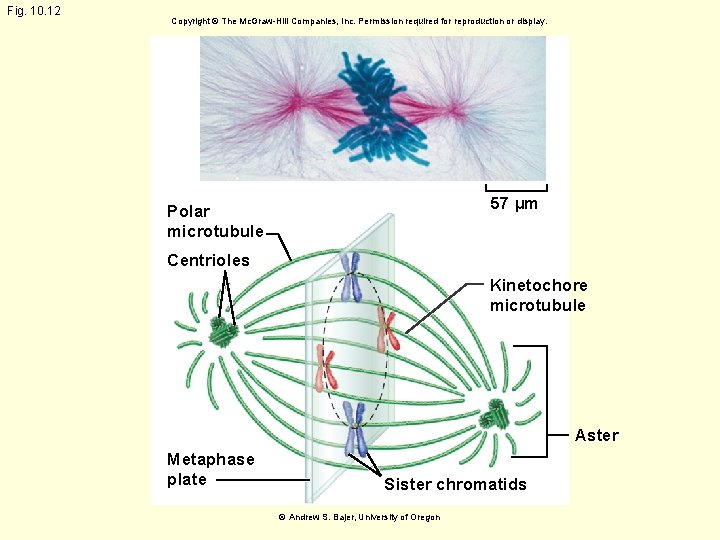
Fig. 10. 12 Copyright © The Mc. Graw-Hill Companies, Inc. Permission required for reproduction or display. 57 µm Polar microtubule Centrioles Kinetochore microtubule Aster Metaphase plate Sister chromatids © Andrew S. Bajer, University of Oregon
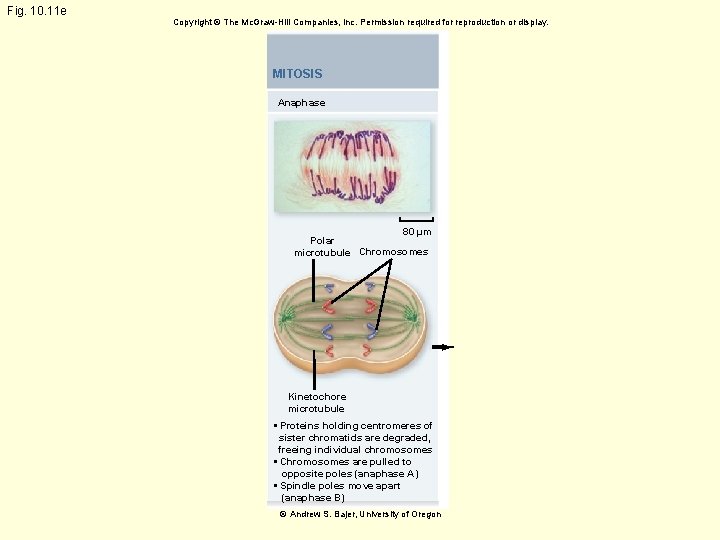
Fig. 10. 11 e Copyright © The Mc. Graw-Hill Companies, Inc. Permission required for reproduction or display. MITOSIS Anaphase 80 µm Polar microtubule Chromosomes Kinetochore microtubule • Proteins holding centromeres of sister chromatids are degraded, freeing individual chromosomes • Chromosomes are pulled to opposite poles (anaphase A) • Spindle poles move apart (anaphase B) © Andrew S. Bajer, University of Oregon
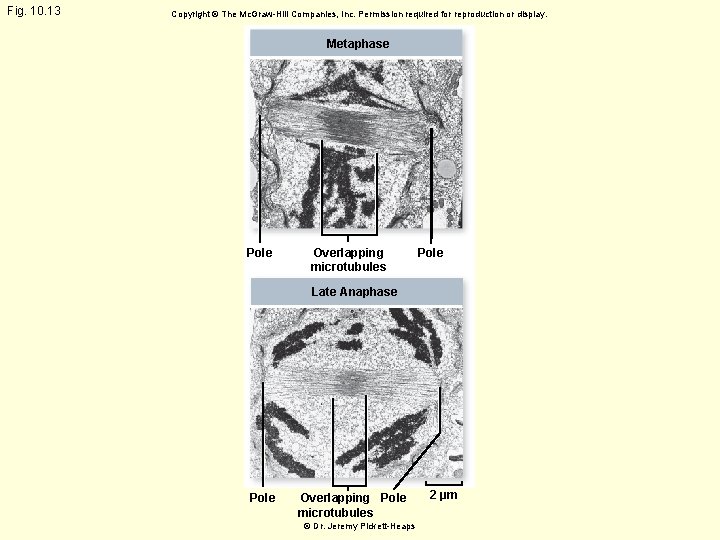
Fig. 10. 13 Copyright © The Mc. Graw-Hill Companies, Inc. Permission required for reproduction or display. Metaphase Pole Overlapping microtubules Pole Late Anaphase Pole Overlapping Pole microtubules © Dr. Jeremy Pickett-Heaps 2 µm
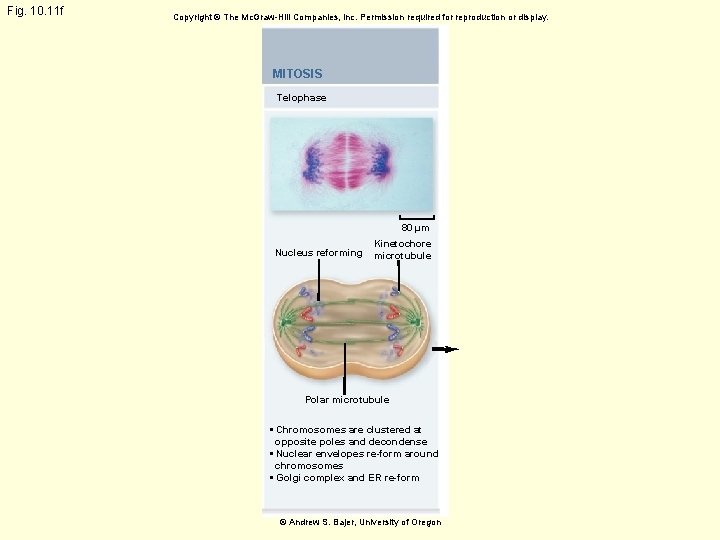
Fig. 10. 11 f Copyright © The Mc. Graw-Hill Companies, Inc. Permission required for reproduction or display. MITOSIS Telophase 80 µm Nucleus reforming Kinetochore microtubule Polar microtubule • Chromosomes are clustered at opposite poles and decondense • Nuclear envelopes re-form around chromosomes • Golgi complex and ER re-form © Andrew S. Bajer, University of Oregon
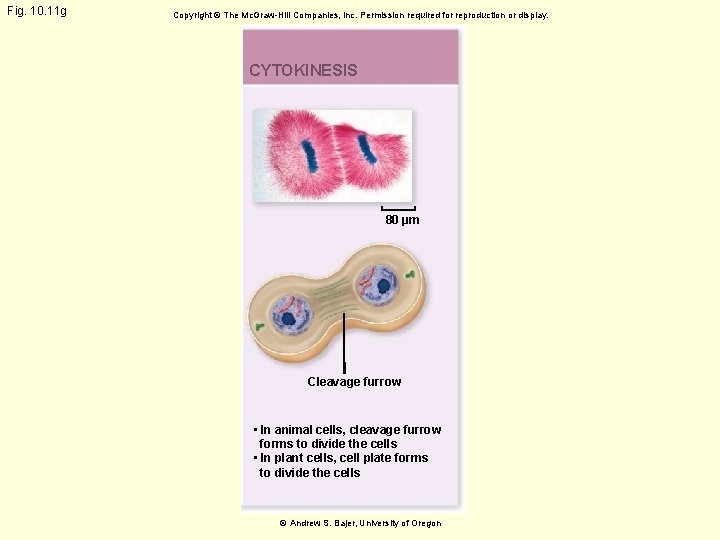
Fig. 10. 11 g Copyright © The Mc. Graw-Hill Companies, Inc. Permission required for reproduction or display. CYTOKINESIS 80 µm Cleavage furrow • In animal cells, cleavage furrow forms to divide the cells • In plant cells, cell plate forms to divide the cells © Andrew S. Bajer, University of Oregon
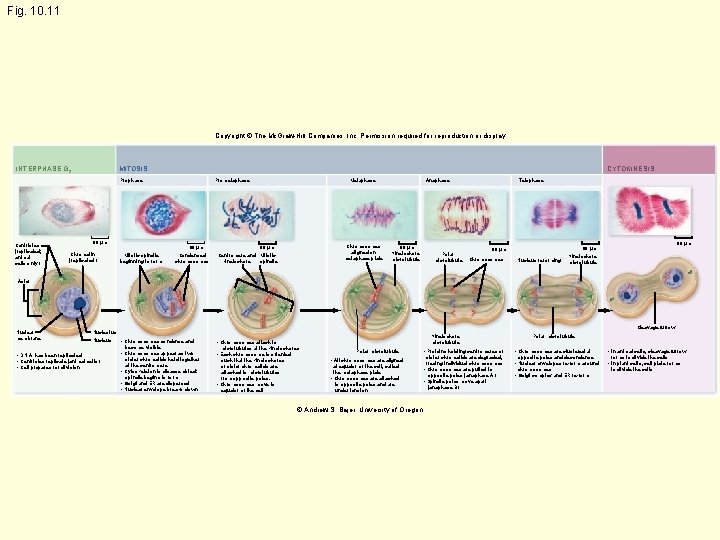
Fig. 10. 11 Copyright © The Mc. Graw-Hill Companies, Inc. Permission required for reproduction or display. INTERPHASE G 2 CYTOKINESIS MITOSIS Prophase Centrioles (replicated; animal cells only) 80 µm Chromatin (replicated) Prometaphase 80 µm Mitotic spindle beginning to form Condensed chromosomes Metaphase Chromosomes aligned on metaphase plate 80 µm Centromere and Mitotic kinetochore spindle Anaphase 80 µm Kinetochore microtubule Polar microtubule Telophase Chromosomes 80 µm Nucleus reforming Kinetochore microtubule Aster Nuclear membrane Cleavage furrow Nucleolus Nucleus • DN A has been replicated • Centrioles replicate (animal cells) • Cell prepares for division • Chromosomes condense and become visible • Chromosomes appear as two sister chromatids held together at the centromere • Cytoskeleton is disassembled: spindle begins to form • Golgi and ER are dispersed • Nuclear envelope breaks down • Chromosomes attach to microtubules at the kinetochores • Each chromosome is oriented such that the kinetochores of sister chromatids are attached to microtubules from opposite poles. • Chromosomes move to equator of the cell Kinetochore microtubule Polar microtubule • All chromosomes are aligned at equator of the cell, called the metaphase plate • Chromosomes are attached to opposite poles and are under tension © Andrew S. Bajer, University of Oregon • Proteins holding centromeres of sister chromatids are degraded, freeing individual chromosomes • Chromosomes are pulled to opposite poles (anaphase A) • Spindle poles move apart (anaphase B) Polar microtubule • Chromosomes are clustered at opposite poles and decondense • Nuclear envelopes re-form around chromosomes • Golgi complex and ER re-form • In animal cells, cleavage furrow forms to divide the cells • In plant cells, cell plate forms to divide the cells
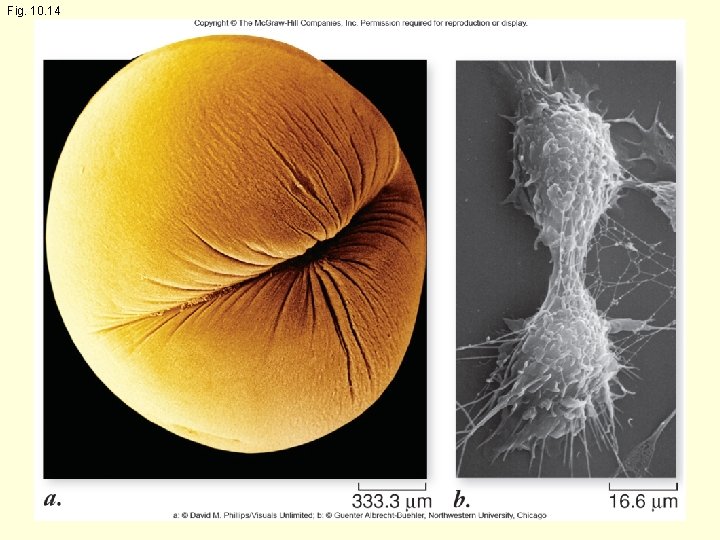
Fig. 10. 14
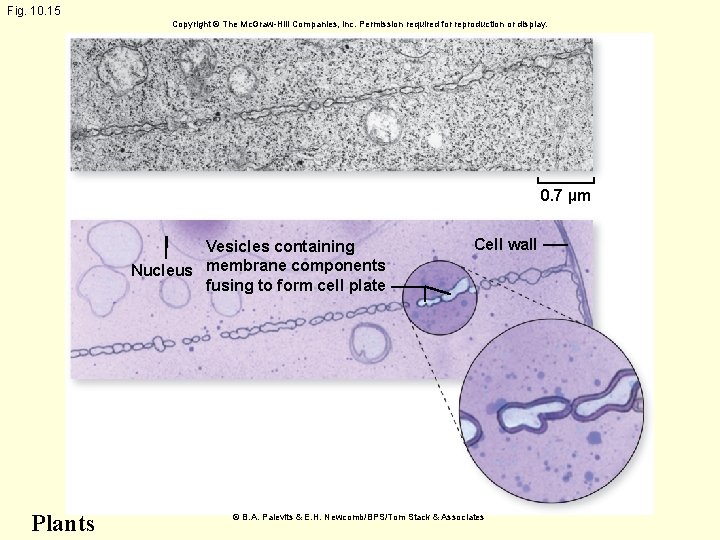
Fig. 10. 15 Copyright © The Mc. Graw-Hill Companies, Inc. Permission required for reproduction or display. 0. 7 µm Vesicles containing Nucleus membrane components fusing to form cell plate Plants Cell wall © B. A. Palevits & E. H. Newcomb/BPS/Tom Stack & Associates
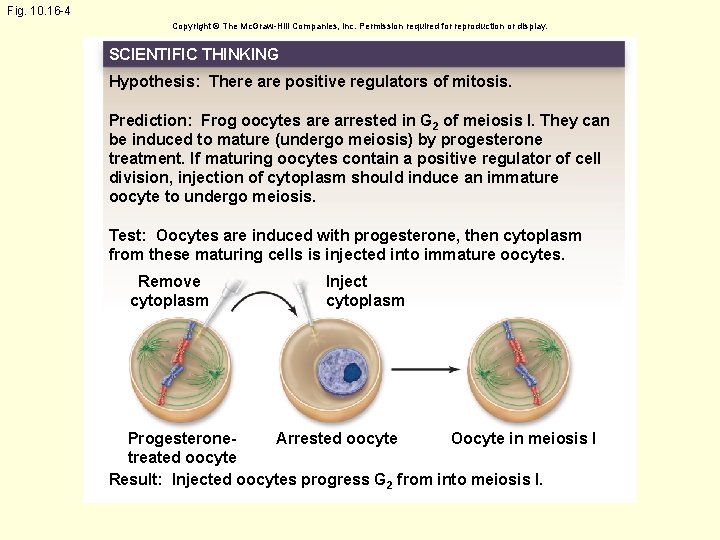
Fig. 10. 16 -1 Copyright © The Mc. Graw-Hill Companies, Inc. Permission required for reproduction or display. SCIENTIFIC THINKING Hypothesis: There are positive regulators of mitosis.
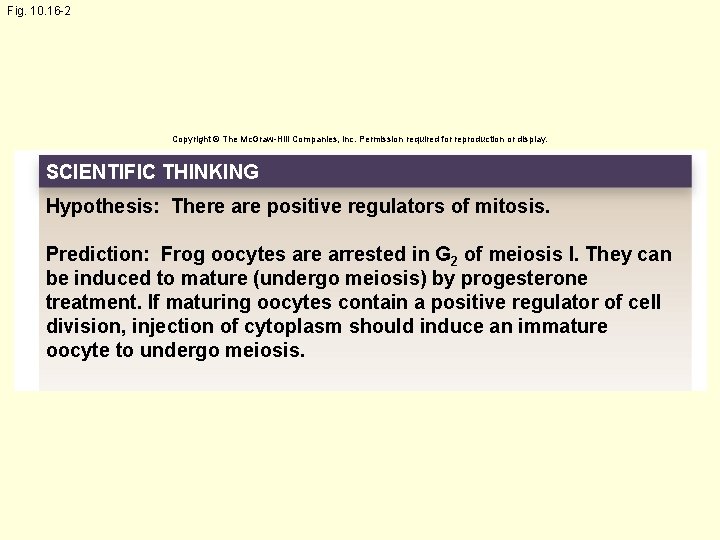
Fig. 10. 16 -2 Copyright © The Mc. Graw-Hill Companies, Inc. Permission required for reproduction or display. SCIENTIFIC THINKING Hypothesis: There are positive regulators of mitosis. Prediction: Frog oocytes are arrested in G 2 of meiosis I. They can be induced to mature (undergo meiosis) by progesterone treatment. If maturing oocytes contain a positive regulator of cell division, injection of cytoplasm should induce an immature oocyte to undergo meiosis.
Fig. 10. 16 -4 Copyright © The Mc. Graw-Hill Companies, Inc. Permission required for reproduction or display. SCIENTIFIC THINKING Hypothesis: There are positive regulators of mitosis. Prediction: Frog oocytes are arrested in G 2 of meiosis I. They can be induced to mature (undergo meiosis) by progesterone treatment. If maturing oocytes contain a positive regulator of cell division, injection of cytoplasm should induce an immature oocyte to undergo meiosis. Test: Oocytes are induced with progesterone, then cytoplasm from these maturing cells is injected into immature oocytes. Remove cytoplasm Inject cytoplasm Progesterone. Arrested oocyte Oocyte in meiosis I treated oocyte Result: Injected oocytes progress G 2 from into meiosis I.
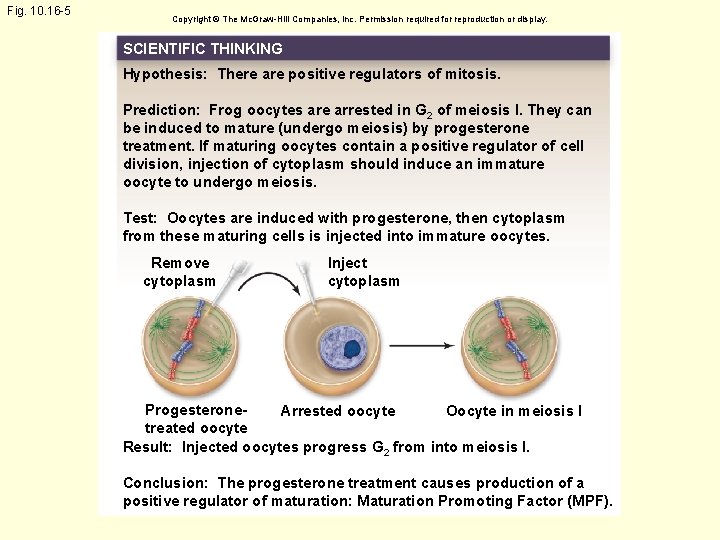
Fig. 10. 16 -5 Copyright © The Mc. Graw-Hill Companies, Inc. Permission required for reproduction or display. SCIENTIFIC THINKING Hypothesis: There are positive regulators of mitosis. Prediction: Frog oocytes are arrested in G 2 of meiosis I. They can be induced to mature (undergo meiosis) by progesterone treatment. If maturing oocytes contain a positive regulator of cell division, injection of cytoplasm should induce an immature oocyte to undergo meiosis. Test: Oocytes are induced with progesterone, then cytoplasm from these maturing cells is injected into immature oocytes. Remove cytoplasm Inject cytoplasm Progesterone. Arrested oocyte Oocyte in meiosis I treated oocyte Result: Injected oocytes progress G 2 from into meiosis I. Conclusion: The progesterone treatment causes production of a positive regulator of maturation: Maturation Promoting Factor (MPF).
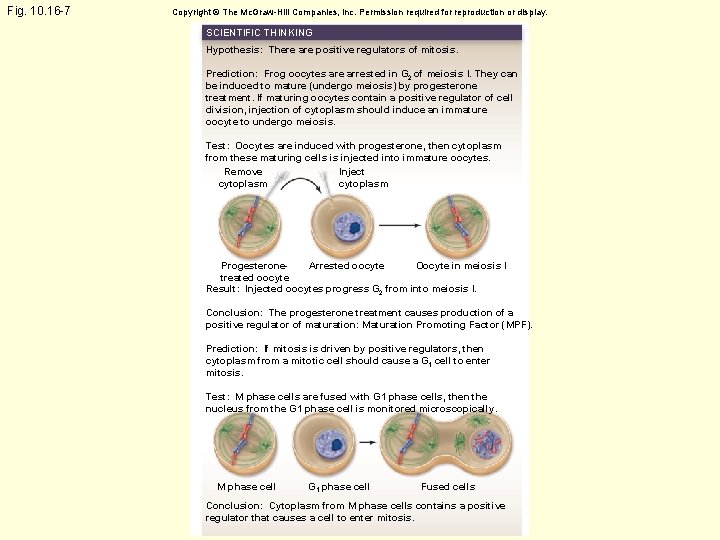
Fig. 10. 16 -7 Copyright © The Mc. Graw-Hill Companies, Inc. Permission required for reproduction or display. SCIENTIFIC THINKING Hypothesis: There are positive regulators of mitosis. Prediction: Frog oocytes are arrested in G 2 of meiosis I. They can be induced to mature (undergo meiosis) by progesterone treatment. If maturing oocytes contain a positive regulator of cell division, injection of cytoplasm should induce an immature oocyte to undergo meiosis. Test: Oocytes are induced with progesterone, then cytoplasm from these maturing cells is injected into immature oocytes. Remove Inject cytoplasm Arrested oocyte Oocyte in meiosis I Progesteronetreated oocyte Result: Injected oocytes progress G 2 from into meiosis I. Conclusion: The progesterone treatment causes production of a positive regulator of maturation: Maturation Promoting Factor (MPF). Prediction: If mitosis is driven by positive regulators, then cytoplasm from a mitotic cell should cause a G 1 cell to enter mitosis. Test: M phase cells are fused with G 1 phase cells, then the nucleus from the G 1 phase cell is monitored microscopically. M phase cell G 1 phase cell Fused cells Conclusion: Cytoplasm from M phase cells contains a positive regulator that causes a cell to enter mitosis.
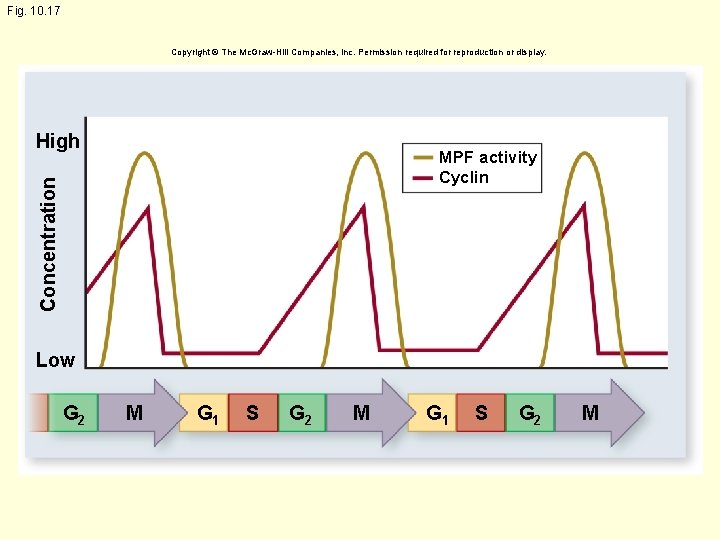
Fig. 10. 17 Copyright © The Mc. Graw-Hill Companies, Inc. Permission required for reproduction or display. High Concentration MPF activity Cyclin Low G 2 M G 1 S G 2 M
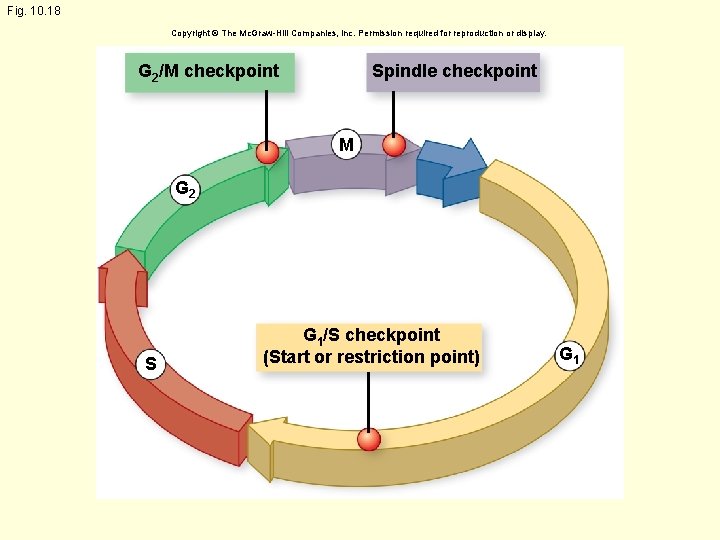
Fig. 10. 18 Copyright © The Mc. Graw-Hill Companies, Inc. Permission required for reproduction or display. G 2/M checkpoint Spindle checkpoint M G 2 S G 1/S checkpoint (Start or restriction point) G 1
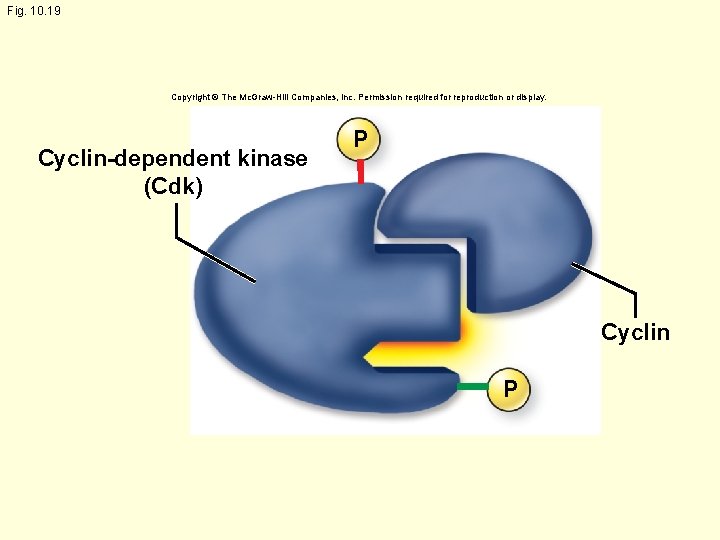
Fig. 10. 19 Copyright © The Mc. Graw-Hill Companies, Inc. Permission required for reproduction or display. Cyclin-dependent kinase (Cdk) P Cyclin P
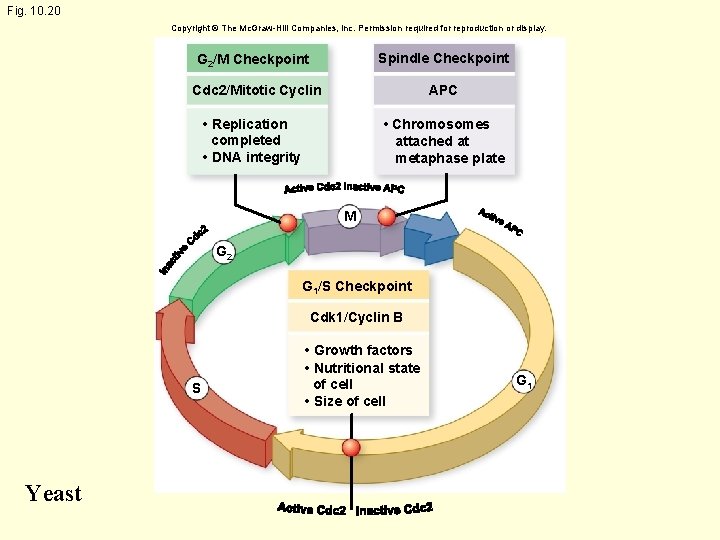
Fig. 10. 20 Copyright © The Mc. Graw-Hill Companies, Inc. Permission required for reproduction or display. G 2/M Checkpoint Spindle Checkpoint Cdc 2/Mitotic Cyclin APC • Replication completed • DNA integrity • Chromosomes attached at metaphase plate M G 2 G 1/S Checkpoint Cdk 1/Cyclin B S Yeast • Growth factors • Nutritional state of cell • Size of cell G 1
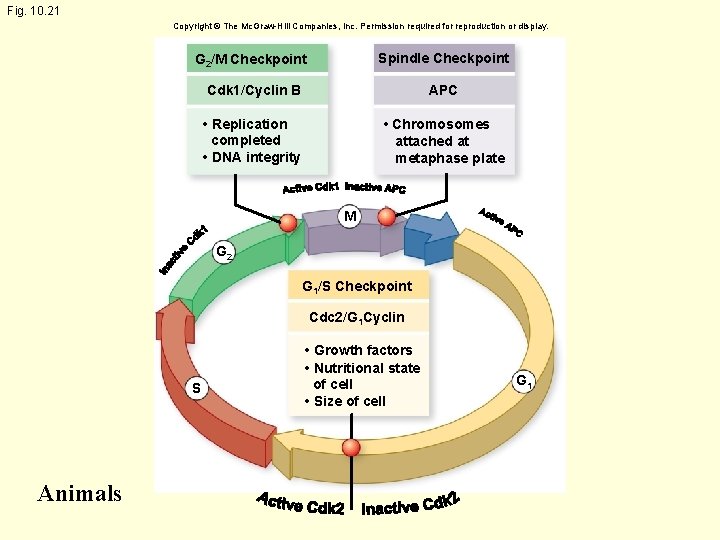
Fig. 10. 21 Copyright © The Mc. Graw-Hill Companies, Inc. Permission required for reproduction or display. G 2/M Checkpoint Spindle Checkpoint Cdk 1/Cyclin B APC • Replication completed • DNA integrity • Chromosomes attached at metaphase plate M G 2 G 1/S Checkpoint Cdc 2/G 1 Cyclin S Animals • Growth factors • Nutritional state of cell • Size of cell G 1
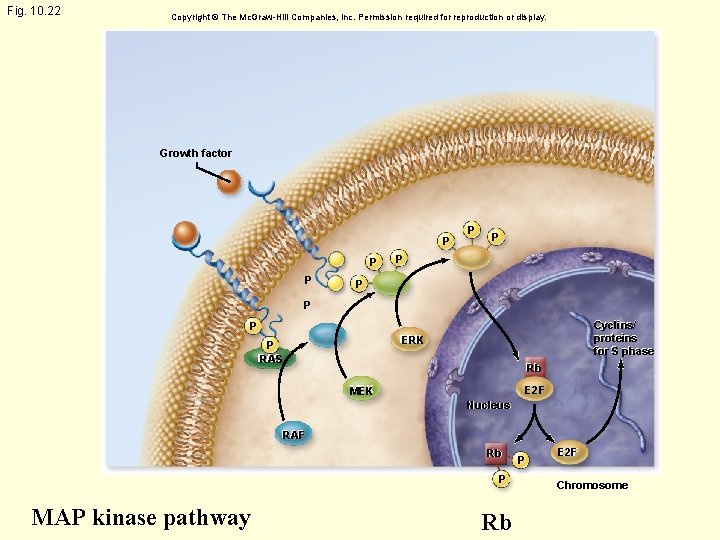
Fig. 10. 22 Copyright © The Mc. Graw-Hill Companies, Inc. Permission required for reproduction or display. Growth factor P P P P Cyclins/ proteins for S phase P ERK P RAS Rb Rb MEK E 2 F Nucleus RAF Rb Rb P MAP kinase pathway Rb P E 2 F Chromosome
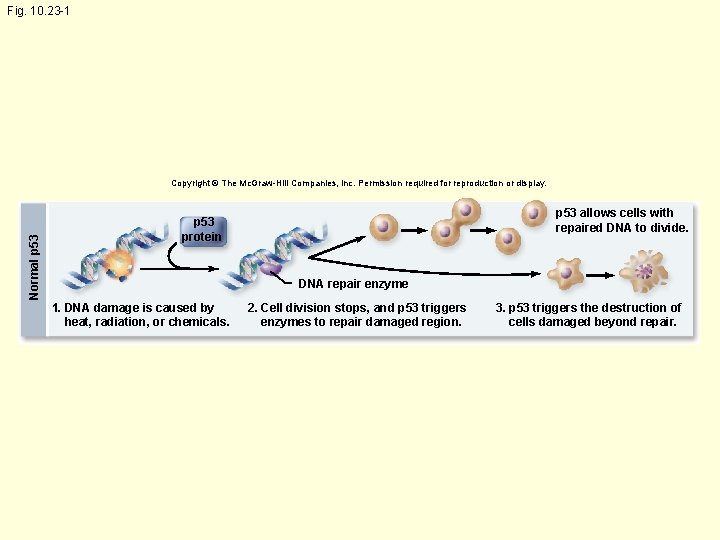
Fig. 10. 23 -1 Normal p 53 Copyright © The Mc. Graw-Hill Companies, Inc. Permission required for reproduction or display. p 53 allows cells with repaired DNA to divide. p 53 protein DNA repair enzyme 1. DNA damage is caused by heat, radiation, or chemicals. 2. Cell division stops, and p 53 triggers enzymes to repair damaged region. 3. p 53 triggers the destruction of cells damaged beyond repair.
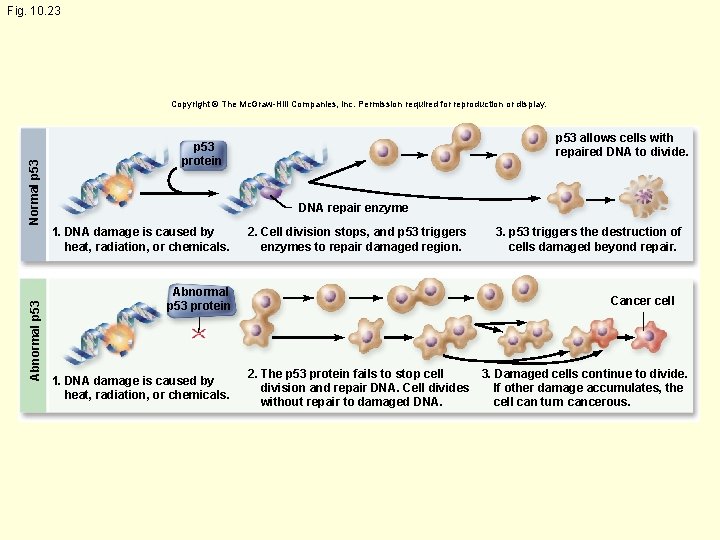
Fig. 10. 23 Normal p 53 Copyright © The Mc. Graw-Hill Companies, Inc. Permission required for reproduction or display. DNA repair enzyme 1. DNA damage is caused by heat, radiation, or chemicals. Abnormal p 53 allows cells with repaired DNA to divide. p 53 protein Abnormal p 53 protein 1. DNA damage is caused by heat, radiation, or chemicals. 2. Cell division stops, and p 53 triggers enzymes to repair damaged region. 3. p 53 triggers the destruction of cells damaged beyond repair. Cancer cell 2. The p 53 protein fails to stop cell 3. Damaged cells continue to divide. division and repair DNA. Cell divides If other damage accumulates, the without repair to damaged DNA. cell can turn cancerous.
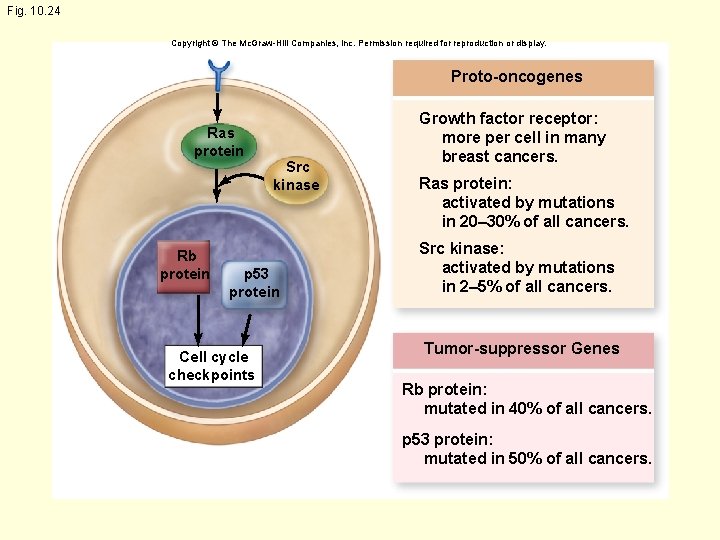
Fig. 10. 24 Copyright © The Mc. Graw-Hill Companies, Inc. Permission required for reproduction or display. Proto-oncogenes Ras protein Rb protein Src kinase p 53 protein Cell cycle checkpoints Growth factor receptor: more per cell in many breast cancers. Ras protein: activated by mutations in 20– 30% of all cancers. Src kinase: activated by mutations in 2– 5% of all cancers. Tumor-suppressor Genes Rb protein: mutated in 40% of all cancers. p 53 protein: mutated in 50% of all cancers.