
Cell division Cell Cycle results in cell duplication

- Slides: 23
Cell division • Cell Cycle results in cell duplication • Growth phase, then synthesis phase (duplication of DNA), then resting phase (double DNA, single nucleus), then mitosis in 5 stages, then cell division • Cell Types: • Active Dividing Cells: Retain full power of Regeneration (Epithelial Tissue, Bone). In case of Injury Repair without Scar Tissue (Fibrosis) • Facultative Dividers: Retain some capacity to divide Need Stimulus (Liver and Skeletal Muscles, Alveolar Cells). Incase of Injury Some Fibrosis • Non-dividing (Terminally differentiated) cells as Cardiac Muscle & Nerve Cell.
Cell division • Stem Cells are partially differentiated • maintain a pool of dividing cells • some differentiate to replace specialized cells: eg new blood cells come from hemopoietic stem cells • Sexual Reproduction of organism • cells divide by meiosis to form gametes (germ cells: sperm, ovum) with 1 set of chromosomes (ie haploid? not diploid)
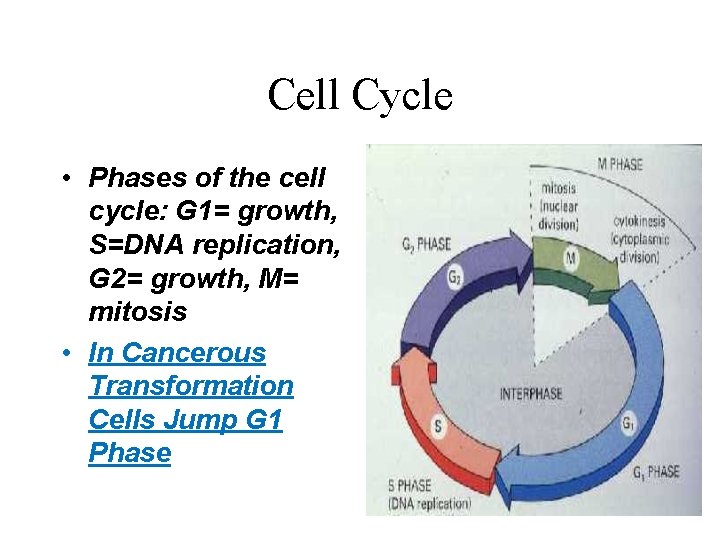
Cell Cycle • Phases of the cell cycle: G 1= growth, S=DNA replication, G 2= growth, M= mitosis • In Cancerous Transformation Cells Jump G 1 Phase
Cell cycle Different phases of the interphase are regulated via Cyclin Dependent Kinases 1 - CYCLIN D synthesized during early G 1 phase , binds to CDK 4 as well as CDK 6, additionally in the late G 1 phase CYCLIN E is synthesized and binds to CDK 2, these three complexes , through other intermediaries permit the cell to enter and Progress Through The S Phase. 2 - CYCLIN A binds to CDK 2 and CDK 1 and these complexes permit the cell to Leave The S Phase and enter the G 2 phase and induce the formation of CYCLIN B. 3 - CYCLIN B binds to CDK 1 and this complex allows the cell to leave the G 2 phase and Enter the M Phase.
Proto-oncogens Cell division is stimulated by Growth Factors that induce the Expression Of Proto-oncongenes which are responsible for regulation of cell division Mutations of protooncogens due to exposure to ionic radiations, chemicals, viral infections and others leads to formation of Oncogens which result in uncontrolled proliferation i. e Cancer
Factors Which Induce Cell Division • Growth hormones & Factors. • Mechanical Force ( Stretch as in Pregnant Uterus). • Injury or/and cell death. • Physiological Regeneration • Response to tensile force ( Bone Growth). • Signals Pass to Specific cells Via Signal Transduction Pathways
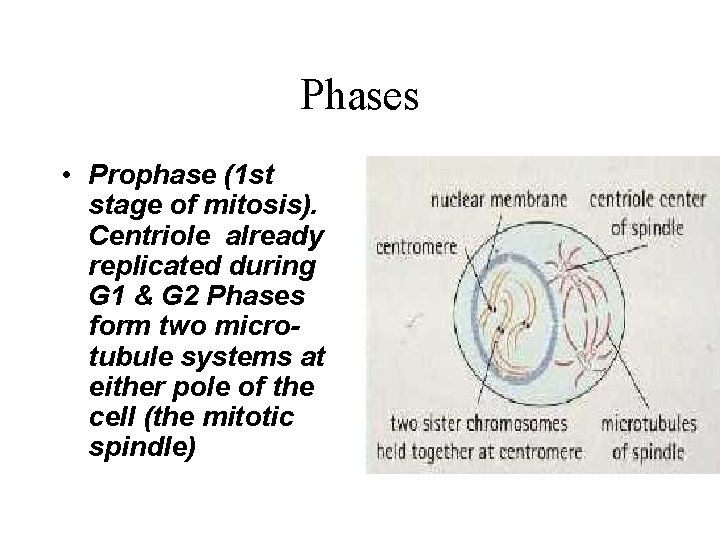
Phases • Prophase (1 st stage of mitosis). Centriole already replicated during G 1 & G 2 Phases form two microtubule systems at either pole of the cell (the mitotic spindle)
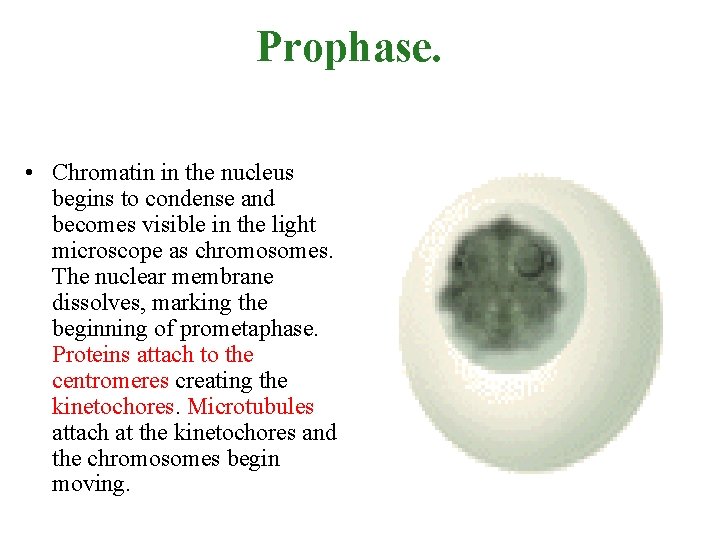
Prophase. • Chromatin in the nucleus begins to condense and becomes visible in the light microscope as chromosomes. The nuclear membrane dissolves, marking the beginning of prometaphase. Proteins attach to the centromeres creating the kinetochores. Microtubules attach at the kinetochores and the chromosomes begin moving.
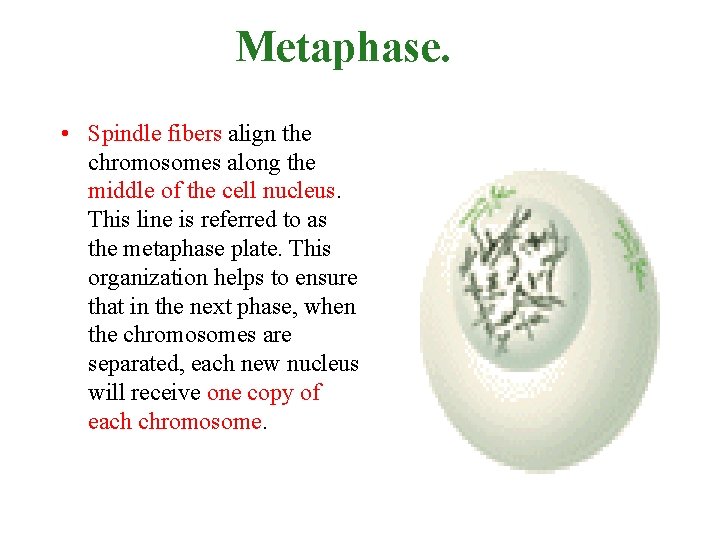
Metaphase. • Spindle fibers align the chromosomes along the middle of the cell nucleus. This line is referred to as the metaphase plate. This organization helps to ensure that in the next phase, when the chromosomes are separated, each new nucleus will receive one copy of each chromosome.
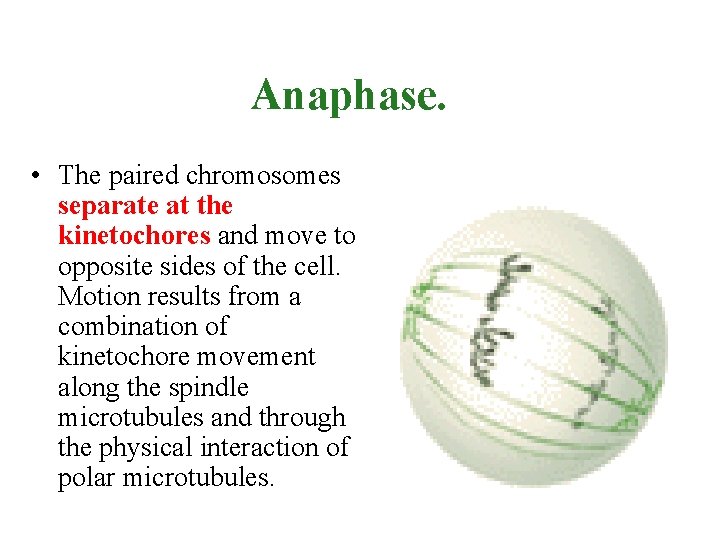
Anaphase. • The paired chromosomes separate at the kinetochores and move to opposite sides of the cell. Motion results from a combination of kinetochore movement along the spindle microtubules and through the physical interaction of polar microtubules.
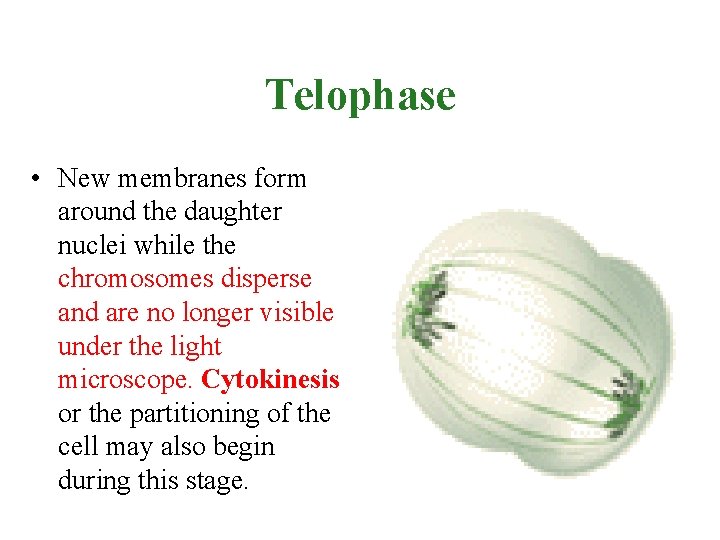
Telophase • New membranes form around the daughter nuclei while the chromosomes disperse and are no longer visible under the light microscope. Cytokinesis or the partitioning of the cell may also begin during this stage.
Meiosis Chromosomes in a Diploid Cell • Summary of chromosome characteristics • Diploid set for humans; 2 n = 46 • Autosomes; homologous chromosomes, one from each parent (humans = 22 sets of 2 ( • Sex chromosomes (humans have 1 set ( 1. Female-sex chromosomes are homologous (XX) 2. Male-sex chromosomes are non-homologous (XY)
Ploidy: Number of sets of chromosomes in a cell • Haploid (n)-- one set chromosomes • Diploid (2 n)-- two sets chromosomes • Most plant and animal adults are diploid (2 n) • Eggs and sperm are haploid (n)
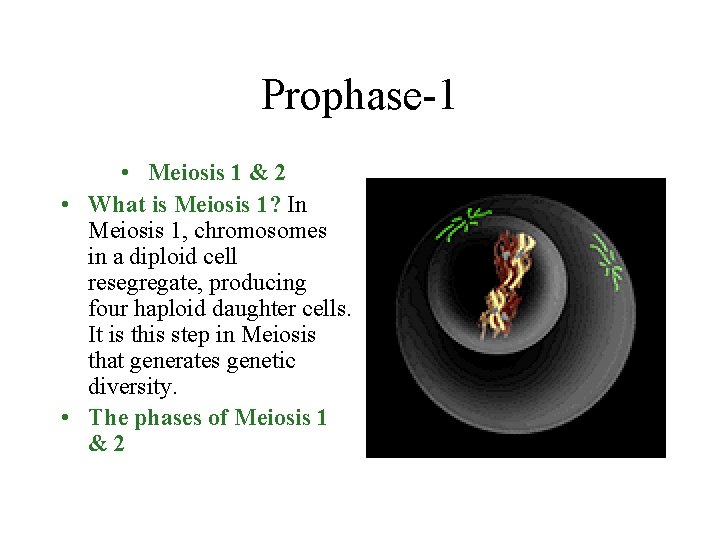
Prophase-1 • Meiosis 1 & 2 • What is Meiosis 1? In Meiosis 1, chromosomes in a diploid cell resegregate, producing four haploid daughter cells. It is this step in Meiosis that generates genetic diversity. • The phases of Meiosis 1 &2
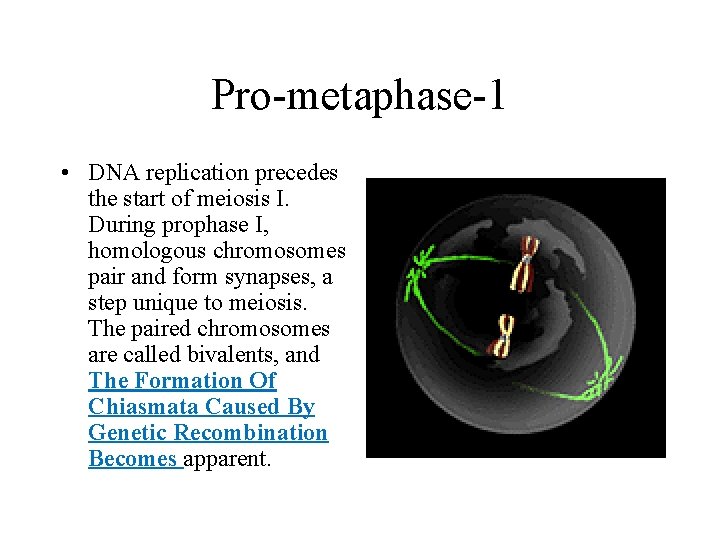
Pro-metaphase-1 • DNA replication precedes the start of meiosis I. During prophase I, homologous chromosomes pair and form synapses, a step unique to meiosis. The paired chromosomes are called bivalents, and The Formation Of Chiasmata Caused By Genetic Recombination Becomes apparent.
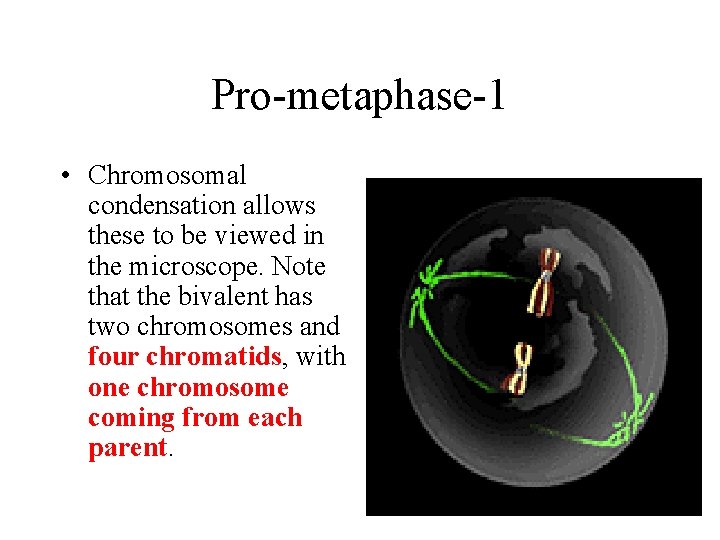
Pro-metaphase-1 • Chromosomal condensation allows these to be viewed in the microscope. Note that the bivalent has two chromosomes and four chromatids, with one chromosome coming from each parent.
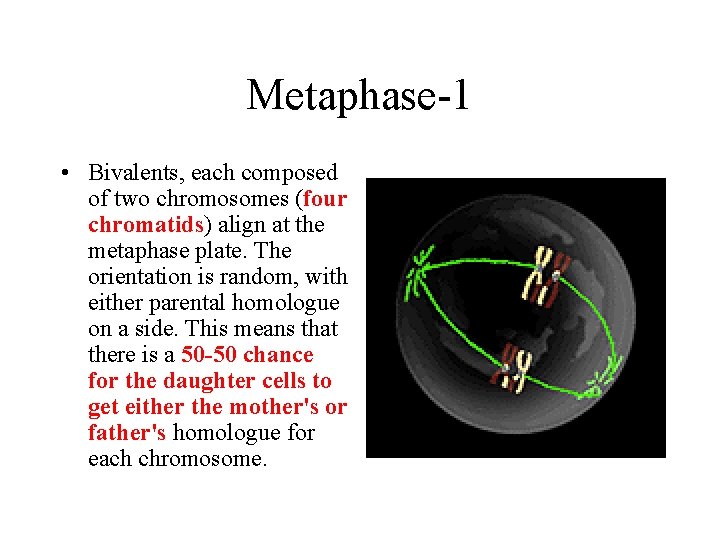
Metaphase-1 • Bivalents, each composed of two chromosomes (four chromatids) align at the metaphase plate. The orientation is random, with either parental homologue on a side. This means that there is a 50 -50 chance for the daughter cells to get either the mother's or father's homologue for each chromosome.
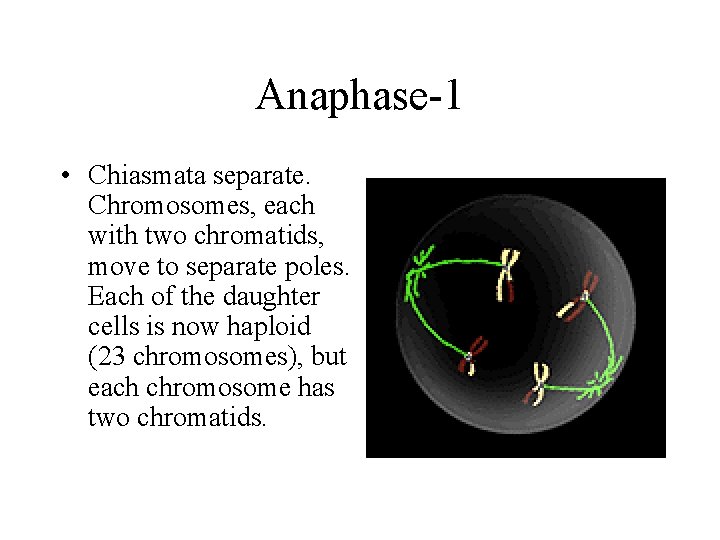
Anaphase-1 • Chiasmata separate. Chromosomes, each with two chromatids, move to separate poles. Each of the daughter cells is now haploid (23 chromosomes), but each chromosome has two chromatids.
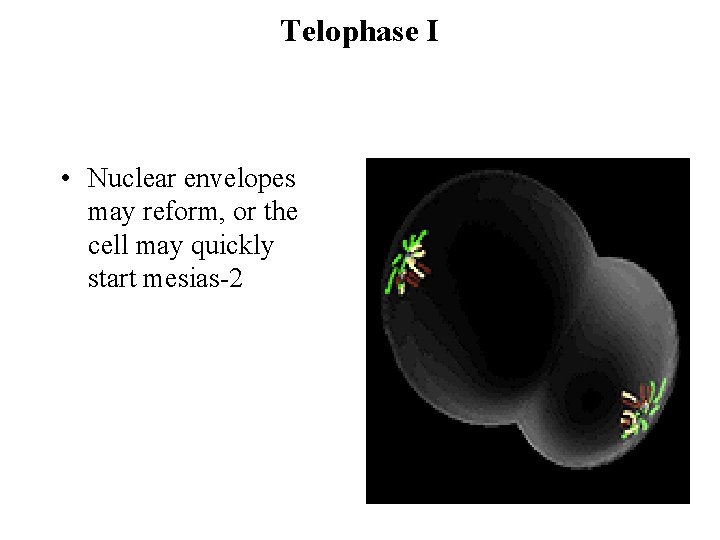
Telophase I • Nuclear envelopes may reform, or the cell may quickly start mesias-2
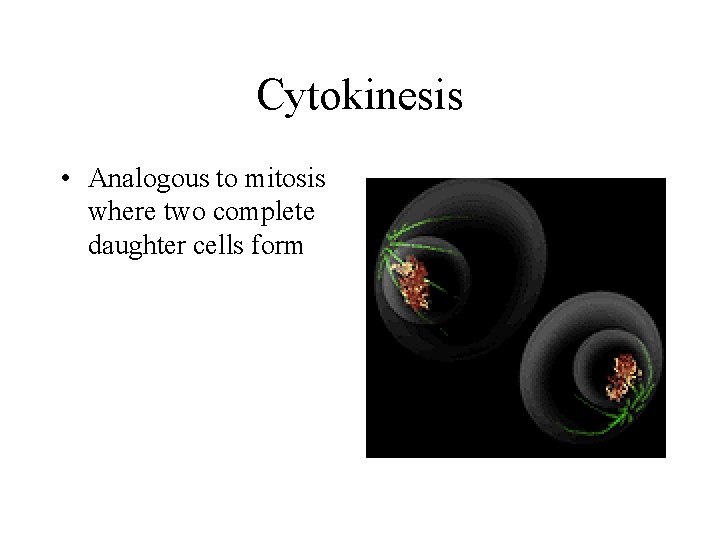
Cytokinesis • Analogous to mitosis where two complete daughter cells form
Meiosis • Meiosis 2 is similar to mitosis. However, there is no "S" phase. The chromatids of each chromosome are no longer identical because of recombination. Meiosis II separates the chromatids producing two daughter cells each with 23 chromosomes (haploid), and each chromosome has only one chromatid.
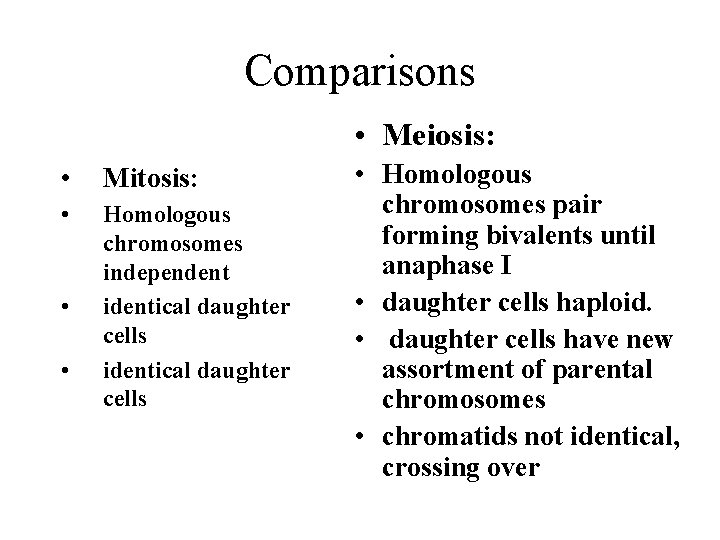
Comparisons • Meiosis: • Mitosis: • Homologous chromosomes independent identical daughter cells • • • Homologous chromosomes pair forming bivalents until anaphase I • daughter cells haploid. • daughter cells have new assortment of parental chromosomes • chromatids not identical, crossing over
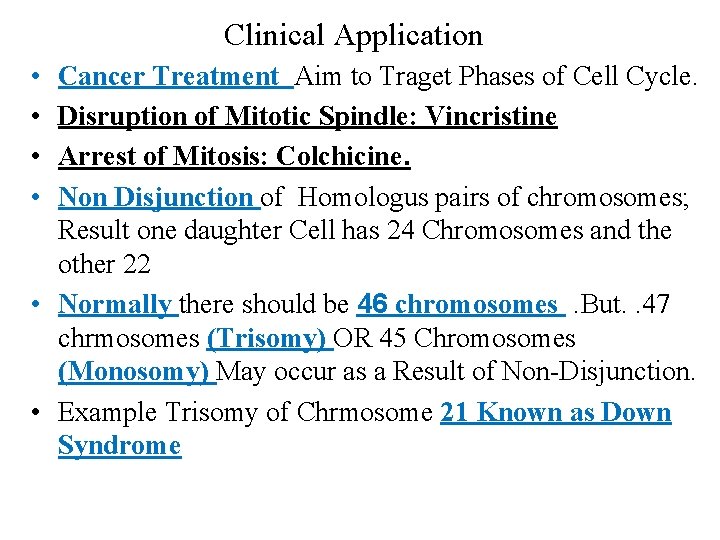
Clinical Application • • Cancer Treatment Aim to Traget Phases of Cell Cycle. Disruption of Mitotic Spindle: Vincristine Arrest of Mitosis: Colchicine. Non Disjunction of Homologus pairs of chromosomes; Result one daughter Cell has 24 Chromosomes and the other 22 • Normally there should be 46 chromosomes. But. . 47 chrmosomes (Trisomy) OR 45 Chromosomes (Monosomy) May occur as a Result of Non-Disjunction. • Example Trisomy of Chrmosome 21 Known as Down Syndrome