
Cell Cycle Cell division is the basis of
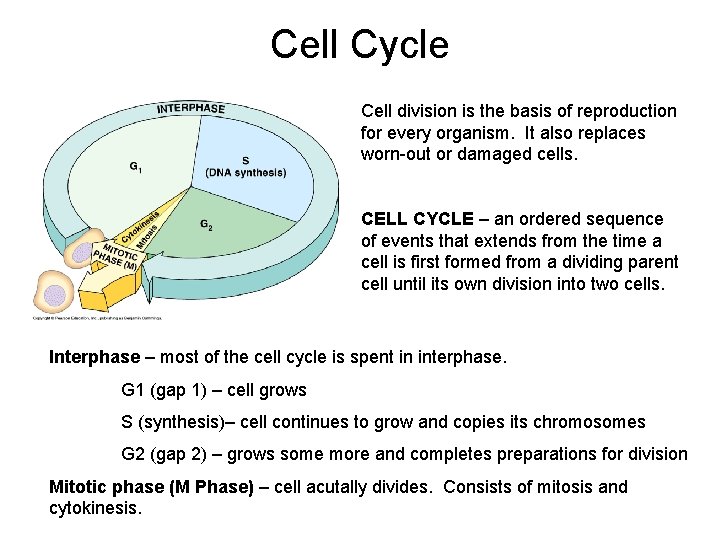
Cell Cycle Cell division is the basis of reproduction for every organism. It also replaces worn-out or damaged cells. CELL CYCLE – an ordered sequence of events that extends from the time a cell is first formed from a dividing parent cell until its own division into two cells. Interphase – most of the cell cycle is spent in interphase. G 1 (gap 1) – cell grows S (synthesis)– cell continues to grow and copies its chromosomes G 2 (gap 2) – grows some more and completes preparations for division Mitotic phase (M Phase) – cell acutally divides. Consists of mitosis and cytokinesis.
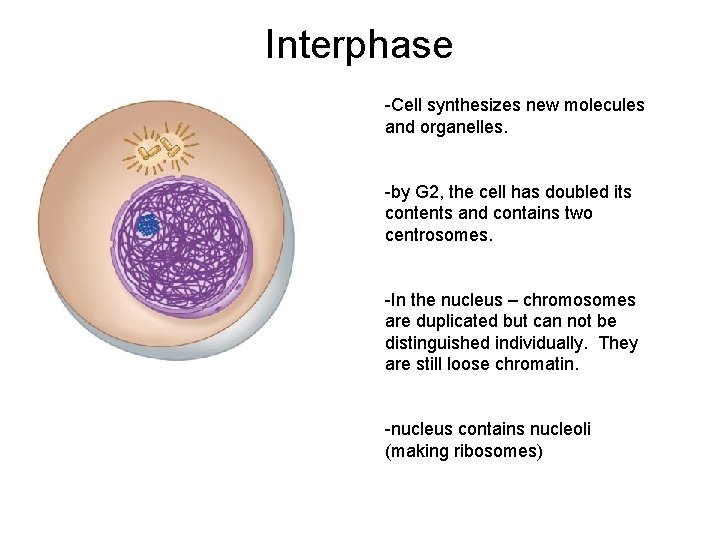
Interphase -Cell synthesizes new molecules and organelles. -by G 2, the cell has doubled its contents and contains two centrosomes. -In the nucleus – chromosomes are duplicated but can not be distinguished individually. They are still loose chromatin. -nucleus contains nucleoli (making ribosomes)
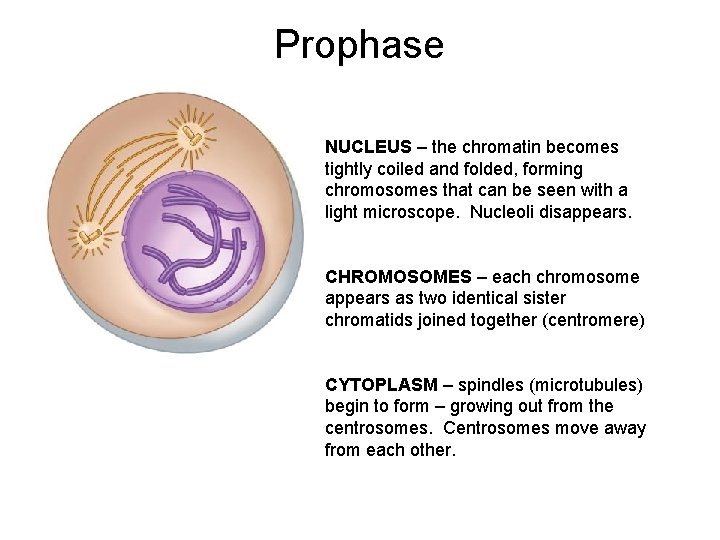
Prophase NUCLEUS – the chromatin becomes tightly coiled and folded, forming chromosomes that can be seen with a light microscope. Nucleoli disappears. CHROMOSOMES – each chromosome appears as two identical sister chromatids joined together (centromere) CYTOPLASM – spindles (microtubules) begin to form – growing out from the centrosomes. Centrosomes move away from each other.

Prometaphase/Metaphase PROMETAPHASE NUCLEUS – nuclear membrane breaks apart and disappears. CYTOPLASM – Centrosomes are at opposite poles. Spindle fibers extend out and reach the chromosomes. CHROMOSOMES – Each chromosome has a kinetochore (at the centromere). Spindle fibers attach to the kinetochore. Spingle fibers move the chromosomes toward the center of cell. METAPHASE CHROMOSOMES – the chromosomes convene on the metaphase plate, an imaginary plane equidistant between the two poles.
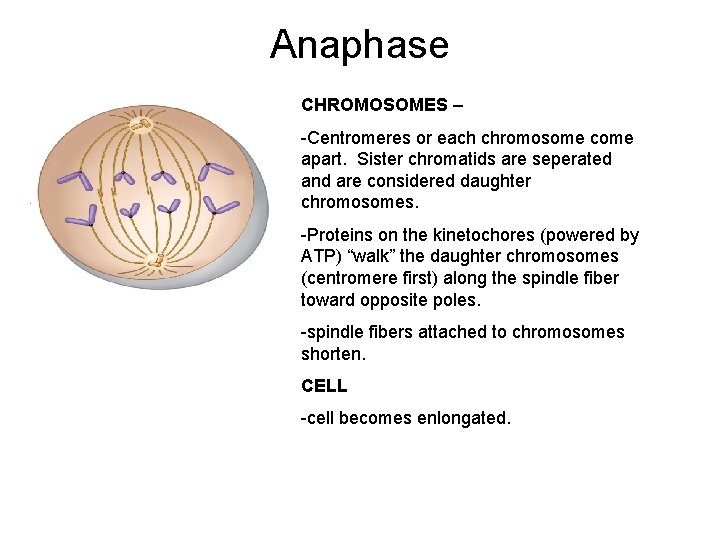
Anaphase CHROMOSOMES – -Centromeres or each chromosome come apart. Sister chromatids are seperated and are considered daughter chromosomes. -Proteins on the kinetochores (powered by ATP) “walk” the daughter chromosomes (centromere first) along the spindle fiber toward opposite poles. -spindle fibers attached to chromosomes shorten. CELL -cell becomes enlongated.

Telophase CELL -elongation continues NUCLEUS -daughter nuclei appear at the two poles. Nuclear membranes (envelopes) from around the chromosomes. -Nucleoli reappear CHROMOSOMES -chromatin of the chromosomes uncoils. CYTOPLASM -spindles disappear
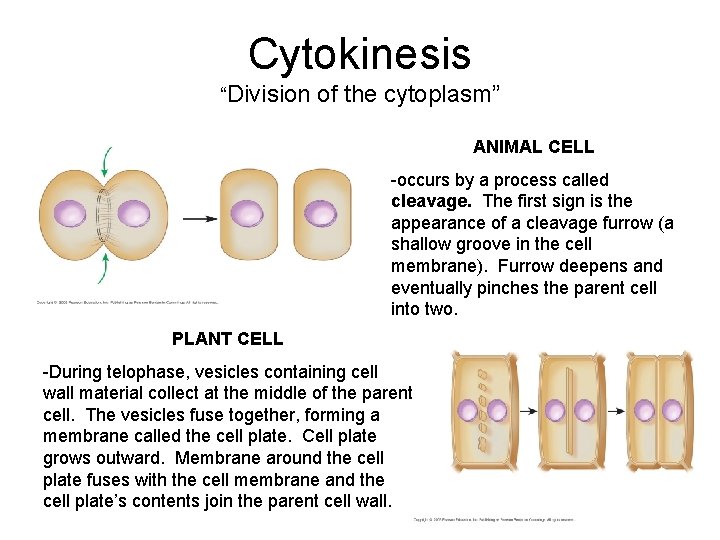
Cytokinesis “Division of the cytoplasm” ANIMAL CELL -occurs by a process called cleavage. The first sign is the appearance of a cleavage furrow (a shallow groove in the cell membrane). Furrow deepens and eventually pinches the parent cell into two. PLANT CELL -During telophase, vesicles containing cell wall material collect at the middle of the parent cell. The vesicles fuse together, forming a membrane called the cell plate. Cell plate grows outward. Membrane around the cell plate fuses with the cell membrane and the cell plate’s contents join the parent cell wall.
- Slides: 7