
Cell Cycle and Mitosis Why do cells divide
- Slides: 23
Cell Cycle and Mitosis
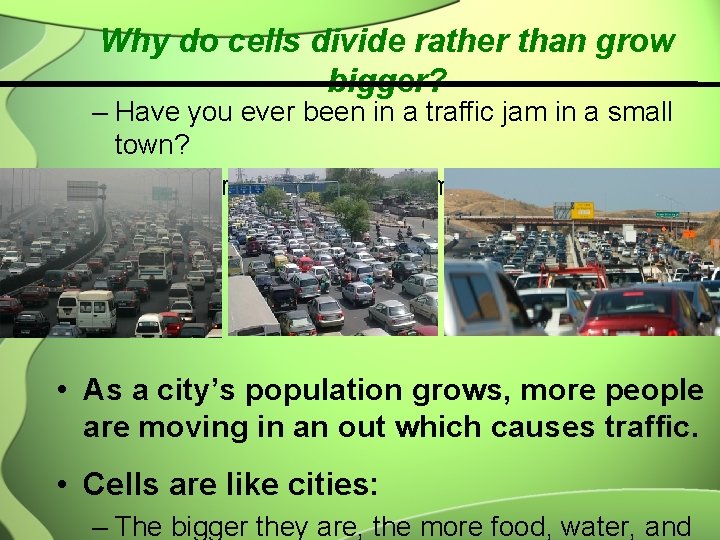
Why do cells divide rather than grow bigger? – Have you ever been in a traffic jam in a small town? – Where are major traffic jams found? • As a city’s population grows, more people are moving in an out which causes traffic. • Cells are like cities: – The bigger they are, the more food, water, and
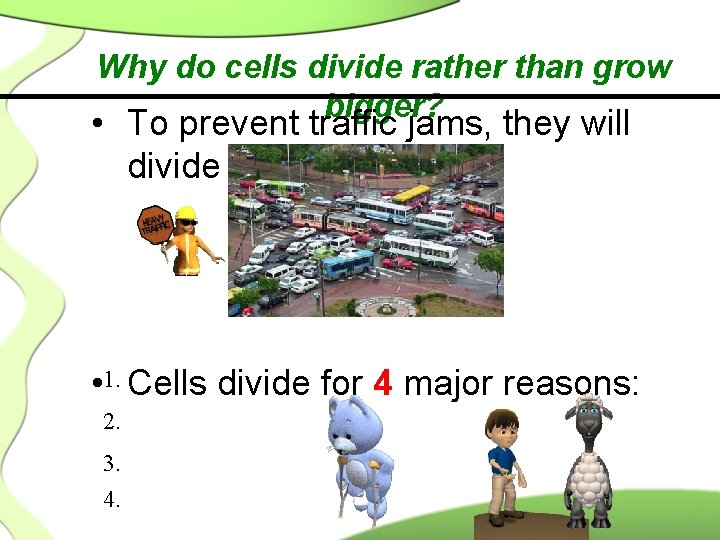
Why do cells divide rather than grow bigger? • To prevent traffic jams, they will divide • 1. Cells divide for 4 major reasons: 2. 3. 4.
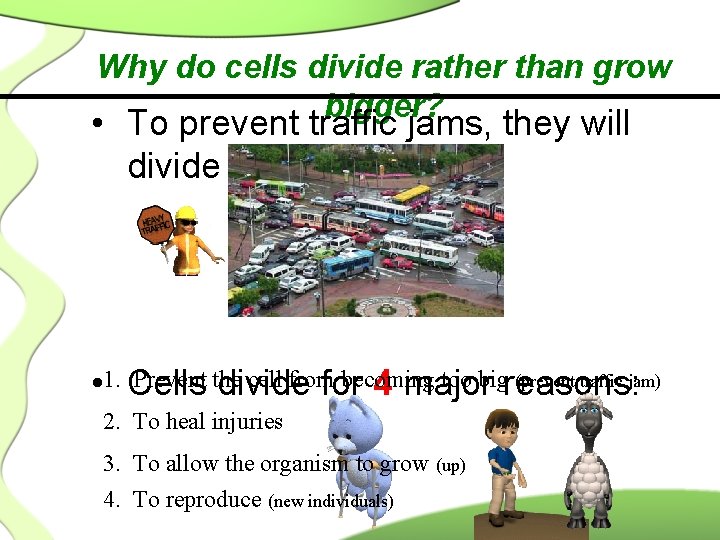
Why do cells divide rather than grow bigger? • To prevent traffic jams, they will divide Prevent the cell from becoming too bigreasons: (prevent traffic jam) • 1. Cells divide for 4 major 2. To heal injuries 3. To allow the organism to grow (up) 4. To reproduce (new individuals)
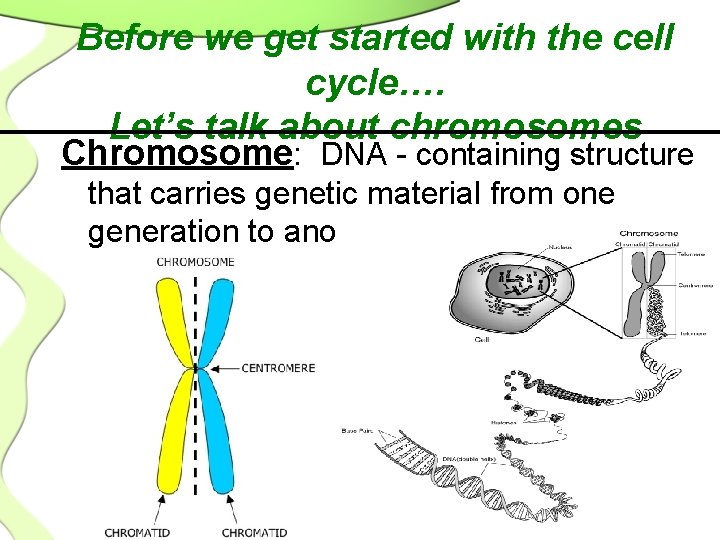
Before we get started with the cell cycle…. Let’s talk about chromosomes Chromosome: DNA - containing structure that carries genetic material from one generation to another.
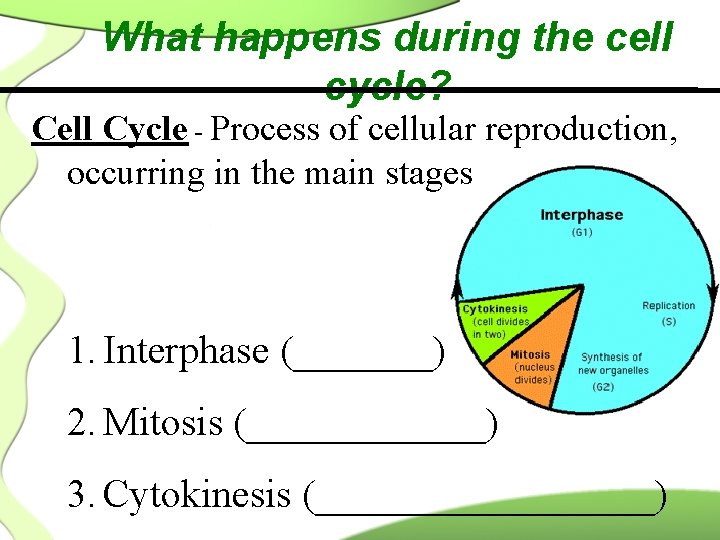
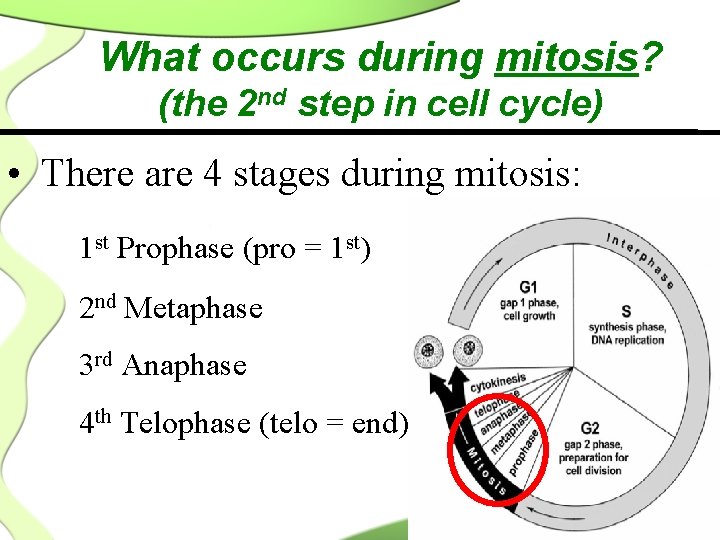
What happens during the cell cycle? Cell Cycle - Process of cellular reproduction, occurring in the main stages 1. Interphase (_______) 2. Mitosis (______) 3. Cytokinesis (_________)
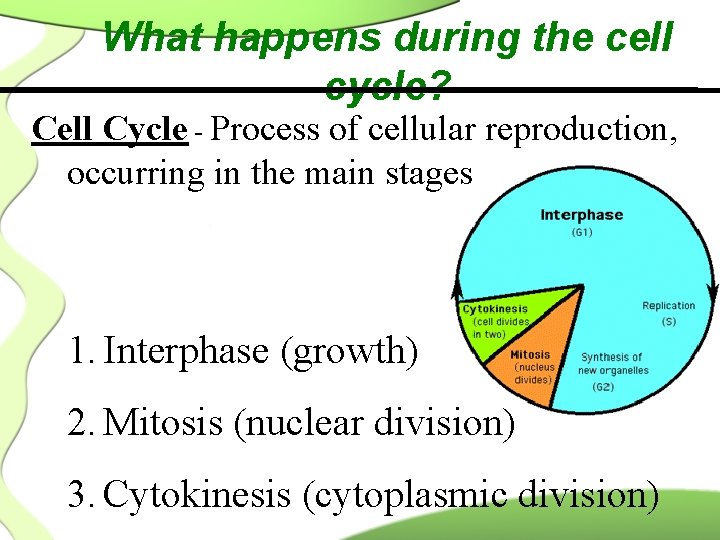
What happens during the cell cycle? Cell Cycle - Process of cellular reproduction, occurring in the main stages 1. Interphase (growth) 2. Mitosis (nuclear division) 3. Cytokinesis (cytoplasmic division)
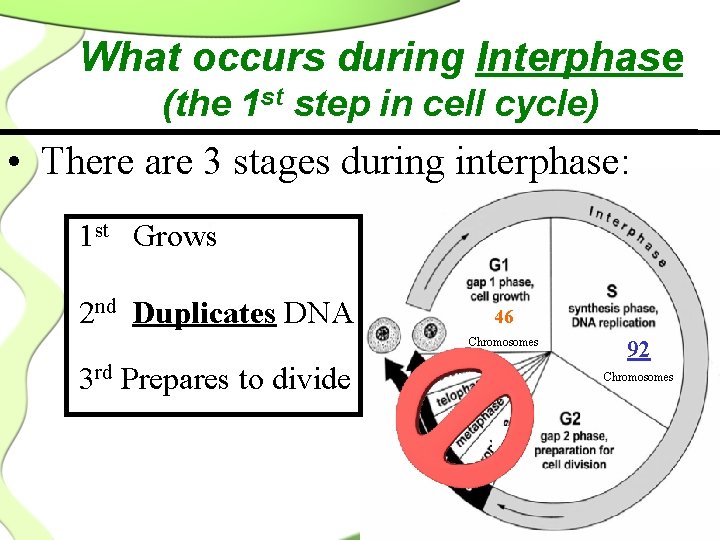
What occurs during Interphase (the 1 st step in cell cycle) • There are 3 stages during interphase: 1 st Grows 2 nd Duplicates DNA 46 Chromosomes 3 rd Prepares to divide 92 Chromosomes
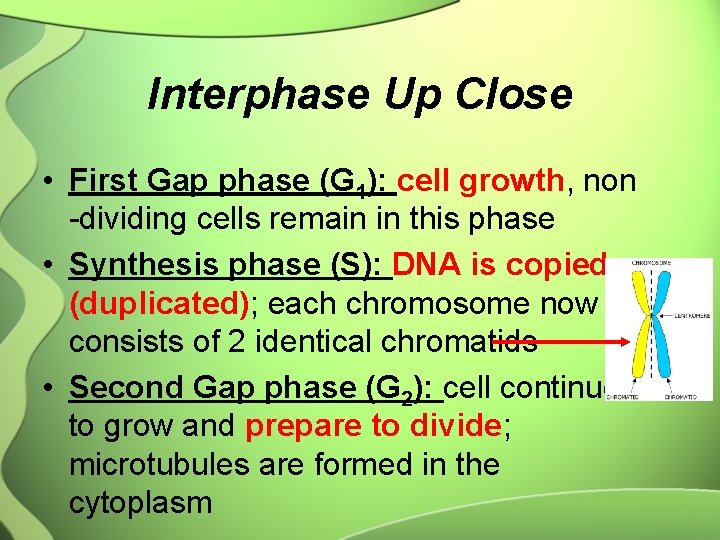
Interphase Up Close • First Gap phase (G 1): cell growth, non -dividing cells remain in this phase • Synthesis phase (S): DNA is copied (duplicated); each chromosome now consists of 2 identical chromatids • Second Gap phase (G 2): cell continues to grow and prepare to divide; microtubules are formed in the cytoplasm
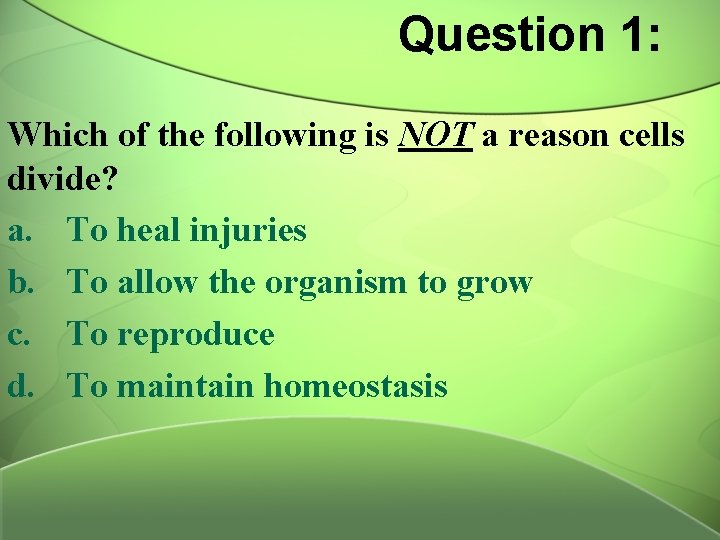
Question 1: Which of the following is NOT a reason cells divide? a. To heal injuries b. To allow the organism to grow c. To reproduce d. To maintain homeostasis
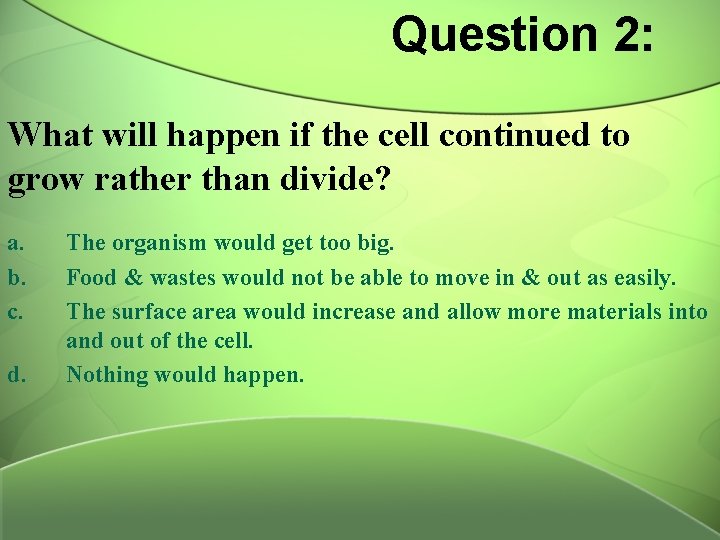
Question 2: What will happen if the cell continued to grow rather than divide? a. b. c. d. The organism would get too big. Food & wastes would not be able to move in & out as easily. The surface area would increase and allow more materials into and out of the cell. Nothing would happen.
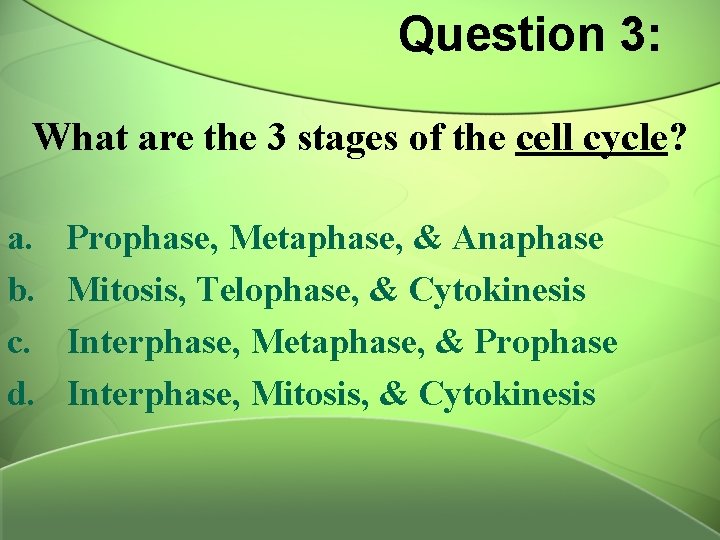
Question 3: What are the 3 stages of the cell cycle? a. b. c. d. Prophase, Metaphase, & Anaphase Mitosis, Telophase, & Cytokinesis Interphase, Metaphase, & Prophase Interphase, Mitosis, & Cytokinesis
Question 4: Which of the following is NOT a stage during Interphase? a. b. c. d. Growth (G 1) DNA replicates (S) Prepares to divide (G 2) Mitosis (M)
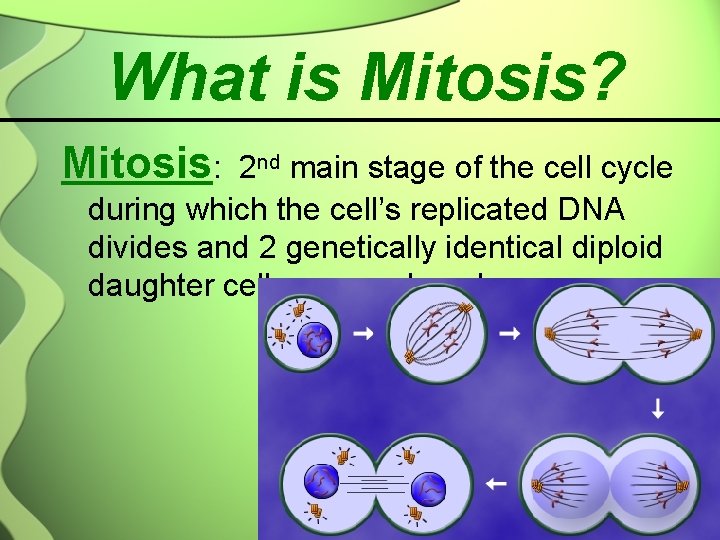
What is Mitosis? Mitosis: 2 nd main stage of the cell cycle during which the cell’s replicated DNA divides and 2 genetically identical diploid daughter cells are produced.
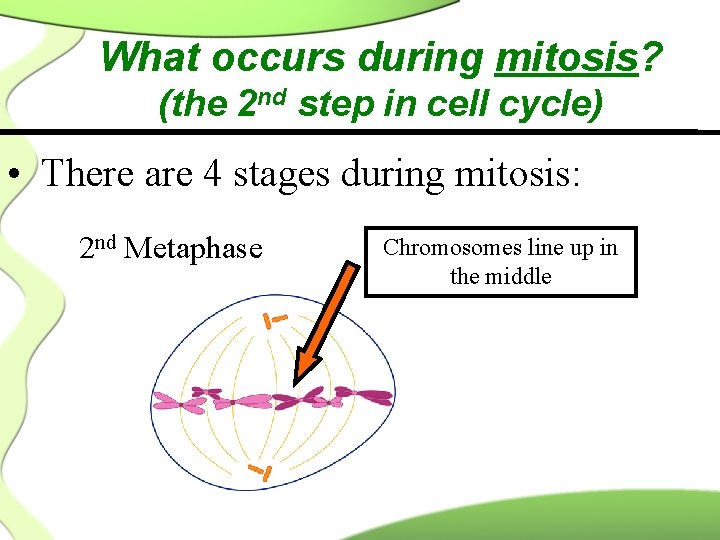
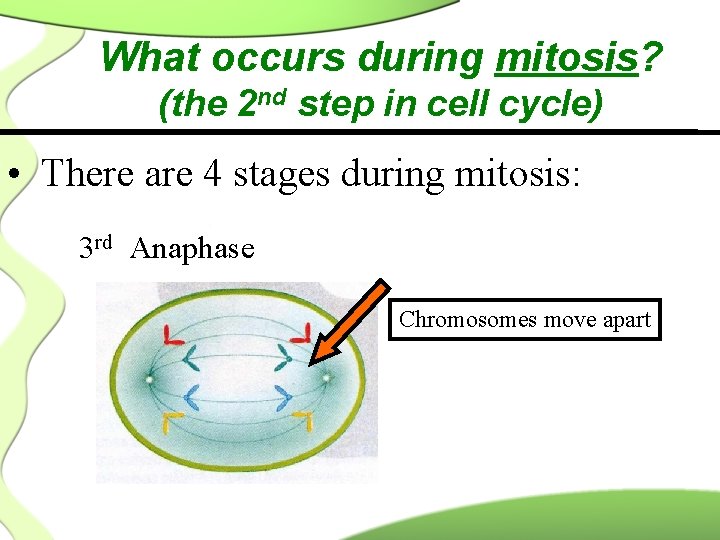
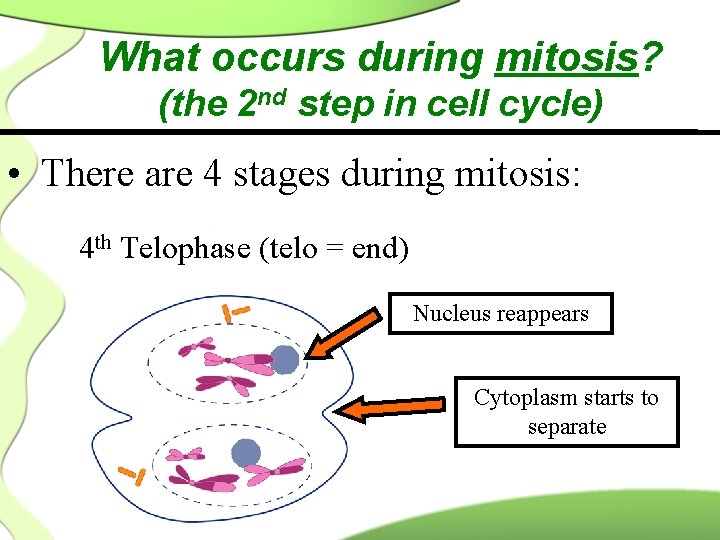
What occurs during mitosis? (the 2 nd step in cell cycle) • There are 4 stages during mitosis: 1 st Prophase (pro = 1 st) 2 nd Metaphase 3 rd Anaphase 4 th Telophase (telo = end)
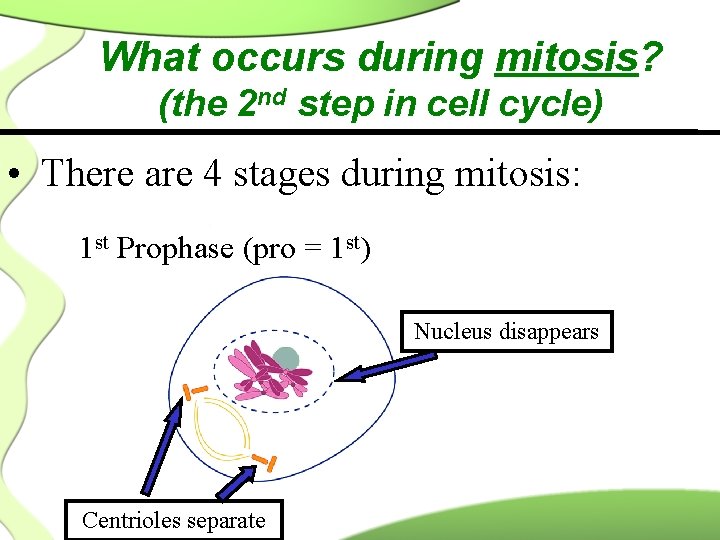
What occurs during mitosis? (the 2 nd step in cell cycle) • There are 4 stages during mitosis: 1 st Prophase (pro = 1 st) Nucleus disappears Centrioles separate
What occurs during mitosis? (the 2 nd step in cell cycle) • There are 4 stages during mitosis: 2 nd Metaphase Chromosomes line up in the middle
What occurs during mitosis? (the 2 nd step in cell cycle) • There are 4 stages during mitosis: 3 rd Anaphase Chromosomes move apart
What occurs during mitosis? (the 2 nd step in cell cycle) • There are 4 stages during mitosis: 4 th Telophase (telo = end) Nucleus reappears Cytoplasm starts to separate
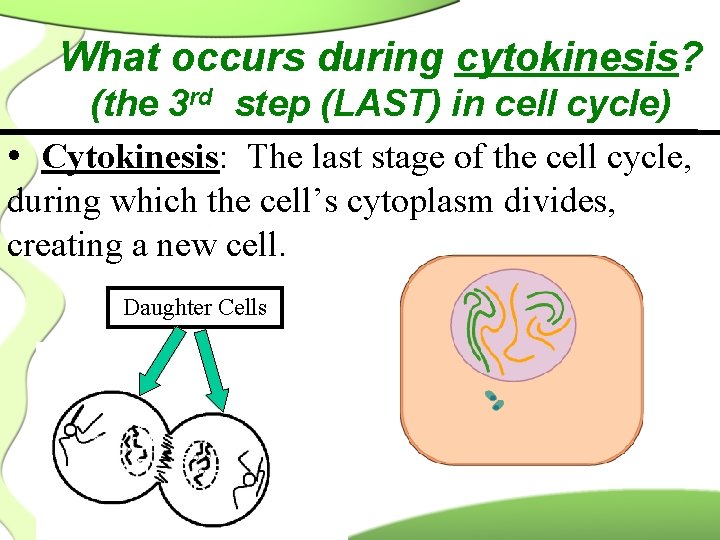
What occurs during cytokinesis? (the 3 rd step (LAST) in cell cycle) • Cytokinesis: The last stage of the cell cycle, during which the cell’s cytoplasm divides, creating a new cell. Daughter Cells
Question 5: Mitosis creates a. 4 genetically identical cells. b. 2 genetically identical cells. c. 4 genetically different cells. d. 2 genetically different cells.
Question 6: What are the 4 stages of mitosis in order? a. Interphase, prophase, metaphase, anaphase b. Interphase, prophase, metaphase, telophase c. Prophase, metaphase, telophase, cytokinesis d. Prophase, metaphase, anaphase, telophase
Question 7: This is the last phase of the cell cycle where the cell’s cytoplasm divides to create 2 daughter cells: a. Cytokinesis b. Interphase c. Telophase d. Metaphase