
CELL CULTURE Modeling of centrifuge using CFD methods
- Slides: 1
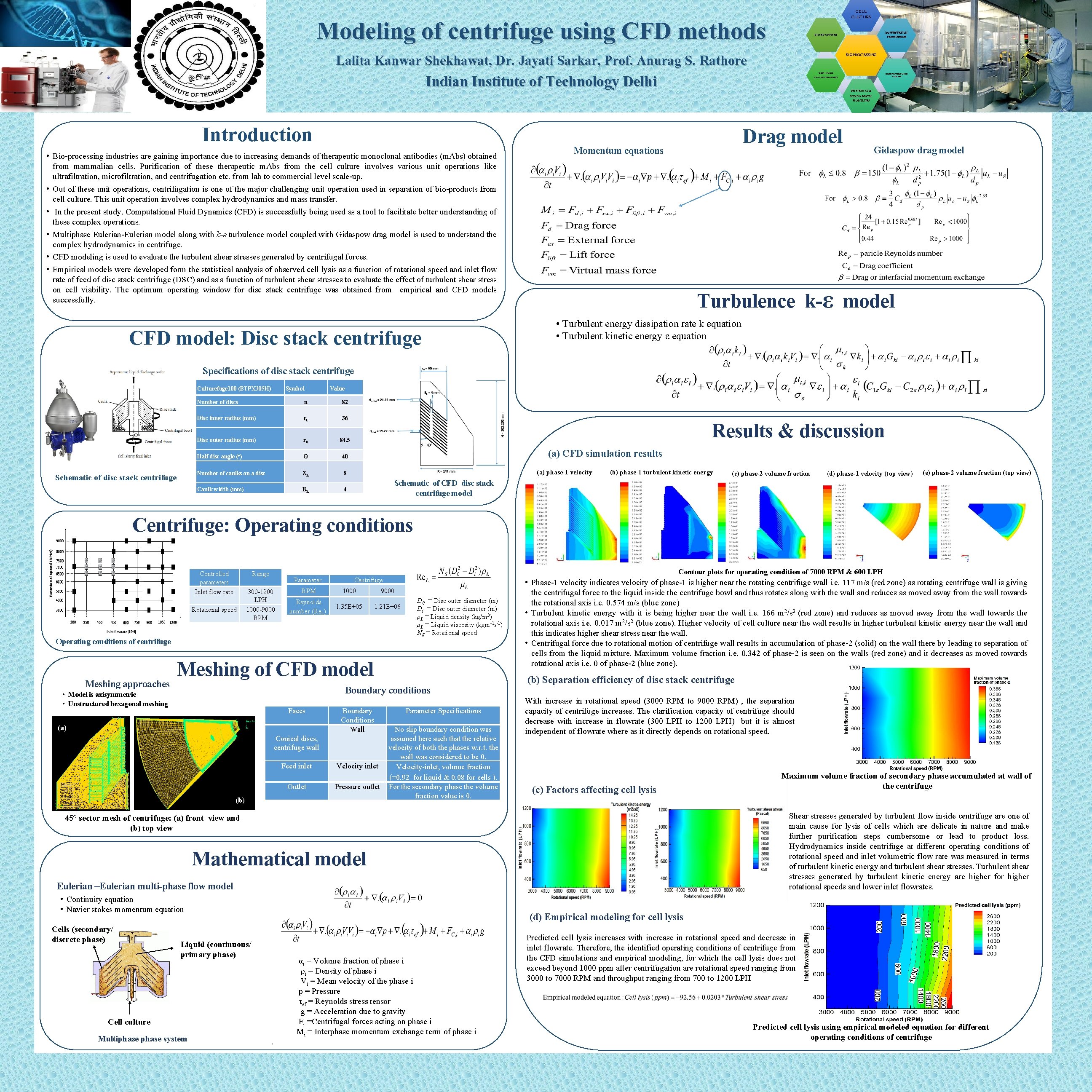
CELL CULTURE Modeling of centrifuge using CFD methods Lalita Kanwar Shekhawat, Dr. Jayati Sarkar, Prof. Anurag S. Rathore BIOPROCESSING BIOSIMILARS CHARACTERISATION Indian Institute of Technology Delhi Introduction • Bio-processing industries are gaining importance due to increasing demands of therapeutic monoclonal antibodies (m. Abs) obtained from mammalian cells. Purification of these therapeutic m. Abs from the cell culture involves various unit operations like ultrafiltration, microfiltration, and centrifugation etc. from lab to commercial level scale-up. • Out of these unit operations, centrifugation is one of the major challenging unit operation used in separation of bio-products from cell culture. This unit operation involves complex hydrodynamics and mass transfer. • In the present study, Computational Fluid Dynamics (CFD) is successfully being used as a tool to facilitate better understanding of these complex operations. • Multiphase Eulerian-Eulerian model along with k-ε turbulence model coupled with Gidaspow drag model is used to understand the complex hydrodynamics in centrifuge. • CFD modeling is used to evaluate the turbulent shear stresses generated by centrifugal forces. • Empirical models were developed form the statistical analysis of observed cell lysis as a function of rotational speed and inlet flow rate of feed of disc stack centrifuge (DSC) and as a function of turbulent shear stresses to evaluate the effect of turbulent shear stress on cell viability. The optimum operating window for disc stack centrifuge was obtained from empirical and CFD models successfully. CFD model: Disc stack centrifuge DOWNSTREAM PROCESSING BIOREACTORS CHROMATOGRAPHIC PROCESS EMPIRICAL & MECHANISTIC MODELING Drag model Momentum equations Gidaspow drag model Turbulence k-ε model • Turbulent energy dissipation rate k equation • Turbulent kinetic energy ε equation Specifications of disc stack centrifuge Culturefuge 100 (BTPX 305 H) Schematic of disc stack centrifuge Symbol Value Number of discs n 82 Disc inner radius (mm) ri 36 Disc outer radius (mm) r 0 84. 5 Half disc angle (o) ϴ 40 Number of caulks on a disc ZL 8 Caulk width (mm) BL 4 Results & discussion (a) CFD simulation results (a) phase-1 velocity (b) phase-1 turbulent kinetic energy (c) phase-2 volume fraction (d) phase-1 velocity (top view) (e) phase-2 volume fraction (top view) Schematic of CFD disc stack centrifuge model Centrifuge: Operating conditions Controlled parameters Inlet flow rate Contour plots for operating condition of 7000 RPM & 600 LPH Range Rotational speed Parameter 300 -1200 LPH 1000 -9000 RPM Reynolds number (Re. L) Centrifuge 1000 1. 35 E+05 9000 1. 21 E+06 Operating conditions of centrifuge Meshing approaches D 0 = Disc outer diameter (m) Di = Disc outer diameter (m) ρL = Liquid density (kg/m 3) μL = Liquid viscosity (kgm-1 s-1) NS = Rotational speed Meshing of CFD model Boundary conditions • Model is axisymmetric • Unstructured hexagonal meshing Faces (a) Boundary Conditions Wall Conical discs, centrifuge wall Feed inlet (b) Outlet Velocity inlet Pressure outlet (b) Parameter Specifications No slip boundary condition was assumed here such that the relative velocity of both the phases w. r. t. the wall was considered to be 0. Velocity-inlet, volume fraction (=0. 92 for liquid & 0. 08 for cells ). For the secondary phase the volume fraction value is 0. • Phase-1 velocity indicates velocity of phase-1 is higher near the rotating centrifuge wall i. e. 117 m/s (red zone) as rotating centrifuge wall is giving the centrifugal force to the liquid inside the centrifuge bowl and thus rotates along with the wall and reduces as moved away from the wall towards the rotational axis i. e. 0. 574 m/s (blue zone) • Turbulent kinetic energy with it is being higher near the wall i. e. 166 m 2/s 2 (red zone) and reduces as moved away from the wall towards the rotational axis i. e. 0. 017 m 2/s 2 (blue zone). Higher velocity of cell culture near the wall results in higher turbulent kinetic energy near the wall and this indicates higher shear stress near the wall. • Centrifugal force due to rotational motion of centrifuge wall results in accumulation of phase-2 (solid) on the wall there by leading to separation of cells from the liquid mixture. Maximum volume fraction i. e. 0. 342 of phase-2 is seen on the walls (red zone) and it decreases as moved towards rotational axis i. e. 0 of phase-2 (blue zone). (b) Separation efficiency of disc stack centrifuge With increase in rotational speed (3000 RPM to 9000 RPM) , the separation capacity of centrifuge increases. The clarification capacity of centrifuge should decrease with increase in flowrate (300 LPH to 1200 LPH) but it is almost independent of flowrate where as it directly depends on rotational speed. (c) Factors affecting cell lysis Shear stresses generated by turbulent flow inside centrifuge are one of main cause for lysis of cells which are delicate in nature and make further purification steps cumbersome or lead to product loss. Hydrodynamics inside centrifuge at different operating conditions of rotational speed and inlet volumetric flow rate was measured in terms of turbulent kinetic energy and turbulent shear stresses. Turbulent shear stresses generated by turbulent kinetic energy are higher for higher rotational speeds and lower inlet flowrates. 45° sector mesh of centrifuge: (a) front view and (b) top view Mathematical model Eulerian –Eulerian multi-phase flow model • Continuity equation • Navier stokes momentum equation Cells (secondary/ discrete phase) (d) Empirical modeling for cell lysis Liquid (continuous/ primary phase) Cell culture Multiphase system Maximum volume fraction of secondary phase accumulated at wall of the centrifuge . αi = Volume fraction of phase i ρi = Density of phase i Vi = Mean velocity of the phase i p = Pressure τef = Reynolds stress tensor g = Acceleration due to gravity Fi =Centrifugal forces acting on phase i Mi = Interphase momentum exchange term of phase i Predicted cell lysis increases with increase in rotational speed and decrease in inlet flowrate. Therefore, the identified operating conditions of centrifuge from the CFD simulations and empirical modeling, for which the cell lysis does not exceed beyond 1000 ppm after centrifugation are rotational speed ranging from 3000 to 7000 RPM and throughput ranging from 700 to 1200 LPH Predicted cell lysis using empirical modeled equation for different operating conditions of centrifuge