
Cell Communication Power Point Lectures for Biology Seventh
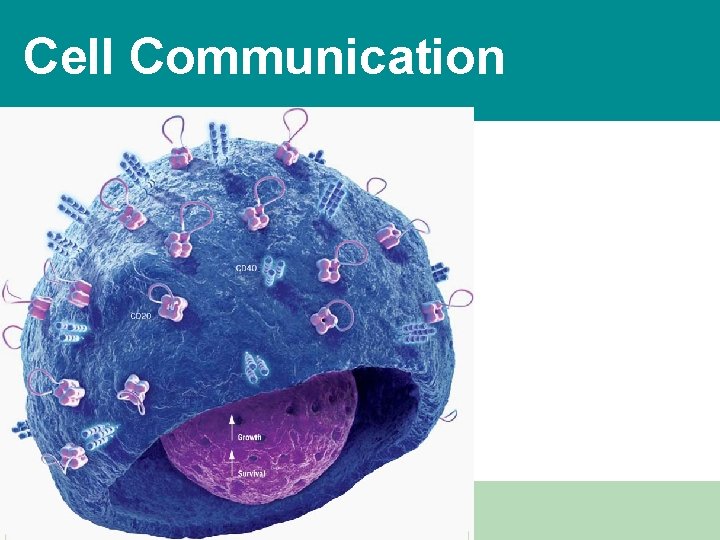
Cell Communication Power. Point Lectures for Biology, Seventh Edition Neil Campbell and Jane Reece Lectures by Chris Romero Copyright © 2005 Pearson Education, Inc. publishing as Benjamin Cummings
Cell-to-cell communication – External signals are converted into responses within the cell – Cells (in multicellular organisms) communicate by a variety of chemical signals. Some examples are: – 1. Hormones, such as insulin- Produced in one tissue, travel through bloodstream, interact with certain cells to change cell activity. – 2. Neurotransmitters, such as dopamine. Released by one nerve cell (neuron), travels very short distance to adjacent neuron, stimulates nerve cell activity Copyright © 2005 Pearson Education, Inc. publishing as Benjamin Cummings
Signal Transduction Pathways – Convert signals on a cell’s surface into cellular responses – Are similar in microbes and mammals, suggesting an early origin Copyright © 2005 Pearson Education, Inc. publishing as Benjamin Cummings
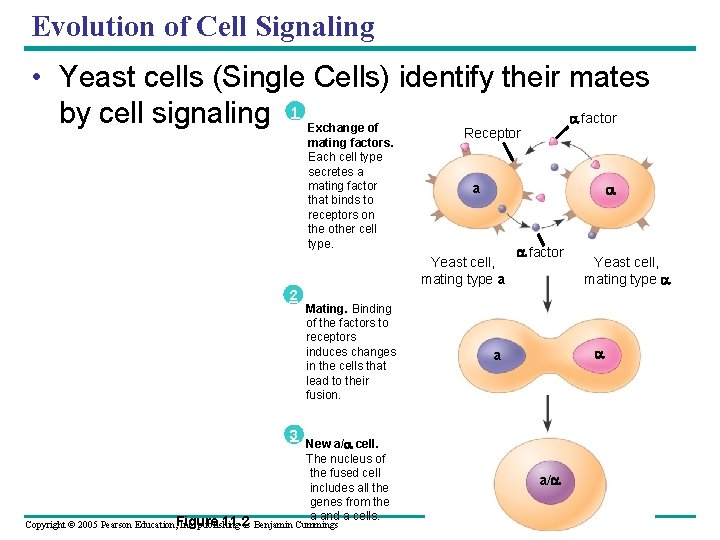
Evolution of Cell Signaling • Yeast cells (Single Cells) identify their mates by cell signaling 1 factor Exchange of mating factors. Each cell type secretes a mating factor that binds to receptors on the other cell type. Receptor a Yeast cell, mating type a 2 3 Mating. Binding of the factors to receptors induces changes in the cells that lead to their fusion. New a/ cell. The nucleus of the fused cell includes all the genes from the a and a cells. 11. 2 as Benjamin Cummings Copyright © 2005 Pearson Education, Figure Inc. publishing factor Yeast cell, mating type a a/
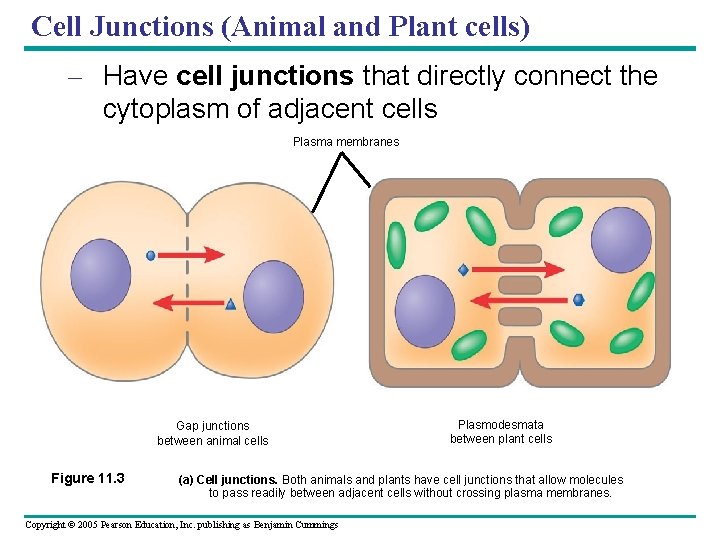
Cell Junctions (Animal and Plant cells) – Have cell junctions that directly connect the cytoplasm of adjacent cells Plasma membranes Gap junctions between animal cells Figure 11. 3 Plasmodesmata between plant cells (a) Cell junctions. Both animals and plants have cell junctions that allow molecules to pass readily between adjacent cells without crossing plasma membranes. Copyright © 2005 Pearson Education, Inc. publishing as Benjamin Cummings
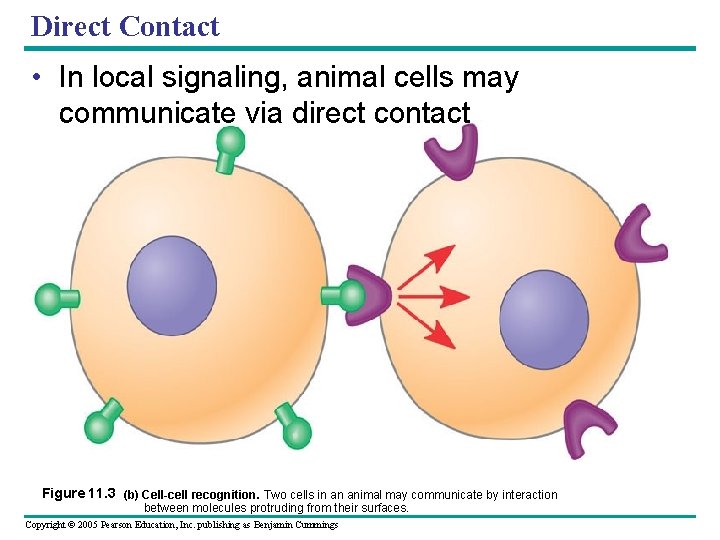
Direct Contact • In local signaling, animal cells may communicate via direct contact Figure 11. 3 (b) Cell-cell recognition. Two cells in an animal may communicate by interaction between molecules protruding from their surfaces. Copyright © 2005 Pearson Education, Inc. publishing as Benjamin Cummings
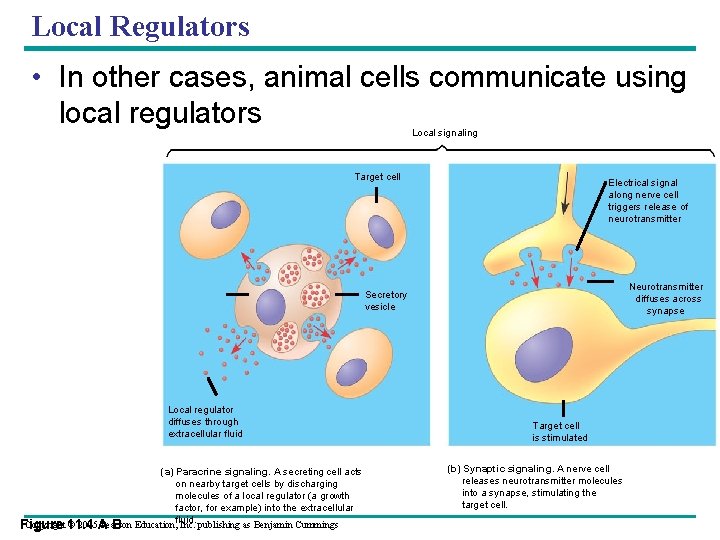
Local Regulators • In other cases, animal cells communicate using local regulators Local signaling Target cell Electrical signal along nerve cell triggers release of neurotransmitter Neurotransmitter diffuses across synapse Secretory vesicle Local regulator diffuses through extracellular fluid (a) Paracrine signaling. A secreting cell acts on nearby target cells by discharging molecules of a local regulator (a growth factor, for example) into the extracellular Copyright © 2005 Pearson Education, fluid. Inc. publishing as Benjamin Cummings Figure 11. 4 A B Target cell is stimulated (b) Synaptic signaling. A nerve cell releases neurotransmitter molecules into a synapse, stimulating the target cell.

Long Distance Signaling – Both plants and animals use hormones in long distance signaling Long-distance signaling Blood vessel Endocrine cell Hormone travels in bloodstream to target cells Target cell Copyright © 2005 Pearson Education, Inc. publishing as Benjamin Cummings Figure 11. 4 C (c) Hormonal signaling. Specialized endocrine cells secrete hormones into body fluids, often the blood. Hormones may reach virtually all body cells.
• Sutherland discovered how the hormone epinephrine acts on cells • He suggested that cells receiving signals went through three processes: 1. Reception 2. Transduction 3. Response Copyright © 2005 Pearson Education, Inc. publishing as Benjamin Cummings
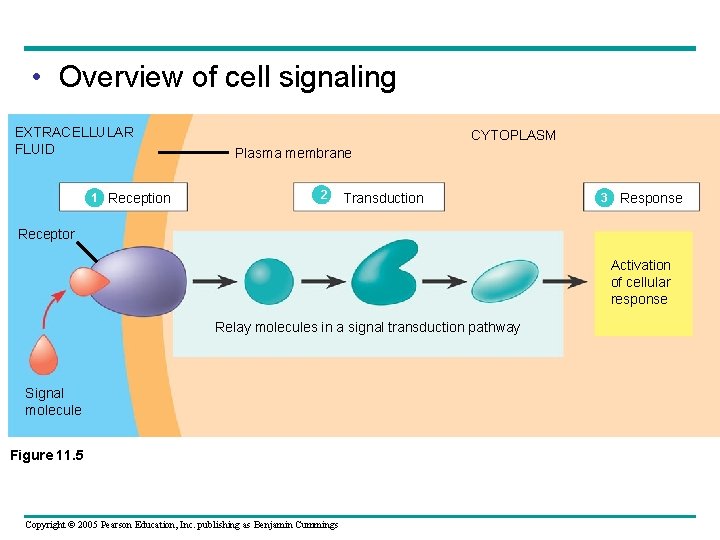
• Overview of cell signaling EXTRACELLULAR FLUID 1 Reception CYTOPLASM Plasma membrane 2 Transduction 3 Response Receptor Activation of cellular response Relay molecules in a signal transduction pathway Signal molecule Figure 11. 5 Copyright © 2005 Pearson Education, Inc. publishing as Benjamin Cummings
Reception • Reception- A signal molecule binds to a receptor protein, causing it to change shape • The binding between signal molecule (ligand) and receptor is highly specific • A conformational change in a receptor is often the initial transduction of the signal • Intracellular receptors are cytoplasmic or nuclear proteins • Signal molecules that are small or hydrophobic and can readily cross the plasma membrane use these receptors Copyright © 2005 Pearson Education, Inc. publishing as Benjamin Cummings
Receptors in the Plasma Membrane • There are three main types of membrane receptors 1. G-protein-linked receptors 2. Tyrosine kinases receptors 3. Ion channel receptors Copyright © 2005 Pearson Education, Inc. publishing as Benjamin Cummings
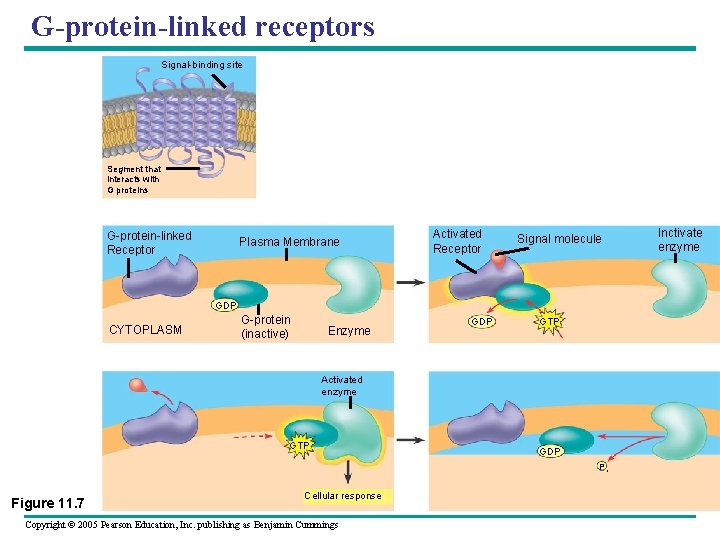
G-protein-linked receptors Signal-binding site Segment that interacts with G proteins G-protein-linked Receptor Plasma Membrane Activated Receptor Signal molecule GDP CYTOPLASM G-protein (inactive) Enzyme GDP GTP Activated enzyme GTP GDP Pi Figure 11. 7 Cellular response Copyright © 2005 Pearson Education, Inc. publishing as Benjamin Cummings Inctivate enzyme
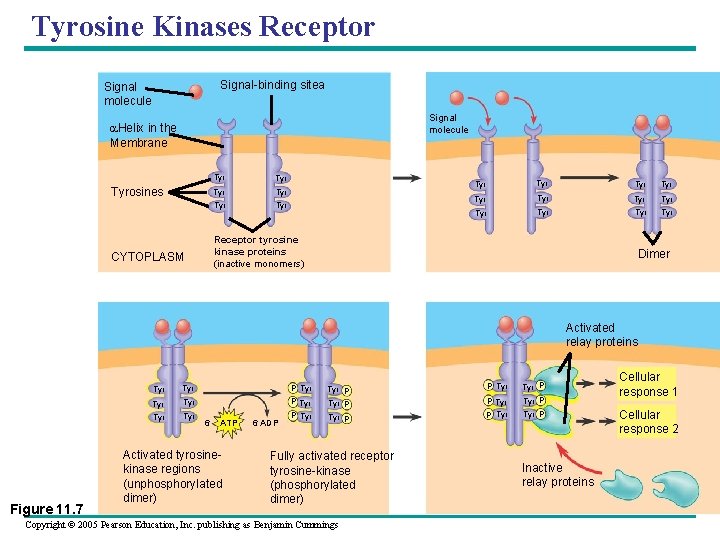
Tyrosine Kinases Receptor Signal-binding sitea Signal molecule Helix in the Membrane Tyrosines Tyr Tyr Tyr Tyr Tyr Receptor tyrosine kinase proteins (inactive monomers) CYTOPLASM Dimer Activated relay proteins Figure 11. 7 Tyr Tyr P Tyr Tyr P P Tyr P 6 ATP Activated tyrosinekinase regions (unphosphorylated dimer) 6 ADP Fully activated receptor tyrosine-kinase (phosphorylated dimer) Copyright © 2005 Pearson Education, Inc. publishing as Benjamin Cummings Inactive relay proteins Cellular response 1 Cellular response 2
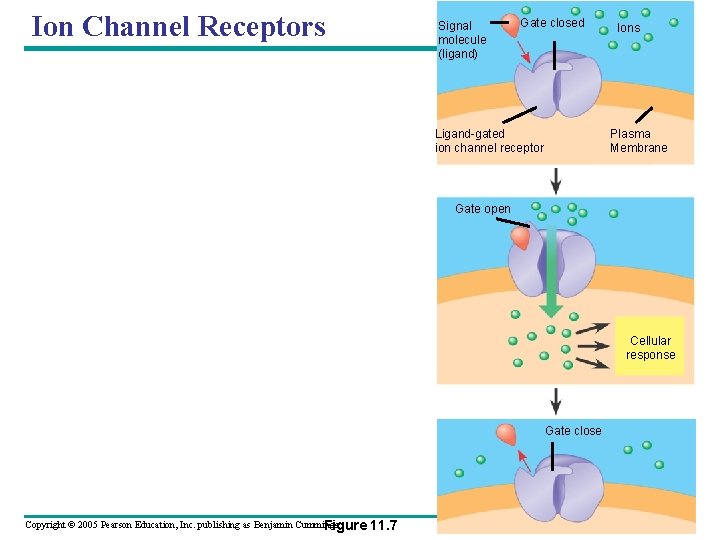
Ion Channel Receptors Signal molecule (ligand) Gate closed Ligand-gated ion channel receptor Ions Plasma Membrane Gate open Cellular response Gate close Copyright © 2005 Pearson Education, Inc. publishing as Benjamin Cummings Figure 11. 7
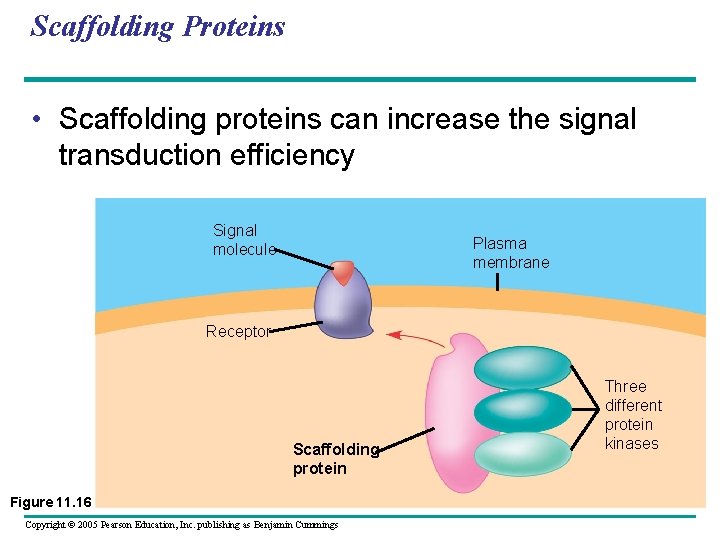
Scaffolding Proteins • Scaffolding proteins can increase the signal transduction efficiency Signal molecule Plasma membrane Receptor Scaffolding protein Figure 11. 16 Copyright © 2005 Pearson Education, Inc. publishing as Benjamin Cummings Three different protein kinases
G- Protein linked receptors • 3 components- allosteric proteins that can change shape in response to signal: 1. Receptor proteins- spans plasma membrane, has receptor site on outside, binding site for G-protein on inside 2. G- protein- loosely attached to inner membrane • • Acts like on-off switch Inactive form when bound to GDP Active form when bound to GTP G-protein soon breaks GTP down to GDP, so “on” stat switches back to “off” 3. Target- usually a membrane bound enzyme • Enzyme is inactive until activated by active Gprotein Copyright © 2005 Pearson Education, Inc. publishing as Benjamin Cummings
Examples that use G-proteins: • Many hormone receptors • Many neurotransmitters • Vision and smell in humans • Bacterial infections (botulism, cholera, etc. ) produce toxins that interfere with G- proteins, leading to disease symptons • As many as 60% of all medicines sold today act by influencing G- protein pathways Copyright © 2005 Pearson Education, Inc. publishing as Benjamin Cummings
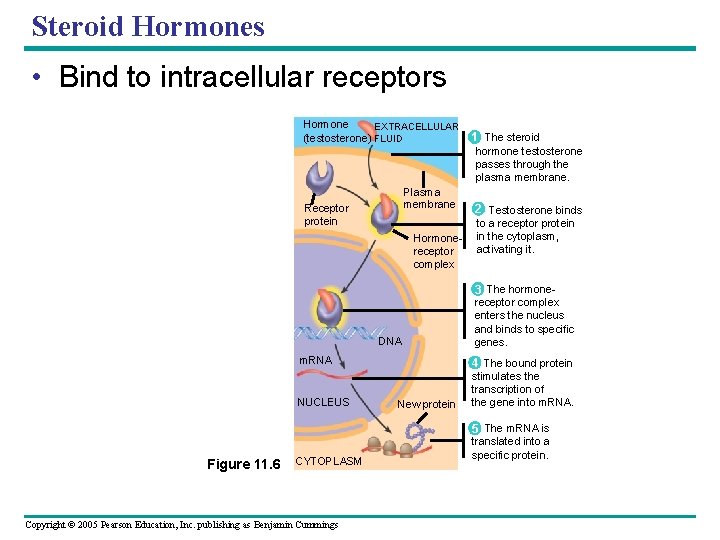
Steroid Hormones • Bind to intracellular receptors Hormone EXTRACELLULAR (testosterone) FLUID 1 The steroid hormone testosterone passes through the plasma membrane. Plasma membrane Receptor protein Hormonereceptor complex 2 Testosterone binds to a receptor protein in the cytoplasm, activating it. 3 The hormone- DNA Figure 11. 6 receptor complex enters the nucleus and binds to specific genes. m. RNA 4 The bound protein NUCLEUS stimulates the transcription of the gene into m. RNA. CYTOPLASM Copyright © 2005 Pearson Education, Inc. publishing as Benjamin Cummings New protein 5 The m. RNA is translated into a specific protein.
Signal Transduction • Transduction: Cascades of molecular interactions relay signals from receptors to target molecules in the cell 1. Protein Phosphorylation 2. Second Messengers Copyright © 2005 Pearson Education, Inc. publishing as Benjamin Cummings
1. Protein Phosphorylation and Dephosphorylation • Multistep pathways – Can amplify a signal and provide more opportunities for coordination and regulation • At each step in a pathway – The signal is transduced into a different form, commonly a conformational/shape change in a protein – Include phosphorylation cascades Copyright © 2005 Pearson Education, Inc. publishing as Benjamin Cummings
Protein Phosphorylation • In this process – A series of protein kinases (enzymes) add a phosphate to the next one in line, activating it – Phosphatase enzymes then remove the phosphates – Kinases are often linked: Kinase 1 activates kinase 2, which activates kinase 3, etc to final target. Copyright © 2005 Pearson Education, Inc. publishing as Benjamin Cummings
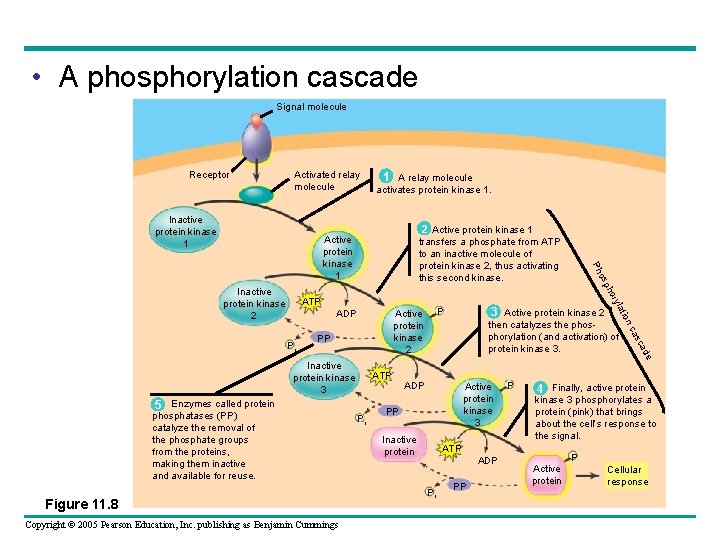
• A phosphorylation cascade Signal molecule Receptor Activated relay molecule Inactive protein kinase 1 1 A relay molecule activates protein kinase 1. ory ph ATP 5 Enzymes called protein phosphatases (PP) catalyze the removal of the phosphate groups from the proteins, making them inactive and available for reuse. Figure 11. 8 Copyright © 2005 Pearson Education, Inc. publishing as Benjamin Cummings ATP Pi ADP Active protein kinase 3 PP Inactive protein P 4 Finally, active protein kinase 3 phosphorylates a protein (pink) that brings about the cell’s response to the signal. ATP ADP Pi PP de Inactive protein kinase 3 a sc ca PP on Pi 3 Active protein kinase 2 then catalyzes the phosphorylation (and activation) of protein kinase 3. P Active protein kinase 2 ADP i lat Inactive protein kinase 2 os Ph 2 Active protein kinase 1 transfers a phosphate from ATP to an inactive molecule of protein kinase 2, thus activating this second kinase. Active protein kinase 1 P Active protein Cellular response
2. Second Messengers • Second messengers- are small, non-protein, water-soluble molecules or ions • Example= cyclic AMP (c. AMP) • c. AMP is made from ATP by enzyme adenyl cyclase (often activated by G-protein) • c. AMP acts like an intracellular hormone, stimulating variety of effects thatdiffers from tissue to tissue Copyright © 2005 Pearson Education, Inc. publishing as Benjamin Cummings
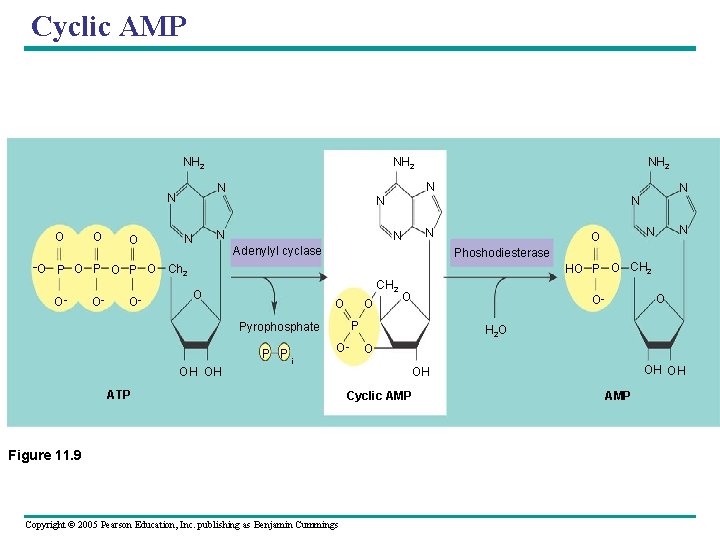
Cyclic AMP NH 2 O O O N N N NH 2 N N N Adenylyl cyclase Phoshodiesterase HO P O CH 2 O P O P O Ch 2 O O N N O – O N CH 2 O OH OH O P Pyrophosphate P Pi O O ATP Figure 11. 9 Copyright © 2005 Pearson Education, Inc. publishing as Benjamin Cummings O H 2 O O OH OH OH Cyclic AMP
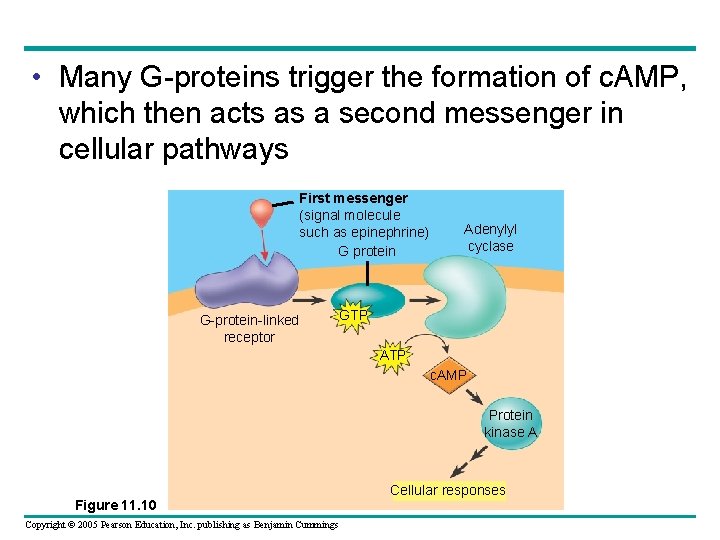
• Many G-proteins trigger the formation of c. AMP, which then acts as a second messenger in cellular pathways First messenger (signal molecule such as epinephrine) G protein G-protein-linked receptor Adenylyl cyclase GTP ATP c. AMP Protein kinase A Figure 11. 10 Copyright © 2005 Pearson Education, Inc. publishing as Benjamin Cummings Cellular responses
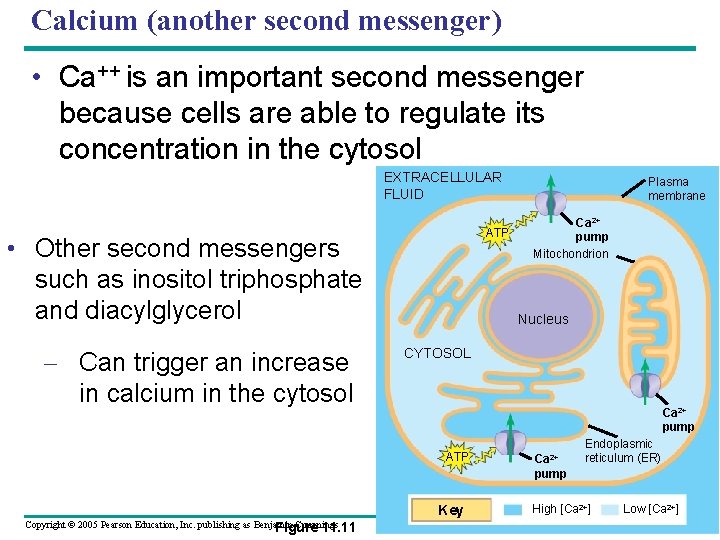
Calcium (another second messenger) • Ca++ is an important second messenger because cells are able to regulate its concentration in the cytosol EXTRACELLULAR FLUID ATP • Other second messengers such as inositol triphosphate and diacylglycerol – Can trigger an increase in calcium in the cytosol Plasma membrane Ca 2+ pump Mitochondrion Nucleus CYTOSOL Ca 2+ pump ATP Ca 2+ Endoplasmic reticulum (ER) pump Key Copyright © 2005 Pearson Education, Inc. publishing as Benjamin Cummings Figure 11. 11 High [Ca 2+] Low [Ca 2+]
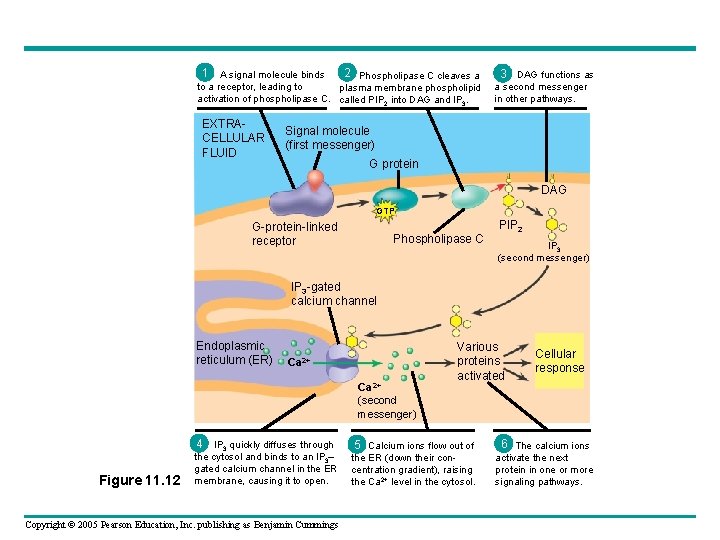
1 A signal molecule binds 2 Phospholipase C cleaves a to a receptor, leading to plasma membrane phospholipid activation of phospholipase C. called PIP 2 into DAG and IP 3. EXTRACELLULAR FLUID 3 DAG functions as a second messenger in other pathways. Signal molecule (first messenger) G protein DAG GTP G-protein-linked receptor Phospholipase C PIP 2 IP 3 (second messenger) IP 3 -gated calcium channel Endoplasmic reticulum (ER) Ca 2+ (second messenger) Figure 11. 12 4 IP 3 quickly diffuses through the cytosol and binds to an IP 3– gated calcium channel in the ER membrane, causing it to open. Copyright © 2005 Pearson Education, Inc. publishing as Benjamin Cummings Various proteins activated 5 Calcium ions flow out of the ER (down their concentration gradient), raising the Ca 2+ level in the cytosol. Cellular response 6 The calcium ions activate the next protein in one or more signaling pathways.
Response • Response: Cell signaling leads to regulation of cytoplasmic activities or transcription • Cells use multi step pathways for amplification • Each activated component can turn “on”, or activate multiple copies of many different target molecules • The more steps involved, the bigger the final number of activated products = activation cascade. Copyright © 2005 Pearson Education, Inc. publishing as Benjamin Cummings
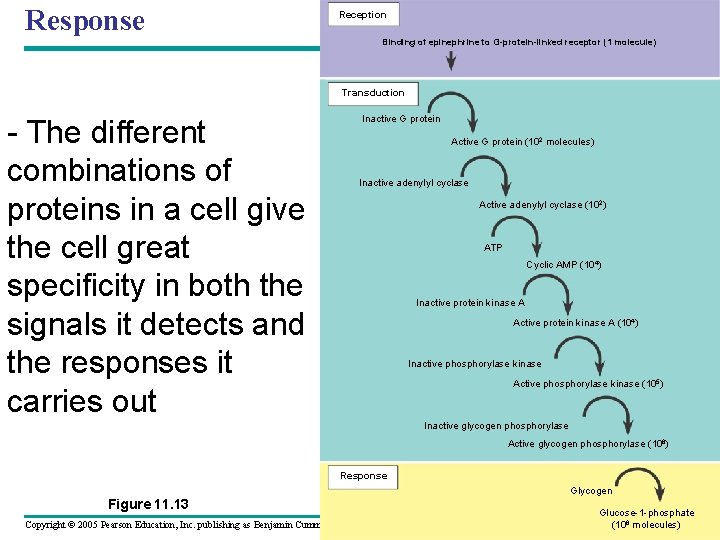
Response Reception Binding of epinephrine to G-protein-linked receptor (1 molecule) Transduction - The different combinations of proteins in a cell give the cell great specificity in both the signals it detects and the responses it carries out Inactive G protein Active G protein (102 molecules) Inactive adenylyl cyclase Active adenylyl cyclase (102) ATP Cyclic AMP (104) Inactive protein kinase A Active protein kinase A (104) Inactive phosphorylase kinase Active phosphorylase kinase (105) Inactive glycogen phosphorylase Active glycogen phosphorylase (106) Response Glycogen Figure 11. 13 Copyright © 2005 Pearson Education, Inc. publishing as Benjamin Cummings Glucose-1 -phosphate (108 molecules)
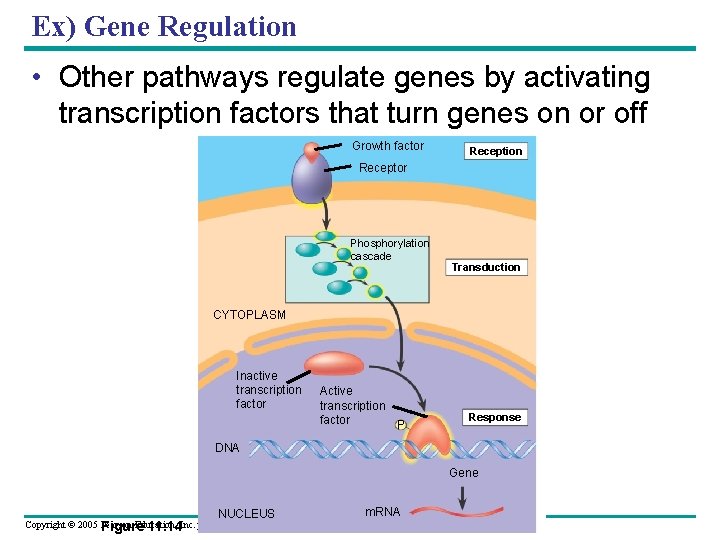
Ex) Gene Regulation • Other pathways regulate genes by activating transcription factors that turn genes on or off Growth factor Reception Receptor Phosphorylation cascade Transduction CYTOPLASM Inactive transcription factor Active transcription factor P Response DNA Gene NUCLEUS Copyright © 2005 Pearson Education, Figure 11. 14 Inc. publishing as Benjamin Cummings m. RNA
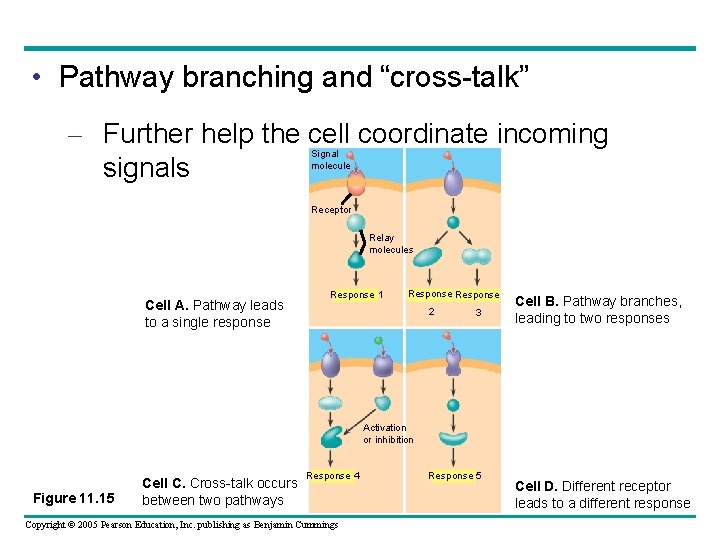
• Pathway branching and “cross-talk” – Further help the cell coordinate incoming signals Signal molecule Receptor Relay molecules Cell A. Pathway leads to a single response Response 1 Response 2 3 Cell B. Pathway branches, leading to two responses Activation or inhibition Figure 11. 15 Cell C. Cross-talk occurs between two pathways Response 4 Copyright © 2005 Pearson Education, Inc. publishing as Benjamin Cummings Response 5 Cell D. Different receptor leads to a different response
Termination of the Signal • Signal response is terminated quickly – By the reversal of ligand binding Copyright © 2005 Pearson Education, Inc. publishing as Benjamin Cummings
- Slides: 33