
Cell Communication Multicellular Organisms Signal transduction pathways coordinate









- Slides: 19
Cell Communication
Multicellular Organisms • Signal transduction pathways coordinate the activities within individual cells that support the function of the organism as a whole
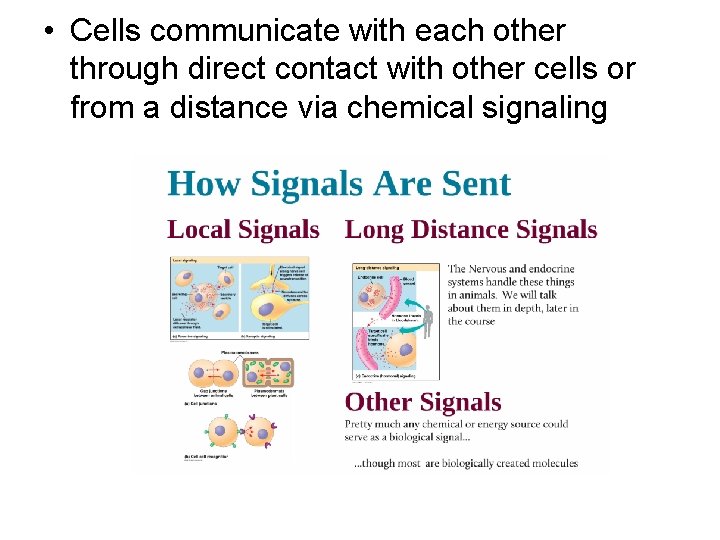
• Cells communicate with each other through direct contact with other cells or from a distance via chemical signaling
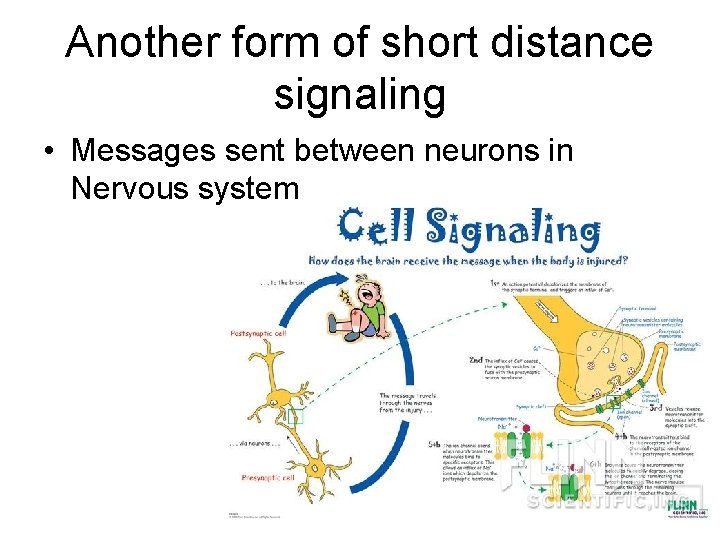
Another form of short distance signaling • Messages sent between neurons in Nervous system
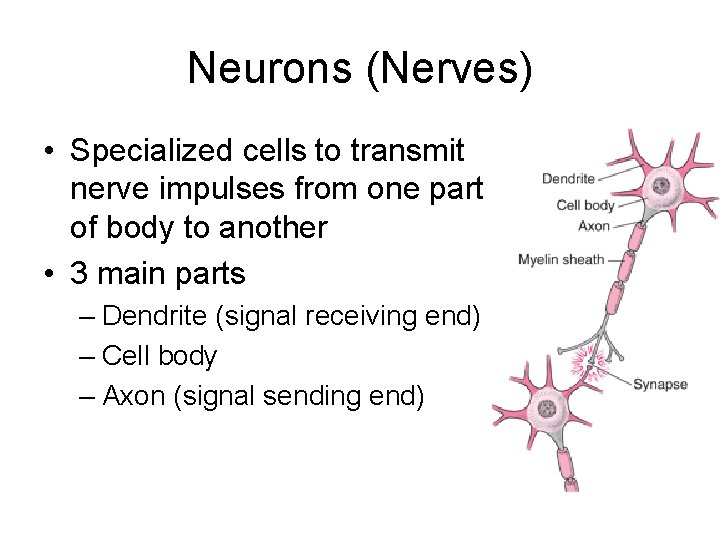
Neurons (Nerves) • Specialized cells to transmit nerve impulses from one part of body to another • 3 main parts – Dendrite (signal receiving end) – Cell body – Axon (signal sending end)
• Many axons have a myelin sheath that acts as an electrical insulator. • Schwann cells, which form the myelin sheath, are separated by gaps of unsheathed axon over which the impulse travels as the signal propagates along the neuron
Synapses • junction between two neurons where messages are passed on by neurotransmitters
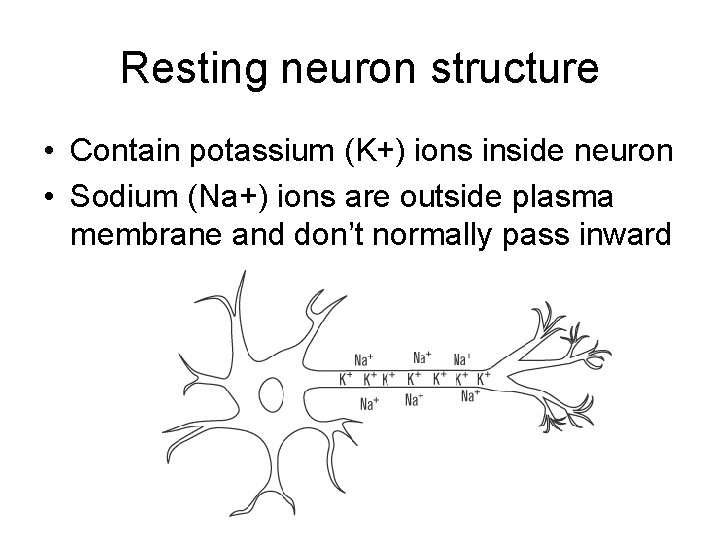
Resting neuron structure • Contain potassium (K+) ions inside neuron • Sodium (Na+) ions are outside plasma membrane and don’t normally pass inward
Polarized neuron • Inactive (not sending an impulse) • Inside of neuron negatively charged to compared to outside
Stimulated neuron. Depolarization • Na+ gates in membrane open and Na+ rushes into cell causing inside to be more positive than outside of cell which activates neuron to transmit an action potential
Action potential • nerve impulse which causes the axon to release a neurotransmitter into synapse that binds to next neuron stimulating it
Cell Repolarization • After action potential • K+ rushes out of cell causing the inside to become negative again • Must occur before neuron can send another nerve impulse
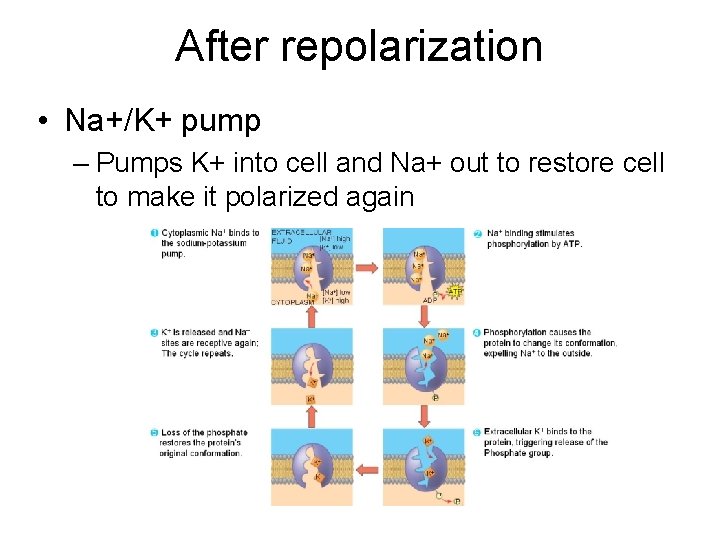
After repolarization • Na+/K+ pump – Pumps K+ into cell and Na+ out to restore cell to make it polarized again
• Transmission of information via neurotransmitters between neurons occur across synapses and result in responses – Responses can be stimulatory or inhibitory – – – Epinephrine Acetylcholine Norepinephrine Dopamine Serotonin GABA
• YOUTUBE Video
Long distance signaling in Humans • Requires cardiovascular system to transport hormones (chemical messages = ligands) to cells in other areas of body
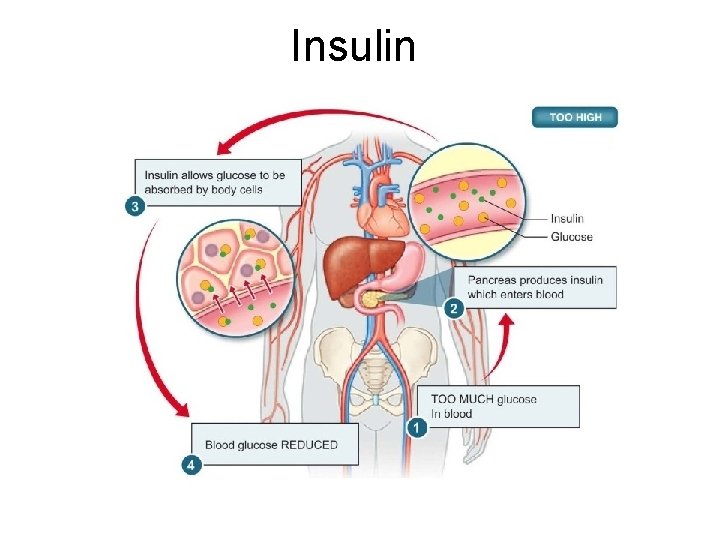
– Endocrine signals (hormones) are produced by endocrine cells that release signaling molecules, which are specific and can travel long distances through the blood to reach all parts of the body – Examples: • • • Insulin Human growth hormone Thyroid hormone Testerone Estrogen
Insulin