
Cell Communication Chapter 11 Types of Cell Communication

- Slides: 22
Cell Communication Chapter 11
Types of Cell Communication • Cells in multicellular organisms communicate via chemical messages • Local (cells are adjacent) • Long-distance • Specific target cells recognize and respond to a specific signaling molecule
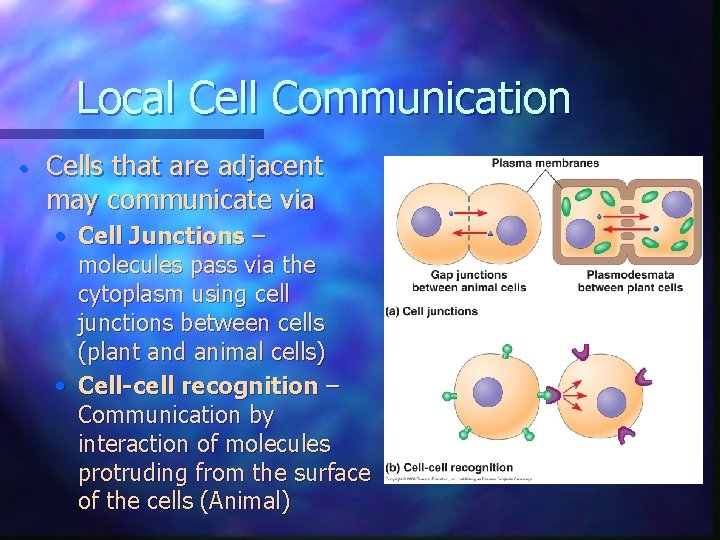
Local Cell Communication • Cells that are adjacent may communicate via • Cell Junctions – molecules pass via the cytoplasm using cell junctions between cells (plant and animal cells) • Cell-cell recognition – Communication by interaction of molecules protruding from the surface of the cells (Animal)
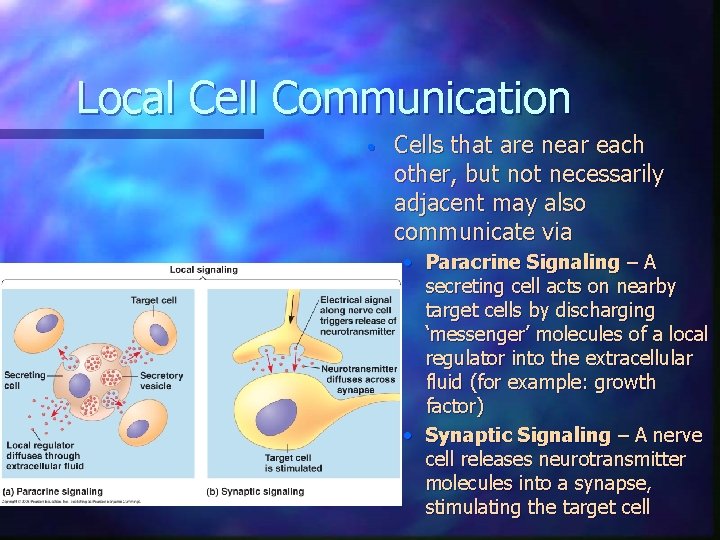
Local Cell Communication • Cells that are near each other, but not necessarily adjacent may also communicate via • Paracrine Signaling – A secreting cell acts on nearby target cells by discharging ‘messenger’ molecules of a local regulator into the extracellular fluid (for example: growth factor) • Synaptic Signaling – A nerve cell releases neurotransmitter molecules into a synapse, stimulating the target cell
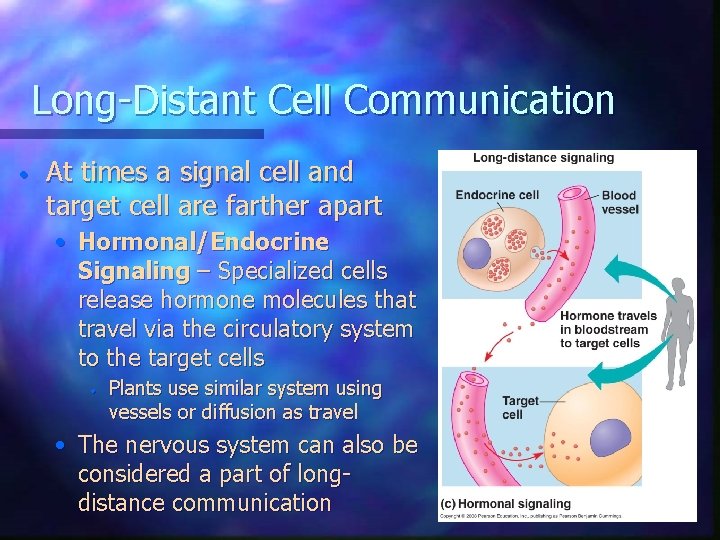
Long-Distant Cell Communication • At times a signal cell and target cell are farther apart • Hormonal/Endocrine Signaling – Specialized cells release hormone molecules that travel via the circulatory system to the target cells • Plants use similar system using vessels or diffusion as travel • The nervous system can also be considered a part of longdistance communication
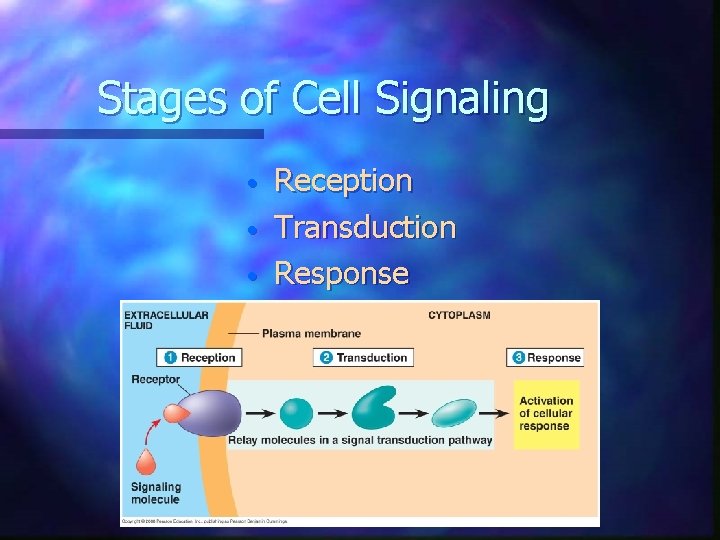
Stages of Cell Signaling • • • Reception Transduction Response
Reception • • • A receptor protein on or near the target cell allows the cell to detect and react to messages The signaling molecule is complimentary in shape and site specific on the receptor molecule Ligand (molecule that specifically binds to another) binding generally causes a receptor protein to change shape and may cause activation of the receptor • Causes the combining of 2 or more receptor molecules, leading to other molecular events
Types of Receptors • Plasma Membrane Receptors • Most are water-soluble and embedded in the cell membrane • Transmits info from extracellular environs to inside the cell via shape change or aggregation • Examples: G protein-coupled receptors, receptor tyrosine kinases, ion channel receptors
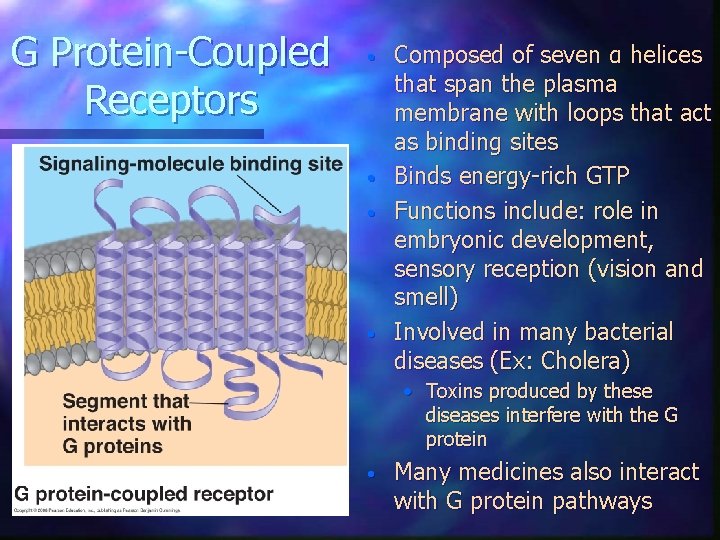
G Protein-Coupled Receptors • • Composed of seven α helices that span the plasma membrane with loops that act as binding sites Binds energy-rich GTP Functions include: role in embryonic development, sensory reception (vision and smell) Involved in many bacterial diseases (Ex: Cholera) • Toxins produced by these diseases interfere with the G protein • Many medicines also interact with G protein pathways
G Protein. Coupled Receptors • • G protein functions as an ‘on/off’ switch for the molecule depending on whether GDP (inactive) or GTP (active) is attached Signaling molecule causes a shape change. The cytoplasmic side binds to the G protein, causing a GDP to be displaced by a GTP, activating the molecule. Activated G protein then binds to an enzyme, triggering the next step in a pathway. GTP is hydrolyzed, creating GDP and leaving the G protein inactive
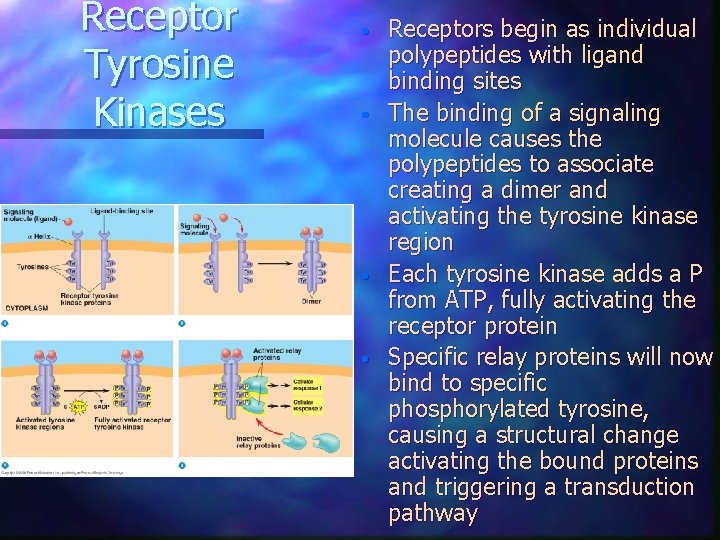
Receptor Tyrosine Kinases • • Receptors begin as individual polypeptides with ligand binding sites The binding of a signaling molecule causes the polypeptides to associate creating a dimer and activating the tyrosine kinase region Each tyrosine kinase adds a P from ATP, fully activating the receptor protein Specific relay proteins will now bind to specific phosphorylated tyrosine, causing a structural change activating the bound proteins and triggering a transduction pathway
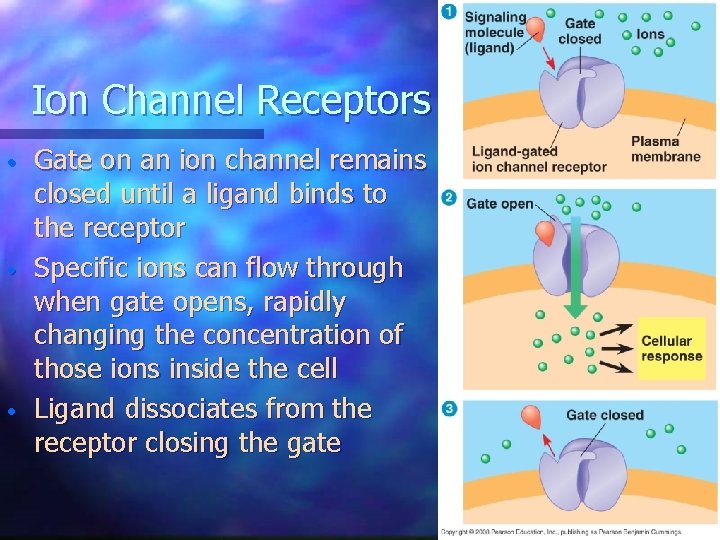
Ion Channel Receptors • • • Gate on an ion channel remains closed until a ligand binds to the receptor Specific ions can flow through when gate opens, rapidly changing the concentration of those ions inside the cell Ligand dissociates from the receptor closing the gate
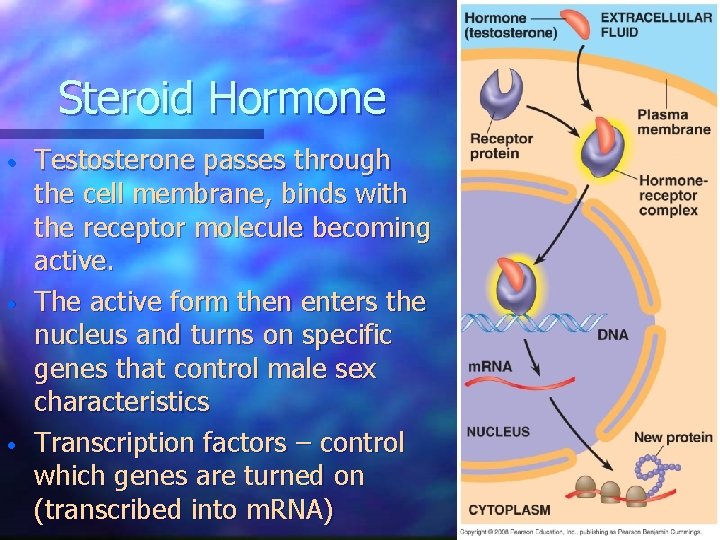
Types of Receptors • Intracellular Receptors • Found in either the cytoplasm or nucleus of target cells • A chemical messenger will need to pass through the plasma membrane • Tend to be either hydrophobic or small enough to cross • Examples: Steroid Hormones, Thyroid Hormones, nitric oxide
Steroid Hormone • • • Testosterone passes through the cell membrane, binds with the receptor molecule becoming active. The active form then enters the nucleus and turns on specific genes that control male sex characteristics Transcription factors – control which genes are turned on (transcribed into m. RNA)
Transduction • Binding of the signaling molecule changes the receptor protein and initiates transduction • May involve a single step, but more often is a sequence of steps in a pathway • For plasma membrane receptors this is usually a multistep pathway • • May include activation of proteins by addition or removal of phosphate groups or release of ions or small molecules Multiple steps allows for amplification, greater coordination and regulation of the signal
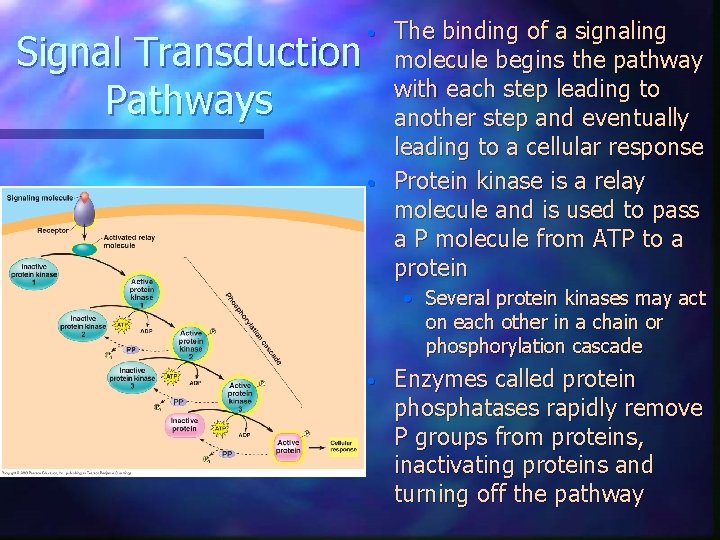
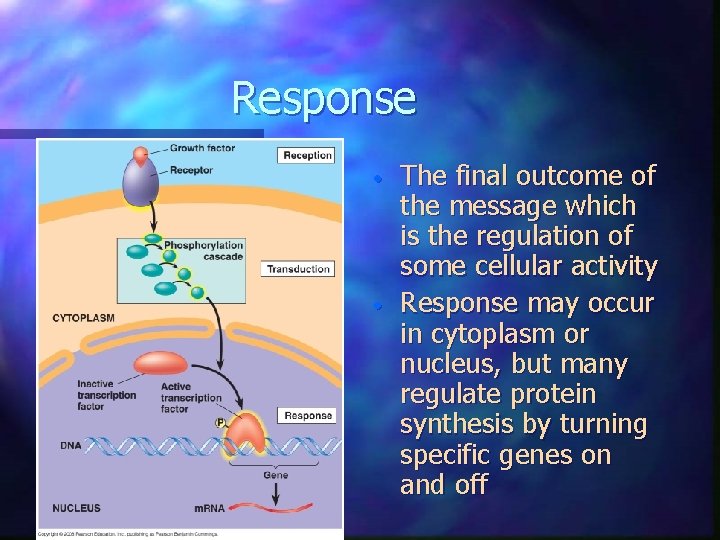
Signal Transduction Pathways • • The binding of a signaling molecule begins the pathway with each step leading to another step and eventually leading to a cellular response Protein kinase is a relay molecule and is used to pass a P molecule from ATP to a protein • Several protein kinases may act on each other in a chain or phosphorylation cascade • Enzymes called protein phosphatases rapidly remove P groups from proteins, inactivating proteins and turning off the pathway
Ions and Molecules as 2 nd Messengers • • • Signal transduction pathways will sometimes involve nonprotein molecules that are water-soluble or ions called 2 nd messengers Can readily spread throughout the cell via diffusion Examples: Cyclic AMP, Calcium ions and IP 3
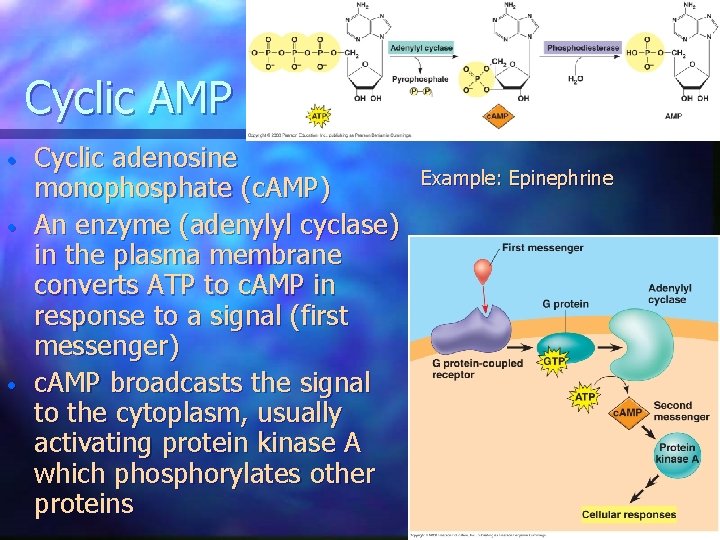
Cyclic AMP • • • Cyclic adenosine monophosphate (c. AMP) An enzyme (adenylyl cyclase) in the plasma membrane converts ATP to c. AMP in response to a signal (first messenger) c. AMP broadcasts the signal to the cytoplasm, usually activating protein kinase A which phosphorylates other proteins Example: Epinephrine
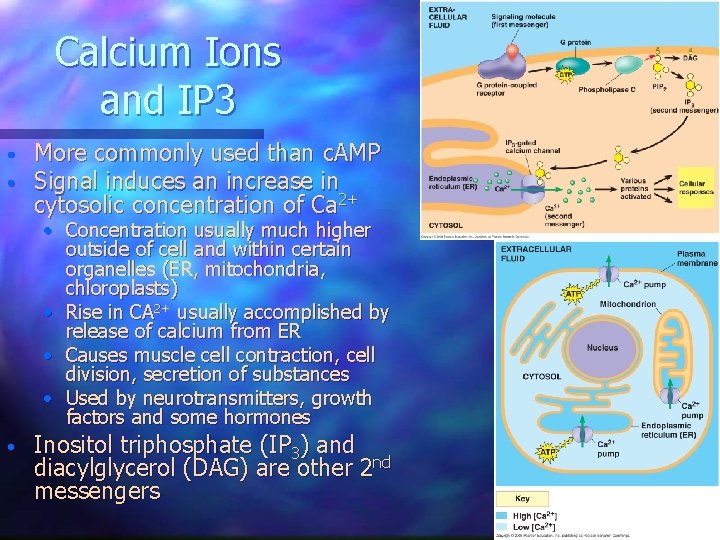
Calcium Ions and IP 3 • • More commonly used than c. AMP Signal induces an increase in cytosolic concentration of Ca 2+ • Concentration usually much higher outside of cell and within certain organelles (ER, mitochondria, chloroplasts) • Rise in CA 2+ usually accomplished by release of calcium from ER • Causes muscle cell contraction, cell division, secretion of substances • Used by neurotransmitters, growth factors and some hormones • Inositol triphosphate (IP 3) and diacylglycerol (DAG) are other 2 nd messengers
Response • • The final outcome of the message which is the regulation of some cellular activity Response may occur in cytoplasm or nucleus, but many regulate protein synthesis by turning specific genes on and off
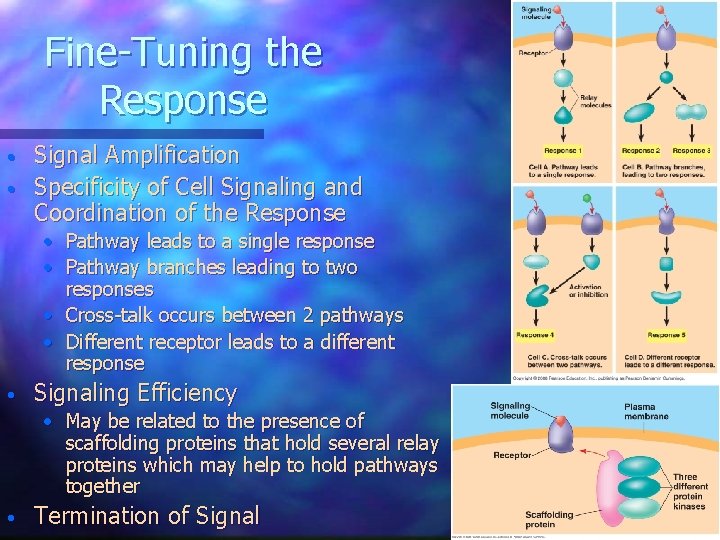
Fine-Tuning the Response • • Signal Amplification Specificity of Cell Signaling and Coordination of the Response • Pathway leads to a single response • Pathway branches leading to two responses • Cross-talk occurs between 2 pathways • Different receptor leads to a different response • Signaling Efficiency • May be related to the presence of scaffolding proteins that hold several relay proteins which may help to hold pathways together • Termination of Signal
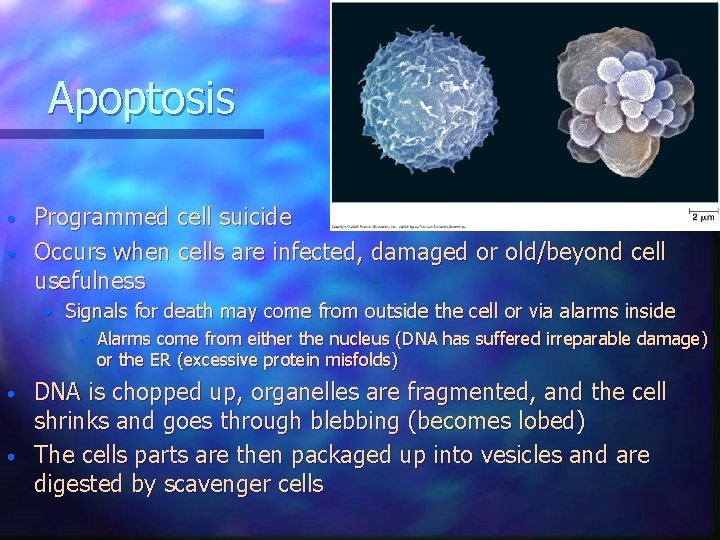
Apoptosis • • Programmed cell suicide Occurs when cells are infected, damaged or old/beyond cell usefulness • Signals for death may come from outside the cell or via alarms inside • • • Alarms come from either the nucleus (DNA has suffered irreparable damage) or the ER (excessive protein misfolds) DNA is chopped up, organelles are fragmented, and the cell shrinks and goes through blebbing (becomes lobed) The cells parts are then packaged up into vesicles and are digested by scavenger cells