
Cell Communication Cell Communication Celltocell communication is absolutely
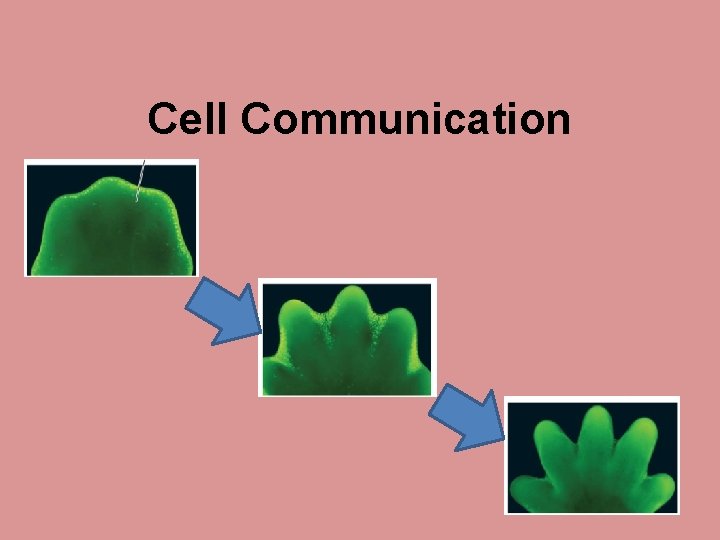
Cell Communication
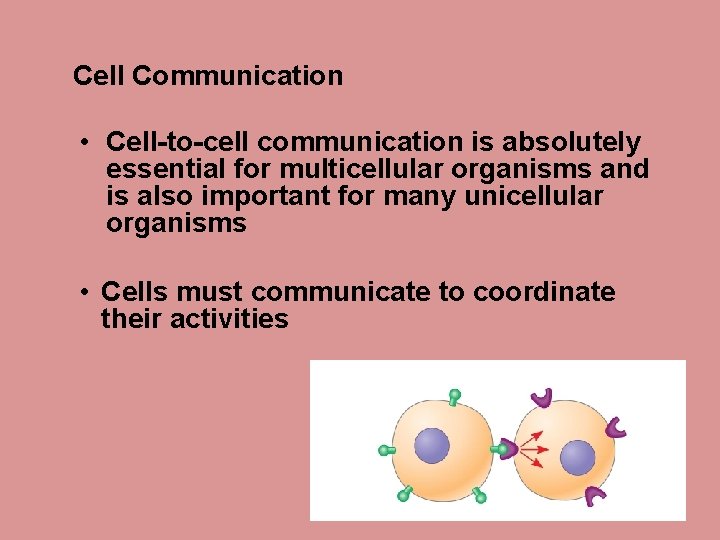
Cell Communication • Cell-to-cell communication is absolutely essential for multicellular organisms and is also important for many unicellular organisms • Cells must communicate to coordinate their activities
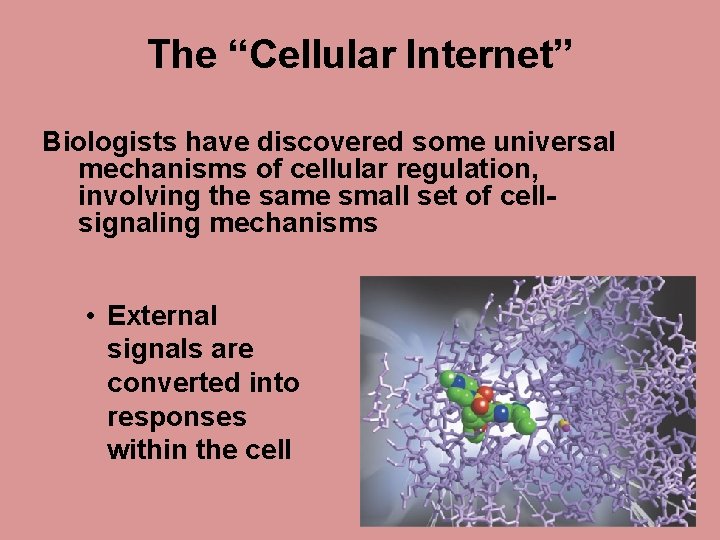
The “Cellular Internet” Biologists have discovered some universal mechanisms of cellular regulation, involving the same small set of cellsignaling mechanisms • External signals are converted into responses within the cell
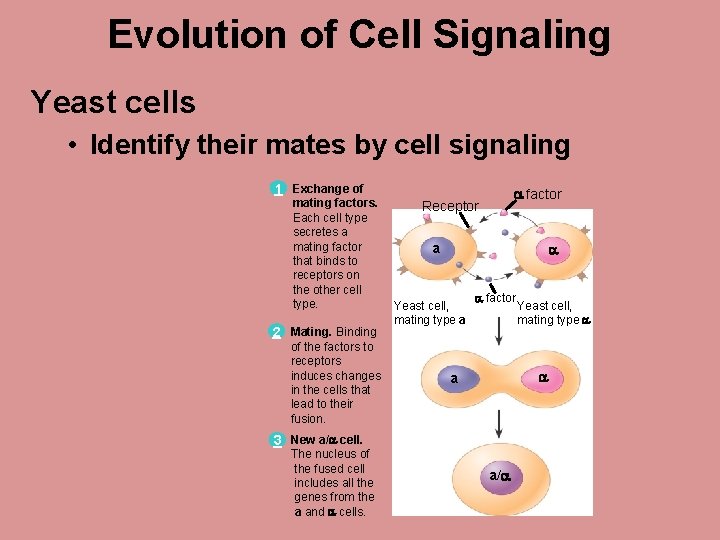
Evolution of Cell Signaling Yeast cells • Identify their mates by cell signaling 1 Exchange of mating factors. Each cell type secretes a mating factor that binds to receptors on the other cell type. 2 Mating. Binding of the factors to receptors induces changes in the cells that lead to their fusion. factor Receptor a Yeast cell, mating type a factor a 3 New a/ cell. The nucleus of the fused cell includes all the genes from the a and cells. Yeast cell, mating type a/
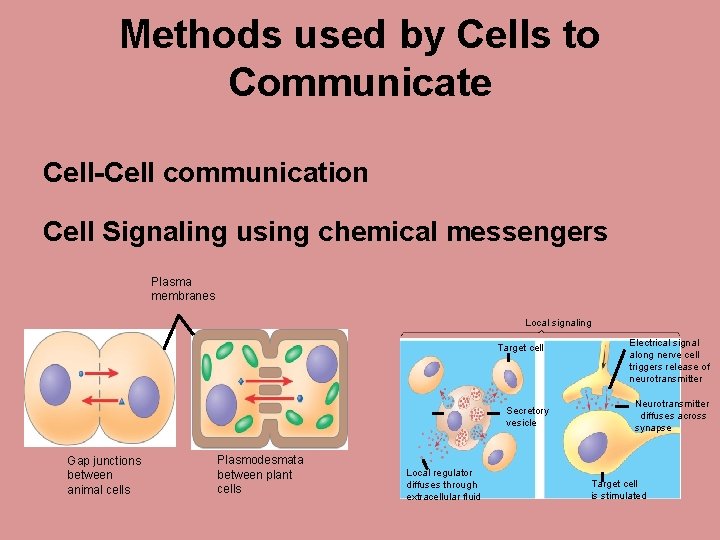
Methods used by Cells to Communicate Cell-Cell communication Cell Signaling using chemical messengers Plasma membranes Local signaling Target cell Secretory vesicle Gap junctions between animal cells Plasmodesmata between plant cells Local regulator diffuses through extracellular fluid Electrical signal along nerve cell triggers release of neurotransmitter Neurotransmitter diffuses across synapse Target cell is stimulated
1. Local signaling over short distances • Cell-Cell Recognition • Local regulators Paracrine (growth factors) Synaptic (neurotransmitters) 2. Long distance signaling • Hormones
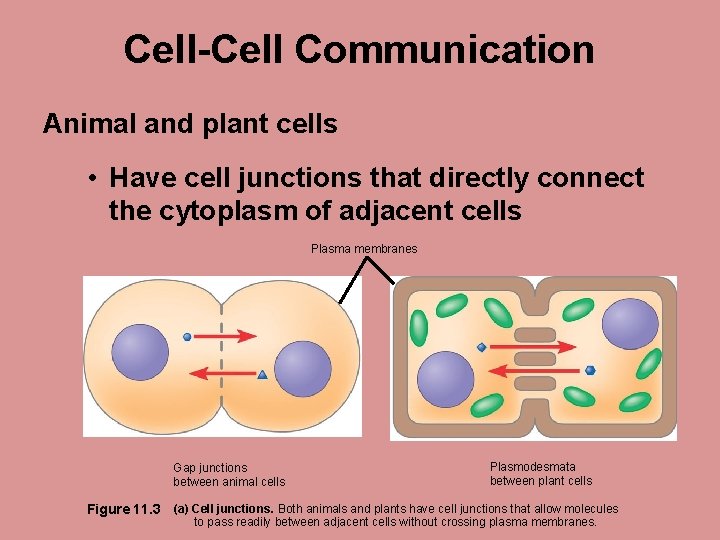
Cell-Cell Communication Animal and plant cells • Have cell junctions that directly connect the cytoplasm of adjacent cells Plasma membranes Gap junctions between animal cells Plasmodesmata between plant cells Figure 11. 3 (a) Cell junctions. Both animals and plants have cell junctions that allow molecules to pass readily between adjacent cells without crossing plasma membranes.
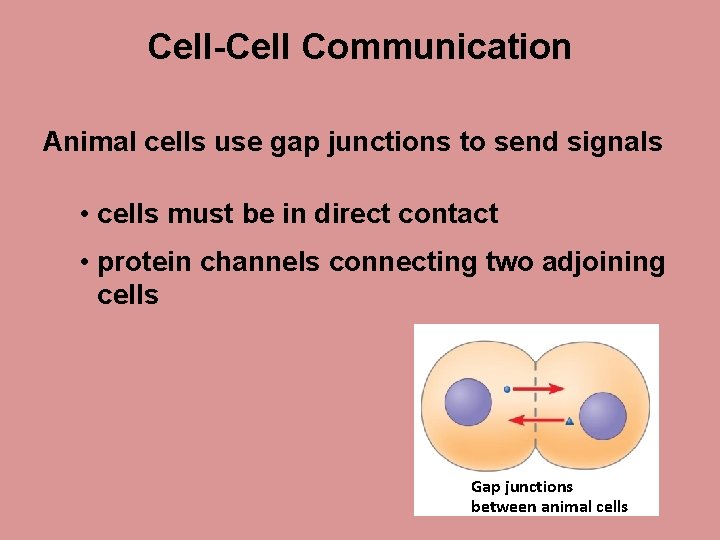
Cell-Cell Communication Animal cells use gap junctions to send signals • cells must be in direct contact • protein channels connecting two adjoining cells Gap junctions between animal cells
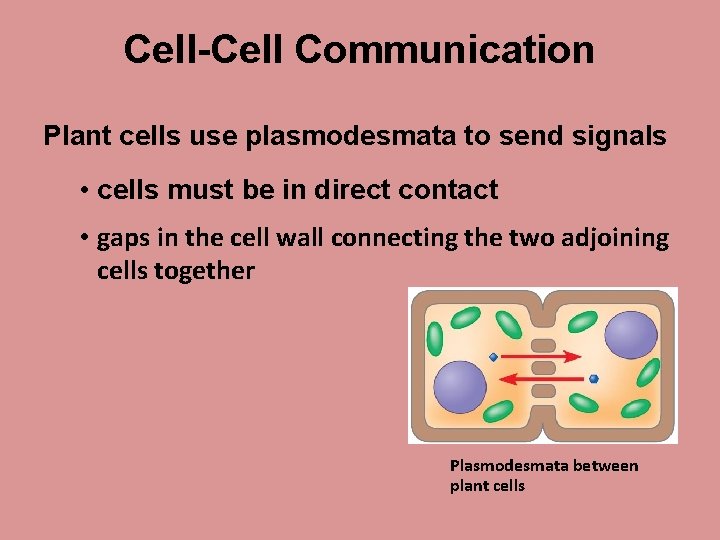
Cell-Cell Communication Plant cells use plasmodesmata to send signals • cells must be in direct contact • gaps in the cell wall connecting the two adjoining cells together Plasmodesmata between plant cells
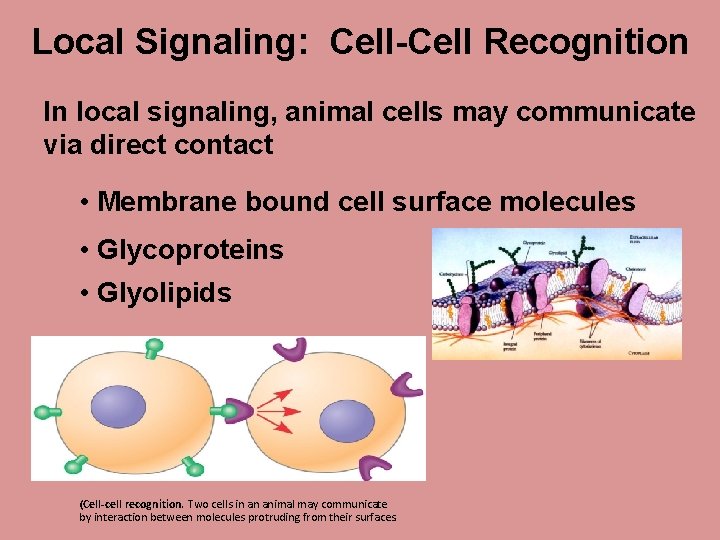
Local Signaling: Cell-Cell Recognition In local signaling, animal cells may communicate via direct contact • Membrane bound cell surface molecules • Glycoproteins • Glyolipids (Cell-cell recognition. Two cells in an animal may communicate by interaction between molecules protruding from their surfaces.
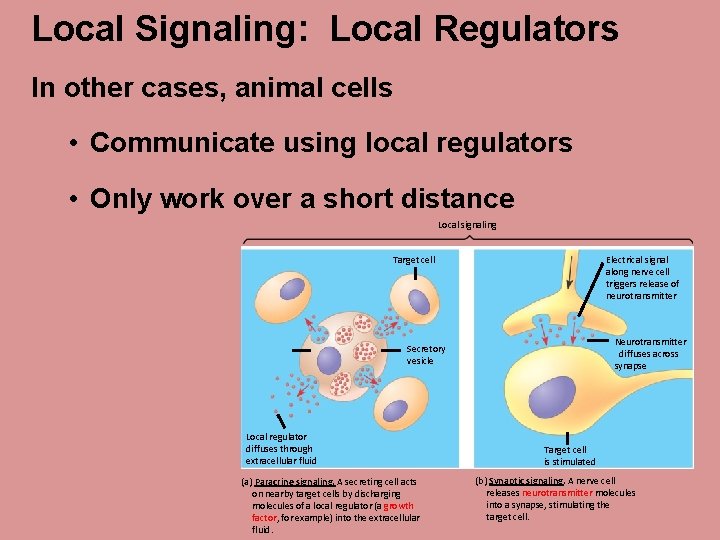
Local Signaling: Local Regulators In other cases, animal cells • Communicate using local regulators • Only work over a short distance Local signaling Target cell Electrical signal along nerve cell triggers release of neurotransmitter Neurotransmitter diffuses across synapse Secretory vesicle Local regulator diffuses through extracellular fluid (a) Paracrine signaling. A secreting cell acts on nearby target cells by discharging molecules of a local regulator (a growth factor, for example) into the extracellular fluid. Target cell is stimulated (b) Synaptic signaling. A nerve cell releases neurotransmitter molecules into a synapse, stimulating the target cell.
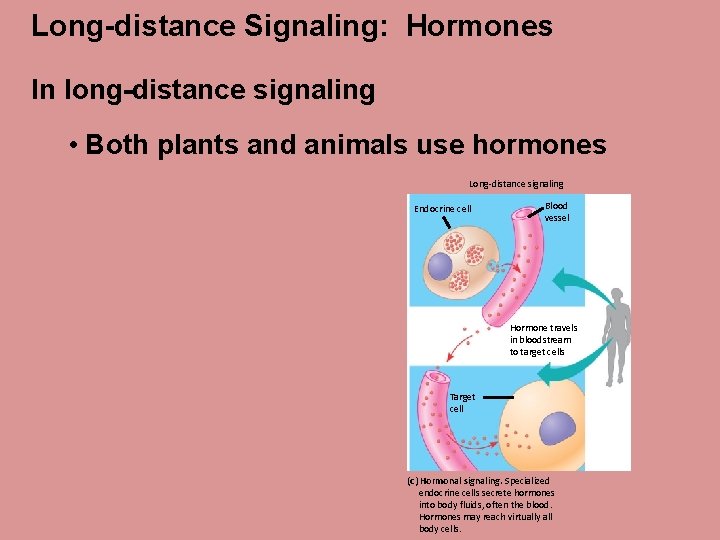
Long-distance Signaling: Hormones In long-distance signaling • Both plants and animals use hormones Long-distance signaling Endocrine cell Blood vessel Hormone travels in bloodstream to target cells Target cell (c) Hormonal signaling. Specialized endocrine cells secrete hormones into body fluids, often the blood. Hormones may reach virtually all body cells.
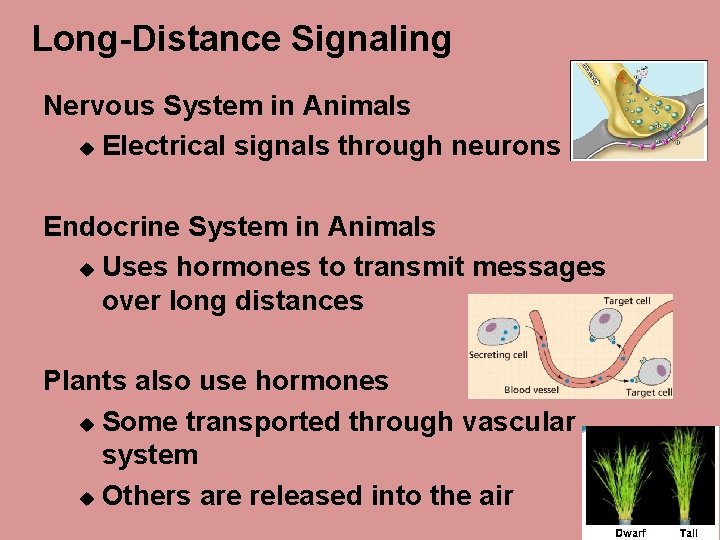
Long-Distance Signaling Nervous System in Animals u Electrical signals through neurons Endocrine System in Animals u Uses hormones to transmit messages over long distances Plants also use hormones u Some transported through vascular system u Others are released into the air
How do Cells Communicate? Earl W. Sutherland • Discovered how the hormone epinephrine acts on cells
How do Cells Communicate? Sutherland suggested that cells receiving signals went through three processes Reception Transduction Response Called Signal transduction pathways • Convert signals on a cell’s surface into cellular responses • Are similar in microbes and mammals, suggesting an early origin
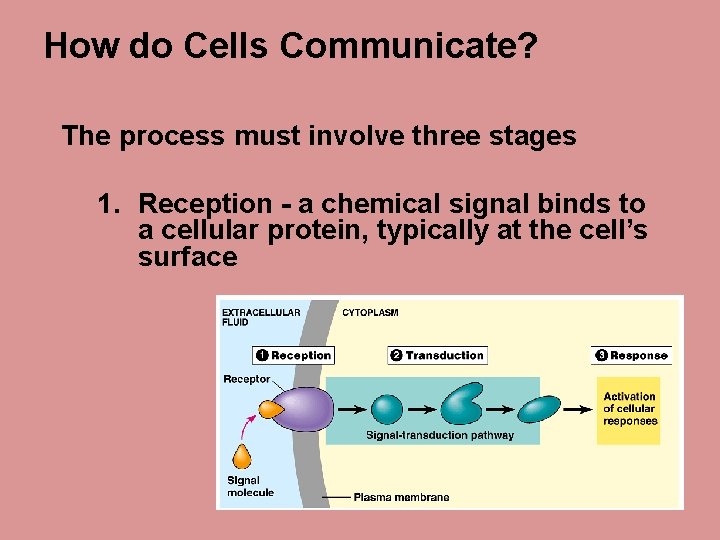
How do Cells Communicate? The process must involve three stages 1. Reception - a chemical signal binds to a cellular protein, typically at the cell’s surface
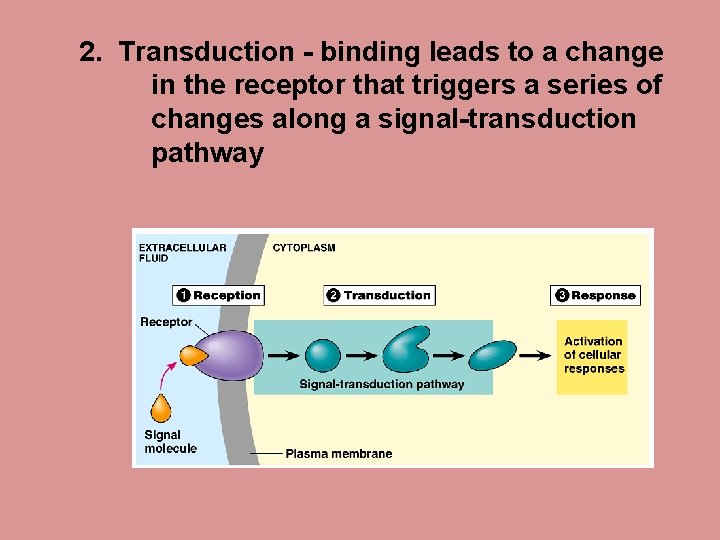
2. Transduction - binding leads to a change in the receptor that triggers a series of changes along a signal-transduction pathway
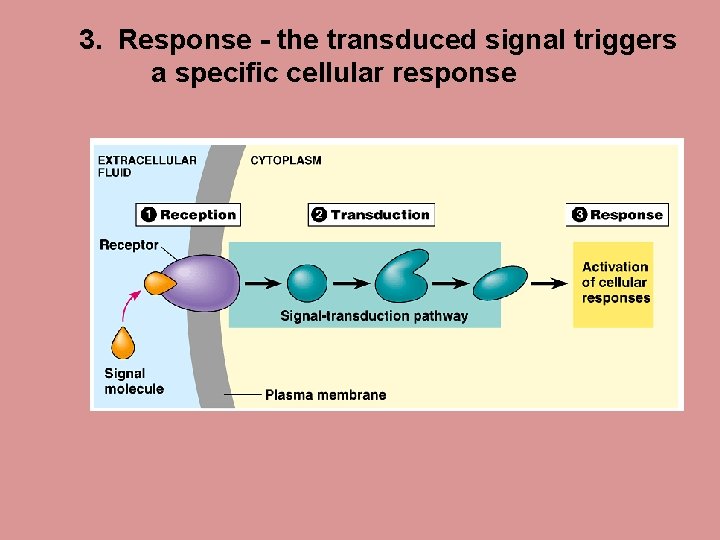
3. Response - the transduced signal triggers a specific cellular response
Signal Transduction Animation • http: //media. pearsoncmg. com/bc/bc_cam pbell_biology_7/media/interactivemedia/a ctivities/load. html? 11&A • http: //www. wiley. com/legacy/college/boy er/0470003790/animations/signal_transdu ction/signal_transduction. htm
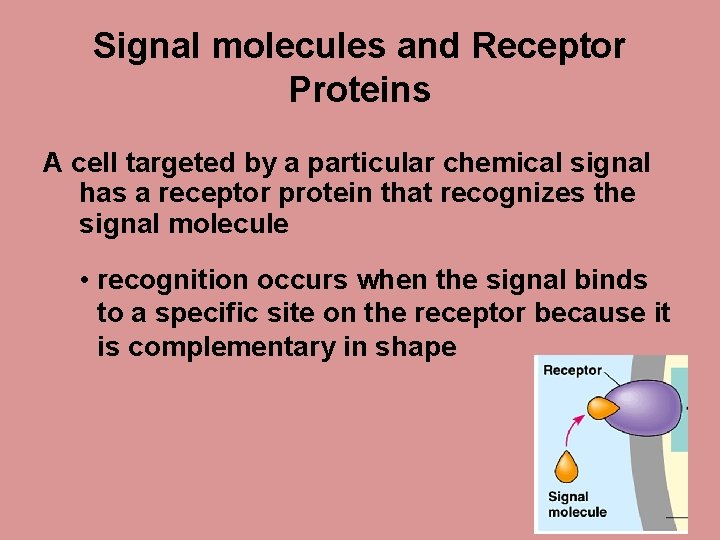
Signal molecules and Receptor Proteins A cell targeted by a particular chemical signal has a receptor protein that recognizes the signal molecule • recognition occurs when the signal binds to a specific site on the receptor because it is complementary in shape
When ligands (small molecules that bind specifically to a larger molecule) attach to the receptor protein, the receptor typically undergoes a change in shape • this may activate the receptor so that it can interact with other molecules
Signal Molecules • most signal molecules are water-soluble and too large to pass through the plasma membrane • they influence cell activities by binding to receptor proteins on the plasma membrane – binding leads to change in the shape of the receptor – these trigger changes in the intracellular environment
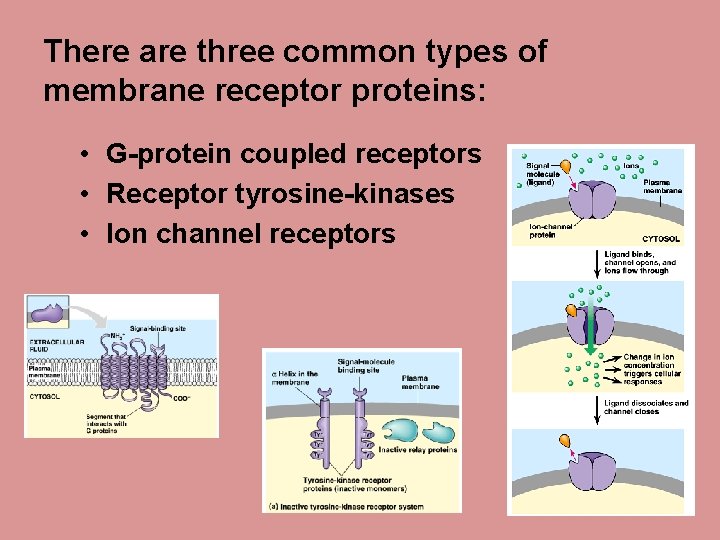
There are three common types of membrane receptor proteins: • G-protein coupled receptors • Receptor tyrosine-kinases • Ion channel receptors
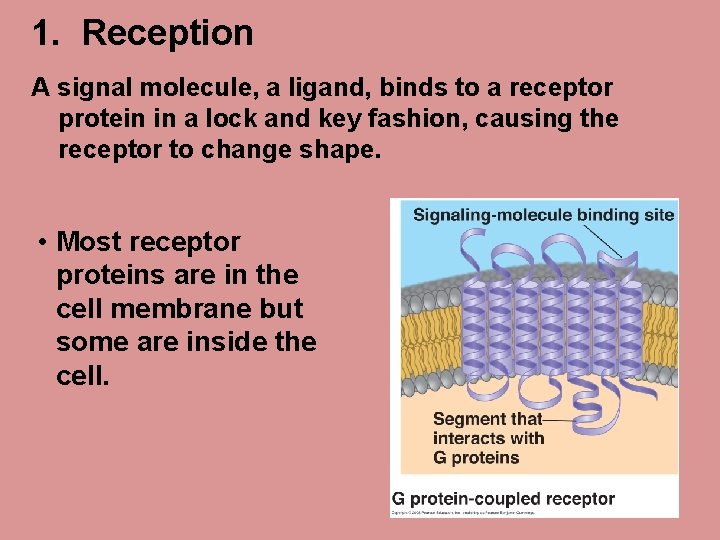
1. Reception A signal molecule, a ligand, binds to a receptor protein in a lock and key fashion, causing the receptor to change shape. • Most receptor proteins are in the cell membrane but some are inside the cell.
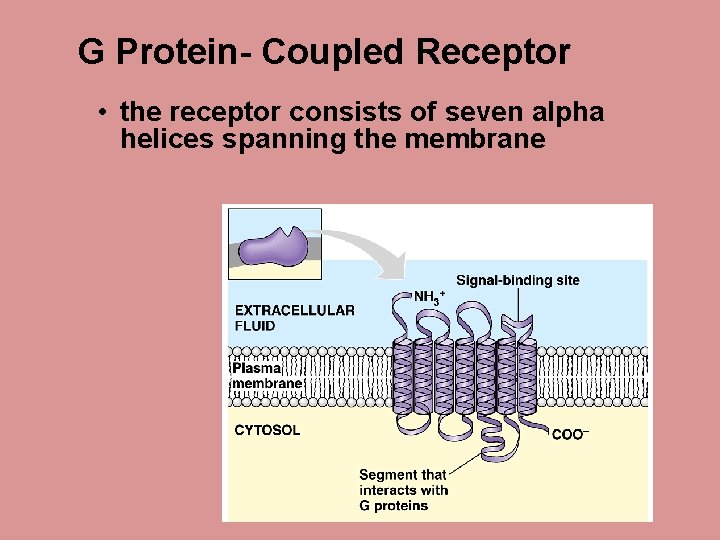
G Protein- Coupled Receptor • the receptor consists of seven alpha helices spanning the membrane
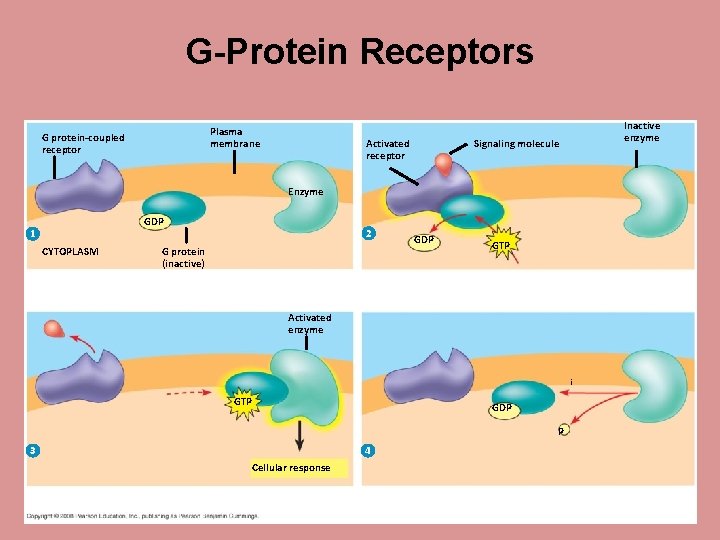
G-Protein Receptors Plasma membrane G protein-coupled receptor Activated receptor Inactive enzyme Signaling molecule Enzyme GDP 1 CYTOPLASM 2 G protein (inactive) GDP GTP Activated enzyme i GTP GDP P 4 3 Cellular response
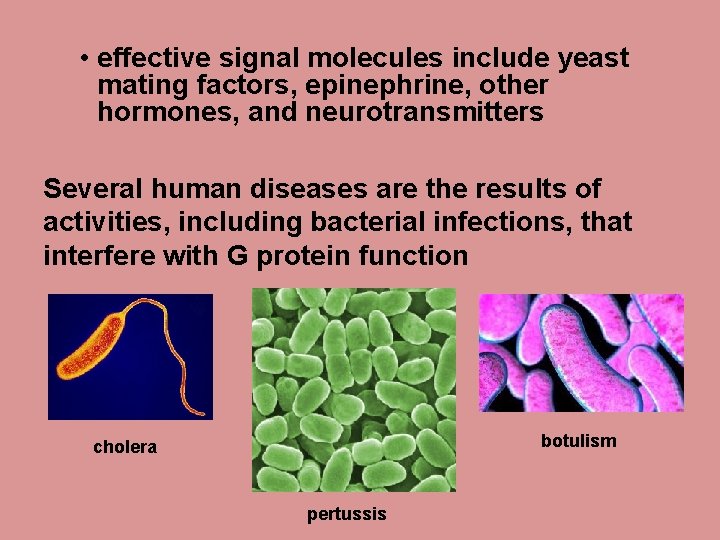
• effective signal molecules include yeast mating factors, epinephrine, other hormones, and neurotransmitters Several human diseases are the results of activities, including bacterial infections, that interfere with G protein function botulism cholera pertussis
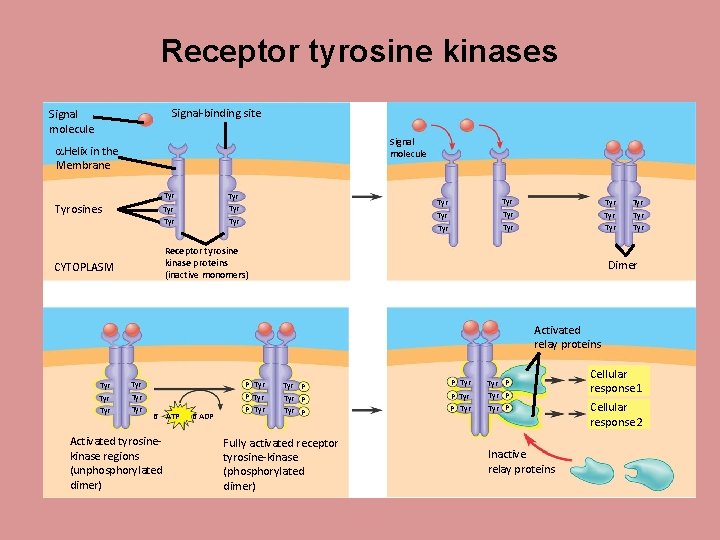
Receptor tyrosine kinases Signal-binding site Signal molecule Helix in the Membrane Tyrosines Tyr Tyr Tyr Tyr Tyr Receptor tyrosine kinase proteins (inactive monomers) CYTOPLASM Dimer Activated relay proteins Tyr Tyr Tyr 6 ATP Activated tyrosinekinase regions (unphosphorylated dimer) 6 ADP P Tyr P Tyr P Fully activated receptor tyrosine-kinase (phosphorylated dimer) P Tyr P Tyr P Inactive relay proteins Cellular response 1 Cellular response 2
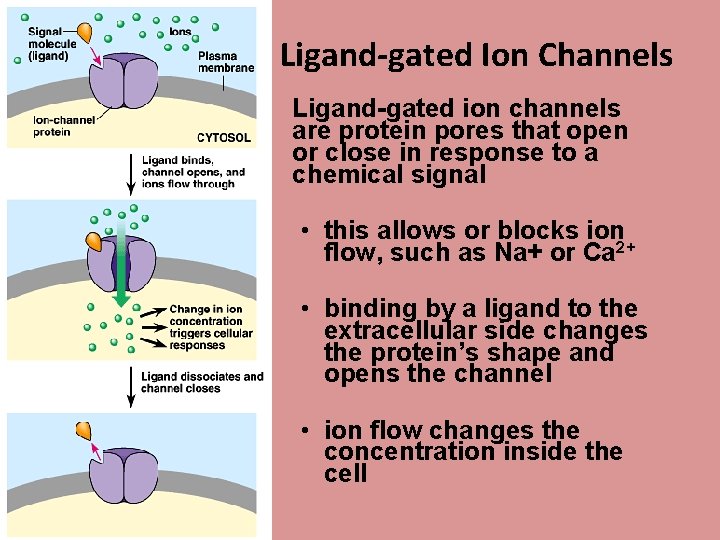
Ligand-gated Ion Channels • Ligand-gated ion channels are protein pores that open or close in response to a chemical signal • this allows or blocks ion flow, such as Na+ or Ca 2+ • binding by a ligand to the extracellular side changes the protein’s shape and opens the channel • ion flow changes the concentration inside the cell
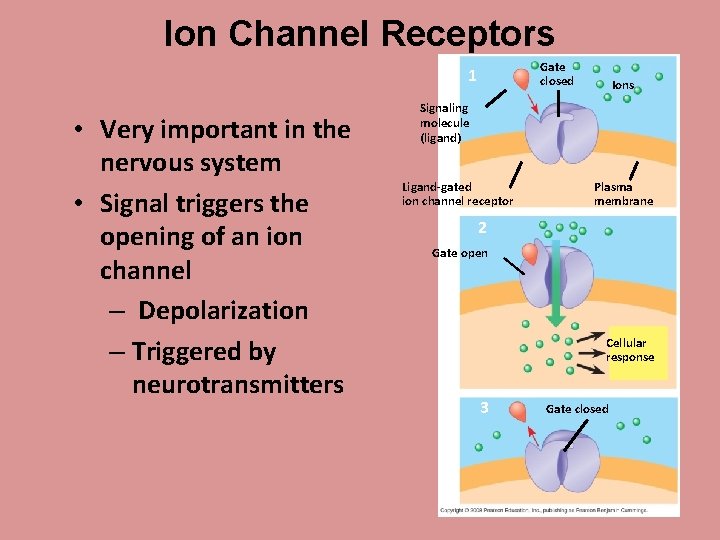
Ion Channel Receptors Gate closed 1 • Very important in the nervous system • Signal triggers the opening of an ion channel – Depolarization – Triggered by neurotransmitters Ions Signaling molecule (ligand) Ligand-gated ion channel receptor Plasma membrane 2 Gate open Cellular response 3 Gate closed
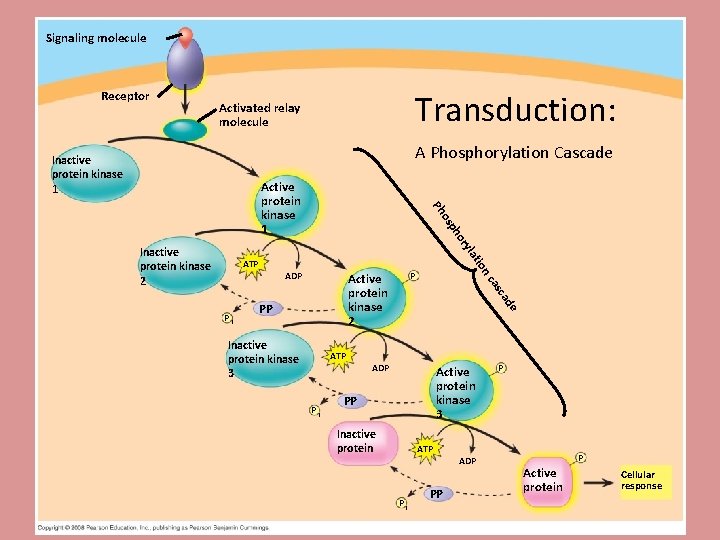
2. Transduction • Transduction: Cascades of molecular interactions relay signals from receptors to target molecules in the cell • Multistep pathways – Can amplify a signal (Amplifies the signal by activating multiple copies of the next component in the pathway) – Provide more opportunities for coordination and regulation • At each step in a pathway, the signal is transduced into a different form, commonly a conformational change in a protein.
Signaling molecule Receptor Transduction: Activated relay molecule A Phosphorylation Cascade Inactive protein kinase 1 ATP P Inactive protein kinase 3 de PP i sca Active protein kinase 2 ca P ADP n tio Inactive protein kinase 2 yla or ph os Ph Active protein kinase 1 ATP ADP Pi Active protein kinase 3 PP Inactive protein ATP Pi PP ADP P P Active protein Cellular response
Protein Phosphorylation and Dephosphorylation Many signal pathways • Include phosphorylation cascades • In this process, a series of protein kinases add a phosphate to the next one in line, activating it • Phosphatase enzymes then remove the phosphates
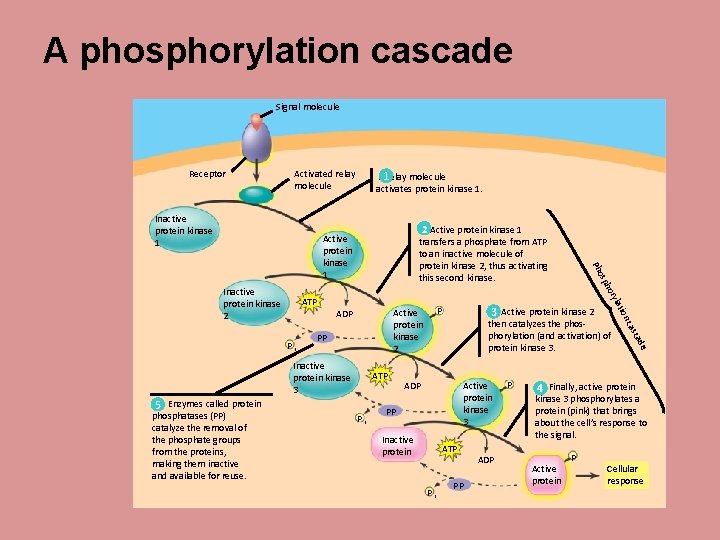
A phosphorylation cascade Signal molecule Receptor Activated relay molecule Inactive protein kinase 1 A 1 relay molecule activates protein kinase 1. ATP Inactive protein kinase 3 5 Enzymes called protein phosphatases (PP) catalyze the removal of the phosphate groups from the proteins, making them inactive and available for reuse. ATP Pi ADP Active protein kinase 3 PP Inactive protein ATP P i PP ADP P e cad cas PP on Pi 3 Active protein kinase 2 then catalyzes the phosphorylation (and activation) of protein kinase 3. P Active protein kinase 2 ADP ati ryl Inactive protein kinase 2 ho osp Ph 2 Active protein kinase 1 transfers a phosphate from ATP to an inactive molecule of protein kinase 2, thus activating this second kinase. Active protein kinase 1 4 Finally, active protein kinase 3 phosphorylates a protein (pink) that brings about the cell’s response to the signal. Active protein P Cellular response
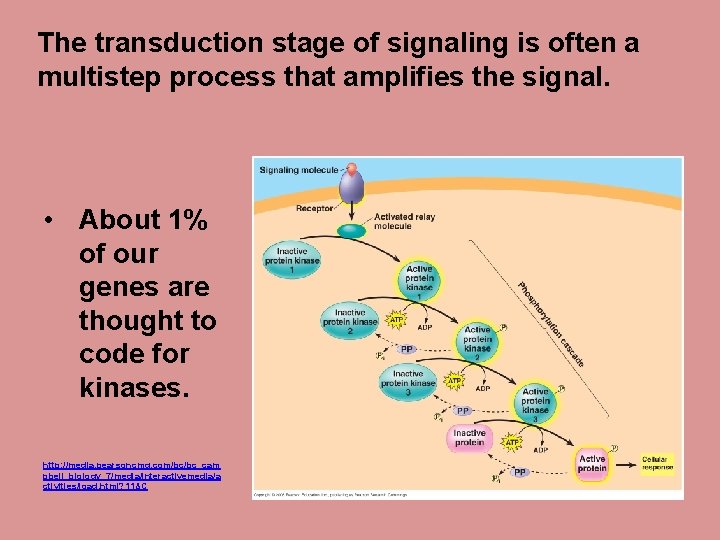
The transduction stage of signaling is often a multistep process that amplifies the signal. • About 1% of our genes are thought to code for kinases. http: //media. pearsoncmg. com/bc/bc_cam pbell_biology_7/media/interactivemedia/a ctivities/load. html? 11&C
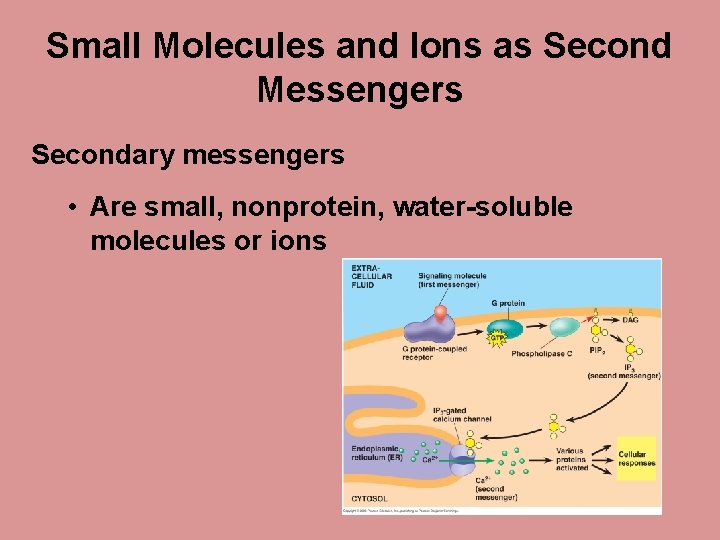
Small Molecules and Ions as Second Messengers Secondary messengers • Are small, nonprotein, water-soluble molecules or ions
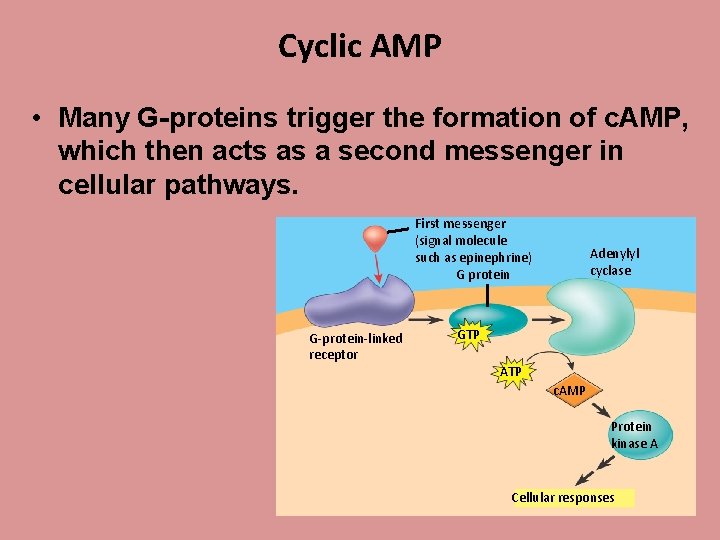
Cyclic AMP • Many G-proteins trigger the formation of c. AMP, which then acts as a second messenger in cellular pathways. First messenger (signal molecule such as epinephrine) G protein G-protein-linked receptor Adenylyl cyclase GTP ATP c. AMP Protein kinase A Cellular responses
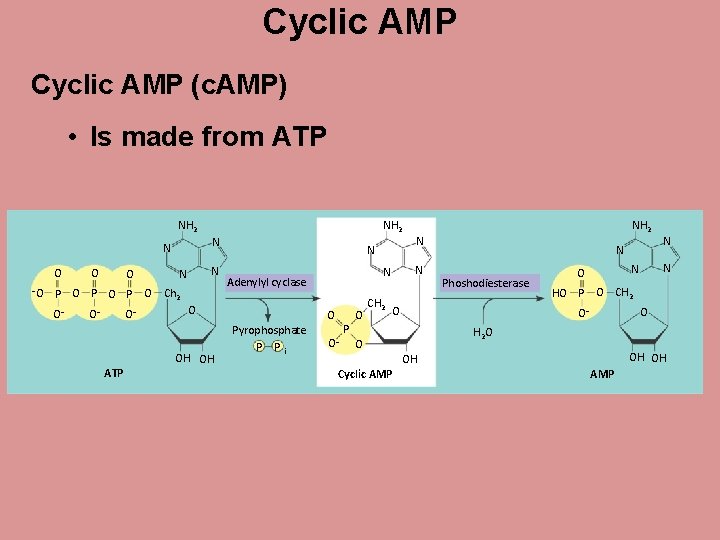
Cyclic AMP (c. AMP) • Is made from ATP NH 2 N N O – O O NH 2 N N O P O P O Ch 2 O O O ATP N O OH OH Pyrophosphate P Pi O O P O CH 2 N N N Adenylyl cyclase NH 2 N Phoshodiesterase O HO P O CH 2 O O H 2 O O OH OH OH Cyclic AMP N N O N AMP
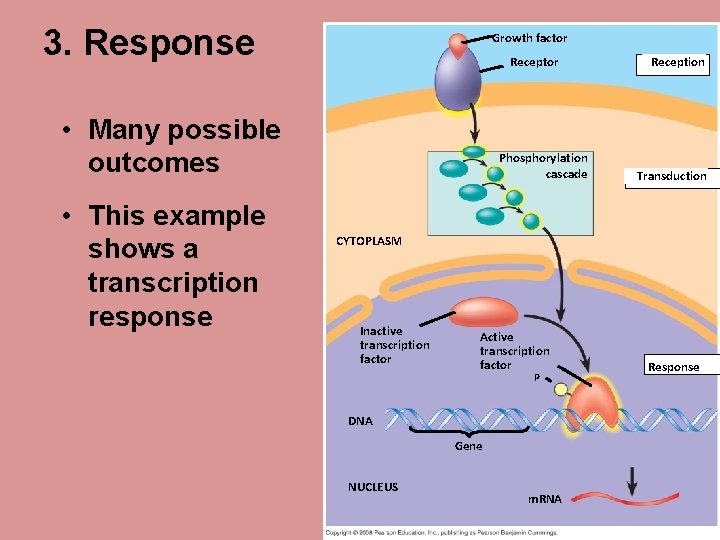
3. Response Growth factor Receptor • Many possible outcomes • This example shows a transcription response Phosphorylation cascade Reception Transduction CYTOPLASM Inactive transcription factor Active transcription factor P DNA Gene NUCLEUS m. RNA Response
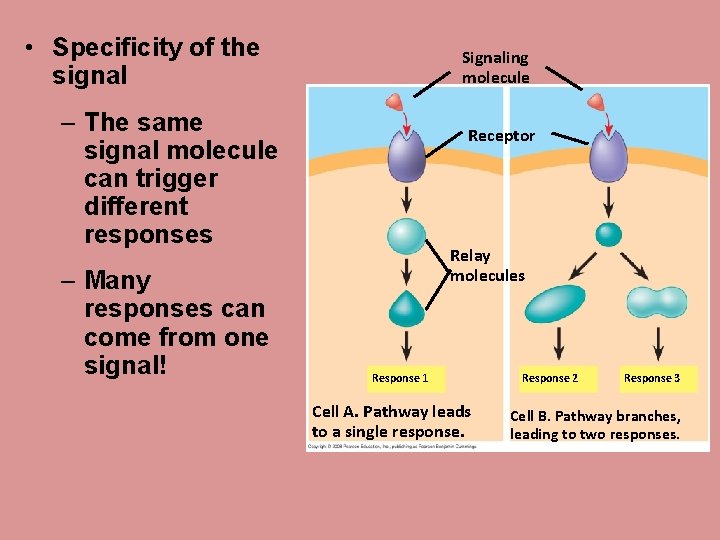
• Specificity of the signal Signaling molecule – The same signal molecule can trigger different responses – Many responses can come from one signal! Receptor Relay molecules Response 1 Cell A. Pathway leads to a single response. Response 2 Response 3 Cell B. Pathway branches, leading to two responses.
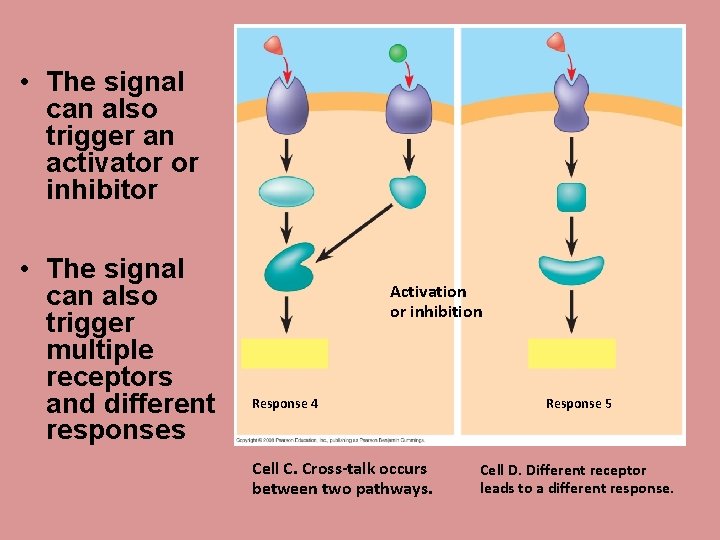
• The signal can also trigger an activator or inhibitor • The signal can also trigger multiple receptors and different responses Activation or inhibition Response 4 Cell C. Cross-talk occurs between two pathways. Response 5 Cell D. Different receptor leads to a different response.
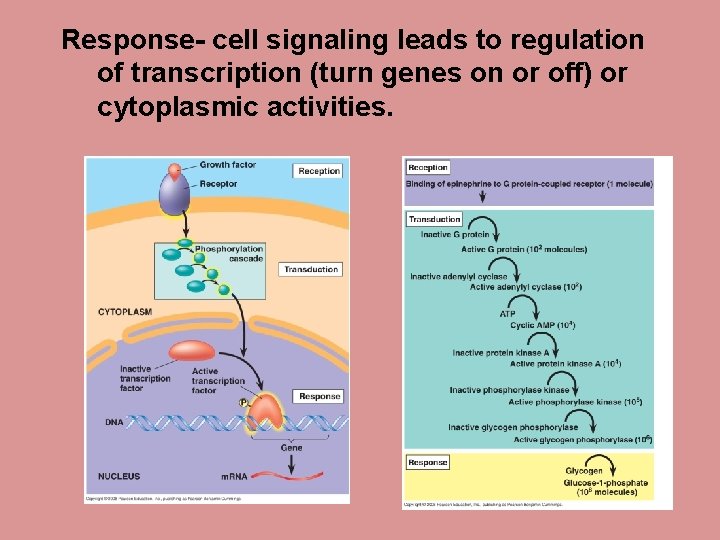
Response- cell signaling leads to regulation of transcription (turn genes on or off) or cytoplasmic activities.
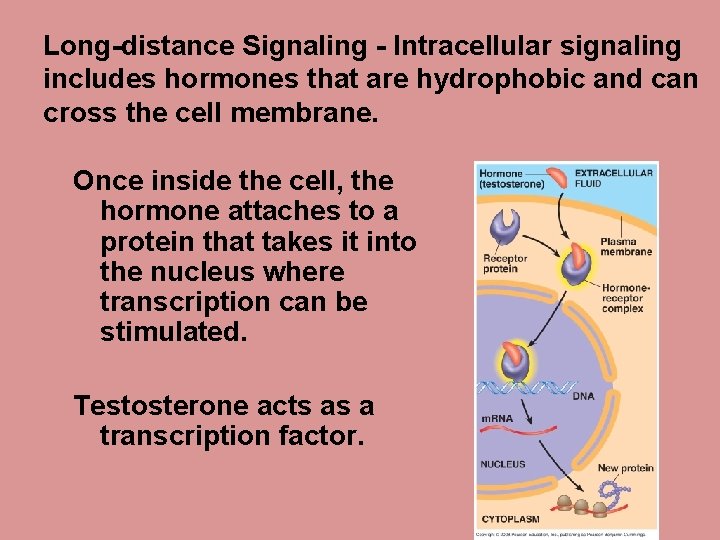
Long-distance Signaling - Intracellular signaling includes hormones that are hydrophobic and can cross the cell membrane. Once inside the cell, the hormone attaches to a protein that takes it into the nucleus where transcription can be stimulated. Testosterone acts as a transcription factor.
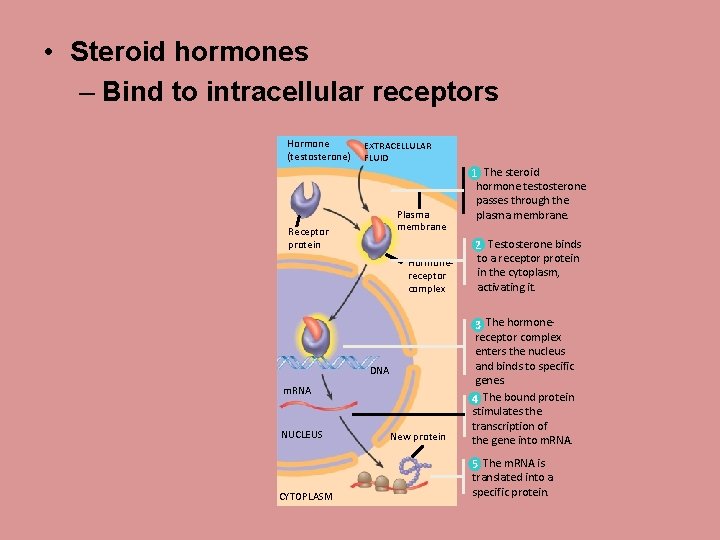
• Steroid hormones – Bind to intracellular receptors Hormone (testosterone) EXTRACELLULAR FLUID Plasma membrane Receptor protein Hormonereceptor complex DNA m. RNA NUCLEUS CYTOPLASM New protein 1 The steroid hormone testosterone passes through the plasma membrane. 2 Testosterone binds to a receptor protein in the cytoplasm, activating it. 3 The hormonereceptor complex enters the nucleus and binds to specific genes. 4 The bound protein stimulates the transcription of the gene into m. RNA. 5 The m. RNA is translated into a specific protein.
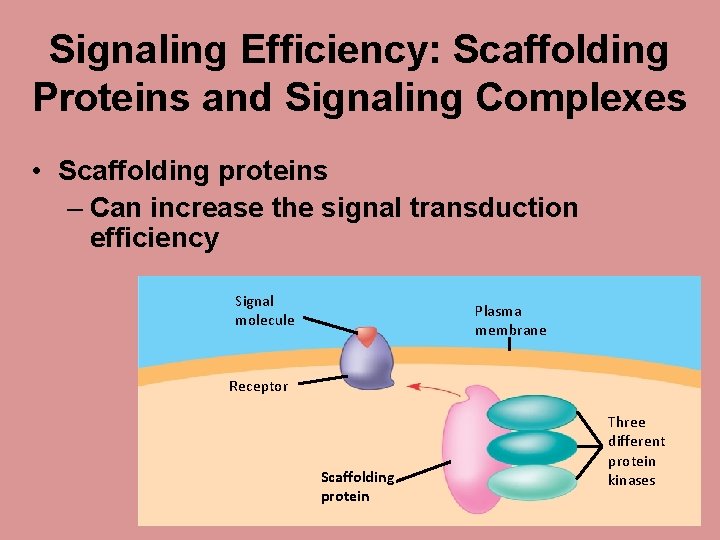
Signaling Efficiency: Scaffolding Proteins and Signaling Complexes • Scaffolding proteins – Can increase the signal transduction efficiency Signal molecule Plasma membrane Receptor Scaffolding protein Three different protein kinases
Termination of the Signal • Signal response is terminated quickly – By the reversal of ligand binding
- Slides: 46