
Cell Communication and Control Binding of insulin to
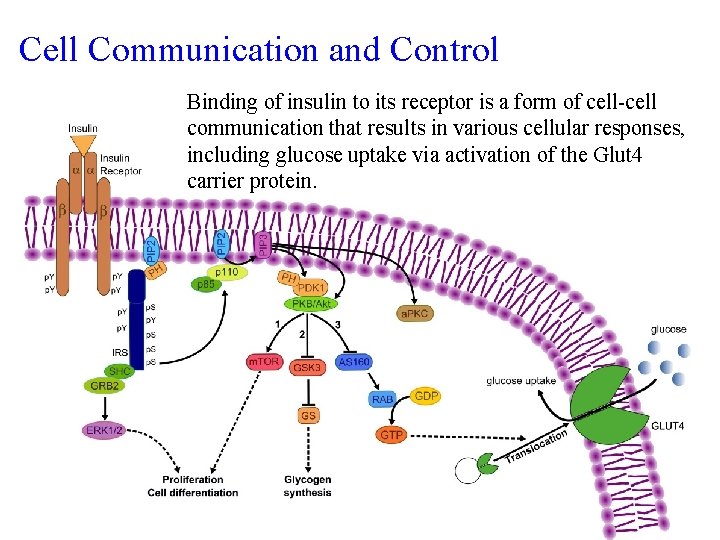
Cell Communication and Control Binding of insulin to its receptor is a form of cell-cell communication that results in various cellular responses, including glucose uptake via activation of the Glut 4 carrier protein.
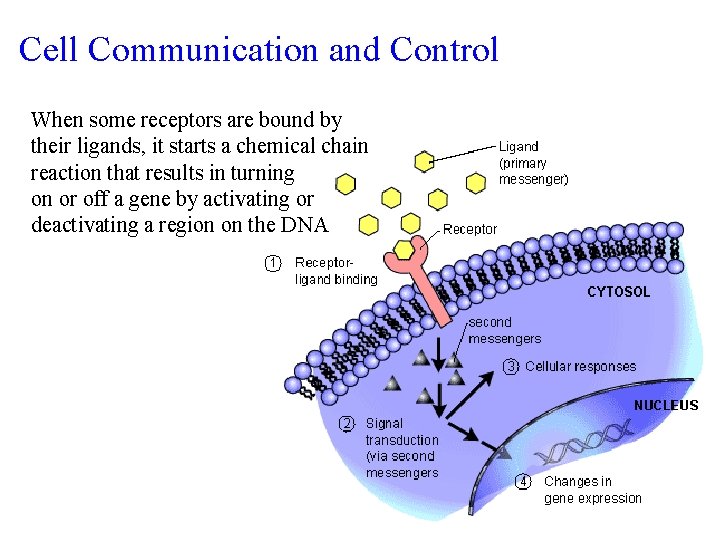
Cell Communication and Control When some receptors are bound by their ligands, it starts a chemical chain reaction that results in turning on or off a gene by activating or deactivating a region on the DNA
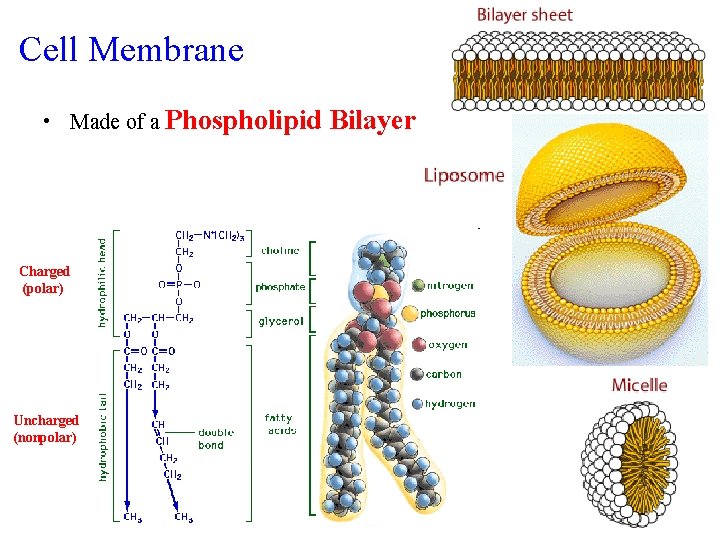
Cell Membrane • Made of a Phospholipid Charged (polar) Uncharged (nonpolar) Bilayer
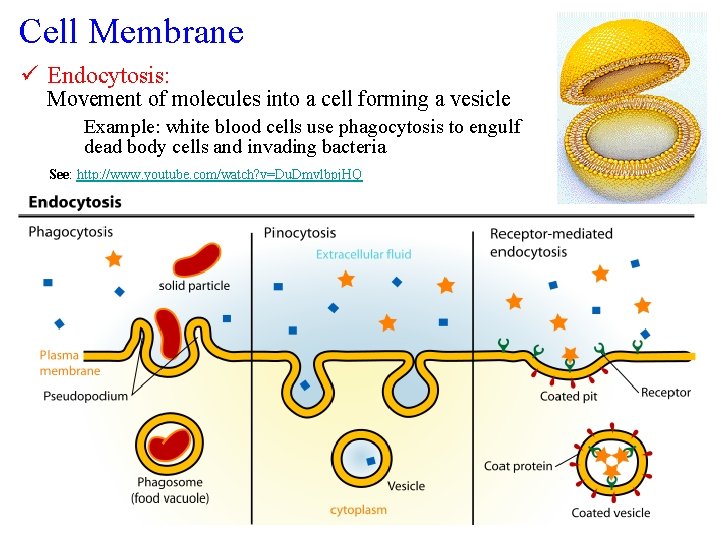
Cell Membrane ü Endocytosis: Movement of molecules into a cell forming a vesicle Example: white blood cells use phagocytosis to engulf dead body cells and invading bacteria See: http: //www. youtube. com/watch? v=Du. Dmvlbpj. HQ
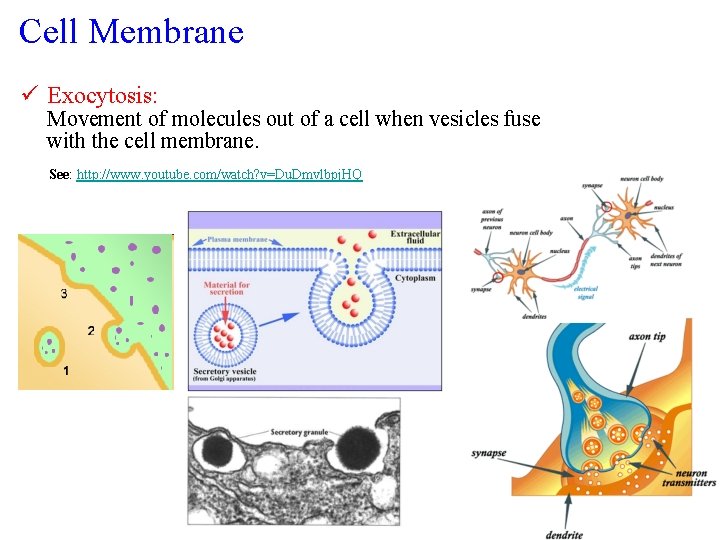
Cell Membrane ü Exocytosis: Movement of molecules out of a cell when vesicles fuse with the cell membrane. See: http: //www. youtube. com/watch? v=Du. Dmvlbpj. HQ

Cell Membrane ü Eukaryotic cells have membrane-bound internal organelles composed of lipid bilayer membranes – Nuclear Envelope – Endoplasmic Reticulum (rough and smooth) – Golgi Apparatus – Mitochondria – Chloroplasts (in plants) – Vesicles, Lysosomes, Peroxisomes & Vacuoles
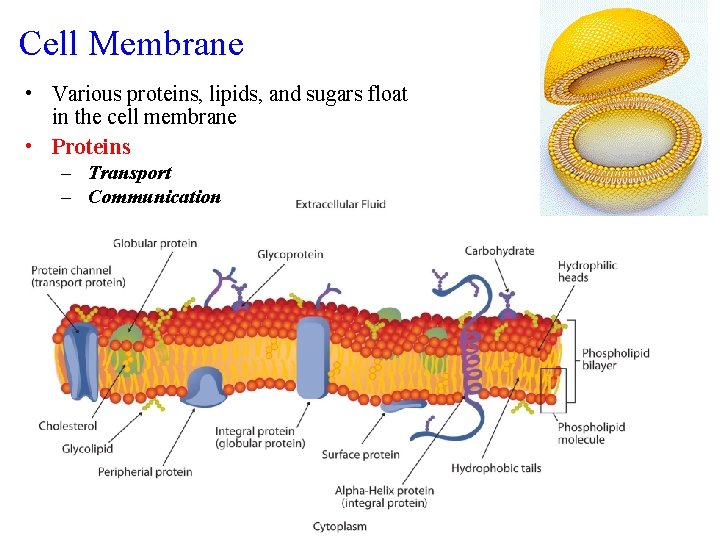
Cell Membrane • Various proteins, lipids, and sugars float in the cell membrane • Proteins – Transport – Communication
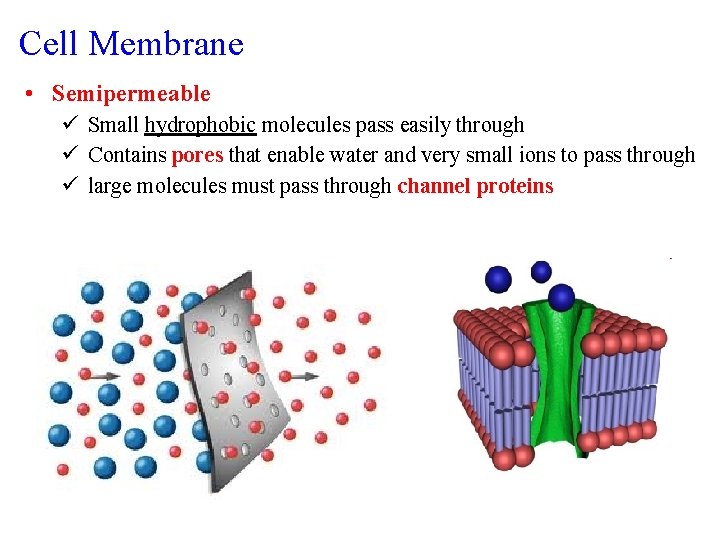
Cell Membrane • Semipermeable ü Small hydrophobic molecules pass easily through ü Contains pores that enable water and very small ions to pass through ü large molecules must pass through channel proteins
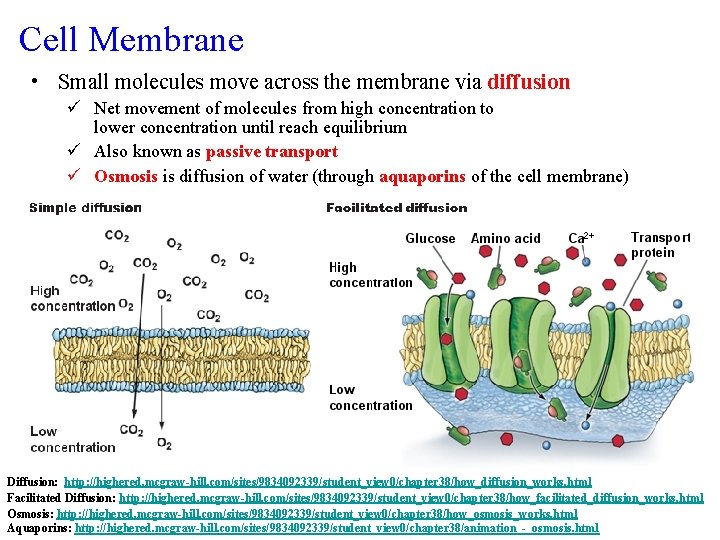
Cell Membrane • Small molecules move across the membrane via diffusion ü Net movement of molecules from high concentration to lower concentration until reach equilibrium ü Also known as passive transport ü Osmosis is diffusion of water (through aquaporins of the cell membrane) Diffusion: http: //highered. mcgraw-hill. com/sites/9834092339/student_view 0/chapter 38/how_diffusion_works. html Facilitated Diffusion: http: //highered. mcgraw-hill. com/sites/9834092339/student_view 0/chapter 38/how_facilitated_diffusion_works. html Osmosis: http: //highered. mcgraw-hill. com/sites/9834092339/student_view 0/chapter 38/how_osmosis_works. html Aquaporins: http: //highered. mcgraw-hill. com/sites/9834092339/student_view 0/chapter 38/animation_-_osmosis. html
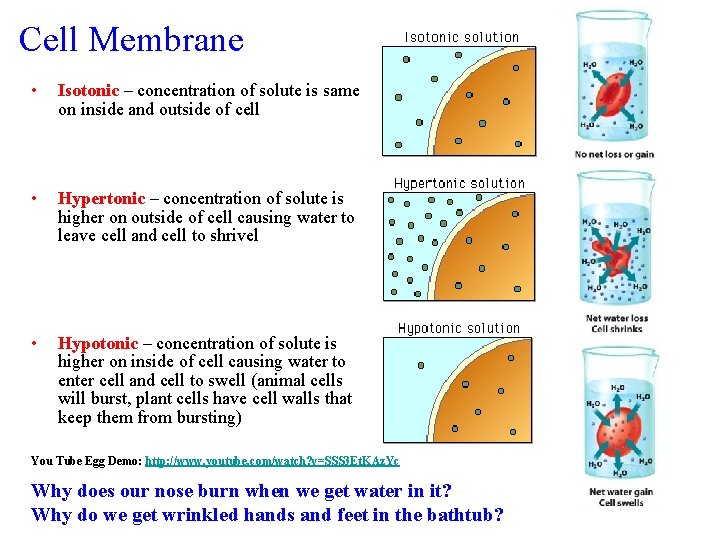
Cell Membrane • Isotonic – concentration of solute is same on inside and outside of cell • Hypertonic – concentration of solute is higher on outside of cell causing water to leave cell and cell to shrivel • Hypotonic – concentration of solute is higher on inside of cell causing water to enter cell and cell to swell (animal cells will burst, plant cells have cell walls that keep them from bursting) You Tube Egg Demo: http: //www. youtube. com/watch? v=SSS 3 Et. KAz. Yc Why does our nose burn when we get water in it? Why do we get wrinkled hands and feet in the bathtub?
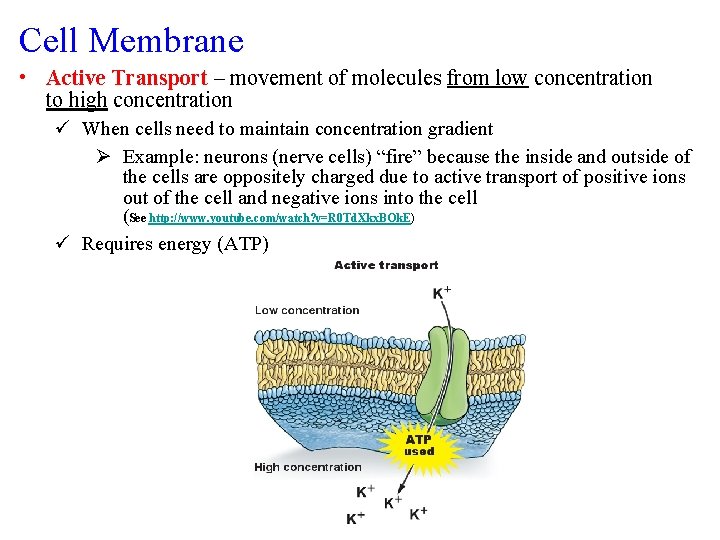
Cell Membrane • Active Transport – movement of molecules from low concentration to high concentration ü When cells need to maintain concentration gradient Ø Example: neurons (nerve cells) “fire” because the inside and outside of the cells are oppositely charged due to active transport of positive ions out of the cell and negative ions into the cell (See http: //www. youtube. com/watch? v=R 0 Td. Xkx. BOk. E) ü Requires energy (ATP)
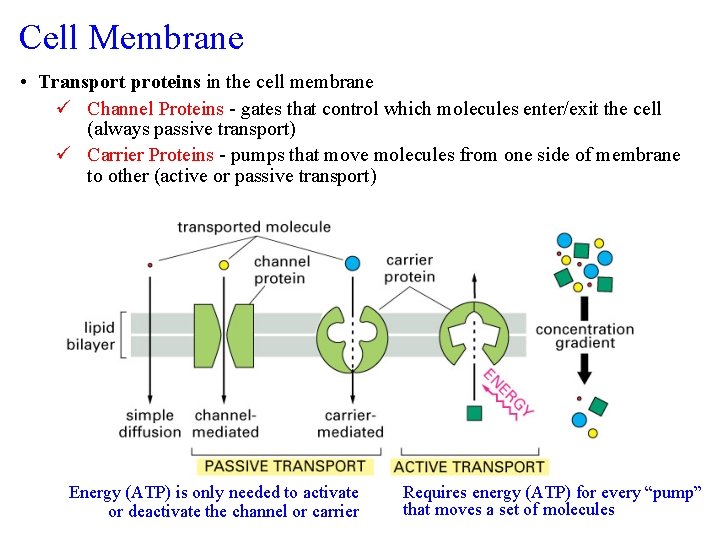
Cell Membrane • Transport proteins in the cell membrane ü Channel Proteins - gates that control which molecules enter/exit the cell (always passive transport) ü Carrier Proteins - pumps that move molecules from one side of membrane to other (active or passive transport) Energy (ATP) is only needed to activate or deactivate the channel or carrier Requires energy (ATP) for every “pump” that moves a set of molecules
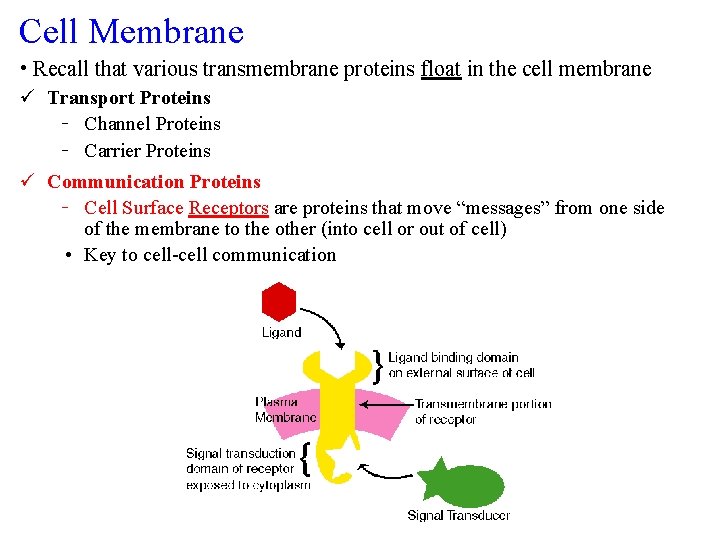
Cell Membrane • Recall that various transmembrane proteins float in the cell membrane ü Transport Proteins Channel Proteins Carrier Proteins ü Communication Proteins Cell Surface Receptors are proteins that move “messages” from one side of the membrane to the other (into cell or out of cell) • Key to cell-cell communication
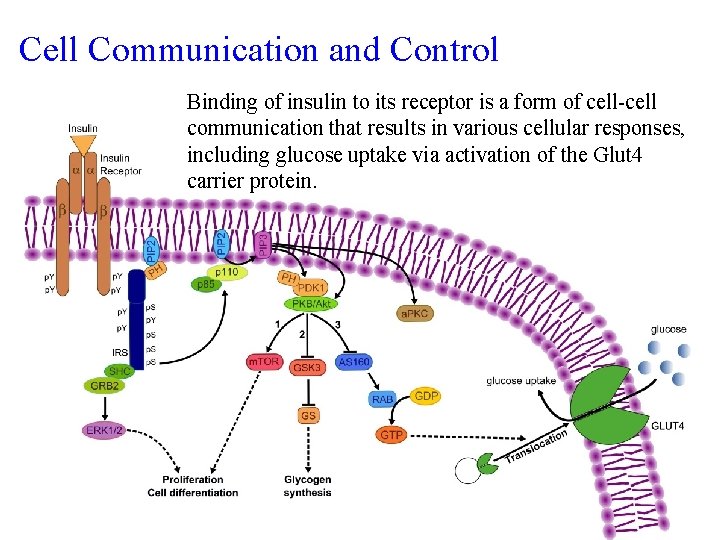
Cell Communication and Control Binding of insulin to its receptor is a form of cell-cell communication that results in various cellular responses, including glucose uptake via activation of the Glut 4 carrier protein.
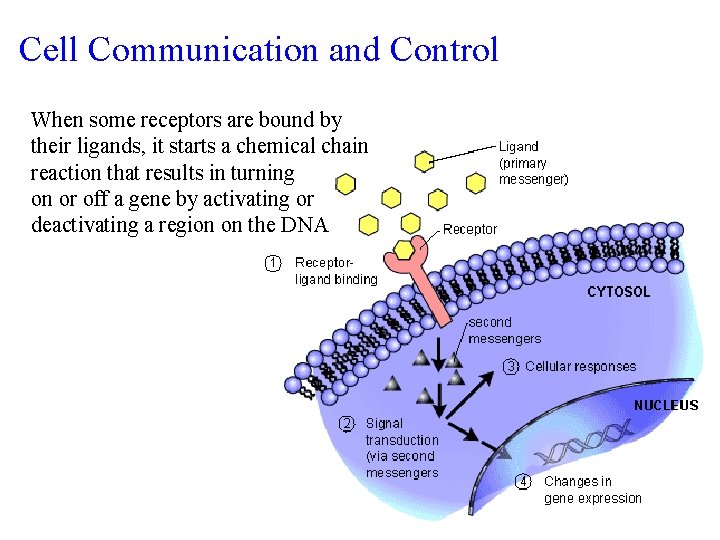
Cell Communication and Control When some receptors are bound by their ligands, it starts a chemical chain reaction that results in turning on or off a gene by activating or deactivating a region on the DNA
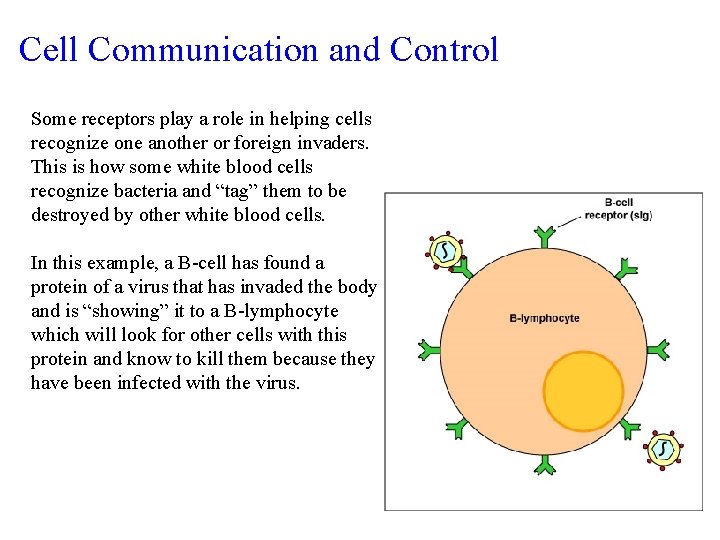
Cell Communication and Control Some receptors play a role in helping cells recognize one another or foreign invaders. This is how some white blood cells recognize bacteria and “tag” them to be destroyed by other white blood cells. In this example, a B-cell has found a protein of a virus that has invaded the body and is “showing” it to a B-lymphocyte which will look for other cells with this protein and know to kill them because they have been infected with the virus.
Osmosis Experiment Gummy Bear Experiment: Tap Water • One gummy bear osmosis experiment involves soaking gummy bears overnight in plain water. To complete this experiment, you should first have students measure the height, width, and depth of the gummy bear, and record this information in their lab books. Place the gummy bears in cups of water -- one per student -- and set aside. Then discuss hypotheses -- what do the students think will happen to the bears? The next day, the bears will have expanded, as water moved by diffusion through the bear's semipermeable membrane to reach an isotonic state where the concentration of water molecules inside and outside the bear were the same. Have the students measure the bears again, and calculate the percentage of growth. Gummy Bear Experiment: Salt Water • Conduct the same experiment, this time soaking the gummy bears in salt water. Again ask students to predict the outcome: will the addition of salt change the outcome of the experiment in any way? If you soak the original, water-expanded gummy bears in salt water, they will shrink; osmosis will cause water to leave the gummy bear. However, if you soak new gummy bears in salt water, they will shrink immeasurably, as the bears' gelatin construction will cause it to hold its shape and size, for the most part, even when water leaves the bear.
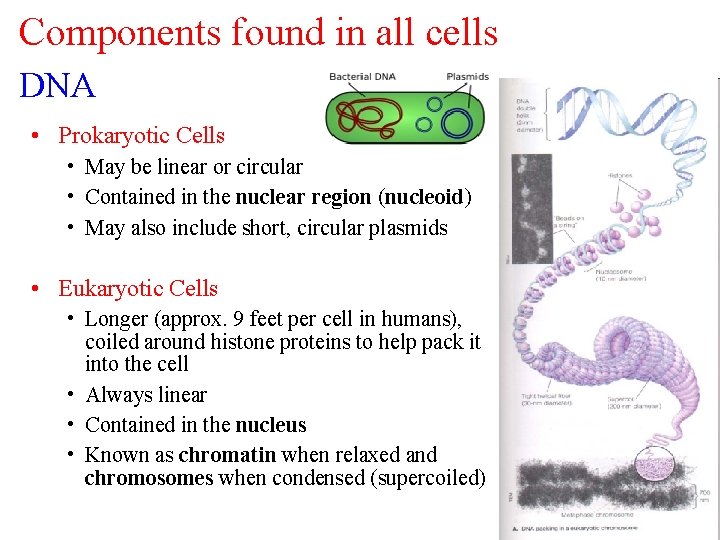
Components found in all cells DNA • Prokaryotic Cells • May be linear or circular • Contained in the nuclear region (nucleoid) • May also include short, circular plasmids • Eukaryotic Cells • Longer (approx. 9 feet per cell in humans), coiled around histone proteins to help pack it into the cell • Always linear • Contained in the nucleus • Known as chromatin when relaxed and chromosomes when condensed (supercoiled)
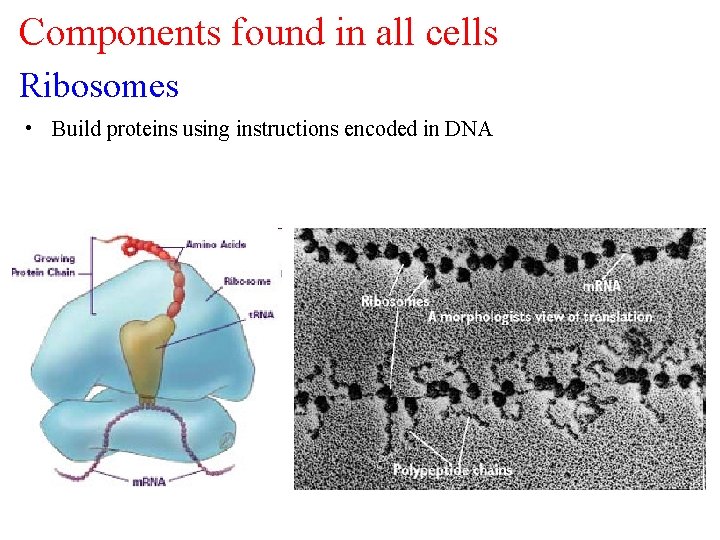
Components found in all cells Ribosomes • Build proteins using instructions encoded in DNA
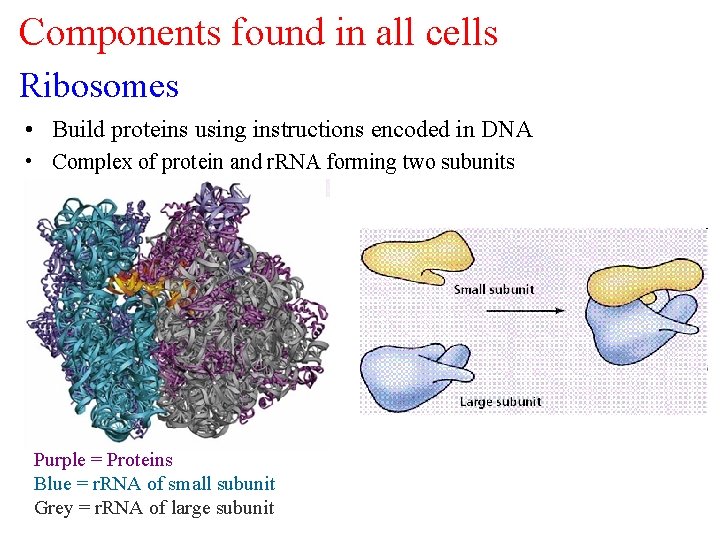
Components found in all cells Ribosomes • Build proteins using instructions encoded in DNA • Complex of protein and r. RNA forming two subunits Purple = Proteins Blue = r. RNA of small subunit Grey = r. RNA of large subunit
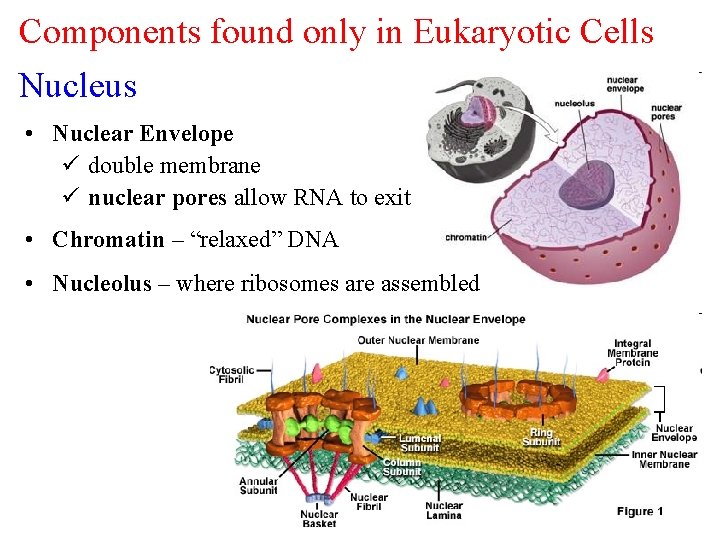
Components found only in Eukaryotic Cells Nucleus • Nuclear Envelope ü double membrane ü nuclear pores allow RNA to exit • Chromatin – “relaxed” DNA • Nucleolus – where ribosomes are assembled
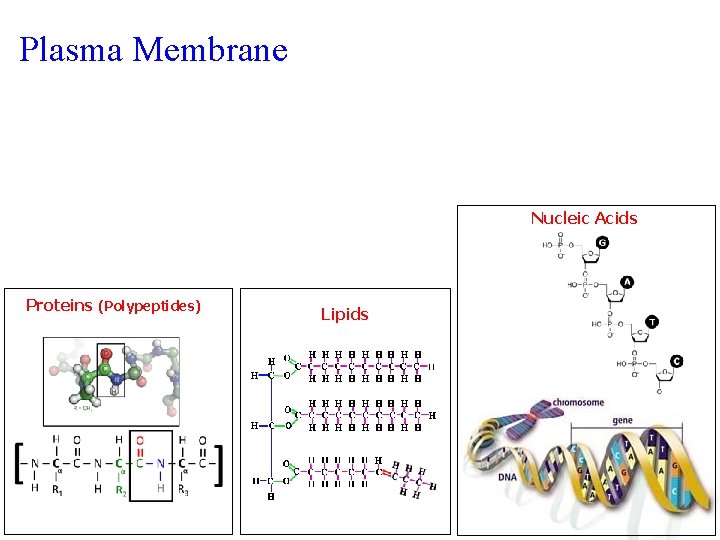
Plasma Membrane Nucleic Acids Proteins (Polypeptides) Lipids
Cells: Web Resources General Cell Structure • • • http: //www. youtube. com/watch? v=Nii. LS_ov. Lw. M&feature=related (3: 10) http: //cellsalive. com http: //www. youtube. com/watch? v=4 NA 7 c. SMDgmg http: //vcell. ndsu. edu/animations/ http: //www. johnkyrk. com/ http: //www. youtube. com/watch? v=Bt. ZEq. Q 1 cpmk&feature=related Cell Membrane • • • Osmosis: http: //highered. mcgraw-hill. com/sites/9834092339/student_view 0/chapter 38/animation_-_osmosis. html Osmosis: http: //www. youtube. com/watch? v=sdi. Jt. DRJQEc&feature=related Osmosis & Diffusion: http: //www. youtube. com/watch? v=quc. TUo. HAeu. Y&feature=related Passive Transport: http: //www. youtube. com/watch? v=s 0 p 1 ztrb. XPY&feature=related (0: 27) Active Transport: http: //www. youtube. com/watch? v=STz. Oi. Rqzz. L 4&feature=related (0: 21) Endocytosis & Exocytosis: http: //www. youtube. com/watch? v=4 g. Ltk 8 Yc 1 Zc&feature=related (0: 35) Nucleus & DNA • • • Nucleus: http: //www. youtube. com/watch? v=rea. YXf. POy 9 M DNA Structure: http: //www. youtube. com/watch? v=qy 8 dk 5 i. S 1 f 0 DNA Structure: http: //www. youtube. com/watch? v=l-hr. Ls 03 Kj. Y&feature=related DNA Packing: http: //www. youtube. com/watch? v=is. NRi. SD 8 k. Jw&feature=related (0: 48) DNA Packing: http: //www. youtube. com/watch? v=l. UESm. HDr. N 40&feature=related (0: 48) http: //www. youtube. com/watch? v=ZXt 4 p. DVb 2 W 0&feature=related
- Slides: 24