
Cell Biology MCAS Review Cell Theory 1 All

Cell Biology MCAS Review
Cell Theory 1. All living things are made of cells. 2. Cells are the basic unit of structure and function of living things. 3. All cells come from existing cells.
Two Types of Cells Prokaryotes • Do not have a nucleus. • Do have DNA, contained in the cytoplasm. • Simpler, smaller cells. Have fewer organelles (cell membrane, ribosomes, cytoskeleton). Eukaryotes • Do have a nucleus. • Do have DNA, contained in the nucleus. • Larger, more complicated cells (have more organelles). • Can have specialized functions.
Which of the following organisms is a prokaryote? • A. Agaricus arvensis, horse mushroom • B. Rhizopus stolonifer, bread mold fungus • C. Saccharomyces cerevisiae, baker’s yeast • D. Thiopedia rosea, purple sulfur bacterium
Which of the following characteristics is most useful when classifying a eukaryote into a kingdom? • A. how the organism feeds • B. how the organism moves • C. the organism’s color and mass • D. the organism’s form and structure
Organelles • Organelles are the tiny parts inside a cell that help it function. • Each organelle has a specific function. • Cytoplasm: The material inside the cell membrane and outside of the nucleus.

Cell Membrane • Composed of a phospholipid bilayer, protein channels, and carbohydrates. • Regulates the movement of materials into and out of the cell.

Cell Wall • Found only in Plant cells, outside of the cell membrane. • Composed of carbohydrates. • Supports the cell’s shape and protects the cell.
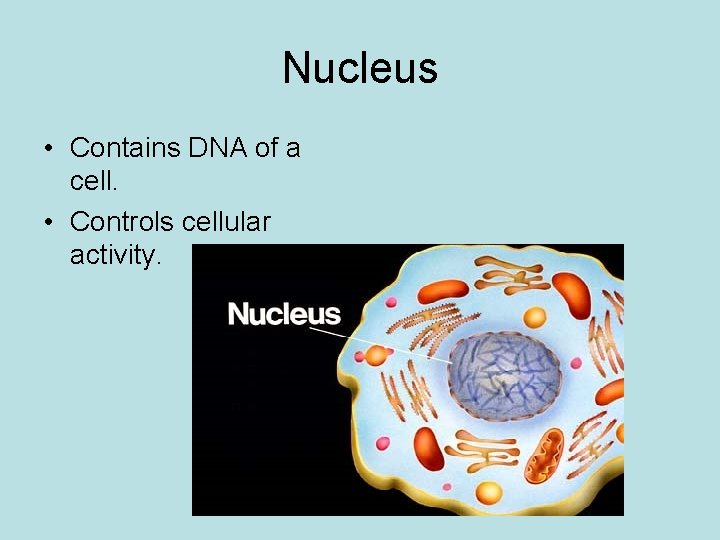
Nucleus • Contains DNA of a cell. • Controls cellular activity.
A researcher is studying a particular disease-causing agent. The agent has a protein coat, but it lacks a nucleus, contains no other organelles, and can reproduce only when it is inside an animal cell. The researcher should classify the agent as which of the following? A. a bacterium B. a fungus C. a protist D. a virus
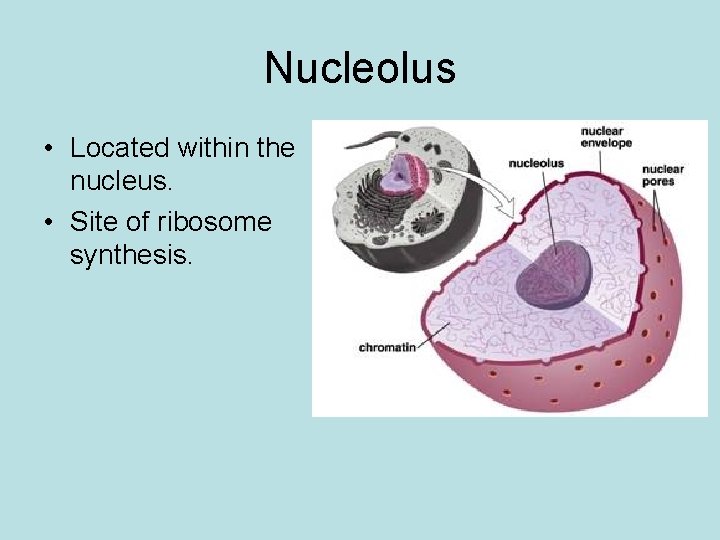
Nucleolus • Located within the nucleus. • Site of ribosome synthesis.

Rough Endoplasmic Reticulum • Has ribosomes attached. • Involved in protein synthesis.

Smooth Endoplasmic Reticulum • No ribosomes attached. • Involved in lipid synthesis.
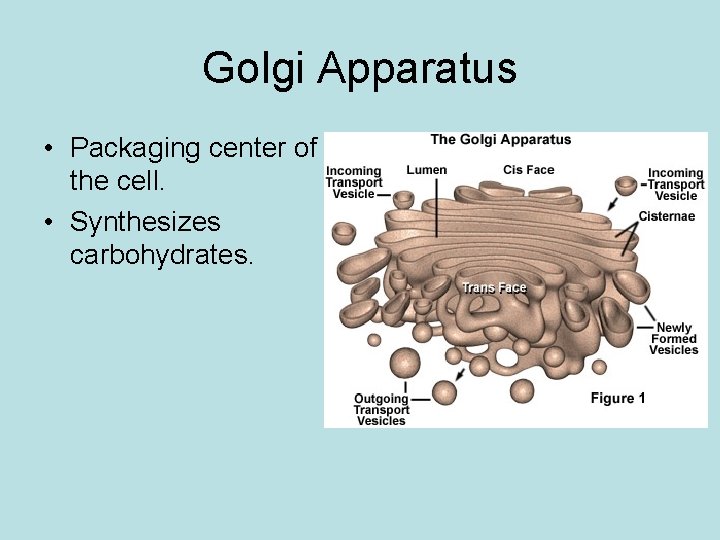
Golgi Apparatus • Packaging center of the cell. • Synthesizes carbohydrates.
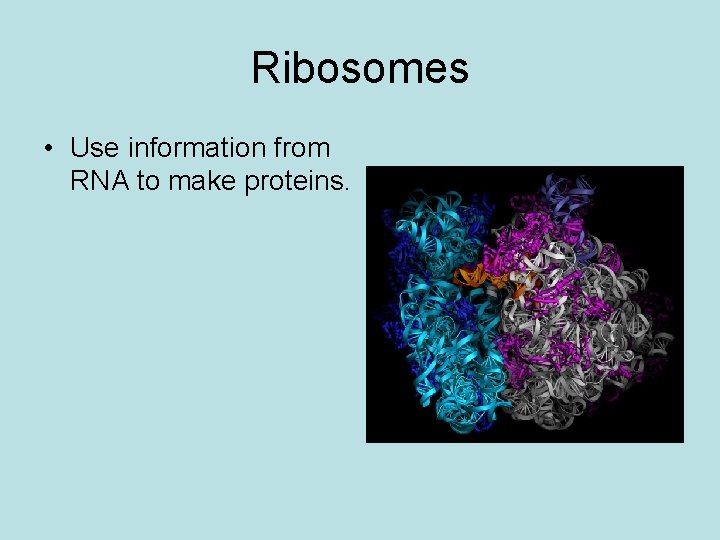
Ribosomes • Use information from RNA to make proteins.

Lysosome • Only found in animal cells. • Digests old organelles and other cellular waste.
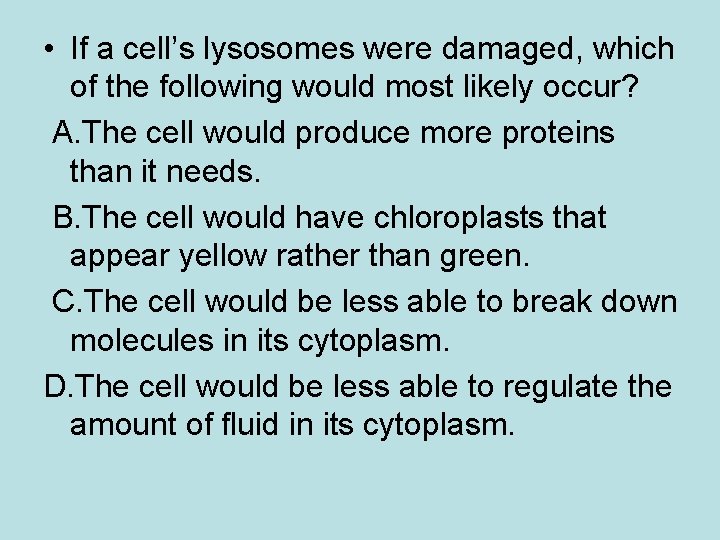
• If a cell’s lysosomes were damaged, which of the following would most likely occur? A. The cell would produce more proteins than it needs. B. The cell would have chloroplasts that appear yellow rather than green. C. The cell would be less able to break down molecules in its cytoplasm. D. The cell would be less able to regulate the amount of fluid in its cytoplasm.
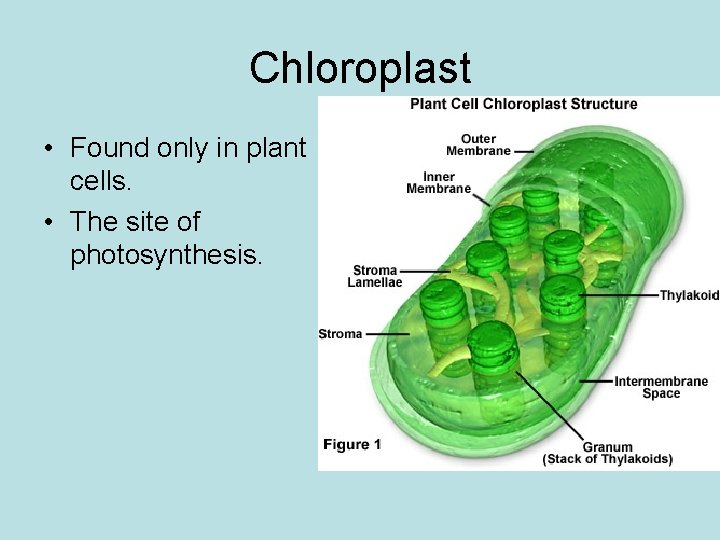
Chloroplast • Found only in plant cells. • The site of photosynthesis.

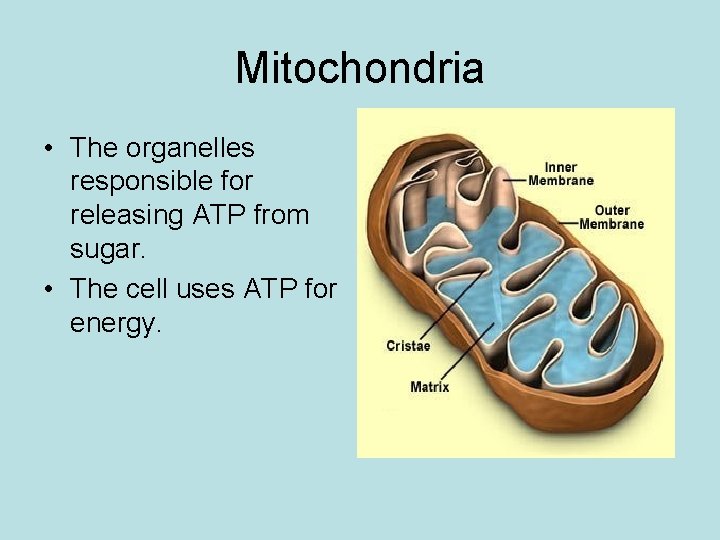
Mitochondria • The organelles responsible for releasing ATP from sugar. • The cell uses ATP for energy.
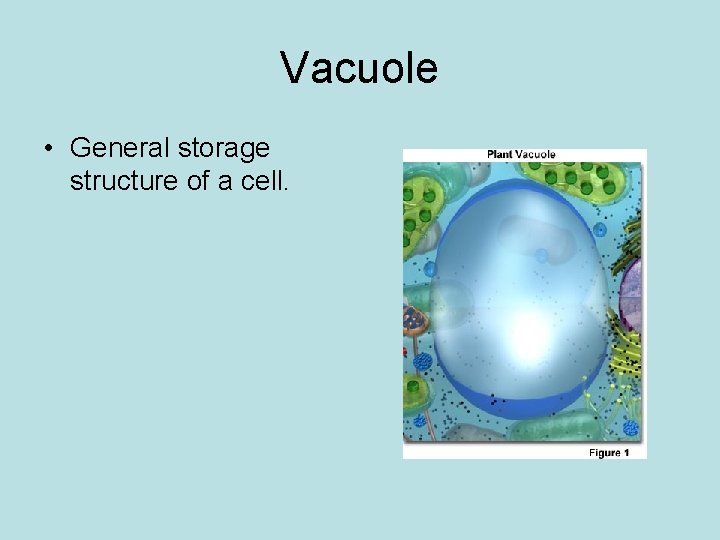
Vacuole • General storage structure of a cell.
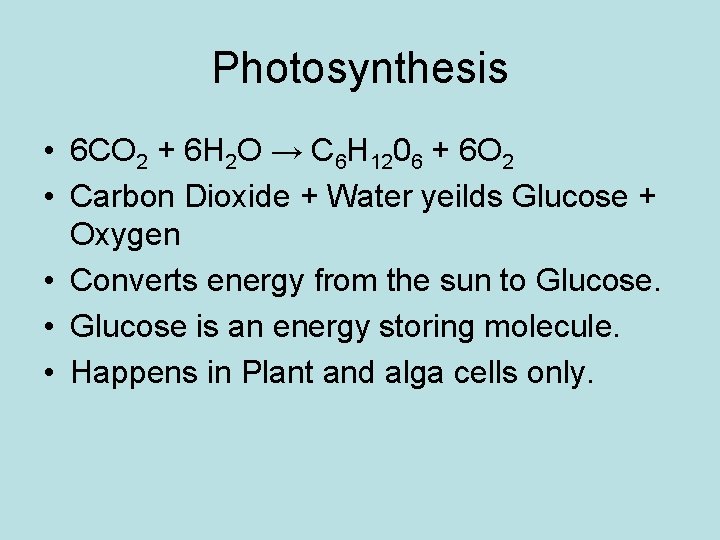
Photosynthesis • 6 CO 2 + 6 H 2 O → C 6 H 1206 + 6 O 2 • Carbon Dioxide + Water yeilds Glucose + Oxygen • Converts energy from the sun to Glucose. • Glucose is an energy storing molecule. • Happens in Plant and alga cells only.
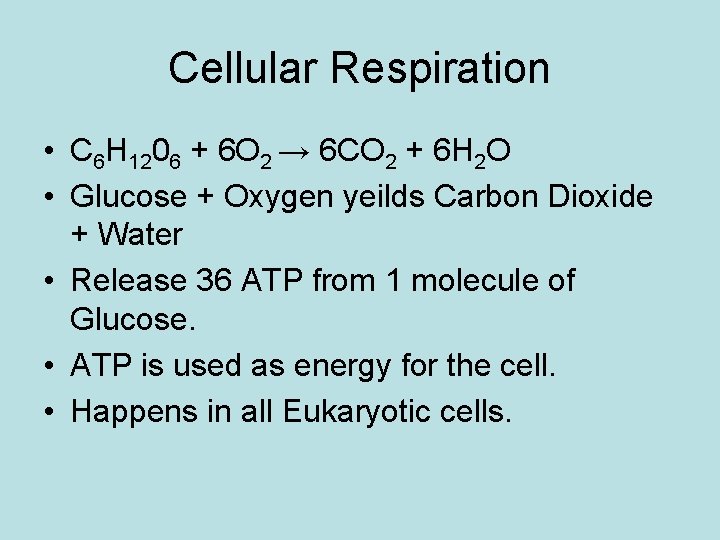
Cellular Respiration • C 6 H 1206 + 6 O 2 → 6 CO 2 + 6 H 2 O • Glucose + Oxygen yeilds Carbon Dioxide + Water • Release 36 ATP from 1 molecule of Glucose. • ATP is used as energy for the cell. • Happens in all Eukaryotic cells.
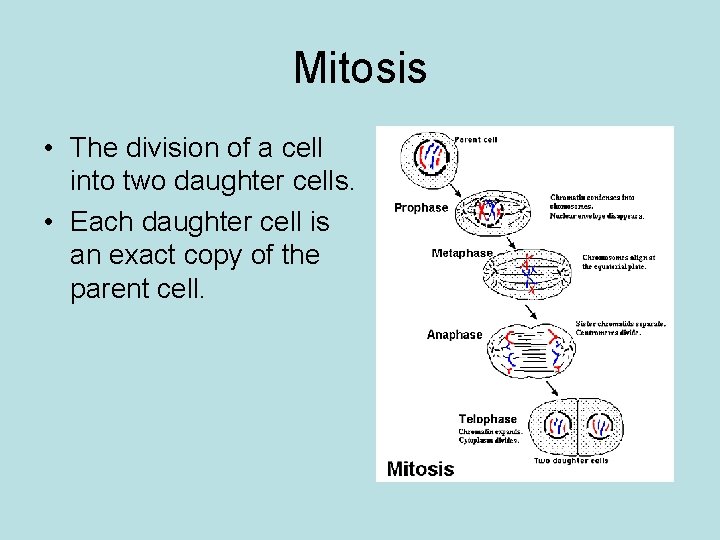
Mitosis • The division of a cell into two daughter cells. • Each daughter cell is an exact copy of the parent cell.
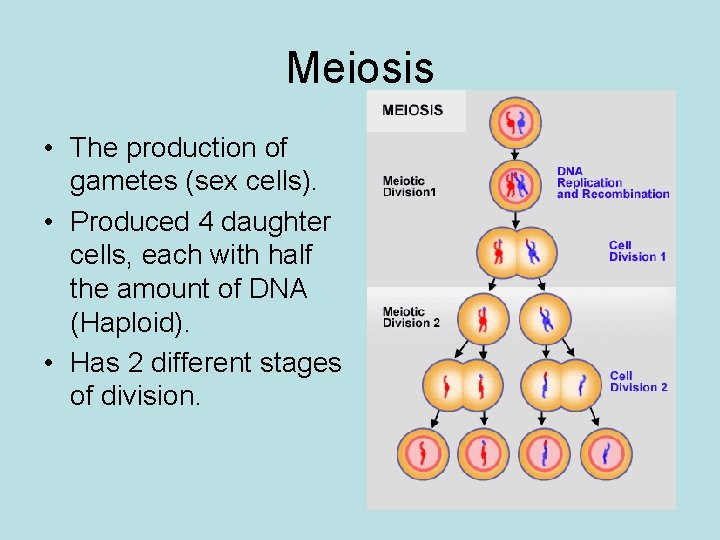
Meiosis • The production of gametes (sex cells). • Produced 4 daughter cells, each with half the amount of DNA (Haploid). • Has 2 different stages of division.
- Slides: 25