
Cell Bio 4 Cell communication introduction to stem
Cell Bio 4 Cell communication & introduction to stem cell Prof. Dr. Hala Elmazar 1

B- Cell signaling • Living cells in a multicellular organism have to communicate e each others in order to maintain homeostasis & life. • Cells communicate e each through signals which result in responses within the cells • The cell signaling system has 3 parts: I. Reception II. Transduction III. response Prof. Dr. Hala Elmazar 2
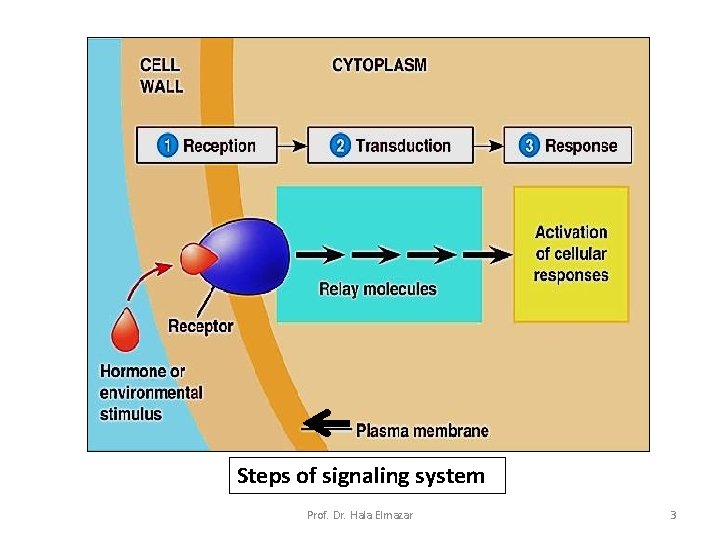
Steps of signaling system Prof. Dr. Hala Elmazar 3
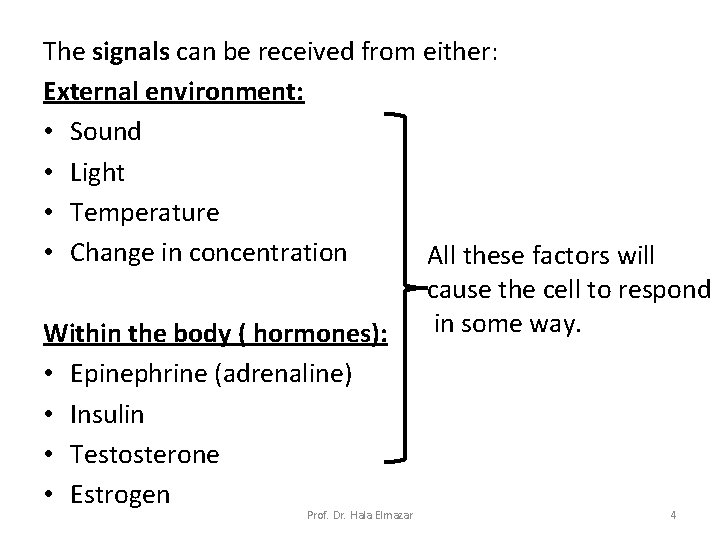
The signals can be received from either: External environment: • Sound • Light • Temperature • Change in concentration All these factors will cause the cell to respond in some way. Within the body ( hormones): • • Epinephrine (adrenaline) Insulin Testosterone Estrogen Prof. Dr. Hala Elmazar 4

Modes of cell signaling 1 - Intracrine: Any hormone or ligand acting inside the cell 2 - Autocrine : the cell secretes a hormone or chemical messenger that binds to receptors on that same cell, leading to changes in the cell. 3 - Direct (Juxtacrine signaling): gap junctions (Cardiac muscles, embryonic development) Prof. Dr. Hala Elmazar 5
4 - Short distance: act locally on different type of cells @ Paracrine (nearby) signaling (cytokines, histamine) @ Synaptic signaling (neurotransmitters : AC) • Paracrine: signals are carried by messenger molecules called "local regulators", that are released by one cell and move to make contact with another cell (e. g. ; blood clotting, tissue repair) • Synaptic: (neurotransmitters). Neurotransmitters are endogenous chemicals that transmit signals from a neuron to a target cell across a synapse. Prof. Dr. Hala Elmazar 6
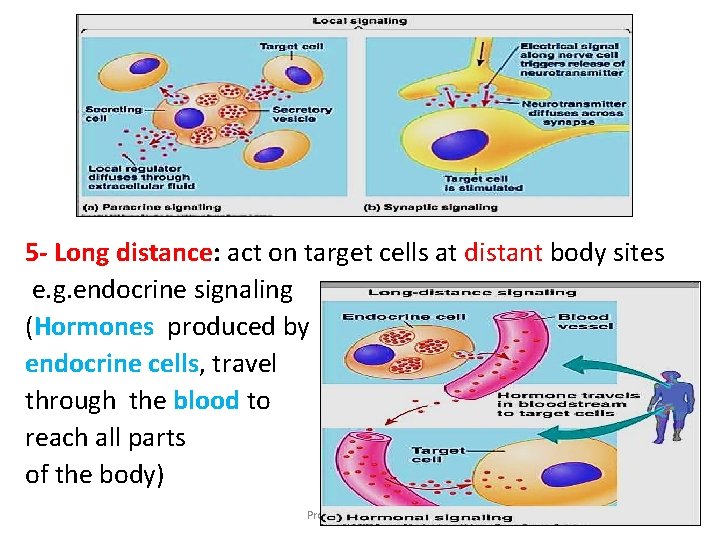
5 - Long distance: act on target cells at distant body sites e. g. endocrine signaling (Hormones produced by endocrine cells, travel through the blood to reach all parts of the body) Prof. Dr. Hala Elmazar 7

I. Reception signaling molecules secreted by or expressed on the cell surface of one cell will bind to receptors expressed by other cells→ changes Receptors: protein molecules found either: § On the cell surface (embedded within the cell membrane) § In the cytoplasm They receive chemical signals from outside the cell receptor Prof. Dr. Hala Elmazar 8
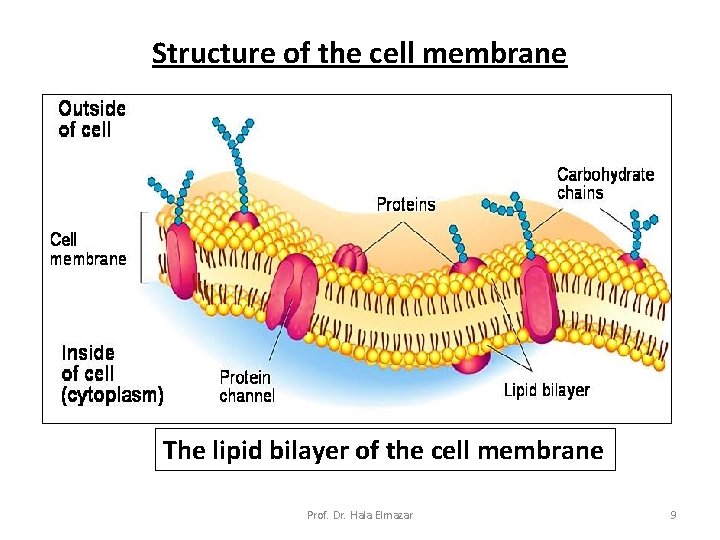
Structure of the cell membrane The lipid bilayer of the cell membrane Prof. Dr. Hala Elmazar 9
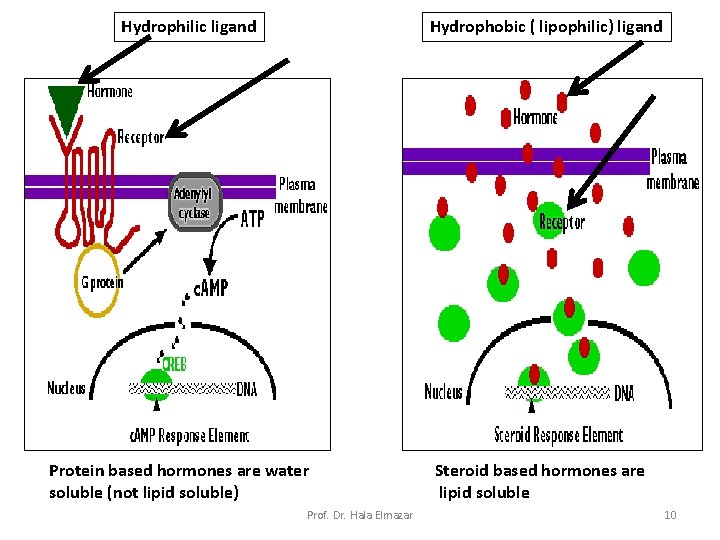
Hydrophilic ligand Hydrophobic ( lipophilic) ligand Protein based hormones are water soluble (not lipid soluble) Prof. Dr. Hala Elmazar Steroid based hormones are lipid soluble 10
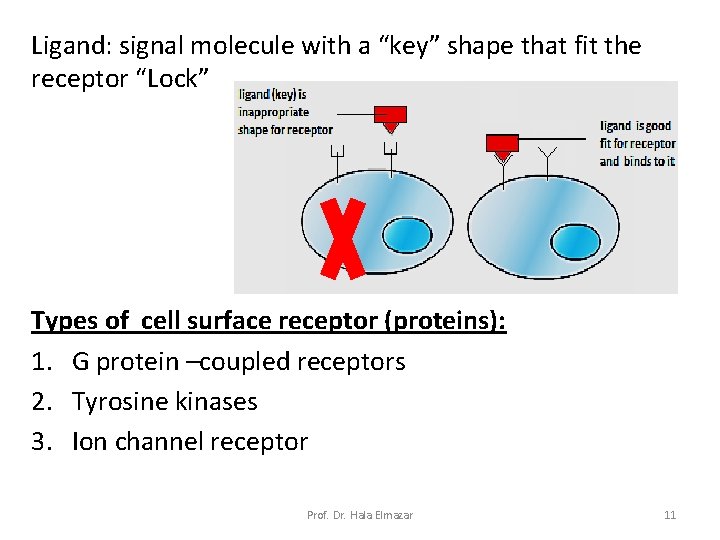
Ligand: signal molecule with a “key” shape that fit the receptor “Lock” Types of cell surface receptor (proteins): 1. G protein –coupled receptors 2. Tyrosine kinases 3. Ion channel receptor Prof. Dr. Hala Elmazar 11
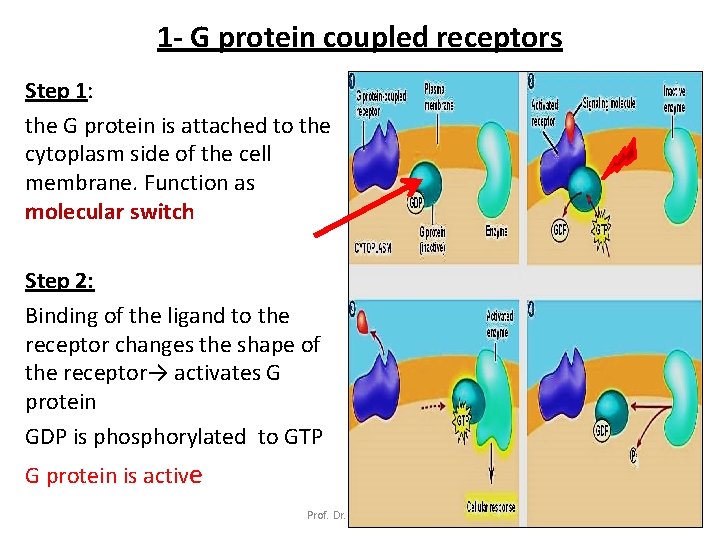
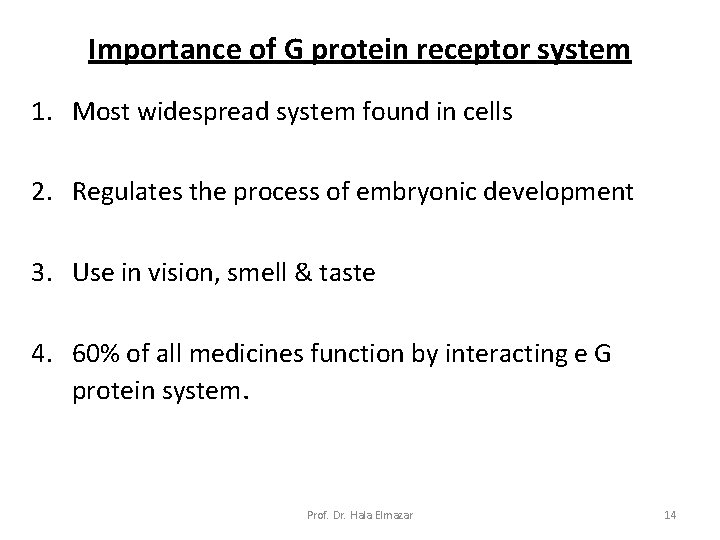
1 - G protein coupled receptors Step 1: the G protein is attached to the cytoplasm side of the cell membrane. Function as molecular switch Step 2: Binding of the ligand to the receptor changes the shape of the receptor→ activates G protein GDP is phosphorylated to GTP G protein is active Prof. Dr. Hala Elmazar 12
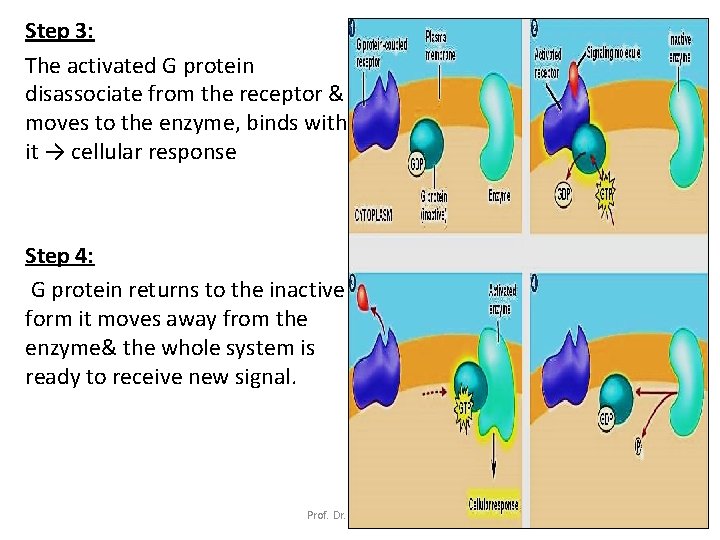
Step 3: The activated G protein disassociate from the receptor & moves to the enzyme, binds with it → cellular response Step 4: G protein returns to the inactive form it moves away from the enzyme& the whole system is ready to receive new signal. Prof. Dr. Hala Elmazar 13
Importance of G protein receptor system 1. Most widespread system found in cells 2. Regulates the process of embryonic development 3. Use in vision, smell & taste 4. 60% of all medicines function by interacting e G protein system. Prof. Dr. Hala Elmazar 14
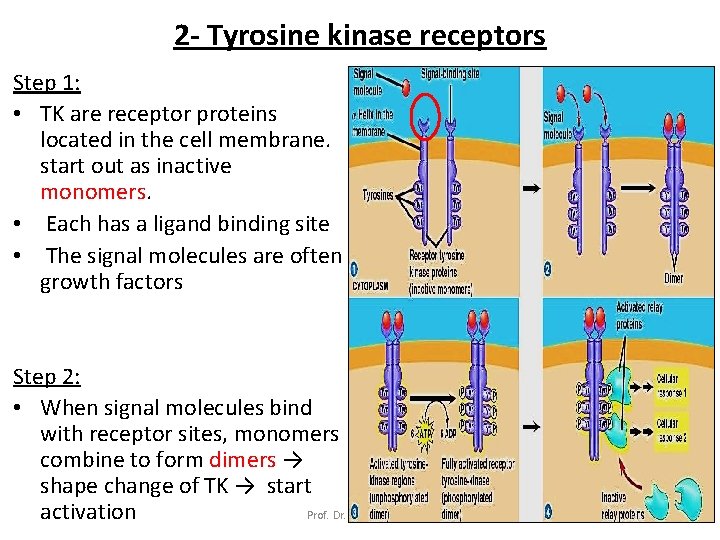
2 - Tyrosine kinase receptors Step 1: • TK are receptor proteins located in the cell membrane. start out as inactive monomers. • Each has a ligand binding site • The signal molecules are often growth factors Step 2: • When signal molecules bind with receptor sites, monomers combine to form dimers → shape change of TK → start Prof. Dr. Hala Elmazar activation 15
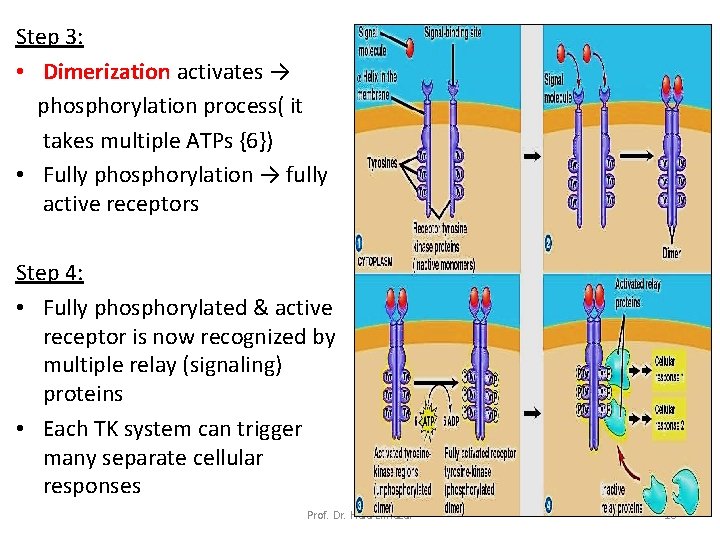
Step 3: • Dimerization activates → phosphorylation process( it takes multiple ATPs {6}) • Fully phosphorylation → fully active receptors Step 4: • Fully phosphorylated & active receptor is now recognized by multiple relay (signaling) proteins • Each TK system can trigger many separate cellular responses Prof. Dr. Hala Elmazar 16
Importance of Tyrosine kinase receptor system • One receptor tyrosine kinase (DIMER) can activate more different responses, providing a way for cells to regulate growth • Key difference between TK receptors & G coupled receptors • Many cancers are caused by mutated tyrosine receptors that get activated without a signal molecule ( cells growing out of control) Prof. Dr. Hala Elmazar 17
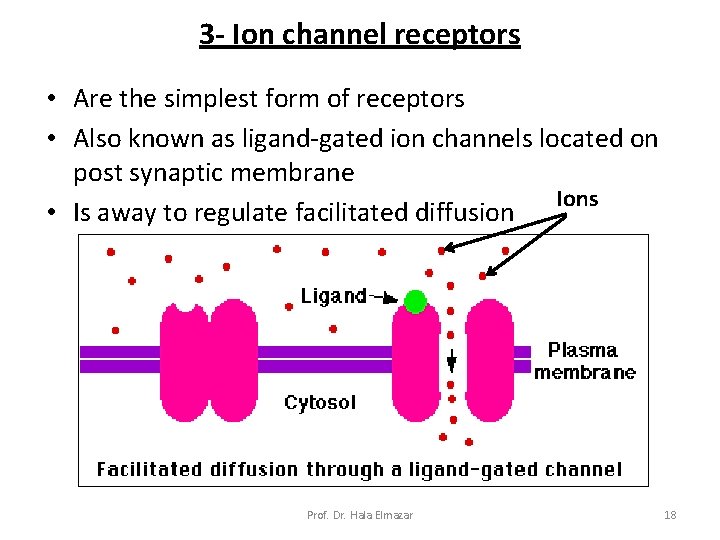
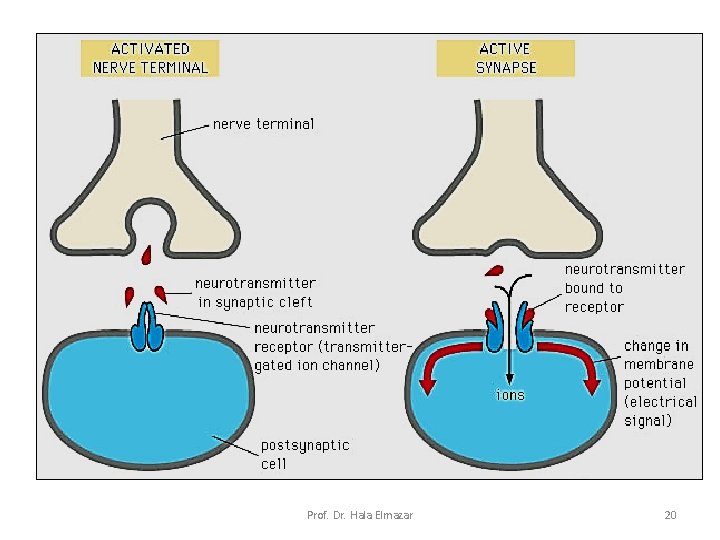
3 - Ion channel receptors • Are the simplest form of receptors • Also known as ligand-gated ion channels located on post synaptic membrane Ions • Is away to regulate facilitated diffusion Prof. Dr. Hala Elmazar 18
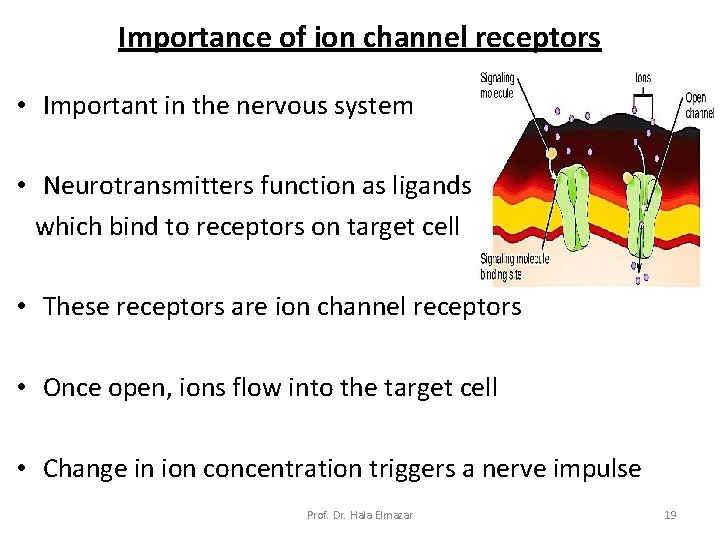
Importance of ion channel receptors • Important in the nervous system • Neurotransmitters function as ligands which bind to receptors on target cell • These receptors are ion channel receptors • Once open, ions flow into the target cell • Change in ion concentration triggers a nerve impulse Prof. Dr. Hala Elmazar 19
Prof. Dr. Hala Elmazar 20
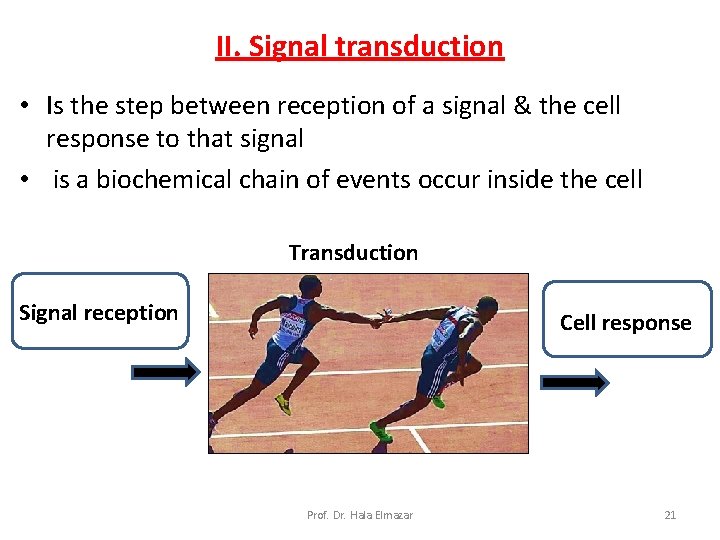
II. Signal transduction • Is the step between reception of a signal & the cell response to that signal • is a biochemical chain of events occur inside the cell Transduction Signal reception Cell response Prof. Dr. Hala Elmazar 21
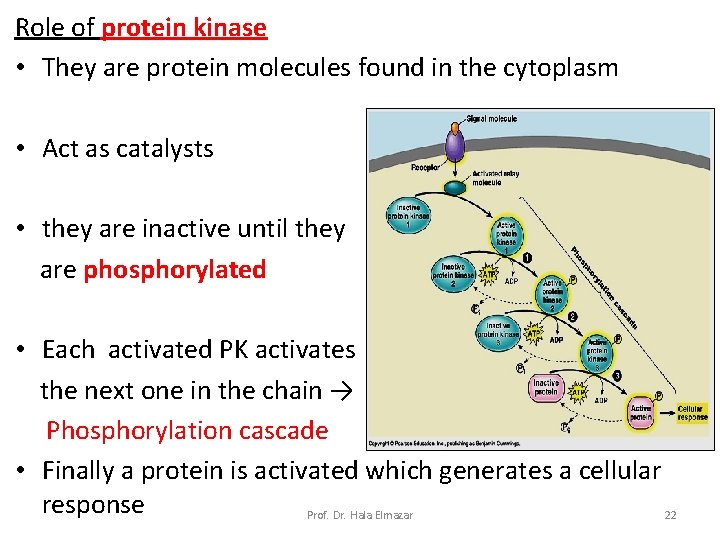
Role of protein kinase • They are protein molecules found in the cytoplasm • Act as catalysts • they are inactive until they are phosphorylated • Each activated PK activates the next one in the chain → Phosphorylation cascade • Finally a protein is activated which generates a cellular response Prof. Dr. Hala Elmazar 22
Second messengers • The extra- cellular signal molecule (ligand) is the 1 st messenger • 2 nd messengers are non protein molecules that transduce signals inside cells (used to relay messages), used to amplify the signal • Examples of 2 nd messengers are: 1. c. AMP 2. c. GMP 3. Calcium ions 4. Inositol triphosphate (IP 3) Prof. Dr. Hala Elmazar 23
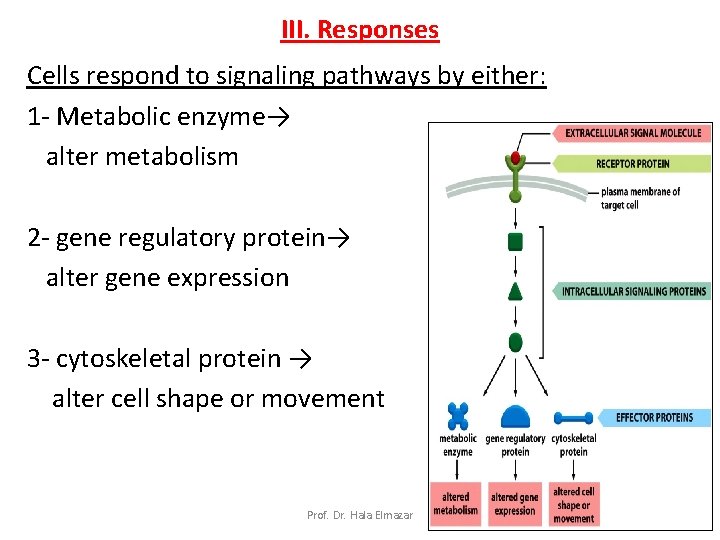
III. Responses Cells respond to signaling pathways by either: 1 - Metabolic enzyme→ alter metabolism 2 - gene regulatory protein→ alter gene expression 3 - cytoskeletal protein → alter cell shape or movement Prof. Dr. Hala Elmazar 24
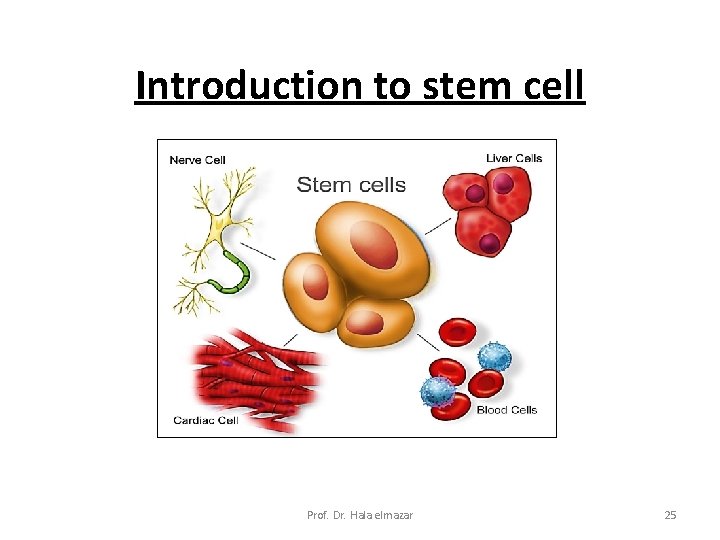
Introduction to stem cell Prof. Dr. Hala elmazar 25
What is a stem cell? Definition: • Undifferentiated cell that can differentiate into specialized cells & can divide by mitosis to produce more stem cells • stem cells are unique because it Can do both: v Differentiate: Make other types of cells(specialized cells of the body) AND v Self-renew: Make copies of itself Prof. Dr. Hala elmazar 26
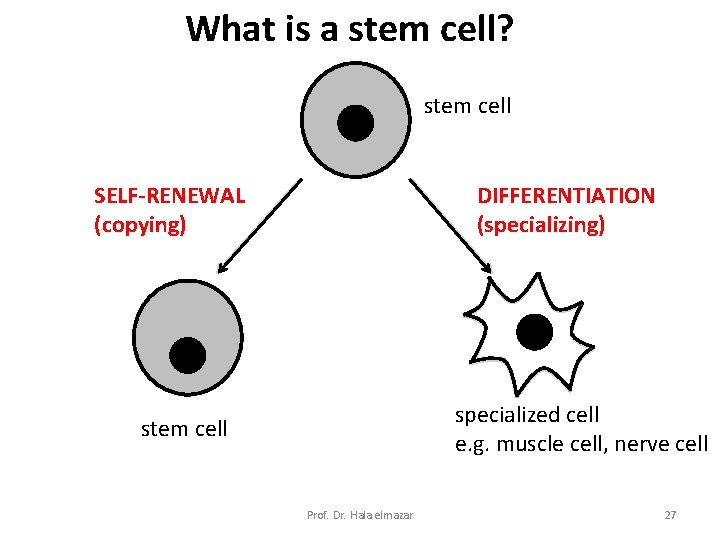
What is a stem cell? stem cell SELF-RENEWAL (copying) DIFFERENTIATION (specializing) specialized cell e. g. muscle cell, nerve cell stem cell Prof. Dr. Hala elmazar 27
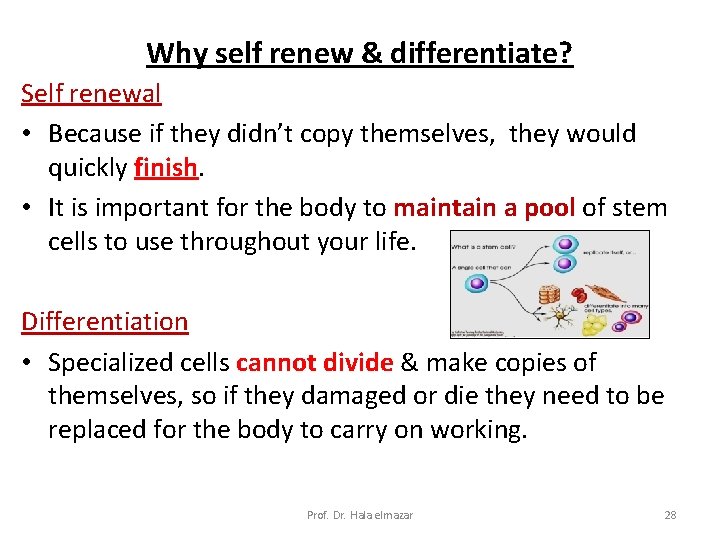
Why self renew & differentiate? Self renewal • Because if they didn’t copy themselves, they would quickly finish. • It is important for the body to maintain a pool of stem cells to use throughout your life. Differentiation • Specialized cells cannot divide & make copies of themselves, so if they damaged or die they need to be replaced for the body to carry on working. Prof. Dr. Hala elmazar 28
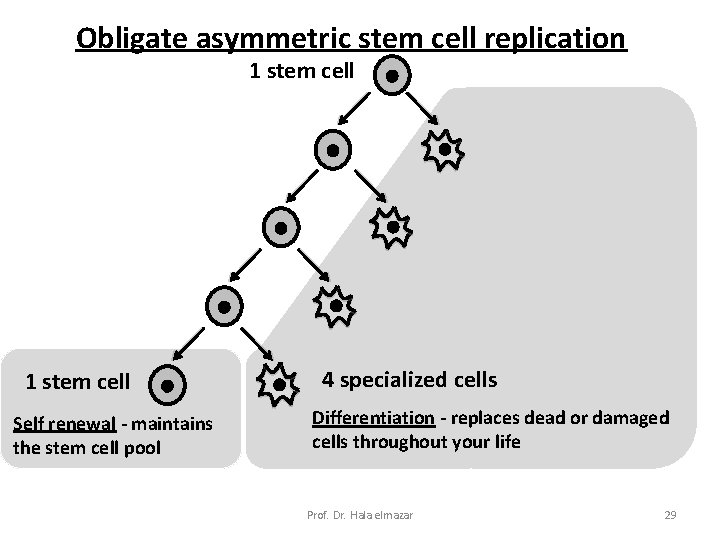
Obligate asymmetric stem cell replication 1 stem cell Self renewal - maintains the stem cell pool 4 specialized cells Differentiation - replaces dead or damaged cells throughout your life Prof. Dr. Hala elmazar 29
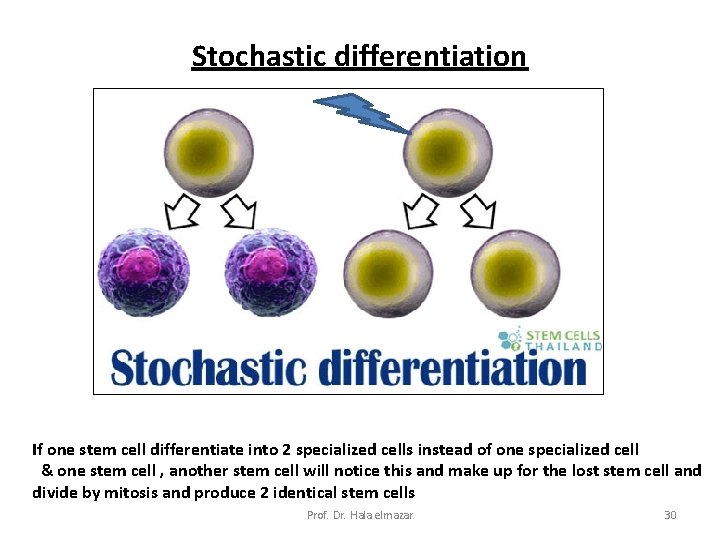
Stochastic differentiation If one stem cell differentiate into 2 specialized cells instead of one specialized cell & one stem cell , another stem cell will notice this and make up for the lost stem cell and divide by mitosis and produce 2 identical stem cells Prof. Dr. Hala elmazar 30
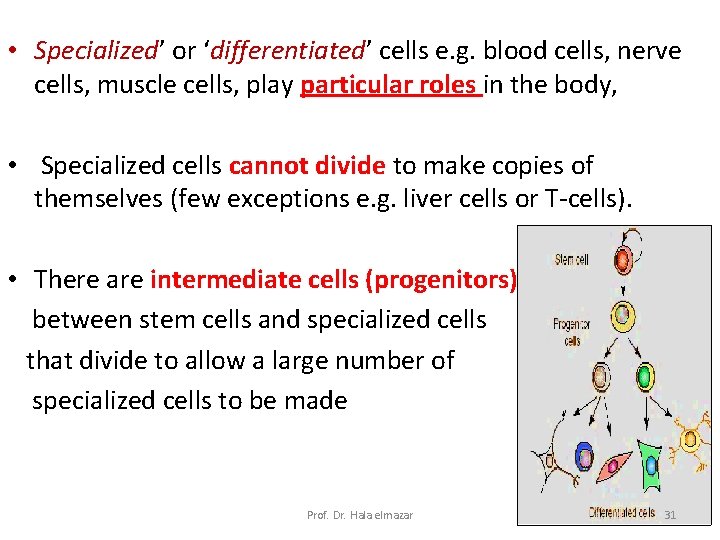
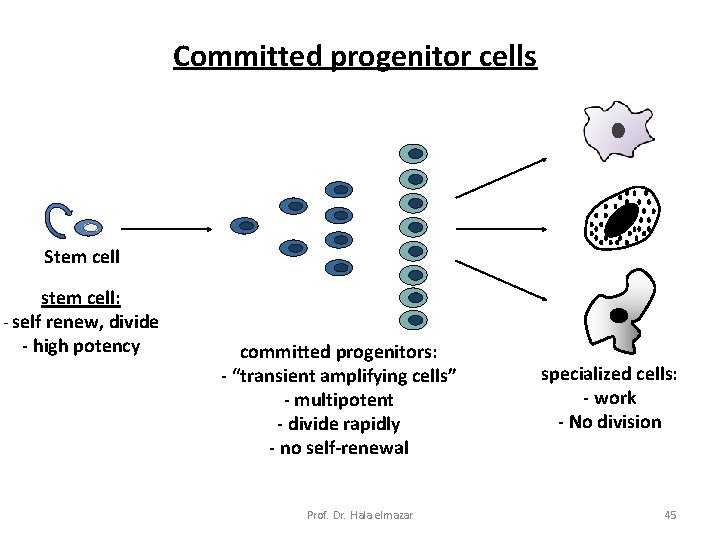
• Specialized’ or ‘differentiated’ cells e. g. blood cells, nerve cells, muscle cells, play particular roles in the body, • Specialized cells cannot divide to make copies of themselves (few exceptions e. g. liver cells or T-cells). • There are intermediate cells (progenitors) between stem cells and specialized cells that divide to allow a large number of specialized cells to be made Prof. Dr. Hala elmazar 31
Types of stem cells There are 2 types of stem cells: 1. Embryonic stem cells (ES) 2. Tissue (adult /somatic) stem cells (TS) Embryonic stem cells: Found in inner cell mass of blastocyst (a very early stage embryo that has about 50 to 100 cells) Tissue (adult /somatic)stem cells: found in the tissues of the body (in a fetus, baby, child or adult). Prof. Dr. Hala elmazar 32
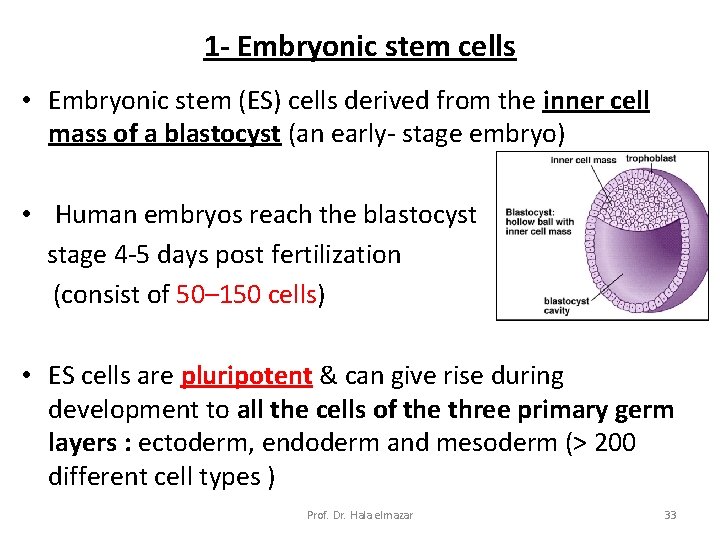
1 - Embryonic stem cells • Embryonic stem (ES) cells derived from the inner cell mass of a blastocyst (an early- stage embryo) • Human embryos reach the blastocyst stage 4 -5 days post fertilization (consist of 50– 150 cells) • ES cells are pluripotent & can give rise during development to all the cells of the three primary germ layers : ectoderm, endoderm and mesoderm (> 200 different cell types ) Prof. Dr. Hala elmazar 33
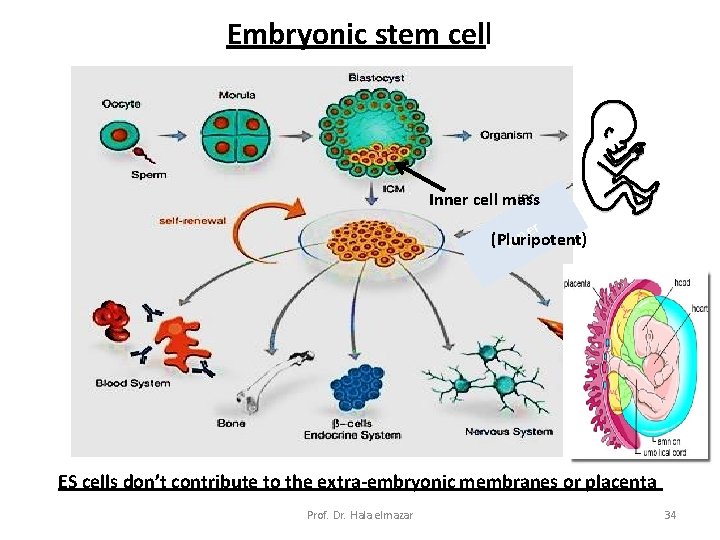
Embryonic stem cell Inner cell mass er n (Pluripotent) n I ES cells don’t contribute to the extra-embryonic membranes or placenta Prof. Dr. Hala elmazar 34
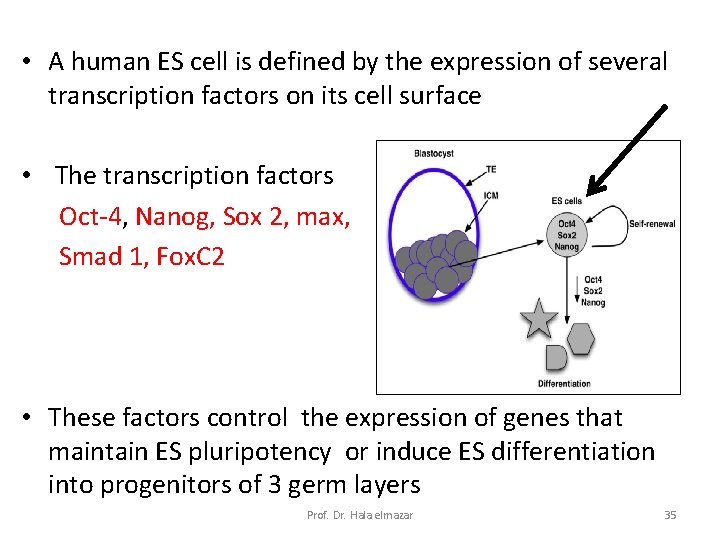
• A human ES cell is defined by the expression of several transcription factors on its cell surface • The transcription factors Oct-4, Nanog, Sox 2, max, Smad 1, Fox. C 2 • These factors control the expression of genes that maintain ES pluripotency or induce ES differentiation into progenitors of 3 germ layers Prof. Dr. Hala elmazar 35
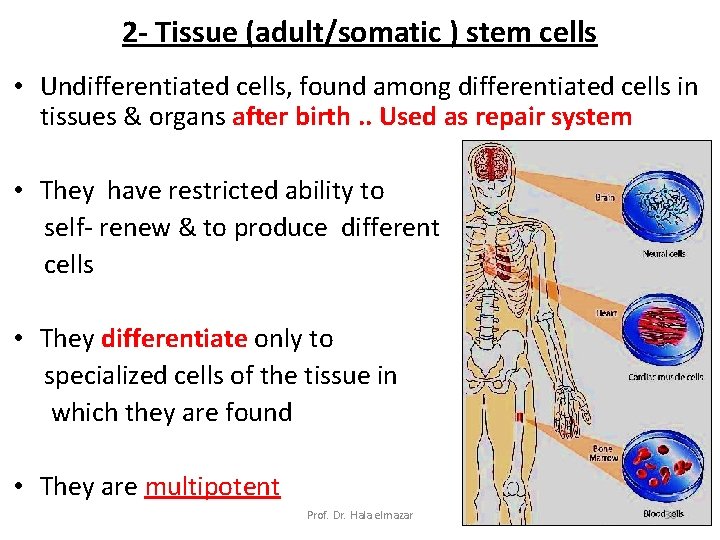
2 - Tissue (adult/somatic ) stem cells • Undifferentiated cells, found among differentiated cells in tissues & organs after birth. . Used as repair system • They have restricted ability to self- renew & to produce different cells • They differentiate only to specialized cells of the tissue in which they are found • They are multipotent Prof. Dr. Hala elmazar 36
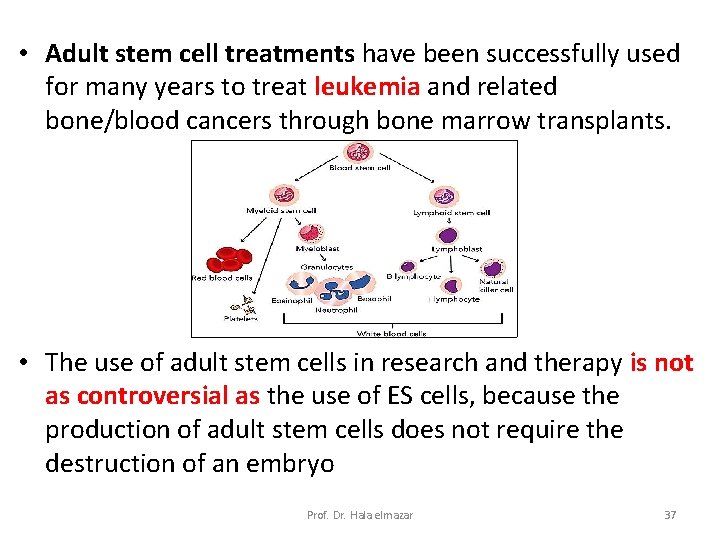
• Adult stem cell treatments have been successfully used for many years to treat leukemia and related bone/blood cancers through bone marrow transplants. • The use of adult stem cells in research and therapy is not as controversial as the use of ES cells, because the production of adult stem cells does not require the destruction of an embryo Prof. Dr. Hala elmazar 37
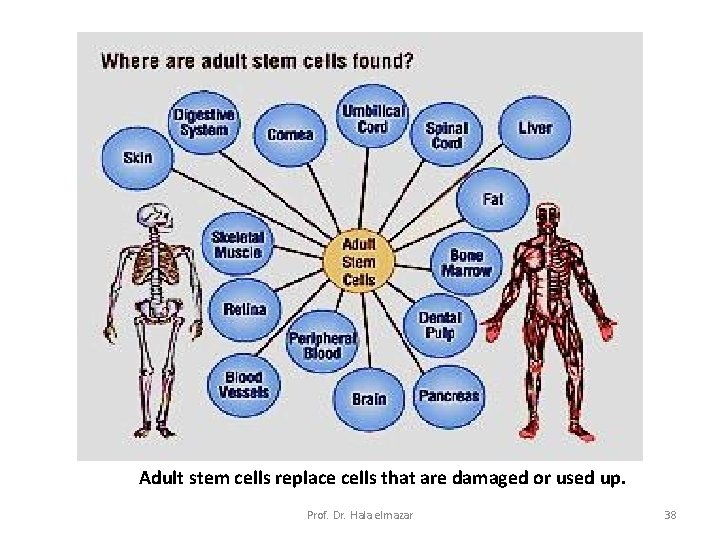
Adult stem cells replace cells that are damaged or used up. Prof. Dr. Hala elmazar 38
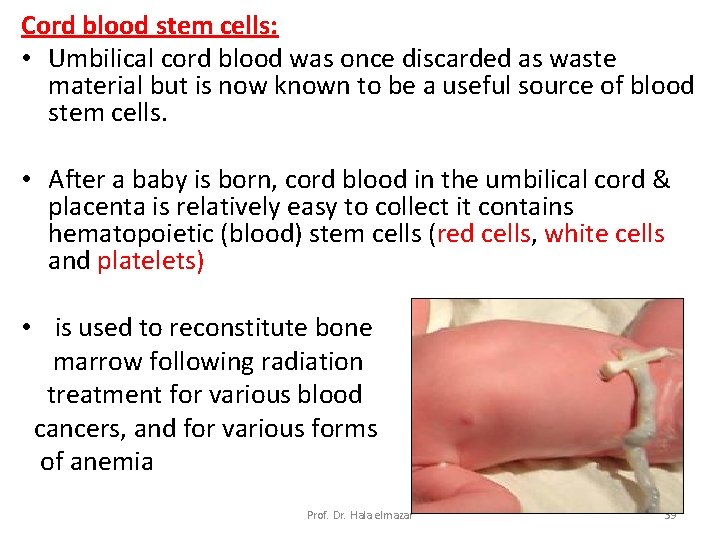
Cord blood stem cells: • Umbilical cord blood was once discarded as waste material but is now known to be a useful source of blood stem cells. • After a baby is born, cord blood in the umbilical cord & placenta is relatively easy to collect it contains hematopoietic (blood) stem cells (red cells, white cells and platelets) • is used to reconstitute bone marrow following radiation treatment for various blood cancers, and for various forms of anemia Prof. Dr. Hala elmazar 39
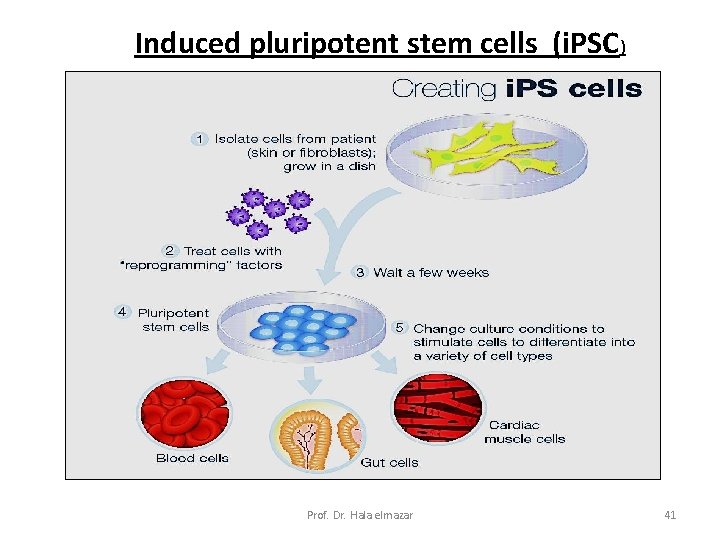
Induced pluripotent stem cells (i. PSC) • i. PSC technology is a huge discovery (2006) → NP 2012 • Concept: mature cells can be reprogrammed to become pluripotent. • Technique : done by introduce a few specific genes into already specialized cells ( Ex: ms cells) → the cells will forget what type of cells they are & revert back & reprogrammed back into pluripotent stem cell • Goal: regenerative medicine …. . To replace damage tissue in a given person by using pluripotent stem cells from his own body, not only the patient will get the new organ he needs but also NO any immune- rejection complication Prof. Dr. Hala elmazar 40
Induced pluripotent stem cells (i. PSC) Prof. Dr. Hala elmazar 41
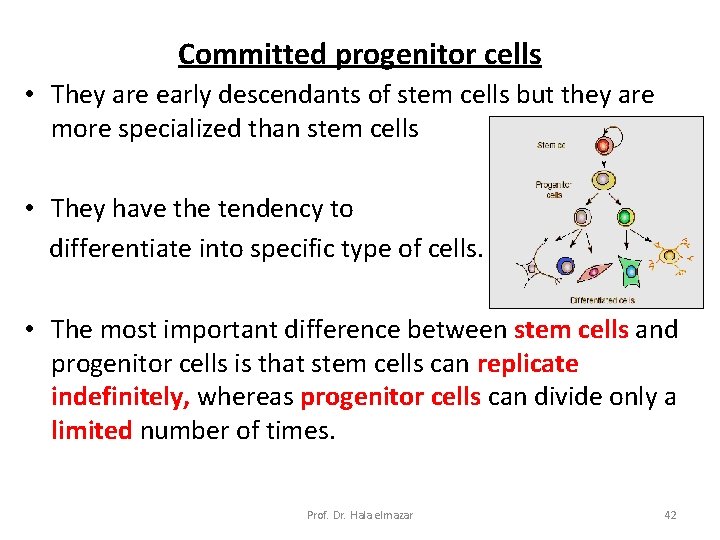
Committed progenitor cells • They are early descendants of stem cells but they are more specialized than stem cells • They have the tendency to differentiate into specific type of cells. • The most important difference between stem cells and progenitor cells is that stem cells can replicate indefinitely, whereas progenitor cells can divide only a limited number of times. Prof. Dr. Hala elmazar 42
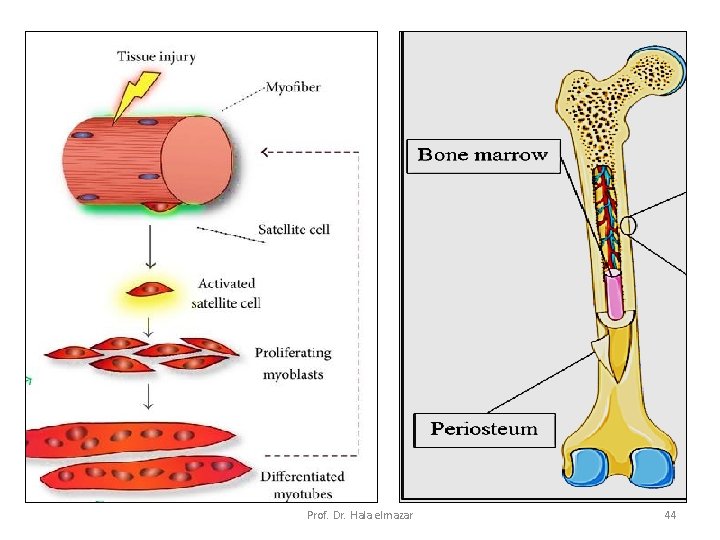
• Genetic & environmental factors determine the pathway of differentiation that the progenitor cells will take to form a specific linage. They remain dormant in the tissue till need. • Their main role is to replace cells in case of tissue injury, damage or dead cells • Example: ü Satellite cells found in muscles. ü Periosteum contains progenitor cells that develop into osteoblasts. Prof. Dr. Hala elmazar 43
Prof. Dr. Hala elmazar 44
Committed progenitor cells Stem cell stem cell: - self renew, divide - high potency committed progenitors: - “transient amplifying cells” - multipotent - divide rapidly - no self-renewal Prof. Dr. Hala elmazar specialized cells: - work - No division 45
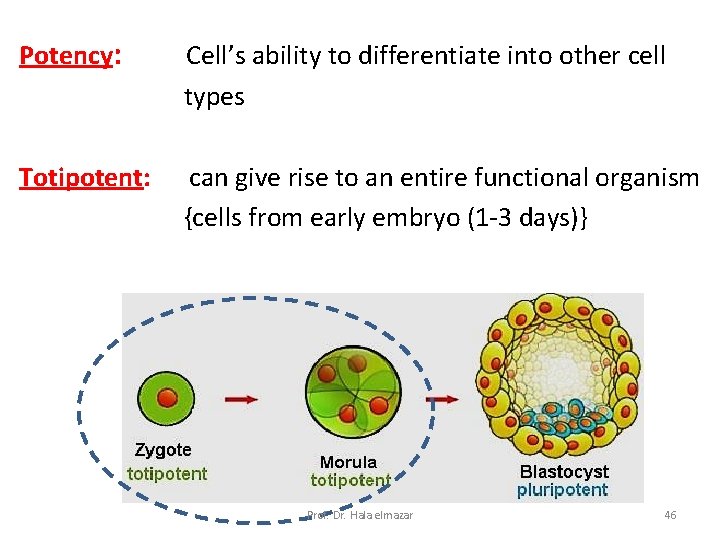
Potency: Cell’s ability to differentiate into other cell types Totipotent: can give rise to an entire functional organism {cells from early embryo (1 -3 days)} Prof. Dr. Hala elmazar 46
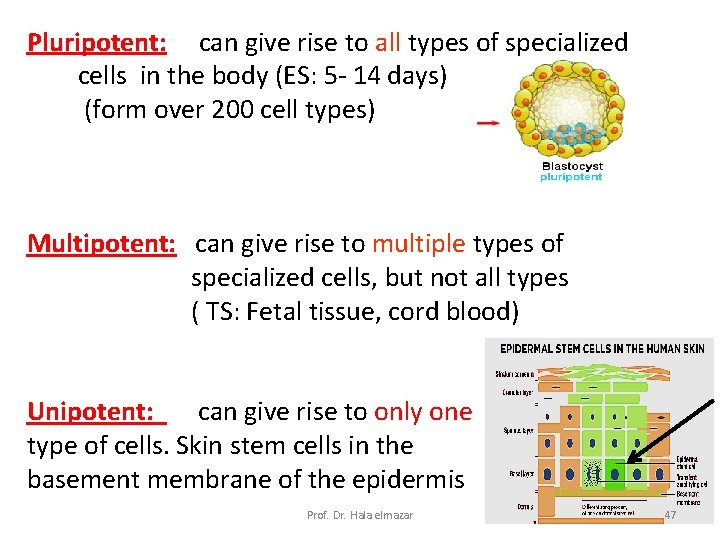
Pluripotent: can give rise to all types of specialized cells in the body (ES: 5 - 14 days) (form over 200 cell types) Multipotent: can give rise to multiple types of specialized cells, but not all types ( TS: Fetal tissue, cord blood) Unipotent: can give rise to only one type of cells. Skin stem cells in the basement membrane of the epidermis Prof. Dr. Hala elmazar 47
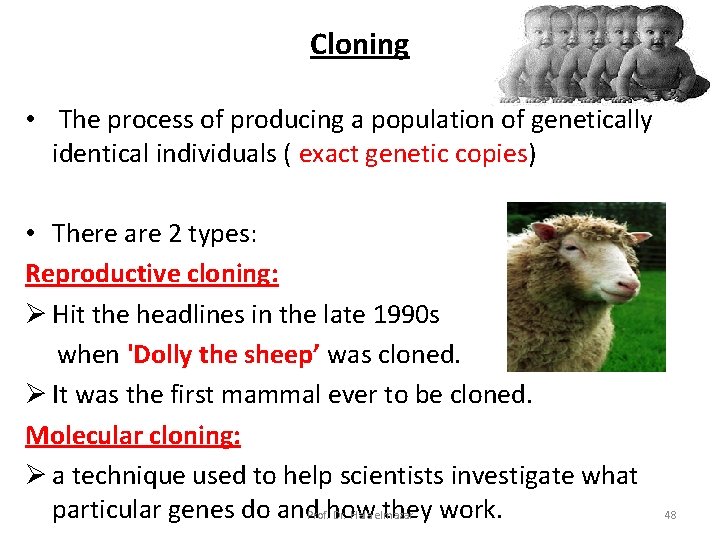
Cloning • The process of producing a population of genetically identical individuals ( exact genetic copies) • There are 2 types: Reproductive cloning: Ø Hit the headlines in the late 1990 s when 'Dolly the sheep’ was cloned. Ø It was the first mammal ever to be cloned. Molecular cloning: Ø a technique used to help scientists investigate what particular genes do and. Prof. how they work. Dr. Hala elmazar 48
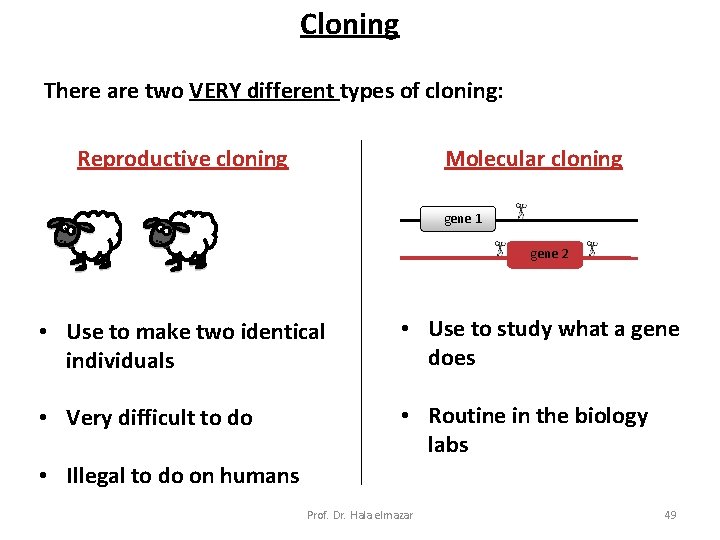
Cloning There are two VERY different types of cloning: Reproductive cloning Molecular cloning gene 1 gene 2 • Use to make two identical individuals • Use to study what a gene does • Very difficult to do • Routine in the biology labs • Illegal to do on humans Prof. Dr. Hala elmazar 49
Reproductive cloning To make Dolly, scientists done what so called somatic cell nuclear transfer (SCNT) Somatic cell: somatic cell is any cell in the body other than sperm & egg because it has the 2 complete sets of chromosomes (46 = 23 pairs) Nuclear : nucleus holds DNA which contains all the information needed to form an organism Transfer: moving an object from one place to another Prof. Dr. Hala elmazar 50
Technique • They took the nucleus out of a normal somatic cell from a sheep (original). • They put that nucleus into an egg cell of another sheep that had no nucleus. • They then had a new cell. • To make the new cell start to divide and grow, they gave it an electric shock. Prof. Dr. Hala elmazar 51
• Then it started to divide and develop into an embryo. When it had grown into a very early stage embryo called a blastocyst • it then was implanted into the womb of another sheep so that it could grow into a lamb and be born. • The new sheep is a clone of the sheep that donated the somatic cell. Both sheep have the same DNA Prof. Dr. Hala elmazar 52
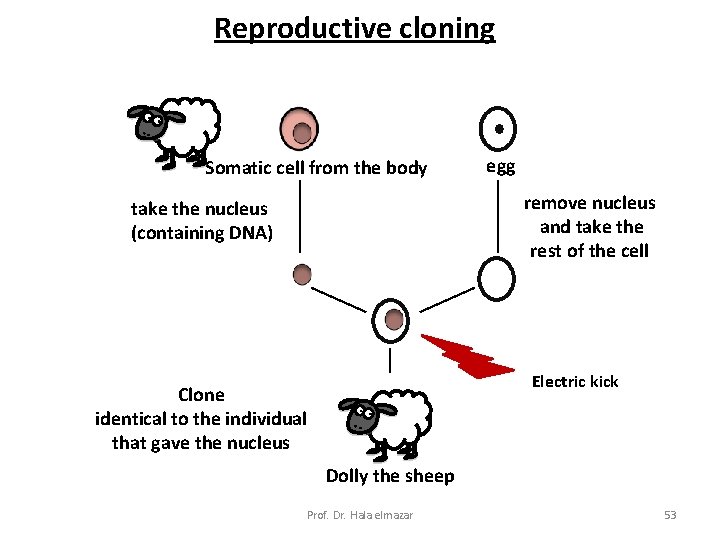
Reproductive cloning Somatic cell from the body egg remove nucleus and take the rest of the cell take the nucleus (containing DNA) Electric kick Clone identical to the individual that gave the nucleus Dolly the sheep Prof. Dr. Hala elmazar 53
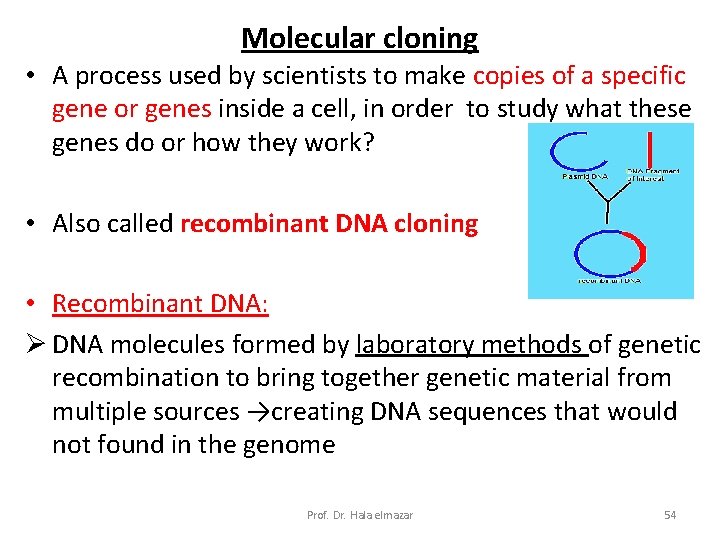
Molecular cloning • A process used by scientists to make copies of a specific gene or genes inside a cell, in order to study what these genes do or how they work? • Also called recombinant DNA cloning • Recombinant DNA: Ø DNA molecules formed by laboratory methods of genetic recombination to bring together genetic material from multiple sources →creating DNA sequences that would not found in the genome Prof. Dr. Hala elmazar 54
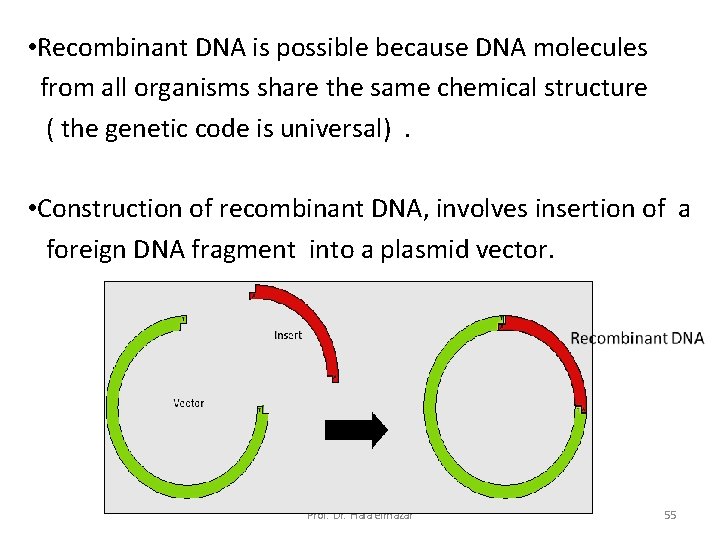
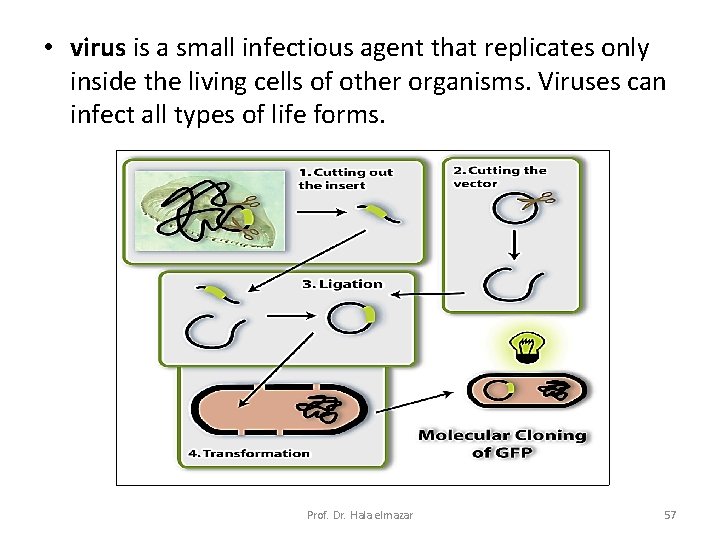
• Recombinant DNA is possible because DNA molecules from all organisms share the same chemical structure ( the genetic code is universal). • Construction of recombinant DNA, involves insertion of a foreign DNA fragment into a plasmid vector. Prof. Dr. Hala elmazar 55
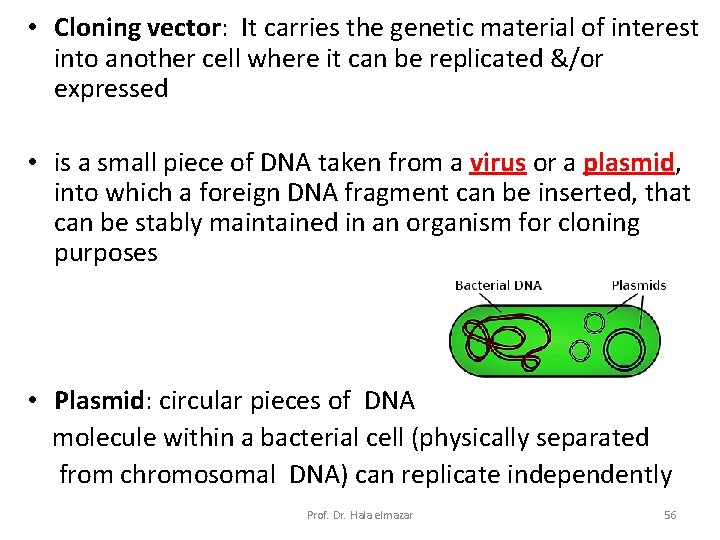
• Cloning vector: It carries the genetic material of interest into another cell where it can be replicated &/or expressed • is a small piece of DNA taken from a virus or a plasmid, into which a foreign DNA fragment can be inserted, that can be stably maintained in an organism for cloning purposes • Plasmid: circular pieces of DNA molecule within a bacterial cell (physically separated from chromosomal DNA) can replicate independently Prof. Dr. Hala elmazar 56
• virus is a small infectious agent that replicates only inside the living cells of other organisms. Viruses can infect all types of life forms. Prof. Dr. Hala elmazar 57
Technique 1 - Select the DNA molecule to be cloned (of interest) 2 - Select DNA molecule that will serve as a vector 3 - cleave the vector DNA strand with ? ? , then insert foreign DNA → recombinant DNA 4 - Introduction of recombinant DNA in host cells → transformation 5 - When the cell divides, it makes copies of itself. Each new daughter cell contains an exact copy of the new DNA (cloned DNA) 6 - Selection & screening of colonies with desired DNA Prof. Dr. Hala elmazar 58
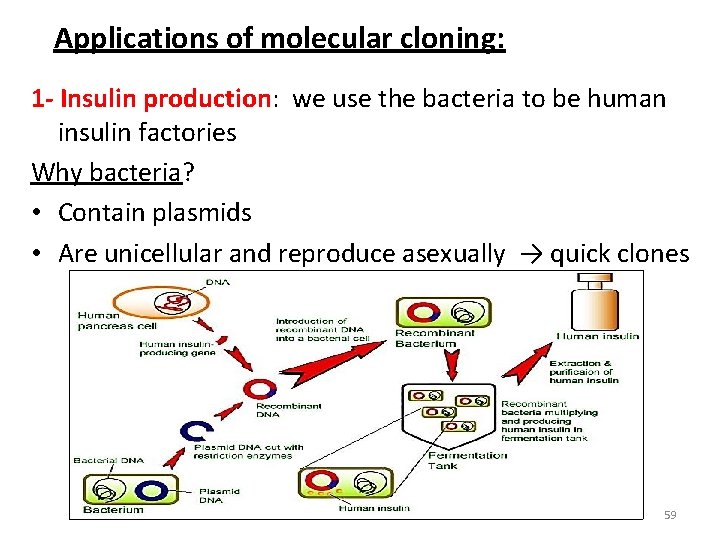
Applications of molecular cloning: 1 - Insulin production: we use the bacteria to be human insulin factories Why bacteria? • Contain plasmids • Are unicellular and reproduce asexually → quick clones Prof. Dr. Hala elmazar 59
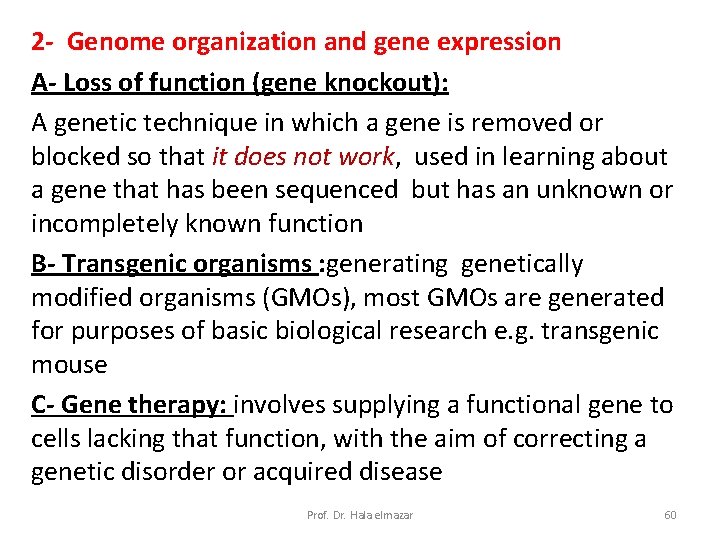
2 - Genome organization and gene expression A- Loss of function (gene knockout): A genetic technique in which a gene is removed or blocked so that it does not work, used in learning about a gene that has been sequenced but has an unknown or incompletely known function B- Transgenic organisms : generating genetically modified organisms (GMOs), most GMOs are generated for purposes of basic biological research e. g. transgenic mouse C- Gene therapy: involves supplying a functional gene to cells lacking that function, with the aim of correcting a genetic disorder or acquired disease Prof. Dr. Hala elmazar 60

Thank you Prof. Dr. Hala elmazar 61
- Slides: 61