
Celestial Navigation Ancient Greece Kennedy Brett Constellations We
Celestial Navigation Ancient Greece { Kennedy & Brett
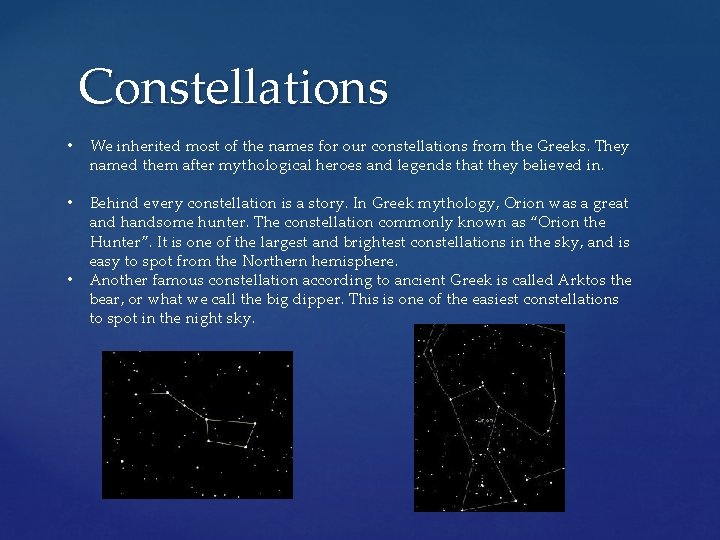
Constellations • We inherited most of the names for our constellations from the Greeks. They named them after mythological heroes and legends that they believed in. • Behind every constellation is a story. In Greek mythology, Orion was a great and handsome hunter. The constellation commonly known as “Orion the Hunter”. It is one of the largest and brightest constellations in the sky, and is easy to spot from the Northern hemisphere. Another famous constellation according to ancient Greek is called Arktos the bear, or what we call the big dipper. This is one of the easiest constellations to spot in the night sky. •
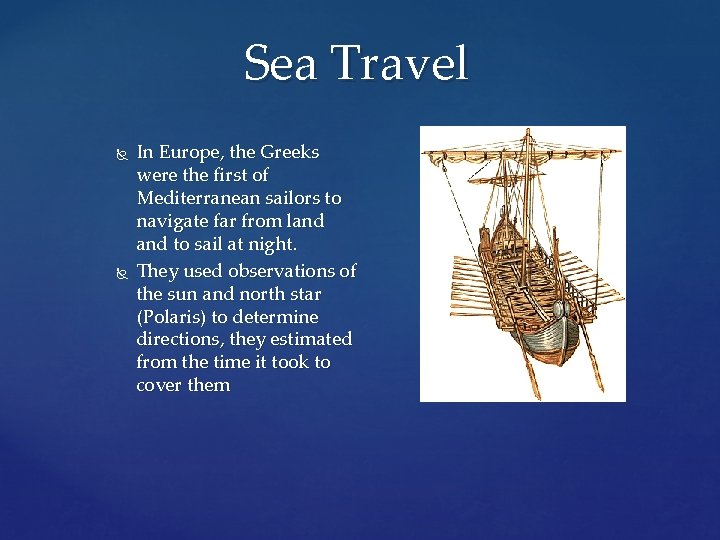
Sea Travel In Europe, the Greeks were the first of Mediterranean sailors to navigate far from land to sail at night. They used observations of the sun and north star (Polaris) to determine directions, they estimated from the time it took to cover them
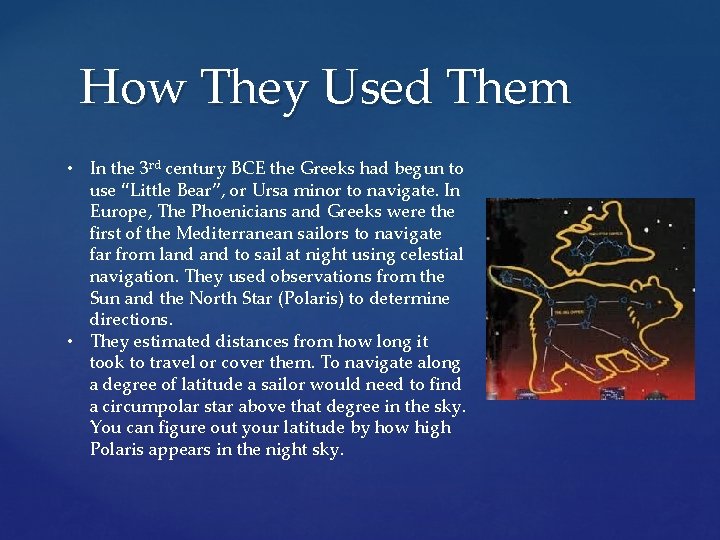
How They Used Them • In the 3 rd century BCE the Greeks had begun to use “Little Bear”, or Ursa minor to navigate. In Europe, The Phoenicians and Greeks were the first of the Mediterranean sailors to navigate far from land to sail at night using celestial navigation. They used observations from the Sun and the North Star (Polaris) to determine directions. • They estimated distances from how long it took to travel or cover them. To navigate along a degree of latitude a sailor would need to find a circumpolar star above that degree in the sky. You can figure out your latitude by how high Polaris appears in the night sky.
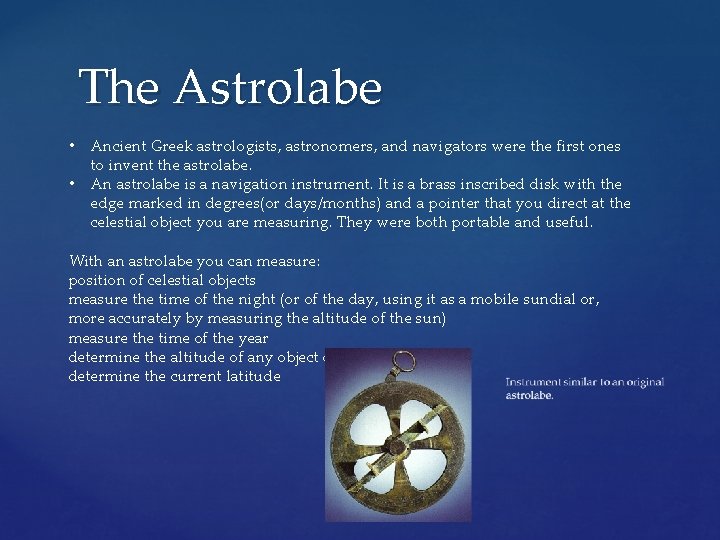
The Astrolabe • • Ancient Greek astrologists, astronomers, and navigators were the first ones to invent the astrolabe. An astrolabe is a navigation instrument. It is a brass inscribed disk with the edge marked in degrees(or days/months) and a pointer that you direct at the celestial object you are measuring. They were both portable and useful. With an astrolabe you can measure: position of celestial objects measure the time of the night (or of the day, using it as a mobile sundial or, more accurately by measuring the altitude of the sun) measure the time of the year determine the altitude of any object over the horizon determine the current latitude
The Astrolabe • • The name comes from the Greek words “astron” and “lambanien” meaning "the one who catches the heavenly bodies” The 1 st one was developed in Alexandria in 160 BC. The first astrolabe is credited to the Greek astronomer and mathematician Hipparchus. After this the Mariner’s astrolabe was invented for ships at sea. This was much larger. The Mariner's Astrolabe was used to determine the latitude of a ship at sea by measuring the noon altitude of the Sun or a star. Over the past centuries the astrolabe has been developed and made much more complex, but is still an instrument that is used today by navigators.
Sources wikipedia. com celestialnavigation. net erikdeman. de space. com visav. phys. uvic. ca Ancient Greece! By Avery Hart Smart-opedia by Eve Drobot
- Slides: 7