
CELESTIAL BODIESPart II STARS PLANETS AND DWARF PLANETS
CELESTIAL BODIES-Part II • STARS • PLANETS AND DWARF PLANETS • OTHER CELESTIAL BODIES – SATELLITES – ASTEROIDS – COMETS – METEOROIDS
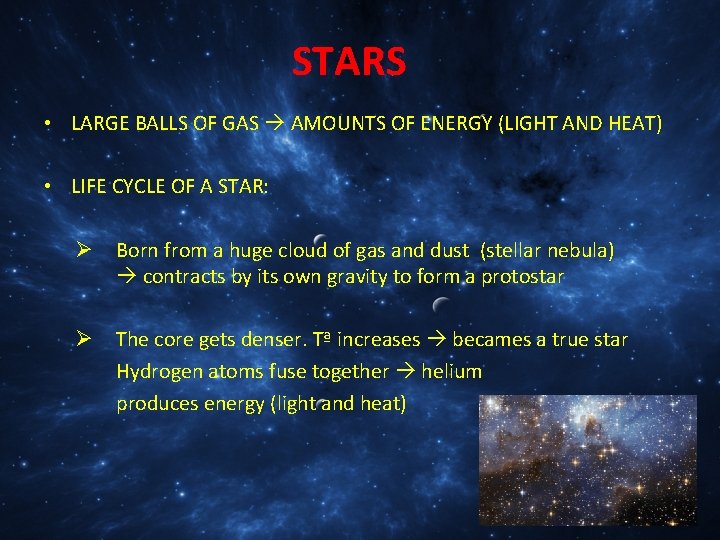
STARS • LARGE BALLS OF GAS AMOUNTS OF ENERGY (LIGHT AND HEAT) • LIFE CYCLE OF A STAR: Ø Born from a huge cloud of gas and dust (stellar nebula) contracts by its own gravity to form a protostar Ø The core gets denser. Tª increases becames a true star Hydrogen atoms fuse together helium produces energy (light and heat)
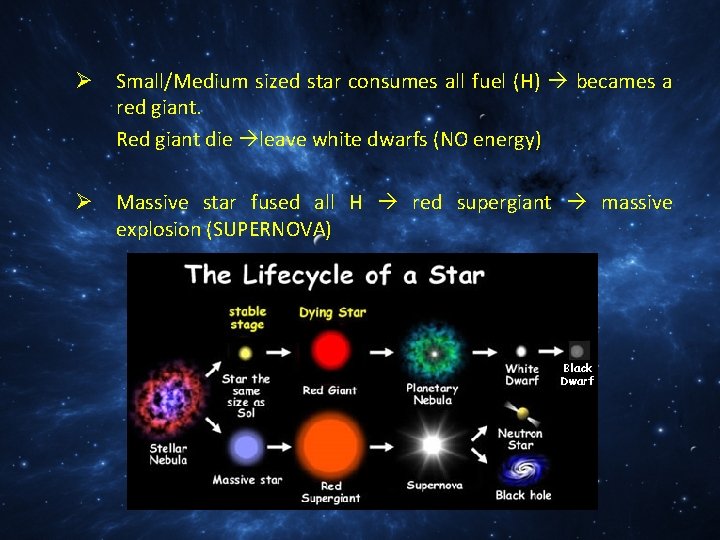
Ø Small/Medium sized star consumes all fuel (H) becames a red giant. Red giant die leave white dwarfs (NO energy) Ø Massive star fused all H red supergiant massive explosion (SUPERNOVA)
PLANETS AND DWARF PLANETS • Do not emit light • Visible by reflected light of a star • Spherical and with or without satellites • Planets do not share their orbit with other celestial bodies • Dwarf planets share their orbit • Movements: – Rotation – Revolution
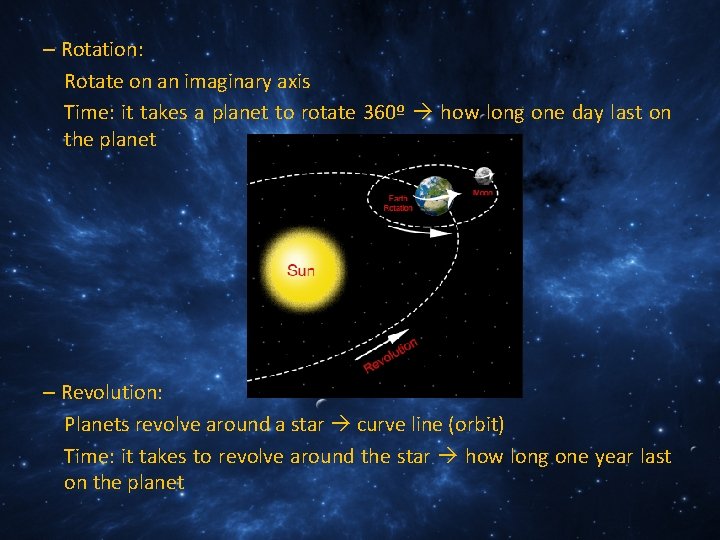
– Rotation: Rotate on an imaginary axis Time: it takes a planet to rotate 360º how long one day last on the planet – Revolution: Planets revolve around a star curve line (orbit) Time: it takes to revolve around the star how long one year last on the planet

OTHER CELESTIAL BODIES • Satellites or moons Celestial bodies that orbit planets or dwarf planets • Asteroids rocky bodies, smaller than planets, orbit a star • Comets Masses of ice, dust and rocks move around a star in an elliptical orbit Get closer to a star ice changes into gas Gas illuminated by the light of the star tail
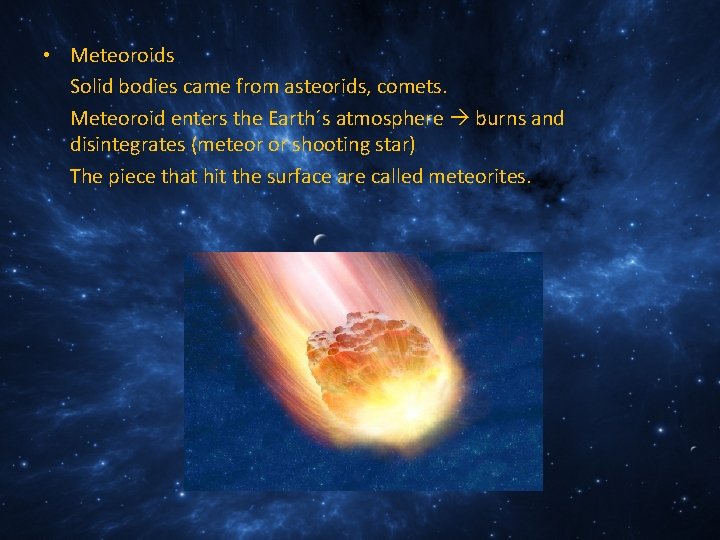
• Meteoroids Solid bodies came from asteorids, comets. Meteoroid enters the Earth´s atmosphere burns and disintegrates (meteor or shooting star) The piece that hit the surface are called meteorites.
- Slides: 7