
Celebrating Quality From Local to Global limits Space
Celebrating Quality

From Local to Global limits Space International issues Place National systems Cultural understanding and diversity Community School GEOGRAPHY Scale Student Interdependenc e Connected Lives – The Importance of geographical perspectives Physical and Environmenta l interaction human processes http: //www. qca. org. uk/secondarycurriculumreview/index. htm
What is ‘quality geography’? • What range of geographical experiences does a Before wehave caninmonitor/evaluate the student a Quality Dept? • What will students sayingwe about Geography curriculum in ourbe school need to have? • How will students express this? firm criteria in our heads about what – discuss the statement, ‘quality geography’ looks record like. responses on ‘Post it’ notes, diamond rank for importance. – Send a representative to go to other groups to explore quality differences/similarities Key message: geography engages pupil interest, captures imagination and stimulates enthusiasm for learning.
The Importance of Geography • • The study of geography helps make sense of the beautiful, complex and dynamically changing world. Geography stimulates an interest in, and a sense of wonder about places. It explains how places and landscapes are formed, how people and environment interact, and how a diverse range of economies and societies are interconnected. It builds on pupils’ own experiences to investigate at all scales from the personal to the global. Geographical enquiry encourages questioning, investigation and critical thinking about issues affecting the world and people’s lives, for the present and future. Fieldwork is an essential element of this. Pupils learn to think spatially, using maps, visual images and new technologies, including geographical information systems, to obtain, present and analyse information. Geography inspires pupils to think about their own place in the world, their values and responsibilities to other people, to the environment and to the sustainability of the planet.
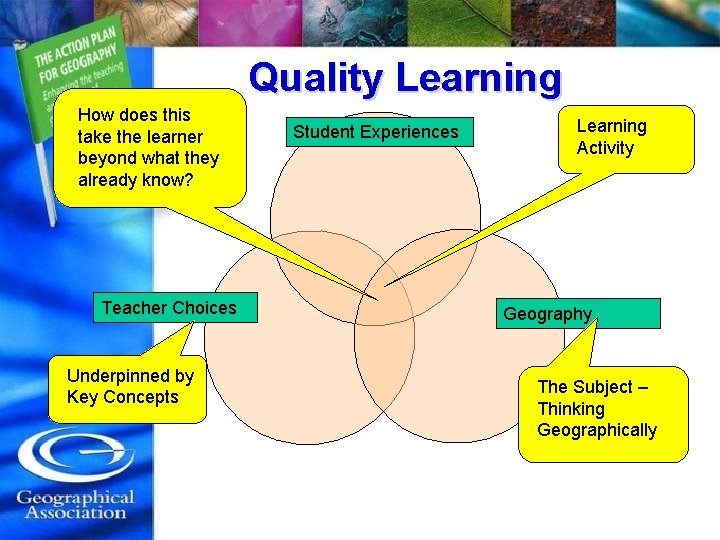
Quality Learning How does this take the learner beyond what they already know? Teacher Choices Underpinned by Key Concepts Student Experiences Learning Activity Geography The Subject – Thinking Geographically
The Secondary Geography Quality Mark
The Secondary Geography Quality Mark Aims to • Recognise and celebrate Quality Geography • Offer a framework for reflection and evaluation • Provide a powerful tool for subject leaders
The Secondary Geography Quality Mark What’s in it for me? • • Identify and celebrate good geography Provide a framework for subject leaders to reflect and evaluate their curriculum Provide a framework and a tool to help geography teachers clarify their own CPD needs Improve for all pupils the quality of the educational experience through geography
The Secondary Geography Quality Mark • How well do you know your department? • How well does the leadership team know your department? • What is this knowledge based on?
About the pilot Sept 2006 – May 2007 42 schools involved in the pilot phase The 42 pilot schools are working to a framework with several aims; • testing and exploring ways to develop the process • testing and developing the framework • exploring the nature of evidence and what constitutes quality geography • Contribution to the development of the final documentation • Sept 07 production of a Tool Kit with a SEF, the SGQM, exemplar materials and CPD suggestions.
What assessment is made? The first level award is verified on the basis of the written evidence. To recognise ‘some outstanding features’ schools would be subject to sample verification and written evidence. The award of High quality plus ‘Many outstanding features’ requires a verification visit to the registered school. This will be done by local geography specialists
How to plan, prepare and apply for the award 1. 2. 3. 4. 4. 5. The subject leader and department complete a selfevaluation This provides a visual overview of the current situation and helps to identify areas of development. An action plan is produced Register intention to apply for the Mark with the G. A. and pay the appropriate fee (to be decided) or register as an Associate member. Begin working for the Mark at any time. describe and explain evidence for each criterion and give the educational and geographical context of their school
The Framework
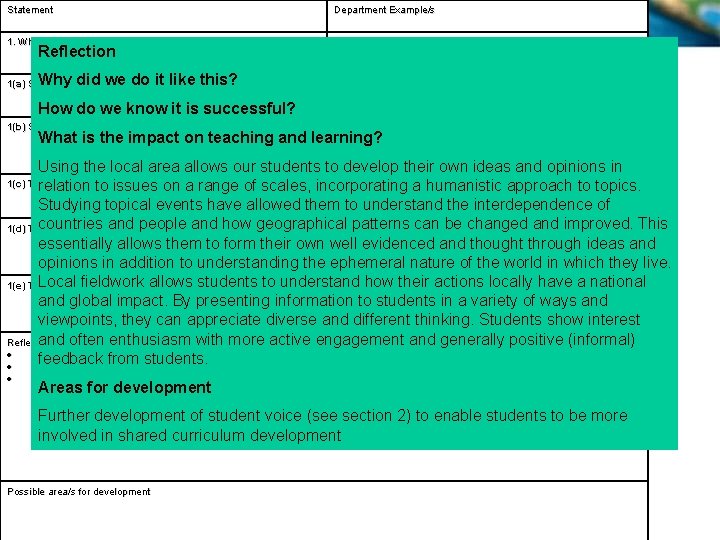
Statement Department Example/s 1. What are the distinctive characteristics of Geography in your school? Reflection Why did we do it like this? 1(a) Students relate geographical thinking with their everyday experiences, so that the relevance of geography is clear to them. How do we know it is successful? 1(b) Students demonstrate an informed understanding of the geography’s organising concepts such as place, interdependence, scale and process. The distinctiveness of geography is apparent. What is the impact on teaching and learning? Using the local area allows our students to develop their own ideas and opinions in 1(c) The department responsive to innovation relation toisissues on a rangeinofgeography scales, incorporating a humanistic approach to topics. education and actively initiates developments in curriculum Studying topical events have allowed them to understand the interdependence of materials and organisation. countries and people how geographical patterns can be changed and improved. This 1(d) The department employs a variety and of approaches to geography. These are regularly reviewed and evaluated for essentially allows them to form their own well evidenced and thought through ideas and their effectiveness in supporting standards and achievement opinionsiningeography addition to understanding the ephemeral nature of the world in which they live. Local fieldwork allowsthestudents how their actions locally have a national 1(e) The KS 3 curriculum incorporates effective useto of understand ICT, maps and fieldwork where appropriate. This should include and global impact. By presenting information to students in a variety of ways and GIS where possible and the use of high quality images and/or visualisation software. viewpoints, they can appreciate diverse and different thinking. Students show interest and enthusiasm with more active engagement and generally positive (informal) Reflection andoften evaluation Why do we do it like this? feedback from students. How do we know it is successful? What is the impact on teaching and learning? Areas for development Further development of student voice (see section 2) to enable students to be more involved in shared curriculum development Possible area/s for development
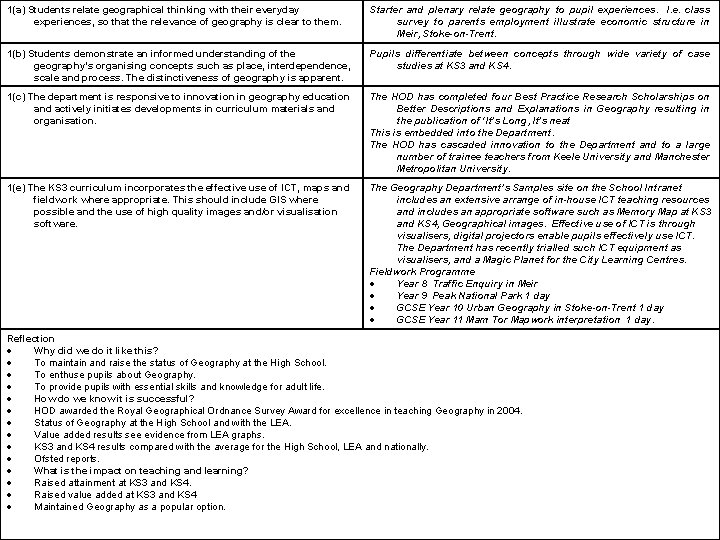
1(a) Students relate geographical thinking with their everyday experiences, so that the relevance of geography is clear to them. Starter and plenary relate geography to pupil experiences. I. e. class survey to parents employment illustrate economic structure in Meir, Stoke-on-Trent. 1(b) Students demonstrate an informed understanding of the geography’s organising concepts such as place, interdependence, scale and process. The distinctiveness of geography is apparent. Pupils differentiate between concepts through wide variety of case studies at KS 3 and KS 4. 1(c) The department is responsive to innovation in geography education and actively initiates developments in curriculum materials and organisation. The HOD has completed four Best Practice Research Scholarships on Better Descriptions and Explanations in Geography resulting in the publication of ‘It’s Long, It’s neat This is embedded into the Department. The HOD has cascaded innovation to the Department and to a large number of trainee teachers from Keele University and Manchester Metropolitan University. 1(e) The KS 3 curriculum incorporates the effective use of ICT, maps and fieldwork where appropriate. This should include GIS where possible and the use of high quality images and/or visualisation software. The Geography Department’s Samples site on the School Intranet includes an extensive arrange of in-house ICT teaching resources and includes an appropriate software such as Memory Map at KS 3 and KS 4, Geographical images. Effective use of ICT is through visualisers, digital projectors enable pupils effectively use ICT. The Department has recently trialled such ICT equipment as visualisers, and a Magic Planet for the City Learning Centres. Fieldwork Programme Year 8 Traffic Enquiry in Meir Year 9 Peak National Park 1 day GCSE Year 10 Urban Geography in Stoke-on-Trent 1 day GCSE Year 11 Mam Tor Mapwork interpretation 1 day. Reflection Why did we do it like this? To maintain and raise the status of Geography at the High School. To enthuse pupils about Geography. To provide pupils with essential skills and knowledge for adult life. How do we know it is successful? HOD awarded the Royal Geographical Ordnance Survey Award for excellence in teaching Geography in 2004. Status of Geography at the High School and with the LEA. Value added results see evidence from LEA graphs. KS 3 and KS 4 results compared with the average for the High School, LEA and nationally. Ofsted reports. What is the impact on teaching and learning? Raised attainment at KS 3 and KS 4. Raised value added at KS 3 and KS 4 Maintained Geography as a popular option.
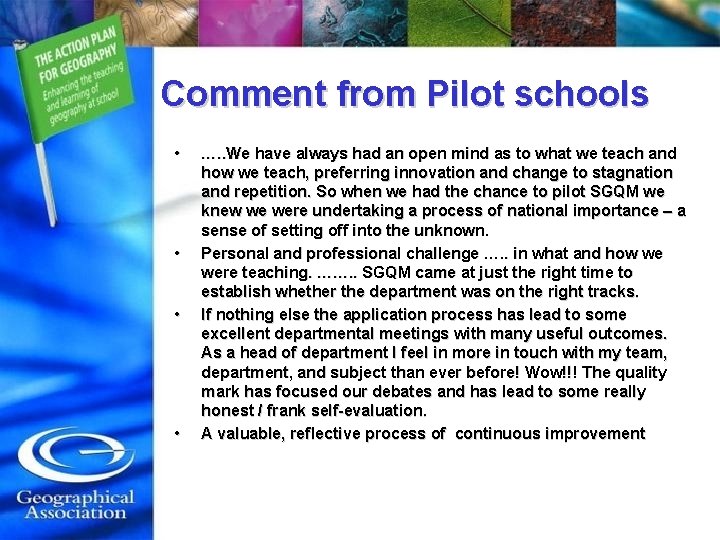
Comment from Pilot schools • • …. . We have always had an open mind as to what we teach and how we teach, preferring innovation and change to stagnation and repetition. So when we had the chance to pilot SGQM we knew we were undertaking a process of national importance – a sense of setting off into the unknown. Personal and professional challenge …. . in what and how we were teaching. ……. . SGQM came at just the right time to establish whether the department was on the right tracks. If nothing else the application process has lead to some excellent departmental meetings with many useful outcomes. As a head of department I feel in more in touch with my team, department, and subject than ever before! Wow!!! The quality mark has focused our debates and has lead to some really honest / frank self-evaluation. A valuable, reflective process of continuous improvement
Exploring the criteria Individually scan the document, choose an area to explore – identify colleagues who have chosen the same area • Working in small groups (pairs/threes) – Explore issues/thoughts/comments • Feedback Session • Where next?
Where Next? • Be very excited! • Sign up as an Associate Member • This entitles you to support through the Secondary Geography Quality Mark forum of the VLE and access to all Quality Mark CPD
- Slides: 18