
Celebrate the 60 th Birthdays of Professors Takashi
Celebrate the 60 th Birthdays of Professors Takashi Nakamura and Kei-ichi Maeda From Rong-Gen Cai
Connection between Thermodynamics and Gravitational Dynamics Rong-Gen Cai (蔡荣根) Institute of Theoretical Physics Chinese Academy of Sciences (JGRG 20, Kyoto, Sept 21, 2010)
Gravity is one of four fundamental interactions in Nature ? However, a recent paper by E. Verlinde “ On the Origin of Gravity and the Laws of Newton” ar. Xiv: 1001. 0785 See also a paper by T. Padmanabhan, ar. Xiv: 0912. 3165 “ Equipartition of energy in the horizon degrees of freedom and the emergence of gravity” T. Padmanabhan: Thermodynamical Aspects of Gravity: New insights ar. Xiv: 0911. 5004, Rept. Prog. Phys. 73: 046901, 2010. A. D. Sakharov: Vacuum quantum fluctuations in curved space and theory of gravitation Sov. Phys. Dokl. 12: 1040 -1041, 1968
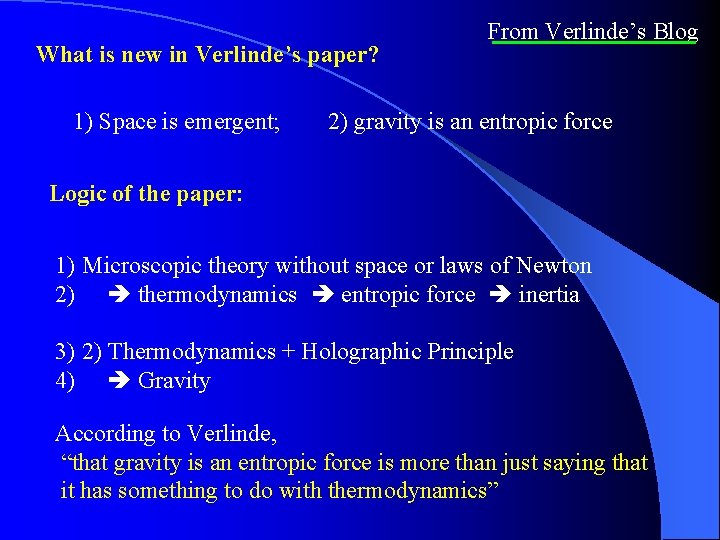
What is new in Verlinde’s paper? From Verlinde’s Blog 1) Space is emergent; 2) gravity is an entropic force Logic of the paper: 1) Microscopic theory without space or laws of Newton 2) thermodynamics entropic force inertia 3) 2) Thermodynamics + Holographic Principle 4) Gravity According to Verlinde, “that gravity is an entropic force is more than just saying that it has something to do with thermodynamics”
Some pieces of evidence for the deep relation between Thermodynamics and Gravity
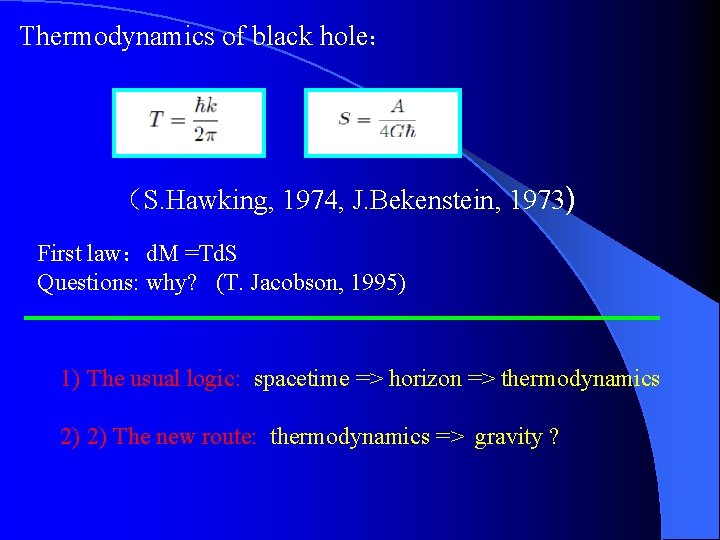
Thermodynamics of black hole: (S. Hawking, 1974, J. Bekenstein, 1973) First law:d. M =Td. S Questions: why? (T. Jacobson, 1995) 1) The usual logic: spacetime => horizon => thermodynamics 2) 2) The new route: thermodynamics => gravity ?
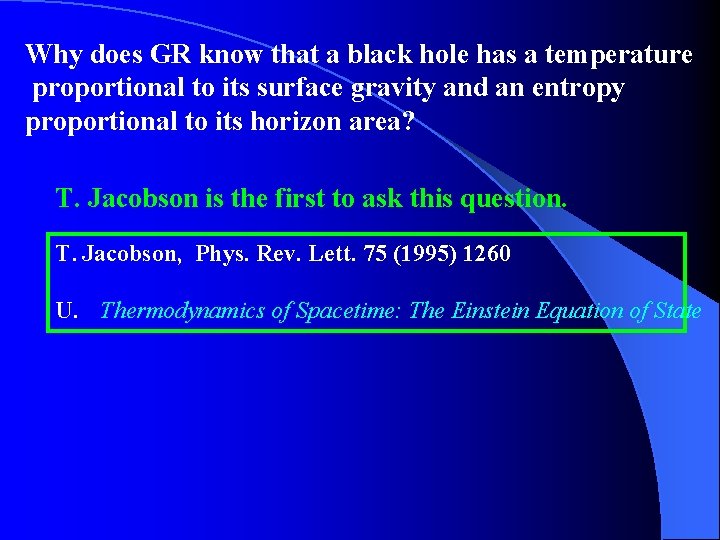
Why does GR know that a black hole has a temperature proportional to its surface gravity and an entropy proportional to its horizon area? T. Jacobson is the first to ask this question. T. Jacobson, Phys. Rev. Lett. 75 (1995) 1260 U. Thermodynamics of Spacetime: The Einstein Equation of State
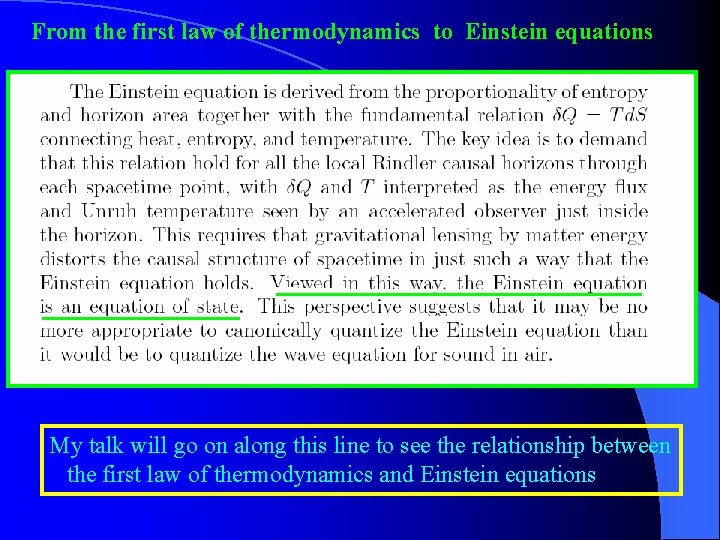
From the first law of thermodynamics to Einstein equations My talk will go on along this line to see the relationship between the first law of thermodynamics and Einstein equations
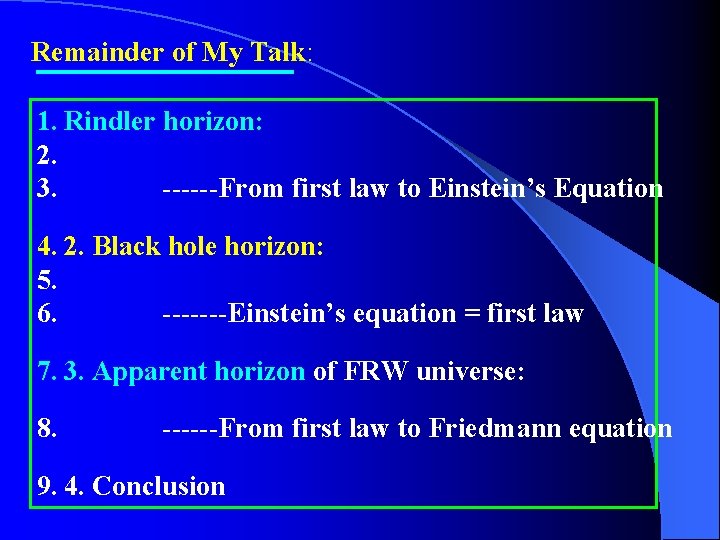
Remainder of My Talk: 1. Rindler horizon: 2. 3. ------From first law to Einstein’s Equation 4. 2. Black hole horizon: 5. 6. -------Einstein’s equation = first law 7. 3. Apparent horizon of FRW universe: 8. ------From first law to Friedmann equation 9. 4. Conclusion
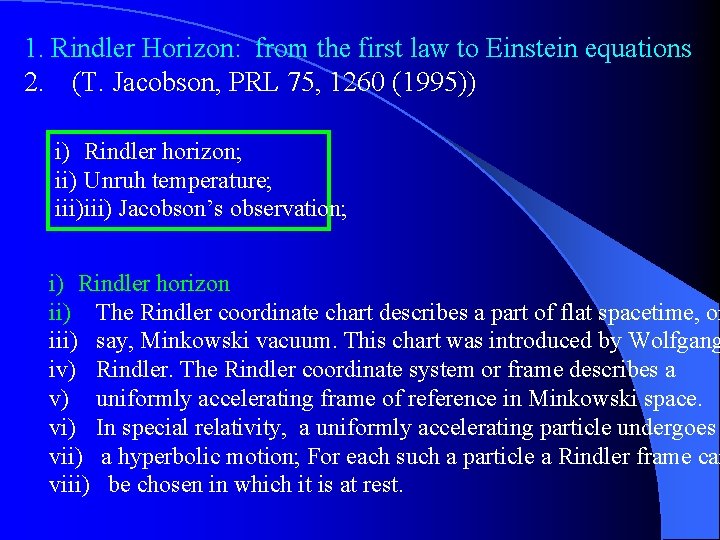
1. Rindler Horizon: from the first law to Einstein equations 2. (T. Jacobson, PRL 75, 1260 (1995)) i) Rindler horizon; ii) Unruh temperature; iii) Jacobson’s observation; i) Rindler horizon ii) The Rindler coordinate chart describes a part of flat spacetime, or iii) say, Minkowski vacuum. This chart was introduced by Wolfgang iv) Rindler. The Rindler coordinate system or frame describes a v) uniformly accelerating frame of reference in Minkowski space. vi) In special relativity, a uniformly accelerating particle undergoes vii) a hyperbolic motion; For each such a particle a Rindler frame can viii) be chosen in which it is at rest.
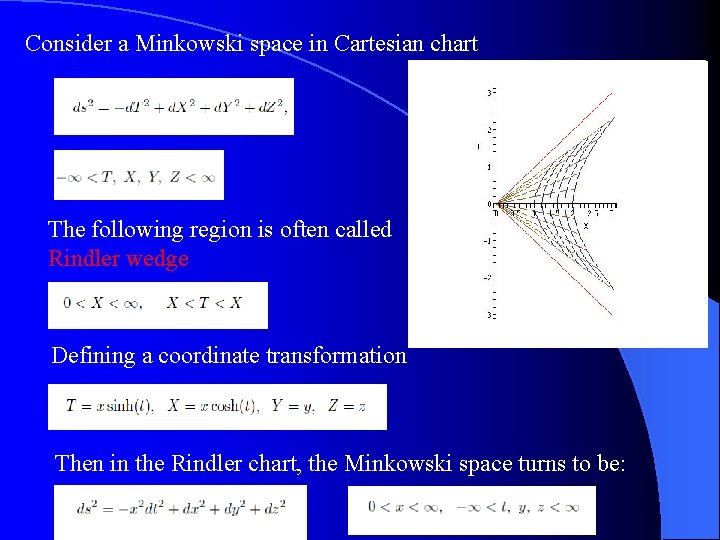
Consider a Minkowski space in Cartesian chart The following region is often called Rindler wedge Defining a coordinate transformation Then in the Rindler chart, the Minkowski space turns to be:
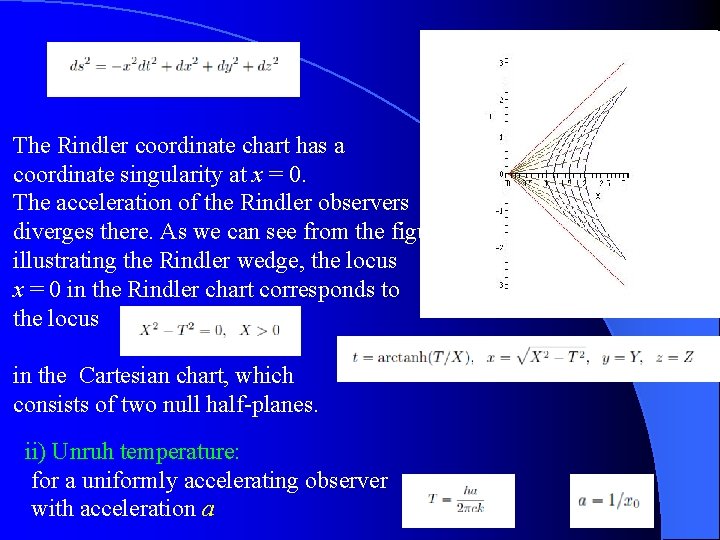
The Rindler coordinate chart has a coordinate singularity at x = 0. The acceleration of the Rindler observers diverges there. As we can see from the figure illustrating the Rindler wedge, the locus x = 0 in the Rindler chart corresponds to the locus in the Cartesian chart, which consists of two null half-planes. ii) Unruh temperature: for a uniformly accelerating observer with acceleration a
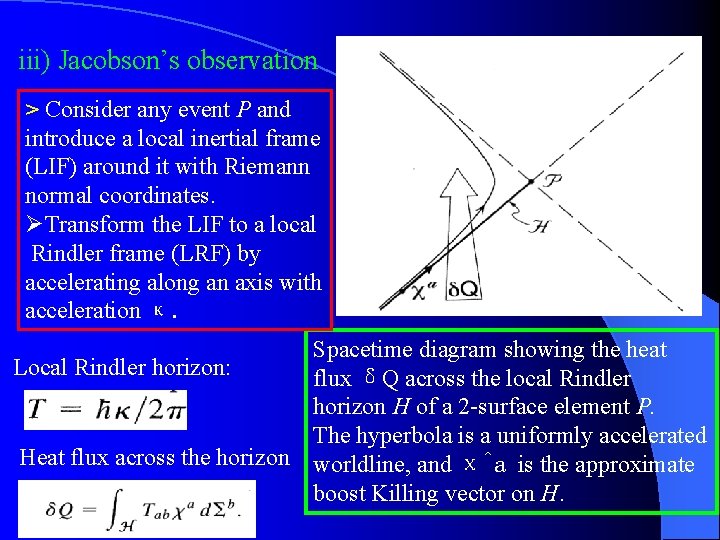
iii) Jacobson’s observation > Consider any event P and introduce a local inertial frame (LIF) around it with Riemann normal coordinates. ØTransform the LIF to a local Rindler frame (LRF) by accelerating along an axis with acceleration κ. Spacetime diagram showing the heat Local Rindler horizon: flux δQ across the local Rindler horizon H of a 2 -surface element P. The hyperbola is a uniformly accelerated Heat flux across the horizon worldline, and χ^a is the approximate boost Killing vector on H.
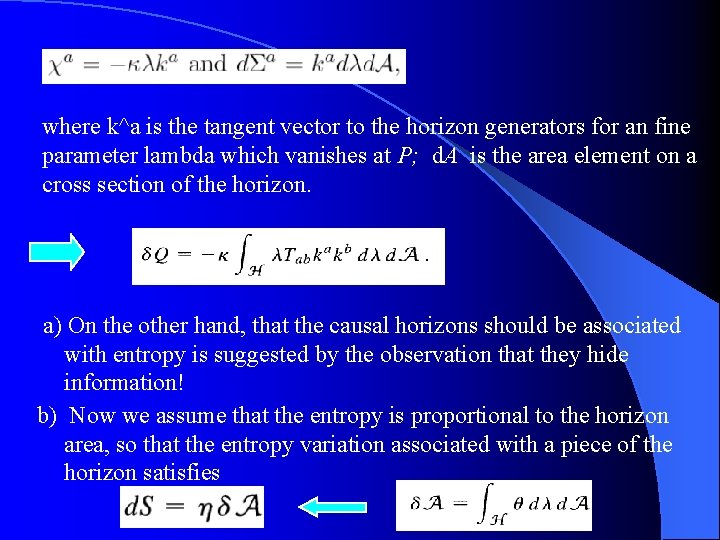
where k^a is the tangent vector to the horizon generators for an fine parameter lambda which vanishes at P; d. A is the area element on a cross section of the horizon. a) On the other hand, that the causal horizons should be associated with entropy is suggested by the observation that they hide information! b) Now we assume that the entropy is proportional to the horizon area, so that the entropy variation associated with a piece of the horizon satisfies
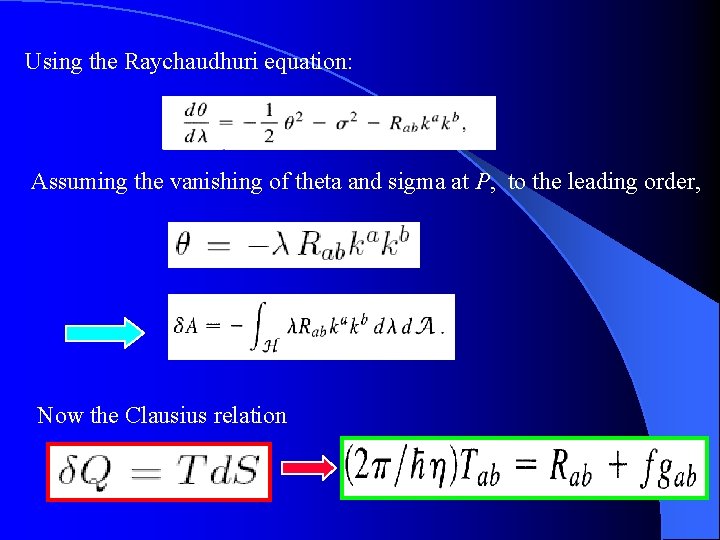
Using the Raychaudhuri equation: Assuming the vanishing of theta and sigma at P, to the leading order, Now the Clausius relation
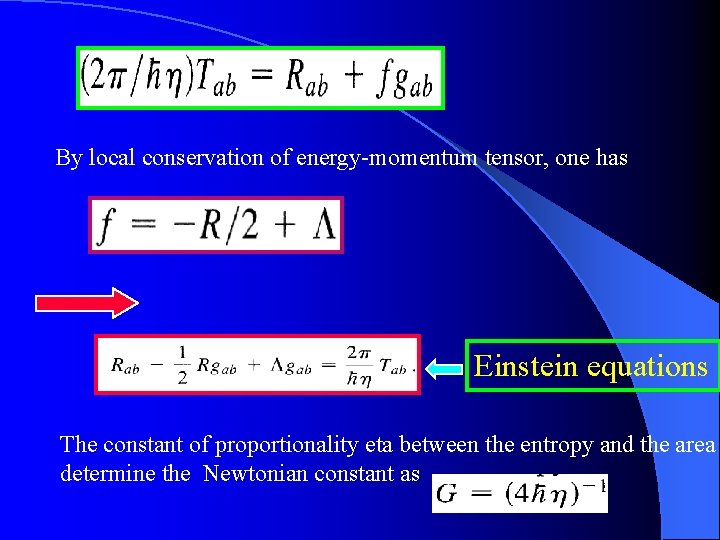
By local conservation of energy-momentum tensor, one has Einstein equations The constant of proportionality eta between the entropy and the area determine the Newtonian constant as
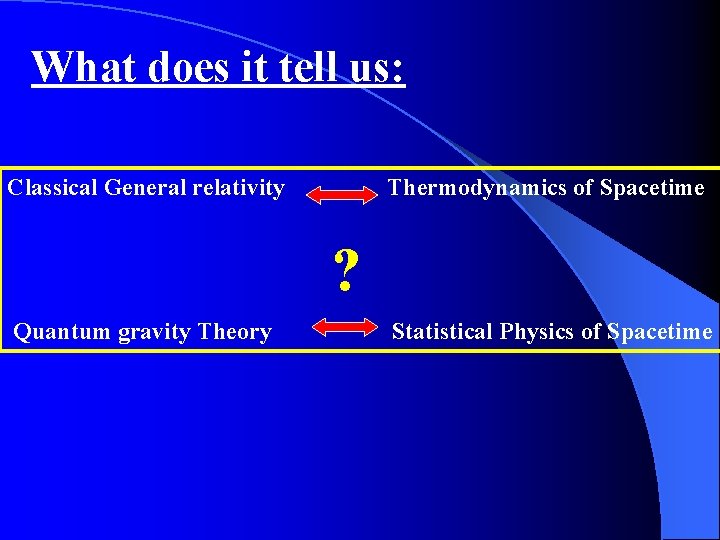
What does it tell us: Classical General relativity Thermodynamics of Spacetime ? Quantum gravity Theory Statistical Physics of Spacetime
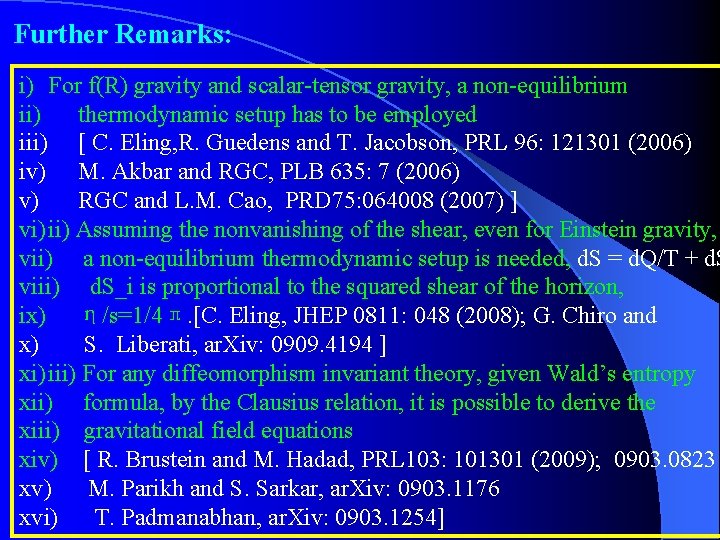
Further Remarks: i) For f(R) gravity and scalar-tensor gravity, a non-equilibrium ii) thermodynamic setup has to be employed iii) [ C. Eling, R. Guedens and T. Jacobson, PRL 96: 121301 (2006) iv) M. Akbar and RGC, PLB 635: 7 (2006) v) RGC and L. M. Cao, PRD 75: 064008 (2007) ] vi) ii) Assuming the nonvanishing of the shear, even for Einstein gravity, vii) a non-equilibrium thermodynamic setup is needed, d. S = d. Q/T + d. S viii) d. S_i is proportional to the squared shear of the horizon, ix) η/s=1/4π. [C. Eling, JHEP 0811: 048 (2008); G. Chiro and x) S. Liberati, ar. Xiv: 0909. 4194 ] xi) iii) For any diffeomorphism invariant theory, given Wald’s entropy xii) formula, by the Clausius relation, it is possible to derive the xiii) gravitational field equations xiv) [ R. Brustein and M. Hadad, PRL 103: 101301 (2009); 0903. 0823 xv) M. Parikh and S. Sarkar, ar. Xiv: 0903. 1176 xvi) T. Padmanabhan, ar. Xiv: 0903. 1254]
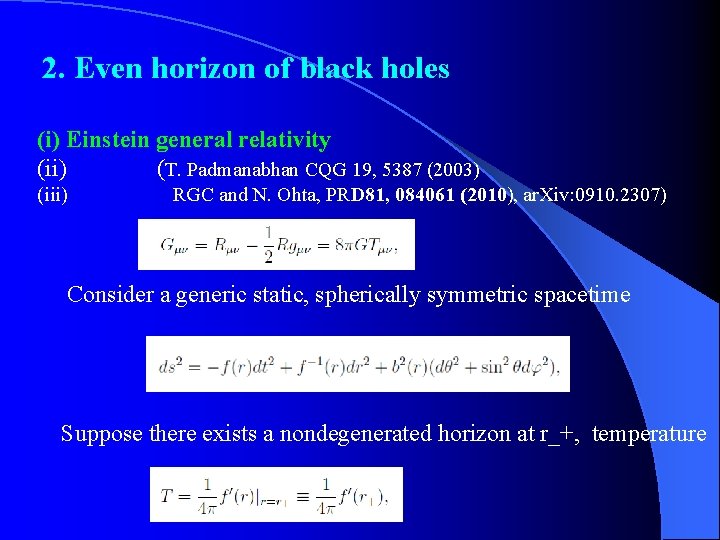
2. Even horizon of black holes (i) Einstein general relativity (ii) (T. Padmanabhan CQG 19, 5387 (2003) (iii) RGC and N. Ohta, PRD 81, 084061 (2010), ar. Xiv: 0910. 2307) Consider a generic static, spherically symmetric spacetime Suppose there exists a nondegenerated horizon at r_+, temperature
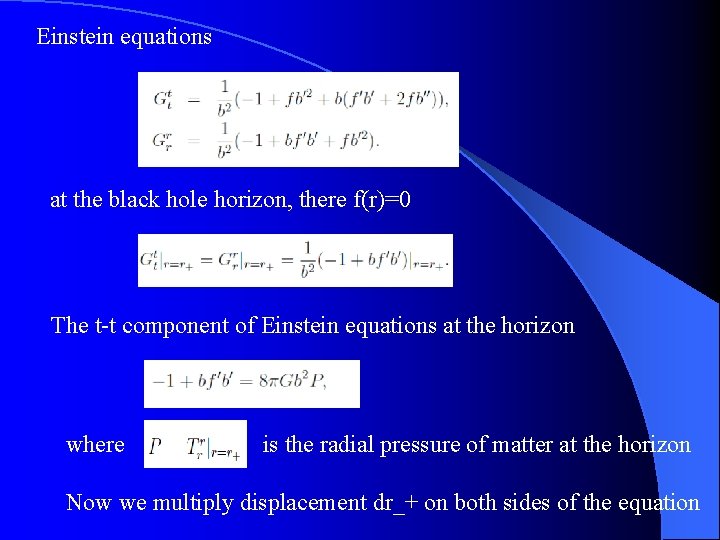
Einstein equations at the black hole horizon, there f(r)=0 The t-t component of Einstein equations at the horizon where is the radial pressure of matter at the horizon Now we multiply displacement dr_+ on both sides of the equation
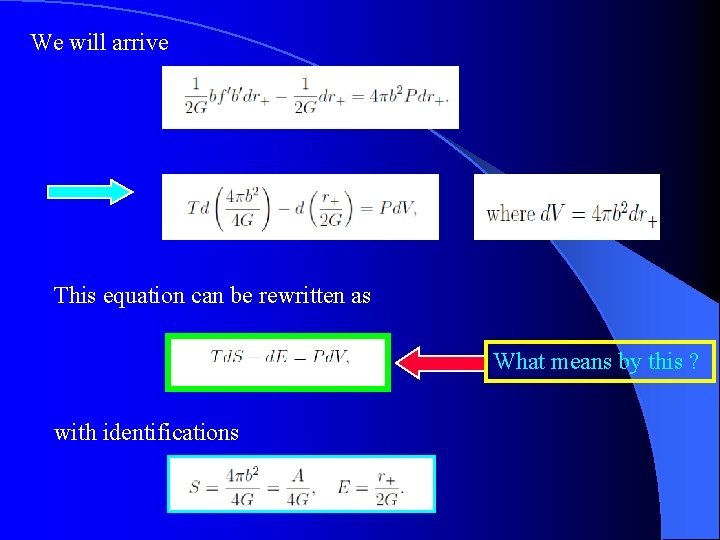
We will arrive This equation can be rewritten as What means by this ? with identifications
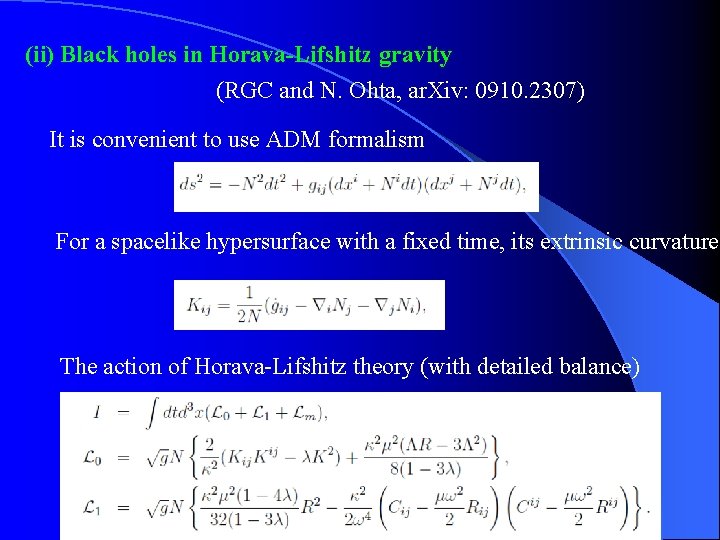
(ii) Black holes in Horava-Lifshitz gravity (RGC and N. Ohta, ar. Xiv: 0910. 2307) It is convenient to use ADM formalism For a spacelike hypersurface with a fixed time, its extrinsic curvature The action of Horava-Lifshitz theory (with detailed balance)
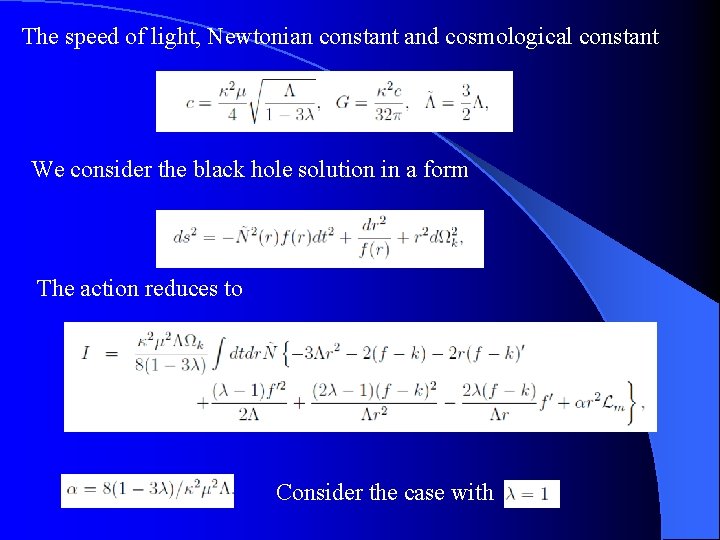
The speed of light, Newtonian constant and cosmological constant We consider the black hole solution in a form The action reduces to Consider the case with
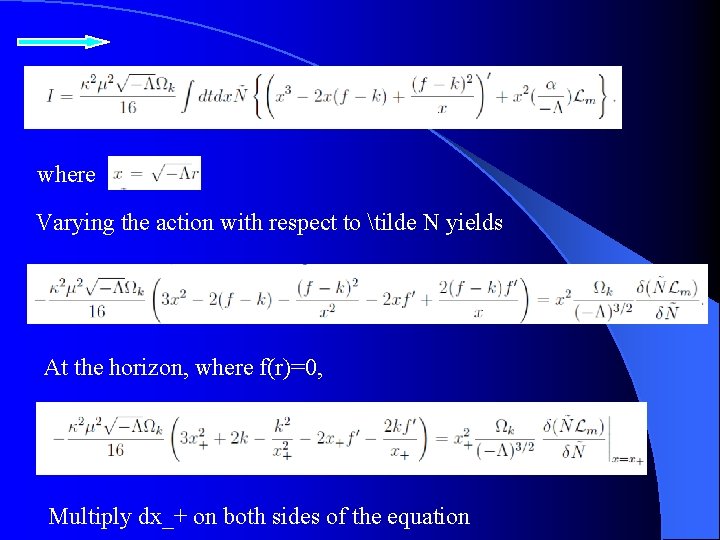
where Varying the action with respect to tilde N yields At the horizon, where f(r)=0, Multiply dx_+ on both sides of the equation
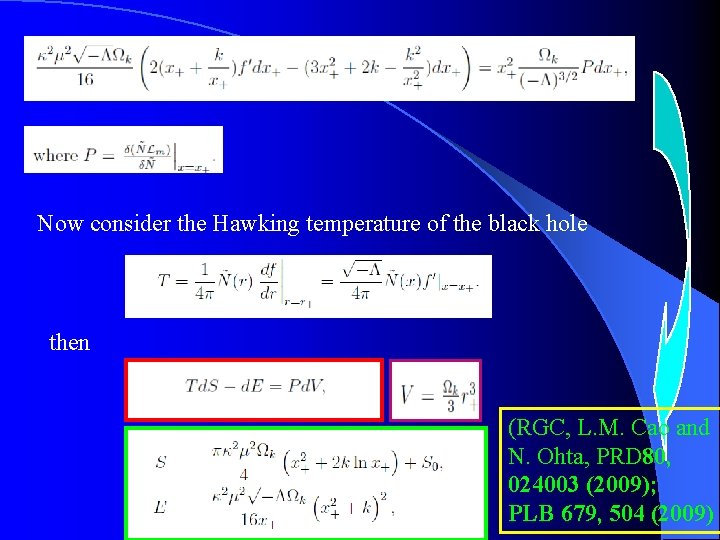
Now consider the Hawking temperature of the black hole then (RGC, L. M. Cao and N. Ohta, PRD 80, 024003 (2009); PLB 679, 504 (2009)
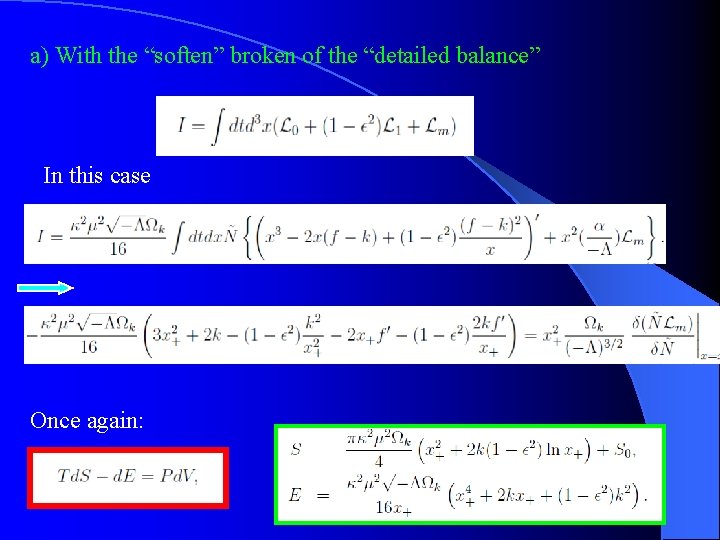
a) With the “soften” broken of the “detailed balance” In this case Once again:
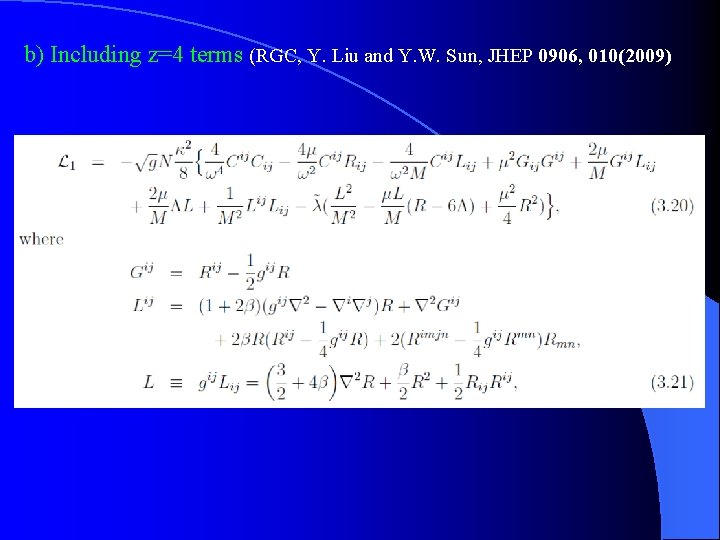
b) Including z=4 terms (RGC, Y. Liu and Y. W. Sun, JHEP 0906, 010(2009)
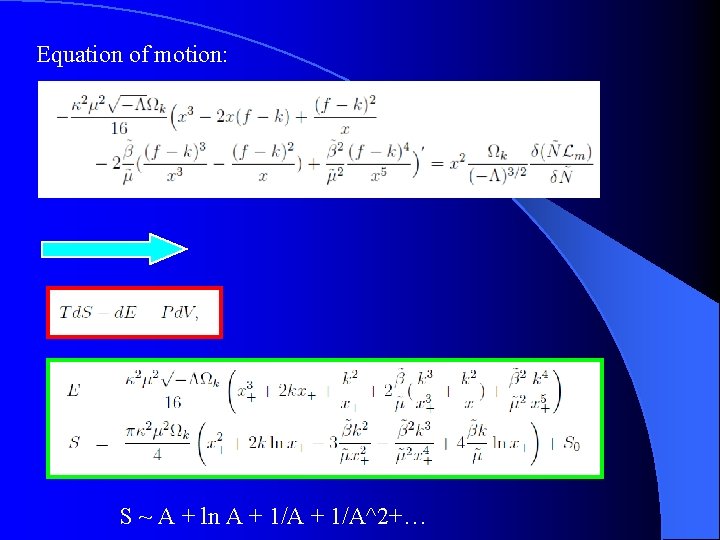
Equation of motion: S ~ A + ln A + 1/A^2+…
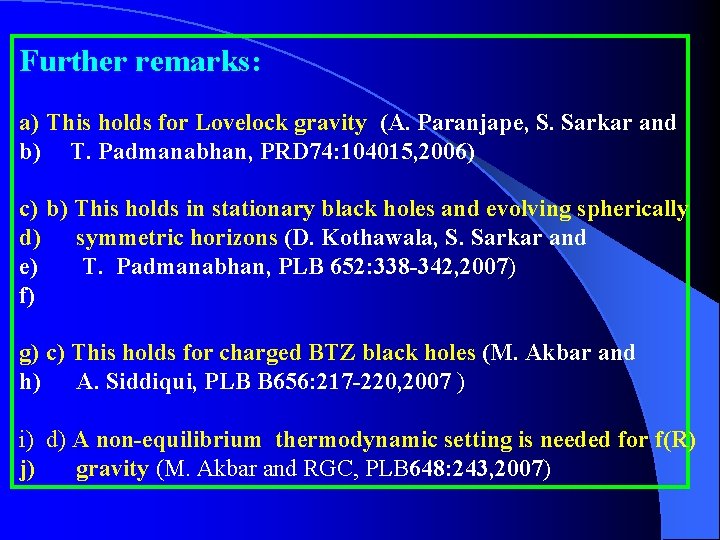
Further remarks: a) This holds for Lovelock gravity (A. Paranjape, S. Sarkar and b) T. Padmanabhan, PRD 74: 104015, 2006) c) b) This holds in stationary black holes and evolving spherically d) symmetric horizons (D. Kothawala, S. Sarkar and e) T. Padmanabhan, PLB 652: 338 -342, 2007) f) g) c) This holds for charged BTZ black holes (M. Akbar and h) A. Siddiqui, PLB B 656: 217 -220, 2007 ) i) d) A non-equilibrium thermodynamic setting is needed for f(R) j) gravity (M. Akbar and RGC, PLB 648: 243, 2007)
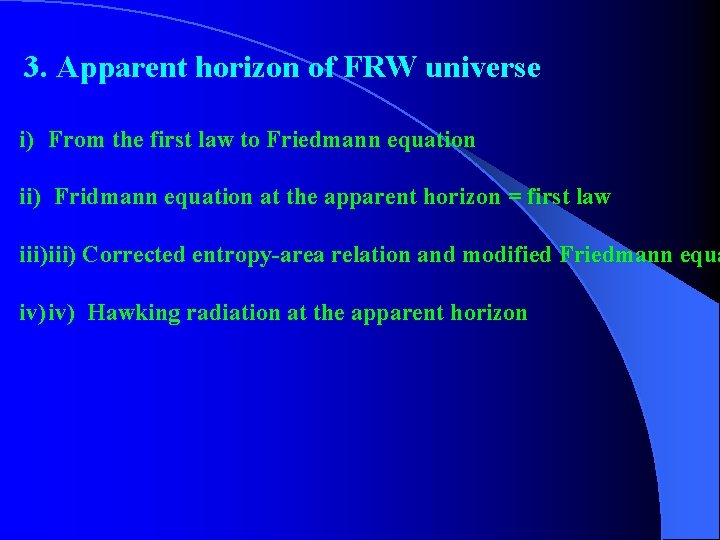
3. Apparent horizon of FRW universe i) From the first law to Friedmann equation ii) Fridmann equation at the apparent horizon = first law iii) Corrected entropy-area relation and modified Friedmann equa iv) Hawking radiation at the apparent horizon
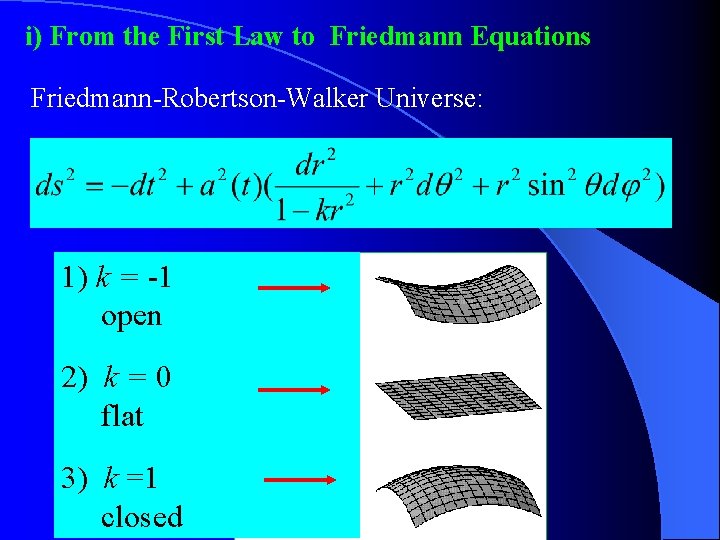
i) From the First Law to Friedmann Equations Friedmann-Robertson-Walker Universe: 1) k = -1 open 2) k = 0 flat 3) k =1 closed
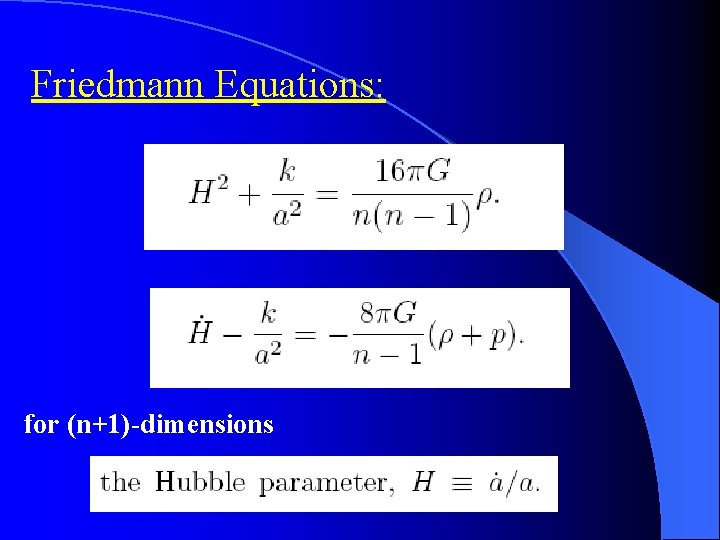
Friedmann Equations: for (n+1)-dimensions
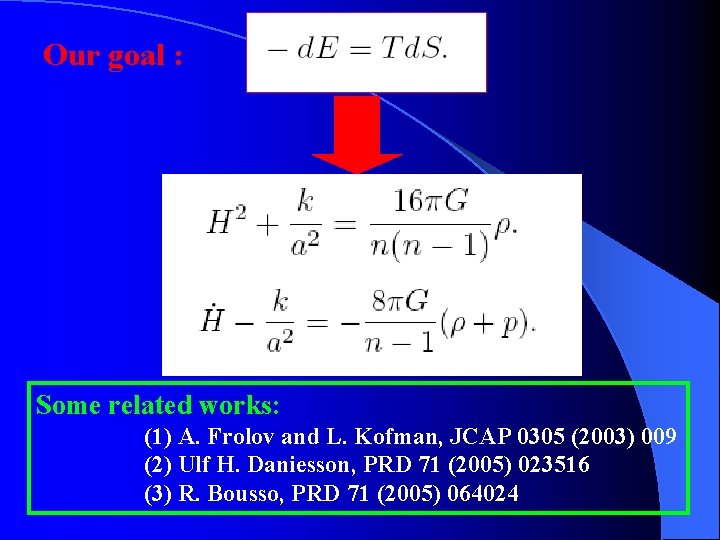
Our goal : Some related works: (1) A. Frolov and L. Kofman, JCAP 0305 (2003) 009 (2) Ulf H. Daniesson, PRD 71 (2005) 023516 (3) R. Bousso, PRD 71 (2005) 064024
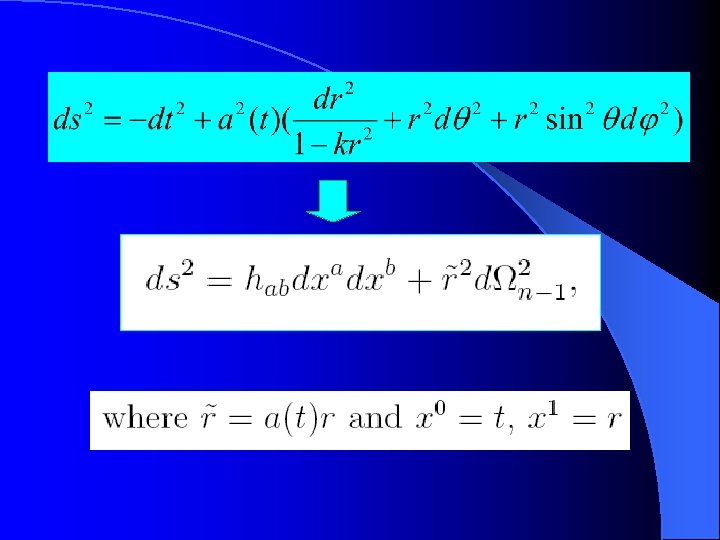
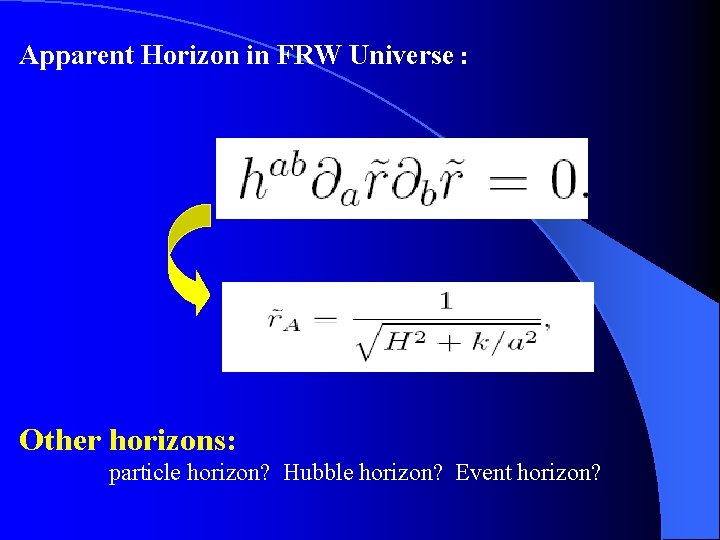
Apparent Horizon in FRW Universe : Other horizons: particle horizon? Hubble horizon? Event horizon?
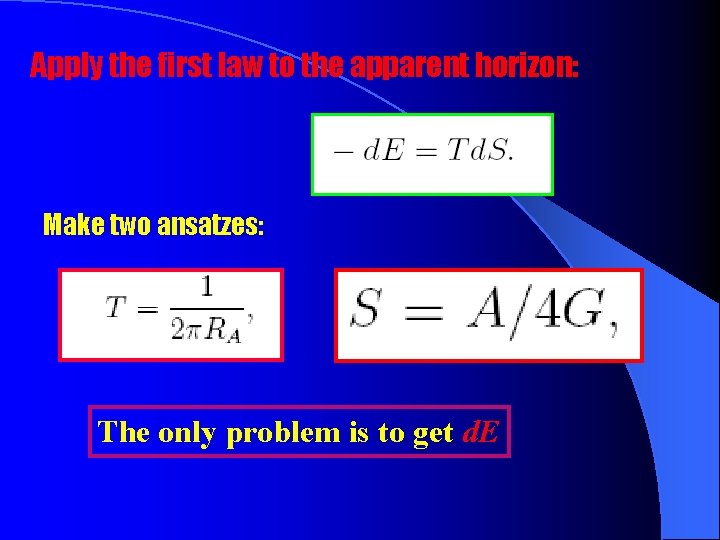
Apply the first law to the apparent horizon: Make two ansatzes: The only problem is to get d. E
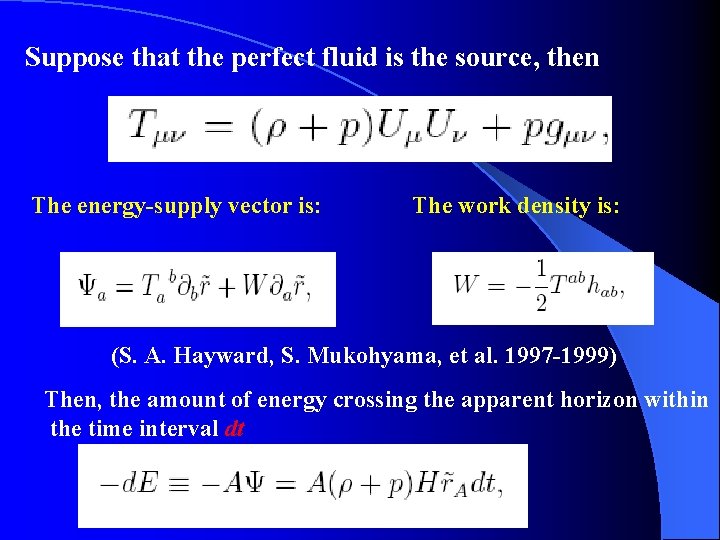
Suppose that the perfect fluid is the source, then The energy-supply vector is: The work density is: (S. A. Hayward, S. Mukohyama, et al. 1997 -1999) Then, the amount of energy crossing the apparent horizon within the time interval dt
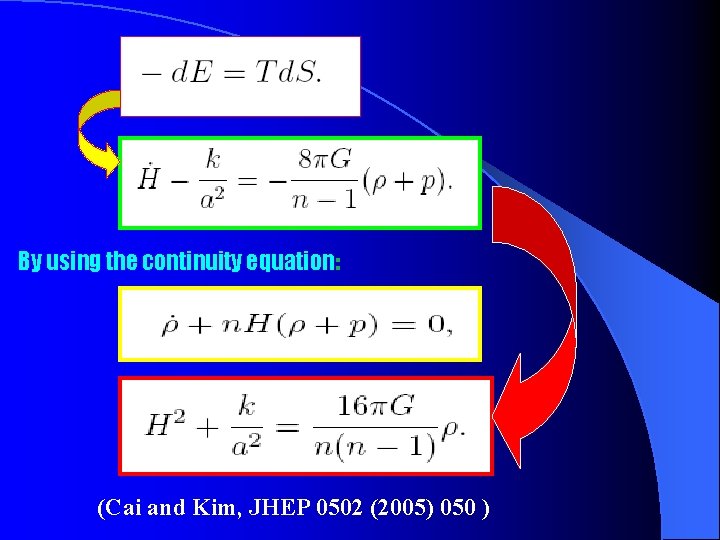
By using the continuity equation: (Cai and Kim, JHEP 0502 (2005) 050 )
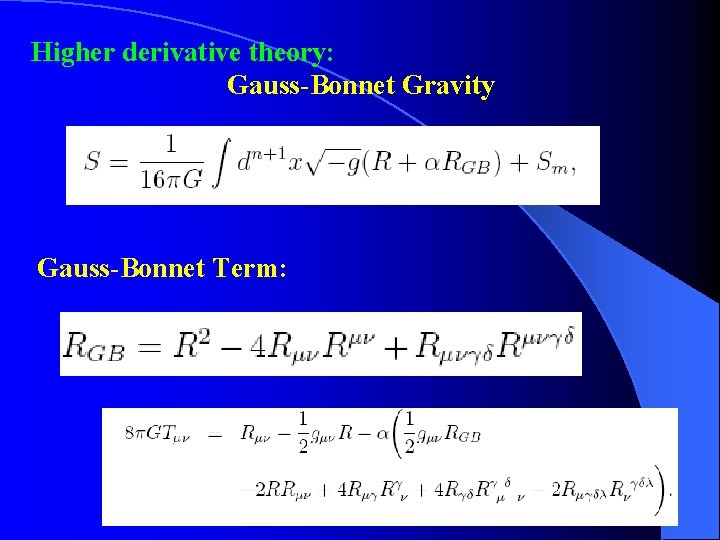
Higher derivative theory: Gauss-Bonnet Gravity Gauss-Bonnet Term:
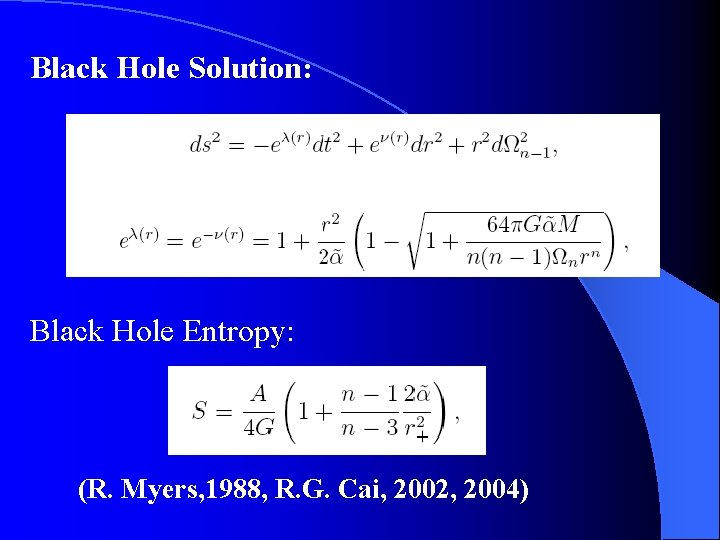
Black Hole Solution: Black Hole Entropy: (R. Myers, 1988, R. G. Cai, 2002, 2004)
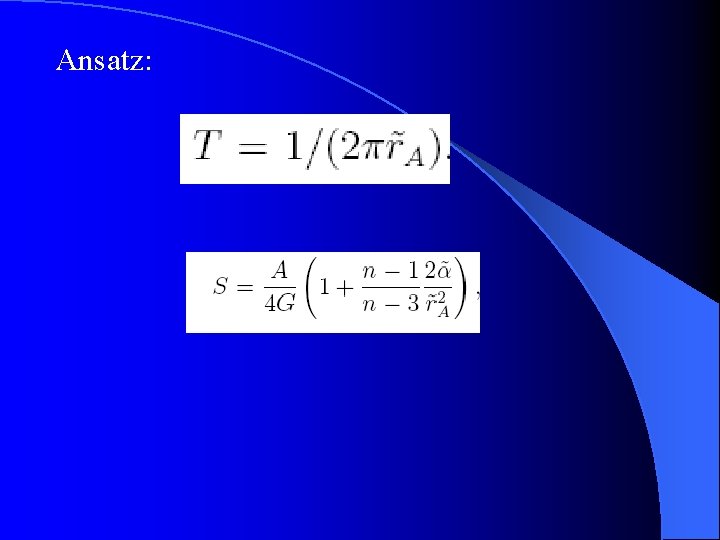
Ansatz:
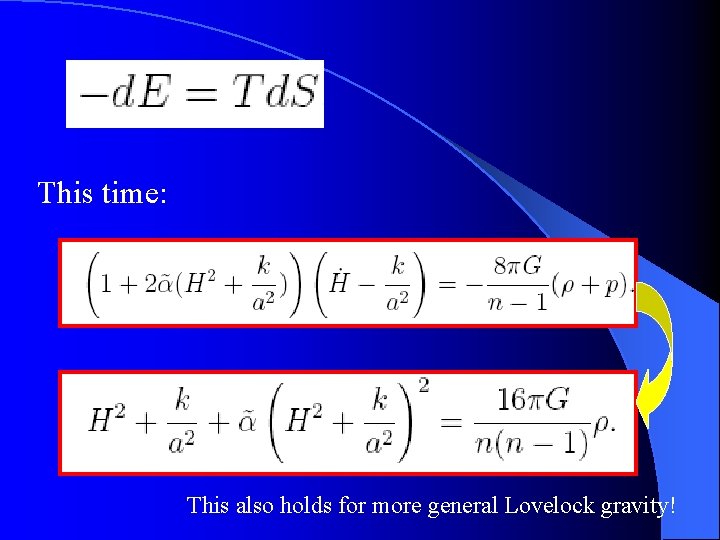
This time: This also holds for more general Lovelock gravity!
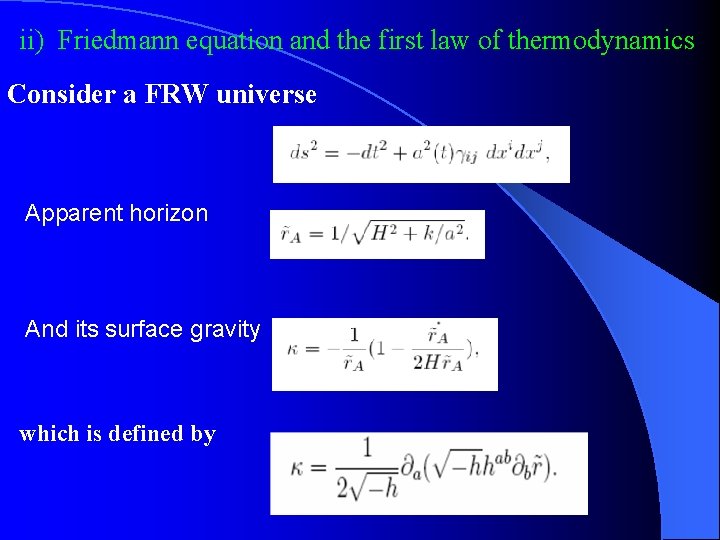
ii) Friedmann equation and the first law of thermodynamics Consider a FRW universe Apparent horizon And its surface gravity which is defined by
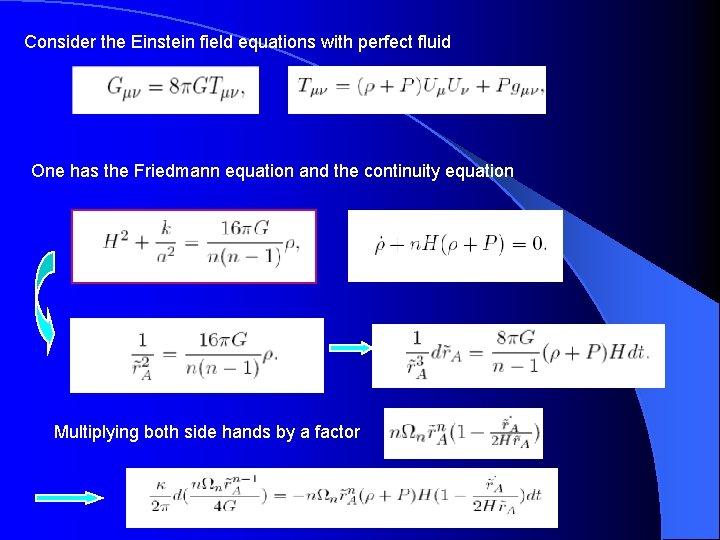
Consider the Einstein field equations with perfect fluid One has the Friedmann equation and the continuity equation Multiplying both side hands by a factor
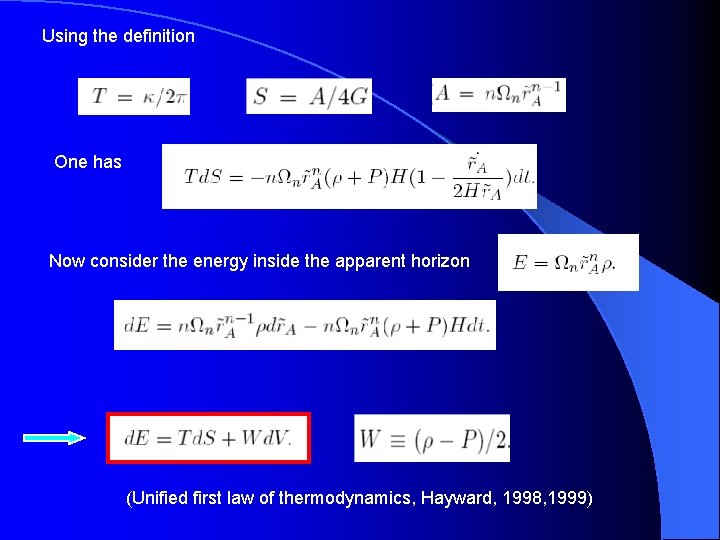
Using the definition One has Now consider the energy inside the apparent horizon (Unified first law of thermodynamics, Hayward, 1998, 1999)
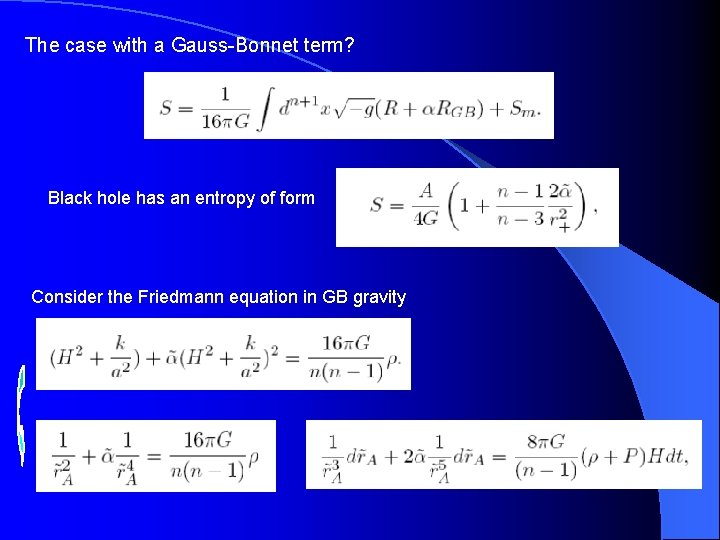
The case with a Gauss-Bonnet term? Black hole has an entropy of form Consider the Friedmann equation in GB gravity
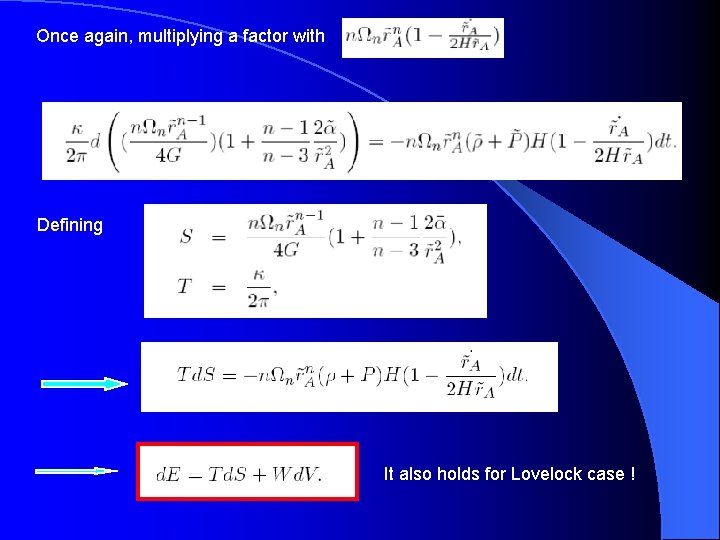
Once again, multiplying a factor with Defining It also holds for Lovelock case !
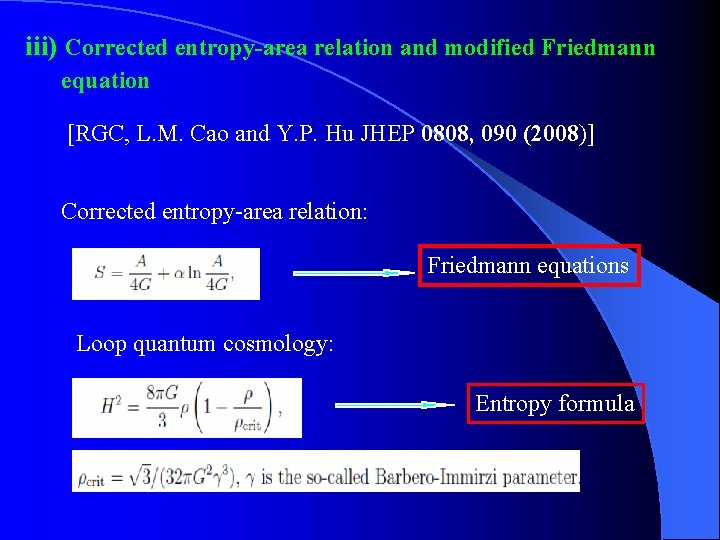
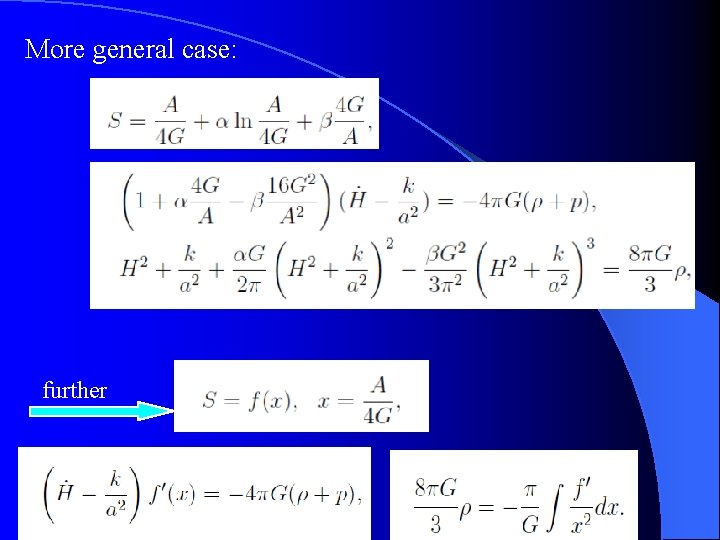
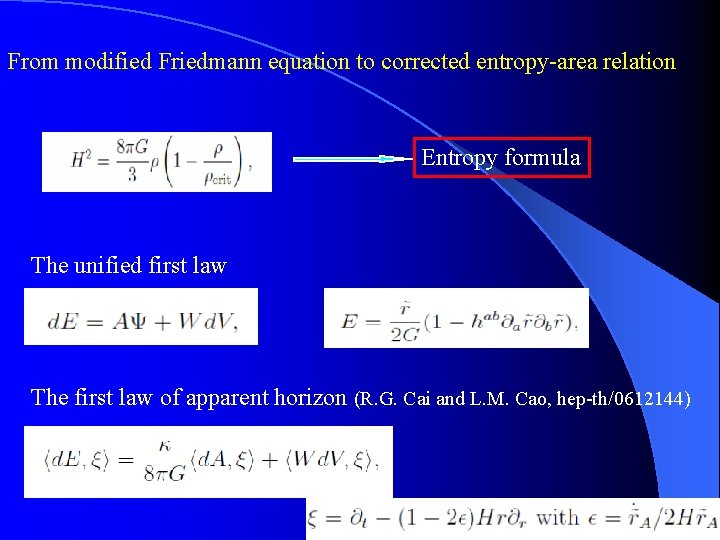
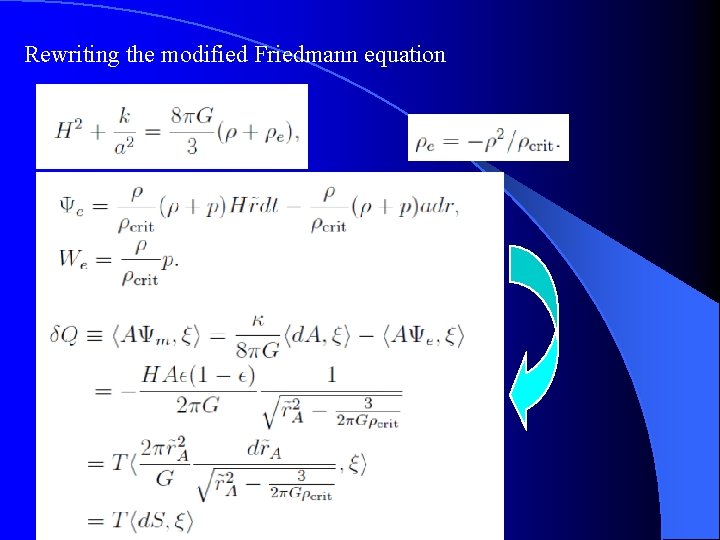
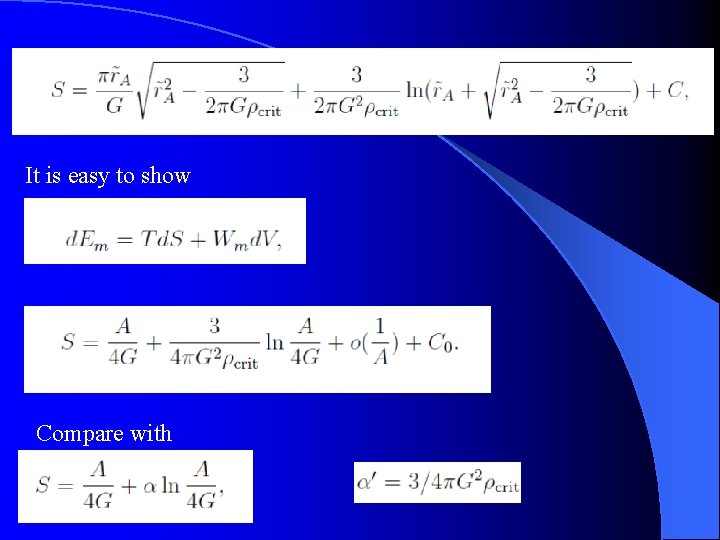
iii) Corrected entropy-area relation and modified Friedmann equation [RGC, L. M. Cao and Y. P. Hu JHEP 0808, 090 (2008)] Corrected entropy-area relation: Friedmann equations Loop quantum cosmology: Entropy formula
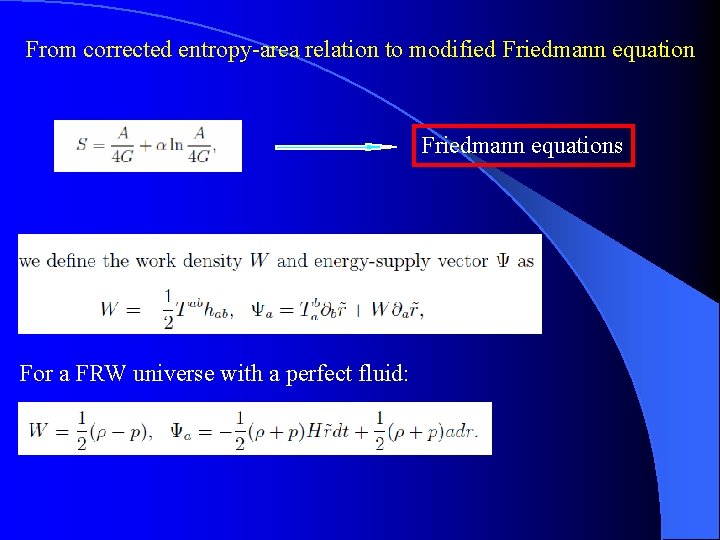
From corrected entropy-area relation to modified Friedmann equations For a FRW universe with a perfect fluid:
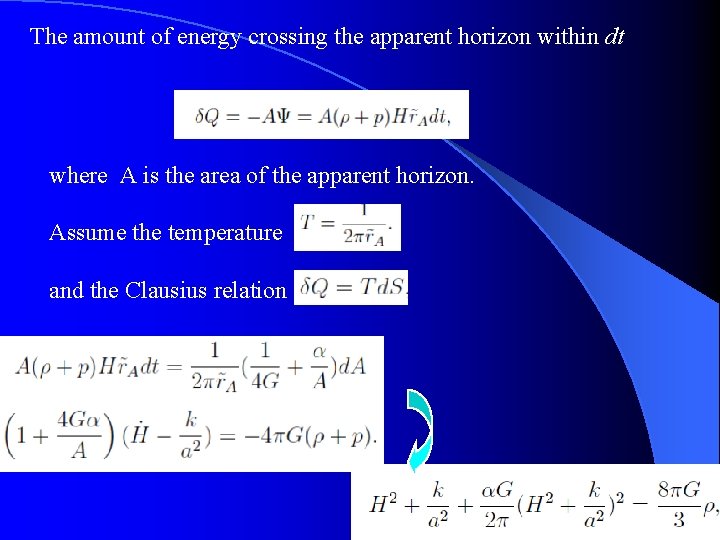
The amount of energy crossing the apparent horizon within dt where A is the area of the apparent horizon. Assume the temperature and the Clausius relation
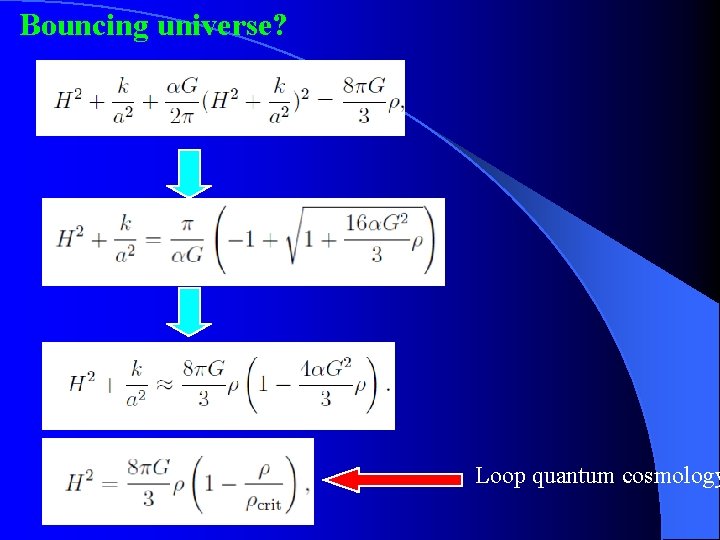
Bouncing universe? Loop quantum cosmology
More general case: further
From modified Friedmann equation to corrected entropy-area relation Entropy formula The unified first law The first law of apparent horizon (R. G. Cai and L. M. Cao, hep-th/0612144)
Rewriting the modified Friedmann equation
It is easy to show Compare with
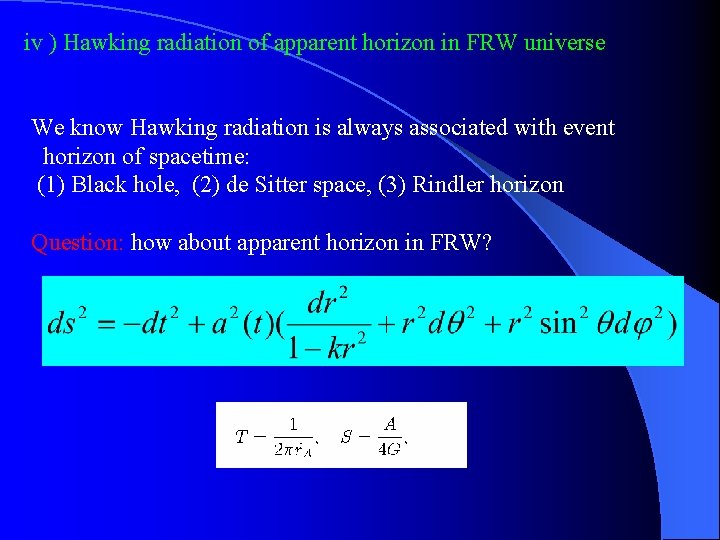
iv ) Hawking radiation of apparent horizon in FRW universe We know Hawking radiation is always associated with event horizon of spacetime: (1) Black hole, (2) de Sitter space, (3) Rindler horizon Question: how about apparent horizon in FRW?
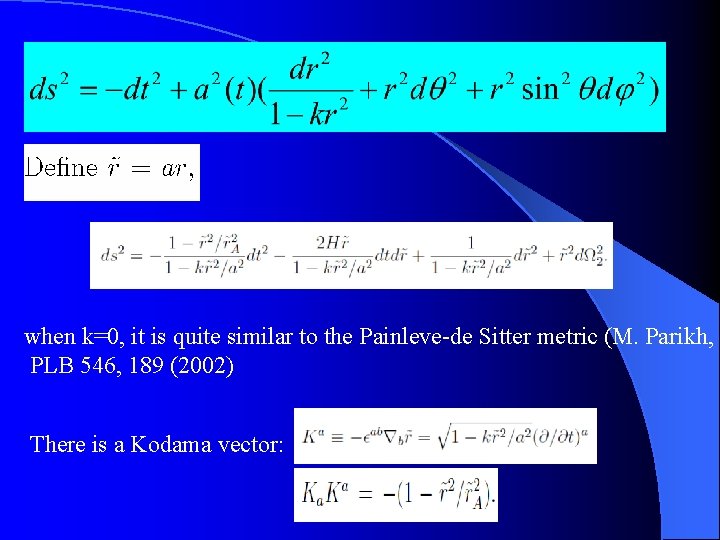
when k=0, it is quite similar to the Painleve-de Sitter metric (M. Parikh, PLB 546, 189 (2002) There is a Kodama vector:
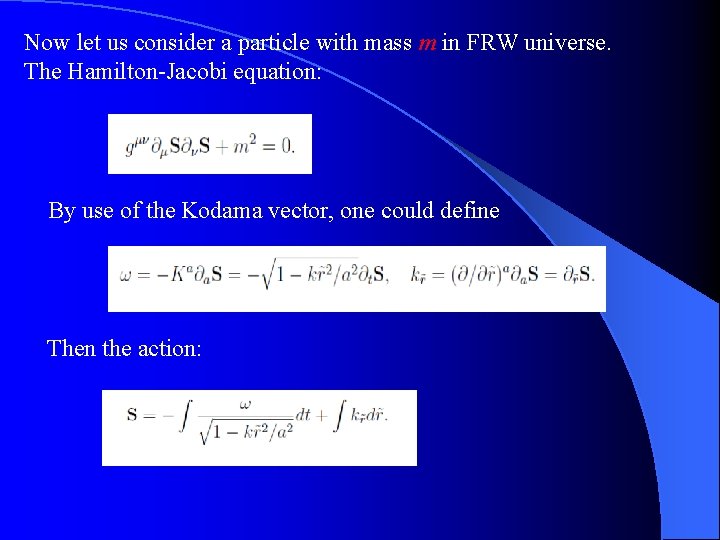
Now let us consider a particle with mass m in FRW universe. The Hamilton-Jacobi equation: By use of the Kodama vector, one could define Then the action:
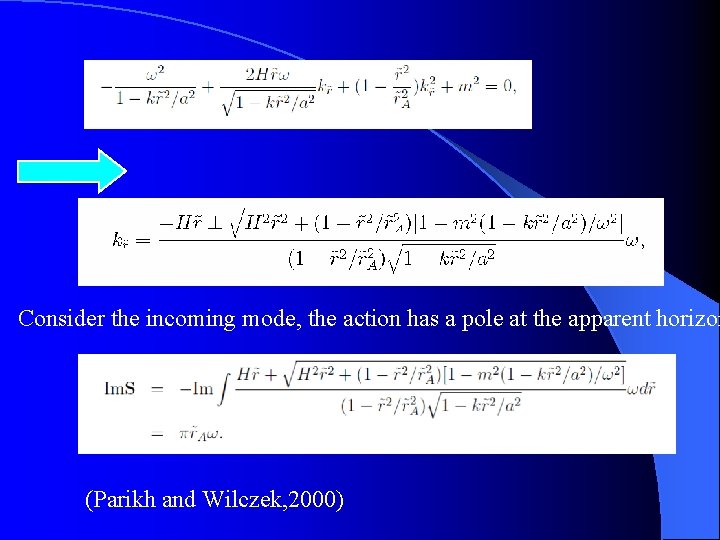
Consider the incoming mode, the action has a pole at the apparent horizon (Parikh and Wilczek, 2000)
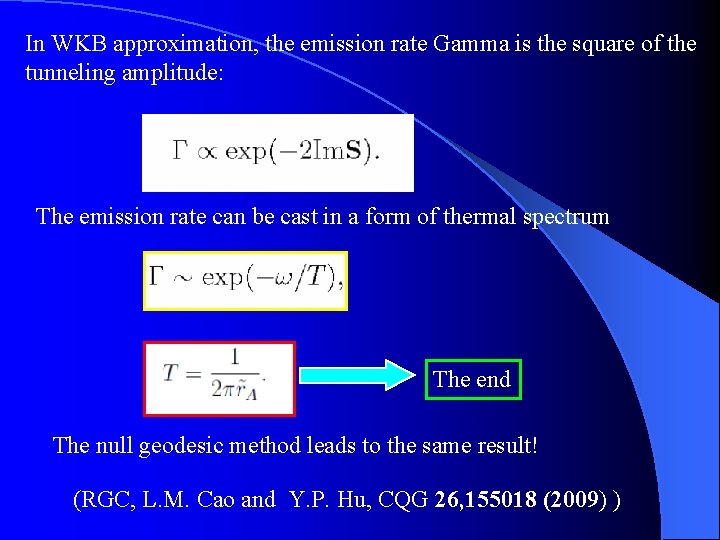
In WKB approximation, the emission rate Gamma is the square of the tunneling amplitude: The emission rate can be cast in a form of thermal spectrum The end The null geodesic method leads to the same result! (RGC, L. M. Cao and Y. P. Hu, CQG 26, 155018 (2009) )
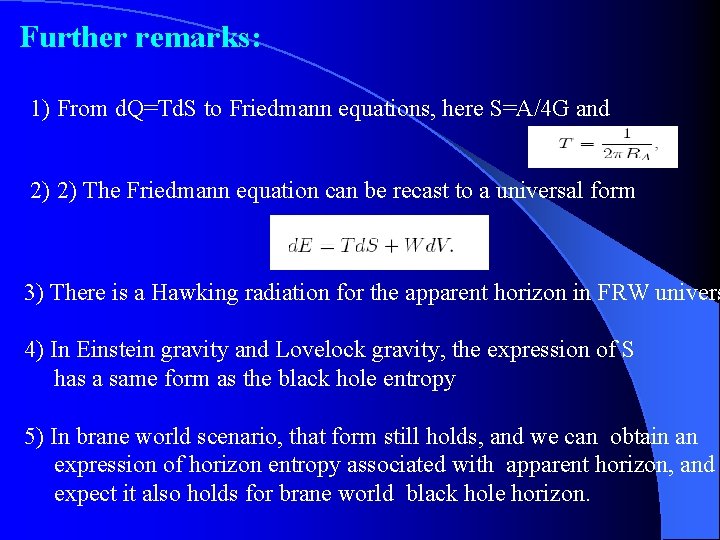
Further remarks: 1) From d. Q=Td. S to Friedmann equations, here S=A/4 G and 2) 2) The Friedmann equation can be recast to a universal form 3) There is a Hawking radiation for the apparent horizon in FRW univers 4) In Einstein gravity and Lovelock gravity, the expression of S has a same form as the black hole entropy 5) In brane world scenario, that form still holds, and we can obtain an expression of horizon entropy associated with apparent horizon, and expect it also holds for brane world black hole horizon.
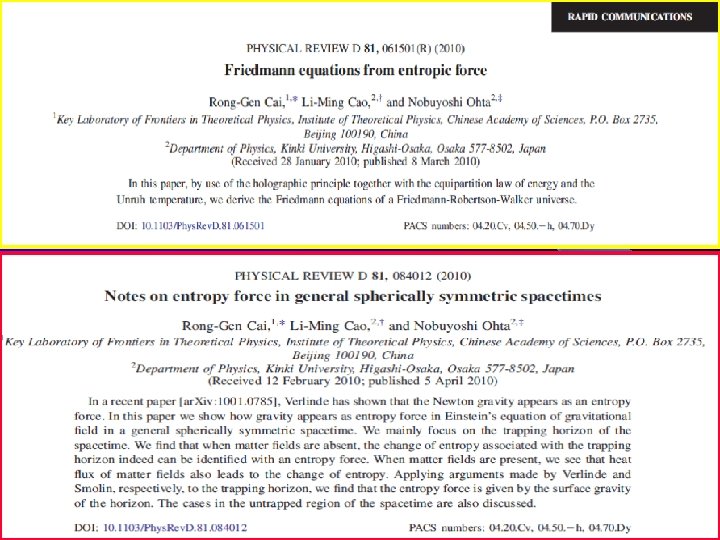
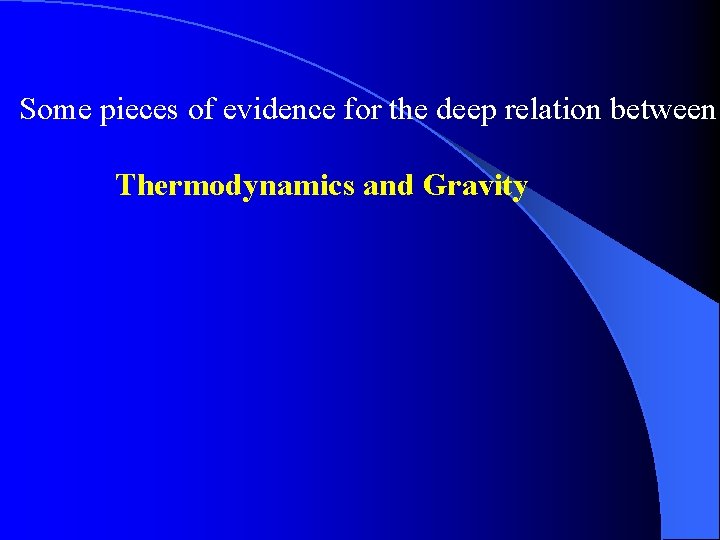
My papers on this subject: 1) RGC and S. P. Kim, JHEP 0502, 050 (2005) 2) M. Akbar and RGC, PLB 635,7 (2006); PRD 75, 084003 (2007); PLB 648, 243 (2007) 3) RGC and L. M. Cao, PRD 75, 064008 (2007); NPB 785, 135 (2007) 4) A. Sheykhi, B. Wang and RGC, NPB 779, 1 (2007), PRD 76, 023515 (2007) 5) R. G. Cai, L. M. Cao and Y. P. Hu, JHEP 0808, 090 (2008) 6) R. G. Cai, Prog. Theor. Phys. Suppl. 172, 100 (2008) 7) RGC, L. M. Cao, Y. P. Hu and S. P. Kim, PRD 78, 124012 (2008) 8) R. G. Cai, L. M. Cao and Y. P. Hu, CQG 26, 155018 (2009) 9) RGC, L. M. Cao, Y. P. Hu and N. Ohta, PRD 80, 104016 (2009) 10) RGC and N. Ohta, PRD 81, 084061 (2010) 11) RGC, L. M. Cao and N. Ohta, PRD 81, 061501 (2010) 12) RGC, L. M. Cao and N. Ohta, PRD 81, 084012 (2010)

Thank You !
- Slides: 64