
Celebrate Science Scientific activities Goshen College students engaged
Celebrate Science! Scientific activities Goshen College students engaged in the past year.
Science Speakers Jacob Penner, Behavioral and Chemical Ecology of a Sexually Dimorphic Desert Lizard Joelle Friesen, Investigation into a Putative Fumarate Reductase in Leishmania major Stuart Kurtz, Pigmentation Genetics of Domestic Pigeons: Pink-eyed Dilution Jacob Swartley, Domestic Pigeons: The Dilution Series
Conferences Indiana Academy of Science David Jantz, Brenner Burkholder, Nathanael Dick, Tessa Yoder, Aaron Kauffmann & David Slagel, Optical Density Accurately Predicts Dry Mass of Algae Produced in a Buoyant-Lift Photobioreactor Aaron Graber, Byeon. Chan Lim, Hayley Mann, Jacob Roth, Zachary Zimmerman, Caleb Derstine & Deeksha Pagar, Combinatorial Synthesis of Candidate Antibiotics Jacob Swartley & Stuart Kurtz, Domestic Pigeons: The Dilution Series Stuart Kurtz, Pigmentation Genetics of Domestic Pigeons: Pink-Eyed Dilute Jessica Davila, Contractile Measurements from Frog (rana pipiens) Gastrocnemius Muscle Used for the First Time to Study Short-Term Synaptic Plasticity Nathan O'Leary, Honey Bee Pheromones: Ethyl Oleate and Alcohol Sensitivity Alejandro Genis, Local Drifting Behavior of the Western Honey Bee (Apis mellifera)
Conferences Butler Conference Jessica Davila, Michael Nivens & Amber Mosley, Priming and Memory: The Effects of Body Position, a Type of Body Language Priming, on Memory of Affectively Conotated Words Olivia Ginn & Aaron George, Gender Differences in Conformity to Group Behavior Indiana REU Math Conference and Math. Fest (Mathematical Association of America) Matthew Chen, Nucleolus and Group Monotonicity Jon Kaasa, Voting Power in Norway’s Parliament Mathematical Association of America, Indiana Section: Fall: Matt Chen, Crystopher Echavarria, Deeksha Pagar, Sijan Shrestha, Emily Schaeffer Spring: Matthew Chen, Abby Flickner, Lucas Harnish, Jon Kaasa, Matthew Pletcher, Peter Schrock, Bryan Yoder
Academic Year Research Some courses have a research component. Often there is academic credit available. Career and graduate study exploration. Resume builder for job applications & graduate school recommendation letters.
Research Programs National Science Foundation Research for Undergraduates Programs are offered at a variety of colleges and universities in a variety of research areas. The Oak Ridge Institute for Science and Education (ORISE) sponsors more than 50 research programs for undergraduate students at national laboratories and other federal research facilities in 24 states and some outside the United States. David Jantz, Biology Education, University of Georgia Jacob Penner, Generalist Insect Herbivory and Plant Defense Traits, UC Davis Peter Wise, Stroud Enviro. DIY Mayfly Data Logger and Modbus RS -485 Sensor, Stroud Water Research Center Vince Kurtz, Learning Robust Failure Recovery for Autonomous Vision Based Flight, Robotics Institute, Carnegie Mellon University

Research Programs Sophie Sears, Therapeutic effects of natural compounds on cadmium-induced prostate cancer, University of Louisville NCI R 25 Cancer Education Program Kate Crawford, Gastric Cancer Research, IU School of Medicine Morgan Catron, Algaetown Research, Goshen College Geoff Miller, Jess Raffel, Ben Wiebe, & Reena Ramo, Ant, Fire, and Elephant Reseach in Kenya Jacob Roth, Optimizing the Cellular Thermal Shift Assay to Validate Target Engagement in Cancer Drug Development, National Center for Advancing Translational Sciences (NCATS), Summer 2016 Summer Intern Poster Day - Honorable Mention Morgan Short & Benjamin Wiebe, Sponge, Lobster, and Crab Research in the Florida Keys, Old Dominion University
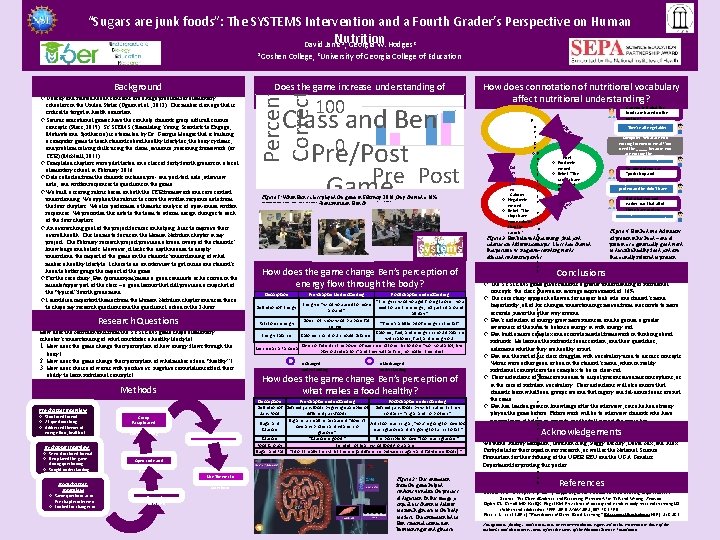
“Sugars are junk foods”: The SYSTEMS Intervention and a Fourth Grader’s Perspective on Human Nutrition David Jantz , Georgia W. Hodges 1 1 Goshen Research Questions How does the Nutrition unit from the SYSTEMS game shape elementary schooler’s understanding of what constitutes a healthy lifestyle? 1. How does the game change their perception of how energy flows through the body? 2. How does the game change their perception of what makes a food “healthy”? 3. How does choice of words with positive vs. negative connotations affect their ability to learn nutritional concepts? Methods Pre-chapter Interview v Structured format v 21 questions long v Addressed themes of energy flow, health of food, and vocabulary Group Paraphrased Responses by Code (including class data) In-chapter Interview v Semi-structured format v Ben played the game during questioning v Sought understanding of his thought process Open-code and Paraphrase Responses Post-chapter Interview v Same questions as in Pre chapter interview v Looked for changes in nutritional knowledge Transcribe Interview Thematic Analysis Use Themes to Answer Research Questions 100 Class and Ben. 0. Pre/Post Pre Post. Game Assessment How does connotation of nutritional vocabulary affect nutritional understanding? E v P Dif fer ent fro m Calories v Negatively viewed v Belief: “The chips have more calories than the carrots. ” Figure 1: When Ben’s class played the game in February 2016, they showed a 16% improvement on questions about nutrition. Ben showed a 50% improvement. How does the game change Ben’s perception of energy flow through the body? Description Pre-chapter Understanding Definition of Energy is “what you used to move around. ” Fat stores energy Does not know what purpose fat serves. Post-chapter understanding “Energy is what you get from glucose… you need to use the energy, not just sit around all day. ” “There’s a little bit of energy in the fat”. Calories, fuel, and energy in should balance Energy Balance Calories in and out should balance. with calories, fuel, and energy out. Overconfident in the power of exercise. All one has to do is “work out a lot, like Exercise as a Panacea play outside a ton” and they will be fine, no matter their diet. = Changed understanding Description Pre-chapter understanding Post-chapter understanding Definition of Defined junk foods by giving examples of Defined junk foods by what nutrients they Junk Food different junk foods. contain – “sugar and no protein. ” Sugar is unhealthy because it “doesn’t Sugar and With too much sugar, “you’re going to have too have any protein and vitamins or Glucose much glucose and it’s going to turn into fat. ” glucose. ” Glucose “Glucose is good. ” It is possible to have “too much glucose. ” Food Groups Ben did not learn what food groups are. Sugar and Fat “I don’t really think that there is [a difference between sugary and fat-dense foods]. ” Figure 2: This animation from the game helped students visualize the process of digestion. In this image, a cupcake is shown to deliver too much glucose to the body too fast. The animation led to Ben’s mental connection between sugar and glucose. o s i t i v e l y Fuel v Positively viewed v Belief: “The carrots have more fuel than the chips. ”n re ffe Di rom tf v i e w e Figure 3: Ben believed that energy, fuel, and d calories are different concepts. Class data showed v B e that positive vs. negative-sounding words l affected student responses. i e f : Can you tell what the foods are based on the picture? They're all protein. They're all vegetables and good stuff. Computer: What are you missing from your meal? You need the _____ because you are missing the _____. Pork chop and protein. So why did you say “pork chop and protein”? Um, because the meat has protein and he didn't have any protein. But what you said earlier was that all of these have protein. Well, she needed a main meal. Figure 4: Ben had two definitions of protein in his head – one of protein as a generically good word to describe healthy food, and one that actually referred to protein. Conclusions v The SYSTEMS game gives students a greater understanding of nutritional V concepts: the class showed an average improvement of 16%. e v The case study approach allowed for deeper look into one student’s mind. g v v v = Unchanged understanding How does the game change Ben’s perception of what makes a food healthy? n e r g y n re ffe Di from t schoolers in the United States (Ogden et al. , 2012). This makes it an age that is critical to target in health education. v Serious educational games have the can help students grasp difficult science concepts (Plass, 2015). SYSTEMS (Stimulating Young Scientists to Engage, Motivate and Synthesize) is a team led by Dr. Georgia Hodges that is building a computer game to teach students about healthy lifestyles, the body systems, and problem solving skills using the claim, evidence, reasoning framework (or CER) (Mc. Neill, 2011). v Completed chapters were pilot tested on a class of forty fourth graders in a local elementary school in February 2016. v Data collected from the students included pre- and post-test data, interview data, and written responses to questions in the game. v We built a scoring rubric based on both the CER framework and core content understanding. We applied the rubrics to score the written response data from the four chapters. We also performed a thematic analysis of open-ended written responses. We presented this data to the team to inform design changes to each of the four chapters. v An overarching goal of the project focuses on helping kids to improve their overall health. This led me to focus on the Human Nutrition chapter in my project. The February research project provided a broad sweep of the students’ knowledge and beliefs. However, it lacks the depth needed to deeply understand the impact of the game on the students’ understanding of what makes a healthy lifestyle. I chose to do an interview to get inside one student’s head to better gauge the impact of the game. v For the case study, Ben (pseudonym) made a good candidate as he scored in the middle/upper part of the class – a good learner that still provided a snapshot of the “typical” fourth grade mind. v I identified important themes from the Human Nutrition chapter and used those to shape my research questions and the questions I asked in the 2 -hour interview. Does the game increase understanding of content? Percent Correct Background v Obesity and related health concerns are a huge problem for elementary 2 College, 2 University of Georgia College of Education v v e Importantly, all of his changed understandings moved from inaccurate to more t accurate, never the other way around. a Ben’s definition of energy grew more nuanced and he gained a greater b l awareness of the need to balance energy in with energy out. e Ben built a more complex and accurate mental framework in thinking about s nutrients: He learned the nutrients foods contain, and their quantities, h determine whether they are healthy or not. a Ben and the rest of his class struggled with vocabulary used to discuss concepts. v Words were either good or bad in the student’s mind, when in reality e nutritional concepts are too complex to be so clear-cut. m Clear definitions of terms are needed to dispel preconceived misconceptions, as o in the case of nutrition vocabulary. Clear definitions will also ensure that r e students learn what food groups are and that sugary and fat-dense foods are not the same. e Ben had limited gains in knowledge after the interview, since he had already n e played the game before. Future work will be to interview students who have r never played it before in order to see the full impact the game has. g y t Acknowledgements We thank Audrey Hoffman, Gretchen King, Peggy Mc. Kay, David Nix, and Alex h a Turbyfield for their input in our research, as well as the National Science n Foundation for their funding of the UBER REU and the UGA Genetics Department for printing this poster. j u n k References Mc. Neill, K. L. , & Krajcik, J. S. (2011). Supporting Grade 5 -8 Students in Constructing Explanations in f Science: The Claim, Evidence, and Reasoning Framework for Talk and Writing. Pearson. o Ogden CL, Carroll MD, Kit BK, Flegal KM. Prevalence of obesity and trends in body mass index among US o children and adolescents, 1999– 2010. JAMA 2012; 307: 483– 490. d Plass, J. L. , et al. (2015). "Foundations of Game-Based Learning. " Educational Psychologist 50(4): 258– 283. s. Any opinions, findings, and conclusions or recommendations expressed in this material are those of the author(s) and do not necessarily reflect the views of the National Science Foundation.
Internships David Bontrager, Prairie grazing project and Bird Banding internship at Merry Lea Molly Zook, Shadowed therapists in a physical therapy center. Was able to have an up-close view of the inner workings in this private clinic and learn much more about the whole field Grant Flaming, Fish shocking and monitoring stream health in Elkhart and South Bend counties Micah Weibe-Powell, Altadena Solar in Altadena, California Brian Sutter, Solution Source Michelle Espino, Abonmarche
Maple Scholars Whether it’s exploring the relationship between math and music, testing the stress levels of drunk honeybees, or developing curriculum for a criminal justice course at the county jail, each year Goshen College students spend the summer doing intense study and research during the college’s eight-week Maple Scholars program. During the program, each scholar is paired with a faculty member who serves as both colleague and supervisor. Creating a community of scholars, the students are all housed together and in the Friday colloquium, scholars take turns presenting the work they are doing and answering questions from other students and faculty. At the end is a celebration day when the results of each project are presented to the public.
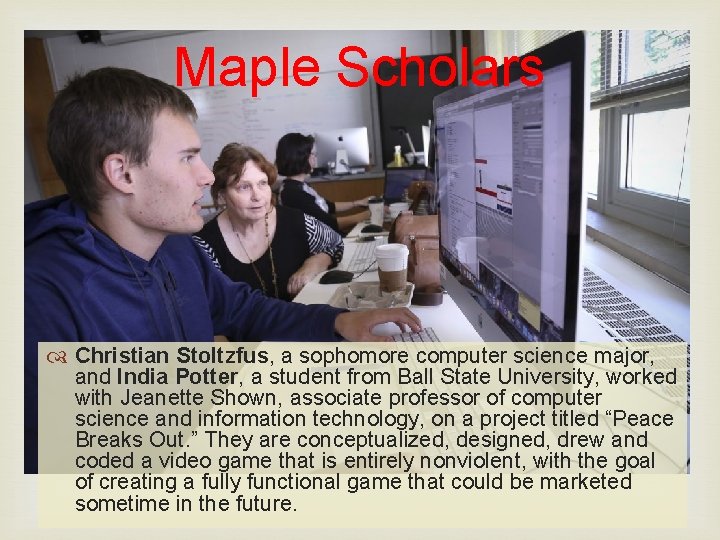
Maple Scholars Christian Stoltzfus, a sophomore computer science major, and India Potter, a student from Ball State University, worked with Jeanette Shown, associate professor of computer science and information technology, on a project titled “Peace Breaks Out. ” They are conceptualized, designed, drew and coded a video game that is entirely nonviolent, with the goal of creating a fully functional game that could be marketed sometime in the future.
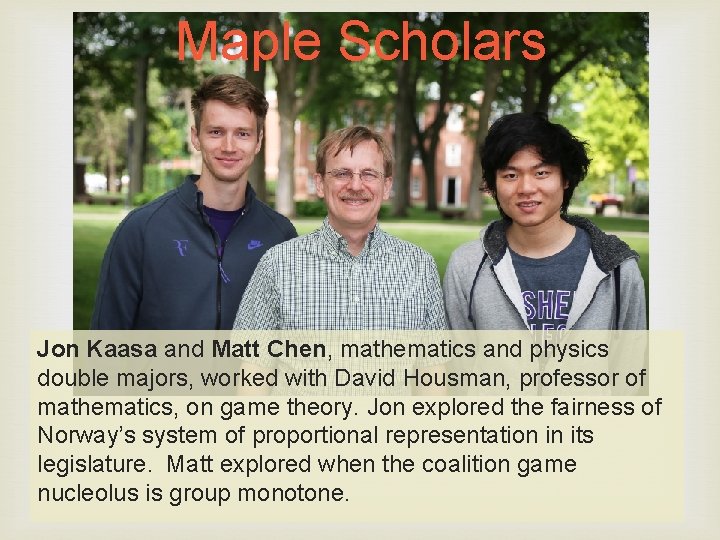
Maple Scholars Jon Kaasa and Matt Chen, mathematics and physics double majors, worked with David Housman, professor of mathematics, on game theory. Jon explored the fairness of Norway’s system of proportional representation in its legislature. Matt explored when the coalition game nucleolus is group monotone.
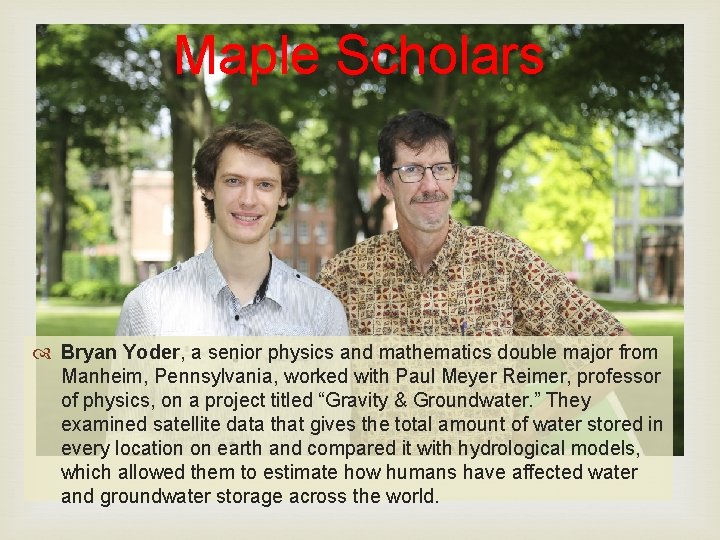
Maple Scholars Bryan Yoder, a senior physics and mathematics double major from Manheim, Pennsylvania, worked with Paul Meyer Reimer, professor of physics, on a project titled “Gravity & Groundwater. ” They examined satellite data that gives the total amount of water stored in every location on earth and compared it with hydrological models, which allowed them to estimate how humans have affected water and groundwater storage across the world.
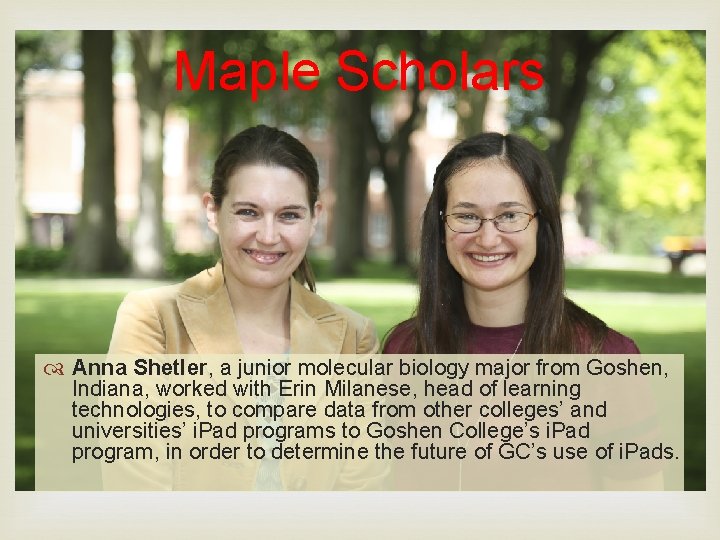
Maple Scholars Anna Shetler, a junior molecular biology major from Goshen, Indiana, worked with Erin Milanese, head of learning technologies, to compare data from other colleges’ and universities’ i. Pad programs to Goshen College’s i. Pad program, in order to determine the future of GC’s use of i. Pads.
Classroom Technology: Exploring i. Pad Programs in Higher Education Anna Shetler Maple Scholars 2016
Purpose of Project • Help administration determine effectiveness of Goshen’s i. Pad Program • Decision in October 2016 • Compare Goshen’s program with programs around the world • What works for other schools?
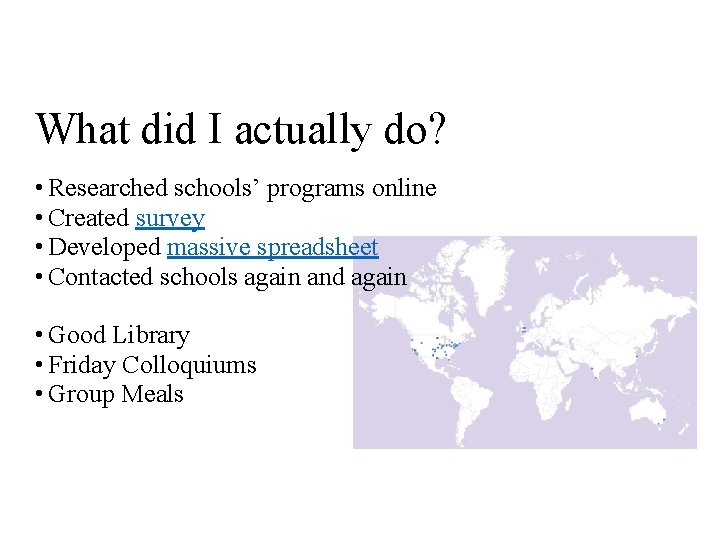
What did I actually do? • Researched schools’ programs online • Created survey • Developed massive spreadsheet • Contacted schools again and again • Good Library • Friday Colloquiums • Group Meals
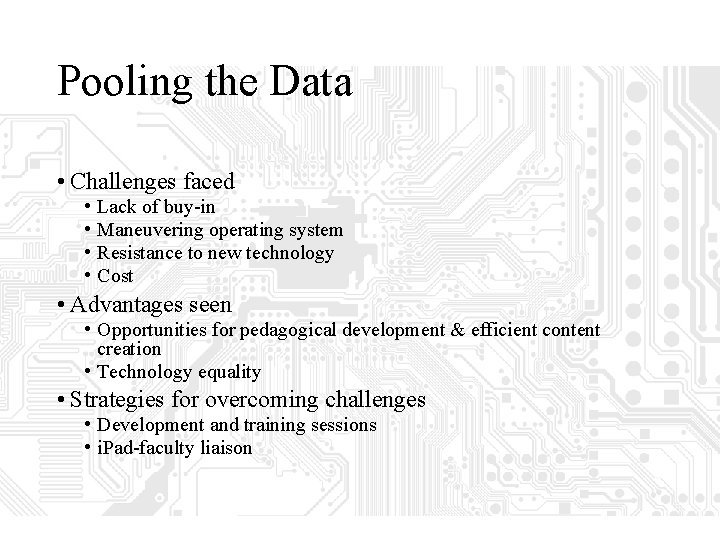
Pooling the Data • Challenges faced • • Lack of buy-in Maneuvering operating system Resistance to new technology Cost • Advantages seen • Opportunities for pedagogical development & efficient content creation • Technology equality • Strategies for overcoming challenges • Development and training sessions • i. Pad-faculty liaison
Continuing the Project Creation of GC Internal App Report for Administration Junior/Senior Research?
Grants Meghan Gerke and Jeanette Shown, Google Ignite. CS, develop and deliver a computer science outreach program in our community
Contests Association for Computing Machinery Programming Contest: Christian Bechler, Kenan Bitikofer, Matthew Pletcher, Peter Schrock, Christian Stoltzfus & Seth Yoder (one team came in 7 th place out of 60 teams in our region) Putnam Competition: Bryan Yoder (73 rd percentile), Peter Schrock & Kenan Bitikofer; GC team ranked 148 out of 554 teams internationally Indiana Colleges Mathematics Contest: Matthew Chen, Abby Flickner, Lucas Harnish, Jon Kaasa, Matthew Pletcher, Peter Schrock, & Bryan Yoder
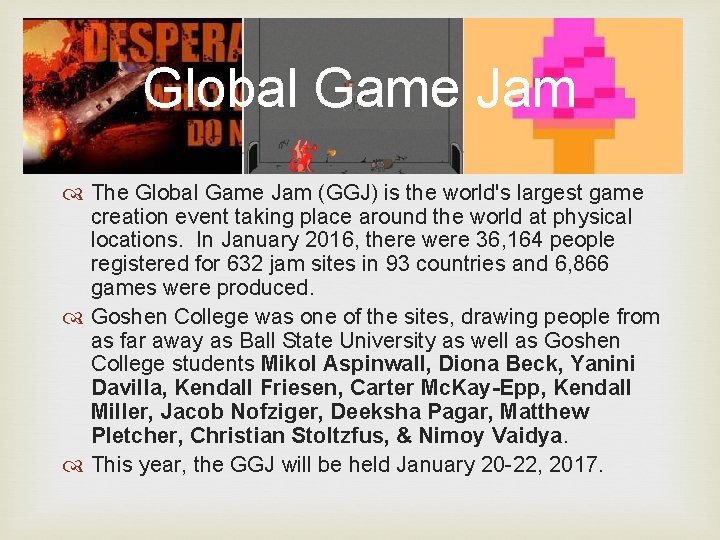
Global Game Jam The Global Game Jam (GGJ) is the world's largest game creation event taking place around the world at physical locations. In January 2016, there were 36, 164 people registered for 632 jam sites in 93 countries and 6, 866 games were produced. Goshen College was one of the sites, drawing people from as far away as Ball State University as well as Goshen College students Mikol Aspinwall, Diona Beck, Yanini Davilla, Kendall Friesen, Carter Mc. Kay-Epp, Kendall Miller, Jacob Nofziger, Deeksha Pagar, Matthew Pletcher, Christian Stoltzfus, & Nimoy Vaidya. This year, the GGJ will be held January 20 -22, 2017.
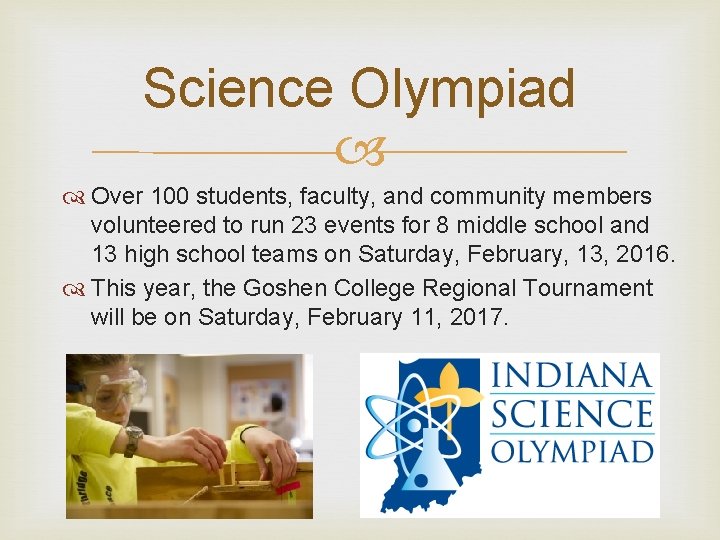
Science Olympiad Over 100 students, faculty, and community members volunteered to run 23 events for 8 middle school and 13 high school teams on Saturday, February, 13, 2016. This year, the Goshen College Regional Tournament will be on Saturday, February 11, 2017.
Alicia Showalter Reynolds Scholarship Awarded to women who are considering graduate studies in the sciences Sophie Sears & Cecilia Lapp Stoltzfus (2015 -16) No one (2016 -17)
Clemens Scholarship Awarded to an upper-level Chemistry major in honor of Don Clemens’ 30+ years as a Chemistry Professor Stuart Kurtz (2015 -16) Lauren Wenger (2016 -17)
Leaf Scholars Academically talented first-generation students majoring in STEM. Money provided by the National Science Foundation. First Years: Ameera Alshuga, Tyler Lautenschleger, Felix Ortiz, Cassie Rivera Sophomores: Morgan Catron, Mc. Kinzi Vega Juniors: Philip Chan, Meghan Gerke, Bryan Nguyen, Dmitriy Shendel Senior: Josue De La Rosa
Sarah G. Rody Scholarship Awarded to women majoring in computing or mathematics Lydia Miller (2015 -16) Meghan Gerke (2016 -17)
Mathematics Instructors' Scholarship Awarded annually to mathematics majors seeking secondary certification Leah Landis, Rae Ann Miller & Colleen Weldy (2016 -17)
General Chemistry Achievement Award Presented by Professor Dan Smith Awarded to the highest achieving students in General Chemistry Prizes provided by CRC Press Mark Kreider
Math Book Awards Awarded to first-year students for outstanding achievement in 200+ level mathematics courses. Started with a donation from Bruce Sellers Rae Ann Miller (Calculus I, Discrete Math) Christian Stoltzfus (Discrete Math, Calculus II) Spencer Aeschliman (Calculus II) Austin Hooley (Calculus I) Trent Yoder (Calculus I)
Celebrate Science! Scientific activities Goshen College students will engage in this year.
- Slides: 31