
Ceilometer Radar Wind Profiler Doppler Lidar Microwave Radiometer
- Slides: 13
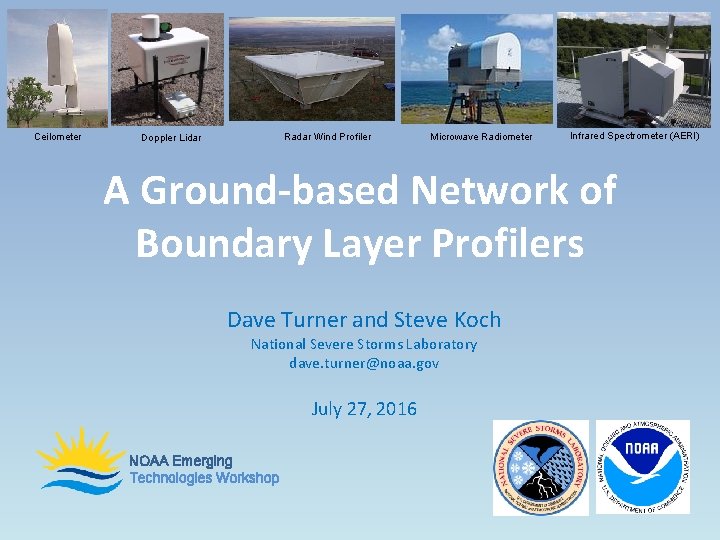
Ceilometer Radar Wind Profiler Doppler Lidar Microwave Radiometer Infrared Spectrometer (AERI) A Ground-based Network of Boundary Layer Profilers Dave Turner and Steve Koch National Severe Storms Laboratory dave. turner@noaa. gov July 27, 2016 NOAA Emerging Technologies Workshop
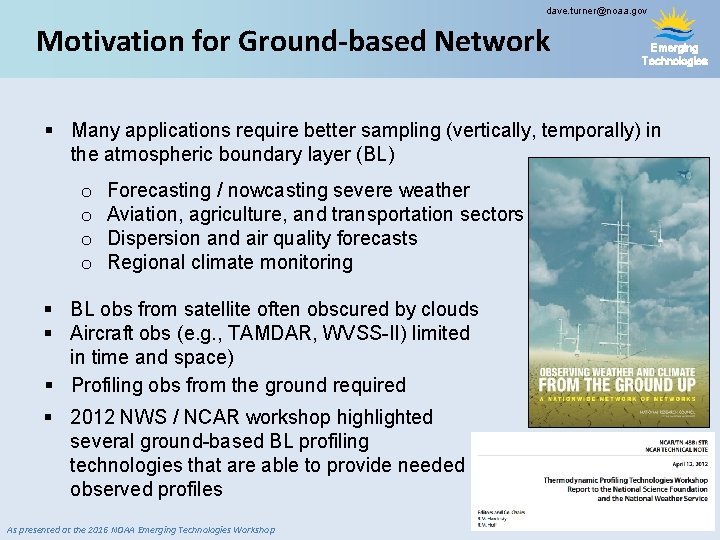
dave. turner@noaa. gov Motivation for Ground-based Network Emerging Technologies § Many applications require better sampling (vertically, temporally) in the atmospheric boundary layer (BL) o o Forecasting / nowcasting severe weather Aviation, agriculture, and transportation sectors Dispersion and air quality forecasts Regional climate monitoring § BL obs from satellite often obscured by clouds § Aircraft obs (e. g. , TAMDAR, WVSS-II) limited in time and space) § Profiling obs from the ground required § 2012 NWS / NCAR workshop highlighted several ground-based BL profiling technologies that are able to provide needed observed profiles As presented at the 2016 NOAA Emerging Technologies Workshop 2
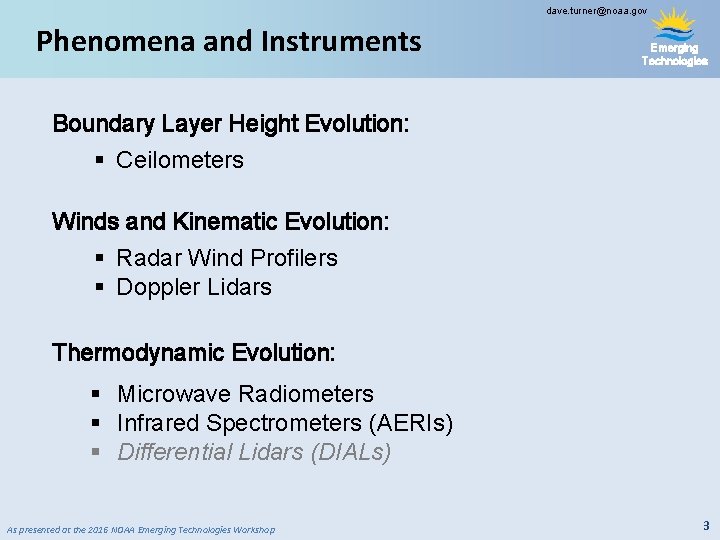
dave. turner@noaa. gov Phenomena and Instruments Emerging Technologies Boundary Layer Height Evolution: § Ceilometers Winds and Kinematic Evolution: § Radar Wind Profilers § Doppler Lidars Thermodynamic Evolution: § Microwave Radiometers § Infrared Spectrometers (AERIs) § Differential Lidars (DIALs) As presented at the 2016 NOAA Emerging Technologies Workshop 3
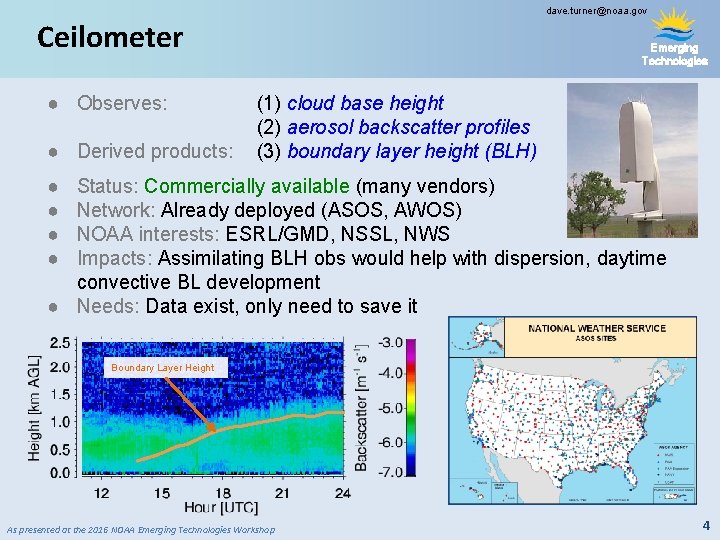
dave. turner@noaa. gov Ceilometer ● Observes: ● Derived products: Emerging Technologies (1) cloud base height (2) aerosol backscatter profiles (3) boundary layer height (BLH) ● ● Status: Commercially available (many vendors) Network: Already deployed (ASOS, AWOS) NOAA interests: ESRL/GMD, NSSL, NWS Impacts: Assimilating BLH obs would help with dispersion, daytime convective BL development ● Needs: Data exist, only need to save it Boundary Layer Height As presented at the 2016 NOAA Emerging Technologies Workshop 4
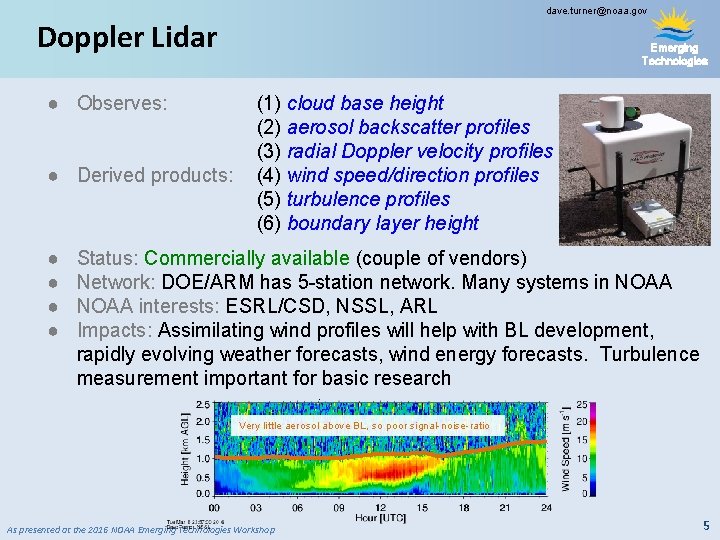
dave. turner@noaa. gov Doppler Lidar ● Observes: ● Derived products: ● ● Emerging Technologies (1) cloud base height (2) aerosol backscatter profiles (3) radial Doppler velocity profiles (4) wind speed/direction profiles (5) turbulence profiles (6) boundary layer height Status: Commercially available (couple of vendors) Network: DOE/ARM has 5 -station network. Many systems in NOAA interests: ESRL/CSD, NSSL, ARL Impacts: Assimilating wind profiles will help with BL development, rapidly evolving weather forecasts, wind energy forecasts. Turbulence measurement important for basic research Very little aerosol above BL, so poor signal-noise-ratio As presented at the 2016 NOAA Emerging Technologies Workshop 5
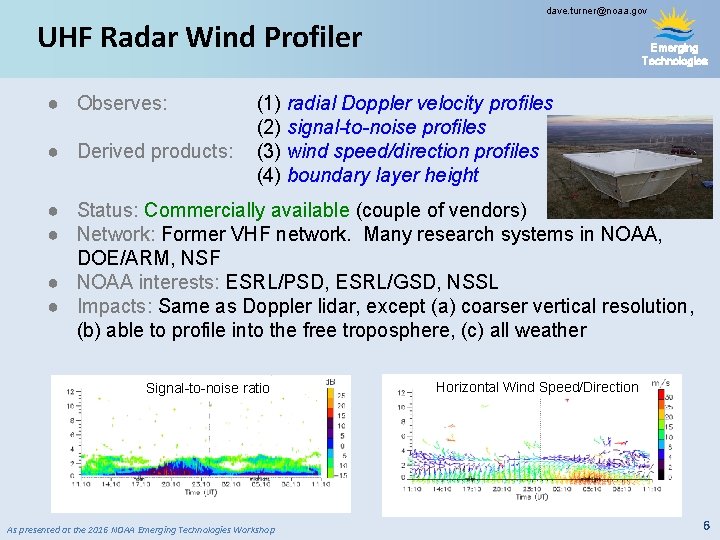
dave. turner@noaa. gov UHF Radar Wind Profiler ● Observes: ● Derived products: Emerging Technologies (1) radial Doppler velocity profiles (2) signal-to-noise profiles (3) wind speed/direction profiles (4) boundary layer height ● Status: Commercially available (couple of vendors) ● Network: Former VHF network. Many research systems in NOAA, DOE/ARM, NSF ● NOAA interests: ESRL/PSD, ESRL/GSD, NSSL ● Impacts: Same as Doppler lidar, except (a) coarser vertical resolution, (b) able to profile into the free troposphere, (c) all weather Signal-to-noise ratio As presented at the 2016 NOAA Emerging Technologies Workshop Horizontal Wind Speed/Direction 6
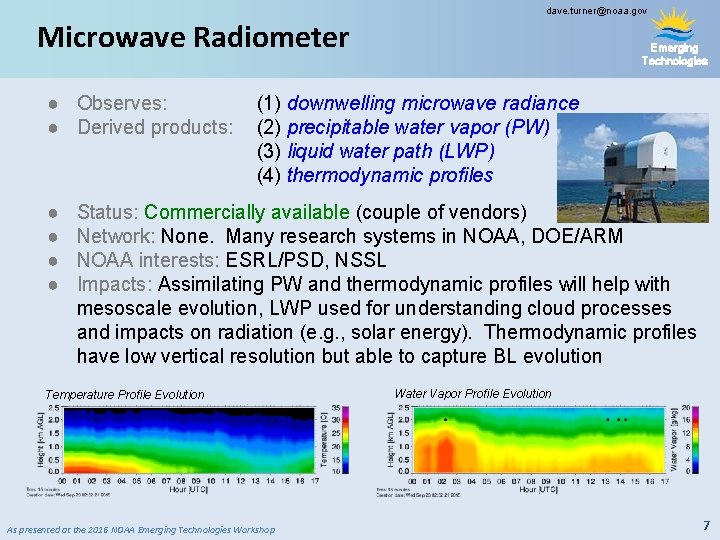
dave. turner@noaa. gov Microwave Radiometer ● Observes: ● Derived products: ● ● Emerging Technologies (1) downwelling microwave radiance (2) precipitable water vapor (PW) (3) liquid water path (LWP) (4) thermodynamic profiles Status: Commercially available (couple of vendors) Network: None. Many research systems in NOAA, DOE/ARM NOAA interests: ESRL/PSD, NSSL Impacts: Assimilating PW and thermodynamic profiles will help with mesoscale evolution, LWP used for understanding cloud processes and impacts on radiation (e. g. , solar energy). Thermodynamic profiles have low vertical resolution but able to capture BL evolution Temperature Profile Evolution As presented at the 2016 NOAA Emerging Technologies Workshop Water Vapor Profile Evolution 7
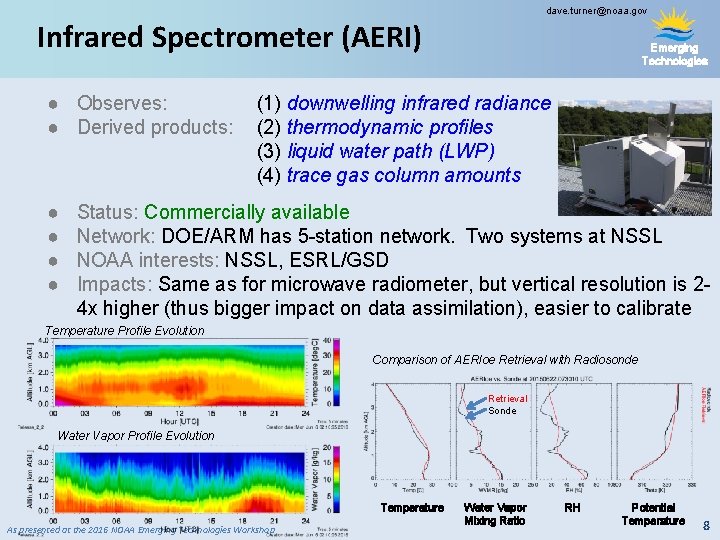
dave. turner@noaa. gov Infrared Spectrometer (AERI) ● Observes: ● Derived products: ● ● Emerging Technologies (1) downwelling infrared radiance (2) thermodynamic profiles (3) liquid water path (LWP) (4) trace gas column amounts Status: Commercially available Network: DOE/ARM has 5 -station network. Two systems at NSSL NOAA interests: NSSL, ESRL/GSD Impacts: Same as for microwave radiometer, but vertical resolution is 24 x higher (thus bigger impact on data assimilation), easier to calibrate Temperature Profile Evolution Comparison of AERIoe Retrieval with Radiosonde Retrieval Sonde Water Vapor Profile Evolution Temperature As presented at the 2016 NOAA Emerging Technologies Workshop Water Vapor Mixing Ratio RH Potential Temperature 8
dave. turner@noaa. gov Boundary Layer Profilers ● ● ● Successes: all of these instruments have been operated autonomously for years in a range of environments Developer of the capability: initial development was done years ago, and instruments are commercially available Partnerships: Many between different OAR labs, DOE, universities Demonstrated capability: to provide 24 / 7 / 365 observations that characterize the vertical and temporal evolution of temperature, water vapor, aerosol backscatter, and winds in the BL Anticipated impacts o o o ● Emerging Technologies Improved mesocale analyses in NWP models (after assimilation) Real-time nowcasting impact (NWS WFOs) Better forecasting of severe weather due to ability to monitor the evolving BL Dispersion modeling, air quality modeling, etc. improved due to better characterization of vertical structure of BL Improved winter weather forecasts, especially the evolution of the freezing level Society impacts o o o Improved severe weather forecasts and warnings Improved forecasts for aviation, transportation, agriculture sectors Better forecasts for improved utilization of solar and wind energy resources As presented at the 2016 NOAA Emerging Technologies Workshop 9
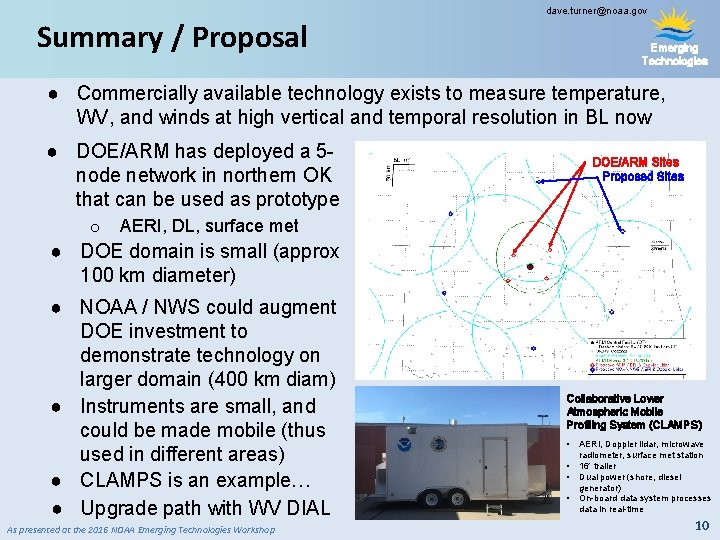
dave. turner@noaa. gov Summary / Proposal Emerging Technologies ● Commercially available technology exists to measure temperature, WV, and winds at high vertical and temporal resolution in BL now ● DOE/ARM has deployed a 5 node network in northern OK that can be used as prototype o DOE/ARM Sites Proposed Sites AERI, DL, surface met ● DOE domain is small (approx 100 km diameter) ● NOAA / NWS could augment DOE investment to demonstrate technology on larger domain (400 km diam) ● Instruments are small, and could be made mobile (thus used in different areas) ● CLAMPS is an example… ● Upgrade path with WV DIAL As presented at the 2016 NOAA Emerging Technologies Workshop Collaborative Lower Atmospheric Mobile Profiling System (CLAMPS) • • AERI, Doppler lidar, microwave radiometer, surface met station 16’ trailer Dual power (shore, diesel generator) On-board data system processes data in real-time 10
dave. turner@noaa. gov Emerging Technologies Additional Backup Slides As presented at the 2016 NOAA Emerging Technologies Workshop 11
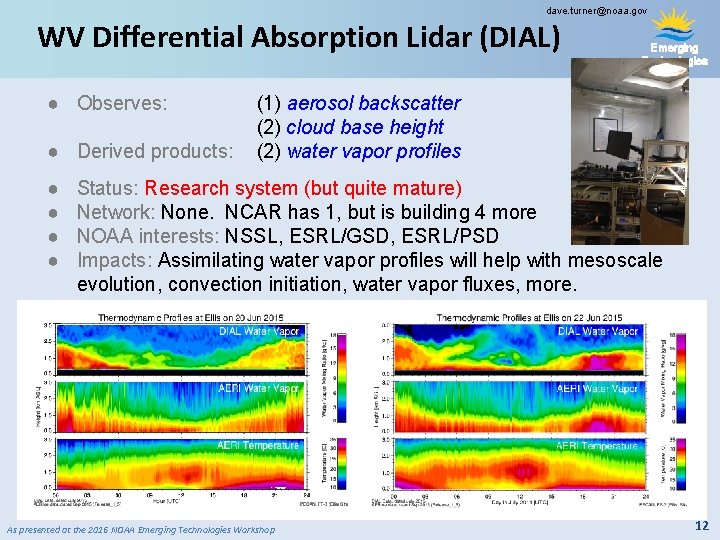
dave. turner@noaa. gov WV Differential Absorption Lidar (DIAL) ● Observes: ● Derived products: ● ● Emerging Technologies (1) aerosol backscatter (2) cloud base height (2) water vapor profiles Status: Research system (but quite mature) Network: None. NCAR has 1, but is building 4 more NOAA interests: NSSL, ESRL/GSD, ESRL/PSD Impacts: Assimilating water vapor profiles will help with mesoscale evolution, convection initiation, water vapor fluxes, more. As presented at the 2016 NOAA Emerging Technologies Workshop 12
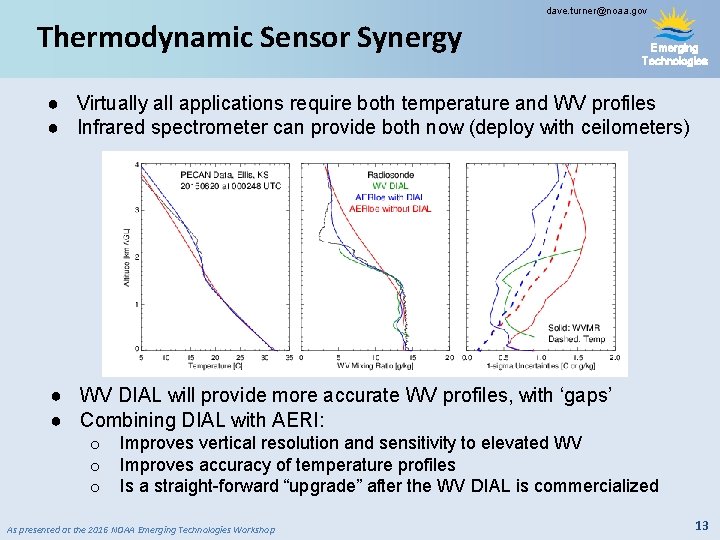
dave. turner@noaa. gov Thermodynamic Sensor Synergy Emerging Technologies ● Virtually all applications require both temperature and WV profiles ● Infrared spectrometer can provide both now (deploy with ceilometers) ● WV DIAL will provide more accurate WV profiles, with ‘gaps’ ● Combining DIAL with AERI: o o o Improves vertical resolution and sensitivity to elevated WV Improves accuracy of temperature profiles Is a straight-forward “upgrade” after the WV DIAL is commercialized As presented at the 2016 NOAA Emerging Technologies Workshop 13