
CEILING LIFT HAZARDS AND MITIGATIONS PRESENTATION Note This
- Slides: 22
CEILING LIFT HAZARDS AND MITIGATIONS PRESENTATION Note: This is an interactive Power. Point and needs to be viewed in slideshow format. VA NATIONAL CENTER FOR PATIENT SAFETY
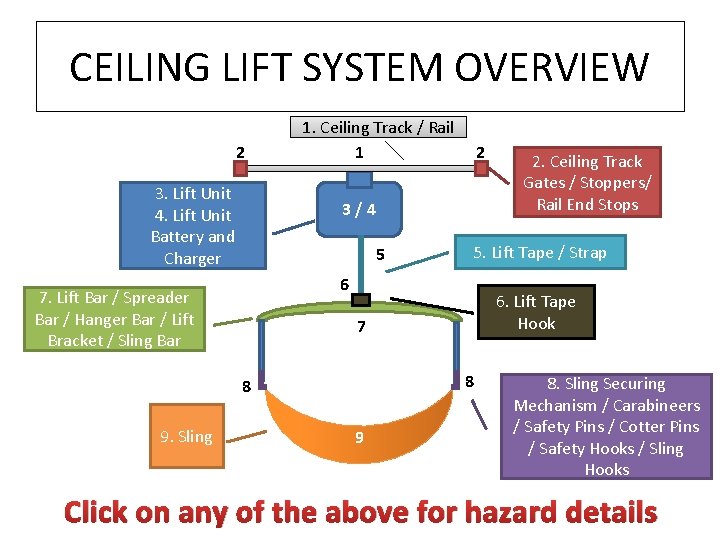
CEILING LIFT SYSTEM OVERVIEW 2 3. Lift Unit 4. Lift Unit Battery and Charger 1. Ceiling Track / Rail 1 3/4 5 6. Lift Tape Hook 7 8 8 9 2. Ceiling Track Gates / Stoppers/ Rail End Stops 5. Lift Tape / Strap 6 7. Lift Bar / Spreader Bar / Hanger Bar / Lift Bracket / Sling Bar 9. Sling 2 8. Sling Securing Mechanism / Carabineers / Safety Pins / Cotter Pins / Safety Hooks / Sling Hooks Click on any of the above for hazard details
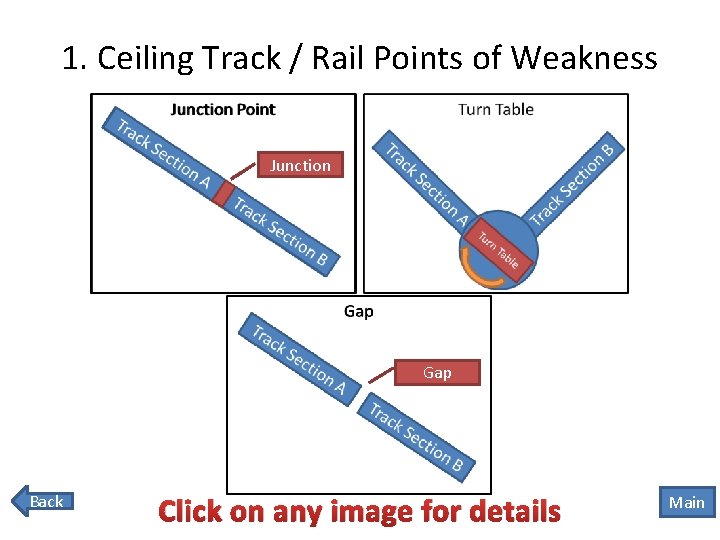
1. Ceiling Track / Rail Points of Weakness Junction Gap Back Click on any image for details Main
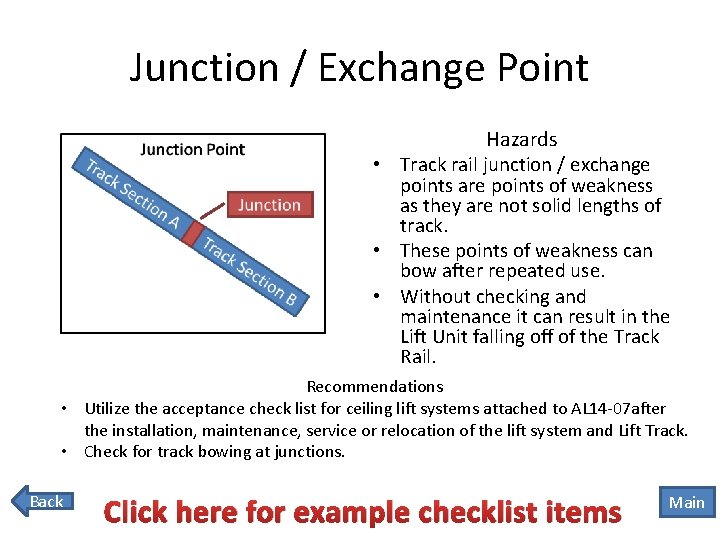
Junction / Exchange Point Junction Hazards • Track rail junction / exchange points are points of weakness as they are not solid lengths of track. • These points of weakness can bow after repeated use. • Without checking and maintenance it can result in the Lift Unit falling off of the Track Rail. Recommendations • Utilize the acceptance check list for ceiling lift systems attached to AL 14 -07 after the installation, maintenance, service or relocation of the lift system and Lift Track. • Check for track bowing at junctions. Back Click here for example checklist items Main
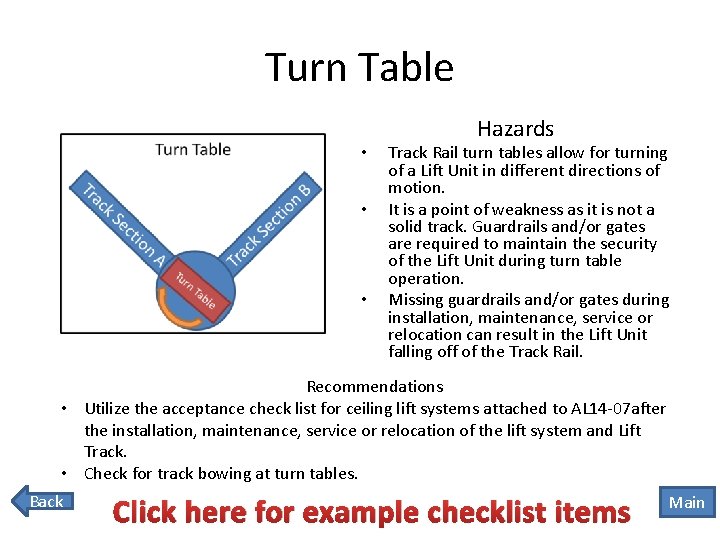
Turn Table • • • Hazards Track Rail turn tables allow for turning of a Lift Unit in different directions of motion. It is a point of weakness as it is not a solid track. Guardrails and/or gates are required to maintain the security of the Lift Unit during turn table operation. Missing guardrails and/or gates during installation, maintenance, service or relocation can result in the Lift Unit falling off of the Track Rail. Recommendations • Utilize the acceptance check list for ceiling lift systems attached to AL 14 -07 after the installation, maintenance, service or relocation of the lift system and Lift Track. • Check for track bowing at turn tables. Back Click here for example checklist items Main
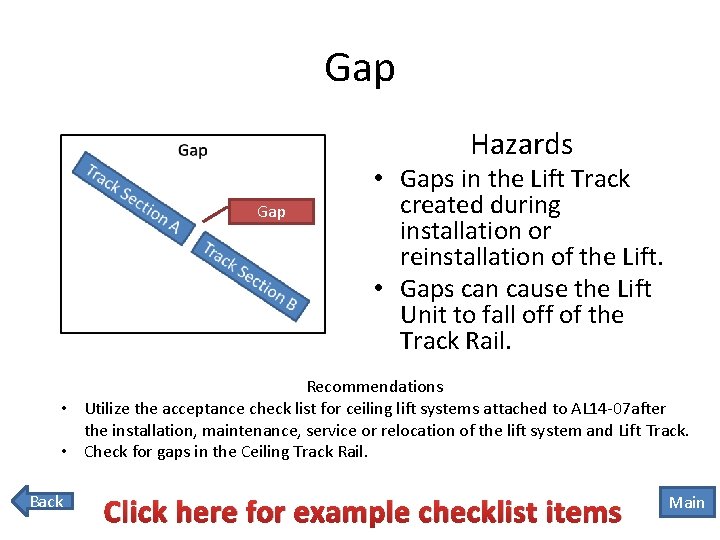
Gap Hazards Gap • Gaps in the Lift Track created during installation or reinstallation of the Lift. • Gaps can cause the Lift Unit to fall off of the Track Rail. Recommendations • Utilize the acceptance check list for ceiling lift systems attached to AL 14 -07 after the installation, maintenance, service or relocation of the lift system and Lift Track. • Check for gaps in the Ceiling Track Rail. Back Click here for example checklist items Main
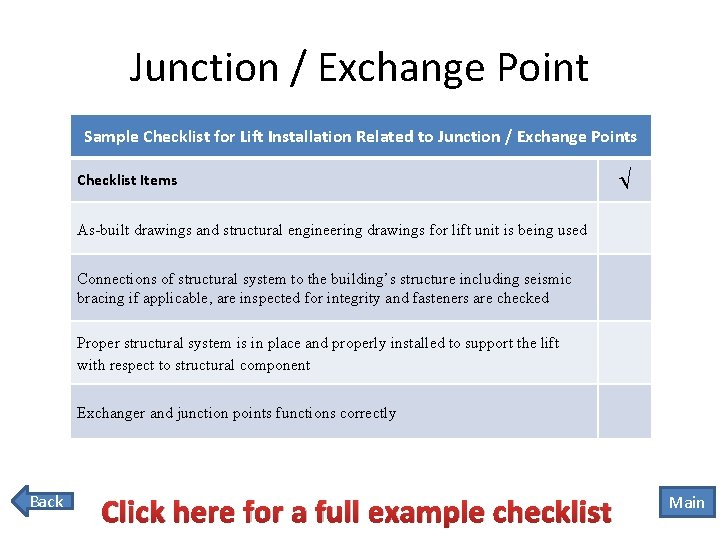
Junction / Exchange Point Sample Checklist for Lift Installation Related to Junction / Exchange Points Checklist Items As-built drawings and structural engineering drawings for lift unit is being used Connections of structural system to the building’s structure including seismic bracing if applicable, are inspected for integrity and fasteners are checked Proper structural system is in place and properly installed to support the lift with respect to structural component Exchanger and junction points functions correctly Back Click here for a full example checklist Main
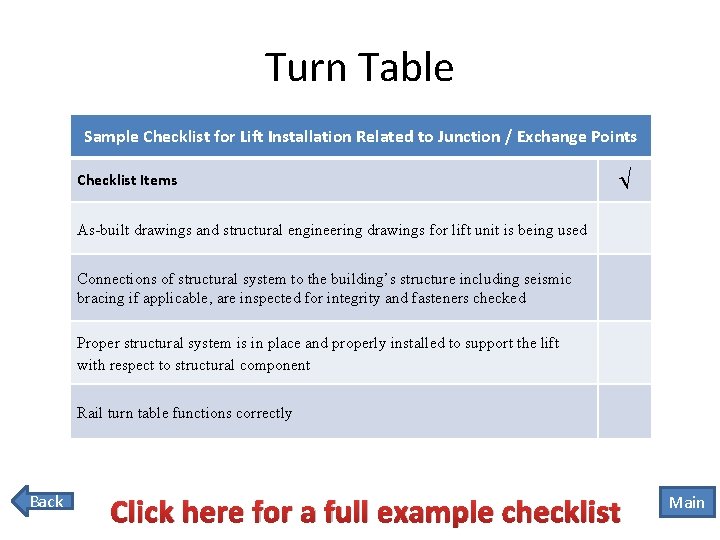
Turn Table Sample Checklist for Lift Installation Related to Junction / Exchange Points Checklist Items As-built drawings and structural engineering drawings for lift unit is being used Connections of structural system to the building’s structure including seismic bracing if applicable, are inspected for integrity and fasteners checked Proper structural system is in place and properly installed to support the lift with respect to structural component Rail turn table functions correctly Back Click here for a full example checklist Main
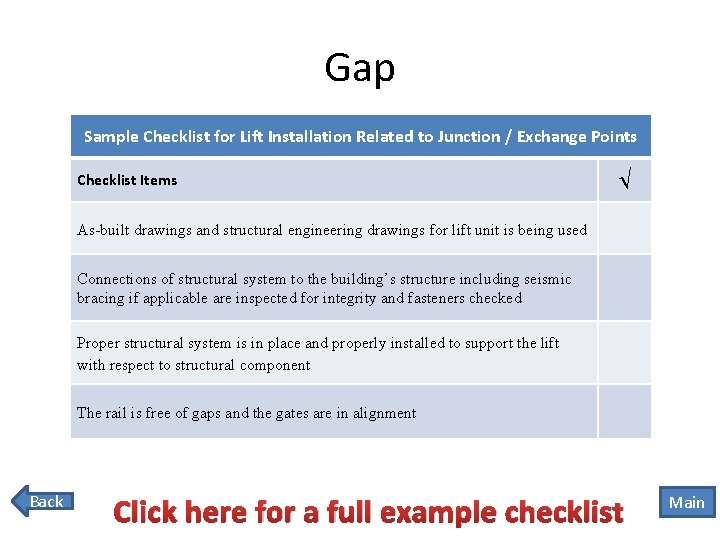
Gap Sample Checklist for Lift Installation Related to Junction / Exchange Points Checklist Items As-built drawings and structural engineering drawings for lift unit is being used Connections of structural system to the building’s structure including seismic bracing if applicable are inspected for integrity and fasteners checked Proper structural system is in place and properly installed to support the lift with respect to structural component The rail is free of gaps and the gates are in alignment Back Click here for a full example checklist Main
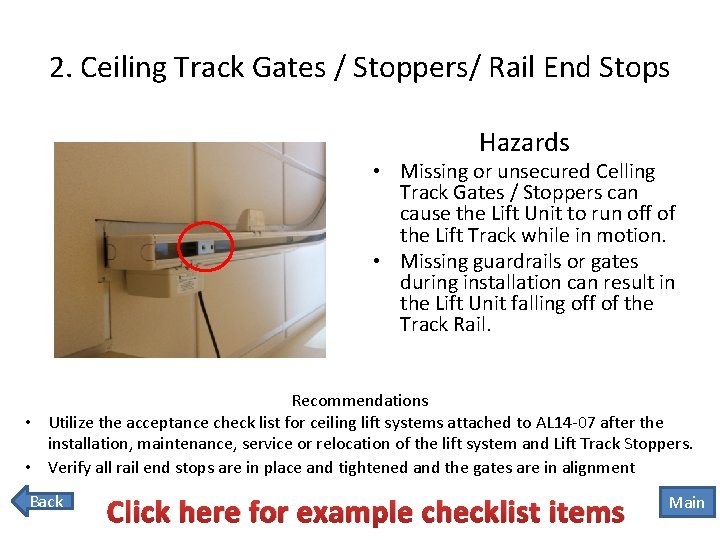
2. Ceiling Track Gates / Stoppers/ Rail End Stops Hazards • Missing or unsecured Celling Track Gates / Stoppers can cause the Lift Unit to run off of the Lift Track while in motion. • Missing guardrails or gates during installation can result in the Lift Unit falling off of the Track Rail. Recommendations • Utilize the acceptance check list for ceiling lift systems attached to AL 14 -07 after the installation, maintenance, service or relocation of the lift system and Lift Track Stoppers. • Verify all rail end stops are in place and tightened and the gates are in alignment Back Click here for example checklist items Main
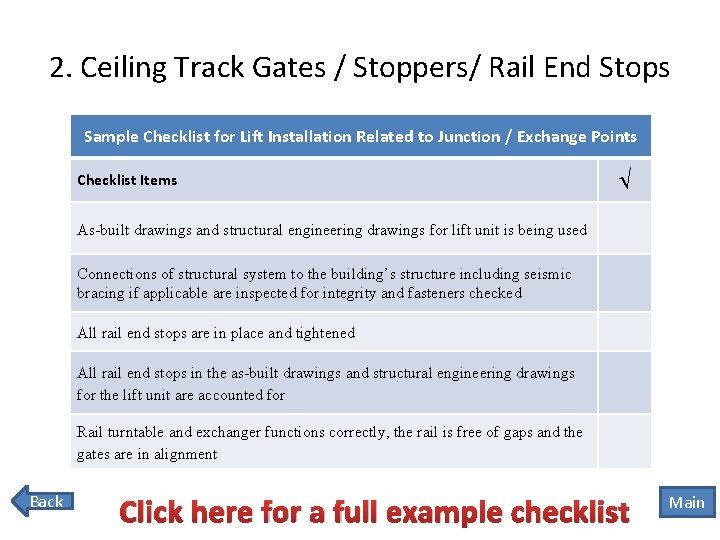
2. Ceiling Track Gates / Stoppers/ Rail End Stops Sample Checklist for Lift Installation Related to Junction / Exchange Points Checklist Items As-built drawings and structural engineering drawings for lift unit is being used Connections of structural system to the building’s structure including seismic bracing if applicable are inspected for integrity and fasteners checked All rail end stops are in place and tightened All rail end stops in the as-built drawings and structural engineering drawings for the lift unit are accounted for Rail turntable and exchanger functions correctly, the rail is free of gaps and the gates are in alignment Back Click here for a full example checklist Main
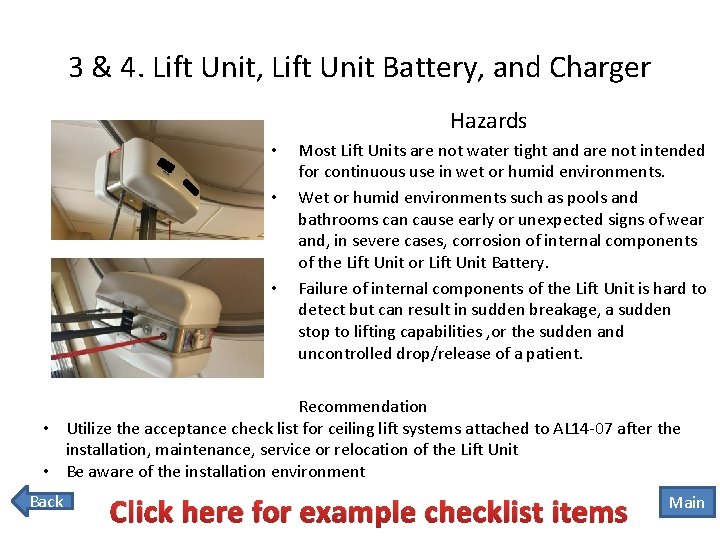
3 & 4. Lift Unit, Lift Unit Battery, and Charger Hazards • • • Most Lift Units are not water tight and are not intended for continuous use in wet or humid environments. Wet or humid environments such as pools and bathrooms can cause early or unexpected signs of wear and, in severe cases, corrosion of internal components of the Lift Unit or Lift Unit Battery. Failure of internal components of the Lift Unit is hard to detect but can result in sudden breakage, a sudden stop to lifting capabilities , or the sudden and uncontrolled drop/release of a patient. Recommendation • Utilize the acceptance check list for ceiling lift systems attached to AL 14 -07 after the installation, maintenance, service or relocation of the Lift Unit • Be aware of the installation environment Back Click here for example checklist items Main
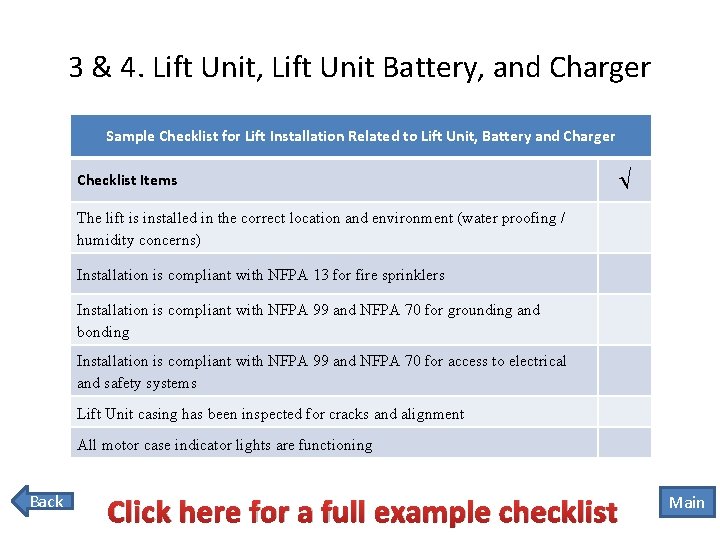
3 & 4. Lift Unit, Lift Unit Battery, and Charger Sample Checklist for Lift Installation Related to Lift Unit, Battery and Charger Checklist Items The lift is installed in the correct location and environment (water proofing / humidity concerns) Installation is compliant with NFPA 13 for fire sprinklers Installation is compliant with NFPA 99 and NFPA 70 for grounding and bonding Installation is compliant with NFPA 99 and NFPA 70 for access to electrical and safety systems Lift Unit casing has been inspected for cracks and alignment All motor case indicator lights are functioning Back Click here for a full example checklist Main
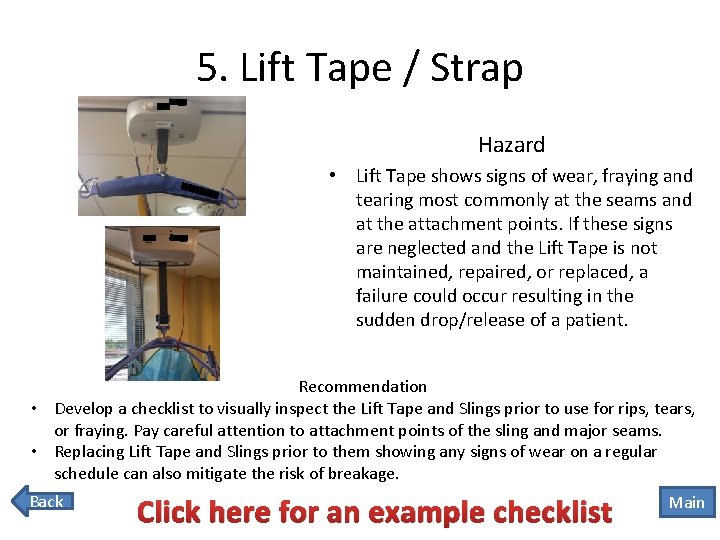
5. Lift Tape / Strap Hazard • Lift Tape shows signs of wear, fraying and tearing most commonly at the seams and at the attachment points. If these signs are neglected and the Lift Tape is not maintained, repaired, or replaced, a failure could occur resulting in the sudden drop/release of a patient. Recommendation • Develop a checklist to visually inspect the Lift Tape and Slings prior to use for rips, tears, or fraying. Pay careful attention to attachment points of the sling and major seams. • Replacing Lift Tape and Slings prior to them showing any signs of wear on a regular schedule can also mitigate the risk of breakage. Back Click here for an example checklist Main
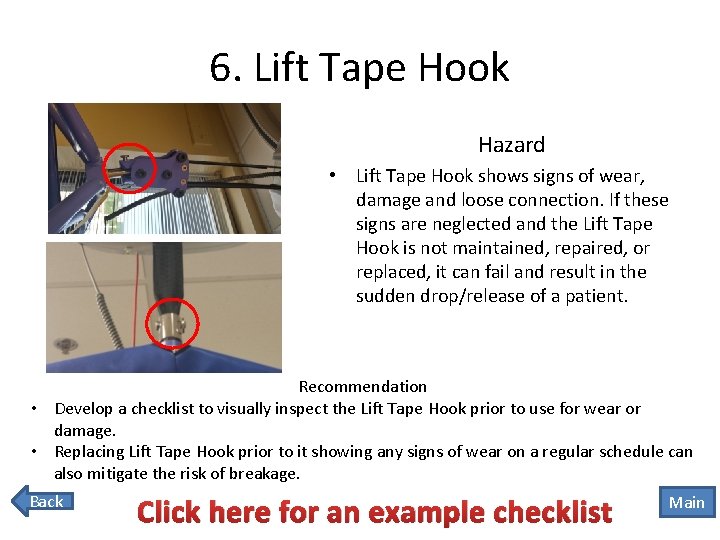
6. Lift Tape Hook Hazard • Lift Tape Hook shows signs of wear, damage and loose connection. If these signs are neglected and the Lift Tape Hook is not maintained, repaired, or replaced, it can fail and result in the sudden drop/release of a patient. Recommendation • Develop a checklist to visually inspect the Lift Tape Hook prior to use for wear or damage. • Replacing Lift Tape Hook prior to it showing any signs of wear on a regular schedule can also mitigate the risk of breakage. Back Click here for an example checklist Main
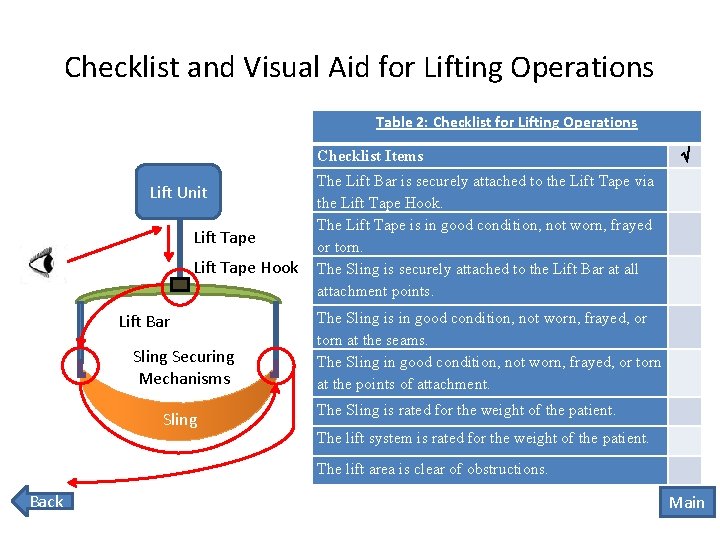
Checklist and Visual Aid for Lifting Operations Table 2: Checklist for Lifting Operations Checklist Items Lift Unit Lift Tape Hook Lift Bar Sling Securing Mechanisms Sling Back The Lift Bar is securely attached to the Lift Tape via the Lift Tape Hook. The Lift Tape is in good condition, not worn, frayed or torn. The Sling is securely attached to the Lift Bar at all attachment points. The Sling is in good condition, not worn, frayed, or torn at the seams. The Sling in good condition, not worn, frayed, or torn at the points of attachment. The Sling is rated for the weight of the patient. The lift system is rated for the weight of the patient. The lift area is clear of obstructions. Main
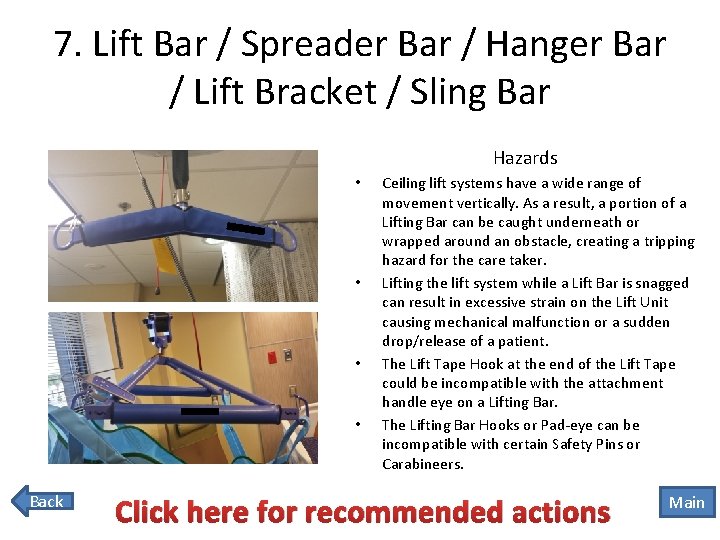
7. Lift Bar / Spreader Bar / Hanger Bar / Lift Bracket / Sling Bar Hazards • • Back Ceiling lift systems have a wide range of movement vertically. As a result, a portion of a Lifting Bar can be caught underneath or wrapped around an obstacle, creating a tripping hazard for the care taker. Lifting the lift system while a Lift Bar is snagged can result in excessive strain on the Lift Unit causing mechanical malfunction or a sudden drop/release of a patient. The Lift Tape Hook at the end of the Lift Tape could be incompatible with the attachment handle eye on a Lifting Bar. The Lifting Bar Hooks or Pad-eye can be incompatible with certain Safety Pins or Carabineers. Click here for recommended actions Main
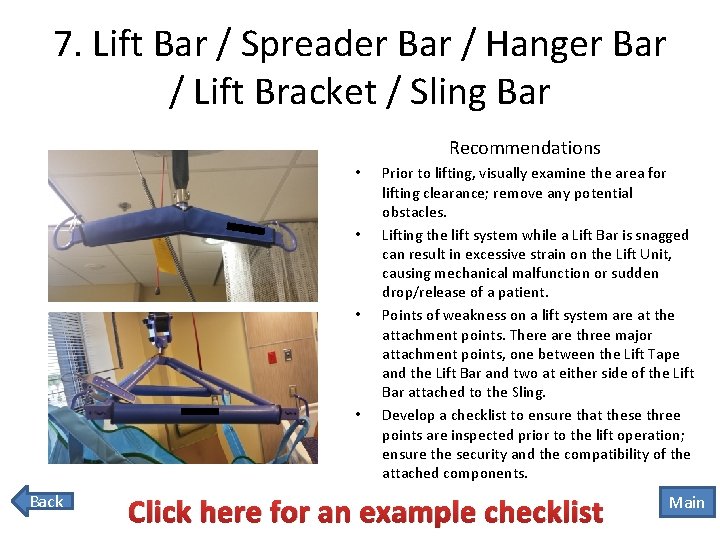
7. Lift Bar / Spreader Bar / Hanger Bar / Lift Bracket / Sling Bar Recommendations • • Back Prior to lifting, visually examine the area for lifting clearance; remove any potential obstacles. Lifting the lift system while a Lift Bar is snagged can result in excessive strain on the Lift Unit, causing mechanical malfunction or sudden drop/release of a patient. Points of weakness on a lift system are at the attachment points. There are three major attachment points, one between the Lift Tape and the Lift Bar and two at either side of the Lift Bar attached to the Sling. Develop a checklist to ensure that these three points are inspected prior to the lift operation; ensure the security and the compatibility of the attached components. Click here for an example checklist Main
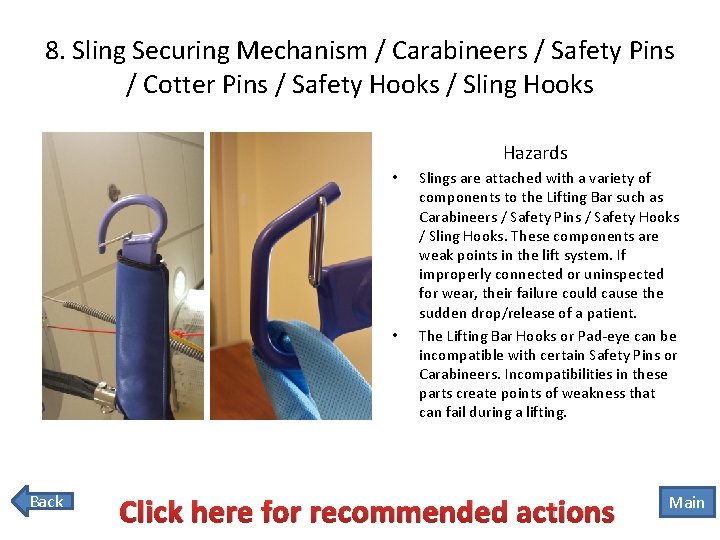
8. Sling Securing Mechanism / Carabineers / Safety Pins / Cotter Pins / Safety Hooks / Sling Hooks Hazards • • Back Slings are attached with a variety of components to the Lifting Bar such as Carabineers / Safety Pins / Safety Hooks / Sling Hooks. These components are weak points in the lift system. If improperly connected or uninspected for wear, their failure could cause the sudden drop/release of a patient. The Lifting Bar Hooks or Pad-eye can be incompatible with certain Safety Pins or Carabineers. Incompatibilities in these parts create points of weakness that can fail during a lifting. Click here for recommended actions Main
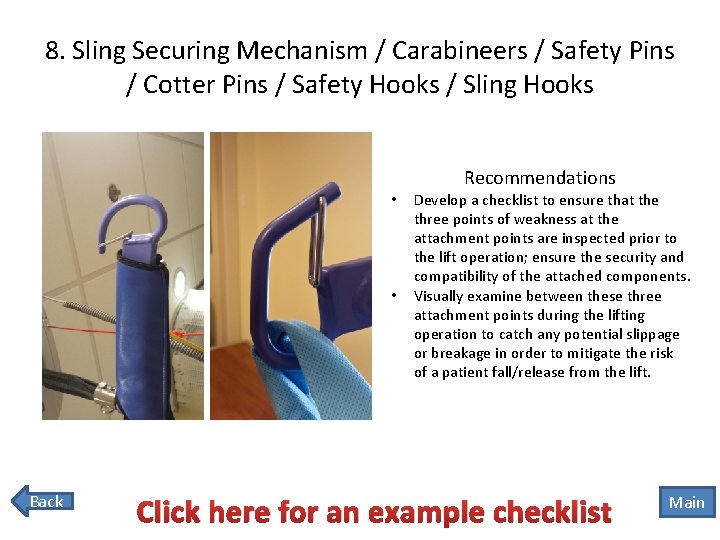
8. Sling Securing Mechanism / Carabineers / Safety Pins / Cotter Pins / Safety Hooks / Sling Hooks • • Back Recommendations Develop a checklist to ensure that the three points of weakness at the attachment points are inspected prior to the lift operation; ensure the security and compatibility of the attached components. Visually examine between these three attachment points during the lifting operation to catch any potential slippage or breakage in order to mitigate the risk of a patient fall/release from the lift. Click here for an example checklist Main
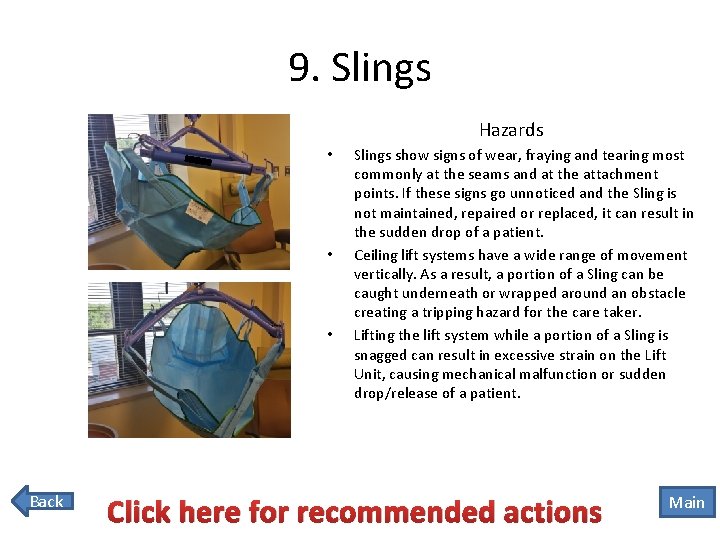
9. Slings Hazards • • • Back Slings show signs of wear, fraying and tearing most commonly at the seams and at the attachment points. If these signs go unnoticed and the Sling is not maintained, repaired or replaced, it can result in the sudden drop of a patient. Ceiling lift systems have a wide range of movement vertically. As a result, a portion of a Sling can be caught underneath or wrapped around an obstacle creating a tripping hazard for the care taker. Lifting the lift system while a portion of a Sling is snagged can result in excessive strain on the Lift Unit, causing mechanical malfunction or sudden drop/release of a patient. Click here for recommended actions Main
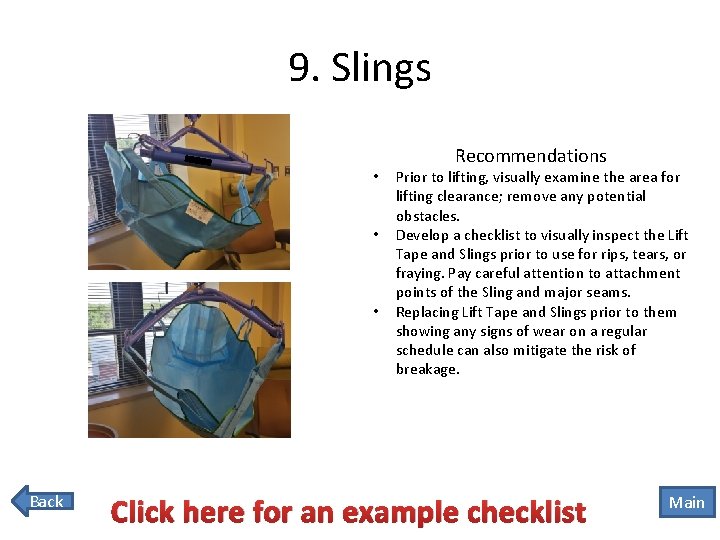
9. Slings • • • Back Recommendations Prior to lifting, visually examine the area for lifting clearance; remove any potential obstacles. Develop a checklist to visually inspect the Lift Tape and Slings prior to use for rips, tears, or fraying. Pay careful attention to attachment points of the Sling and major seams. Replacing Lift Tape and Slings prior to them showing any signs of wear on a regular schedule can also mitigate the risk of breakage. Click here for an example checklist Main