
CEFR Familiarisation Training Lower Secondary Katy Salisbury Overview
CEFR Familiarisation Training Lower Secondary Katy Salisbury
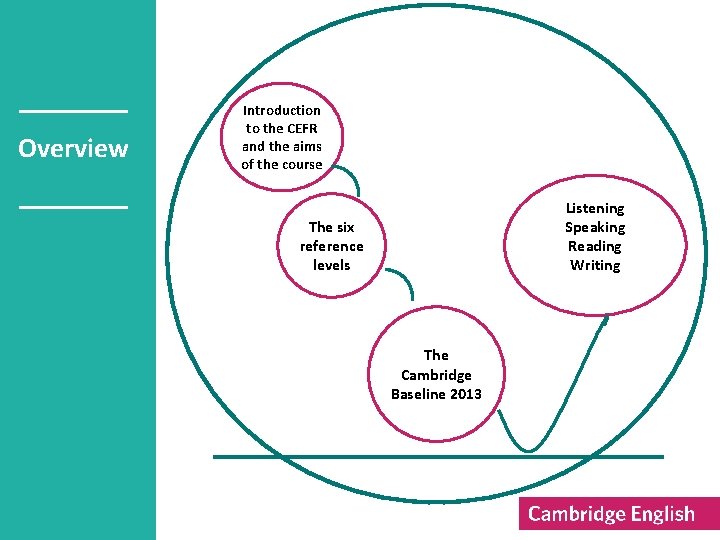
Overview Introduction to the CEFR and the aims of the course Listening Speaking Reading Writing The six reference levels The Cambridge Baseline 2013
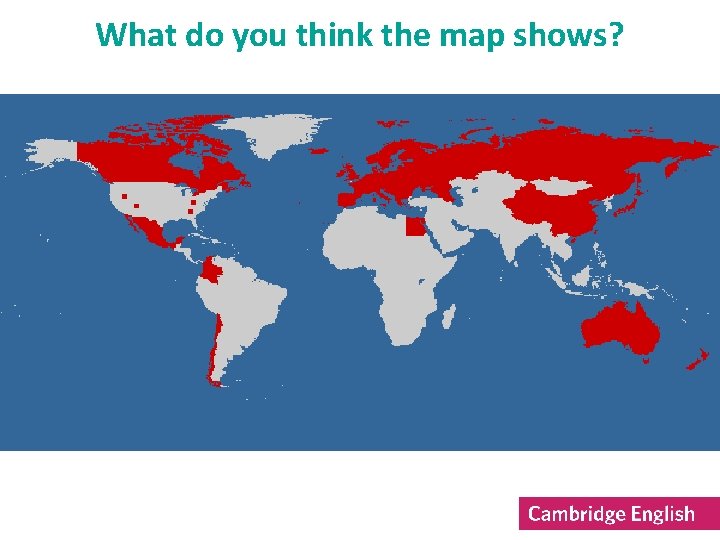
What do you think the map shows?
CEFR regional and world impact • Educational language policy in China, Hong Kong, Japan, Korea, Philippines, Taiwan, Thailand, Singapore and Vietnam is aligned to the CEFR • Countries in South America (Chile, Colombia, Argentina), the Middle East (Bahrain, Qatar) and Africa (Egypt) are incorporating the CEFR into their educational systems • Even countries which have developed their own language frameworks, such as Canada and the USA, are beginning to utilise the CEFR or identify ways of bringing their own frameworks and the CEFR together. • All of the following countries have undertaken CEFR-related projects: Albania, Armenia, Austria, Bulgaria, Croatia, Czech Republic, Cyprus, Denmark, Estonia, Finland, France, Georgia, Germany, Greece, Hungary, Israel, Italy, Lebanon, Lithuania, Macedonia, Moldova, Netherlands, New Zealand, Norway, Mexico, Poland, Portugal, Russia, Serbia, Slovakia, Slovenia, Spain, Sweden, Turkey, Ukraine • Translated into 40 languages

Terminology CEFR Common European Framework of Reference CEF Common European Framework (of reference) CFR Common Framework of Reference
What is the CEFR and why is it useful?

Background to the CEFR • need to create a comprehensive, transparent and coherent basis of understanding as to what being able to use a language at different levels means, regardless of language or location of instruction • growth in European Union membership and processes of integration and movement – increased mobility of people and need for mutual recognition of language qualifications obtained from different institutions and from different countries • developments in language learning: from grammar translation to functional, notional, communicative approaches
Aims of the CEFR • to describe in a comprehensive way what language learners have to learn to do in order to use a language for communication and what knowledge and skills they have to develop so as to be able to act effectively. • to provide a common basis for the elaboration of language syllabuses, curriculum guidelines, examinations and textbooks. • to define levels of proficiency which allow learners’ progress to be measured at each stage of learning and on a life-long basis
![CEFR ‘developmental’ vision ‘What [the CEFR] can do is to stand as a central](http://slidetodoc.com/presentation_image_h2/04884c1e588e48b921d4bef6bed77500/image-9.jpg "CEFR ‘developmental’ vision ‘What [the CEFR] can do is to stand as a central")
CEFR ‘developmental’ vision ‘What [the CEFR] can do is to stand as a central point of reference, itself always open to amendment and further development, in an interactive international system of cooperating institutions. . . whose cumulative experience and expertise produces a solid structure of knowledge, understanding and practice shared by all. ’ John Trim
![CEFR ‘developmental’ vision ‘What [the CEFR] can do is to stand as a central](http://slidetodoc.com/presentation_image_h2/04884c1e588e48b921d4bef6bed77500/image-10.jpg "CEFR ‘developmental’ vision ‘What [the CEFR] can do is to stand as a central")
CEFR ‘developmental’ vision ‘What [the CEFR] can do is to stand as a central point of reference, itself always open to amendment and further development, in an interactive international system of co-operating institutions. . . whose cumulative experience and expertise produces a solid structure of knowledge, understanding and practice shared by all. ’ John Trim

Common uses of the CEFR evaluating language learning needs designing courses teacher training programmes developing syllabuses informing test development guiding assessment criteria development developing learning materials describing language policies informing continuous/self-assessment Handout 1
The CEFR: view of language learning and the six reference levels
The CEFR: two focuses • CEFR presents the view of ‘communication as the goal of language learning …’ • CEFR provides ‘a descriptive framework of levels of language proficiency, enabling all languages and contexts of learning of what it means to master a language at a given level’ … the CEFR’s action-oriented / can-do approach Handout 2
Defining key notions in the CEFR The core view of language learning in the CEFR is that learning a language is essentially a process of learning to use language to perform communicative acts - either in social contexts with others or in private contexts in communicating with ourselves. These are shaped by the different forms of language activity of which they are comprised, which can be described in terms of four broad categories: reception, production, interaction and mediation. The process of engaging with texts - spoken or written - in these different ways requires language users to draw on a range of communicative language competences [linguistic, socio-linguistic, pragmatic] to negotiate communication with flexibility in a variety of contexts. Performing tasks in different contexts, to the extent that these tasks are not routine or automatic and subject to different conditions and constraints, will require learners to use different strategies for their successful completion. It is this broad conception of language use and emergent communicative competences that underpins the action-oriented approach to language teaching and learning embodied in the CEFR.
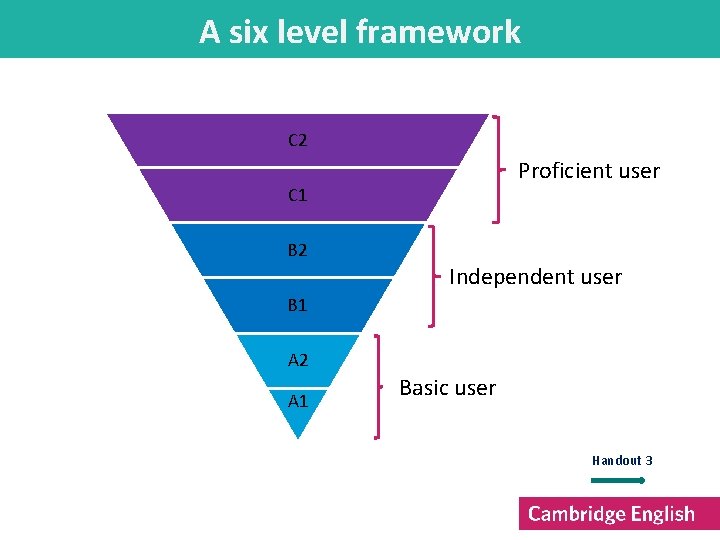
A six level framework C 2 Proficient user C 1 B 2 Independent user B 1 A 2 A 1 Basic user Handout 3
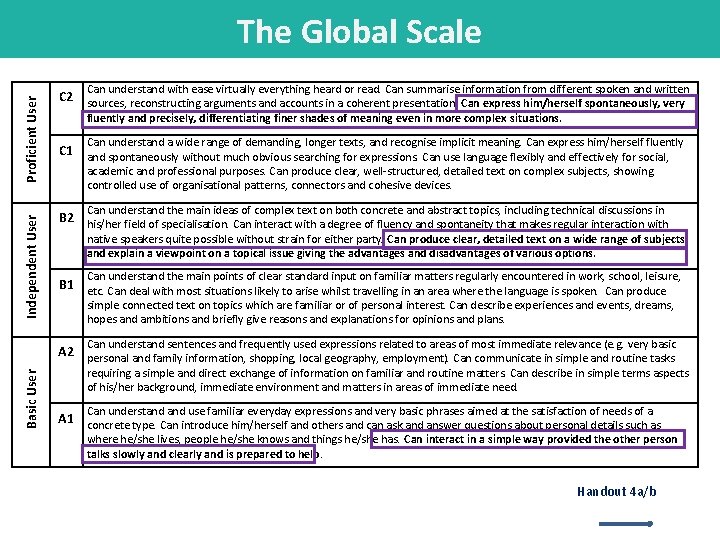
The Global Scale Independent User Proficient User Can understand with ease virtually everything heard or read. Can summarise information from different spoken and written C 2 sources, reconstructing arguments and accounts in a coherent presentation. Can express him/herself spontaneously, very fluently and precisely, differentiating finer shades of meaning even in more complex situations. Can understand a wide range of demanding, longer texts, and recognise implicit meaning. Can express him/herself fluently C 1 and spontaneously without much obvious searching for expressions. Can use language flexibly and effectively for social, academic and professional purposes. Can produce clear, well-structured, detailed text on complex subjects, showing controlled use of organisational patterns, connectors and cohesive devices. Can understand the main ideas of complex text on both concrete and abstract topics, including technical discussions in B 2 his/her field of specialisation. Can interact with a degree of fluency and spontaneity that makes regular interaction with native speakers quite possible without strain for either party. Can produce clear, detailed text on a wide range of subjects and explain a viewpoint on a topical issue giving the advantages and disadvantages of various options. Can understand the main points of clear standard input on familiar matters regularly encountered in work, school, leisure, B 1 etc. Can deal with most situations likely to arise whilst travelling in an area where the language is spoken. Can produce simple connected text on topics which are familiar or of personal interest. Can describe experiences and events, dreams, hopes and ambitions and briefly give reasons and explanations for opinions and plans. Can understand sentences and frequently used expressions related to areas of most immediate relevance (e. g. very basic Basic User A 2 personal and family information, shopping, local geography, employment). Can communicate in simple and routine tasks requiring a simple and direct exchange of information on familiar and routine matters. Can describe in simple terms aspects of his/her background, immediate environment and matters in areas of immediate need. Can understand use familiar everyday expressions and very basic phrases aimed at the satisfaction of needs of a A 1 concrete type. Can introduce him/herself and others and can ask and answer questions about personal details such as where he/she lives, people he/she knows and things he/she has. Can interact in a simple way provided the other person talks slowly and clearly and is prepared to help. Handout 4 a/b
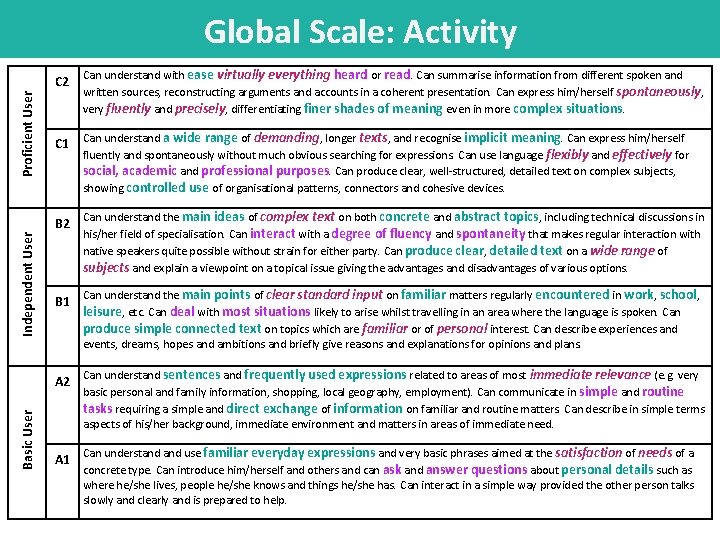
Basic User Independent User Proficient User Global Scale: Activity C 2 Can understand with ease virtually everything heard or read. Can summarise information from different spoken and written sources, reconstructing arguments and accounts in a coherent presentation. Can express him/herself spontaneously, very fluently and precisely, differentiating finer shades of meaning even in more complex situations. C 1 Can understand a wide range of demanding, longer texts, and recognise implicit meaning. Can express him/herself fluently and spontaneously without much obvious searching for expressions. Can use language flexibly and effectively for social, academic and professional purposes. Can produce clear, well-structured, detailed text on complex subjects, showing controlled use of organisational patterns, connectors and cohesive devices. B 2 Can understand the main ideas of complex text on both concrete and abstract topics, including technical discussions in his/her field of specialisation. Can interact with a degree of fluency and spontaneity that makes regular interaction with native speakers quite possible without strain for either party. Can produce clear, detailed text on a wide range of subjects and explain a viewpoint on a topical issue giving the advantages and disadvantages of various options. B 1 Can understand the main points of clear standard input on familiar matters regularly encountered in work, school, leisure, etc. Can deal with most situations likely to arise whilst travelling in an area where the language is spoken. Can produce simple connected text on topics which are familiar or of personal interest. Can describe experiences and events, dreams, hopes and ambitions and briefly give reasons and explanations for opinions and plans. A 2 Can understand sentences and frequently used expressions related to areas of most immediate relevance (e. g. very basic personal and family information, shopping, local geography, employment). Can communicate in simple and routine tasks requiring a simple and direct exchange of information on familiar and routine matters. Can describe in simple terms aspects of his/her background, immediate environment and matters in areas of immediate need. A 1 Can understand use familiar everyday expressions and very basic phrases aimed at the satisfaction of needs of a concrete type. Can introduce him/herself and others and can ask and answer questions about personal details such as where he/she lives, people he/she knows and things he/she has. Can interact in a simple way provided the other person talks slowly and clearly and is prepared to help.
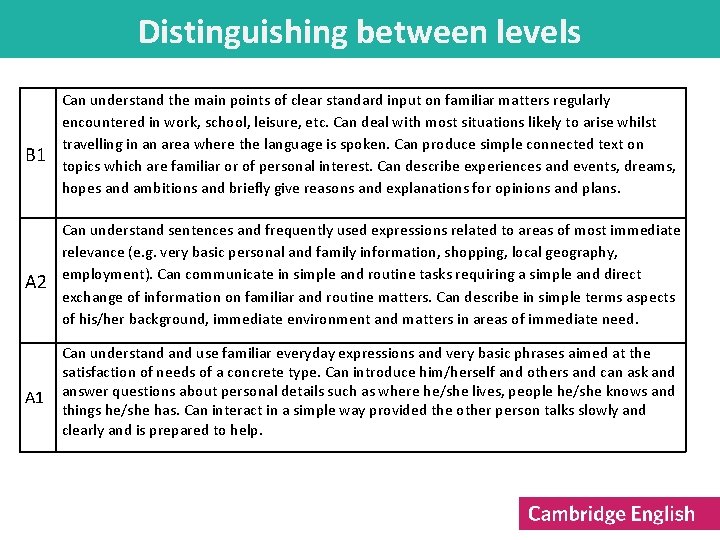
Distinguishing between levels B 1 Can understand the main points of clear standard input on familiar matters regularly encountered in work, school, leisure, etc. Can deal with most situations likely to arise whilst travelling in an area where the language is spoken. Can produce simple connected text on topics which are familiar or of personal interest. Can describe experiences and events, dreams, hopes and ambitions and briefly give reasons and explanations for opinions and plans. A 2 Can understand sentences and frequently used expressions related to areas of most immediate relevance (e. g. very basic personal and family information, shopping, local geography, employment). Can communicate in simple and routine tasks requiring a simple and direct exchange of information on familiar and routine matters. Can describe in simple terms aspects of his/her background, immediate environment and matters in areas of immediate need. A 1 Can understand use familiar everyday expressions and very basic phrases aimed at the satisfaction of needs of a concrete type. Can introduce him/herself and others and can ask and answer questions about personal details such as where he/she lives, people he/she knows and things he/she has. Can interact in a simple way provided the other person talks slowly and clearly and is prepared to help.
WHY CEFR FOR MALAYSIA? Cambridge Baseline 2013
1. What are the key aspirations for English language learning in Malaysia? 2. What are the key challenges to learning English in Malaysia?
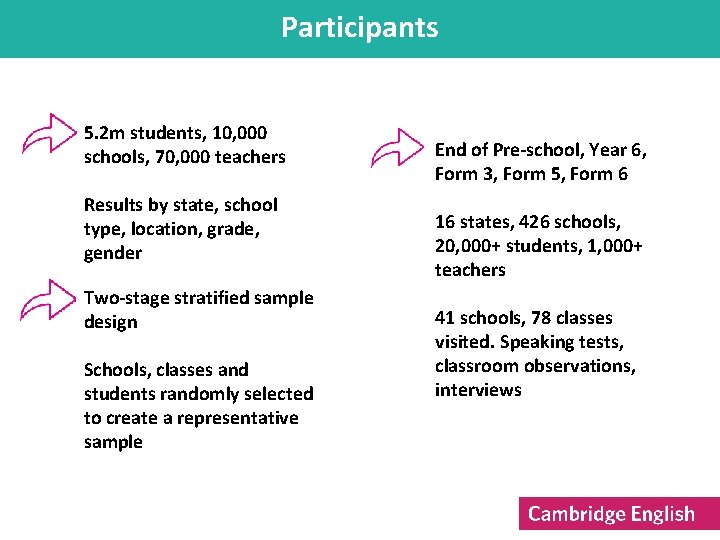
Participants 5. 2 m students, 10, 000 schools, 70, 000 teachers Results by state, school type, location, grade, gender Two-stage stratified sample design Schools, classes and students randomly selected to create a representative sample End of Pre-school, Year 6, Form 3, Form 5, Form 6 16 states, 426 schools, 20, 000+ students, 1, 000+ teachers 41 schools, 78 classes visited. Speaking tests, classroom observations, interviews
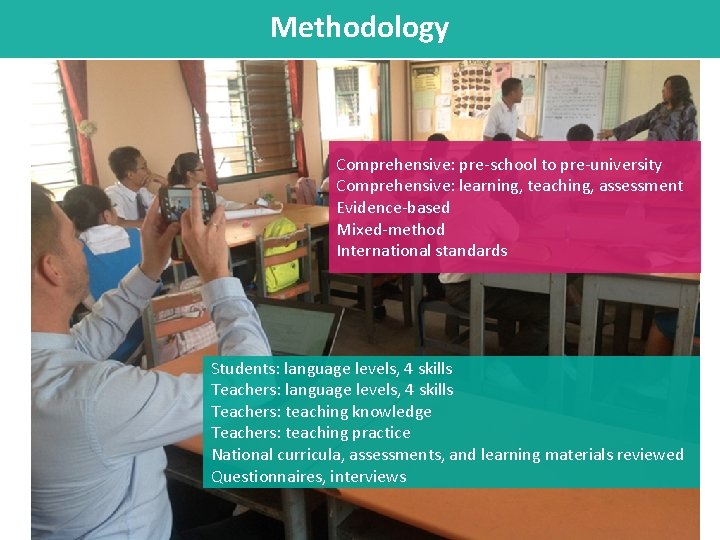
Methodology Comprehensive: pre-school to pre-university Comprehensive: learning, teaching, assessment Evidence-based Mixed-method International standards Students: language levels, 4 skills Teachers: teaching knowledge Teachers: teaching practice National curricula, assessments, and learning materials reviewed Questionnaires, interviews
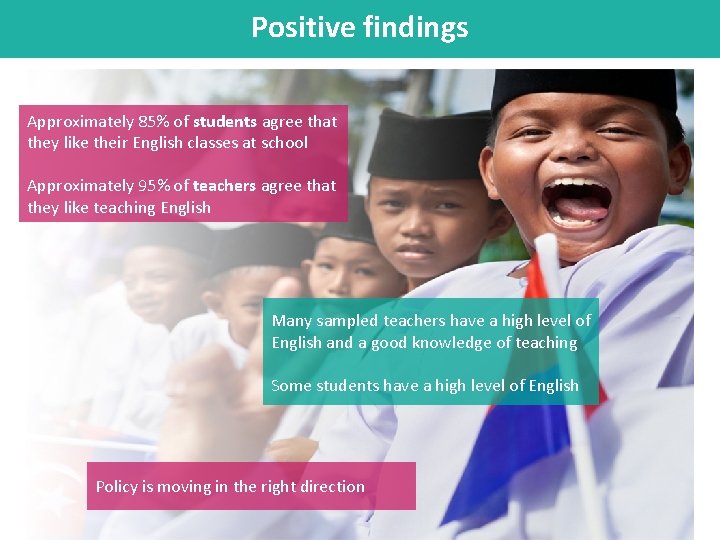
Positive findings Approximately 85% of students agree that they like their English classes at school Approximately 95% of teachers agree that they like teaching English Many sampled teachers have a high level of English and a good knowledge of teaching Some students have a high level of English Policy is moving in the right direction
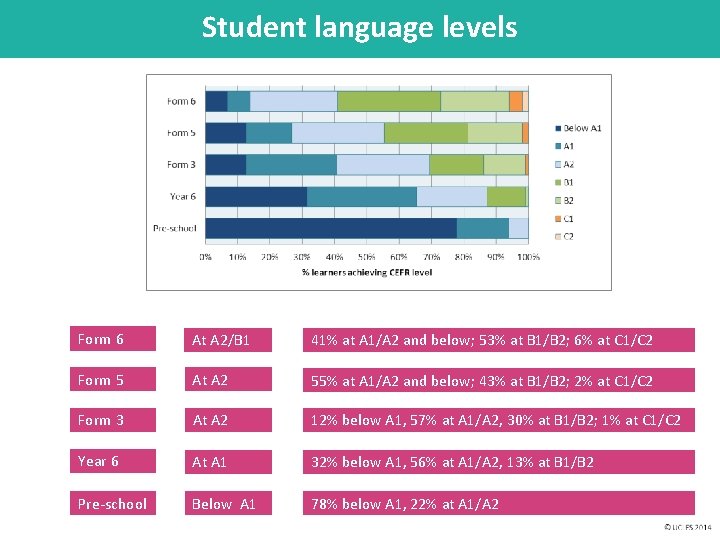
Student language levels Form 6 At A 2/B 1 41% at A 1/A 2 and below; 53% at B 1/B 2; 6% at C 1/C 2 Form 5 At A 2 55% at A 1/A 2 and below; 43% at B 1/B 2; 2% at C 1/C 2 Form 3 At A 2 12% below A 1, 57% at A 1/A 2, 30% at B 1/B 2; 1% at C 1/C 2 Year 6 At A 1 32% below A 1, 56% at A 1/A 2, 13% at B 1/B 2 Pre-school Below A 1 78% below A 1, 22% at A 1/A 2
Students: weakest skill is speaking Speaking emerged as the weakest skill for students at all school grades Students reported that they would most like to improve their speaking skills
Speaking: Production and Interaction scales
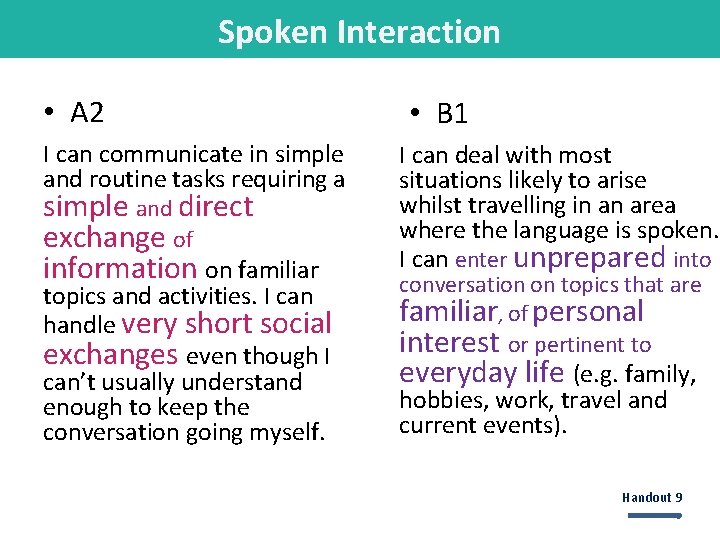
Spoken Interaction • A 2 I can communicate in simple and routine tasks requiring a simple and direct exchange of information on familiar topics and activities. I can handle very short social exchanges even though I can’t usually understand enough to keep the conversation going myself. • B 1 I can deal with most situations likely to arise whilst travelling in an area where the language is spoken. I can enter unprepared into conversation on topics that are familiar, of personal interest or pertinent to everyday life (e. g. family, hobbies, work, travel and current events). Handout 9
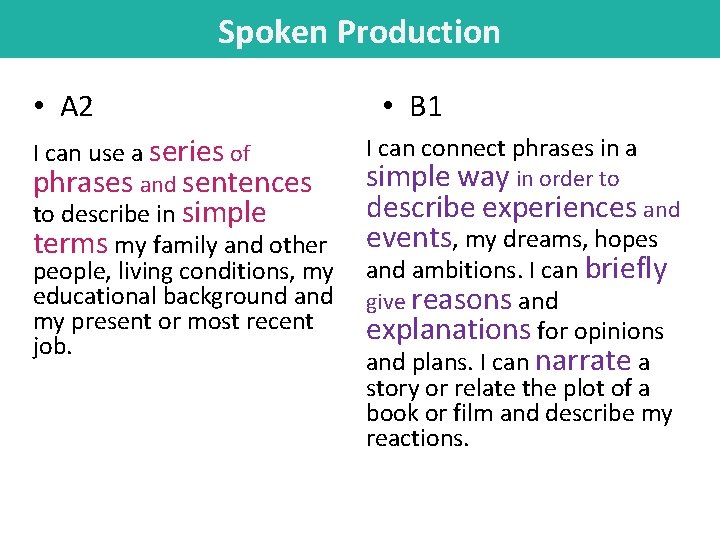
Spoken Production • A 2 I can use a series of • B 1 I can connect phrases in a simple way in order to describe experiences and events, my dreams, hopes people, living conditions, my and ambitions. I can briefly educational background and give reasons and my present or most recent explanations for opinions job. and plans. I can narrate a phrases and sentences to describe in simple terms my family and other story or relate the plot of a book or film and describe my reactions.
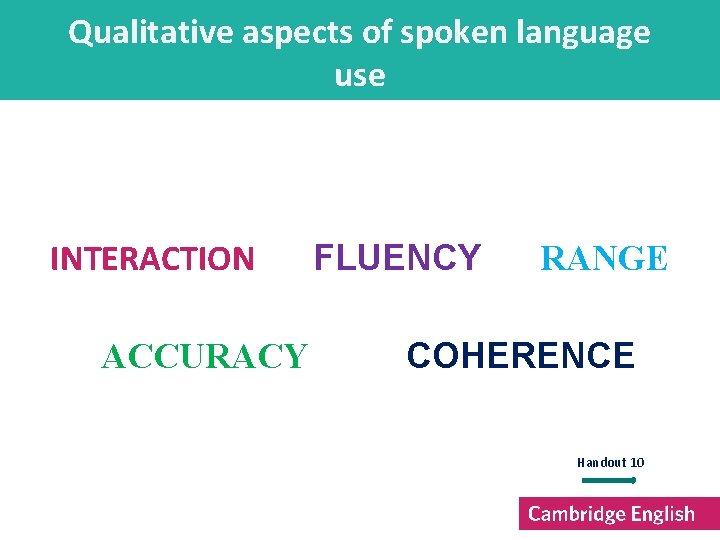
Qualitative aspects of spoken language use INTERACTION ACCURACY FLUENCY RANGE COHERENCE Handout 10
CEFR: Writing Towards a ‘writing construct’
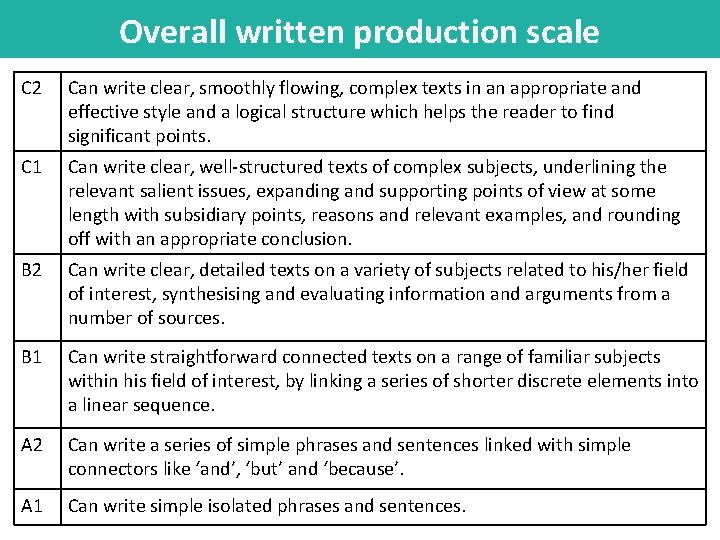
Overall written production scale C 2 Can write clear, smoothly flowing, complex texts in an appropriate and effective style and a logical structure which helps the reader to find significant points. C 1 Can write clear, well-structured texts of complex subjects, underlining the relevant salient issues, expanding and supporting points of view at some length with subsidiary points, reasons and relevant examples, and rounding off with an appropriate conclusion. B 2 Can write clear, detailed texts on a variety of subjects related to his/her field of interest, synthesising and evaluating information and arguments from a number of sources. B 1 Can write straightforward connected texts on a range of familiar subjects within his field of interest, by linking a series of shorter discrete elements into a linear sequence. A 2 Can write a series of simple phrases and sentences linked with simple connectors like ‘and’, ‘but’ and ‘because’. A 1 Can write simple isolated phrases and sentences.
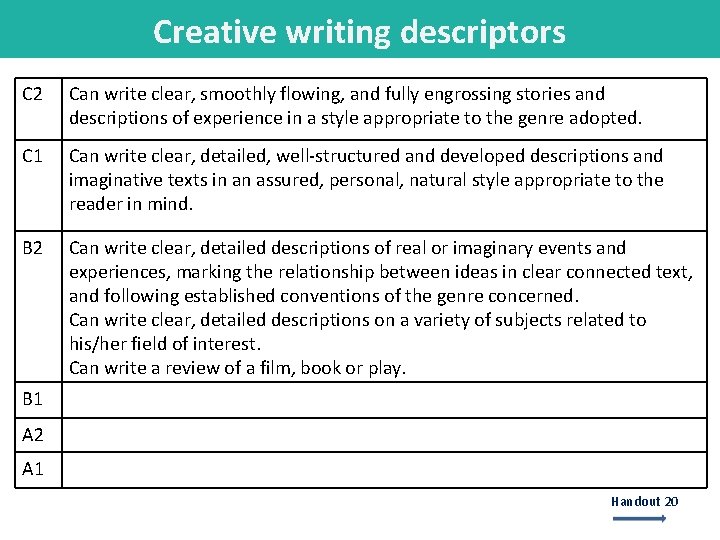
Creative writing descriptors C 2 Can write clear, smoothly flowing, and fully engrossing stories and descriptions of experience in a style appropriate to the genre adopted. C 1 Can write clear, detailed, well-structured and developed descriptions and imaginative texts in an assured, personal, natural style appropriate to the reader in mind. B 2 Can write clear, detailed descriptions of real or imaginary events and experiences, marking the relationship between ideas in clear connected text, and following established conventions of the genre concerned. Can write clear, detailed descriptions on a variety of subjects related to his/her field of interest. Can write a review of a film, book or play. B 1 A 2 A 1 Handout 20
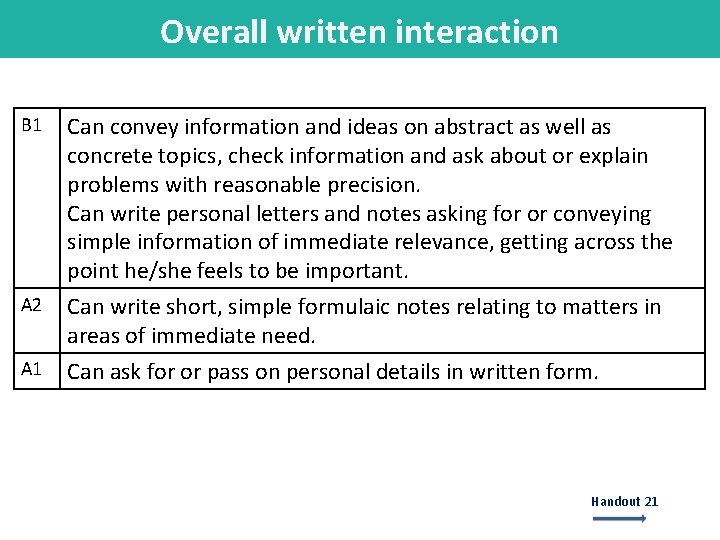
Overall written interaction B 1 Can convey information and ideas on abstract as well as concrete topics, check information and ask about or explain problems with reasonable precision. Can write personal letters and notes asking for or conveying simple information of immediate relevance, getting across the point he/she feels to be important. A 2 Can write short, simple formulaic notes relating to matters in areas of immediate need. Can ask for or pass on personal details in written form. A 1 Handout 21
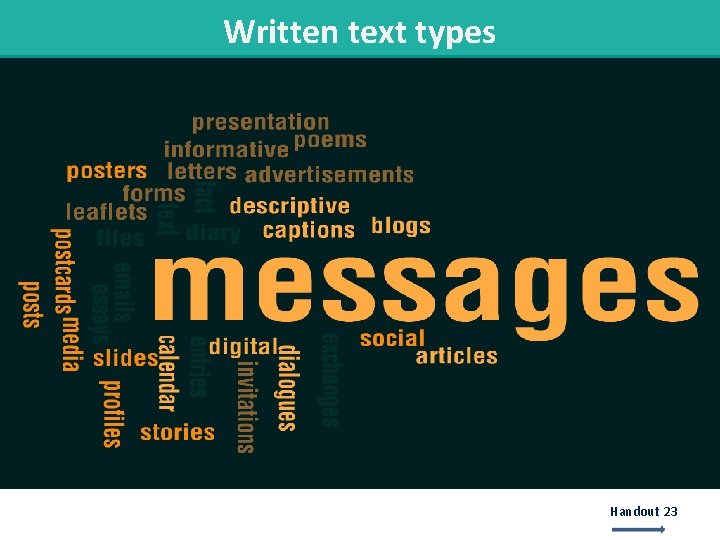
Written text types Handout 23
Day 3 Session 1 CEFR: Language knowledge scales
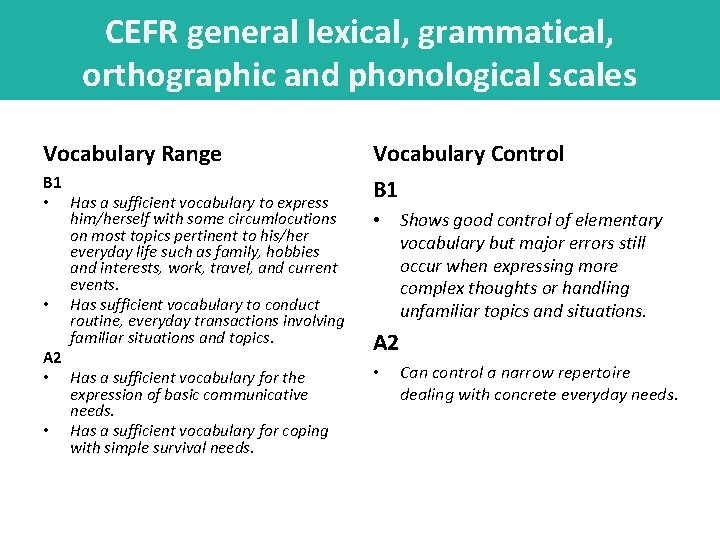
CEFR general lexical, grammatical, orthographic and phonological scales Vocabulary Range Vocabulary Control B 1 • Has a sufficient vocabulary to express him/herself with some circumlocutions on most topics pertinent to his/her everyday life such as family, hobbies and interests, work, travel, and current events. • Has sufficient vocabulary to conduct routine, everyday transactions involving familiar situations and topics. A 2 • Has a sufficient vocabulary for the expression of basic communicative needs. • Has a sufficient vocabulary for coping with simple survival needs. B 1 • Shows good control of elementary vocabulary but major errors still occur when expressing more complex thoughts or handling unfamiliar topics and situations. A 2 • Can control a narrow repertoire dealing with concrete everyday needs.
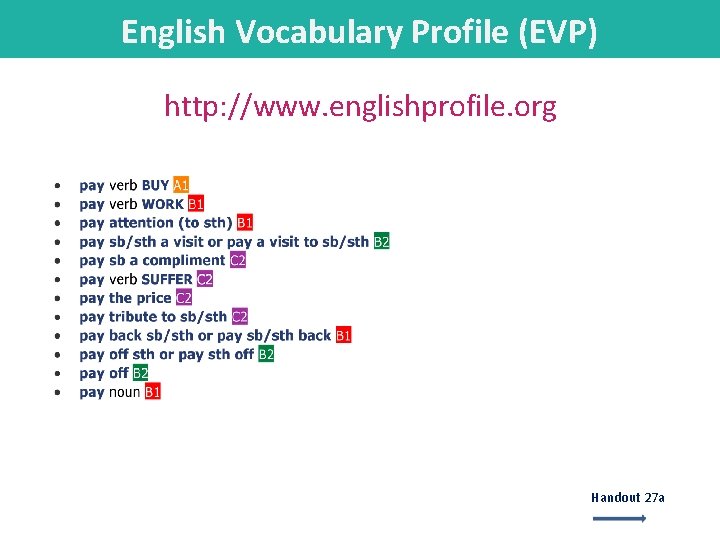
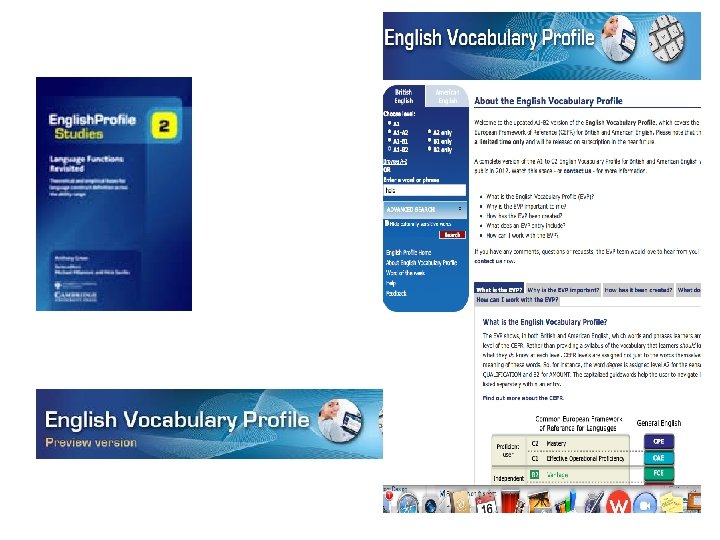
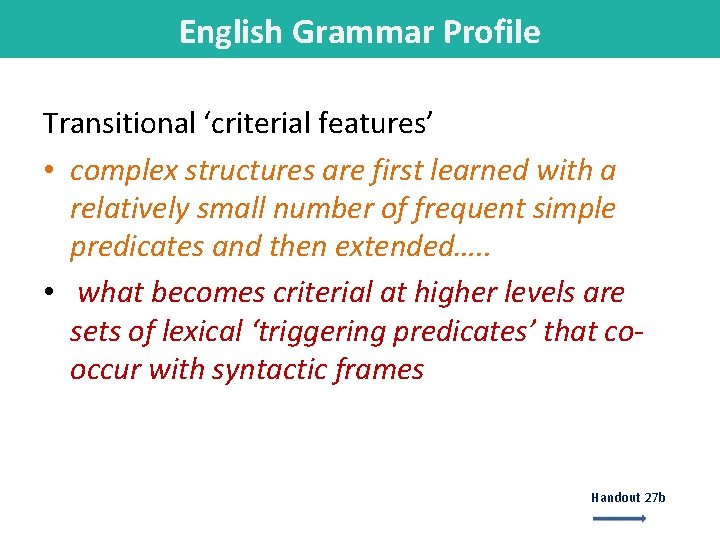
English Vocabulary Profile (EVP) http: //www. englishprofile. org Handout 27 a
English Grammar Profile Transitional ‘criterial features’ • complex structures are first learned with a relatively small number of frequent simple predicates and then extended…. . • what becomes criterial at higher levels are sets of lexical ‘triggering predicates’ that cooccur with syntactic frames Handout 27 b
CEFR: Elements in reception and understanding
Listening input/output challenges and grading • • • length of text language in text sentence length number of distractors picture support language needed for answers Handout 33 a & b
CEFR: Reading Towards a ‘reading construct’
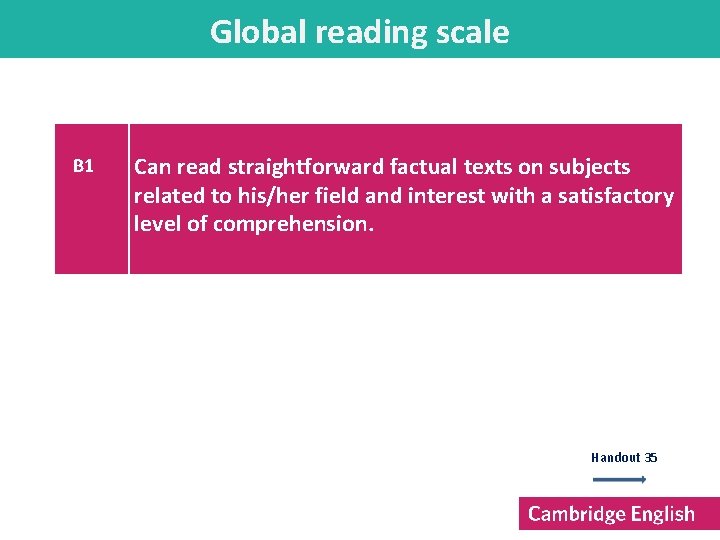
Global reading scale B 1 Can read straightforward factual texts on subjects related to his/her field and interest with a satisfactory level of comprehension. Handout 35
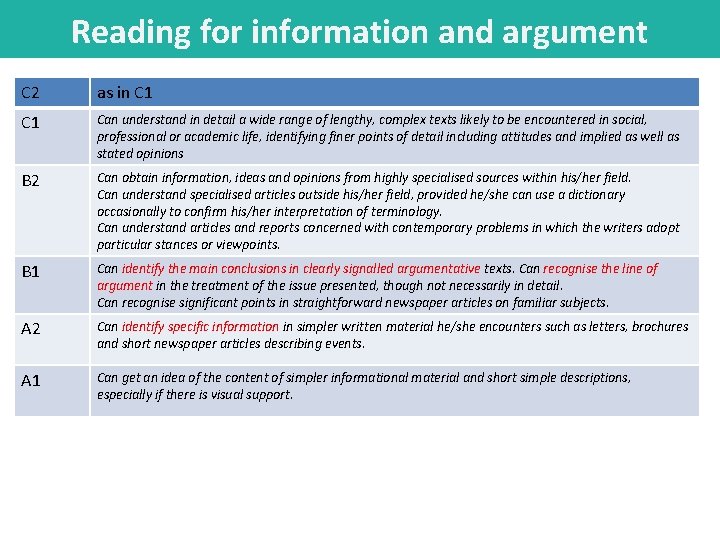
Reading for information and argument C 2 as in C 1 Can understand in detail a wide range of lengthy, complex texts likely to be encountered in social, professional or academic life, identifying finer points of detail including attitudes and implied as well as stated opinions B 2 Can obtain information, ideas and opinions from highly specialised sources within his/her field. Can understand specialised articles outside his/her field, provided he/she can use a dictionary occasionally to confirm his/her interpretation of terminology. Can understand articles and reports concerned with contemporary problems in which the writers adopt particular stances or viewpoints. B 1 Can identify the main conclusions in clearly signalled argumentative texts. Can recognise the line of argument in the treatment of the issue presented, though not necessarily in detail. Can recognise significant points in straightforward newspaper articles on familiar subjects. A 2 Can identify specific information in simpler written material he/she encounters such as letters, brochures and short newspaper articles describing events. A 1 Can get an idea of the content of simpler informational material and short simple descriptions, especially if there is visual support.
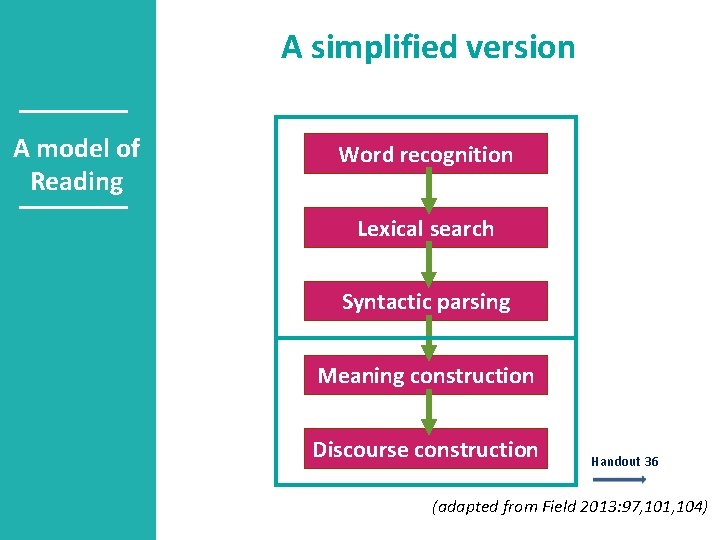
A simplified version A model of Reading Word recognition Lexical search Syntactic parsing Meaning construction Discourse construction Handout 36 (adapted from Field 2013: 97, 101, 104)
![Reading [not aloud] Skills involved include: • • • perceptual skills memory decoding skills](http://slidetodoc.com/presentation_image_h2/04884c1e588e48b921d4bef6bed77500/image-46.jpg "Reading [not aloud] Skills involved include: • • • perceptual skills memory decoding skills")
Reading [not aloud] Skills involved include: • • • perceptual skills memory decoding skills inferencing predicting imagination rapid scanning referring back and forth interpreting
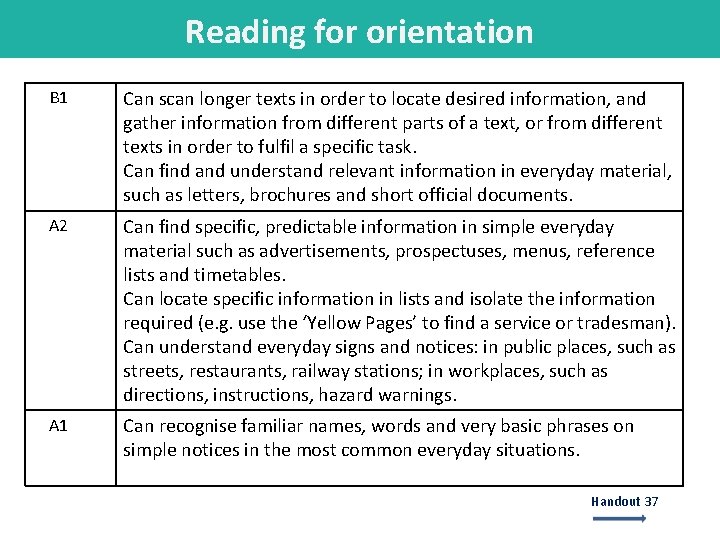
Reading for orientation • • • • B 1 Can scan longer texts in order to locate desired information, and gather information from different parts of a text, or from different texts in order to fulfil a specific task. Can find and understand relevant information in everyday material, such as letters, brochures and short official documents. A 2 Can find specific, predictable information in simple everyday material such as advertisements, prospectuses, menus, reference lists and timetables. Can locate specific information in lists and isolate the information required (e. g. use the ‘Yellow Pages’ to find a service or tradesman). Can understand everyday signs and notices: in public places, such as streets, restaurants, railway stations; in workplaces, such as directions, instructions, hazard warnings. A 1 Can scan longer texts in order to locate desired information, and gather information from different parts of a text, or from different texts in order to fulfil a specific task. B 1 Can find and understand relevant information in everyday material, such as letters, brochures and short official documents. Can find specific, predictable information in simple everyday material such as advertisements, prospectuses, menus, reference lists and timetables. A 2 Can locate specific information in lists and isolate the information required (e. g. use the ‘Yellow Pages’ to find a service or tradesman). Can understand everyday signs and notices: in public places, such as streets, restaurants, railway stations; in workplaces, such as directions, instructions, hazard warnings. A 1 Can recognise familiar names, words and very basic phrases on simple notices in the most common everyday situations. Handout 37
Communicative language pedagogy and the role of assessment
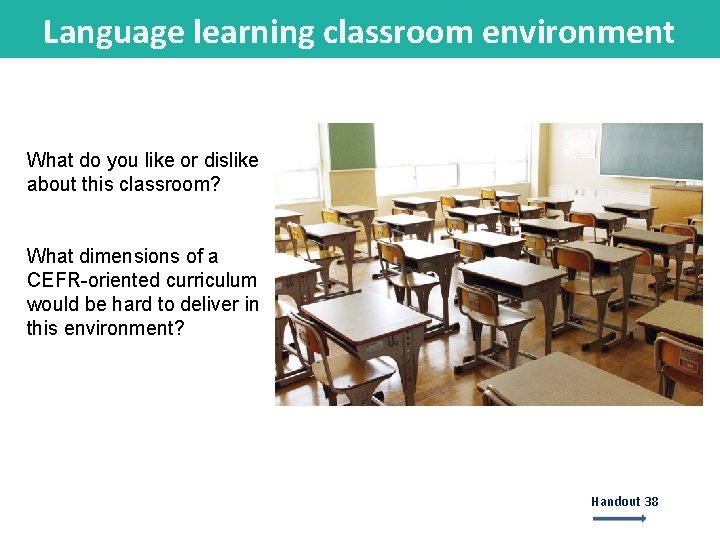
Language learning classroom environment What do you like or dislike about this classroom? What dimensions of a CEFR-oriented curriculum would be hard to deliver in this environment? Handout 38
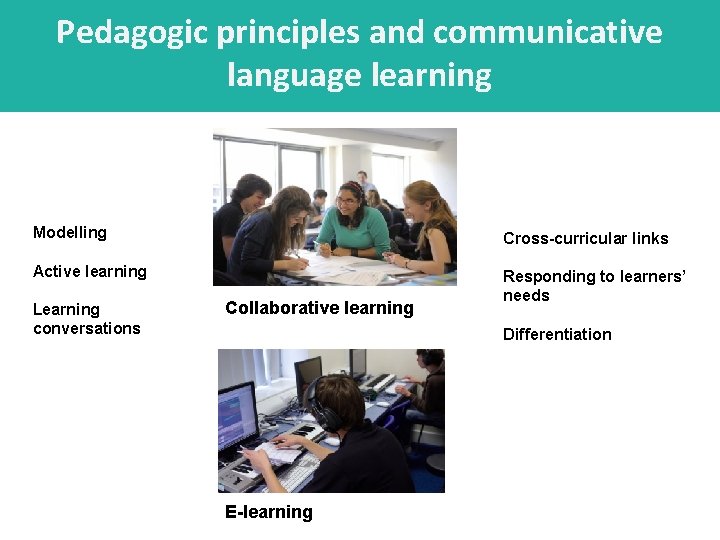
Pedagogic principles and communicative language learning Modelling Cross-curricular links Active learning Responding to learners’ needs Learning conversations Collaborative learning Differentiation E-learning
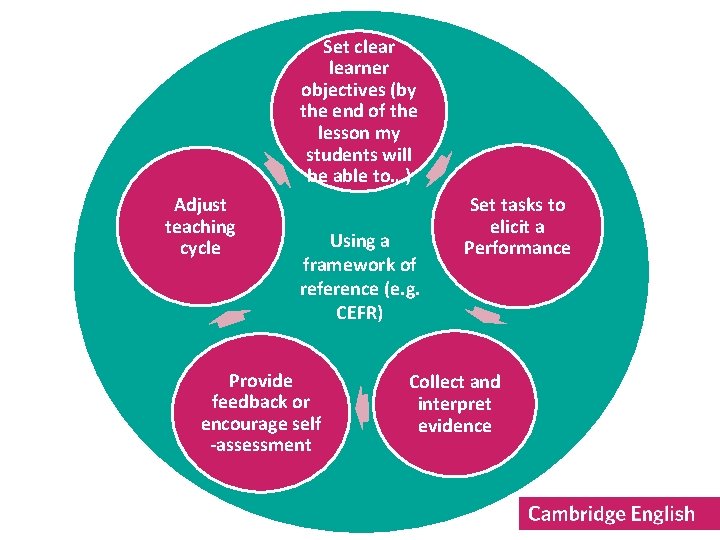
Set clearner objectives (by the end of the lesson my students will be able to…) Adjust teaching cycle Using a framework of reference (e. g. CEFR) Provide feedback or encourage self -assessment Set tasks to elicit a Performance Collect and interpret evidence
Final thoughts Write down 5 key words you recall from the sessions so far. Write down 3 ‘take away’ messages from the day. Compare notes with a partner.
- Slides: 52