
CEDCOM High performance architecture for big data applications
CEDCOM High performance architecture for big data applications Tanguy Raynaud CEDAR Project
Outline • Phase III – In the search of a perfect enabler • Motivation • An Overview of Ced. Com Architecture • The Ced. Components • Block Management Protocol • Communication Protocol • Demonstration • Conclusion and Future Work Note: The main implementer of Cec. Com is Tanguy Raynaud, M. Sc.
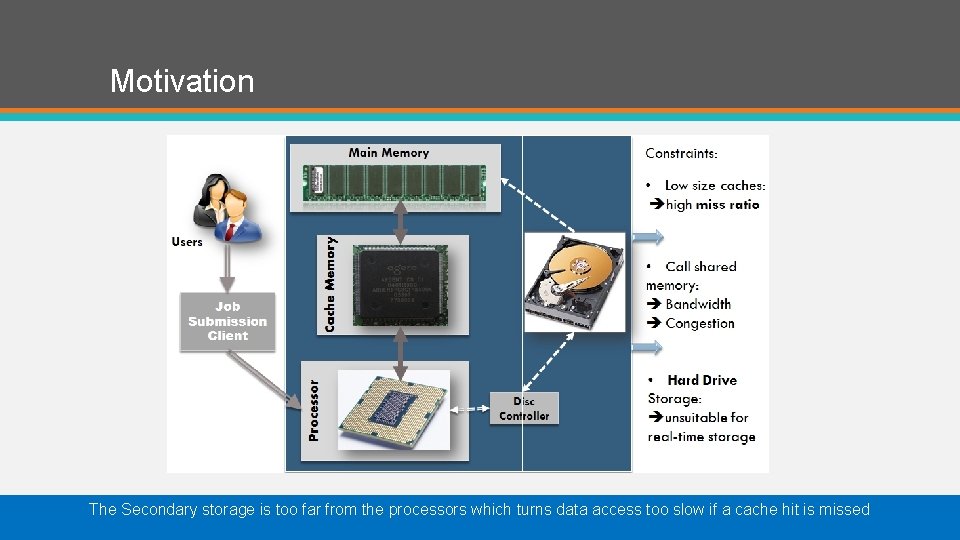
Motivation The Secondary storage is too far from the processors which turns data access too slow if a cache hit is missed
An Overview of Ced. Com • Ced. Com is an architecture which is built on COMA (Cache. Only memory architecture) and some features of Hadoop Distributed File System (HDFS) • COMA is a memory architecture which turns a local memory as a huge dynamic RAM cache called Attraction Memory. • The Hadoop Distributed File System (HDFS) is designed to store very large data sets reliably, and to stream those data sets at high bandwidth to user applications. • Ced. Com is an architecture without having the notion of home node.
An Overview of Ced. Com • Our objective is to develop a high-performance and fault-tolerant architecture for Big Data applications by • enabling CPU (Central Processing Unit) accessing data faster • increasing cache hit ratio • managing data replication in an intelligent manner • migrating data and computation on demand between nodes dynamically depending on the context
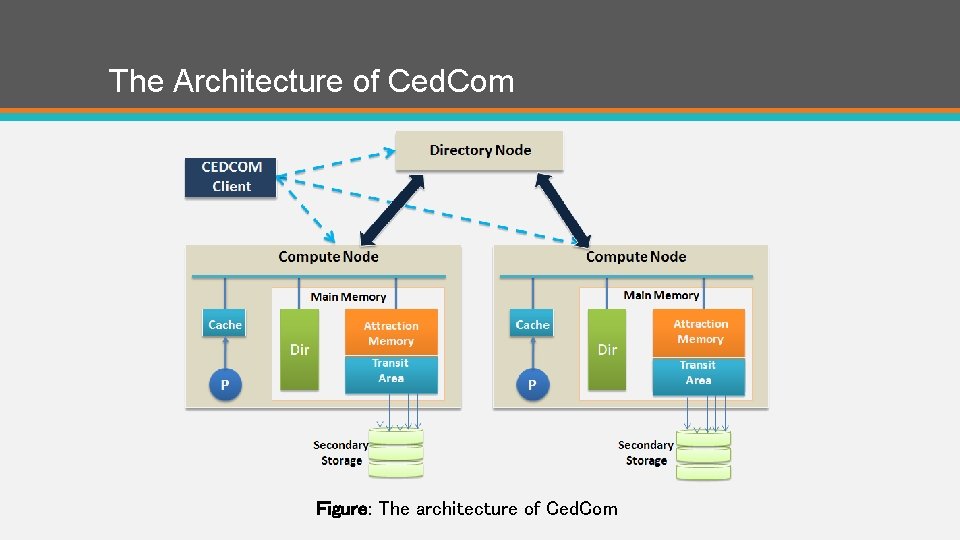
The Architecture of Ced. Com Figure: The architecture of Ced. Com
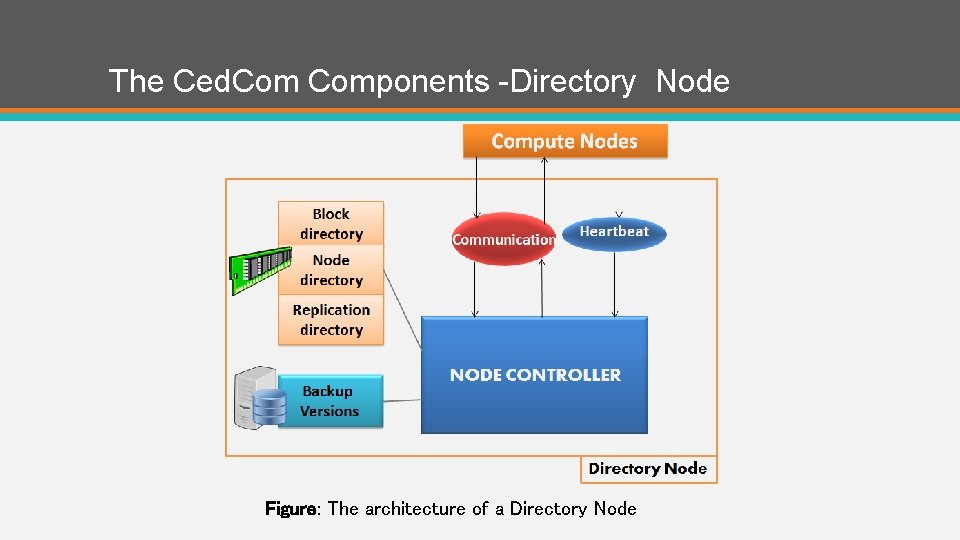
The Ced. Components -Directory Node Figure: The architecture of a Directory Node
The Ced. Components -Directory Node • The directory node is global meta-data server which provides the information of nodes, replicas, and data blocks. • It consists of a node directory, a block directory, a replication directory and a node controller • Node directory • indexes IP address/node • Block directory • indexes files/data blocks • indexes data blocks/compute node
The Ced. Components -Directory Node • Replication Directory • Save the location of the replications • Request new replications • Reload lost blocks onto memory • It registers compute nodes • It helps in migrating data blocks between compute nodes
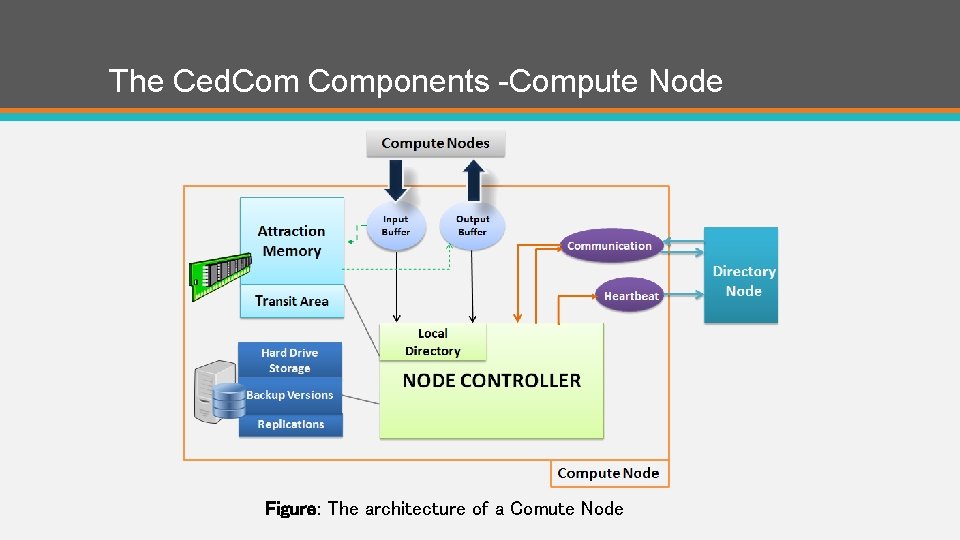
The Ced. Components -Compute Node Figure: The architecture of a Comute Node
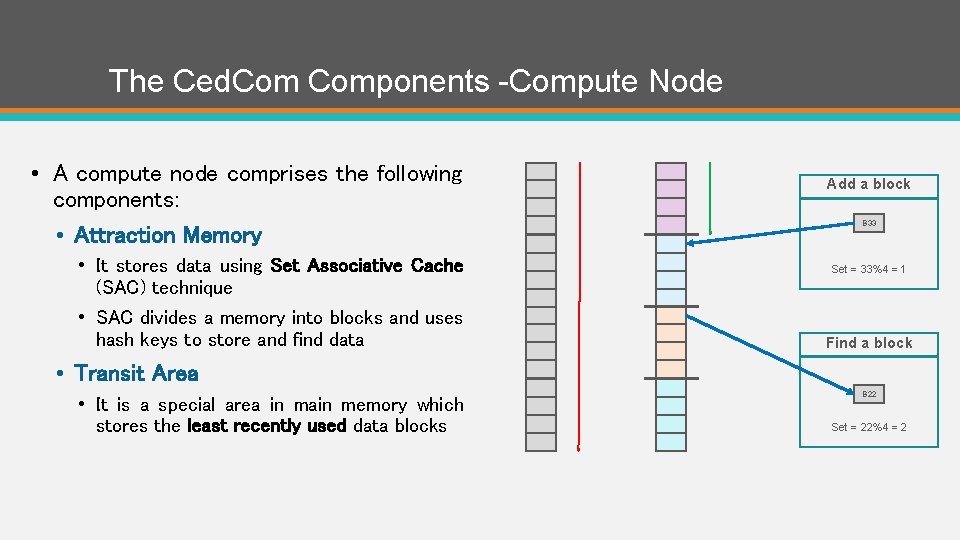
The Ced. Components -Compute Node • A compute node comprises the following components: • Attraction Memory • It stores data using Set Associative Cache (SAC) technique • SAC divides a memory into blocks and uses hash keys to store and find data Add a block B 33 Set = 33%4 = 1 Find a block • Transit Area • It is a special area in main memory which stores the least recently used data blocks B 22 Set = 22%4 = 2
The Ced. Components -Compute Node • Local Storage • Stores replicas to guarantee fault tolerance • Local Directory • Index the location and status of data blocks contained in the local node • Node Controller • Controls various operations performed by the nodes
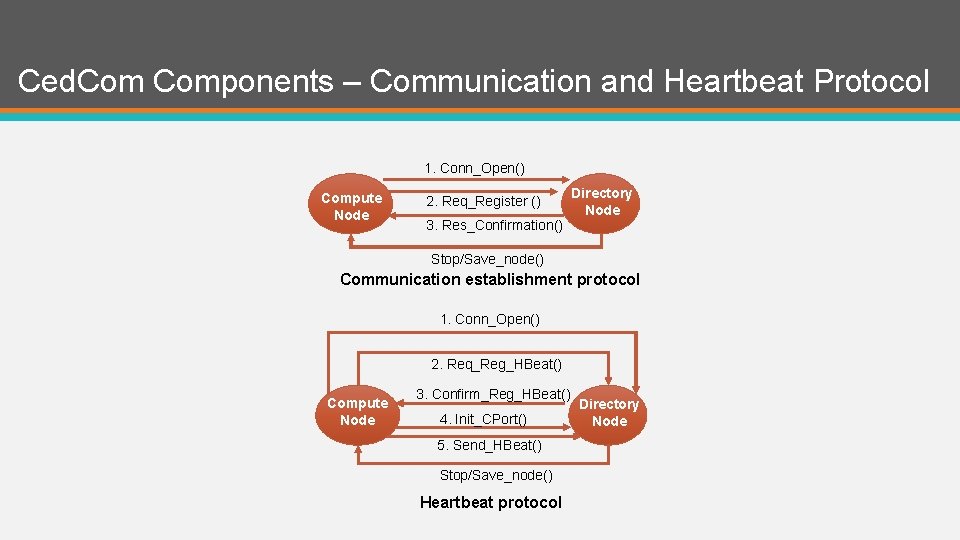
Ced. Components – Communication and Heartbeat Protocol 1. Conn_Open() Compute Node 2. Req_Register () Directory Node 3. Res_Confirmation() Stop/Save_node() Communication establishment protocol 1. Conn_Open() 2. Req_Reg_HBeat() Compute Node 3. Confirm_Reg_HBeat() 4. Init_CPort() 5. Send_HBeat() Stop/Save_node() Heartbeat protocol Directory Node
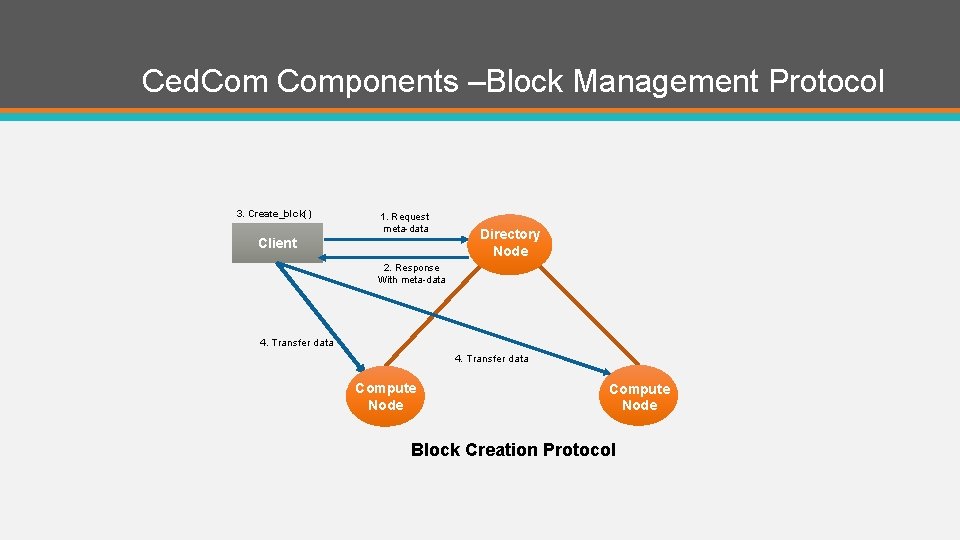
Ced. Components –Block Management Protocol 3. Create_blck() 1. Request meta-data Client Directory Node 2. Response With meta-data 4. Transfer data Compute Node Block Creation Protocol
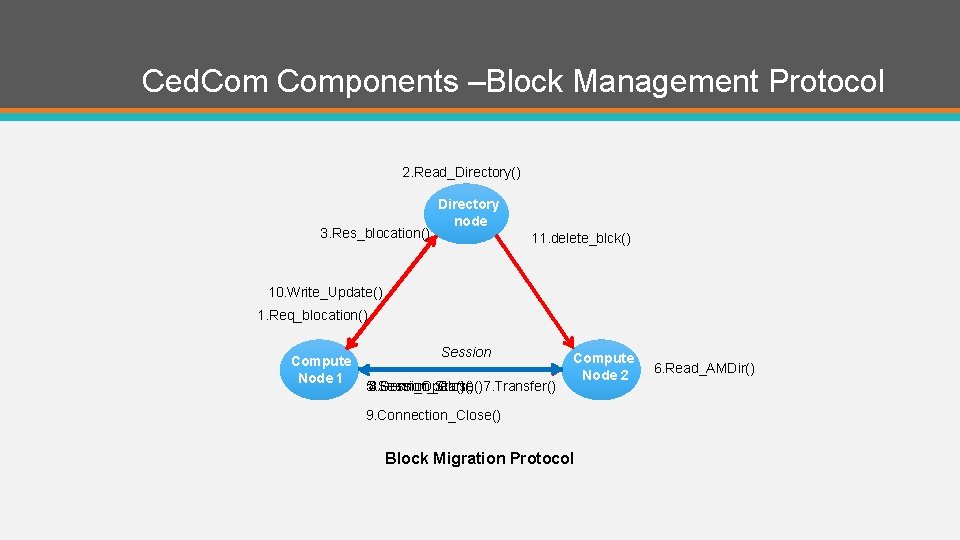
Ced. Components –Block Management Protocol 2. Read_Directory() 3. Res_blocation() Directory node 11. delete_blck() 10. Write_Update() 1. Req_blocation() Compute Node 1 Session 5. Session_Start() 4. Conn_Open() 7. Transfer() 8. Session_Close() Compute Node 2 9. Connection_Close() Block Migration Protocol 6. Read_AMDir()
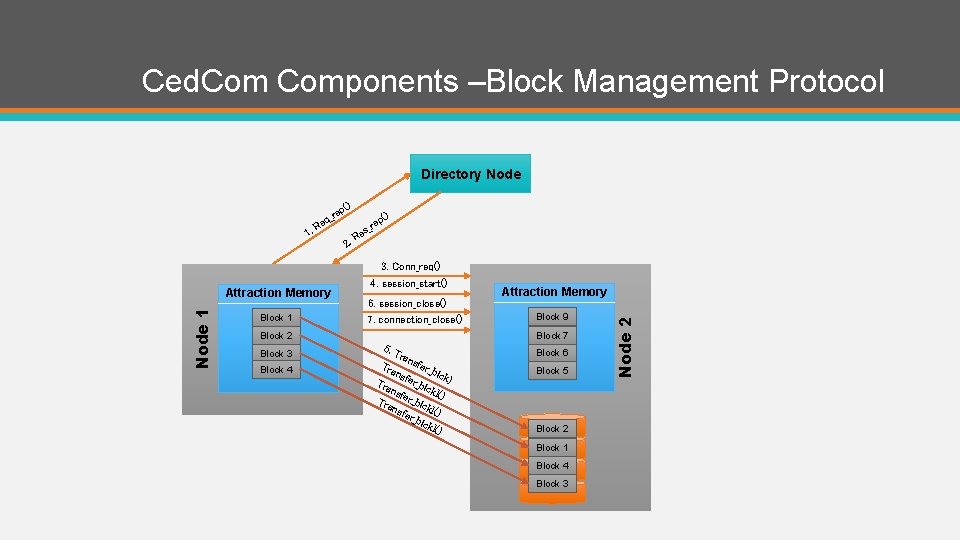
Ced. Components –Block Management Protocol Directory Node p() e q_r e. R 1 2. () ep r _ s Re 3. Conn_req() Block 1 4. session_start() 6. session_close() 7. connection_close() Block 2 Block 3 Block 4 Attraction Memory Block 9 Block 7 5. T Block 6 Tra Block 5 ran sfe r_b nsf lck e ) r_b Tra l c nsf k I() Tra er_blc k. I() nsf er_ blc k. I() Block 2 Block 1 Block 4 Block 3 Node 2 Node 1 Attraction Memory
Conclusion and Potential Improvements • Ced. Com combines two promising technologies COMA and HDFS to guarantee performance of Big Data applications. • It enables building scalable applications. • It has several benefits, • • it it optimizes data access time enables efficient access to caches, migrates data blocks between nodes efficiently, significantly minimizes the data read from secondary storage • Unlike Hadoop, it takes the responsibility of ensuring highperformance. • It does not require an exhaustive number of parameters.
Conclusion and Potential Improvements • A file system should be implemented for Ced. Com architecture. • More experiments should be conducted with Ced. Com in different use cases to guarantee the following • Massive scalability • Dynamic data migration between nodes
Demonstration
- Slides: 19