
CEDA CDM 2015 Seminar Trainer Tim Knowles CDM


- Slides: 28
CEDA CDM 2015 Seminar Trainer: Tim Knowles
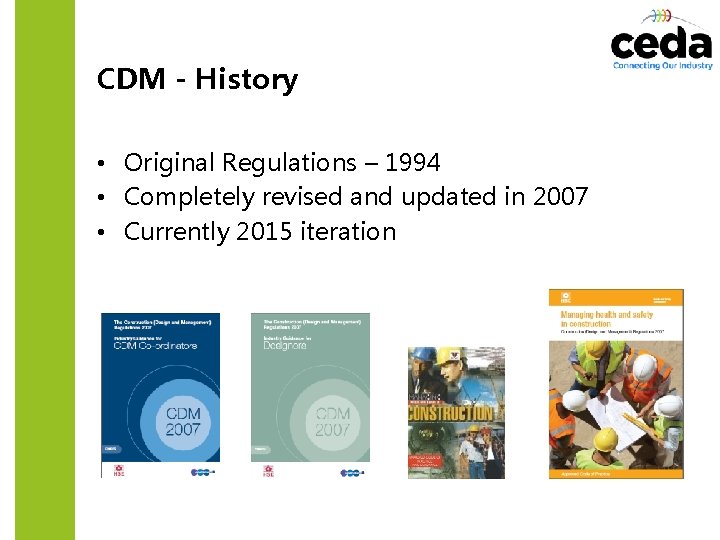
CDM - History • Original Regulations – 1994 • Completely revised and updated in 2007 • Currently 2015 iteration
Legal Structure of CDM • Construction (Design and Management) Regulations 2015 • Guidance on the Regulations – L 153 • Guidance by industry for industry – (CITB 6)
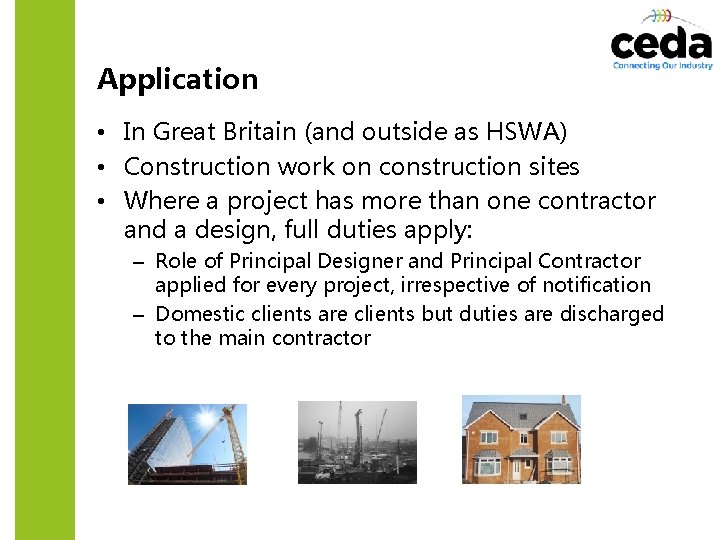
Application • In Great Britain (and outside as HSWA) • Construction work on construction sites • Where a project has more than one contractor and a design, full duties apply: – Role of Principal Designer and Principal Contractor applied for every project, irrespective of notification – Domestic clients are clients but duties are discharged to the main contractor
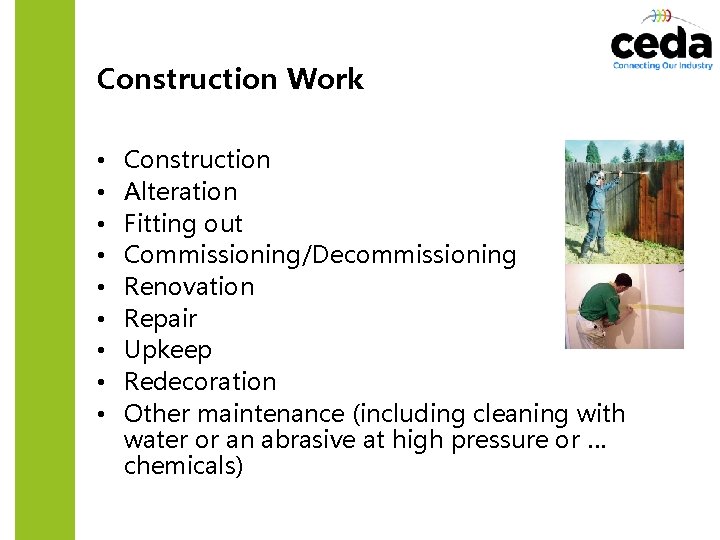
Construction Work • • • Construction Alteration Fitting out Commissioning/Decommissioning Renovation Repair Upkeep Redecoration Other maintenance (including cleaning with water or an abrasive at high pressure or … chemicals)
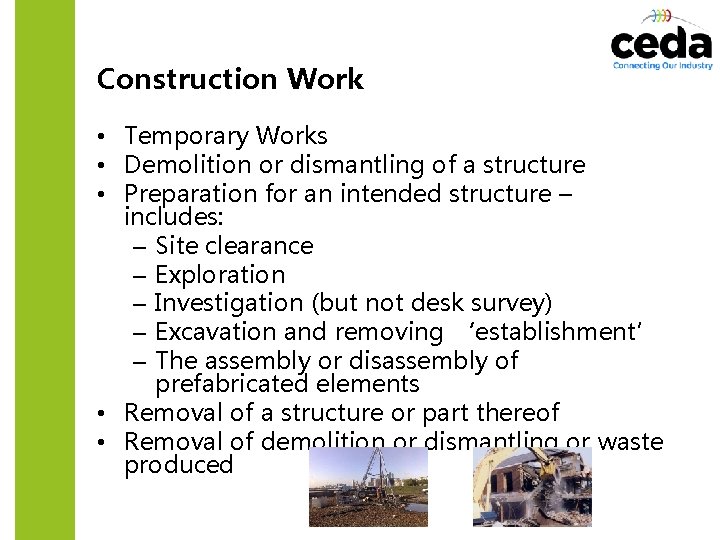
Construction Work • Temporary Works • Demolition or dismantling of a structure • Preparation for an intended structure – includes: – Site clearance – Exploration – Investigation (but not desk survey) – Excavation and removing ‘establishment’ – The assembly or disassembly of prefabricated elements • Removal of a structure or part thereof • Removal of demolition or dismantling or waste produced
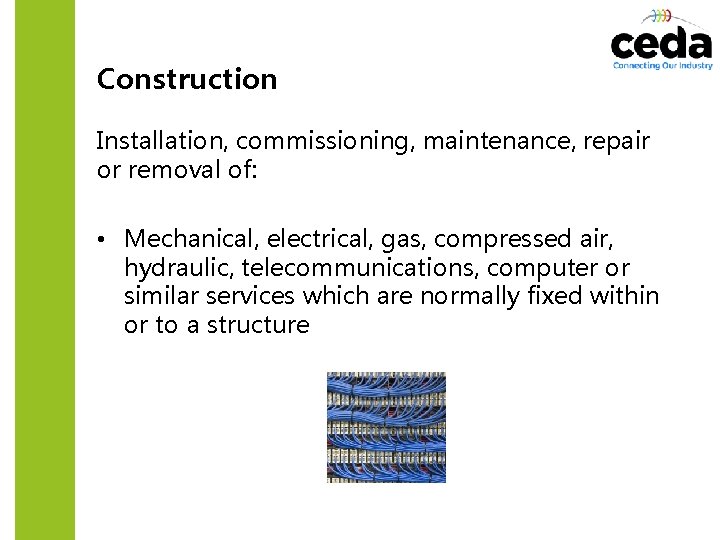
Construction Installation, commissioning, maintenance, repair or removal of: • Mechanical, electrical, gas, compressed air, hydraulic, telecommunications, computer or similar services which are normally fixed within or to a structure
Key to Application • What business will not carry out construction work? • CDM to be addressed within H&S Policy and Procedures by your Safety Advisor
Duty Holders • Client • Principal Designers • Principal Contractors • Contractors All “Body Corporate”
Clients On all projects clients must “ensure”: • Appointment of roles with necessary skill, knowledge and experience • all duty holders (including client) make and maintain suitable arrangements for managing projects (including time and resources) • Principal Designer and Principal Contractor carry out their duties • Provide relevant information promptly • Ensure adequate “Welfare” at start and throughout
Clients Appoint a Principal Designer Appoint a Principal Contractor Notify the project via F 10 Ensure information promptly passed on by Principal Designer • Be aware of start of construction phase and ensure plan developed • Health and Safety file • • • Note: Clients assume all roles until formally appointing in writing
Principal Designers • Mandatory on projects where there is more than one contractor – Skills, knowledge, experience – Advise and assist client on some duties (F 10) • Ensure suitable arrangements in place to manage duties • Plan, manage and monitor health and safety in the pre-construction phase
Principal Designers • Liaise with Principal Contractor • Collect, collate and spread information • Ensure Designers carry out their duties • Identify, eliminate or control significant risk • Co-ordinate design work during construction (H&S) • Review, update or prepare a HSF • Pass HSF to the client
Designers • On all projects • Skill, knowledge and experience • Ensure Client aware of duties before starting – General principle - avoid risks – Provide information about residuals – Assist other duty holders with information on design
Who are Designers? Wide definition – those who: Anyone who prepares or modifies as design, or Arranges for or instructs anyone under their control to do so Duties apply to all projects including non-notifiable and domestic. Those who design overseas.
Who are Designers? Includes: • Architects • Civil and structural engineers • Building services engineers • Landscape Architects • Transport Consultants • Those specifying or purchasing materials • Temporary works designers • Interior fit out designers • Clients who specify • D&B contractors
Designers Duties • Co-ordinate their work with others to manage risk • Co-operate with Principal Designer and others • Provide information for the Health and Safety file
Designers Duties Designers have to avoid foreseeable risks SFARP by: • Eliminating hazards from the construction, cleaning, maintenance, and proposed use (workplace only) and demolition of a structure • Reduce risks from any remaining hazard • Give collective risk reduction measures priority over individual measures
Designers Do Not Need To…. • Control risk on site • Assess unforeseeable hazards and risks • Design for future use outside their design brief • Specify construction methods • Manage contractors • Consider trivial risks What do you need to do? How can you contribute to risk reduction on site?
Principal Contractors duties apply on projects with more than one contractor • Prepare a Construction Phase Plan • Review, revise and refine plan • Implement plan • Relevant skill, knowledge and experience
Principal Contractors • Plan, manage and monitor • • construction phase Liaise with Principal Designer (ongoing design) Ensure adequate welfare Secure the site Draw up site rules Direct contractors Consult /Workers about risks Provide Contractors with information
Principal Contractors • Tell Contractors what is needed for HSF and when and how to provide it • Display F 10 where workers can read it where relevant • Ensure everyone has induction and training
Contractors • Ensure Client aware of their duties before starting work • Plan, manage and monitor work • Provide workers with suitable information • Train employees • Ensure they have adequate welfare – Schedule 2
Contractors On all projects, contractors must ensure: • Demolition or dismantling (Reg 20) – Communicated in writing “Written plan of work” regardless of scale • Reports of inspections – Regulation 24 – Schedule 3
Contractors • Adhere to restrictions on start of work • Provide PC with risk information • Work with the PC, comply with the plan, take other measures where they cannot comply, tell PC where it is necessary to alter or add to the plan • Provide information for the HSF
Notification Project becomes notifiable when works are scheduled to: • Last more than 30 working days AND have more than 20 workers working simultaneously • Exceed 500 person days Must be: • Displayed • Retain particulars in Schedule 1
Key Documentation • Pre-Construction Information • Construction Phase Plan • Health and Safety File
Any Questions