
CECS 474 Computer Network Interoperability CHAPTER 16 Wireless
CECS 474 Computer Network Interoperability CHAPTER 16 Wireless Networking Technologies Tracy Bradley Maples, Ph. D. Computer Engineering & Computer Science Cal ifornia State University, Long Beach Notes for Douglas E. Comer, Computer Networks and Internets (5 th Edition)
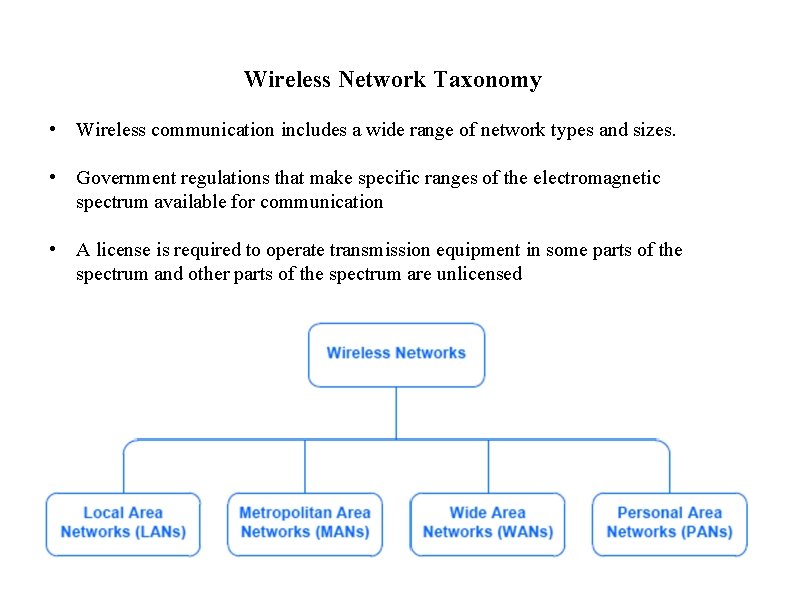
Wireless Network Taxonomy • Wireless communication includes a wide range of network types and sizes. • Government regulations that make specific ranges of the electromagnetic spectrum available for communication • A license is required to operate transmission equipment in some parts of the spectrum and other parts of the spectrum are unlicensed
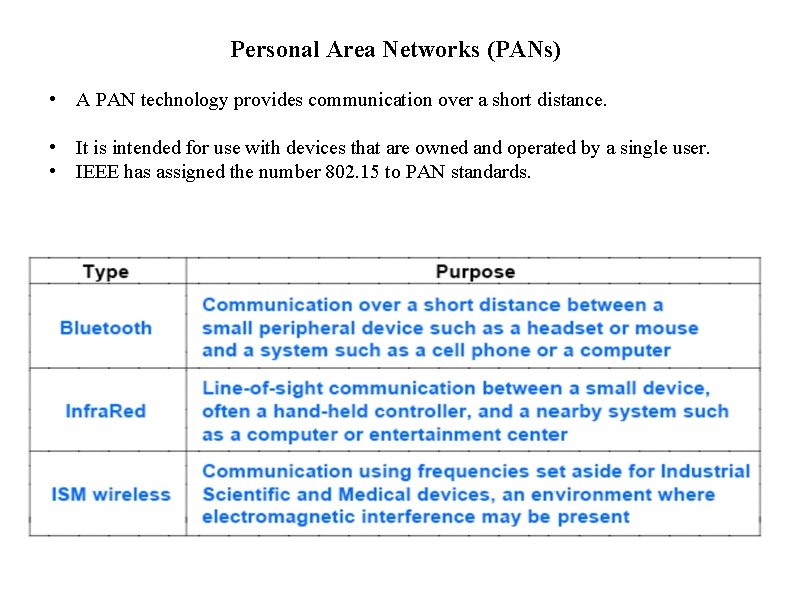
Personal Area Networks (PANs) • A PAN technology provides communication over a short distance. • It is intended for use with devices that are owned and operated by a single user. • IEEE has assigned the number 802. 15 to PAN standards.
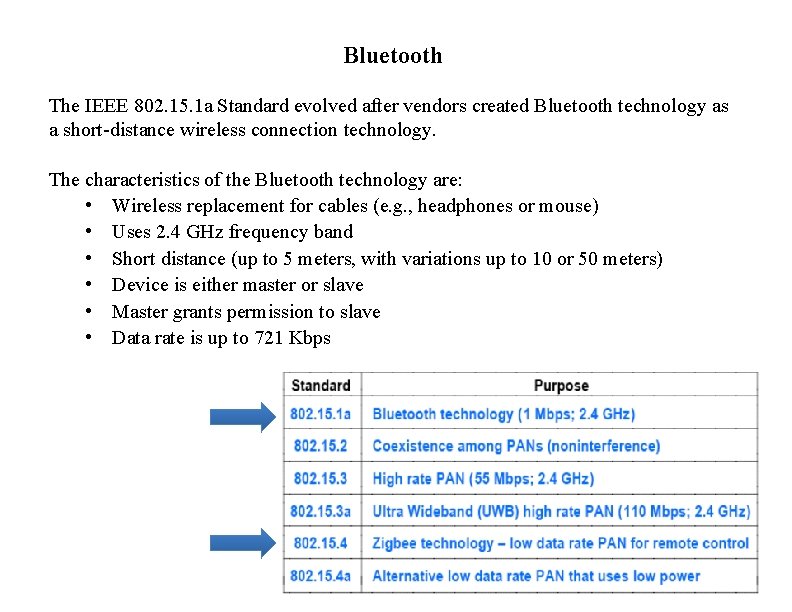
Bluetooth The IEEE 802. 15. 1 a Standard evolved after vendors created Bluetooth technology as a short-distance wireless connection technology. The characteristics of the Bluetooth technology are: • Wireless replacement for cables (e. g. , headphones or mouse) • Uses 2. 4 GHz frequency band • Short distance (up to 5 meters, with variations up to 10 or 50 meters) • Device is either master or slave • Master grants permission to slave • Data rate is up to 721 Kbps
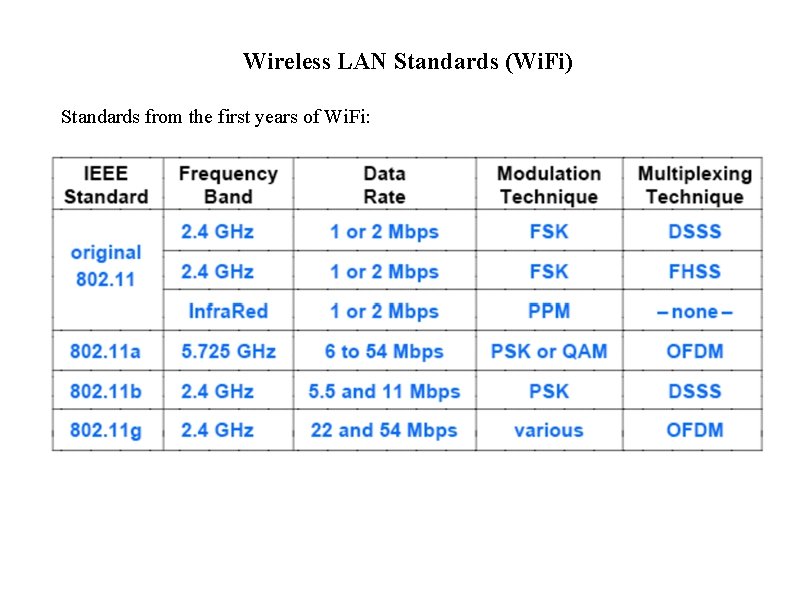
Wireless LAN Standards (Wi. Fi) Standards from the first years of Wi. Fi:
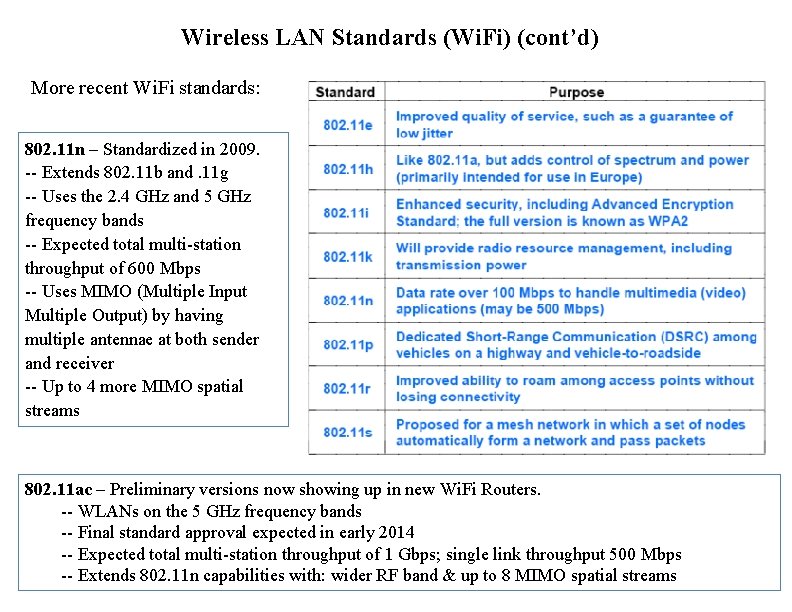
Wireless LAN Standards (Wi. Fi) (cont’d) More recent Wi. Fi standards: 802. 11 n – Standardized in 2009. -- Extends 802. 11 b and. 11 g -- Uses the 2. 4 GHz and 5 GHz frequency bands -- Expected total multi-station throughput of 600 Mbps -- Uses MIMO (Multiple Input Multiple Output) by having multiple antennae at both sender and receiver -- Up to 4 more MIMO spatial streams 802. 11 ac – Preliminary versions now showing up in new Wi. Fi Routers. -- WLANs on the 5 GHz frequency bands -- Final standard approval expected in early 2014 -- Expected total multi-station throughput of 1 Gbps; single link throughput 500 Mbps -- Extends 802. 11 n capabilities with: wider RF band & up to 8 MIMO spatial streams
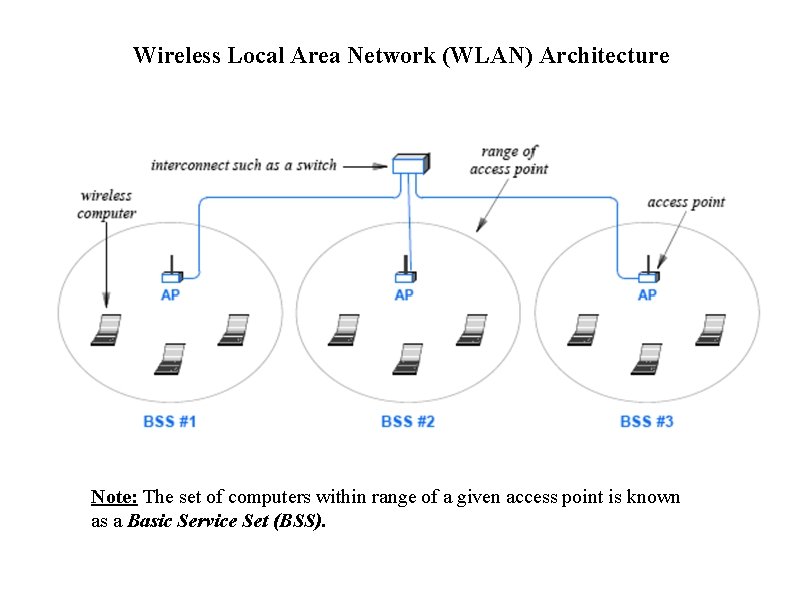
Wireless Local Area Network (WLAN) Architecture Note: The set of computers within range of a given access point is known as a Basic Service Set (BSS).
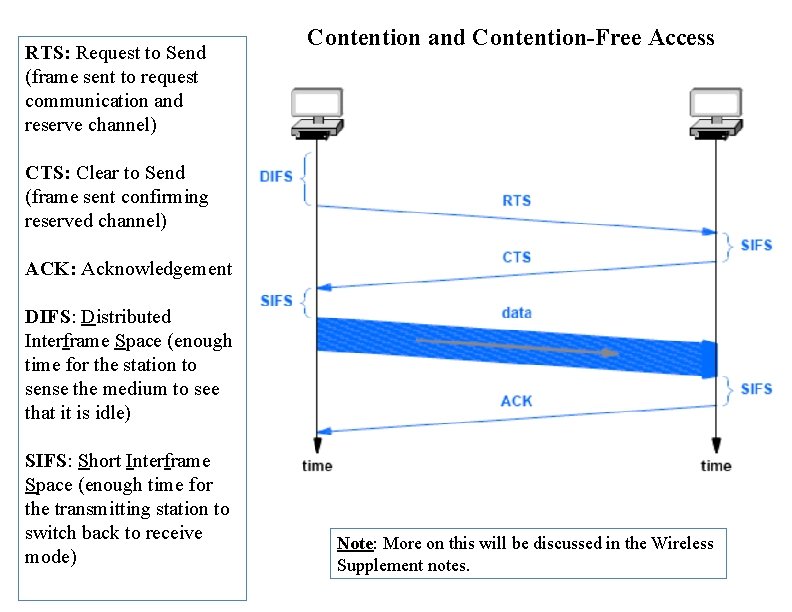
RTS: Request to Send (frame sent to request communication and reserve channel) Contention and Contention-Free Access CTS: Clear to Send (frame sent confirming reserved channel) ACK: Acknowledgement DIFS: Distributed Interframe Space (enough time for the station to sense the medium to see that it is idle) SIFS: Short Interframe Space (enough time for the transmitting station to switch back to receive mode) Note: More on this will be discussed in the Wireless Supplement notes.
Wireless MAN Technology and Wi. MAX Standardized by IEEE under the category IEEE 802. 16. Two main versions of Wi. MAX are being developed that differ in their overall approach: Fixed Wi. MAX • refers to systems built using IEEE 802. 16 -2004 (informally called 802. 16 d) • does not provide for handoff among access points • provides connections between a service provider and a fixed location Mobile Wi. MAX • Standard 802. 16 e-2005 (informally called 802. 16 e) • handoffs among Aps • used for mobile hosts
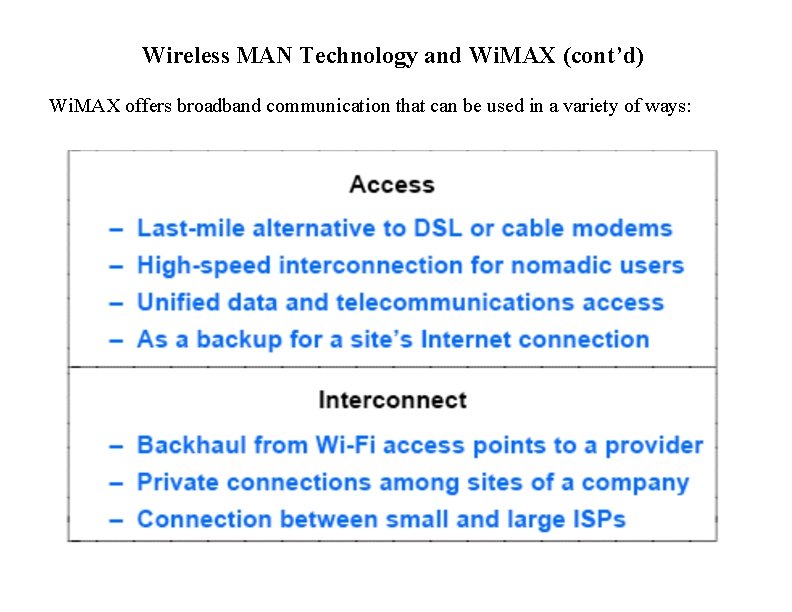
Wireless MAN Technology and Wi. MAX (cont’d) Wi. MAX offers broadband communication that can be used in a variety of ways:
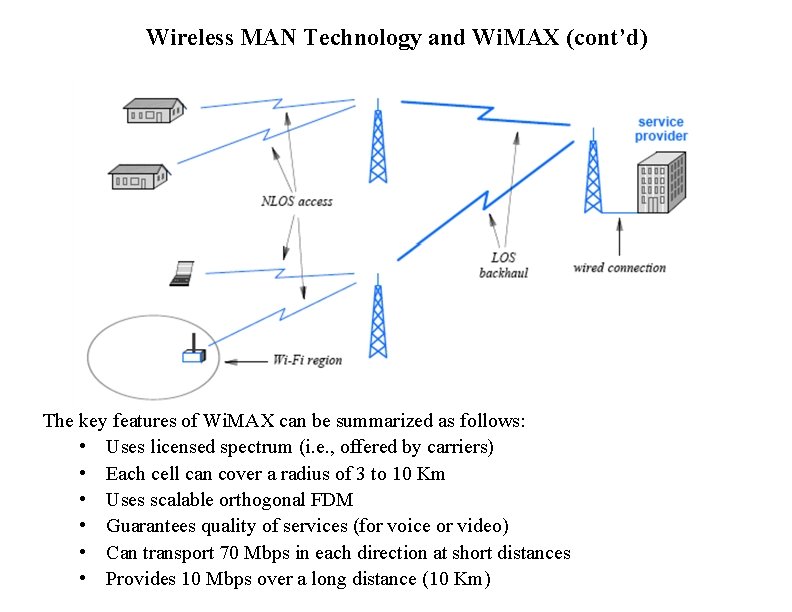
Wireless MAN Technology and Wi. MAX (cont’d) The key features of Wi. MAX can be summarized as follows: • Uses licensed spectrum (i. e. , offered by carriers) • Each cell can cover a radius of 3 to 10 Km • Uses scalable orthogonal FDM • Guarantees quality of services (for voice or video) • Can transport 70 Mbps in each direction at short distances • Provides 10 Mbps over a long distance (10 Km)
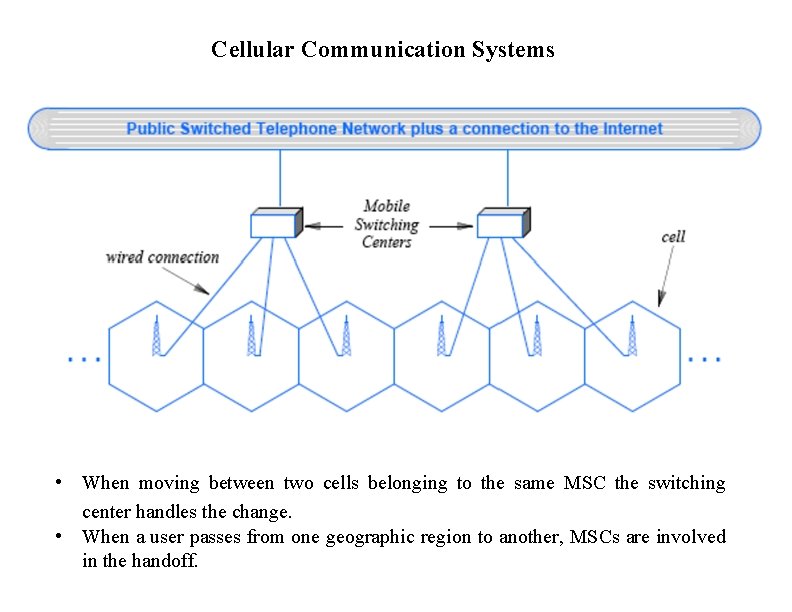
Cellular Communication Systems • When moving between two cells belonging to the same MSC the switching center handles the change. • When a user passes from one geographic region to another, MSCs are involved in the handoff.
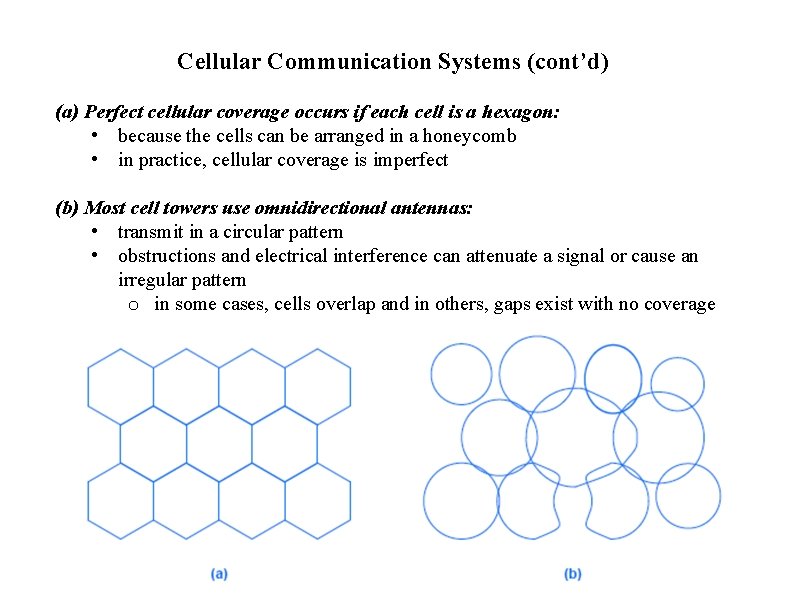
Cellular Communication Systems (cont’d) (a) Perfect cellular coverage occurs if each cell is a hexagon: • because the cells can be arranged in a honeycomb • in practice, cellular coverage is imperfect (b) Most cell towers use omnidirectional antennas: • transmit in a circular pattern • obstructions and electrical interference can attenuate a signal or cause an irregular pattern o in some cases, cells overlap and in others, gaps exist with no coverage
Generations of Cellular Technologies Telecommunications industry divides cellular technologies into four generations: 1 G, 2 G, 3 G, and 4 G (with intermediate versions labeled 2. 5 G and 3. 5 G) Simplified Descriptions: 1 G • Began in the late 1970 s, and extended through the 1980 s • Originally called cellular mobile radio telephones • used analog signals to carry voice 2 G and 2. 5 G • Began in the early 1990 s and continues to be used • One standard: GSM (General System for Communications) • The main distinction between 1 G and 2 G arises because 2 G uses digital signals to carry voice • The label 2. 5 G is used for systems that extend a 2 G system to include some 3 G features
Generations of Cellular Technologies (cont’d) 3 G and 3. 5 G • Began in the 2000 s • Focuses on the addition of higher-speed data services • A 3 G system offers download rates of 400 Kbps to 2 Mbps, and is intended to support applications such as web browsing and photo sharing • Includes EDGE (Enhanced Data Rates for GSM Evolution) (amongst other approaches) • 3 G allows a single telephone to roam across the world 4 G and 4 G LTE (Long Term Evolution) • Began around 2008 • Incompatible with 2 G and 3 G networks and must be implemented separatedly. • Based on GSM/EDGE • Focuses on support for real-time multimedia o such as a television program or high-speed video • They include multiple connection technologies o such as Wi-Fi and satellite o at any time, the phone automatically chooses the best connection technology available
- Slides: 15