
CEBAF Accelerator Status Arne Freyberger Operations Department Accelerator
CEBAF Accelerator Status Arne Freyberger Operations Department Accelerator Division Jefferson Lab
Outline • Accelerator Management Changes • FY 17 Accelerator Operations – Fall 2016 – Spring 2017 • Optimizing 12 Ge. V Operations – Reliability/Availability – Energy Reach • FY 18 – 3+ Hall Operations • Summary 2
Accelerator Division Leadership • On April 30 Andrew Huttonstepped down as the head Accelerator Division – ~10 years as Division Leader – Prior to assuming the Division Leadership, Andrew was Director of Accelerator Operations for ~15 years. • Commissioning of 4 Ge. V CEBAF • Ramp up to 6 Ge. V • Recovery post-Hurricane Isabel • Fulvia Pilathas assumed the role of Acting Division leader until the completion of the search for the new Division leader – Fulvia has also accepted the Director of the Research Accelerator Division at SNS and will assume this position in Fall 2017. 3
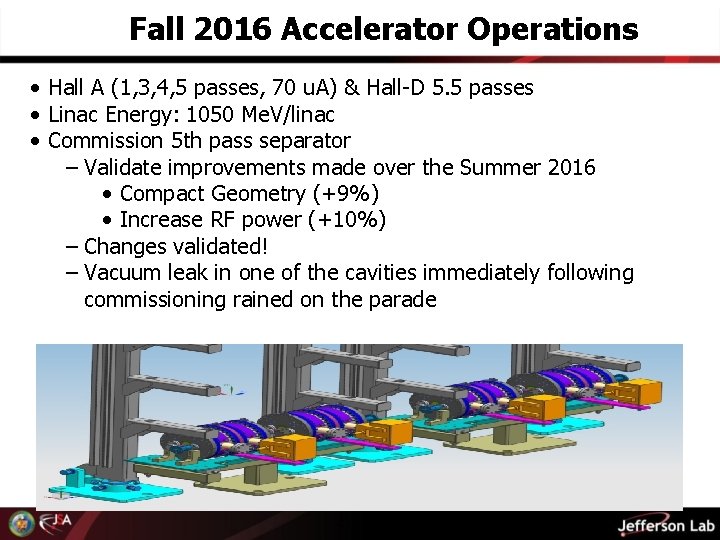
Fall 2016 Accelerator Operations • Hall A (1, 3, 4, 5 passes, 70 u. A) & Hall-D 5. 5 passes • Linac Energy: 1050 Me. V/linac • Commission 5 th pass separator – Validate improvements made over the Summer 2016 • Compact Geometry (+9%) • Increase RF power (+10%) – Changes validated! – Vacuum leak in one of the cavities immediately following commissioning rained on the parade 4
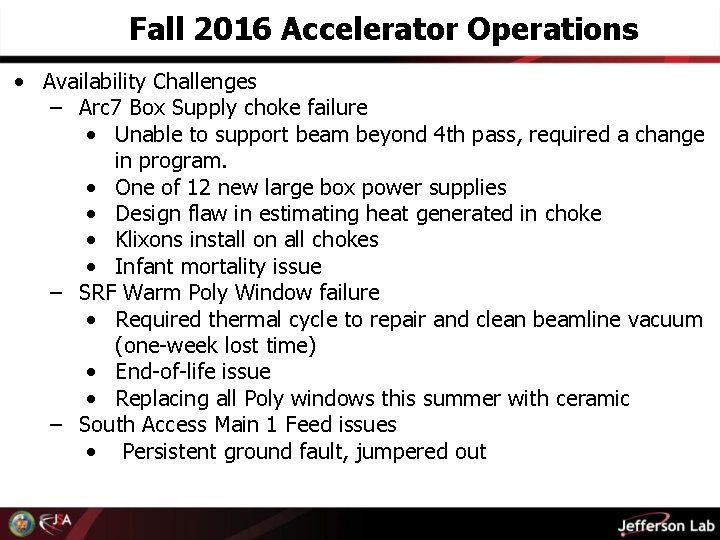
Fall 2016 Accelerator Operations • Availability Challenges – Arc 7 Box Supply choke failure • Unable to support beam beyond 4 th pass, required a change in program. • One of 12 new large box power supplies • Design flaw in estimating heat generated in choke • Klixons install on all chokes • Infant mortality issue – SRF Warm Poly Window failure • Required thermal cycle to repair and clean beamline vacuum (one-week lost time) • End-of-life issue • Replacing all Poly windows this summer with ceramic – South Access Main 1 Feed issues • Persistent ground fault, jumpered out 5
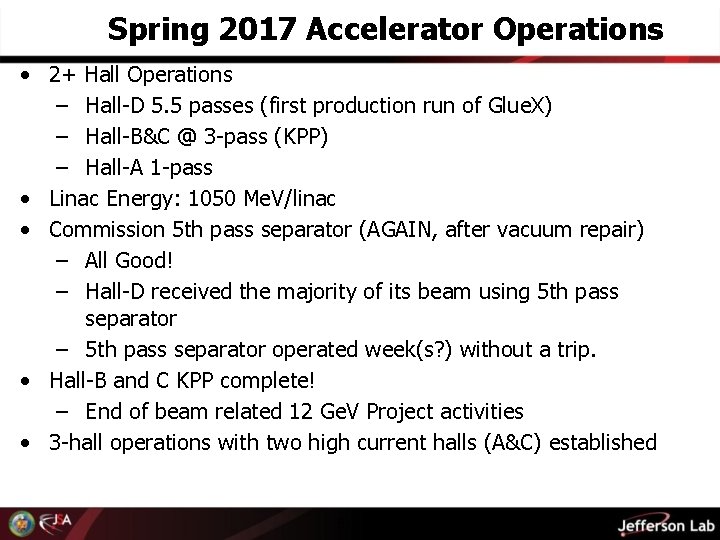
Spring 2017 Accelerator Operations • 2+ Hall Operations – Hall-D 5. 5 passes (first production run of Glue. X) – Hall-B&C @ 3 -pass (KPP) – Hall-A 1 -pass • Linac Energy: 1050 Me. V/linac • Commission 5 th pass separator (AGAIN, after vacuum repair) – All Good! – Hall-D received the majority of its beam using 5 th pass separator – 5 th pass separator operated week(s? ) without a trip. • Hall-B and C KPP complete! – End of beam related 12 Ge. V Project activities • 3 -hall operations with two high current halls (A&C) established 6
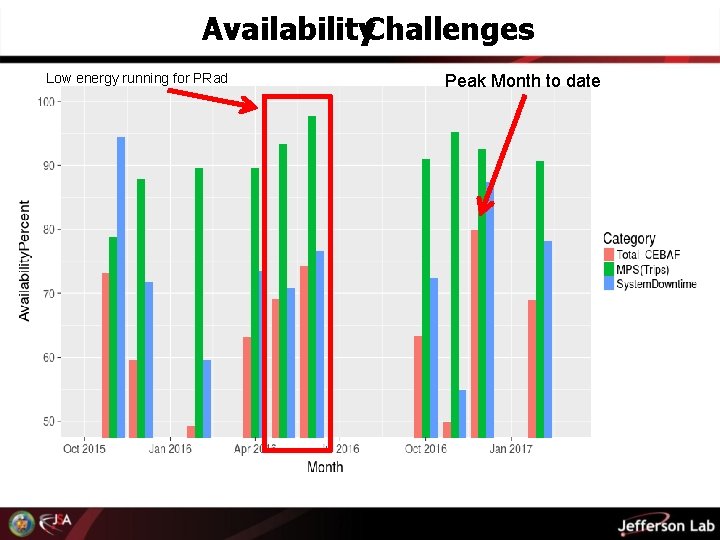
Availability. Challenges Low energy running for PRad Peak Month to date 7
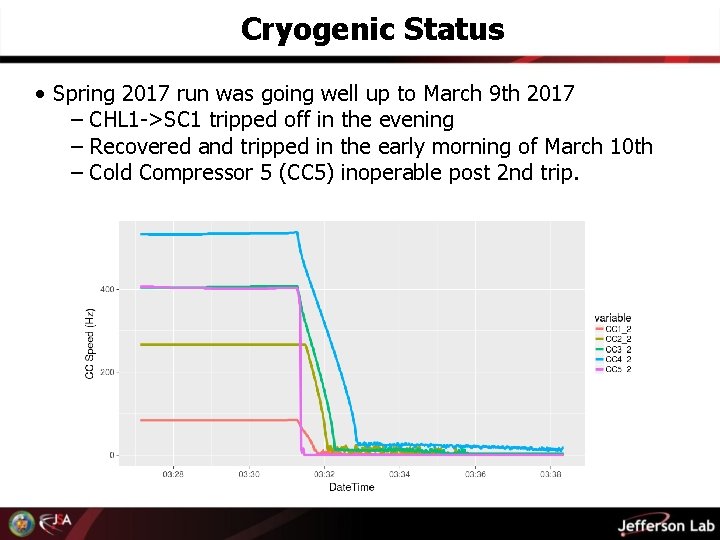
Cryogenic Status • Spring 2017 run was going well up to March 9 th 2017 – CHL 1 ->SC 1 tripped off in the evening – Recovered and tripped in the early morning of March 10 th – Cold Compressor 5 (CC 5) inoperable post 2 nd trip. 8
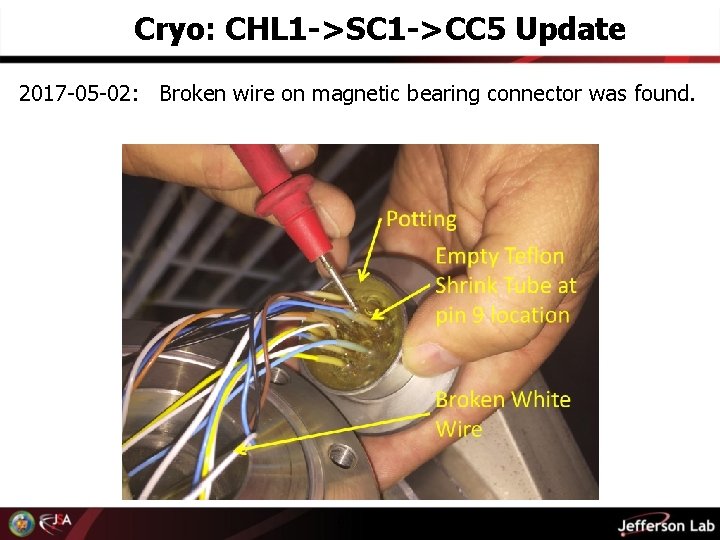
Cryo: CHL 1 ->SC 1 ->CC 5 Update 2017 -05 -02: Broken wire on magnetic bearing connector was found. 9
Optimizing 12 Ge. V Operations • Reliability/Availability Focus –Improved Linac/Cryogenic changes: Reduce risk of cryoplant contamination – Linac LHe Pressure – Identifying errant magnets – 4 -Hall Operations • Energy Reach – Linac energy setting: margin -> reliable operations – Identifying source SRF Particulate • Cleaning/processing warm girder regions – Improved in tunnel vacuum procedures – C 75 Upgrade 10
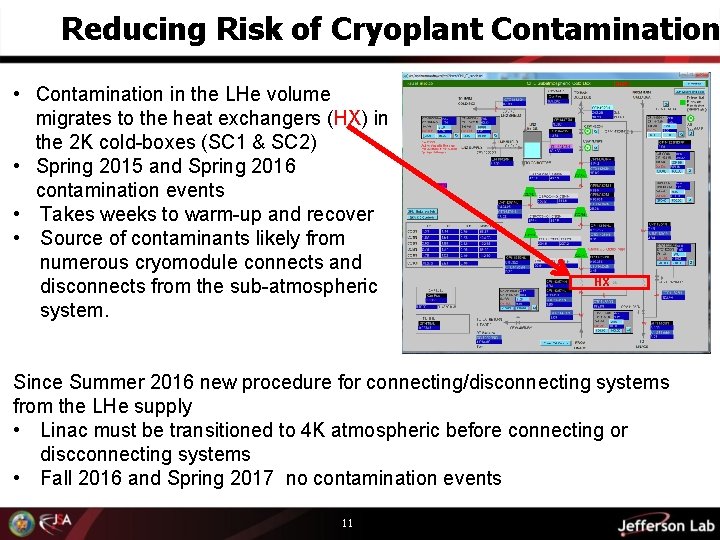
Reducing Risk of Cryoplant Contamination • Contamination in the LHe volume migrates to the heat exchangers (HX) in the 2 K cold-boxes (SC 1 & SC 2) • Spring 2015 and Spring 2016 contamination events • Takes weeks to warm-up and recover • Source of contaminants likely from numerous cryomodule connects and disconnects from the sub-atmospheric system. HX Since Summer 2016 new procedure for connecting/disconnecting systems from the LHe supply • Linac must be transitioned to 4 K atmospheric before connecting or discconnecting systems • Fall 2016 and Spring 2017 no contamination events 11
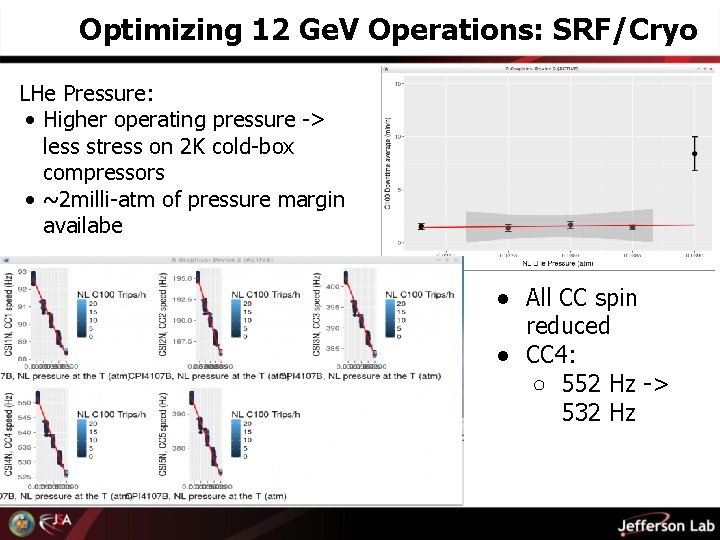
Optimizing 12 Ge. V Operations: SRF/Cryo LHe Pressure: • Higher operating pressure -> less stress on 2 K cold-box compressors • ~2 milli-atm of pressure margin availabe ● All CC spin reduced ● CC 4: ○ 552 Hz -> 532 Hz 12
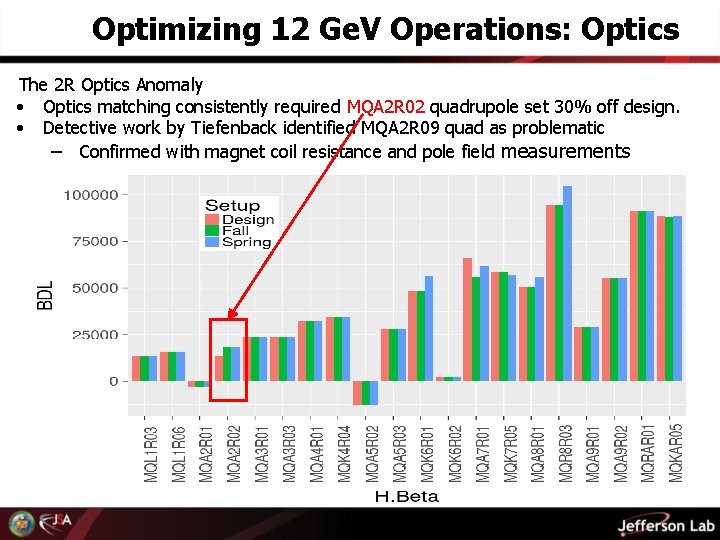
Optimizing 12 Ge. V Operations: Optics The 2 R Optics Anomaly • Optics matching consistently required MQA 2 R 02 quadrupole set 30% off design. • Detective work by Tiefenback identified MQA 2 R 09 quad as problematic – Confirmed with magnet coil resistance and pole field measurements 13
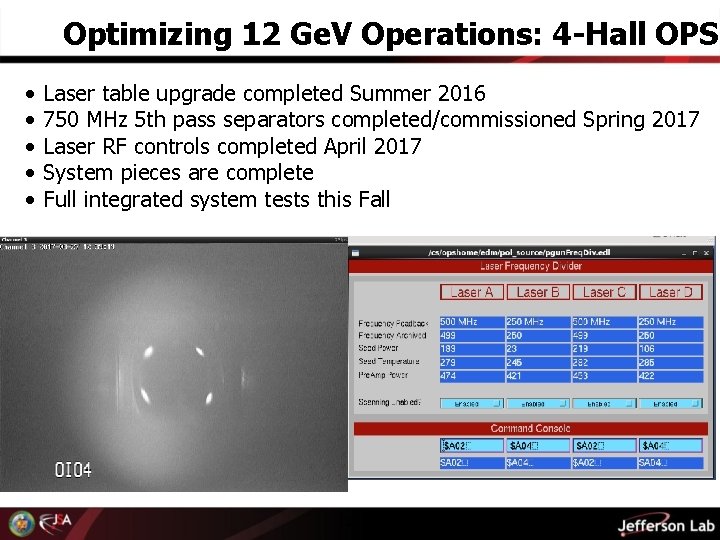
Optimizing 12 Ge. V Operations: 4 -Hall OPS • • • Laser table upgrade completed Summer 2016 750 MHz 5 th pass separators completed/commissioned Spring 2017 Laser RF controls completed April 2017 System pieces are complete Full integrated system tests this Fall 14
Energy Reach • CEBAF C 20 RF trip rate is a function of cavity gradient – Well modeled by Linac Energy Manager with frequent cavity parameter updates from Benesch • Operations requires sufficient gradient margin so that emergent problematic cavities do not derail the program (CEBAF down hard) – Margin of 60 Me. V/linac at the start of each FY – Provides enough margin to deal with entire C 20/C 50 cryomodule • Determine Energy setting that results in 8 RF trips/h from C 20 modules (assume C 50/C 100 contribute another 2 trips/h) • Subtract 60 Me. V/linac from this value to determine the maximum linac energy gain allowed. • Elinac < E 8 trips/h - 60 Me. V 15
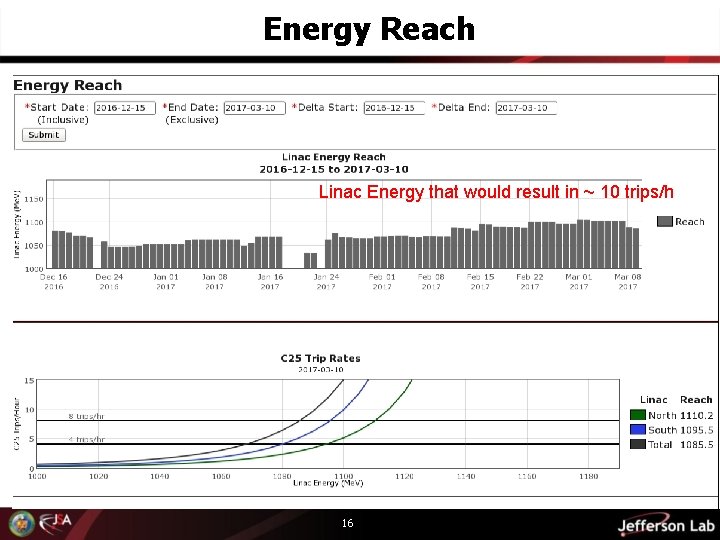
Energy Reach Linac Energy that would result in ~ 10 trips/h 16
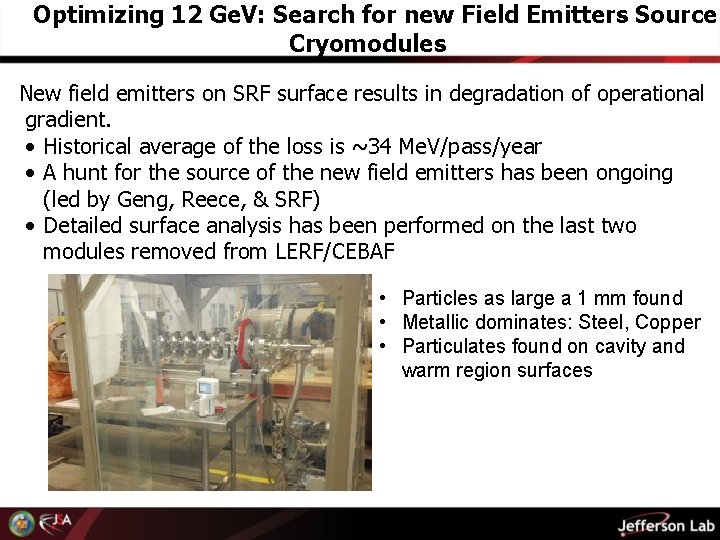
Optimizing 12 Ge. V: Search for new Field Emitters Source Cryomodules New field emitters on SRF surface results in degradation of operational gradient. • Historical average of the loss is ~34 Me. V/pass/year • A hunt for the source of the new field emitters has been ongoing (led by Geng, Reece, & SRF) • Detailed surface analysis has been performed on the last two modules removed from LERF/CEBAF • Particles as large a 1 mm found • Metallic dominates: Steel, Copper • Particulates found on cavity and warm region surfaces 17
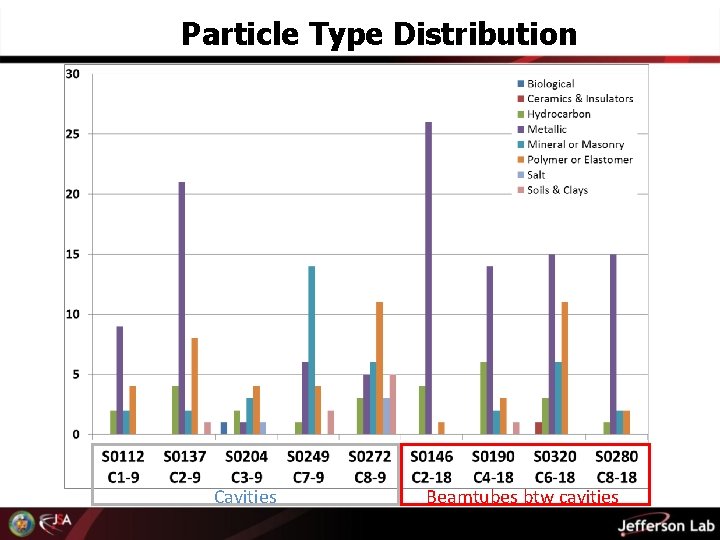
Particle Type Distribution Cavities Beamtubes btw cavities
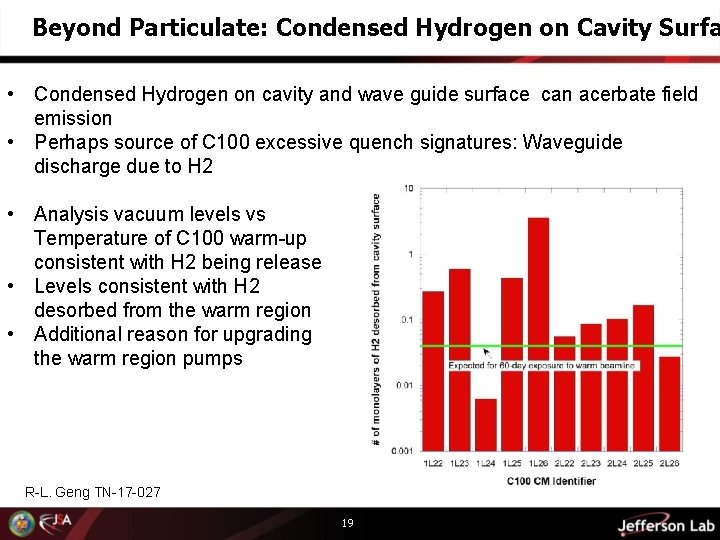
Beyond Particulate: Condensed Hydrogen on Cavity Surfa • Condensed Hydrogen on cavity and wave guide surface can acerbate field emission • Perhaps source of C 100 excessive quench signatures: Waveguide discharge due to H 2 • Analysis vacuum levels vs Temperature of C 100 warm-up consistent with H 2 being release • Levels consistent with H 2 desorbed from the warm region • Additional reason for upgrading the warm region pumps R-L. Geng TN-17 -027 19
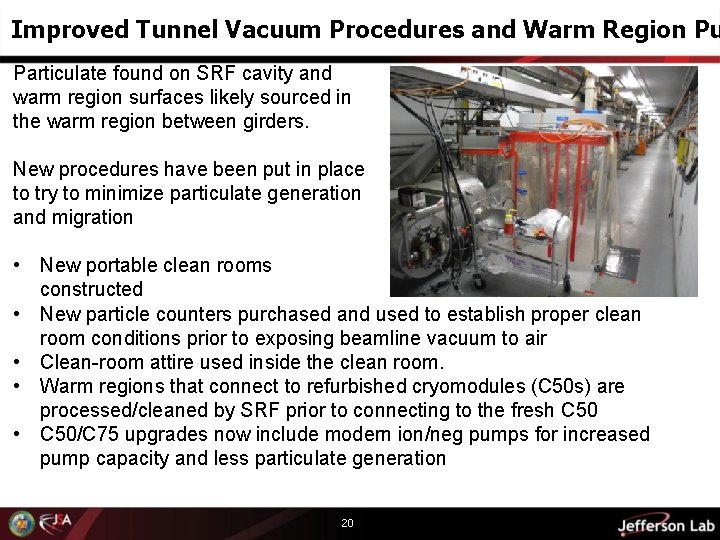
Improved Tunnel Vacuum Procedures and Warm Region Pu Particulate found on SRF cavity and warm region surfaces likely sourced in the warm region between girders. New procedures have been put in place to try to minimize particulate generation and migration • New portable clean rooms constructed • New particle counters purchased and used to establish proper clean room conditions prior to exposing beamline vacuum to air • Clean-room attire used inside the clean room. • Warm regions that connect to refurbished cryomodules (C 50 s) are processed/cleaned by SRF prior to connecting to the fresh C 50 • C 50/C 75 upgrades now include modern ion/neg pumps for increased pump capacity and less particulate generation 20
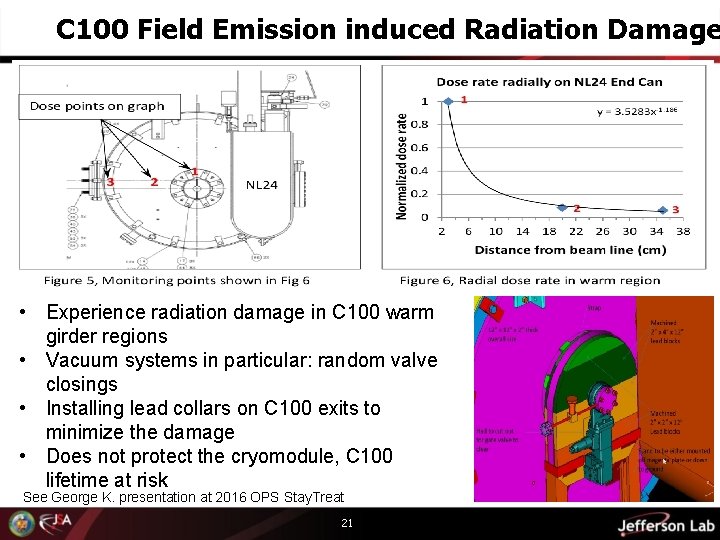
C 100 Field Emission induced Radiation Damage • Experience radiation damage in C 100 warm girder regions • Vacuum systems in particular: random valve closings • Installing lead collars on C 100 exits to minimize the damage • Does not protect the cryomodule, C 100 lifetime at risk See George K. presentation at 2016 OPS Stay. Treat 21
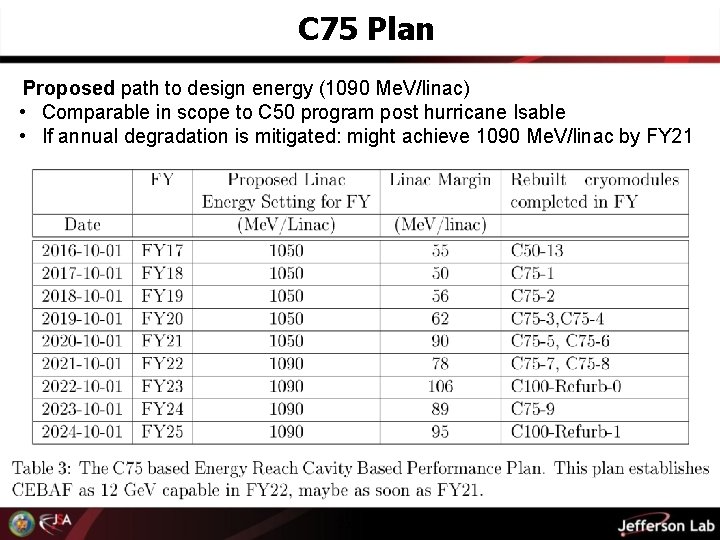
C 75 Plan Proposed path to design energy (1090 Me. V/linac) • Comparable in scope to C 50 program post hurricane Isable • If annual degradation is mitigated: might achieve 1090 Me. V/linac by FY 21 22
Fall 2017 and beyond • Cryogenics situation still fluid, but… – planning for a 2 K operations on two cold-boxes by Sept. • Beam operations resume first week in Oct (start of FY 18) • 3+ hall operation • Linac Energy: 1050 Me. V/linac • Challenges include: – 4 -hall operation for the first time • Expect lower availability – First time two beam for physics through the same slit – First use of the vertical separators for simultaneous 5 th pass beam to A, B or C – Fully loaded linac currents: May push the old compromised klystrons over the edge • There are 50+ klystrons showing end-of-life symptoms 23
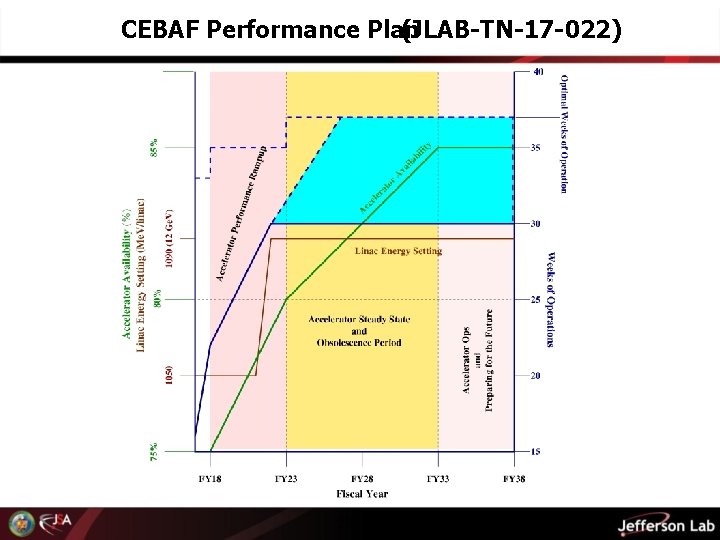
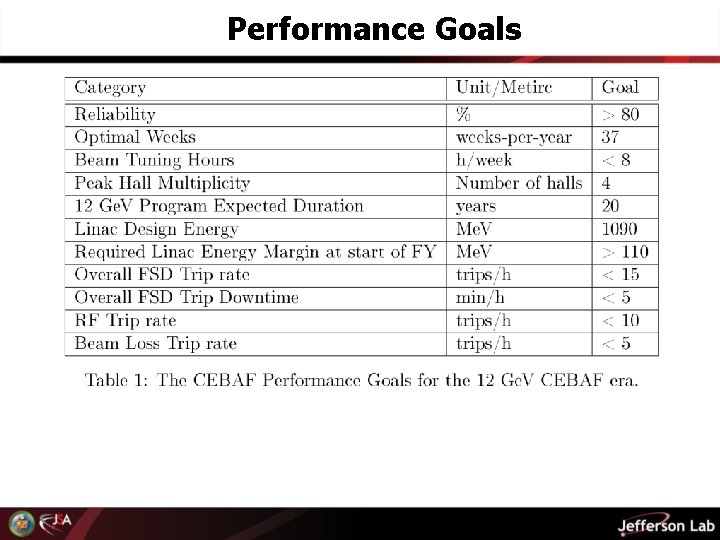
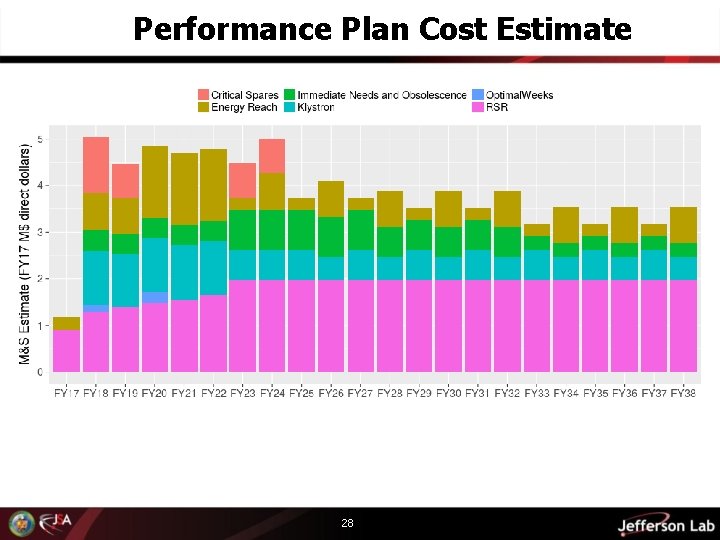
Summary ● 12 Ge. V Experimental program established ○ Hall-A: GMp completed(Hall-A), schedule portion of DVCS completed ○ Hall-B: PRad completed, HPS engineering run ○ Hall-D: First production run Spring 2017 ● 12 Ge. V beam related activities completed ○ Hall-B KPP ○ Hall-C KPP ● Accelerator Operations continues to dial in 12 Ge. V performance ○ Combined effort with CASA, SRF, Engineering, Facilities ● Availability Challenges Remain ○ New systems issues: Box supplies, magnet buses ○ End-of-life issues: SRF Window failures, SC 1 2 K cold-box ○ Performance Plan (JLAB-TN-17 -022) ■ Lack of critical spares ■ End-of-life issues and obsolescence 24
Backup 25
CEBAF Performance Plan (JLAB-TN-17 -022) 26
Performance Goals 27
Performance Plan Cost Estimate 28
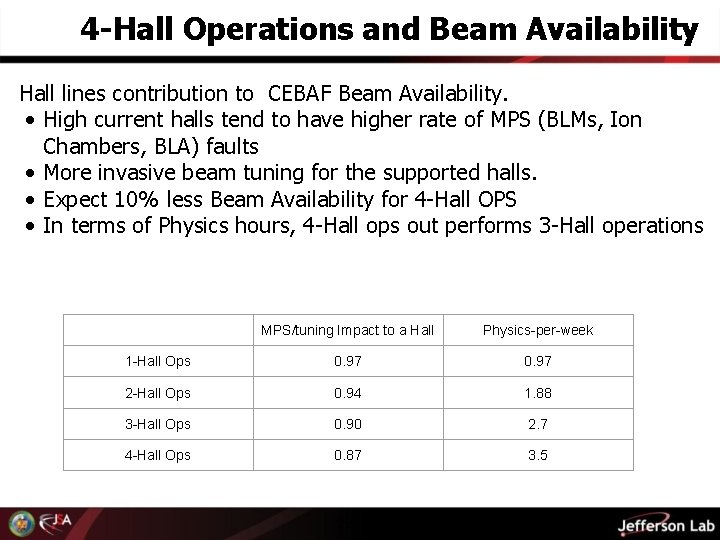
4 -Hall Operations and Beam Availability Hall lines contribution to CEBAF Beam Availability. • High current halls tend to have higher rate of MPS (BLMs, Ion Chambers, BLA) faults • More invasive beam tuning for the supported halls. • Expect 10% less Beam Availability for 4 -Hall OPS • In terms of Physics hours, 4 -Hall ops out performs 3 -Hall operations MPS/tuning Impact to a Hall Physics-per-week 1 -Hall Ops 0. 97 2 -Hall Ops 0. 94 1. 88 3 -Hall Ops 0. 90 2. 7 4 -Hall Ops 0. 87 3. 5 29
- Slides: 29