
CEAIrfu Saclay IAP Paris APC Paris CNES Toulouse


- Slides: 13
CEA-Irfu, Saclay IAP, Paris APC, Paris CNES, Toulouse NAOC, Beijing XIOPM, Xi’an IHEP, Beijing SECM, Shanghai IRAP, Toulouse LAM, Marseille CPPM, Marseille GEPI, Meudon LAL, Orsay LUPM, Montpellier University of Leicester MPE, Garching SVOM in the multi-messenger area Sarah Antier LAL, France (antier@lal. in 2 p 3. fr) On behalf of the SVOM consortium 02/06/2017 1
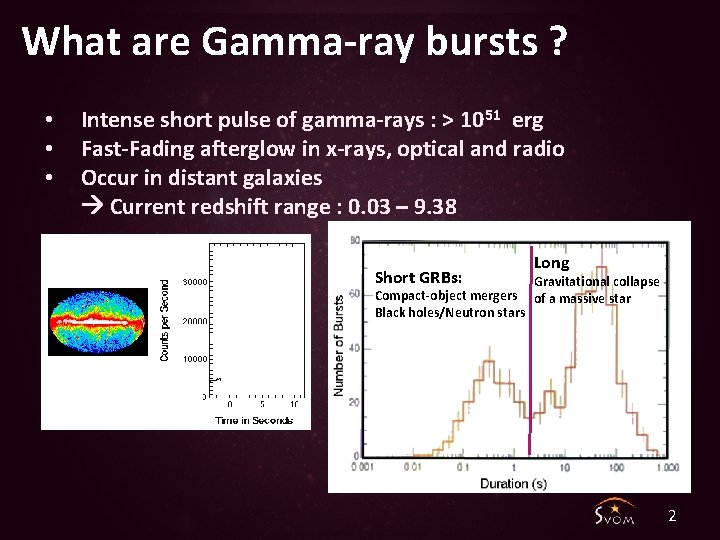
What are Gamma-ray bursts ? • • • Intense short pulse of gamma-rays : > 1051 erg Fast-Fading afterglow in x-rays, optical and radio Occur in distant galaxies Current redshift range : 0. 03 – 9. 38 Short GRBs: Compact-object mergers Black holes/Neutron stars Long Gravitational collapse of a massive star 2
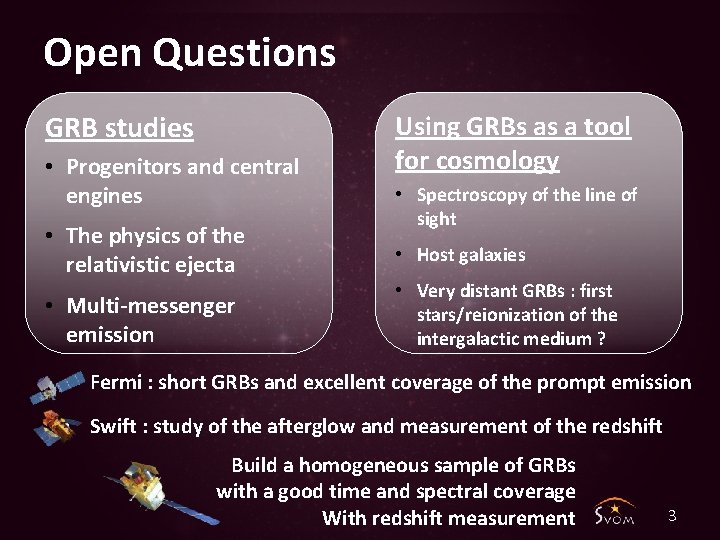
Open Questions GRB studies • Progenitors and central engines • The physics of the relativistic ejecta • Multi-messenger emission Using GRBs as a tool for cosmology • Spectroscopy of the line of sight • Host galaxies • Very distant GRBs : first stars/reionization of the intergalactic medium ? • Fermi : short GRBs and excellent coverage of the prompt emission • Swift : study of the afterglow and measurement of the redshift Build a homogeneous sample of GRBs with a good time and spectral coverage With redshift measurement 3
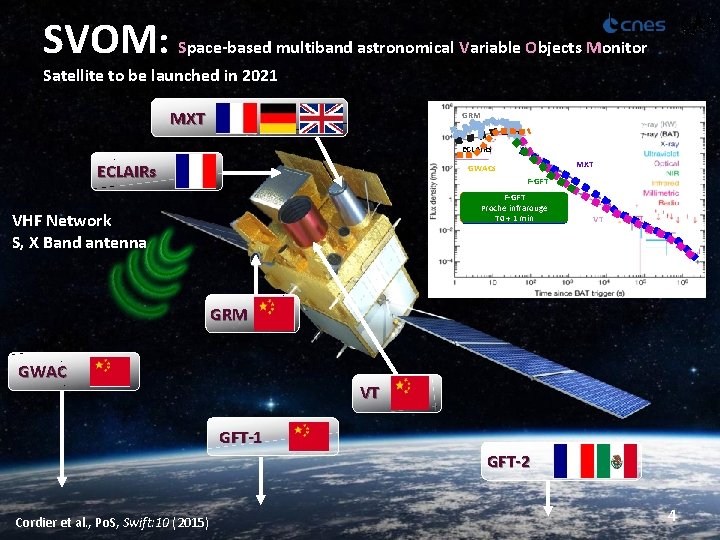
SVOM: Space-based multiband astronomical Variable Objects Monitor Satellite to be launched in 2021 MXT GRM ECLAIRs MXT GWACs F-GFT ECLAIRs GWACs GRM F-GFT VT MXT Rayons –Gamma X durs Proche infrarouge Visible X-mous Temps T 0 min T 0 ++T 0 31 min VHF Network S, X Band antenna VT GRM GWAC VT GFT-1 GFT-2 Cordier et al. , Po. S, Swift: 10 (2015) 4
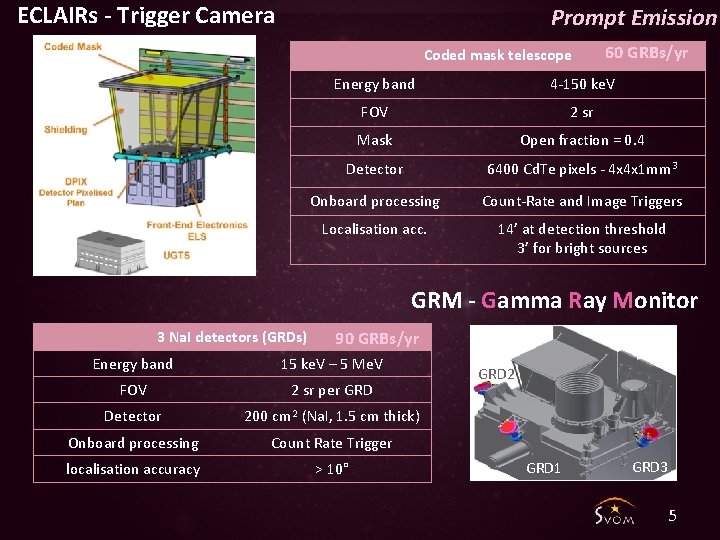
ECLAIRs - Trigger Camera Prompt Emission Coded mask telescope 60 GRBs/yr Energy band 4 -150 ke. V FOV 2 sr Mask Open fraction = 0. 4 Detector 6400 Cd. Te pixels - 4 x 4 x 1 mm 3 Onboard processing Count-Rate and Image Triggers Localisation acc. 14’ at detection threshold 3’ for bright sources GRM - Gamma Ray Monitor 3 Na. I detectors (GRDs) 90 GRBs/yr Energy band 15 ke. V – 5 Me. V FOV 2 sr per GRD Detector 200 cm 2 (Na. I, 1. 5 cm thick) Onboard processing Count Rate Trigger localisation accuracy > 10° GRD 2 GRD 1 GRD 3 5
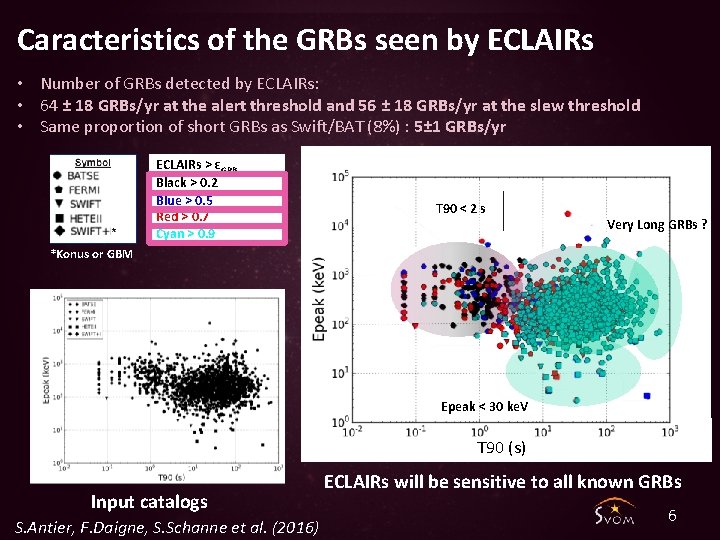
Caracteristics of the GRBs seen by ECLAIRs • Number of GRBs detected by ECLAIRs: • 64 ± 18 GRBs/yr at the alert threshold and 56 ± 18 GRBs/yr at the slew threshold • Same proportion of short GRBs as Swift/BAT (8%) : 5± 1 GRBs/yr ECLAIRs > ɛGRB Black > 0. 2 Blue > 0. 5 Red > 0. 7 Cyan > 0. 9 T 90 < 2 s Very Long GRBs ? *Konus or GBM Epeak < 30 ke. V T 90 (s) Input catalogs S. Antier, F. Daigne, S. Schanne et al. (2016) ECLAIRs will be sensitive to all known GRBs 6
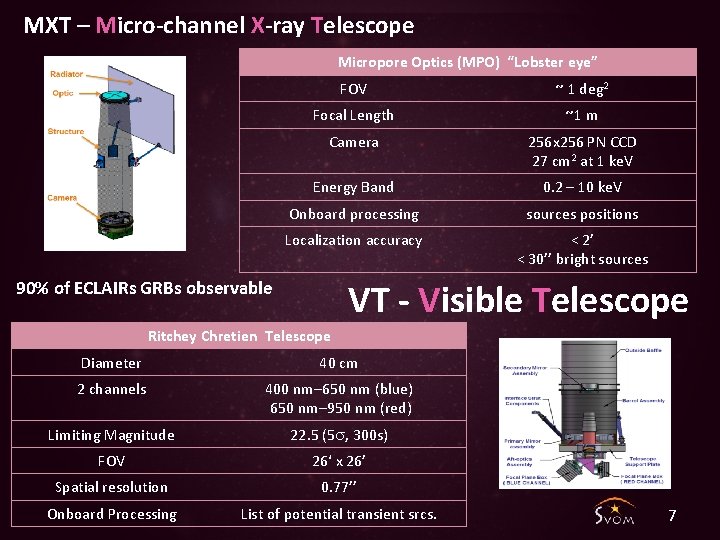
MXT – Micro-channel X-ray Telescope Micropore Optics (MPO) “Lobster eye” FOV ~ 1 deg 2 Focal Length ~1 m Camera 256 x 256 PN CCD 27 cm 2 at 1 ke. V Energy Band 0. 2 – 10 ke. V Onboard processing sources positions Localization accuracy < 2’ < 30’’ bright sources VT - Visible Telescope 90% of ECLAIRs GRBs observable Ritchey Chretien Telescope Diameter 40 cm 2 channels 400 nm– 650 nm (blue) 650 nm– 950 nm (red) Limiting Magnitude 22. 5 (5 , 300 s) FOV 26‘ x 26’ Spatial resolution 0. 77’’ Onboard Processing List of potential transient srcs. 7
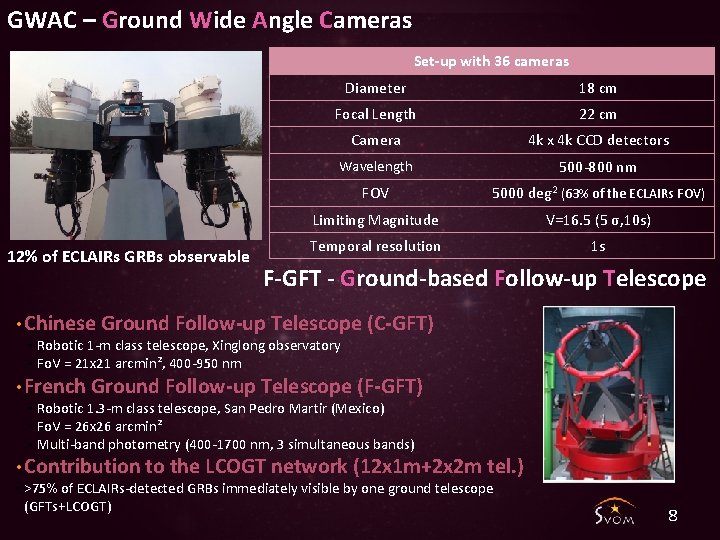
GWAC – Ground Wide Angle Cameras Set-up with 36 cameras 12% of ECLAIRs GRBs observable Diameter 18 cm Focal Length 22 cm Camera 4 k x 4 k CCD detectors Wavelength 500 -800 nm FOV 5000 deg 2 (63% of the ECLAIRs FOV) Limiting Magnitude V=16. 5 (5 σ, 10 s) Temporal resolution 1 s F-GFT - Ground-based Follow-up Telescope • Chinese Ground Follow-up Telescope (C-GFT) Robotic 1 -m class telescope, Xinglong observatory • Fo. V = 21 x 21 arcmin², 400 -950 nm • • French Ground Follow-up Telescope (F-GFT) Robotic 1. 3 -m class telescope, San Pedro Martir (Mexico) • Fo. V = 26 x 26 arcmin² • Multi-band photometry (400 -1700 nm, 3 simultaneous bands) • • Contribution to the LCOGT network (12 x 1 m+2 x 2 m tel. ) • >75% of ECLAIRs-detected GRBs immediately visible by one ground telescope (GFTs+LCOGT) 8
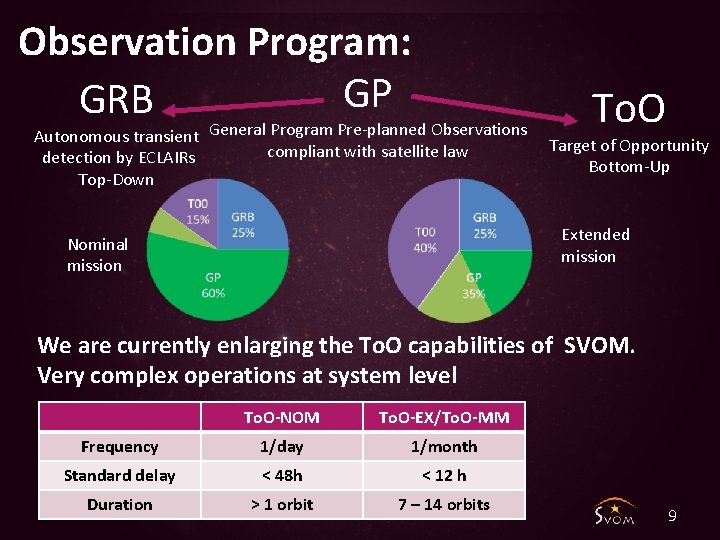
Observation Program: GP GRB Autonomous transient General Program Pre-planned Observations compliant with satellite law detection by ECLAIRs Top-Down To. O Target of Opportunity Bottom-Up Extended mission Nominal mission We are currently enlarging the To. O capabilities of SVOM. Very complex operations at system level To. O-NOM To. O-EX/To. O-MM Frequency 1/day 1/month Standard delay < 48 h < 12 h Duration > 1 orbit 7 – 14 orbits 9
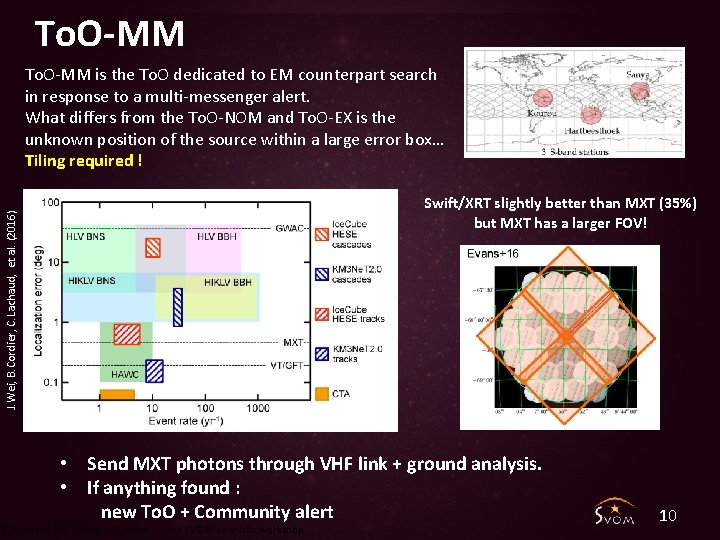
To. O-MM is the To. O dedicated to EM counterpart search in response to a multi-messenger alert. What differs from the To. O-NOM and To. O-EX is the unknown position of the source within a large error box… Tiling required ! J. Wei, B. Cordier, C. Lachaud, et al. (2016) Swift/XRT slightly better than MXT (35%) but MXT has a larger FOV! • Send MXT photons through VHF link + ground analysis. • If anything found : new To. O + Community alert C. Lachaud & J. Wang - Qiannan - 2 nd SVOM scientific workshop 10
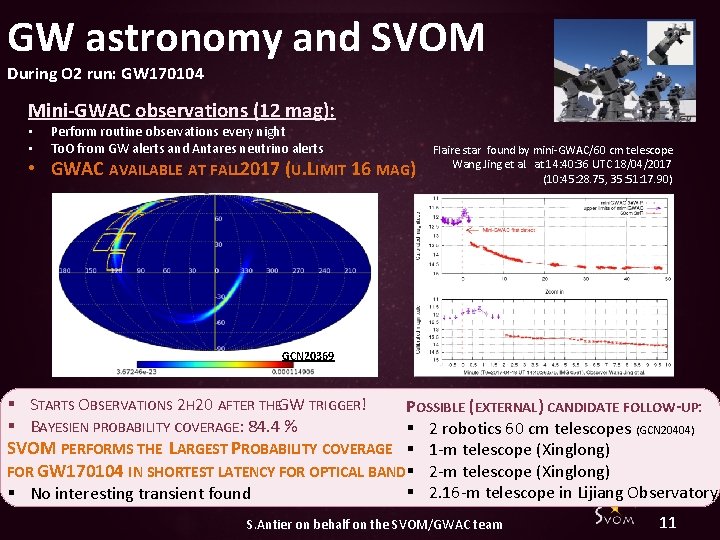
GW astronomy and SVOM During O 2 run: GW 170104 Mini-GWAC observations (12 mag): • • Perform routine observations every night To. O from GW alerts and Antares neutrino alerts • GWAC AVAILABLE AT FALL 2017 (U. LIMIT 16 MAG) Flaire star found by mini-GWAC/60 cm telescope Wang Jing et al. at 14: 40: 36 UTC 18/04/2017 (10: 45: 28. 75, 35: 51: 17. 90) GCN 20369 § STARTS OBSERVATIONS 2 H 20 AFTER THEGW TRIGGER! POSSIBLE (EXTERNAL) CANDIDATE FOLLOW-UP: § BAYESIEN PROBABILITY COVERAGE: 84. 4 % § 2 robotics 60 cm telescopes (GCN 20404) SVOM PERFORMS THE LARGEST PROBABILITY COVERAGE § 1 -m telescope (Xinglong) FOR GW 170104 IN SHORTEST LATENCY FOR OPTICAL BAND§ 2 -m telescope (Xinglong) § 2. 16 -m telescope in Lijiang Observatory § No interesting transient found S. Antier on behalf on the SVOM/GWAC team 11
Conclusion and perspectives Now, with the time domain and multi-messenger astronomy in strong developments, SVOM is ready to play an important role in the future… Sarah Antier, LAL, Orsay – SVOM in the context of multi-messenger area 12
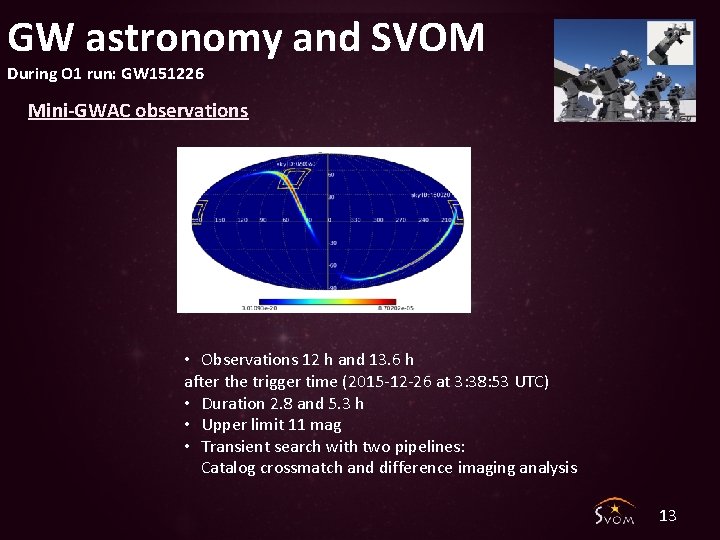
GW astronomy and SVOM During O 1 run: GW 151226 Mini-GWAC observations • Observations 12 h and 13. 6 h after the trigger time (2015 -12 -26 at 3: 38: 53 UTC) • Duration 2. 8 and 5. 3 h • Upper limit 11 mag • Transient search with two pipelines: Catalog crossmatch and difference imaging analysis 13