
Ce LAND PBq 144 Ce144 Pr source in
Ce. LAND: PBq 144 Ce-144 Pr source in Kam. LAND Jelena Maricic on behalf of Ce. LAND/Kam. LAND collaboration Cos. PA 2013 Honolulu, 11/14/2013
Outline �Physics motivation for the very short baseline neutrino oscillations search �Concept of the antineutrino generator experiment � 144 Ce-144 Pr PBq antineutrino generator �Search for sterile neutrinos in Kam. LAND with 144 Ce 144 Pr PBq source: Ce. LAND �Shielding, transportation, deployment �Sensitivity to short baseline oscillations �Summary and future steps Jelena Maricic, University of Hawaii 2
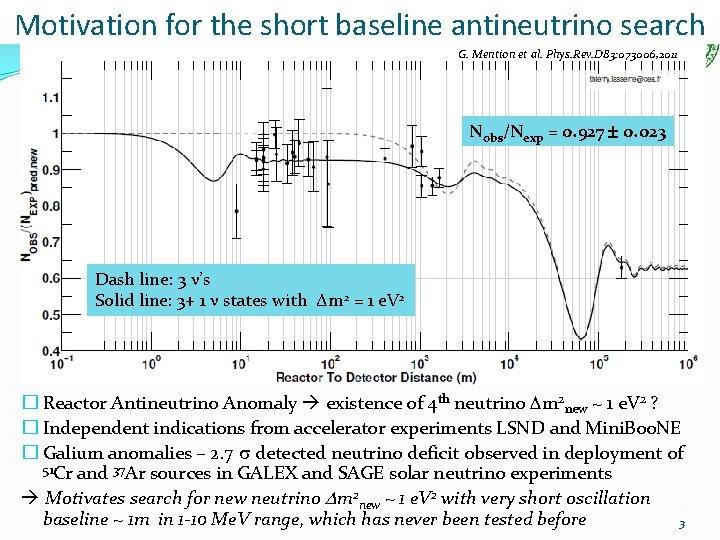
Motivation for the short baseline antineutrino search G. Mention et al. Phys. Rev. D 83: 073006, 2011 Nobs/Nexp = 0. 927 0. 023 Dash line: 3 ν’s Solid line: 3+ 1 ν states with Δm 2 = 1 e. V 2 � Reactor Antineutrino Anomaly existence of 4 th neutrino m 2 new ~ 1 e. V 2 ? � Independent indications from accelerator experiments LSND and Mini. Boo. NE � Galium anomalies – 2. 7 detected neutrino deficit observed in deployment of 51 Cr and 37 Ar sources in GALEX and SAGE solar neutrino experiments Motivates search for new neutrino m 2 new ~ 1 e. V 2 with very short oscillation baseline ~ 1 m in 1 -10 Me. V range, which has never been tested before 3
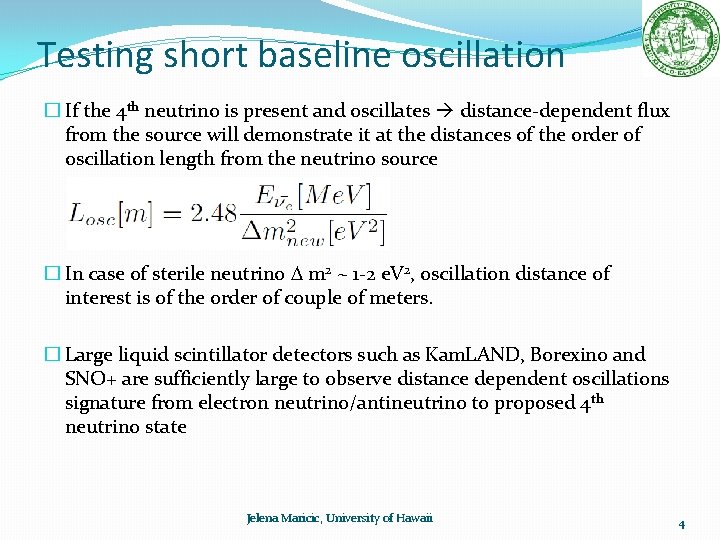
Testing short baseline oscillation � If the 4 th neutrino is present and oscillates distance-dependent flux from the source will demonstrate it at the distances of the order of oscillation length from the neutrino source � In case of sterile neutrino m 2 ~ 1 -2 e. V 2, oscillation distance of interest is of the order of couple of meters. � Large liquid scintillator detectors such as Kam. LAND, Borexino and SNO+ are sufficiently large to observe distance dependent oscillations signature from electron neutrino/antineutrino to proposed 4 th neutrino state Jelena Maricic, University of Hawaii 4
Neutrino and antineutrino generators � Neutrino generators such as 51 Cr and 37 Ar have been used in the past � Monoenergetic � Require measurement of vertex position only for L/E � Detection in LS via elastic scattering off electrons must be very strong (5 -10 MCi) to overcome solar neutrino background � Antineutrino generators are detected in LS detected via inverse beta decay (IBD) � Antineutrino energy > 1. 8 Me. V (IBD threshold) � Lifetime > 1 month to allow time for production and transport � Requires nuclei with high Qβ and long lifetime � No single nucleus satisfies this condition � Pairs of beta decay nuclei needed: the first one with low Qβ and long lifetime followed by the second one with high Qβ and short lifetime Jelena Maricic, University of Hawaii 5
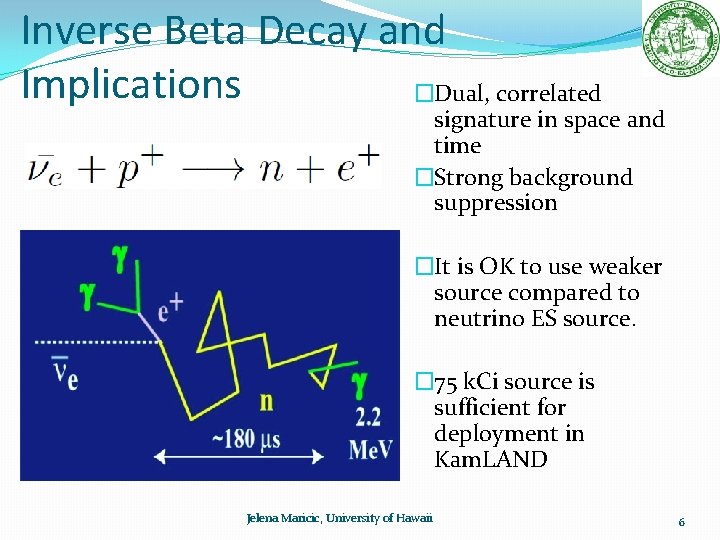
Inverse Beta Decay and Implications �Dual, correlated signature in space and time �Strong background suppression �It is OK to use weaker source compared to neutrino ES source. � 75 k. Ci source is sufficient for deployment in Kam. LAND Jelena Maricic, University of Hawaii 6
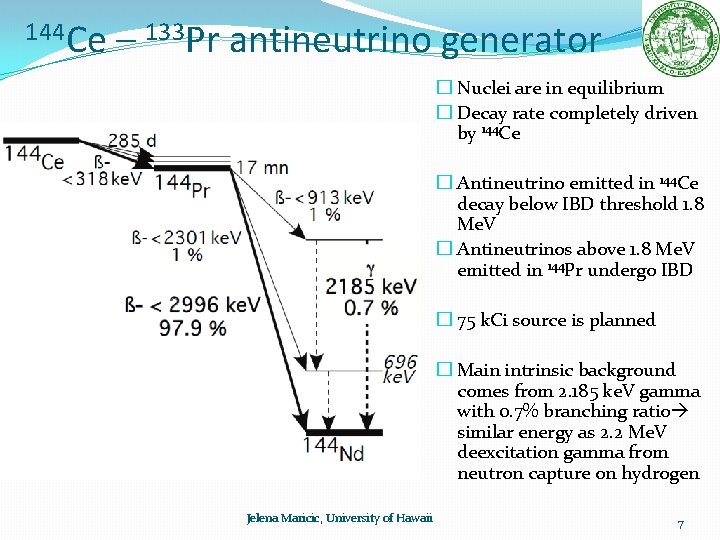
144 Ce – 133 Pr antineutrino generator � Nuclei are in equilibrium � Decay rate completely driven by 144 Ce � Antineutrino emitted in 144 Ce decay below IBD threshold 1. 8 Me. V � Antineutrinos above 1. 8 Me. V emitted in 144 Pr undergo IBD � 75 k. Ci source is planned � Main intrinsic background comes from 2. 185 ke. V gamma with 0. 7% branching ratio similar energy as 2. 2 Me. V deexcitation gamma from neutron capture on hydrogen Jelena Maricic, University of Hawaii 7
144 Ce source production I �Natural cerium is mostly 140 Ce (88. 45%) in the form of Ce. O 2 in presence of oxygen � 144 Ce is a fission product, with 5. 2% fission yield from 235 U �It has the longest lifetime of all cerium isotopes (half-life 285 days) – much longer than any other isotope �Its long half-life allows time for production from irradiated fuel, transport to reprocessing facility and year long deployment in the LS detector �Fresher irradiated fuel has a higher 144 Ce fraction, allowing a more compact packaging of the source and higher source activity, which is important for the oscillation measurement Jelena Maricic, University of Hawaii 8
144 Ce source production II � 144 Ce source will be produced at Mayak reprocessing facility in Russia � They will produce (85+15 – 10)k. Ci source based on the beta activity measurement with 8% uncertainty. � Excellent chance to get a source above 75 k. Ci activity at Kam. LAND! � Usage of standard Mayak cylindrical container 15 cm in diameter and 15 cm in height, with double capsule walls (3 mm and 4 mm thick steel wit 0. 5 mm gap) foreseen � Extra space (if available) will be filled with additional Ce. O 2 up to 100 k. Ci activity free of charge! � This will depend on the fuel age; typical SNF 3 -5 years old; possibility to use fresher fuel, just 1. 7 - 2 year after irradiation! � 144 Ce fraction between (0. 6+0. 1 -0. 15)% at 3 years after irradiation Jelena Maricic, University of Hawaii 9
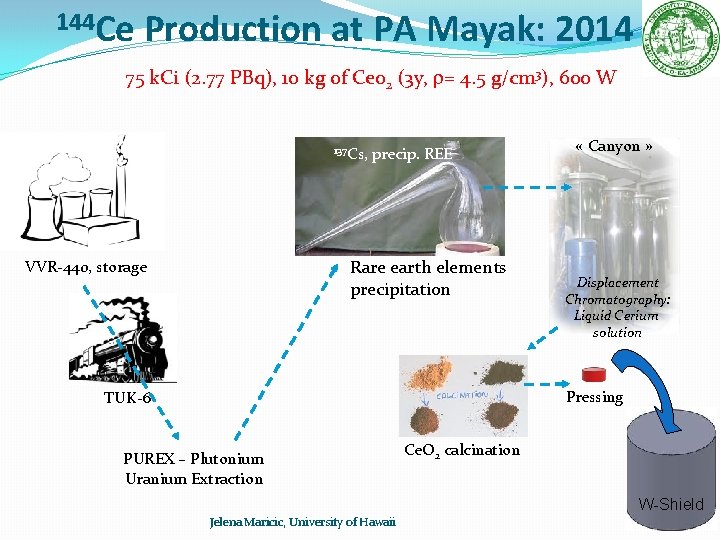
144 Ce Production at PA Mayak: 2014 75 k. Ci (2. 77 PBq), 10 kg of Ce 02 (3 y, = 4. 5 g/cm 3), 600 W 137 Cs, precip. REE Rare earth elements precipitation VVR-440, storage « Canyon » Displacement Chromatography: Liquid Cerium solution Pressing TUK-6 PUREX – Plutonium Uranium Extraction Ce. O 2 calcination W-Shield Jelena Maricic, University of Hawaii 10
High Z-shielding �Tungsten shielding that is 97% tungsten and = 18. 5 g/cm 3 will be used �Shielding has two-fold purpose: �Biological protection during transportation and handling �Suppression of the 2. 186 Me. V gamma during deployment: 525 Ci activity from 75 k. Ci 144 Ce �Biological protection is estimated in terms of equivalent dose received by a person at 1 m distance from the surface of the shield/container � 16 cm thick tungsten shield around 75 k. Ci source is sufficient for biological and deployment protection 2. 2 ton weight �Several transportation options under consideration Jelena Maricic, University of Hawaii 11
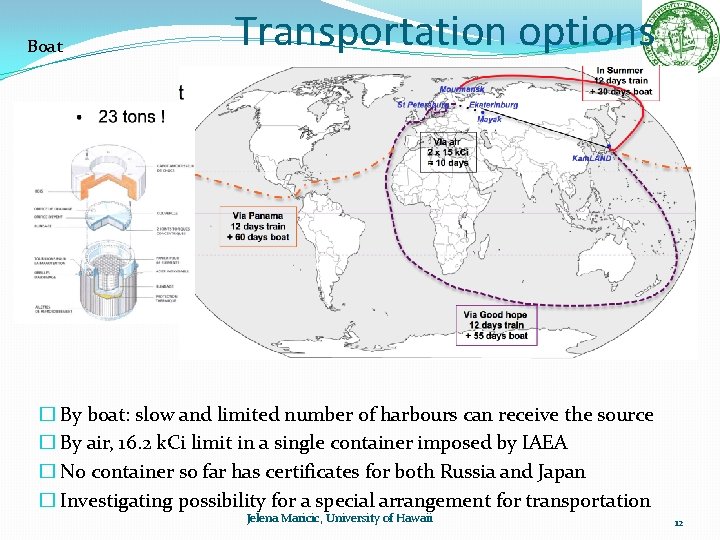
Boat Transportation options � By boat: slow and limited number of harbours can receive the source � By air, 16. 2 k. Ci limit in a single container imposed by IAEA � No container so far has certificates for both Russia and Japan � Investigating possibility for a special arrangement for transportation Jelena Maricic, University of Hawaii 12
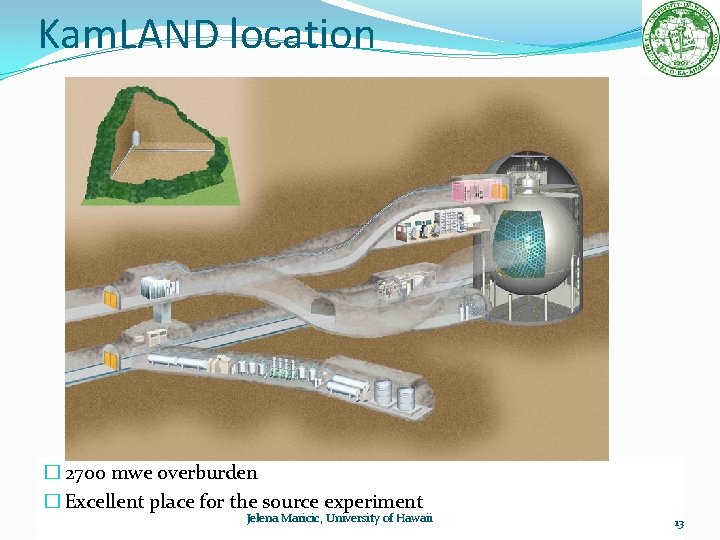
Kam. LAND location � 2700 mwe overburden � Excellent place for the source experiment Jelena Maricic, University of Hawaii 13
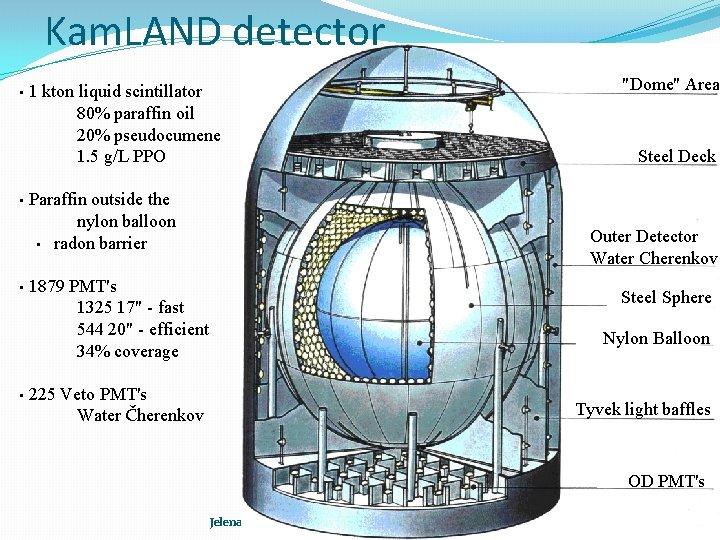
Kam. LAND detector • • 1 kton liquid scintillator 80% paraffin oil 20% pseudocumene 1. 5 g/L PPO Paraffin outside the nylon balloon • radon barrier "Dome" Area Steel Deck Outer Detector Water Cherenkov 1879 PMT's 1325 17" fast 544 20" efficient 34% coverage Steel Sphere Nylon Balloon 225 Veto PMT's Water Čherenkov Tyvek light baffles OD PMT's Jelena Maricic, University of Hawaii 14
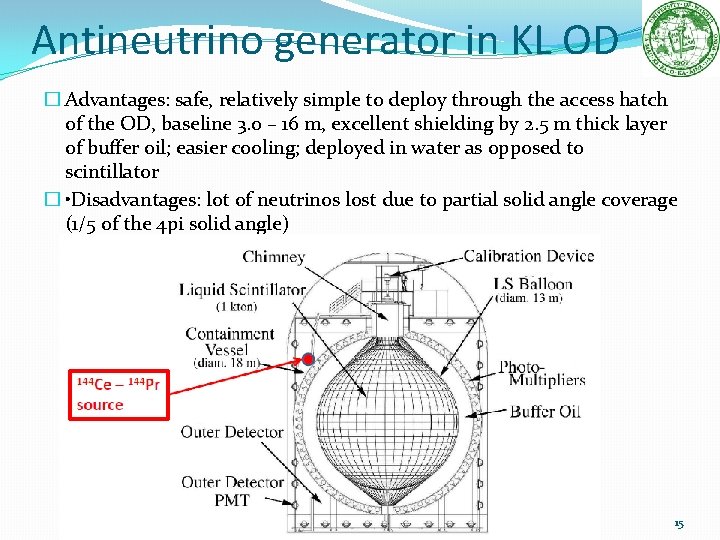
Antineutrino generator in KL OD � Advantages: safe, relatively simple to deploy through the access hatch of the OD, baseline 3. 0 – 16 m, excellent shielding by 2. 5 m thick layer of buffer oil; easier cooling; deployed in water as opposed to scintillator � • Disadvantages: lot of neutrinos lost due to partial solid angle coverage (1/5 of the 4 pi solid angle) Jelena Maricic, University of Hawaii 15
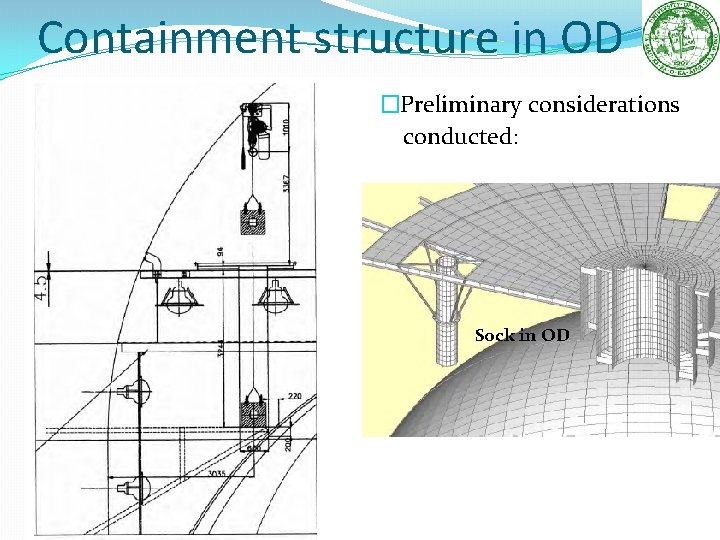
Containment structure in OD �Preliminary considerations conducted: Sock in OD Jelena Maricic, University of Hawaii 16
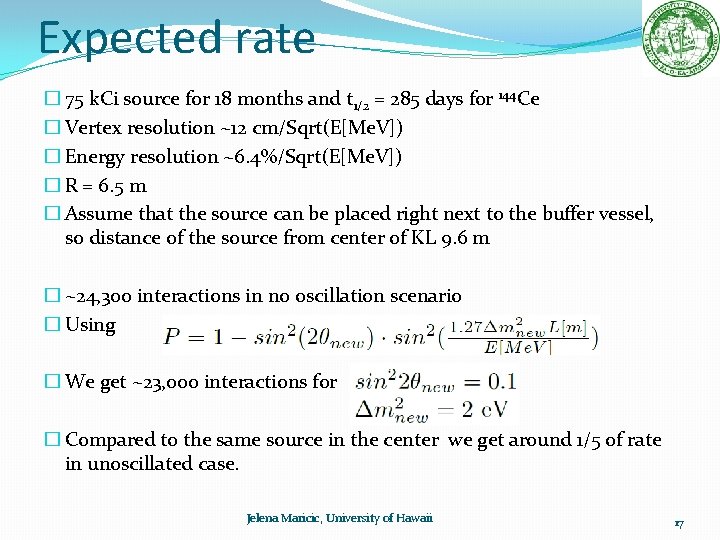
Expected rate � 75 k. Ci source for 18 months and t 1/2 = 285 days for 144 Ce � Vertex resolution ~12 cm/Sqrt(E[Me. V]) � Energy resolution ~6. 4%/Sqrt(E[Me. V]) � R = 6. 5 m � Assume that the source can be placed right next to the buffer vessel, so distance of the source from center of KL 9. 6 m � ~24, 300 interactions in no oscillation scenario � Using � We get ~23, 000 interactions for � Compared to the same source in the center we get around 1/5 of rate in unoscillated case. Jelena Maricic, University of Hawaii 17
![Rate Oscillated vs Unoscillated Spectrum ] e[m] Rate Distanc e. V M [ E](http://slidetodoc.com/presentation_image/19f4ffc8542c5d76c72fae3201522d6b/image-18.jpg "Rate Oscillated vs Unoscillated Spectrum ] e[m] Rate Distanc e. V M [ E")
Rate Oscillated vs Unoscillated Spectrum ] e[m] Rate Distanc e. V M [ E Di stance[ Jelena Maricic, University of Hawaii m] V] E[ 18 e M
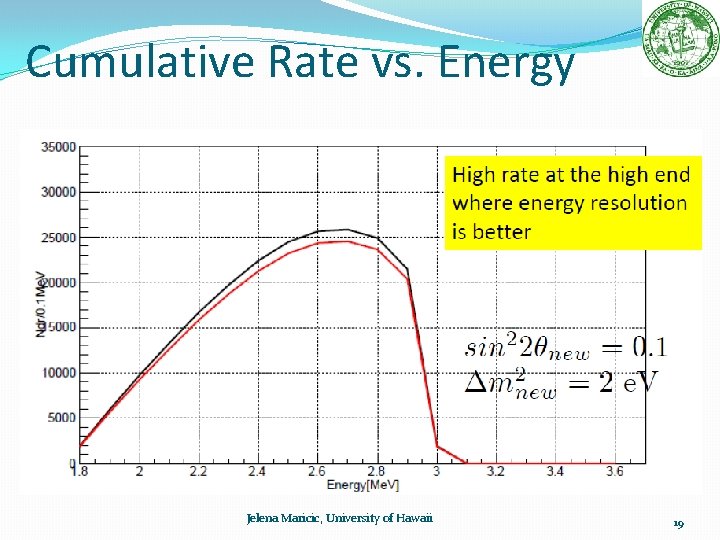
Cumulative Rate vs. Energy Jelena Maricic, University of Hawaii 19
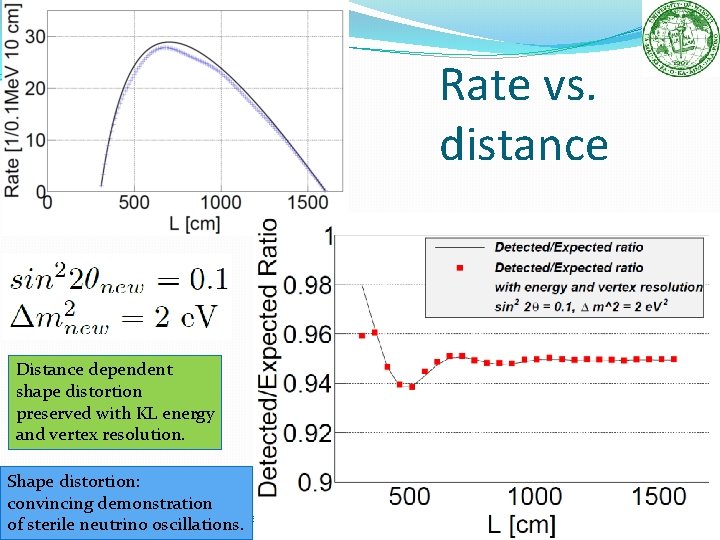
Rate vs. distance Distance dependent shape distortion preserved with KL energy and vertex resolution. Shape distortion: convincing demonstration of sterile neutrino oscillations. Jelena Maricic, University of Hawaii 20
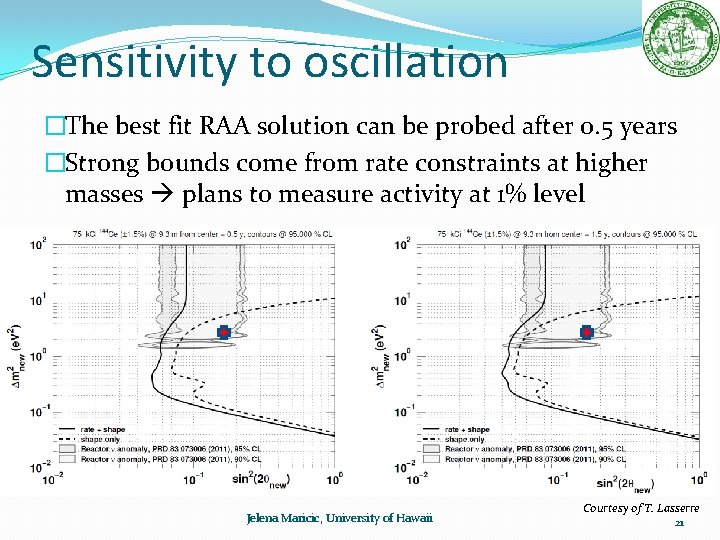
Sensitivity to oscillation �The best fit RAA solution can be probed after 0. 5 years �Strong bounds come from rate constraints at higher masses plans to measure activity at 1% level Jelena Maricic, University of Hawaii Courtesy of T. Lasserre 21
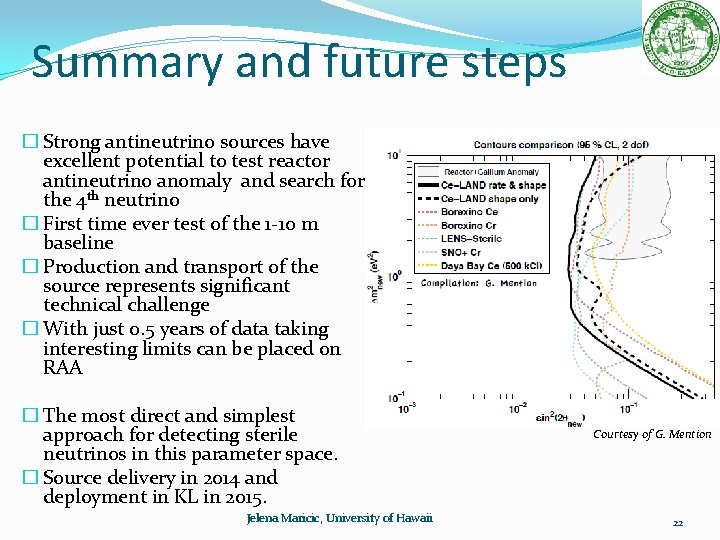
Summary and future steps � Strong antineutrino sources have excellent potential to test reactor antineutrino anomaly and search for the 4 th neutrino � First time ever test of the 1 -10 m baseline � Production and transport of the source represents significant technical challenge � With just 0. 5 years of data taking interesting limits can be placed on RAA � The most direct and simplest approach for detecting sterile neutrinos in this parameter space. � Source delivery in 2014 and deployment in KL in 2015. Jelena Maricic, University of Hawaii Courtesy of G. Mention 22
- Slides: 22