
CE 374 K Hydrology Lecture 1 Syllabus sequence
CE 374 K Hydrology – Lecture 1 • Syllabus, sequence of topics • Hydrology as a science and as a profession • Hydrologic cycle and world water balance • Water as a physical substance • Water data sharing (separate Powerpoint presentation) Readings: • For today – Applied Hydrology and Chapter 1 • For Thursday, Applied Hydrology, Sections 2. 1 and 2. 2
Hydrology as a Science • “Hydrology is the science that treats the waters of the earth, their occurrence, circulation and distribution, their chemical and physical properties, and their reaction with their environment, including their relation to living things. The domain of hydrology embraces the full life history of water on the earth” The “Blue Book” From “Opportunities in Hydrologic Science”, National Academies Press, 1992 http: //www. nap. edu/catalog. php? record_id=1543 Has this definition evolved in recent years? Are new issues important?
Hydrology as a Profession • A profession is a “calling requiring specialized knowledge, which has as its prime purpose the rendering of a public service” • What hydrologists do: – Water use – water withdrawal and instream uses – Water Control – flood and drought mitigation – Pollution Control – point and nonpoint sources Have these functions changed in recent years? Are priorities different now?
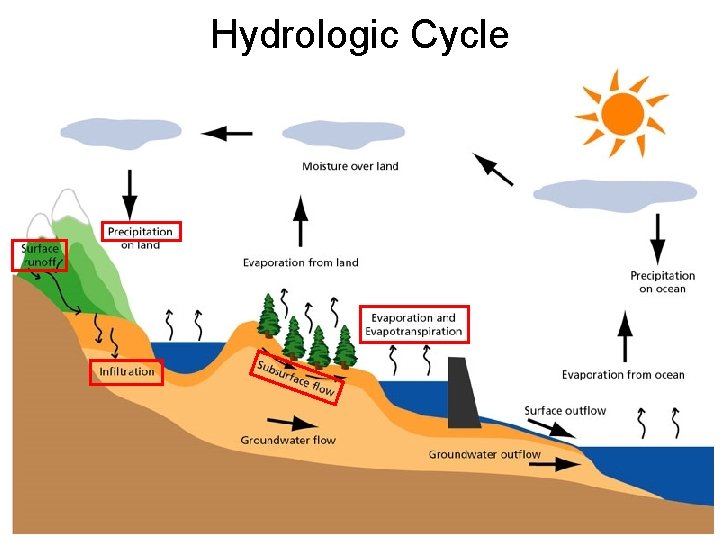
Hydrologic Cycle
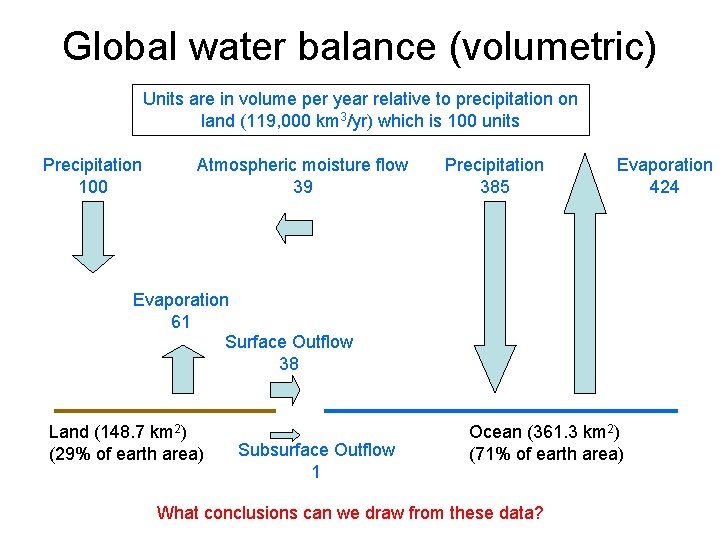
Global water balance (volumetric) Units are in volume per year relative to precipitation on land (119, 000 km 3/yr) which is 100 units Precipitation 100 Atmospheric moisture flow 39 Precipitation 385 Evaporation 424 Evaporation 61 Surface Outflow 38 Land (148. 7 km 2) (29% of earth area) Subsurface Outflow 1 Ocean (361. 3 km 2) (71% of earth area) What conclusions can we draw from these data?
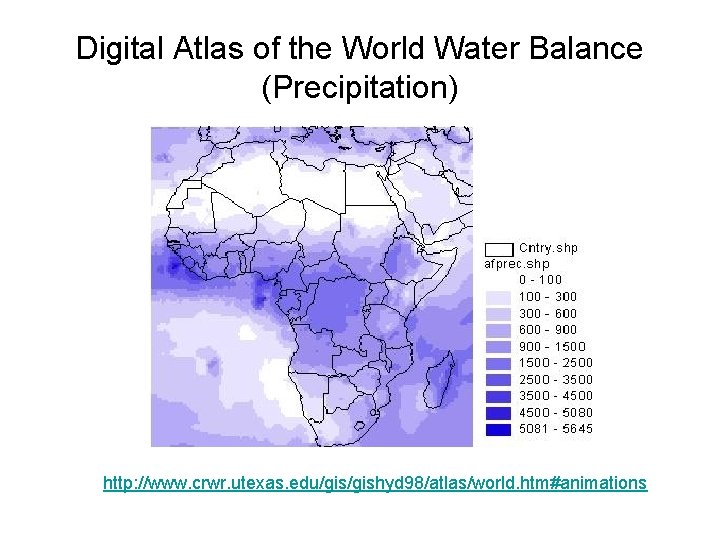
Digital Atlas of the World Water Balance (Precipitation) http: //www. crwr. utexas. edu/gishyd 98/atlas/world. htm#animations
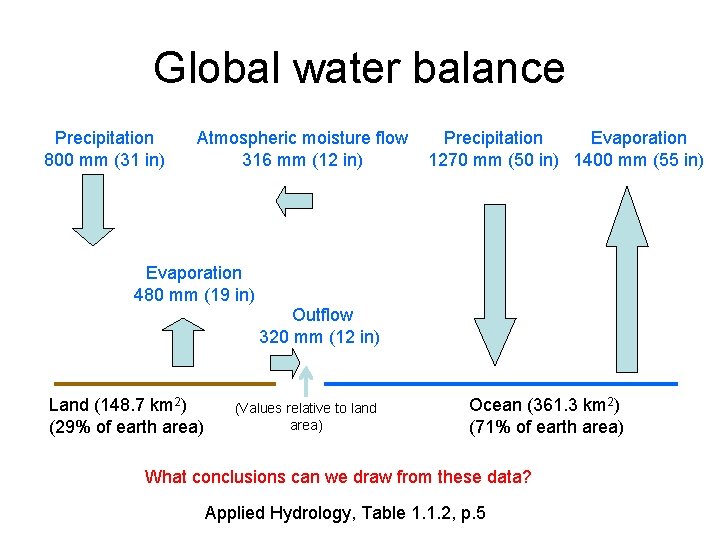
Global water balance Precipitation 800 mm (31 in) Atmospheric moisture flow 316 mm (12 in) Precipitation Evaporation 1270 mm (50 in) 1400 mm (55 in) Evaporation 480 mm (19 in) Outflow 320 mm (12 in) Land (148. 7 km 2) (29% of earth area) (Values relative to land area) Ocean (361. 3 km 2) (71% of earth area) What conclusions can we draw from these data? Applied Hydrology, Table 1. 1. 2, p. 5
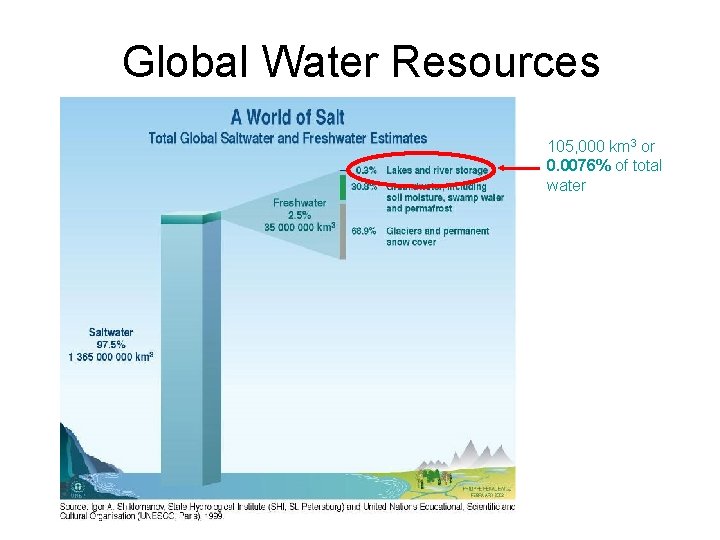
Global Water Resources 105, 000 km 3 or 0. 0076% of total water
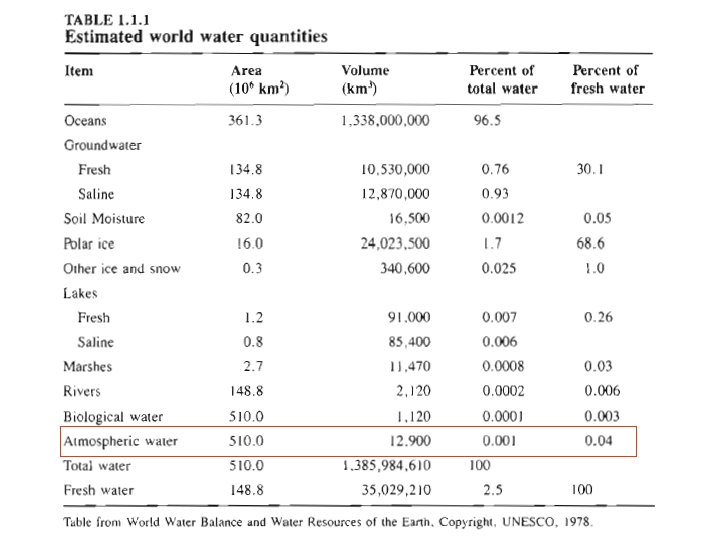
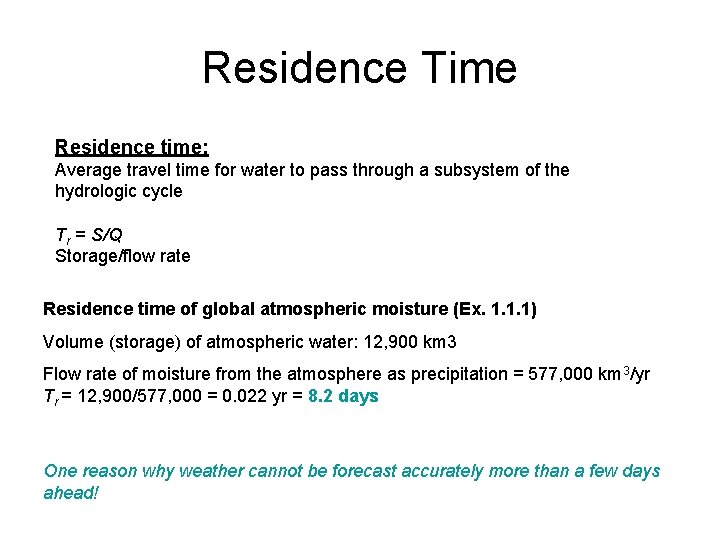
Residence Time Residence time: Average travel time for water to pass through a subsystem of the hydrologic cycle Tr = S/Q Storage/flow rate Residence time of global atmospheric moisture (Ex. 1. 1. 1) Volume (storage) of atmospheric water: 12, 900 km 3 Flow rate of moisture from the atmosphere as precipitation = 577, 000 km 3/yr Tr = 12, 900/577, 000 = 0. 022 yr = 8. 2 days One reason why weather cannot be forecast accurately more than a few days ahead!
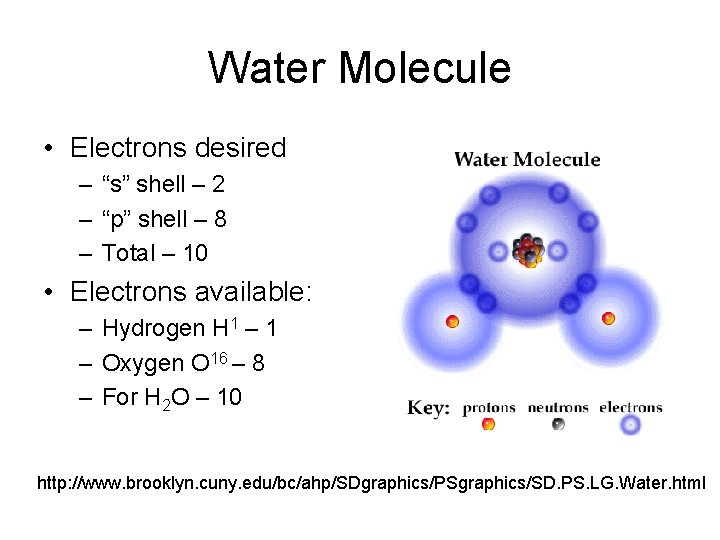
Water Molecule • Electrons desired – “s” shell – 2 – “p” shell – 8 – Total – 10 • Electrons available: – Hydrogen H 1 – Oxygen O 16 – 8 – For H 2 O – 10 http: //www. brooklyn. cuny. edu/bc/ahp/SDgraphics/PSgraphics/SD. PS. LG. Water. html
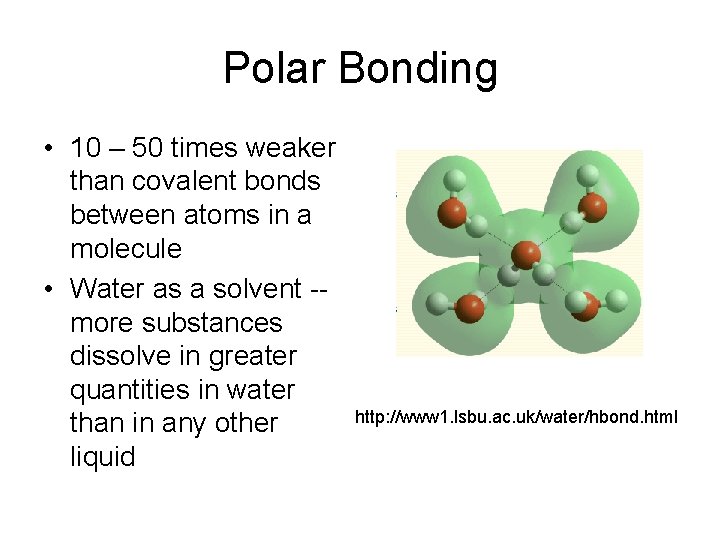
Polar Bonding • 10 – 50 times weaker than covalent bonds between atoms in a molecule • Water as a solvent -more substances dissolve in greater quantities in water than in any other liquid http: //www 1. lsbu. ac. uk/water/hbond. html
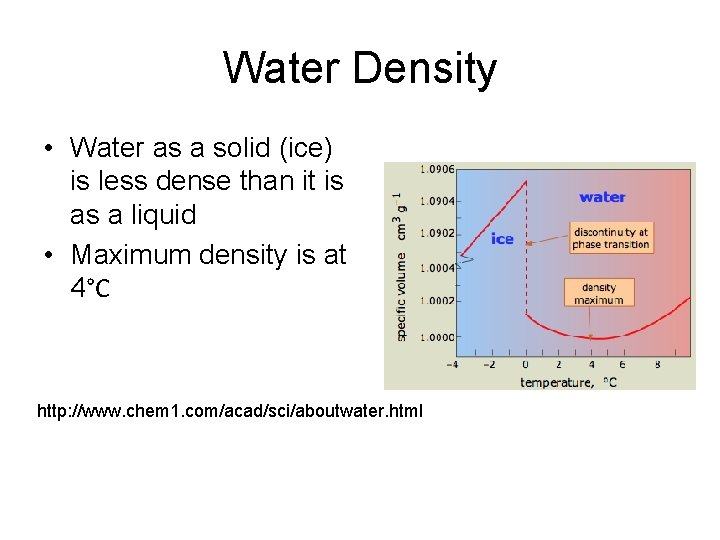
Water Density • Water as a solid (ice) is less dense than it is as a liquid • Maximum density is at 4°C http: //www. chem 1. com/acad/sci/aboutwater. html
- Slides: 13