
CE 3500 Transportation Engineering Introduction to Pavement Materials







- Slides: 21
CE 3500 Transportation Engineering Introduction to Pavement Materials April 1, 2011
ANNOUNCEMENTS
Homework 4 due Wednesday No lab Thursday; Dr. Jim Kladianos will be speaking in lab April 14.
REVIEW
PAVEMENT BASICS
The two main types of pavement: • Asphalt • Concrete
The two main types of pavement: • Asphalt • "Asphalt concrete" • Flexible pavement is the more technical term • Concrete • "Portland cement concrete" • Rigid pavement is the better term What's the difference?
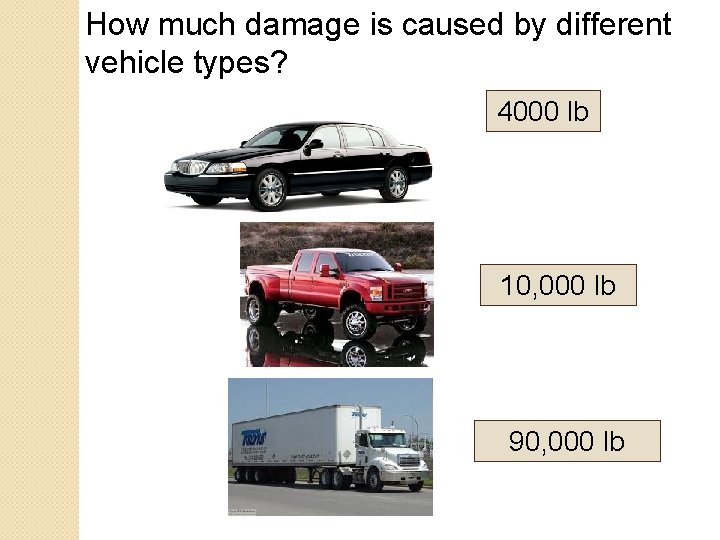
How much damage is caused by different vehicle types? 4000 lb 10, 000 lb 90, 000 lb
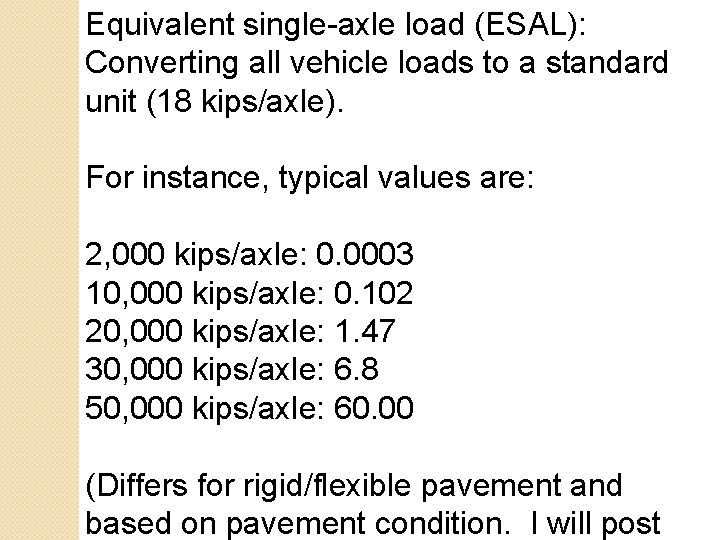
Equivalent single-axle load (ESAL): Converting all vehicle loads to a standard unit (18 kips/axle). For instance, typical values are: 2, 000 kips/axle: 0. 0003 10, 000 kips/axle: 0. 102 20, 000 kips/axle: 1. 47 30, 000 kips/axle: 6. 8 50, 000 kips/axle: 60. 00 (Differs for rigid/flexible pavement and based on pavement condition. I will post
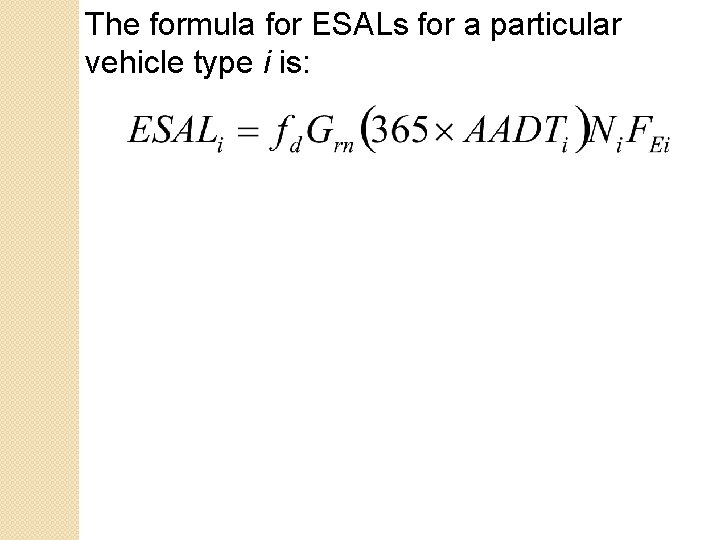
The formula for ESALs for a particular vehicle type i is:
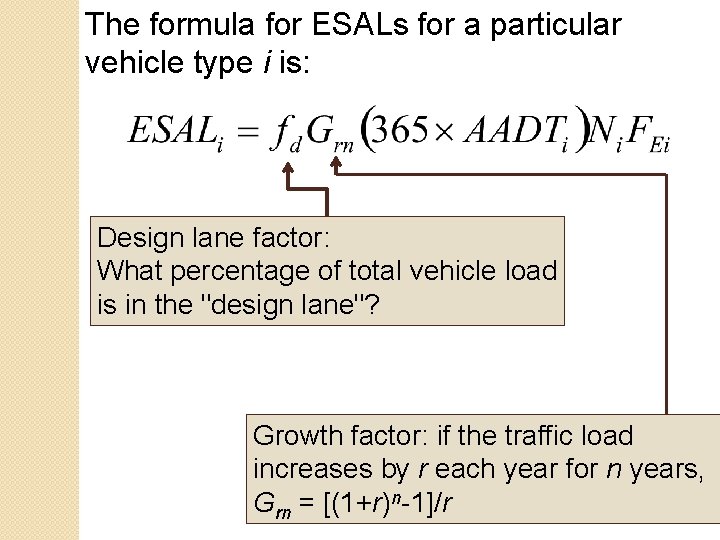
The formula for ESALs for a particular vehicle type i is: Design lane factor: What percentage of total vehicle load is in the "design lane"? Growth factor: if the traffic load increases by r each year for n years, Grn = [(1+r)n-1]/r
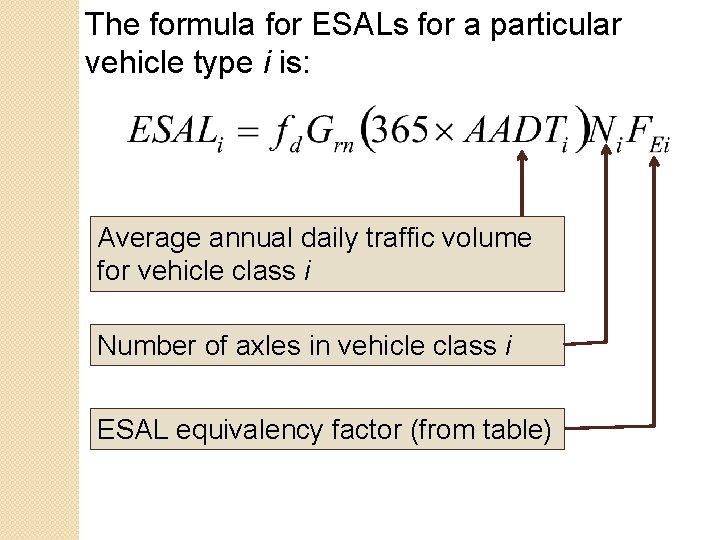
The formula for ESALs for a particular vehicle type i is: Average annual daily traffic volume for vehicle class i Number of axles in vehicle class i ESAL equivalency factor (from table)
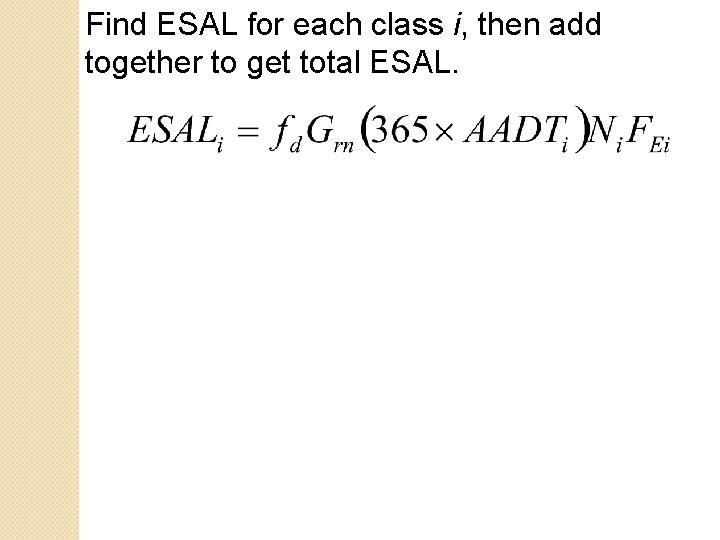
Find ESAL for each class i, then add together to get total ESAL.
EXAMPLE
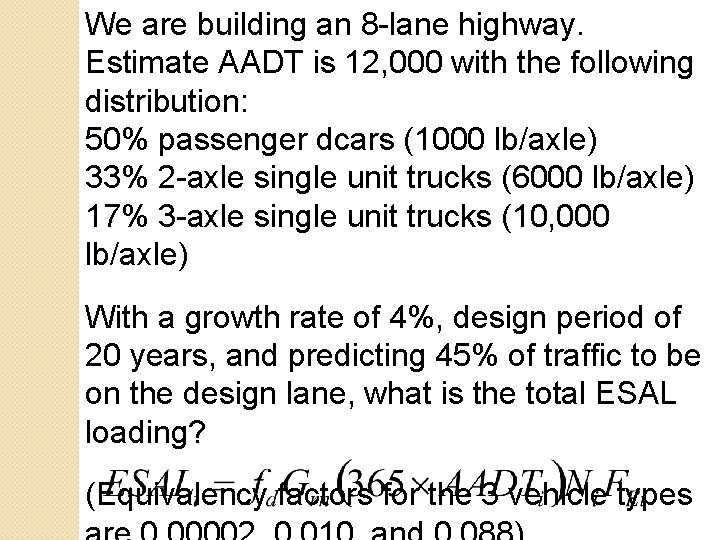
We are building an 8 -lane highway. Estimate AADT is 12, 000 with the following distribution: 50% passenger dcars (1000 lb/axle) 33% 2 -axle single unit trucks (6000 lb/axle) 17% 3 -axle single unit trucks (10, 000 lb/axle) With a growth rate of 4%, design period of 20 years, and predicting 45% of traffic to be on the design lane, what is the total ESAL loading? (Equivalency factors for the 3 vehicle types
FLEXIBLE PAVEMENT CONCEPTS
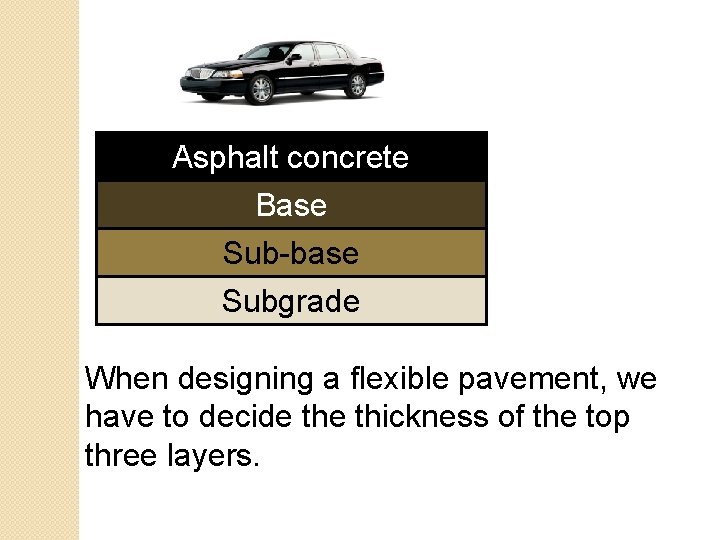
Asphalt concrete Base Sub-base Subgrade When designing a flexible pavement, we have to decide thickness of the top three layers.
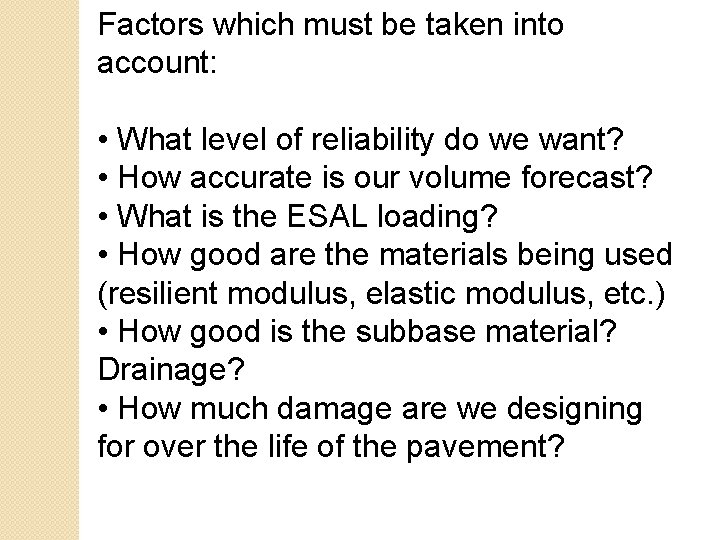
Factors which must be taken into account: • What level of reliability do we want? • How accurate is our volume forecast? • What is the ESAL loading? • How good are the materials being used (resilient modulus, elastic modulus, etc. ) • How good is the subbase material? Drainage? • How much damage are we designing for over the life of the pavement?
Factors which must be taken into account: • What level of reliability do we want? (typically 90%, 95%, 99%)
Factors which must be taken into account: • How accurate is our volume forecast? Measured by the overall standard deviation (0. 2 -0. 6)
Factors which must be taken into account: How much damage are we designing for over the life of the pavement? Initial and final serviceability index