
CDPD Cellular Digital Packet Data Daniel Grobe Sachs
CDPD: Cellular Digital Packet Data Daniel Grobe Sachs Quji Guo
What is CDPD? • Motivation: Packet data over AMPS – AMPS is unsuited for packet data • Long call setup times • Modem handshaking required – Analog providers have AMPS allocation. • Use AMPS channels to provide data service. • “Cellular digital packet data” • Can’t interfere with existing analog service. – CDPD is cheap: no new spectrum license needed!
Design Goals • Goals: – Low speed, high latency data service • Primarily intended for paging and email. – Provide broadcast and multiple-access service. – Dynamically shared media, always online. – Share channels with AMPS allocation – Transparency to existing AMPS service.
CDPD History • Standard released Jan, 1995 (v 1. 1) • Initially used by police (~1996) • Wide service availability around 2000 – Omnisky, Verizon Wireless, others. • Covers most US population centers – Champaign-Urbana now covered. – Rural area coverage poor.

CDPD Market • CDPD is used primarily for – Law enforcement – Handheld/laptop IP access – Main competition: “Wireless Web” phones. • CDPD costs: – Wireless modems: ~$300 (Omnisky Palm V) – Service: $30 -$40 per month (handheld) – $40 -$80 per month (laptop)
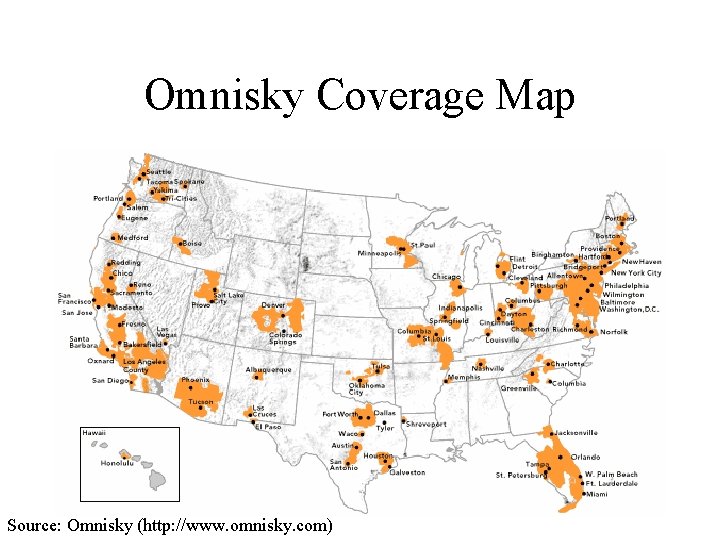
Omnisky Coverage Map Source: Omnisky (http: //www. omnisky. com)
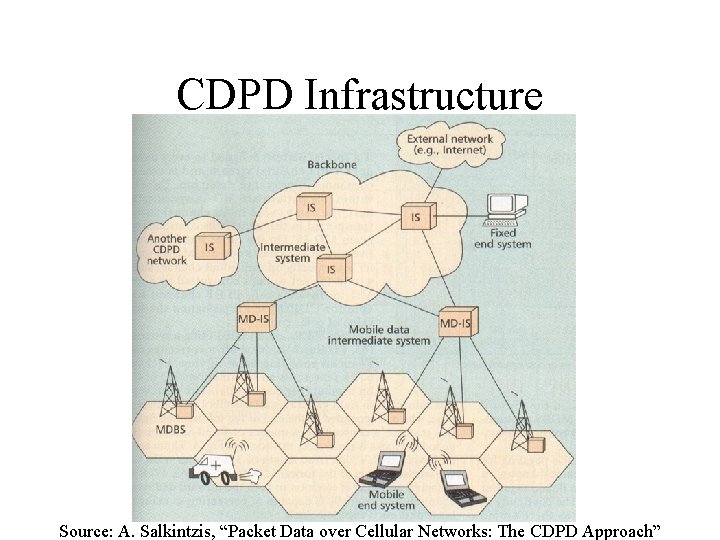
CDPD Infrastructure Source: A. Salkintzis, “Packet Data over Cellular Networks: The CDPD Approach”
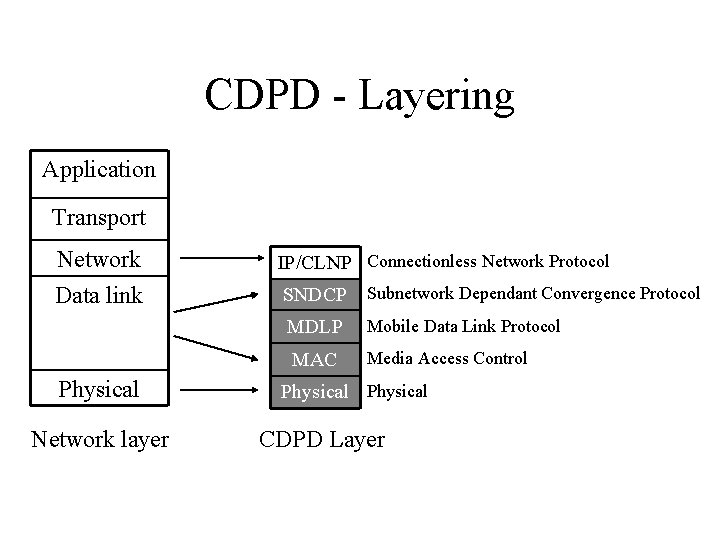
CDPD - Layering Application Transport Network Data link Physical Network layer IP/CLNP Connectionless Network Protocol SNDCP Subnetwork Dependant Convergence Protocol MDLP Mobile Data Link Protocol MAC Media Access Control Physical CDPD Layer
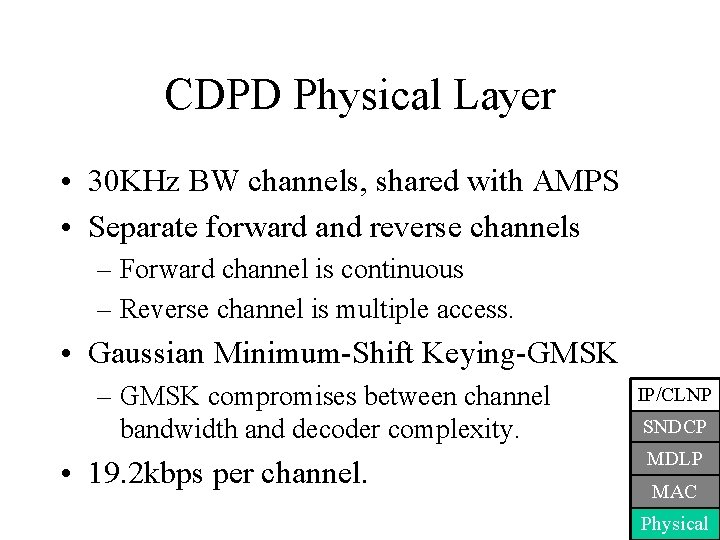
CDPD Physical Layer • 30 KHz BW channels, shared with AMPS • Separate forward and reverse channels – Forward channel is continuous – Reverse channel is multiple access. • Gaussian Minimum-Shift Keying-GMSK – GMSK compromises between channel bandwidth and decoder complexity. • 19. 2 kbps per channel. IP/CLNP SNDCP MDLP MAC Physical
AMPS and CDPD • CDPD runs alongside AMPS – AMPS system is unaware of CDPD system – CDPD system watches AMPS behavior • AMPS generally has unused channels. – Blocked calls when all channels are allocated. – 1% block probability => all channels used only 1% of the time.
CDPD Channel Usage • CDPD uses unused AMPS channels. – Usually are several available. – Each 30 KHz channel = 19. 2 kbps up and down • CDPD channel hopping. – Forced: AMPS must be vacated within 40 ms of allocation for voice use. – Planned: Regular hops prevent AMPS system from identifying channel as unusable.
Channel Scanning • 1. Check signal levels from nearby cells. – Use a list of reference channels distributed by the CDPD infrastructure to find levels. • 2. Select cell with best signal. – If non-critical and no cell is significantly better than current, no handoff is done (hysteresis) • 3. Scan RF channels in cell for CDPD. – Stop when an acceptable channel is found.
Handoff in CDPD • Critical handoffs: Must choose new channel – High error rate is observed or BS signal lost. – Received signal strength below a threshold. – Base station does not receive data from mobile. • Noncritical handoffs – Channel rescan interval expires. – Signal strength changes significantly.
CDPD effects on AMPS • CDPD logically transparent to AMPS • Can reduce AMPS service quality – More channel usage => increased interference. – If AMPS system is close to SIR margin, CDPD can push it below. – Full CDPD usage can push SIR down ~2 d. B • 19 channels/cell, Pblock = 0. 02, 12. 3 Erlangs – Limiting channels used reduces SIR cost. .
Data Transmission Format • All links are base to mobile. – Mobile to mobile goes through base station. – Full-duplex; separate forward and reverse links. • Forward link – Continuous transmission by BS • Reverse link – Shared multiple access for mobiles. – Reverse link activity indicated by BS. IP/CLNP SNDCP MDLP MAC Physical
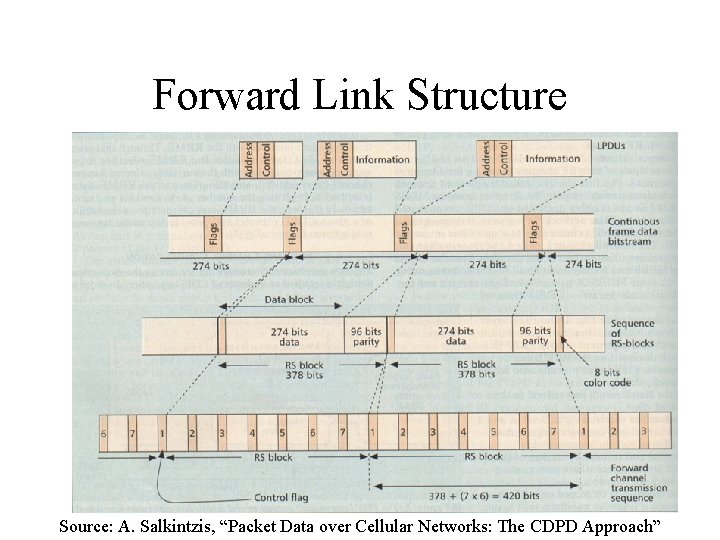
Forward Link Structure Source: A. Salkintzis, “Packet Data over Cellular Networks: The CDPD Approach”
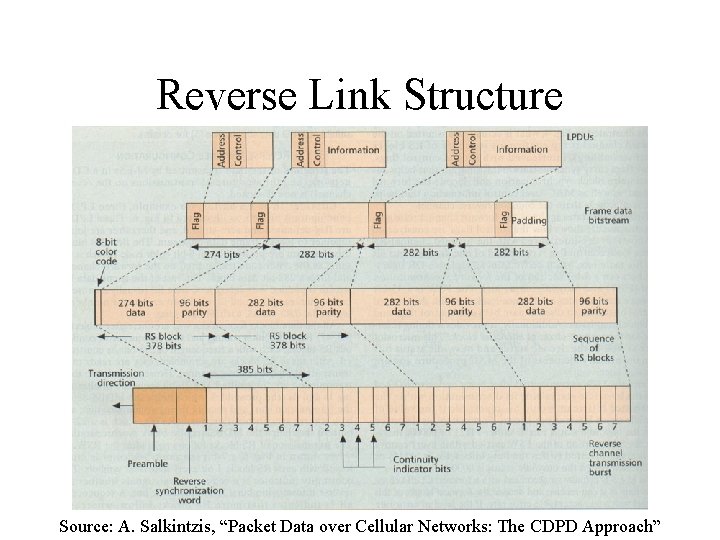
Reverse Link Structure Source: A. Salkintzis, “Packet Data over Cellular Networks: The CDPD Approach”
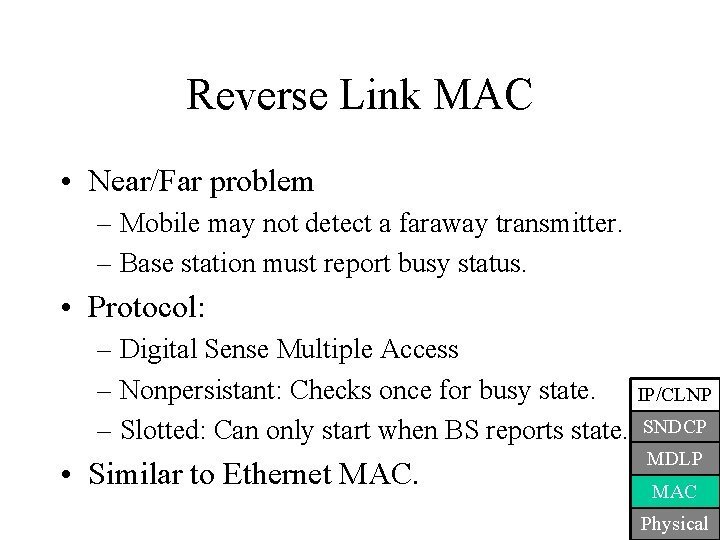
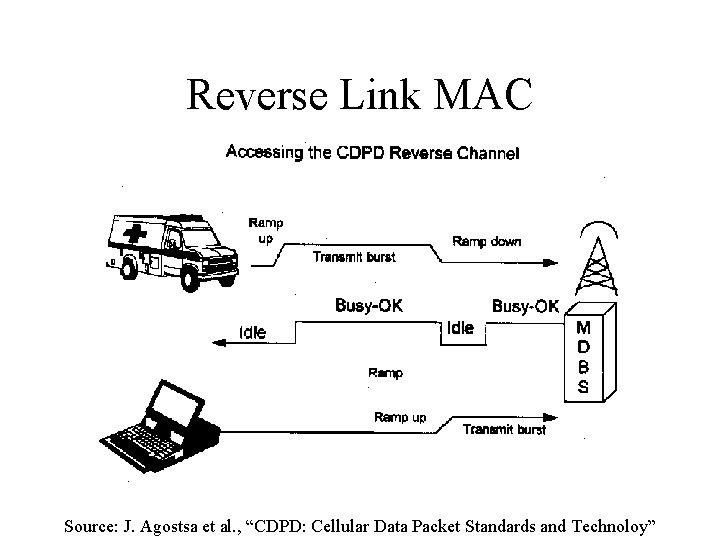
Reverse Link MAC • Near/Far problem – Mobile may not detect a faraway transmitter. – Base station must report busy status. • Protocol: – Digital Sense Multiple Access – Nonpersistant: Checks once for busy state. IP/CLNP – Slotted: Can only start when BS reports state. SNDCP • Similar to Ethernet MAC. MDLP MAC Physical
Reverse Link MAC Source: J. Agostsa et al. , “CDPD: Cellular Data Packet Standards and Technoloy”
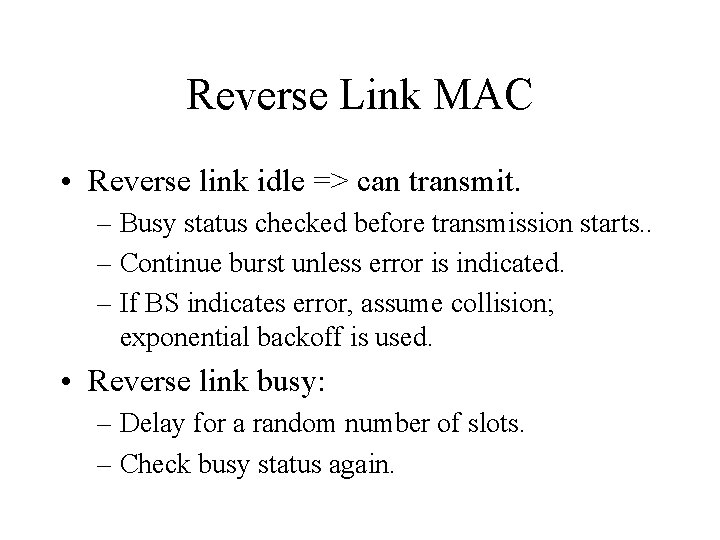
Reverse Link MAC • Reverse link idle => can transmit. – Busy status checked before transmission starts. . – Continue burst unless error is indicated. – If BS indicates error, assume collision; exponential backoff is used. • Reverse link busy: – Delay for a random number of slots. – Check busy status again.
Mobile Data Link Protocol IP/CLNP SNDCP MDLP MAC Source: J. Agostsa et al. , “CDPD: Cellular Data Packet Standards and Technoloy” Physical
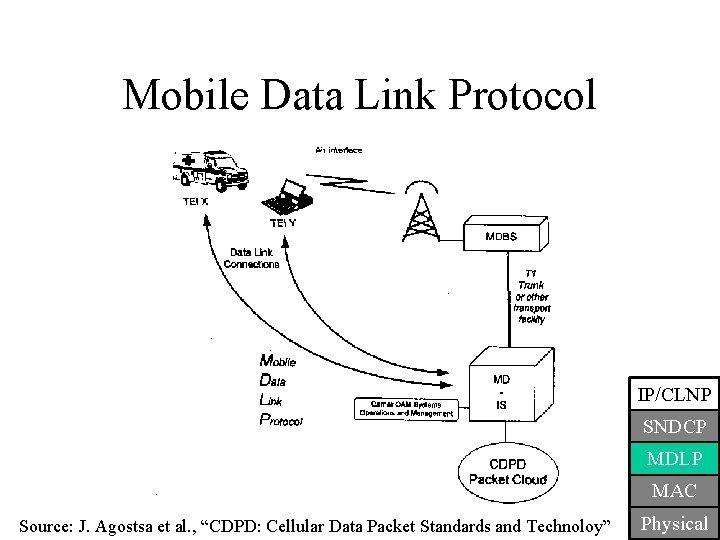
CDPD - MDLP • Mobile Data Link Layer Protocol (MDLP) – High-level data link control (HDLC) • Similar to ISDN HDLC. – Mobile (M-ES) to Infrastructure (MD-IS) • In this layer, air link and BS become transparent • Connection oriented – MDLP Frame (message structure) • Address, control field, information field • No checksum; MAC discards incorrect packets.
CDPD - MDLP • Temporary equipment identifier (TEI) – Identifies destination mobile - virtual address. – Assigned by infrastructure. • Packet types – Unacknowledged information – Sequenced information • Sequence number, ack, timeout • Sliding window • Selective rejection supported.
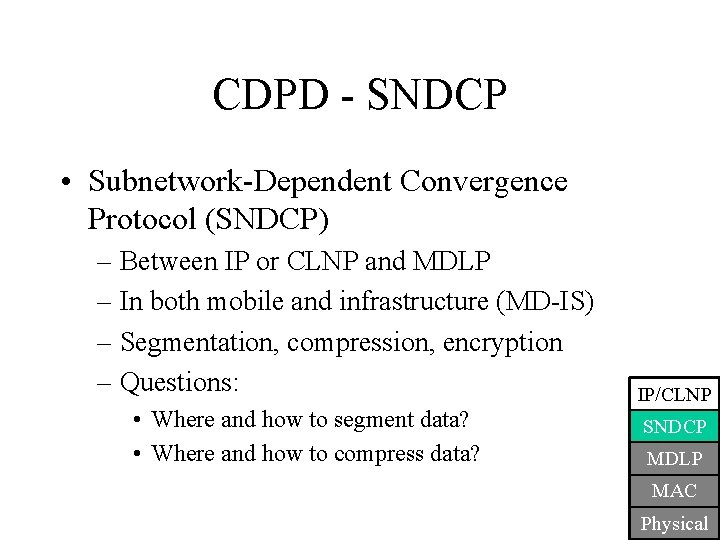
CDPD - SNDCP • Subnetwork-Dependent Convergence Protocol (SNDCP) – Between IP or CLNP and MDLP – In both mobile and infrastructure (MD-IS) – Segmentation, compression, encryption – Questions: • Where and how to segment data? • Where and how to compress data? IP/CLNP SNDCP MDLP MAC Physical
CDPD - SNDCP • Segmentation – Goal: to fit the size of underlying frames – Two type of headers • Sequenced headers: – For compressed, encrypted, and segmented user data. • Unnumbered headers: Control information. – Efficiency consideration (similar to X. 25) • Which layer should segment/assemble messages? • Use “More” indicator to avoid IP fragmentation.
CDPD - SNDCP • Compression – Header compression • To send the “Delta” information – Data compression • V. 42 bis – a dictionary-based compression – Which layer should compress data? • Source-dependent compression – higher layer • Source-independent compression – lower layer
CDPD - Registration • Low-level protocols ignore authentication. • Registration and Authentication – M-ES, serving MD-IS, home MD-IS • Base station (MDBS) has no network function. – Network Equipment identifier (IP, etc. ) – Forwarding database in home MD-IS • Deregistration – Table maintenance timer
Problems with CDPD • Limited bandwidth – 19. 2 kbps shared per channel – Modern applications demand more bandwidth. • Security: – “Man in the middle” identity theft attack – IP network attacks – Denial of Service attacks easy.
Potential Improvements • Multichannel / multicarrier transmission – Would allow faster rates with AMPS compatibility. • Security Improvements – Secure against “man-in-the-middle” attacks. • Switch to CDMA/GSM. – Digital cellular services are more able to accommodate data services.
References • J. Agosta and T. Russell, CDPD: Cellular Packet Data Standards and Technology, Mc. Graw Hill, 1996. • Y. Frankel et al. , “Security Issues in a CDPD Wireless Network, ” IEEE Personal Communications, August 1995, pp. 16 -26. • D. Saha and S. Kay, “Cellular Digital Packet Data Network, ” IEEE Transactions on Vehicular Technology, August 1997, pp. 697 -706. • A. Salkintzis, “Packet Data over Cellular Networks: The CDPD Approach, ” IEEE Communication Magazine, June 1999, pp. 152 -159. • A. Salkintzis, “Radio Resource Management in Cellular Digital Packet Data Networks, ” IEEE Personal Communications, December 1999, pp. 28 -36
- Slides: 30