
CDMA EVDO LTE Interoperability and migration plans B
CDMA / EVDO/ LTE Interoperability and migration plans B. V. Raman CDMA Development Group bvraman@cdg. org Colombo, Sri Lanka, 7 -10 April 2009
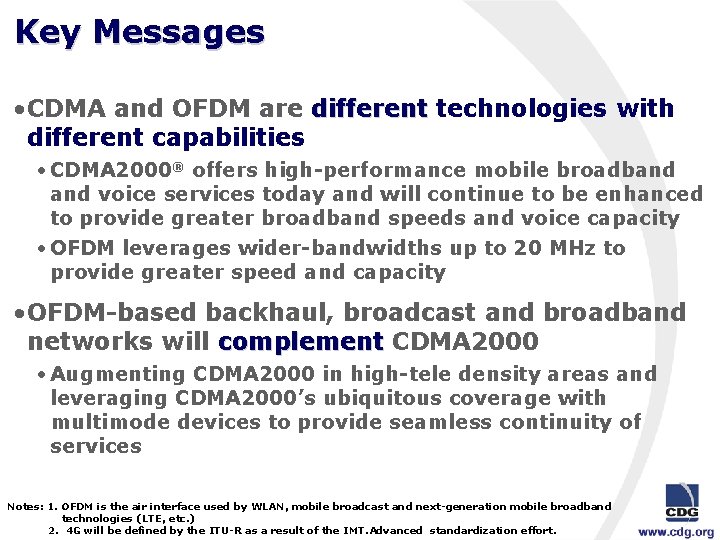
Key Messages • CDMA and OFDM are different technologies with different capabilities • CDMA 2000® offers high-performance mobile broadband voice services today and will continue to be enhanced to provide greater broadband speeds and voice capacity • OFDM leverages wider-bandwidths up to 20 MHz to provide greater speed and capacity • OFDM-based backhaul, broadcast and broadband networks will complement CDMA 2000 • Augmenting CDMA 2000 in high-tele density areas and leveraging CDMA 2000’s ubiquitous coverage with multimode devices to provide seamless continuity of services Notes: 1. OFDM is the air interface used by WLAN, mobile broadcast and next-generation mobile broadband technologies (LTE, etc. ) 2. 4 G will be defined by the ITU-R as a result of the IMT. Advanced standardization effort.
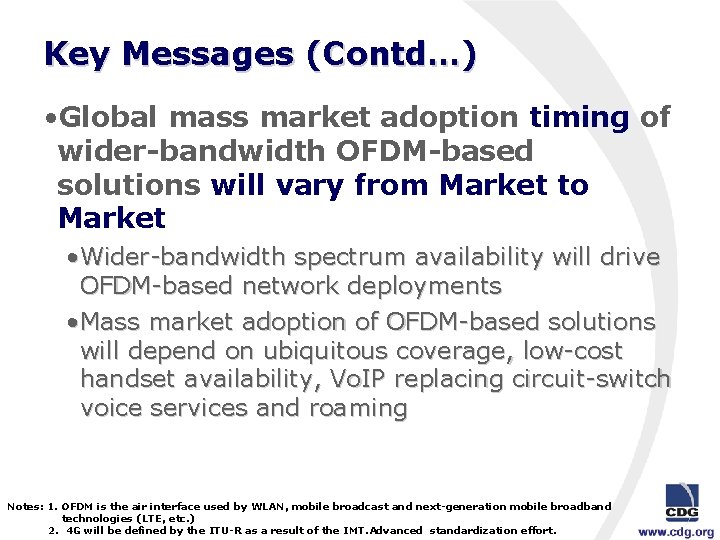
Key Messages (Contd…) • Global mass market adoption timing of wider-bandwidth OFDM-based solutions will vary from Market to Market • Wider-bandwidth spectrum availability will drive OFDM-based network deployments • Mass market adoption of OFDM-based solutions will depend on ubiquitous coverage, low-cost handset availability, Vo. IP replacing circuit-switch voice services and roaming Notes: 1. OFDM is the air interface used by WLAN, mobile broadcast and next-generation mobile broadband technologies (LTE, etc. ) 2. 4 G will be defined by the ITU-R as a result of the IMT. Advanced standardization effort.
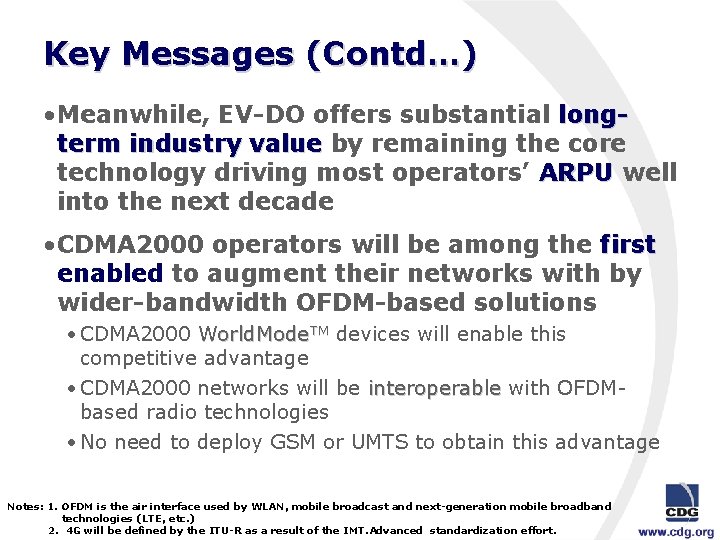
Key Messages (Contd…) • Meanwhile, EV-DO offers substantial longterm industry value by remaining the core technology driving most operators’ ARPU well into the next decade • CDMA 2000 operators will be among the first enabled to augment their networks with by wider-bandwidth OFDM-based solutions • CDMA 2000 World. Mode. TM devices will enable this competitive advantage • CDMA 2000 networks will be interoperable with OFDMbased radio technologies • No need to deploy GSM or UMTS to obtain this advantage Notes: 1. OFDM is the air interface used by WLAN, mobile broadcast and next-generation mobile broadband technologies (LTE, etc. ) 2. 4 G will be defined by the ITU-R as a result of the IMT. Advanced standardization effort.

CDMA and OFDM-based Technologies CDMA and OFDM are different technologies with different capabilities Wide bandwidth OFDM-based networks will complement 3 G broadband networks for Broadband Backhaul Wi. MAX (802. 16 d) Broadcast MFLO DVB-H ISDB-T T-DMB S-DMB Additional Broadband Capacity LTE Mobile Wi. MAX (802. 16 e/m) Wi-Fi (802. 11 n) OFDM leverages wider-bandwidths up to 20 MHz
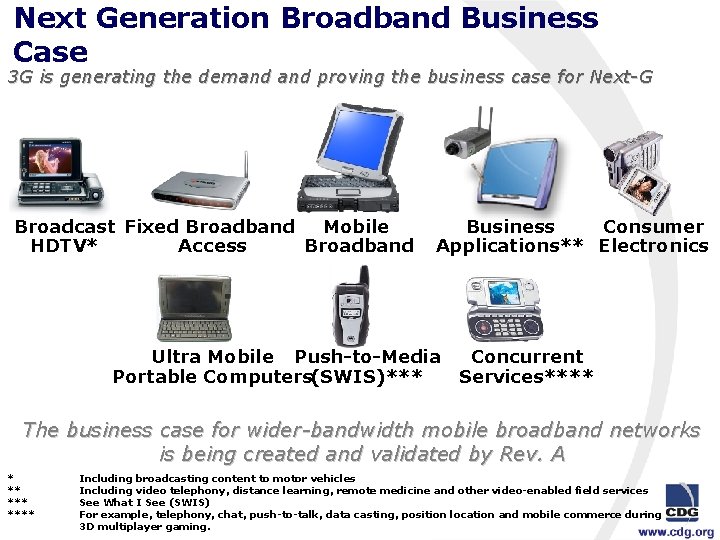
Next Generation Broadband Business Case 3 G is generating the demand proving the business case for Next-G Broadcast Fixed Broadband Mobile HDTV* Access Broadband Business Consumer Applications** Electronics Ultra Mobile Push-to-Media Portable Computers(SWIS)*** Concurrent Services**** The business case for wider-bandwidth mobile broadband networks is being created and validated by Rev. A * ** **** Including broadcasting content to motor vehicles Including video telephony, distance learning, remote medicine and other video-enabled field services See What I See (SWIS) For example, telephony, chat, push-to-talk, data casting, position location and mobile commerce during 3 D multiplayer gaming.
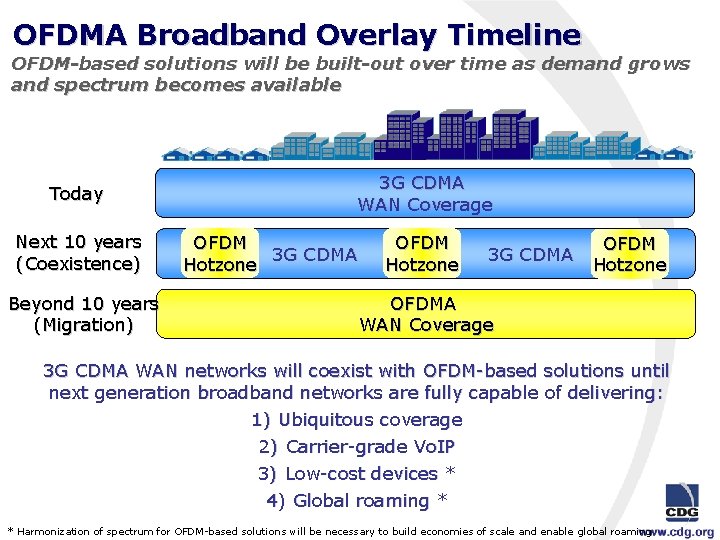
OFDMA Broadband Overlay Timeline OFDM-based solutions will be built-out over time as demand grows and spectrum becomes available Today Next 10 years (Coexistence) Beyond 10 years (Migration) 3 G CDMA WAN Coverage OFDM 3 G CDMA Hotzone OFDM Hotzone 3 G CDMA OFDM Hotzone OFDMA WAN Coverage 3 G CDMA WAN networks will coexist with OFDM-based solutions until next generation broadband networks are fully capable of delivering: 1) Ubiquitous coverage 2) Carrier-grade Vo. IP 3) Low-cost devices * 4) Global roaming * * Harmonization of spectrum for OFDM-based solutions will be necessary to build economies of scale and enable global roaming
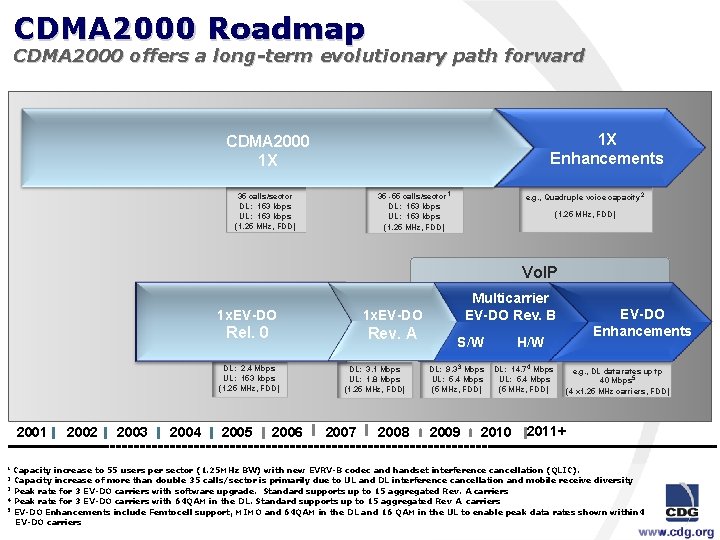
CDMA 2000 Roadmap CDMA 2000 offers a long-term evolutionary path forward CDMA 2000 Roadmap 1 X Enhancements 1 X 35 -55 calls/sector 1 DL: 153 kbps UL: 153 kbps (1. 25 MHz, FDD) 35 calls/sector DL: 153 kbps UL: 153 kbps (1. 25 MHz, FDD) e. g. , Quadruple voice capacity 2 (1. 25 MHz, FDD) Vo. IP 1 x. EV-DO Rel. 0 Rev. A DL: 2. 4 Mbps UL: 153 kbps (1. 25 MHz, FDD) 2001 2002 2003 2004 2005 2006 DL: 3. 1 Mbps UL: 1. 8 Mbps (1. 25 MHz, FDD) 2007 2008 Multicarrier EV-DO Rev. B S/W DL: 9. 33 Mbps UL: 5. 4 Mbps (5 MHz, FDD) 2009 H/W DL: 14. 74 Mbps UL: 5. 4 Mbps (5 MHz, FDD) 2010 EV-DO Enhancements e. g. , DL data rates up tp 40 Mbps 5 (4 x 1. 25 MHz carriers, FDD) 2011+ Capacity increase to 55 users per sector (1. 25 MHz BW) with new EVRV-B codec and handset interference cancellation (QLIC). Capacity increase of more than double 35 calls/sector is primarily due to UL and DL interference cancellation and mobile receive diversity 3 Peak rate for 3 EV-DO carriers with software upgrade. Standard supports up to 15 aggregated Rev. A carriers 4 Peak rate for 3 EV-DO carriers with 64 QAM in the DL. Standard supports up to 15 aggregated Rev A carriers 5 EV-DO Enhancements include Femtocell support, MIMO and 64 QAM in the DL and 16 QAM in the UL to enable peak data rates shown within 4 EV-DO carriers 1 2
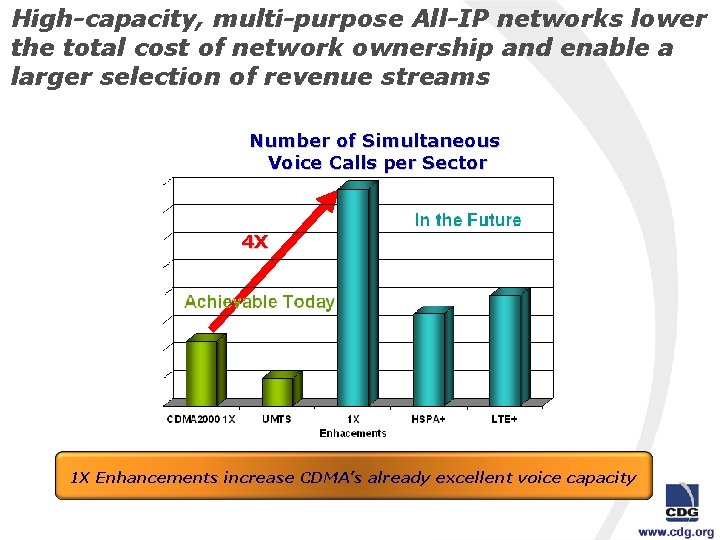
High-capacity, multi-purpose All-IP networks lower the total cost of network ownership and enable a larger selection of revenue streams Number of Simultaneous Voice Calls per Sector 4 X 1 X Enhancements increase CDMA’s already excellent voice capacity
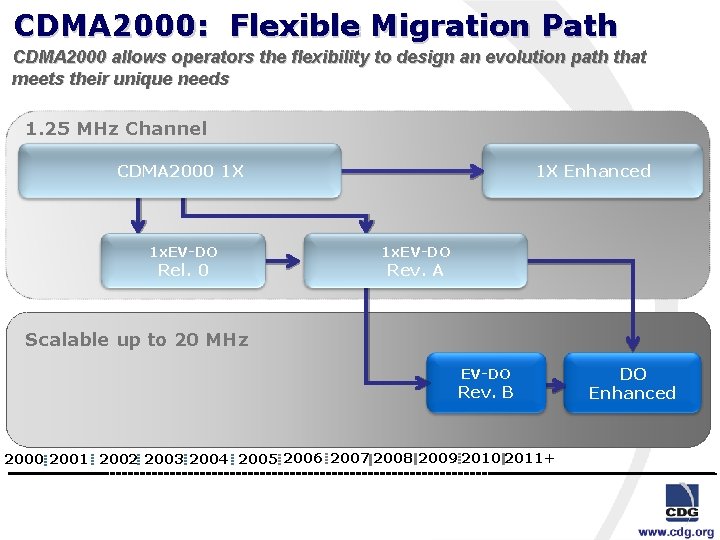
CDMA 2000: Flexible Migration Path CDMA 2000 allows operators the flexibility to design an evolution path that meets their unique needs 1. 25 MHz Channel CDMA 2000 Roadmap CDMA 2000 1 X 1 x. EV-DO Rel. 0 1 X Enhanced 1 x. EV-DO Rev. A Scalable up to 20 MHz EV-DO Rev. B 2000 2001 2002 2003 2004 2005 2006 2007 2008 2009 2010 2011+ DO Enhanced
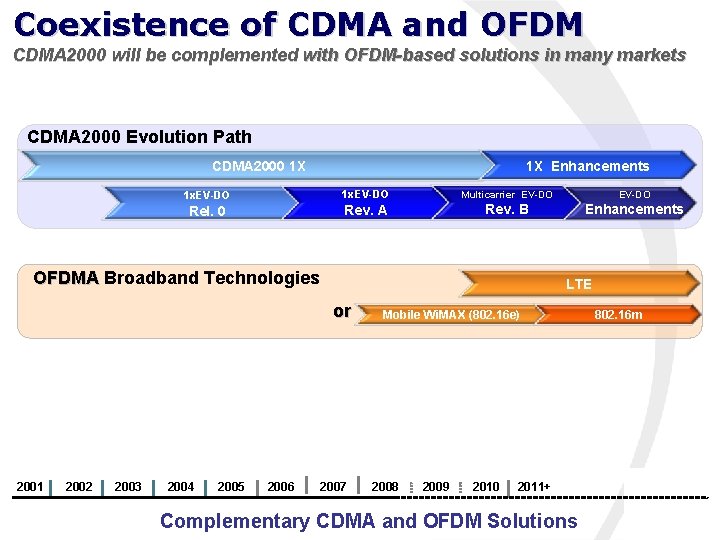
Coexistence of CDMA and OFDM CDMA 2000 will be complemented with OFDM-based solutions in many markets CDMA 2000 Evolution Path CDMA 2000 1 X 1 X Enhancements 1 x. EV-DO Multicarrier EV-DO Rel. 0 Rev. A Rev. B Enhancements OFDMA Broadband Technologies LTE or 2001 2002 2003 2004 2005 2006 2007 Mobile Wi. MAX (802. 16 e) 2008 2009 2010 2011+ Complementary CDMA and OFDM Solutions 802. 16 m
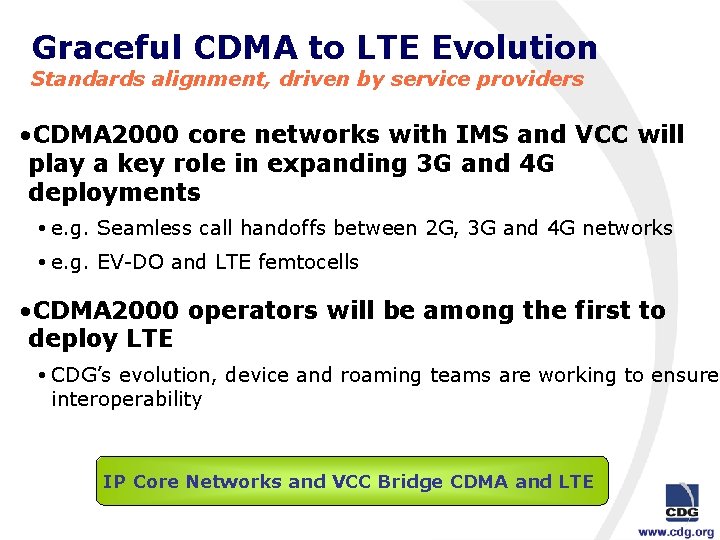
Graceful CDMA to LTE Evolution Standards alignment, driven by service providers • CDMA 2000 core networks with IMS and VCC will play a key role in expanding 3 G and 4 G deployments e. g. Seamless call handoffs between 2 G, 3 G and 4 G networks e. g. EV-DO and LTE femtocells • CDMA 2000 operators will be among the first to deploy LTE CDG’s evolution, device and roaming teams are working to ensure interoperability IP Core Networks and VCC Bridge CDMA and LTE
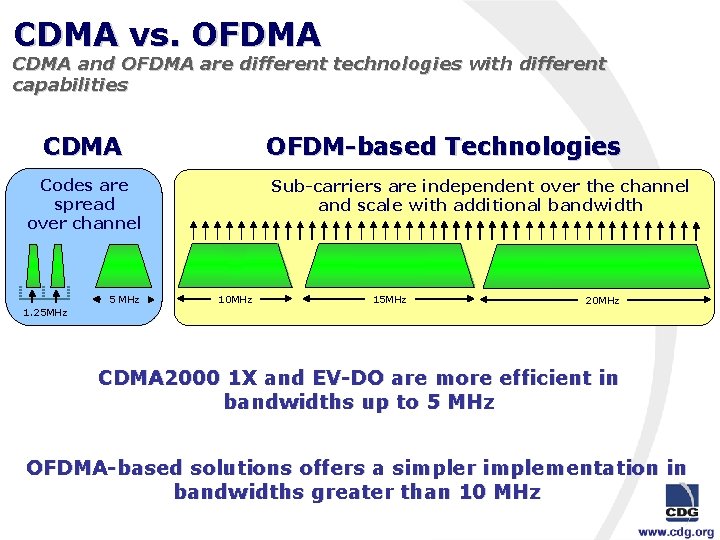
CDMA vs. OFDMA CDMA and OFDMA are different technologies with different capabilities CDMA OFDM-based Technologies Codes are spread over channel 5 MHz 1. 25 MHz Sub-carriers are independent over the channel and scale with additional bandwidth 10 MHz 15 MHz 20 MHz CDMA 2000 1 X and EV-DO are more efficient in bandwidths up to 5 MHz OFDMA-based solutions offers a simpler implementation in bandwidths greater than 10 MHz
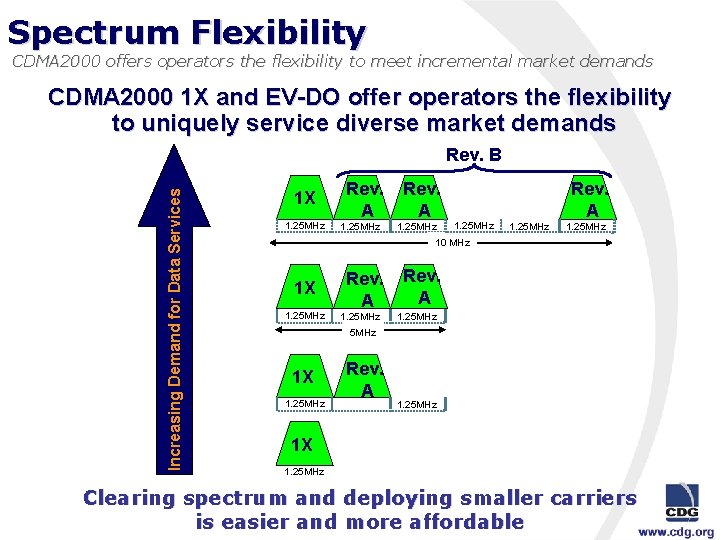
Spectrum Flexibility CDMA 2000 offers operators the flexibility to meet incremental market demands CDMA 2000 1 X and EV-DO offer operators the flexibility to uniquely service diverse market demands Increasing Demand for Data Services Rev. B 1 X 1. 25 MHz Rev. A 1. 25 MHz 10 MHz 1 X 1. 25 MHz Rev. A 1. 25 MHz 1 X 1. 25 MHz Clearing spectrum and deploying smaller carriers is easier and more affordable
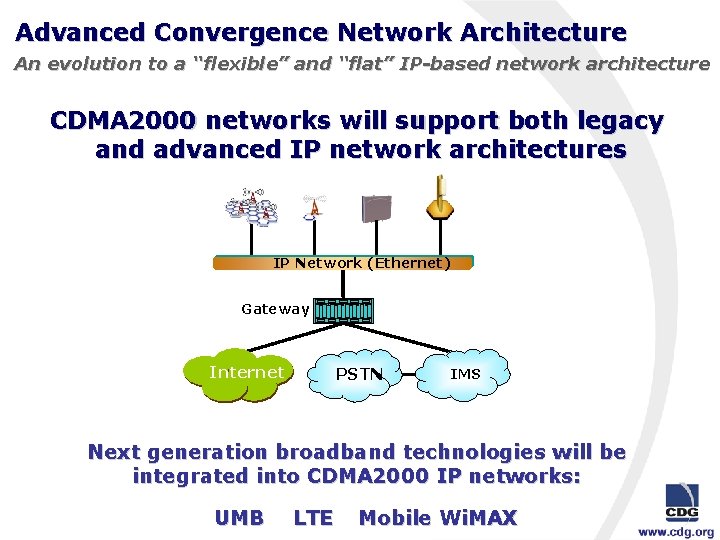
Advanced Convergence Network Architecture An evolution to a “flexible” and “flat” IP-based network architecture CDMA 2000 networks will support both legacy and advanced IP network architectures IP Network (Ethernet) Gateway Internet PSTN IMS Next generation broadband technologies will be integrated into CDMA 2000 IP networks: UMB LTE Mobile Wi. MAX
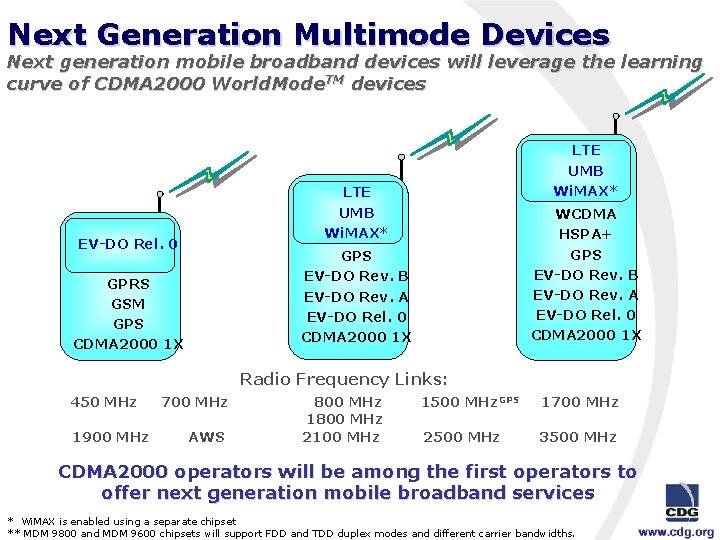
Next Generation Multimode Devices Next generation mobile broadband devices will leverage the learning curve of CDMA 2000 World. Mode. TM devices LTE UMB Wi. MAX* EV-DO Rel. 0 WCDMA HSPA+ GPS EV-DO Rev. B EV-DO Rev. A EV-DO Rel. 0 CDMA 2000 1 X GPRS GSM GPS CDMA 2000 1 X Radio Frequency Links: 450 MHz 1900 MHz 700 MHz AWS 800 MHz 1800 MHz 2100 MHz 1500 MHz. GPS 1700 MHz 2500 MHz 3500 MHz CDMA 2000 operators will be among the first operators to offer next generation mobile broadband services * Wi. MAX is enabled using a separate chipset ** MDM 9800 and MDM 9600 chipsets will support FDD and TDD duplex modes and different carrier bandwidths.
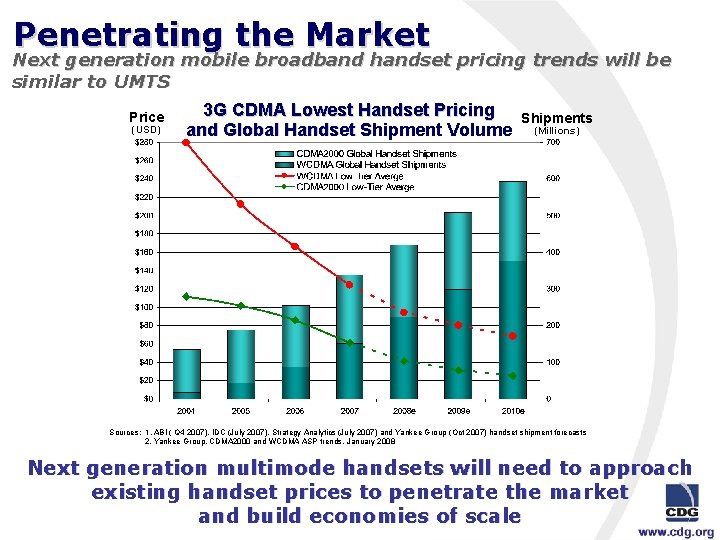
Penetrating the Market Next generation mobile broadband handset pricing trends will be similar to UMTS Price (USD) 3 G CDMA Lowest Handset Pricing and Global Handset Shipment Volume Shipments (Millions) Sources: 1. ABI ( Q 4 2007), IDC (July 2007), Strategy Analytics (July 2007) and Yankee Group (Oct 2007) handset shipment forecasts 2. Yankee Group, CDMA 2000 and WCDMA ASP trends, January 2008 Next generation multimode handsets will need to approach existing handset prices to penetrate the market and build economies of scale
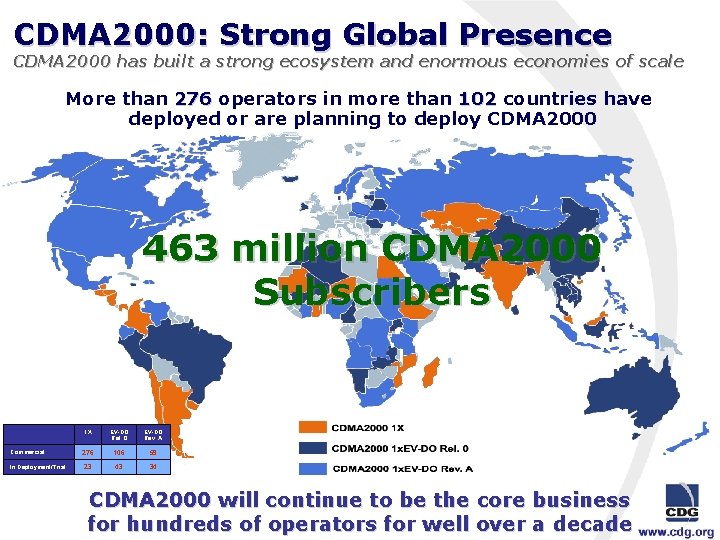
CDMA 2000: Strong Global Presence CDMA 2000 has built a strong ecosystem and enormous economies of scale More than 276 operators in more than 102 countries have deployed or are planning to deploy CDMA 2000 463 million CDMA 2000 Subscribers Commercial In Deployment/Trial 1 X EV-DO Rel. 0 EV-DO Rev. A 276 106 59 23 43 34 CDMA 2000 will continue to be the core business for hundreds of operators for well over a decade
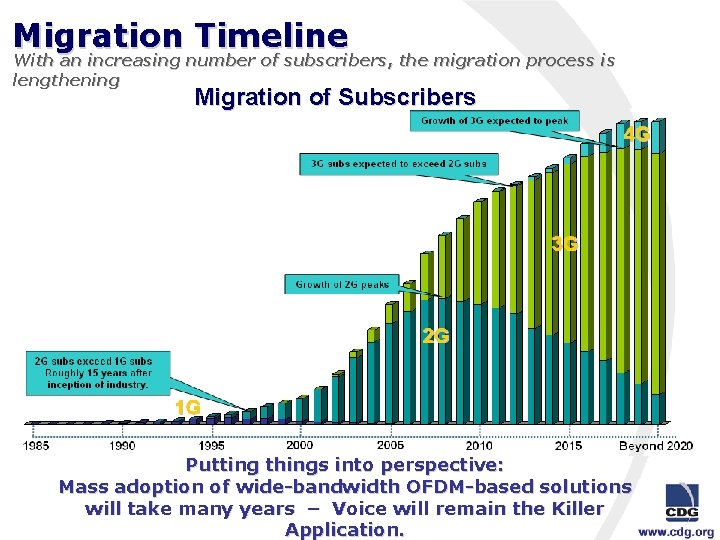
Migration Timeline With an increasing number of subscribers, the migration process is lengthening Migration of Subscribers Putting things into perspective: Mass adoption of wide-bandwidth OFDM-based solutions will take many years – Voice will remain the Killer Application.
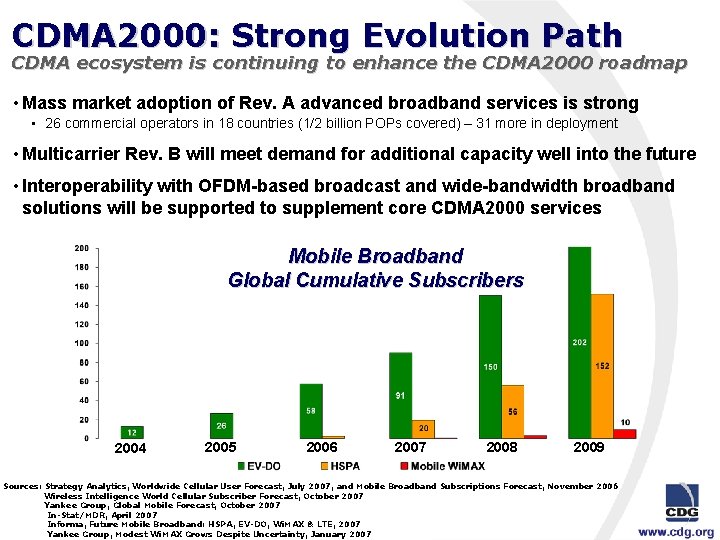
CDMA 2000: Strong Evolution Path CDMA ecosystem is continuing to enhance the CDMA 2000 roadmap • Mass market adoption of Rev. A advanced broadband services is strong • 26 commercial operators in 18 countries (1/2 billion POPs covered) – 31 more in deployment • Multicarrier Rev. B will meet demand for additional capacity well into the future • Interoperability with OFDM-based broadcast and wide-bandwidth broadband solutions will be supported to supplement core CDMA 2000 services Mobile Broadband Global Cumulative Subscribers 2004 2005 2006 2007 2008 2009 Sources: Strategy Analytics, Worldwide Cellular User Forecast, July 2007, and Mobile Broadband Subscriptions Forecast, November 2006 Wireless Intelligence World Cellular Subscriber Forecast, October 2007 Yankee Group, Global Mobile Forecast, October 2007 In-Stat/MDR, April 2007 Informa, Future Mobile Broadband: HSPA, EV-DO, Wi. MAX & LTE, 2007 Yankee Group, Modest Wi. MAX Grows Despite Uncertainty, January 2007
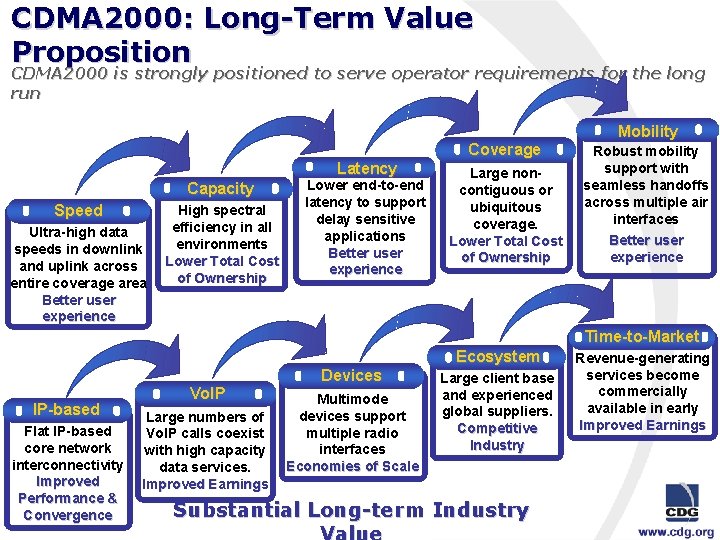
CDMA 2000: Long-Term Value Proposition CDMA 2000 is strongly positioned to serve operator requirements for the long run Mobility Coverage Latency Capacity Speed Ultra-high data speeds in downlink and uplink across entire coverage area Better user experience High spectral efficiency in all environments Lower Total Cost of Ownership Lower end-to-end latency to support delay sensitive applications Better user experience Large noncontiguous or ubiquitous coverage. Lower Total Cost of Ownership Robust mobility support with seamless handoffs across multiple air interfaces Better user experience Time-to-Market IP-based Flat IP-based core network interconnectivity Improved Performance & Convergence Vo. IP Large numbers of Vo. IP calls coexist with high capacity data services. Improved Earnings Devices Multimode devices support multiple radio interfaces Economies of Scale Ecosystem Large client base and experienced global suppliers. Competitive Industry Substantial Long-term Industry Revenue-generating services become commercially available in early Improved Earnings
- Slides: 21