
CDMA 2000 1 x EVDO Overview Version 01
- Slides: 8
CDMA 2000 1 x. EV-DO Overview Version 01. 01
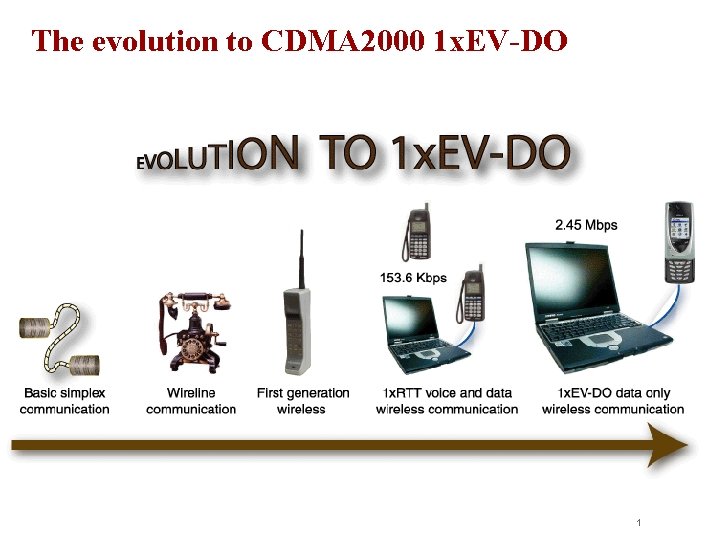
The evolution to CDMA 2000 1 x. EV-DO 1
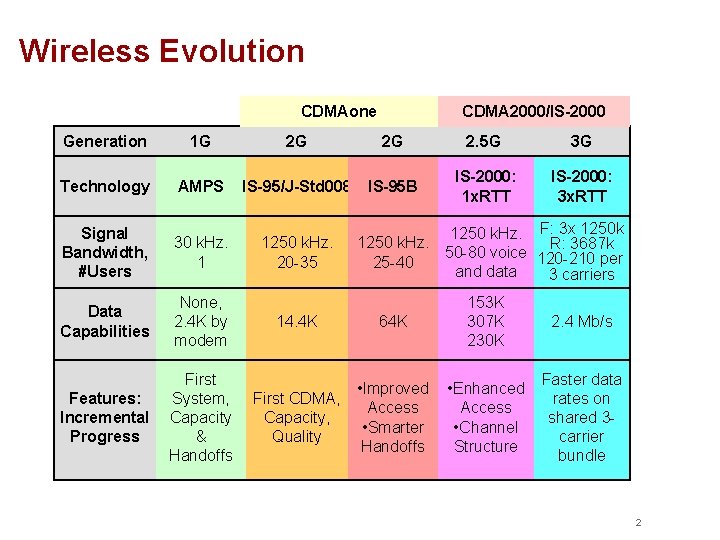
Wireless Evolution CDMAone CDMA 2000/IS-2000 Generation 1 G 2 G 2 G 2. 5 G 3 G Technology AMPS IS-95/J-Std 008 IS-95 B IS-2000: 1 x. RTT IS-2000: 3 x. RTT Signal Bandwidth, #Users 30 k. Hz. 1 Data Capabilities None, 2. 4 K by modem Features: Incremental Progress First System, Capacity & Handoffs 1250 k. Hz. 20 -35 1250 k. Hz. F: 3 x 1250 k 1250 k. Hz. R: 3687 k 50 -80 voice 120 -210 per 25 -40 and data 3 carriers 14. 4 K 153 K 307 K 230 K 2. 4 Mb/s • Enhanced Access • Channel Structure Faster data rates on shared 3 carrier bundle 64 K • Improved First CDMA, Access Capacity, • Smarter Quality Handoffs 2
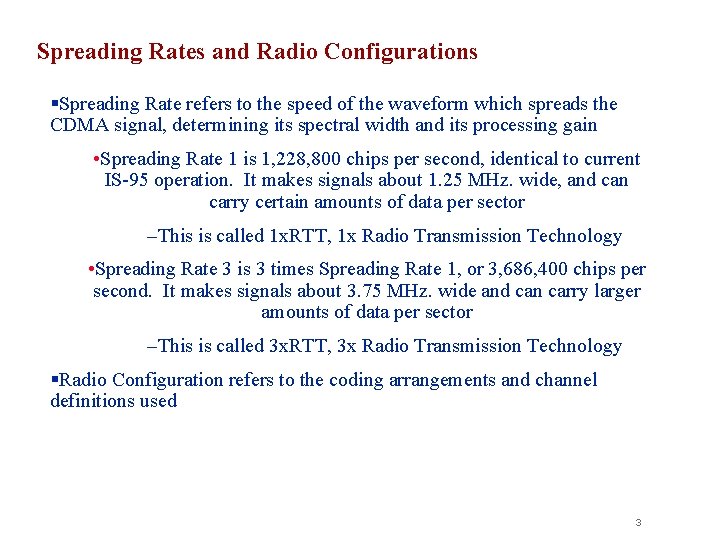
Spreading Rates and Radio Configurations §Spreading Rate refers to the speed of the waveform which spreads the CDMA signal, determining its spectral width and its processing gain • Spreading Rate 1 is 1, 228, 800 chips per second, identical to current IS-95 operation. It makes signals about 1. 25 MHz. wide, and can carry certain amounts of data per sector –This is called 1 x. RTT, 1 x Radio Transmission Technology • Spreading Rate 3 is 3 times Spreading Rate 1, or 3, 686, 400 chips per second. It makes signals about 3. 75 MHz. wide and can carry larger amounts of data per sector –This is called 3 x. RTT, 3 x Radio Transmission Technology §Radio Configuration refers to the coding arrangements and channel definitions used 3
IS-2000 Overview §Basic operation is compatible with existing IS-95 B systems • New transmission modes offer faster data rates –Up to 153. 6 kbps packet or 14. 4 kbps circuit switch data • More effective Mobile signal • Reverse Link Pilot transmitted by mobile in advanced modes –Allows synchronous demodulation §Improved convolutional encoding for more robust channels §Faster power control on forward link §Quick-paging channel improves slotted-mode paging 4
The path to CDMA 2000 1 x. EV-DO CDMA 2000 1 X in the beginning: • CDMA 2000 1 x. EV-DO is an evolution from conventional IS-2000 (CDMA 2000 1 X) networks. • CDMA 2000 1 X offers both voice and data capabilities compared to conventional CDMA (IS-95) networks (voice only) • CDMA 2000 1 X high speed packet data —Rates of up to 153. 6 Kbps (144 Kbps user) 5
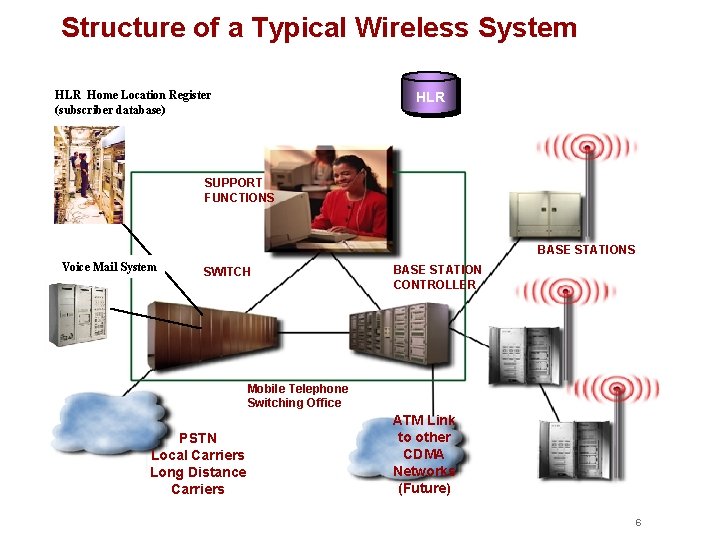
Structure of a Typical Wireless System HLR Home Location Register (subscriber database) HLR SUPPORT FUNCTIONS BASE STATIONS Voice Mail System SWITCH BASE STATION CONTROLLER Mobile Telephone Switching Office PSTN Local Carriers Long Distance Carriers ATM Link to other CDMA Networks (Future) 6
What is CDMA 2000 1 x. EV-DO? • CDMA 2000 1 x. EV-DO (1 x. RTT evolution–data only) is a wireless packet data-only technology —Used for customer data applications where voice communication is not required • high-speed packet data support of variable rates up to 2. 45 Mbps on the forward link and up to 153. 6 kbps on the reverse (upload) link • CDMA 2000 1 x. EV-DO uses time-division multiplexing (TDM) in the forward direction, meaning there are no soft handoffs in the forward direction and only one terminal receives data from each sector at a given time 7