
CDIO Standards Conceiving Designing Implementing Operating Edward Crawley
- Slides: 25
CDIO Standards Conceiving- Designing- Implementing - Operating Edward Crawley Peter Gray Johan Malmqvist Peter Goodhew June 2010
OBJECTIVES OF DISCUSSION TODAY ä The historical development of the CDIO Standards ä Proposed modification of the Standards to include specific rubrics ä Proposed change in the CDIO application process to include self-evaluation based on the Standards ä Proposed creation of a CDIO Certification Program
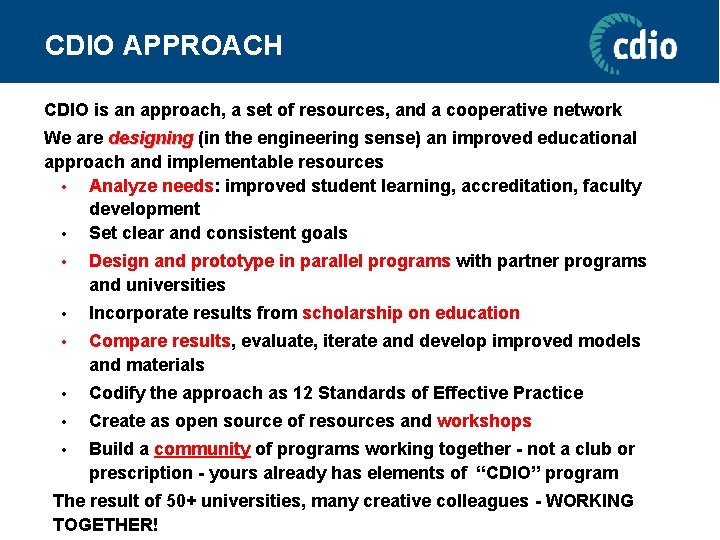
CDIO APPROACH CDIO is an approach, a set of resources, and a cooperative network We are designing (in the engineering sense) an improved educational approach and implementable resources • Analyze needs: improved student learning, accreditation, faculty development • Set clear and consistent goals • Design and prototype in parallel programs with partner programs and universities • Incorporate results from scholarship on education • Compare results, evaluate, iterate and develop improved models and materials • Codify the approach as 12 Standards of Effective Practice • Create as open source of resources and workshops • Build a community of programs working together - not a club or prescription - yours already has elements of “CDIO” program The result of 50+ universities, many creative colleagues - WORKING TOGETHER!
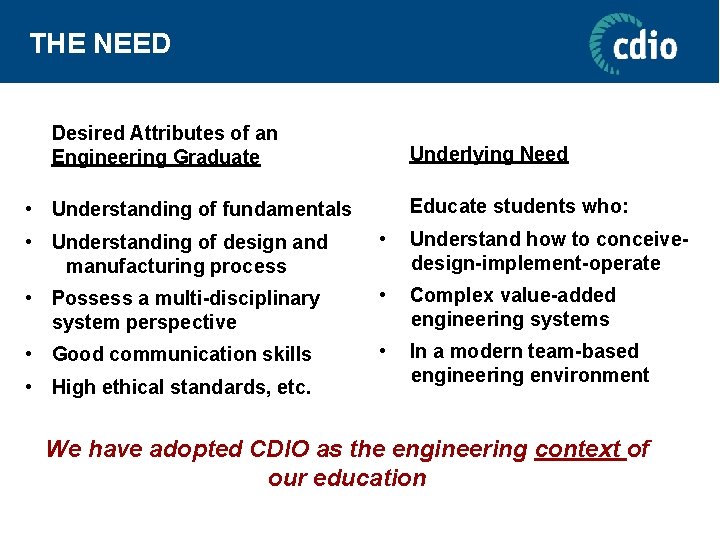
THE NEED Desired Attributes of an Engineering Graduate Underlying Need Educate students who: • Understanding of fundamentals • Understanding of design and manufacturing process • Understand how to conceivedesign-implement-operate • Possess a multi-disciplinary system perspective • Complex value-added engineering systems • Good communication skills • In a modern team-based engineering environment • High ethical standards, etc. We have adopted CDIO as the engineering context of our education
GOALS OF CDIO • To educate students to master a deeper working knowledge of the technical fundamentals • To educate engineers to lead in the creation and operation of new products and systems • To educate all to understand the importance and strategic impact of research and technological development on society And to attract and retain student in engineering
VISION We envision an education that stresses the fundamentals, set in the context of Conceiving – Designing – Implementing – Operating systems and products: • A curriculum organised around mutually supporting disciplines, but with authentic CDIO activities highly interwoven • Rich with student design-build projects • Featuring active and experiential learning • Set in both classrooms and modern learning laboratories and workspaces • Constantly improved through robust assessment and evaluation processes
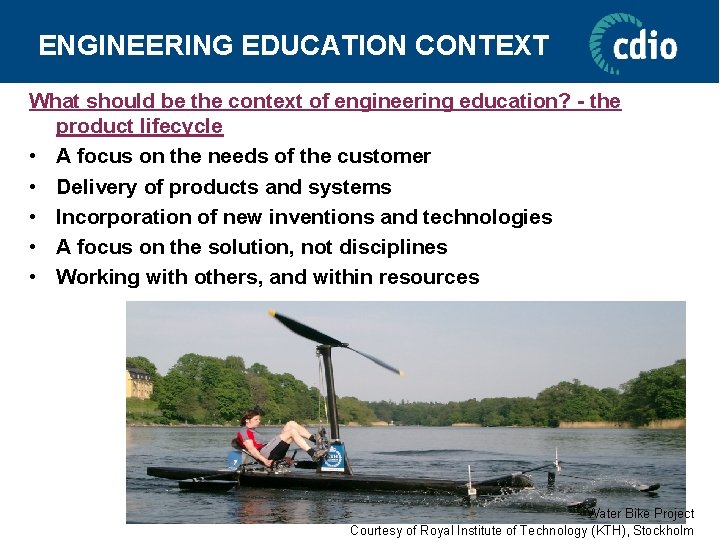
ENGINEERING EDUCATION CONTEXT What should be the context of engineering education? - the product lifecycle • A focus on the needs of the customer • Delivery of products and systems • Incorporation of new inventions and technologies • A focus on the solution, not disciplines • Working with others, and within resources Water Bike Project Courtesy of Royal Institute of Technology (KTH), Stockholm
BENEFITS OF LEARNING IN THIS CONTEXT Setting the education of engineers in the context of engineering practice gains the benefits of Contextual Learning • Increases retention of new knowledge and skills • Interconnects concepts and knowledge that build on each other • Communicates the rationale for, meaning of, and relevance of, what students are learning
EFFECTIVE PRACTICE STANDARD ONE Adoption of the principle that product, process, and system lifecycle development and deployment -Conceiving, Designing, Implementing and Operating -are the context for engineering education l It is what engineers do! l It is the underlying need and basis for the skills lists that industry proposes to university educators l It is the natural context in which to teach these skills to engineering students l It better supports the learning of the technical fundamentals
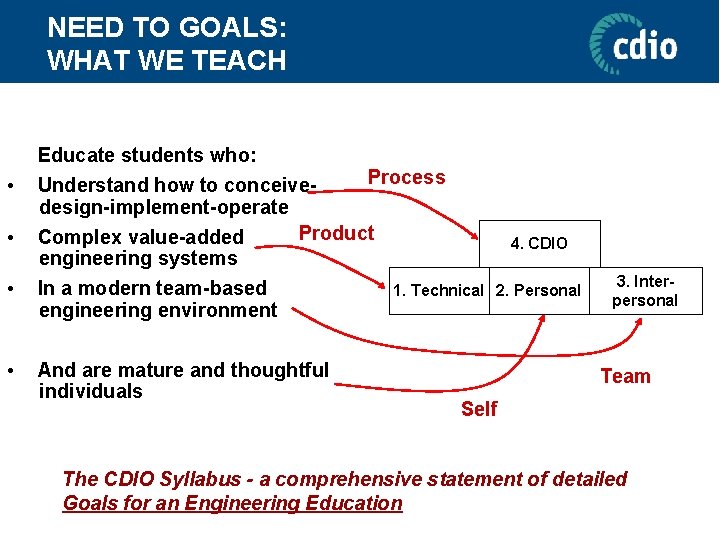
NEED TO GOALS: WHAT WE TEACH • • Educate students who: Process Understand how to conceivedesign-implement-operate Product Complex value-added engineering systems In a modern team-based 1. Technical engineering environment And are mature and thoughtful individuals 4. CDIO 2. Personal 3. Interpersonal Team Self The CDIO Syllabus - a comprehensive statement of detailed Goals for an Engineering Education
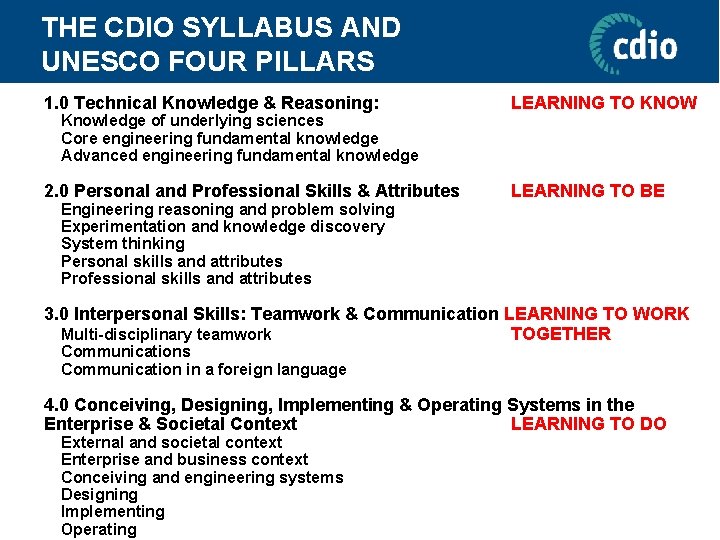
THE CDIO SYLLABUS AND UNESCO FOUR PILLARS 1. 0 Technical Knowledge & Reasoning: LEARNING TO KNOW 2. 0 Personal and Professional Skills & Attributes LEARNING TO BE Knowledge of underlying sciences Core engineering fundamental knowledge Advanced engineering fundamental knowledge Engineering reasoning and problem solving Experimentation and knowledge discovery System thinking Personal skills and attributes Professional skills and attributes 3. 0 Interpersonal Skills: Teamwork & Communication LEARNING TO WORK Multi-disciplinary teamwork TOGETHER Communications Communication in a foreign language 4. 0 Conceiving, Designing, Implementing & Operating Systems in the Enterprise & Societal Context LEARNING TO DO External and societal context Enterprise and business context Conceiving and engineering systems Designing Implementing Operating
CDIO SYLLABUS • Rational, Comprehensive • Basis for design of curriculum and assessment of student learning • In revision: • Alignment with national standards • Clarity of some topics • Strengthening of sustainability, international efforts • Addition of engineering leadership and entrepreneurship
EFFECTIVE PRACTICE STANDARD 2 Specific, detailed learning outcomes for personal and interpersonal skills, and product, process, and system building skills, as well as disciplinary knowledge, consistent with program goals and validated by program stakeholders l “Resolves” tensions among stakeholders l Allows for the design of curriculum l Basis of student evaluation l Tells us what to teach
EQF AND CDIO SYLLABUS ä European Qualifications Framework (EQF) is a framework to allow correspondence between degree programs in different (European) nations • 8 levels from schools to university degrees to lifelong education • Levels are generic, but cite proficiency, autonomy and context but no topic ä CDIO Syllabus cites topics, university develops proficiency, and has no autonomy or context ä DOCET project developed correspondence between EQF and CDIO that allows linkage of Syllabus topics to levels in EQF framework ä A way to engage stakeholders, and simplify international comparison of programs ä See paper in W 4 C Overview of Engineering 16: 40 today
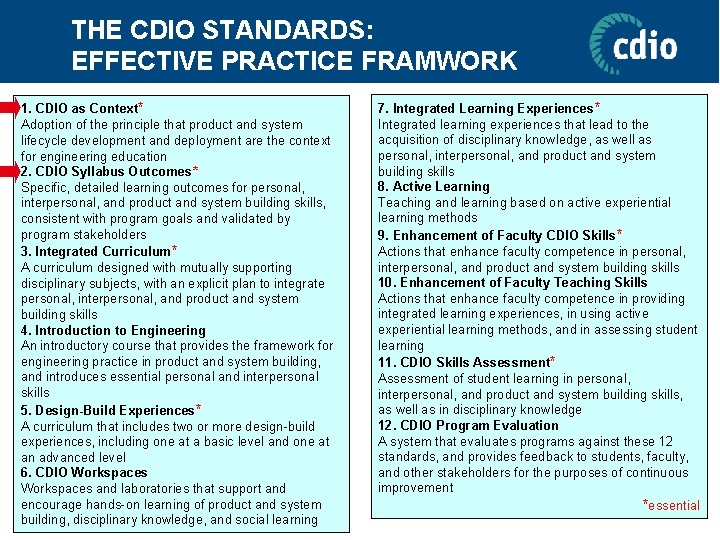
THE CDIO STANDARDS: EFFECTIVE PRACTICE FRAMWORK 1. CDIO as Context * Adoption of the principle that product and system lifecycle development and deployment are the context for engineering education 2. CDIO Syllabus Outcomes* Specific, detailed learning outcomes for personal, interpersonal, and product and system building skills, consistent with program goals and validated by program stakeholders 3. Integrated Curriculum * A curriculum designed with mutually supporting disciplinary subjects, with an explicit plan to integrate personal, interpersonal, and product and system building skills 4. Introduction to Engineering An introductory course that provides the framework for engineering practice in product and system building, and introduces essential personal and interpersonal skills 5. Design-Build Experiences * A curriculum that includes two or more design-build experiences, including one at a basic level and one at an advanced level 6. CDIO Workspaces and laboratories that support and encourage hands-on learning of product and system building, disciplinary knowledge, and social learning 7. Integrated Learning Experiences * Integrated learning experiences that lead to the acquisition of disciplinary knowledge, as well as personal, interpersonal, and product and system building skills 8. Active Learning Teaching and learning based on active experiential learning methods 9. Enhancement of Faculty CDIO Skills * Actions that enhance faculty competence in personal, interpersonal, and product and system building skills 10. Enhancement of Faculty Teaching Skills Actions that enhance faculty competence in providing integrated learning experiences, in using active experiential learning methods, and in assessing student learning 11. CDIO Skills Assessment * Assessment of student learning in personal, interpersonal, and product and system building skills, as well as in disciplinary knowledge 12. CDIO Program Evaluation A system that evaluates programs against these 12 standards, and provides feedback to students, faculty, and other stakeholders for the purposes of continuous improvement *essential
CDIO STANDARDS ä Guides to effective practice - Based on benchmarking, our development and scholarship on learning - Provide guidance for program design and evaluation - Provide framework for organizing our activities (book, web site, workshops, etc. ) - Provide framework for discussions and co-development - Basis for program self-evaluation in 2005 and 2008 ➤ Originally created to answer the question from industry “how would I know a CDIO Program if I saw one? ” in answer to our question “would you pay a graduate from a CDIO program more than other graduates? ”
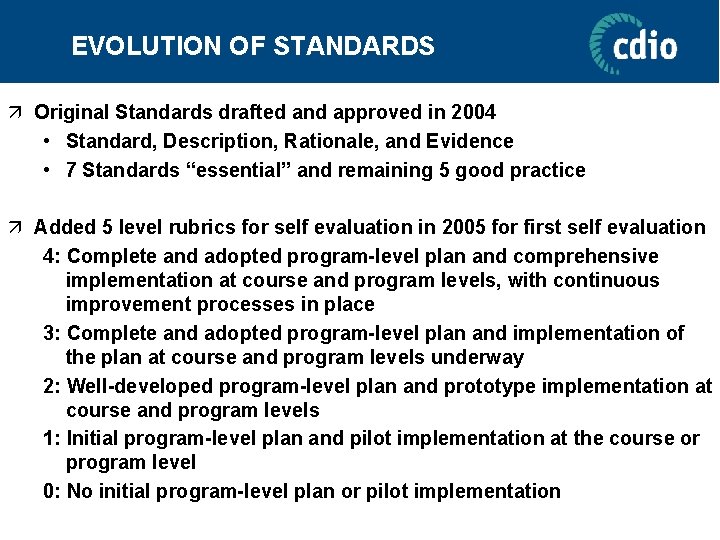
EVOLUTION OF STANDARDS ä Original Standards drafted and approved in 2004 • Standard, Description, Rationale, and Evidence • 7 Standards “essential” and remaining 5 good practice ä Added 5 level rubrics for self evaluation in 2005 for first self evaluation 4: Complete and adopted program-level plan and comprehensive implementation at course and program levels, with continuous improvement processes in place 3: Complete and adopted program-level plan and implementation of the plan at course and program levels underway 2: Well-developed program-level plan and prototype implementation at course and program levels 1: Initial program-level plan and pilot implementation at the course or program level 0: No initial program-level plan or pilot implementation
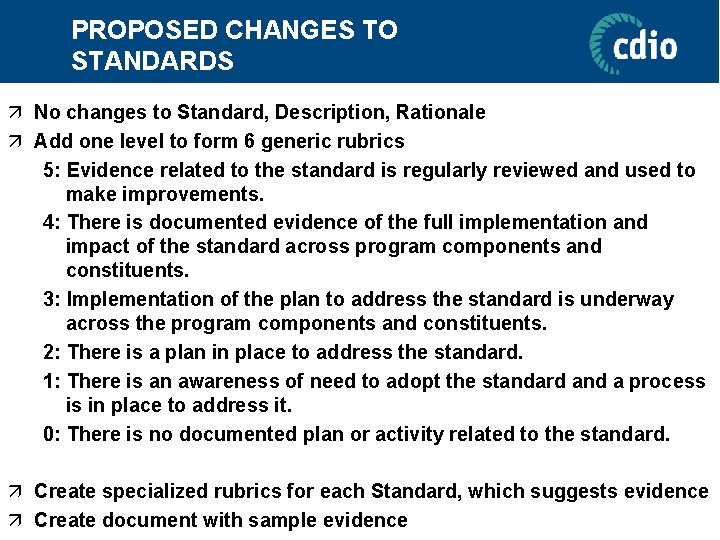
PROPOSED CHANGES TO STANDARDS ä No changes to Standard, Description, Rationale ä Add one level to form 6 generic rubrics 5: Evidence related to the standard is regularly reviewed and used to make improvements. 4: There is documented evidence of the full implementation and impact of the standard across program components and constituents. 3: Implementation of the plan to address the standard is underway across the program components and constituents. 2: There is a plan in place to address the standard. 1: There is an awareness of need to adopt the standard and a process is in place to address it. 0: There is no documented plan or activity related to the standard. ä Create specialized rubrics for each Standard, which suggests evidence ä Create document with sample evidence
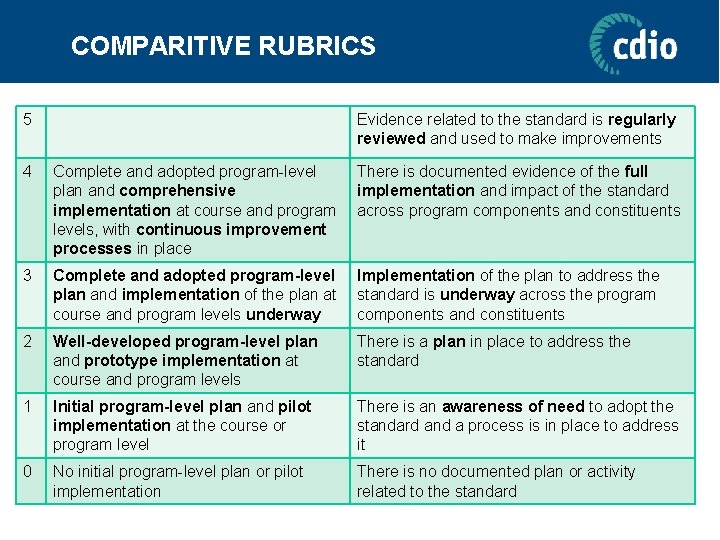
COMPARITIVE RUBRICS 5 Evidence related to the standard is regularly reviewed and used to make improvements 4 Complete and adopted program-level plan and comprehensive implementation at course and program levels, with continuous improvement processes in place There is documented evidence of the full implementation and impact of the standard across program components and constituents 3 Complete and adopted program-level plan and implementation of the plan at course and program levels underway Implementation of the plan to address the standard is underway across the program components and constituents 2 Well-developed program-level plan and prototype implementation at course and program levels There is a plan in place to address the standard 1 Initial program-level plan and pilot implementation at the course or program level There is an awareness of need to adopt the standard and a process is in place to address it 0 No initial program-level plan or pilot implementation There is no documented plan or activity related to the standard
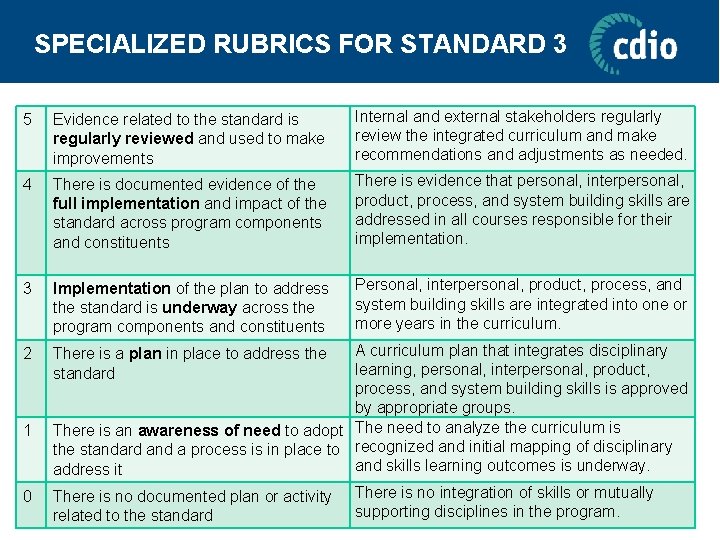
SPECIALIZED RUBRICS FOR STANDARD 3 5 Evidence related to the standard is regularly reviewed and used to make improvements Internal and external stakeholders regularly review the integrated curriculum and make recommendations and adjustments as needed. 4 There is documented evidence of the full implementation and impact of the standard across program components and constituents There is evidence that personal, interpersonal, product, process, and system building skills are addressed in all courses responsible for their implementation. 3 Implementation of the plan to address the standard is underway across the program components and constituents Personal, interpersonal, product, process, and system building skills are integrated into one or more years in the curriculum. 2 There is a plan in place to address the standard 1 0 A curriculum plan that integrates disciplinary learning, personal, interpersonal, product, process, and system building skills is approved by appropriate groups. There is an awareness of need to adopt The need to analyze the curriculum is the standard and a process is in place to recognized and initial mapping of disciplinary and skills learning outcomes is underway. address it There is no documented plan or activity related to the standard There is no integration of skills or mutually supporting disciplines in the program.
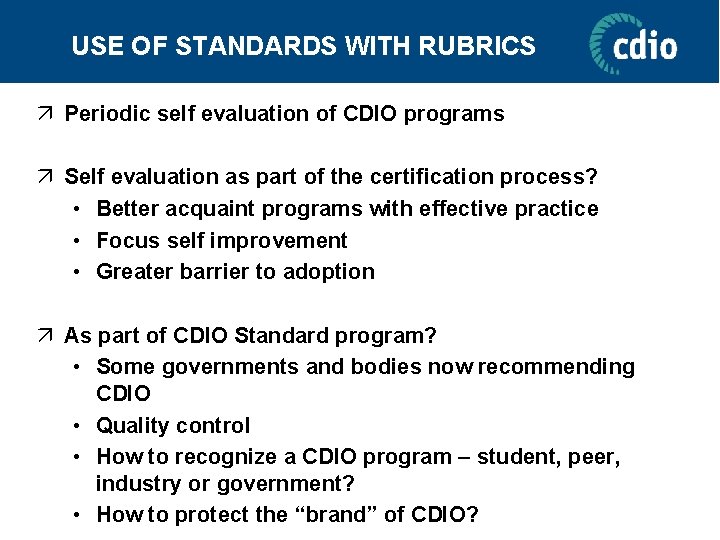
USE OF STANDARDS WITH RUBRICS ä Periodic self evaluation of CDIO programs ä Self evaluation as part of the certification process? • Better acquaint programs with effective practice • Focus self improvement • Greater barrier to adoption ä As part of CDIO Standard program? • Some governments and bodies now recommending CDIO • Quality control • How to recognize a CDIO program – student, peer, industry or government? • How to protect the “brand” of CDIO?
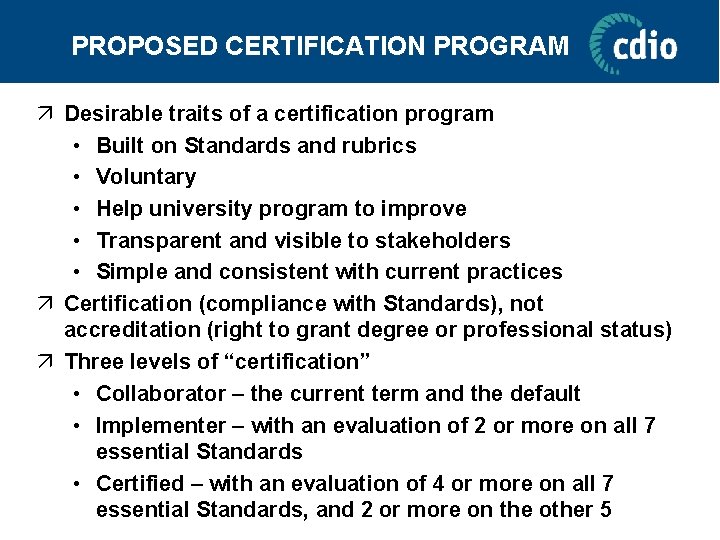
PROPOSED CERTIFICATION PROGRAM ä Desirable traits of a certification program • Built on Standards and rubrics • Voluntary • Help university program to improve • Transparent and visible to stakeholders • Simple and consistent with current practices ä Certification (compliance with Standards), not accreditation (right to grant degree or professional status) ä Three levels of “certification” • Collaborator – the current term and the default • Implementer – with an evaluation of 2 or more on all 7 essential Standards • Certified – with an evaluation of 4 or more on all 7 essential Standards, and 2 or more on the other 5
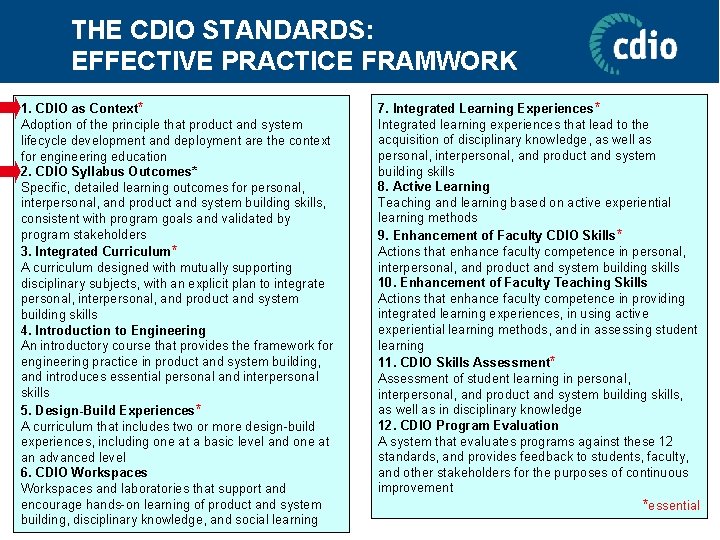
THE CDIO STANDARDS: EFFECTIVE PRACTICE FRAMWORK 1. CDIO as Context * Adoption of the principle that product and system lifecycle development and deployment are the context for engineering education 2. CDIO Syllabus Outcomes* Specific, detailed learning outcomes for personal, interpersonal, and product and system building skills, consistent with program goals and validated by program stakeholders 3. Integrated Curriculum * A curriculum designed with mutually supporting disciplinary subjects, with an explicit plan to integrate personal, interpersonal, and product and system building skills 4. Introduction to Engineering An introductory course that provides the framework for engineering practice in product and system building, and introduces essential personal and interpersonal skills 5. Design-Build Experiences * A curriculum that includes two or more design-build experiences, including one at a basic level and one at an advanced level 6. CDIO Workspaces and laboratories that support and encourage hands-on learning of product and system building, disciplinary knowledge, and social learning 7. Integrated Learning Experiences * Integrated learning experiences that lead to the acquisition of disciplinary knowledge, as well as personal, interpersonal, and product and system building skills 8. Active Learning Teaching and learning based on active experiential learning methods 9. Enhancement of Faculty CDIO Skills * Actions that enhance faculty competence in personal, interpersonal, and product and system building skills 10. Enhancement of Faculty Teaching Skills Actions that enhance faculty competence in providing integrated learning experiences, in using active experiential learning methods, and in assessing student learning 11. CDIO Skills Assessment * Assessment of student learning in personal, interpersonal, and product and system building skills, as well as in disciplinary knowledge 12. CDIO Program Evaluation A system that evaluates programs against these 12 standards, and provides feedback to students, faculty, and other stakeholders for the purposes of continuous improvement *essential
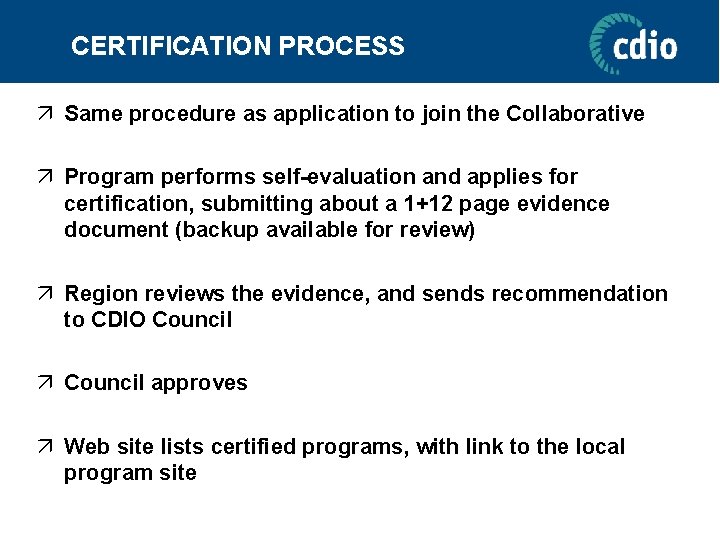
CERTIFICATION PROCESS ä Same procedure as application to join the Collaborative ä Program performs self-evaluation and applies for certification, submitting about a 1+12 page evidence document (backup available for review) ä Region reviews the evidence, and sends recommendation to CDIO Council ä Council approves ä Web site lists certified programs, with link to the local program site
SUMMARY ä The CDIO Standards has been a powerful, stable, and useful instrument for half a decade ä The framework for CDIO development, sharing, evaluation ä Propose modest modification to the rubrics for the Standards ä Consider asking new applicants to perform self-evaluation ä Propose Certification Program • Transparently identifies true adopters of CDIO • Protects the CDIO brand ä This is a proposal, which we provide for comment and debate