
CDES VCE PSYCHOLOGY TEACHERS CONFERENCE 14 February 2017
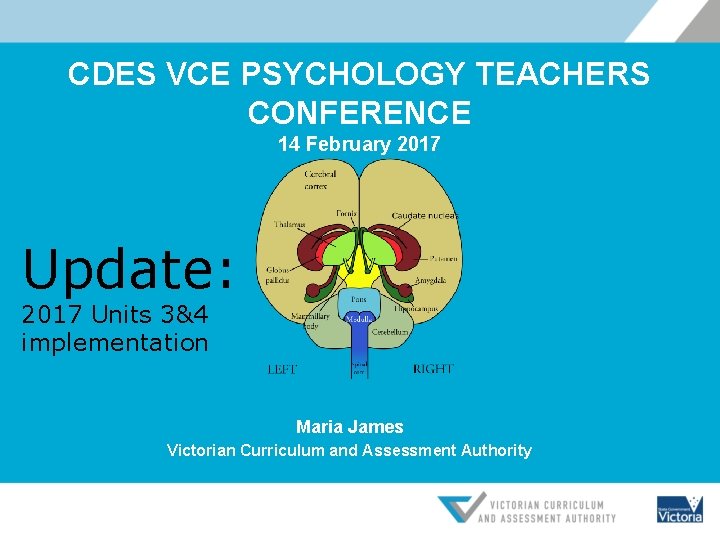
CDES VCE PSYCHOLOGY TEACHERS CONFERENCE 14 February 2017 Update: 2017 Units 3&4 implementation Maria James Victorian Curriculum and Assessment Authority
© Victorian Curriculum and Assessment Authority 2015 § Third parties may own copyright in some content included in this presentation, as indicated. § The term VCE and associated logos are registered trademarks of the VCAA. § VCAA content may be used in accordance with the VCAA’s Intellectual Property and Copyright Policy: http: //www. vcaa. vic. edu. au/Pages/aboutus/polic ies/policy-copyright. aspx
Workshop aims q Outline timelines for publication of VCE support materials q. Review assessment – internal and external q. Discuss course scope q. Outline forthcoming PD opportunities q. Respond to audience questions

VCE Unit 3 Science enrolments 2005 -2015 18, 000 16, 000 14, 000 12, 000 Biology 10, 000 Chemistry Environmental Science 8, 000 Physics Psychology 6, 000 4, 000 2, 000 0 2005 2006 2007 2008 2009 2010 2011 2012 2013 2014 2015
Correct study design Schools must deliver the new study design VCE Psychology resources are available at http: //www. vcaa. vic. edu. au/P ages/vce/studies/psychology/ psychoindex. aspx Accreditation period: Units 1 and 2: 2016 -2020 Units 3 and 4: 2017 -2021
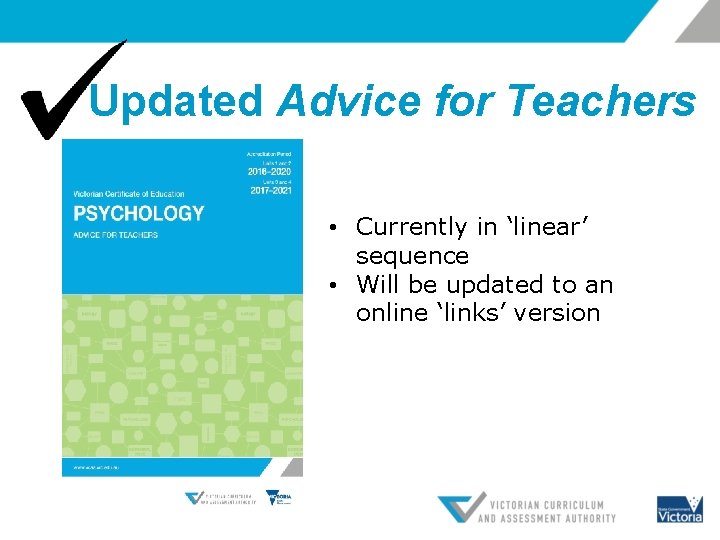
Updated Advice for Teachers • Currently in ‘linear’ sequence • Will be updated to an online ‘links’ version
Who is the study design for? q Students progressing to further studies in science and/or associated science disciplines (science literacy) q Students with a general interest in science and its applications in society (scientific literacy)
DEPTH (without drowning) …rather than… BREADTH
GABA…and dopamine Current Unit 3 AOS 1 - Nervous system functioning - Dot Pt #5. . the role of GABA in Parkinson's disease. Proposed. . . the role of dopamine in Parkinson's disease.
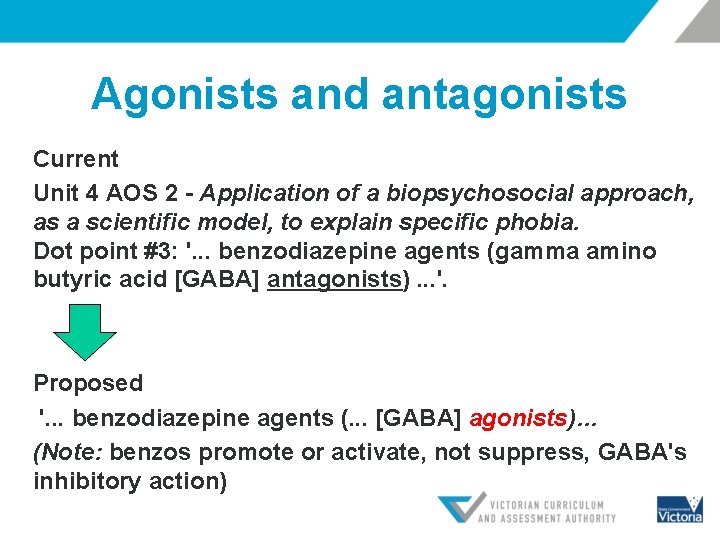
Agonists and antagonists Current Unit 4 AOS 2 - Application of a biopsychosocial approach, as a scientific model, to explain specific phobia. Dot point #3: '. . . benzodiazepine agents (gamma amino butyric acid [GABA] antagonists). . . '. Proposed '. . . benzodiazepine agents (. . . [GABA] agonists)… (Note: benzos promote or activate, not suppress, GABA's inhibitory action)
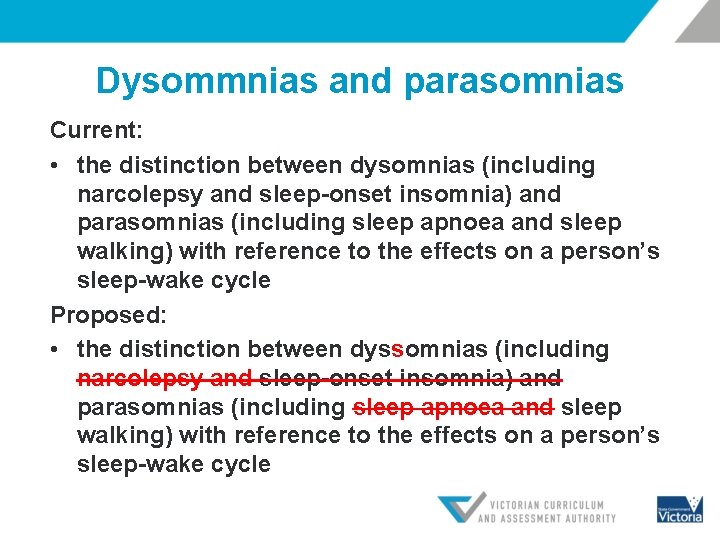
Dysommnias and parasomnias Current: • the distinction between dysomnias (including narcolepsy and sleep-onset insomnia) and parasomnias (including sleep apnoea and sleep walking) with reference to the effects on a person’s sleep-wake cycle Proposed: • the distinction between dyssomnias (including narcolepsy and sleep-onset insomnia) and parasomnias (including sleep apnoea and sleep walking) with reference to the effects on a person’s sleep-wake cycle
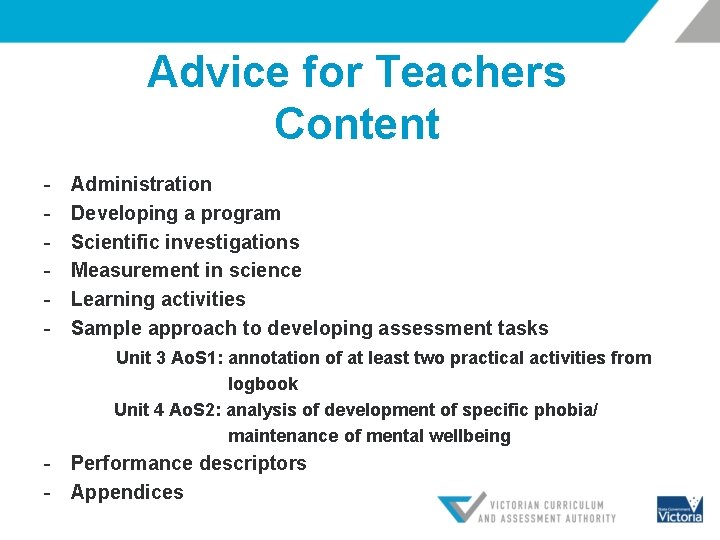
Advice for Teachers Content - Administration Developing a program Scientific investigations Measurement in science Learning activities Sample approach to developing assessment tasks Unit 3 Ao. S 1: annotation of at least two practical activities from logbook Unit 4 Ao. S 2: analysis of development of specific phobia/ maintenance of mental wellbeing - Performance descriptors - Appendices
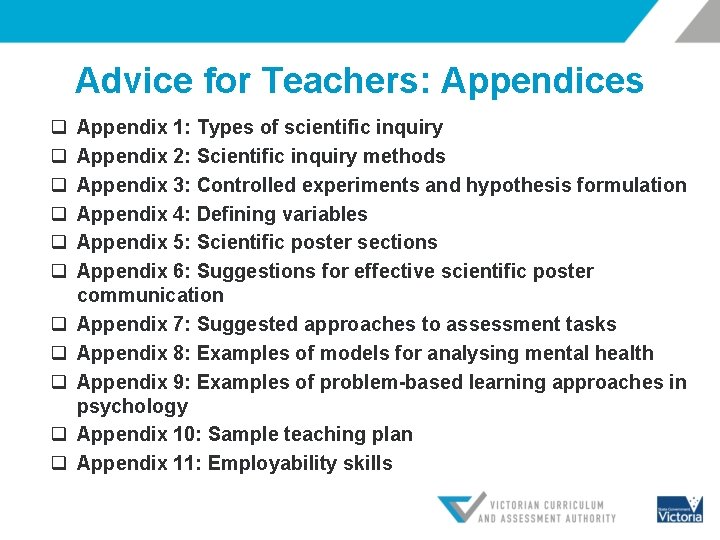
Advice for Teachers: Appendices q q q Appendix 1: Types of scientific inquiry Appendix 2: Scientific inquiry methods Appendix 3: Controlled experiments and hypothesis formulation Appendix 4: Defining variables Appendix 5: Scientific poster sections Appendix 6: Suggestions for effective scientific poster communication Appendix 7: Suggested approaches to assessment tasks Appendix 8: Examples of models for analysing mental health Appendix 9: Examples of problem-based learning approaches in psychology Appendix 10: Sample teaching plan Appendix 11: Employability skills
Unit 3 and 4 SAC tasks At least one task selected from: q Annotations of at least two practical activities from a practical logbook q Evaluation of research q A report of a student investigation q An analysis of data including generalisations and conclusions q Media analysis/response q A response to a set of structured questions q A reflective blog/learning journal related to selected activities or in response to an issue q A test (approximately 50 minutes or not exceeding 1000 words for each task)
What is a ‘report of a practical activity’? (refer to Advice for Teachers) Report of a practical activity or laboratory investigation The report should be preceded by a practical activity or laboratory investigation that has been fully and/or partially completed under supervision and that has been recorded in a student’s logbook. The logbook can then be taken into class for reference by students in producing a report in a format designated by the teacher. Reports may take any form as deemed appropriate by the teacher, and may include an oral presentation, simple tabulations of results with a student comment, a response to an overarching question or a set of structured questions linking the selected practical activities, full practical reports that include an abstract, an aim, a hypothesis, a method, results, discussion, a conclusion and references. Although practical activities and laboratory investigations may be conducted individually, in small groups or as a class, the report must be completed individually.
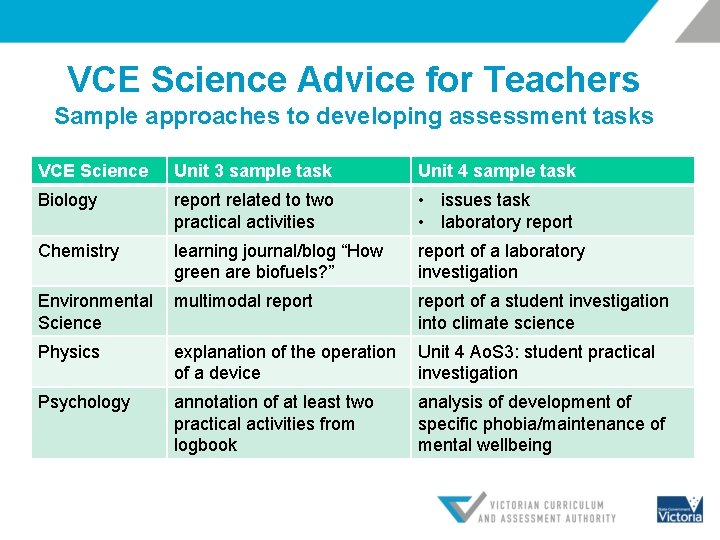
VCE Science Advice for Teachers Sample approaches to developing assessment tasks VCE Science Unit 3 sample task Unit 4 sample task Biology report related to two practical activities • issues task • laboratory report Chemistry learning journal/blog “How green are biofuels? ” report of a laboratory investigation Environmental Science multimodal report of a student investigation into climate science Physics explanation of the operation of a device Unit 4 Ao. S 3: student practical investigation Psychology annotation of at least two practical activities from logbook analysis of development of specific phobia/maintenance of mental wellbeing
School-assessed Coursework audits q audit numbers are increased in first year of implementation (25% of schools offering study) q SACs should assess skills and knowledge that may not be easily assessed in an external examination q reports to VCAA of student stress – teachers should assess sufficiently to determine a ‘rank order’ q Unit 3 and 4 SAC reports published online in 2018
VCE SACs and S/N q All parts of an outcome must be considered in determination of an S/N for each outcome q Not all parts of an outcome need to be assessed in a single SAC: q Assessment may be diagnostic/formative/summative Unit 3 Ao. S 1: “Explain how the structure and function of the human nervous system enables a person to interact with the external world analyse the different ways in which stress can affect nervous system functioning. ” SAC: response to an issue OR report of a laboratory investigation
Sample exam q Proportionally greater focus on scientific skills – approximately equal weighting of all Unit 3&4 Ao. S q Examination specifications published q Time (2. 5 hours) unchanged q Contributes to 60% of study score (unchanged) q Format changed: - Key knowledge in Units 3 and 4, and key science skills (more explicit compared with previous study design) on pages 11 and 12 of the study design all examined - Section A (MCQ) - Section B (short-answer and extended-answer questions including questions with multiple parts and a single 10 -mark question)
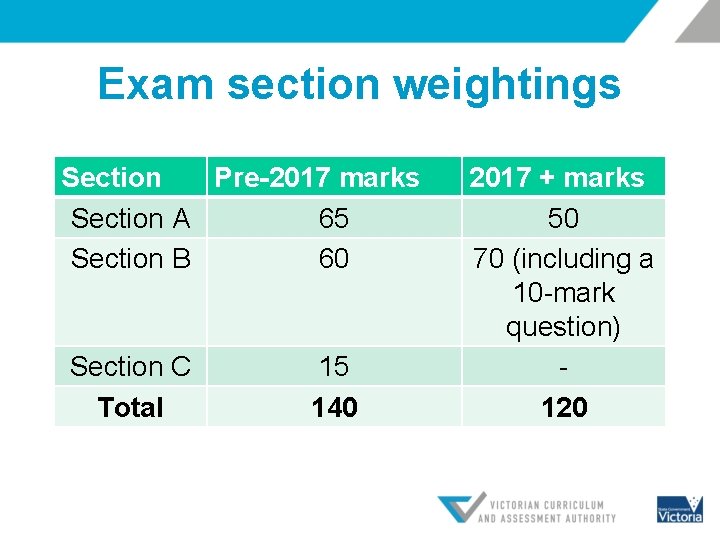
Exam section weightings Section Pre-2017 marks Section A 65 Section B 60 Section C Total 15 140 2017 + marks 50 70 (including a 10 -mark question) 120
External Examination General Advice q Each examination will test a representative sample of the key knowledge from all outcomes in Units 3 and 4, and the key science skills found in the section on ‘Cross-study specifications’ in the study design (pages 10 and 11). q Examination questions may relate to one or more areas of study and may integrate research methodologies and ethical principles. q The examination may include questions that refer to visual and/or written material, including scenarios and/or experiments. q The weighting of examination questions will reflect approximately the weighting of the outcomes in the study design. q All questions will be compulsory. q Students should use command/task words, other instructional information within questions and corresponding mark allocations to guide their responses.
Exam specifications: statistics q. No data book q No calculator: Students will not be expected to calculate any statistics in the exam q Students will be expected to draw conclusions from descriptive statistics about a sample and hypothesis involved in a specified research study q Students will be expected to make qualitative generalisations about a research population after considering research design
Exam specifications: writing style q Extended answer questions may be related to psychological concepts and theories as well as research methods and ethics q Students will not be expected to write a response using conventions of psychological report writing in the examination as this skill is assessed through School-assessed Coursework
Sample examination questions that illustrate ‘new directions’ in the study design
Brain bits Question: Do I need to teach the lobes of the brain and their roles, or Broca’s/Wernicke’s areas? Unit 3, Area of study, dot point 1: • the roles of the different divisions of the nervous system (central and peripheral nervous systems and their associated subdivisions) in responding to, and integrating with, sensory stimuli received by the body
Section A MCQ: science skills Question In an experiment, it is essential to control for extraneous variables so that A there is a probability that the results will be obtained by chance. B a valid conclusion can be drawn about the effect of the independent variable on the dependent variable. C a valid conclusion can be drawn about the effect of the dependent variable on the independent variable. D the hypothesis is supported and the results of the experiment can be generalised to the broader population.
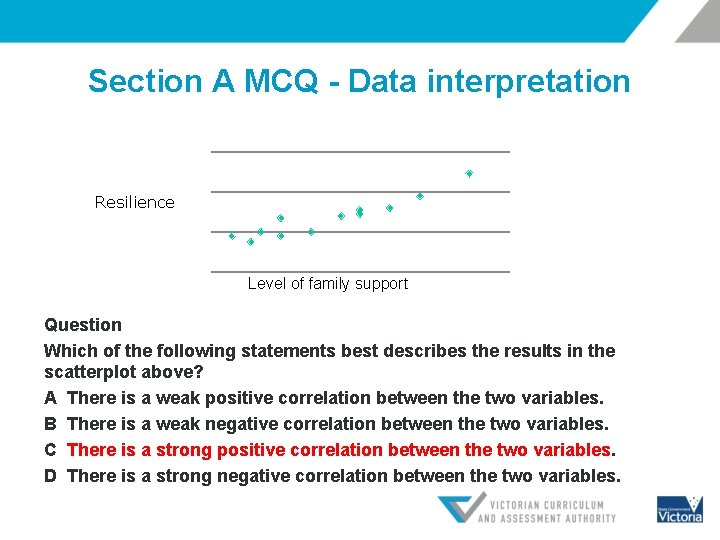
Section A MCQ - Data interpretation Resilience Level of family support Question Which of the following statements best describes the results in the scatterplot above? A There is a weak positive correlation between the two variables. B There is a weak negative correlation between the two variables. C There is a strong positive correlation between the two variables. D There is a strong negative correlation between the two variables.
Section A MCQ – study design changes Question In his late sixties Mr Ng develops Parkinson’s disease and finds it difficult to control the voluntary movement of his muscles. The impaired movement experienced by people with Parkinson’s disease is a result of neurons in the part of the brain that controls movement undergoing A proliferation, leading to a decrease in the production of dopamine. B proliferation, leading to an increase in the production of dopamine. C degeneration, leading to a decrease in the production of dopamine. D degeneration, leading to an increase in the production of dopamine.
Study design – new content: role of neurotransmitters Unit 3 Area of study 1 q. The role of neurotransmitters in the transmission of neural information between neurons (lock-and-key process) to produce excitatory effects (as with glutamate) or inhibitory effects (as with GABA)
Section A MCQ – new content Question Which of the following statements is correct? A Synaptic plasticity occurs only in early childhood. B Long-term depression is based on the principal that ‘neurons that fire together wire together’. C Long-term depression may occur when the number of glutamate receptors are decreased, strengthening the synaptic response to the release of neurotransmitters. D Synapses are strengthened in long-term potentiation when glutamate receptors are increased, causing a higher excitatory response to the release of neurotransmitters.
Neurotransmitters and learning Unit 3, Ao. S 2 • the role of neurotransmitters and neurohormones in the neural basis of memory and learning (including the role of glutamate in synaptic plasticity and the role of adrenaline in the consolidation of emotionally arousing experiences)
Section A MCQ – new content Question Whilst rushing out the door to go to school, Sarah accidentally smashed her parents’ antique vase. She was so shaken up by the event that she had trouble sleeping that night and kept replaying the accident in her head for the next two days. The neurotransmitter involved in the consolidation of Sarah’s memory of the accident that would aid in her memory of the event is A a benzodiazepine agent. B dopamine. C adrenaline. D gamma-amino butyric acid (GABA).
Section B – short answer Question (2 marks) Three months ago, 45 -year-old Milos lost his job from the company where he had worked for 25 years. He is still unemployed despite applying for many jobs. He has two teenage children living at home and his wife works full-time as a teacher. Before losing his job he had promised to take his family on an overseas holiday for Christmas. He is having difficulty sleeping but has made sure that he has been eating well and exercising daily. He has also recently made contact with a job agency which provides him with job application and interview skills. • Comment on the likelihood of Milos developing a mental health disorder with reference to cumulative risk.
Section B – structured questions and content integration… 1 of 2 Question (10 marks) Alex and Danny are both VCE students who have been selected to try out for a national Under 21 football squad. Although Alex knows that he is a good player he is feeling overwhelmed by the level of competition for a place in the national squad and is concerned that he is not good enough to gain selection. For the past six months Alex has had difficulty falling asleep at night. He is often still awake at 2. 00 am despite having gone to bed on most nights at around 10. 30 pm. As bedtime approaches Alex worries that he won’t be able to fall asleep. Danny is enjoying football training and is pleased with his skill development. He is confident of squad selection, does not feel excessively stressed and has no trouble sleeping.
Alex and Danny…continued a. b. c. d. e. Identify an example of Alex’s poor self-efficacy. (1 mark) Define the likely sleep disturbance from which Alex is suffering. (1 mark) Explain how cognitive behavioural therapy (CBT) could be used to treat Alex’s sleep disturbance. (3 marks) Explain why Alex and Danny may have evaluated their situations differently in terms of the primary appraisal stage in Lazarus and Folkman’s Transactional Model of Stress and Coping. (3 marks) Outline an approach strategy that could help Alex reduce his levels of stress. (2 marks)
Section B – Unit 4 Ao. S 3”investogation” Question (16 marks) For her extended VCE Psychology practical investigation, Amelia decided to investigate encoding in short-term memory. She used a random sample of 30 students from a cohort of 150 Year 10 students at her school. Two lists of monosyllabic words were read out to participants in the investigation: • List 1: key; pea; ski; flea; tea; bee; knee; tree; sea (monosyllabic words that rhyme) • List 2: sock; bean; stick; ant; milk; fly; leg; leaf; sand (monosyllabic words that do not rhyme) All 30 participants listened to the reading of words in List 1, which was read twice, and were then given two minutes to write down the words they recalled. Next, they all listened to the reading of words in List 2, which was read twice, and were then given two minutes to write down the words they recalled.
Amelia …continued…skills a. Identify the dependent and independent variables in Amelia’s experiment. (2 marks) • • Dependent variable ____ Independent variable ____ b. Name the experimental research design Amelia used in this investigation and state one disadvantage of this choice of design. (2 marks) • • Experimental Research Design ____ Disadvantage ____ c. Amelia used random sampling to select the participants for her investigation. (i) Describe why random sampling is a better choice of sampling technique for this investigation than convenience sampling. (2 marks) (ii) Outline a method that Amelia could have used to take a random sample of Year 10 students. (2 marks)
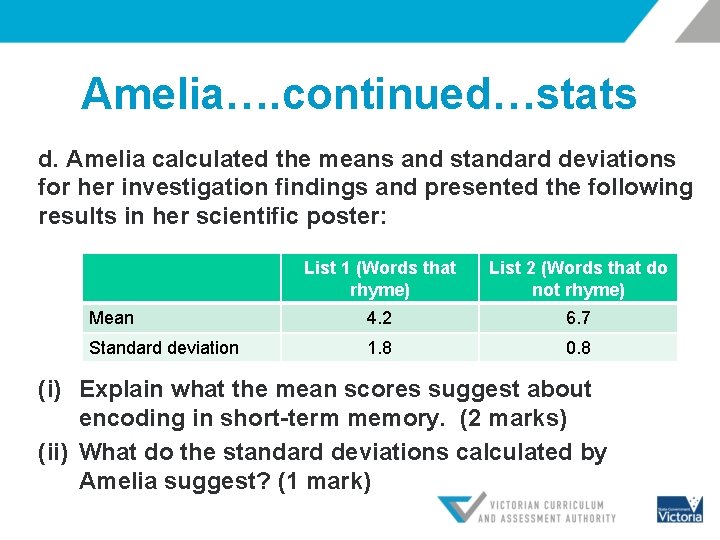
Amelia…. continued…stats d. Amelia calculated the means and standard deviations for her investigation findings and presented the following results in her scientific poster: List 1 (Words that rhyme) List 2 (Words that do not rhyme) Mean 4. 2 6. 7 Standard deviation 1. 8 0. 8 (i) Explain what the mean scores suggest about encoding in short-term memory. (2 marks) (ii) What do the standard deviations calculated by Amelia suggest? (1 mark)
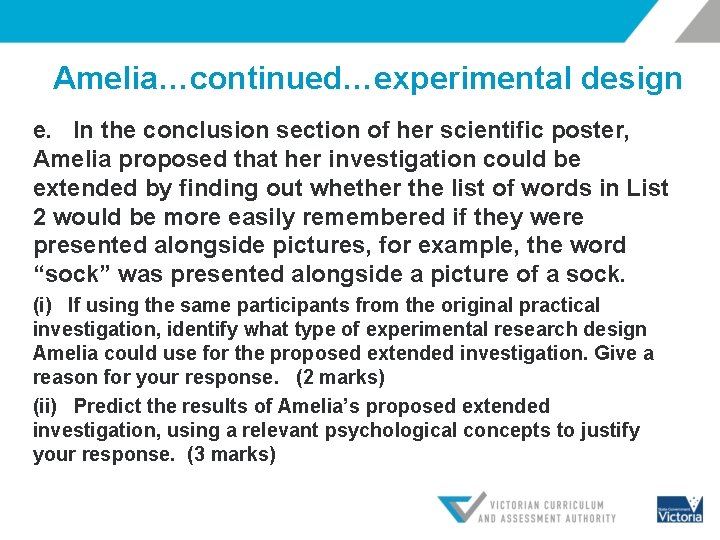
Amelia…continued…experimental design e. In the conclusion section of her scientific poster, Amelia proposed that her investigation could be extended by finding out whether the list of words in List 2 would be more easily remembered if they were presented alongside pictures, for example, the word “sock” was presented alongside a picture of a sock. (i) If using the same participants from the original practical investigation, identify what type of experimental research design Amelia could use for the proposed extended investigation. Give a reason for your response. (2 marks) (ii) Predict the results of Amelia’s proposed extended investigation, using a relevant psychological concepts to justify your response. (3 marks)
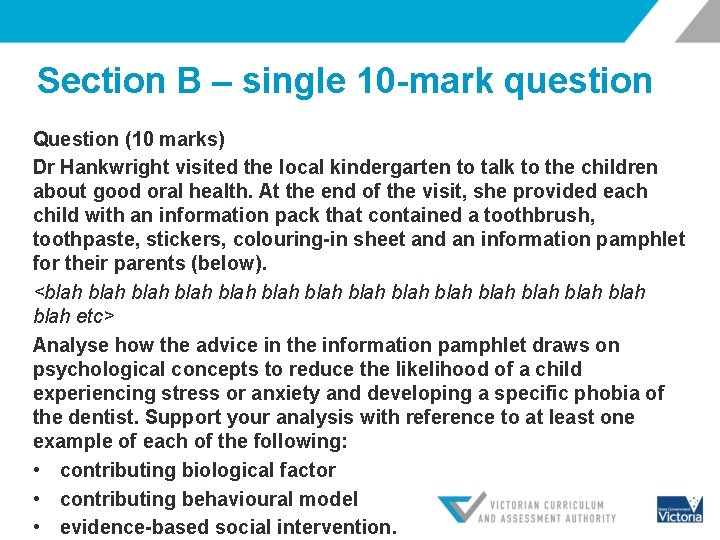
Section B – single 10 -mark question Question (10 marks) Dr Hankwright visited the local kindergarten to talk to the children about good oral health. At the end of the visit, she provided each child with an information pack that contained a toothbrush, toothpaste, stickers, colouring-in sheet and an information pamphlet for their parents (below). <blah blah blah blah etc> Analyse how the advice in the information pamphlet draws on psychological concepts to reduce the likelihood of a child experiencing stress or anxiety and developing a specific phobia of the dentist. Support your analysis with reference to at least one example of each of the following: • contributing biological factor • contributing behavioural model • evidence-based social intervention.
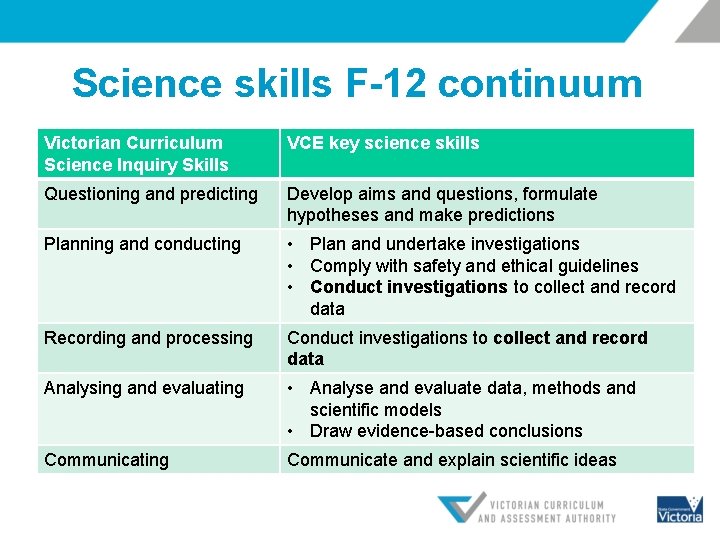
Science skills F-12 continuum Victorian Curriculum Science Inquiry Skills VCE key science skills Questioning and predicting Develop aims and questions, formulate hypotheses and make predictions Planning and conducting • Plan and undertake investigations • Comply with safety and ethical guidelines • Conduct investigations to collect and record data Recording and processing Conduct investigations to collect and record data Analysing and evaluating • Analyse and evaluate data, methods and scientific models • Draw evidence-based conclusions Communicating Communicate and explain scientific ideas
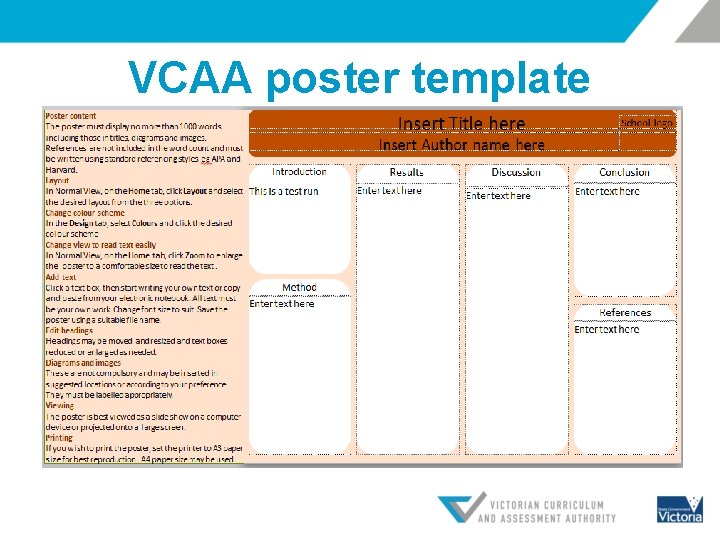
VCAA poster template
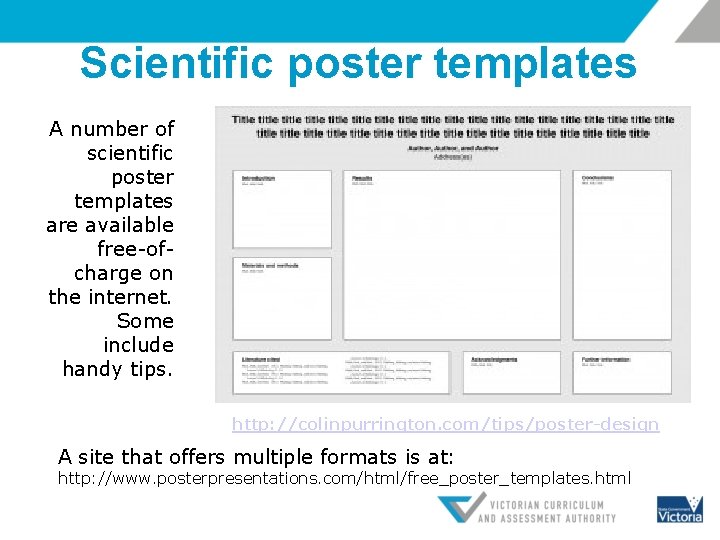
Scientific poster templates A number of scientific poster templates are available free-ofcharge on the internet. Some include handy tips. http: //colinpurrington. com/tips/poster-design A site that offers multiple formats is at: http: //www. posterpresentations. com/html/free_poster_templates. html
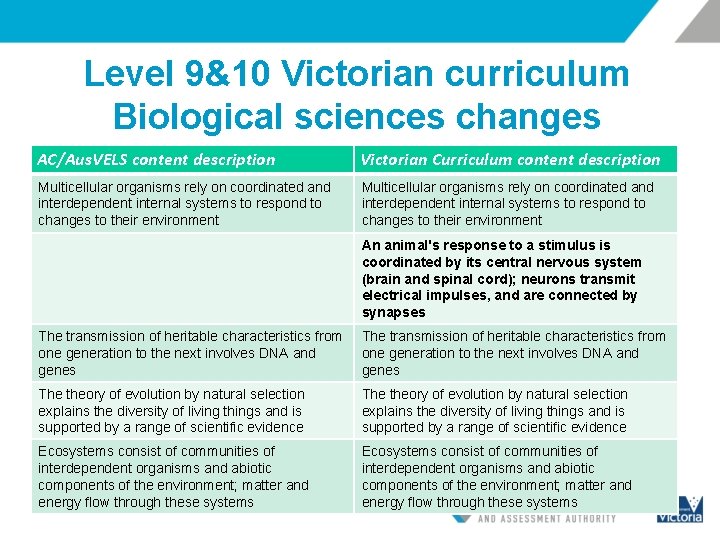
Level 9&10 Victorian curriculum Biological sciences changes AC/Aus. VELS content description Victorian Curriculum content description Multicellular organisms rely on coordinated and interdependent internal systems to respond to changes to their environment An animal's response to a stimulus is coordinated by its central nervous system (brain and spinal cord); neurons transmit electrical impulses, and are connected by synapses The transmission of heritable characteristics from one generation to the next involves DNA and genes The theory of evolution by natural selection explains the diversity of living things and is supported by a range of scientific evidence Ecosystems consist of communities of interdependent organisms and abiotic components of the environment; matter and energy flow through these systems
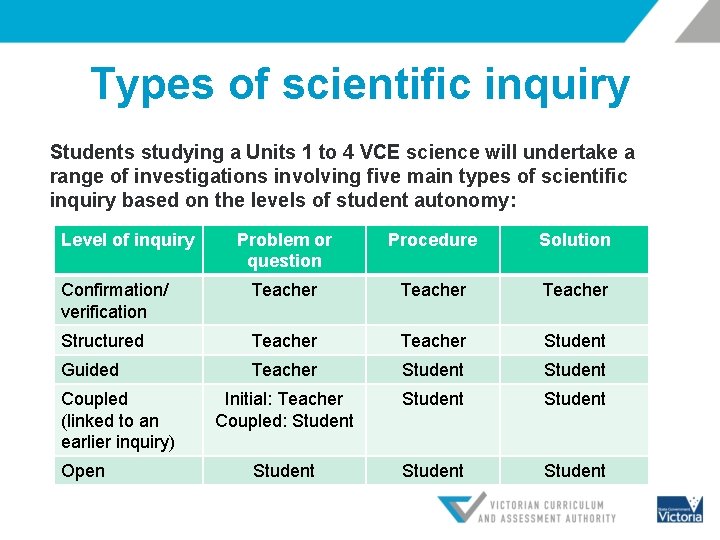
Types of scientific inquiry Students studying a Units 1 to 4 VCE science will undertake a range of investigations involving five main types of scientific inquiry based on the levels of student autonomy: Level of inquiry Problem or question Procedure Solution Confirmation/ verification Teacher Structured Teacher Student Guided Teacher Student Initial: Teacher Coupled: Student Student Coupled (linked to an earlier inquiry) Open
Investigation ethics and safety Students cannot proceed with an investigation unless safe and ethical to do so Discuss the role of the: § student § science coordinator § classroom teacher § laboratory technician
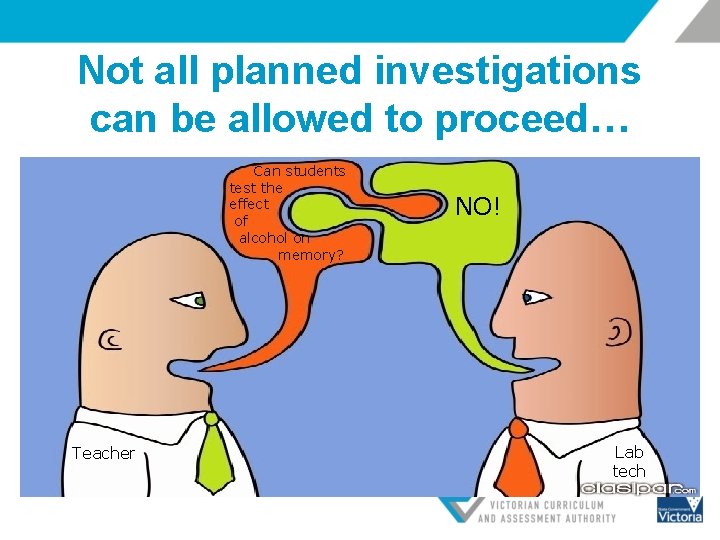
Not all planned investigations can be allowed to proceed… Can students test the effect of alcohol on memory? Teacher NO! Lab tech
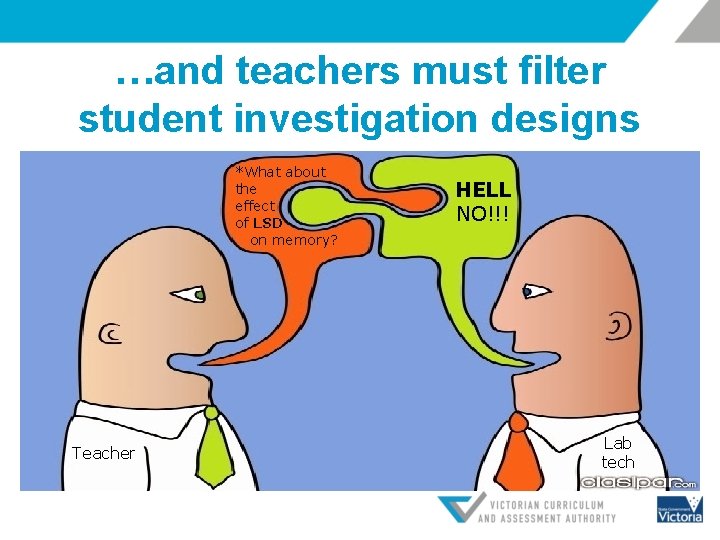
…and teachers must filter student investigation designs *What about the effect of LSD on memory? Teacher HELL NO!!! Lab tech
Area of study 3 investigation: a student-designed or adapted practical investigation “Does the student investigation have to be an experiment? ” - question from a Mildura teacher, November 2015 (Answer: No!)
Area of study 3 investigation: a student-designed or adapted practical investigation “Does every student need to do their own investigation? ” - question from a LABCON lab tech, November 2016 (Answer: No! Students need to design their own experiments – and must be assessed on their capacity to do so – but their suggested experiments may not be viable, and for large classes individual experiments may not be easily managed. Students may use group or class primary data, but must undertake their own analysis and draw their own conclusions. Teachers may select a limited number of investigations for the purpose of safety, authentication and management)
Area of study 3 investigation: a student-designed or adapted practical investigation “It’s just one part of one experiment …taken on a tangent” - quote from a north-eastern region teacher, November 2015
Logbook q Mandated across Units 1 -4 q Content may include: experimental results, research notes, simulation outcomes, visual presentations, field trips, photographs and other images, demonstration summaries and database extract q May be electronic or paper copy: e-files/ notebook/ folder/ scrapbook/ section in folder/ duplicate book q Does not need to be ‘formally’ presented q Use for record, authentication and assessment purposes q Entries should be dated and in chronological order
Poster authentication strategies q Adopt and/or adapt current authentication strategies for tasks requiring extended experiments and/or practical activity reports q Mark poster sections progressively q Use specific questions about science investigation processes as part of the poster development under test conditions q Logbook with dated entries should correlate to student work on poster q Observed practical procedures in class q Question students about content in specific parts of their poster
Poster logistics q No drafts q In Units 1 and 2, a scientific poster may be based on research (library), or primary research q In Unit 3 or 4, or across Units 3 and 4, the poster: - must involve collection of primary data - must include seven sections of poster template, with acknowledgment of level of guidance - may be an extension of a common experiment or fieldwork exercise - may be generated by students based on their own research and subject to authentication (use of photos/video…noted in logbook) - may be undertaken as a class with students contributing to design - may be assessed in stages (if modification required, original marks hold) - marks will be moderated against the examination – class rank order important
Science faculty experimental investigation planner q. Lab managers and science leaders should work together to plan investigations across all VCE sciences for a calendar year so that neither human nor physical resources are exhausted q. Units 1 and 2 can be taught in any order; Units 3 and 4 must be taught as a sequence
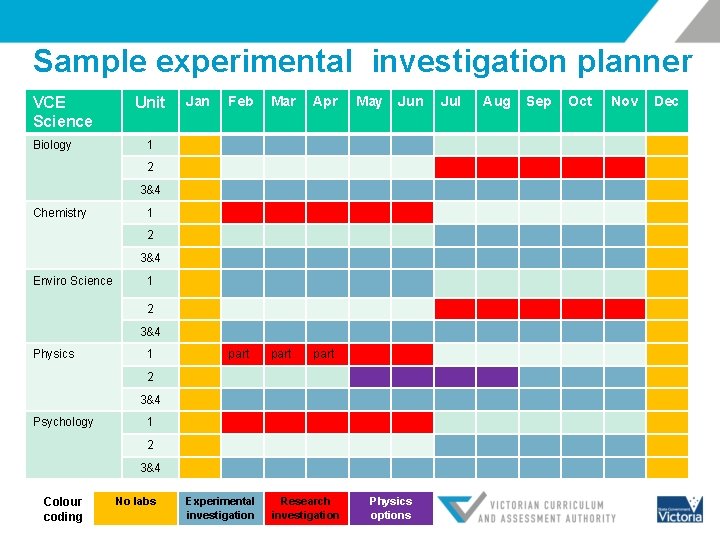
Sample experimental investigation planner VCE Science Biology Unit Jan Feb Mar Apr part May Jun 1 2 3&4 Chemistry 1 2 3&4 Enviro Science 1 2 3&4 Physics 1 2 3&4 Psychology 1 2 3&4 Colour coding No labs Experimental investigation Research investigation Physics options Jul Aug Sep Oct Nov Dec

Professional learning opportunities
Psyched “Psyched” - VCE Psychology Teachers Network q Currently 600 teaches q Aim to share resources via fortnightly emails q Can communicate on a large scale, for example, “Do we have to teach the role of GABA in Parkinson’s disease? ” q Sign up at http: //eepurl. com/coy. TET

Federal Government innovation funding
What is ASELL about? q The ASELL Schools team works with schools to develop effective and engaging laboratory learning activities that include: - targeted elements of science inquiry - adjusted levels of student independent investigation - an engaging context relevant to students - a contemporary science dimension - encouragement of science conceptual learning q The ASELL Schools team uses a tool that helps teachers identify both existing and potential inquiry elements in the practical activities they already use, and provides a systematic way of adjusting the degree of open-endedness of each of these elements
ASELL PD workshops Workshops: q are free q include hands-on activities q are fully catered q may be full or half-day in duration q include comprehensive notes and access to other practical activities q some CRT release money is available
ASELL for psychology teachers Example: Emmaus workshop 24 February 2017 q 1 st hour: hands-on activity involving inquiry q 2 nd hour: discussion about inquiry/brainstorming q 3 rd hour: teachers work in teams to incorporate more inquiry into existing activities Psychology adaptation: q Double-blind taste test – compound chocolate versus naturallysourced chocolate; Coke versus Pepsi; natural maple syrup versus artificial q Association between sight and taste: mash potato that is presented nicely (for example using an ice cream scoop) versus mash that is just dumped on a plate; dehydrated mash potato versus fresh mash
ASELL Contacts q Ian Bentley i. bentley@deakin. edu. au q Prof Kieran Lim kieran. lim@deakin. edu. au q Dr John Long john. long@deakin. edu. au q Dr Peta White peta. white@deakin. edu. au
VCAA contact Maria James Curriculum Manager, Science Email: james. maria. m@edumail. vic. gov. au Telephone: 9032 1722
- Slides: 64