
CDE Rationale for having an ICAP The intent

- Slides: 36
CDE Rationale for having an ICAP � The intent of the ICAP policy is to ultimately decrease dropout rates and increase graduation rates by assisting students in developing and maintaining a personalized postsecondary plan that ensures readiness for postsecondary and workforce success. An ICAP should be designed to assist a student and his or her parent or legal guardian in exploring the postsecondary career and educational opportunities available to the student, aligning course work and curriculum, applying to postsecondary education institutions, securing financial aid and ultimately entering the workforce. - See more at: http: //www. cde. state. co. us/secondaryinitiatives/icap #sthash. ii 6 JLWFB. dpuf Source – CDE Website
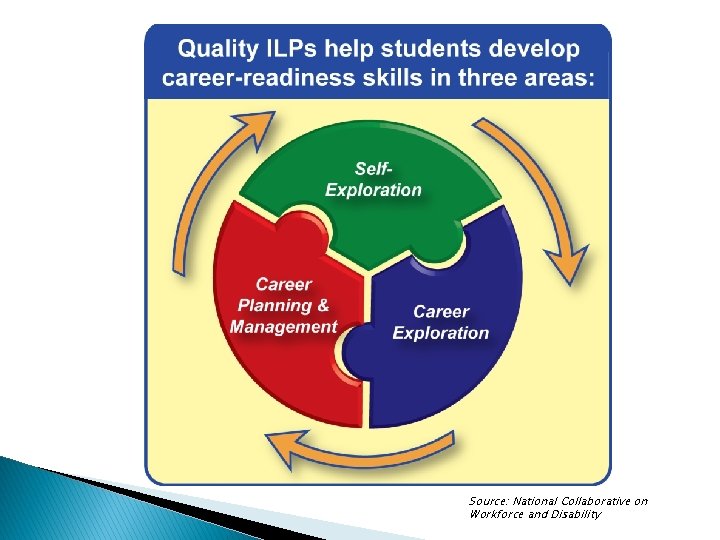
What is a Quality ILP? �A document consisting of a student’s (a) course taking and post-secondary plans aligned to career goals and (b) documentation of the range of college and career readiness skills he/she has developed. �A process that relies on a student’s understanding of the relevance of school courses as well as outof‐school learning opportunities and provides the student access to career development opportunities that incorporate self-exploration, career exploration, and career planning and management activities. Source: National Collaborative on Workforce and Disability
Source: National Collaborative on Workforce and Disability
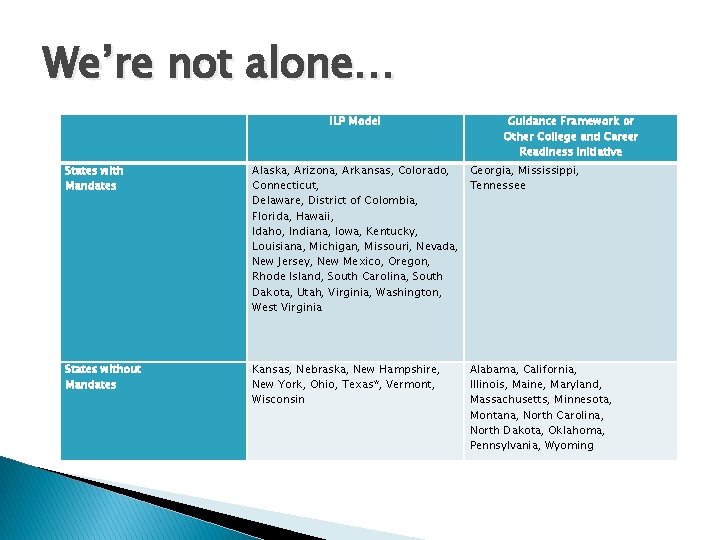
We’re not alone… ILP Model Guidance Framework or Other College and Career Readiness Initiative States with Mandates Alaska, Arizona, Arkansas, Colorado, Georgia, Mississippi, Connecticut, Tennessee Delaware, District of Colombia, Florida, Hawaii, Idaho, Indiana, Iowa, Kentucky, Louisiana, Michigan, Missouri, Nevada, New Jersey, New Mexico, Oregon, Rhode Island, South Carolina, South Dakota, Utah, Virginia, Washington, West Virginia States without Mandates Kansas, Nebraska, New Hampshire, New York, Ohio, Texas*, Vermont, Wisconsin Alabama, California, Illinois, Maine, Maryland, Massachusetts, Minnesota, Montana, North Carolina, North Dakota, Oklahoma, Pennsylvania, Wyoming
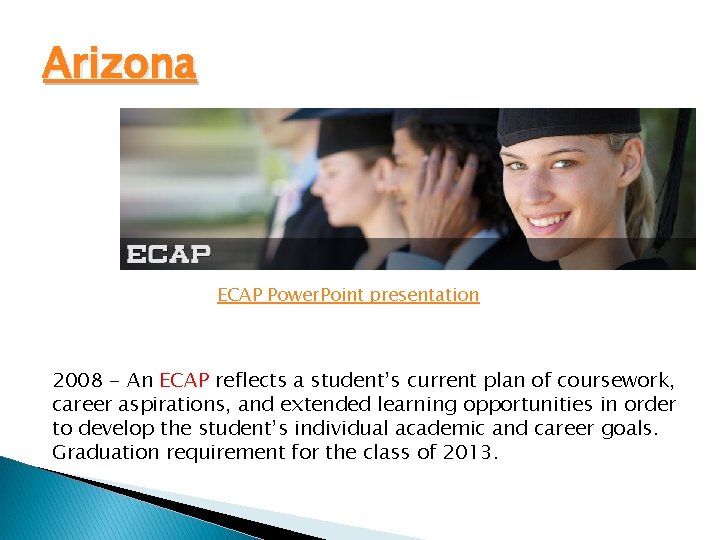
Arizona ECAP Power. Point presentation 2008 - An ECAP reflects a student’s current plan of coursework, career aspirations, and extended learning opportunities in order to develop the student’s individual academic and career goals. Graduation requirement for the class of 2013.
Florida Started in 2005 – 7 th or 8 th grade career preparation course is mandated. In high school, students create a career plan and school counselors sign off on the plan.
Georgia 2009 – Website launched to help students discover a career pathway – “Seal of Completion” became a possible after completing a career graduation pathway
Washington
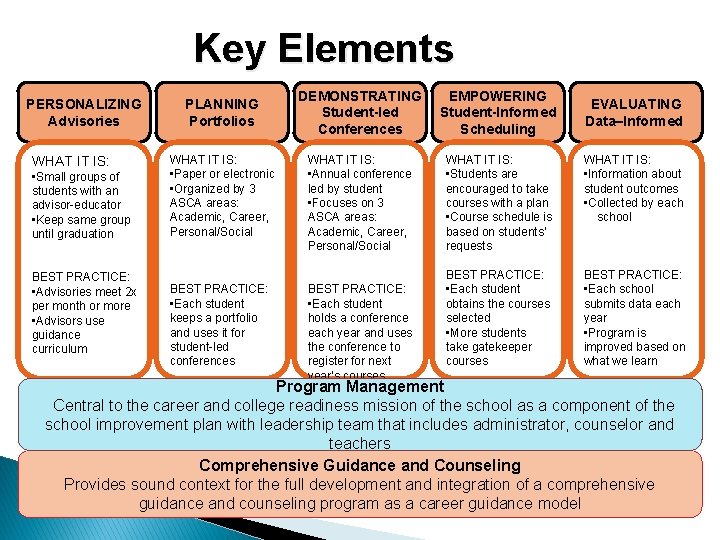
Key Elements PERSONALIZING Advisories WHAT IT IS: • Small groups of students with an advisor-educator • Keep same group until graduation BEST PRACTICE: • Advisories meet 2 x per month or more • Advisors use guidance curriculum PLANNING Portfolios WHAT IT IS: • Paper or electronic • Organized by 3 ASCA areas: Academic, Career, Personal/Social BEST PRACTICE: • Each student keeps a portfolio and uses it for student-led conferences DEMONSTRATING Student-led Conferences EMPOWERING Student-Informed Scheduling WHAT IT IS: • Annual conference led by student • Focuses on 3 ASCA areas: Academic, Career, Personal/Social WHAT IT IS: • Students are encouraged to take courses with a plan • Course schedule is based on students’ requests WHAT IT IS: • Information about student outcomes • Collected by each school BEST PRACTICE: • Each student obtains the courses selected • More students take gatekeeper courses BEST PRACTICE: • Each school submits data each year • Program is improved based on what we learn BEST PRACTICE: • Each student holds a conference each year and uses the conference to register for next year’s courses EVALUATING Data–Informed Program Management Central to the career and college readiness mission of the school as a component of the school improvement plan with leadership team that includes administrator, counselor and teachers Comprehensive Guidance and Counseling Provides sound context for the full development and integration of a comprehensive guidance and counseling program as a career guidance model
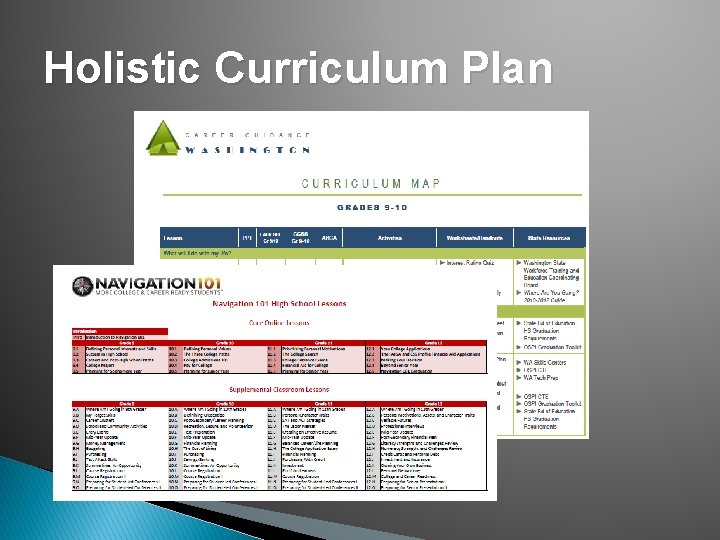
Holistic Curriculum Plan
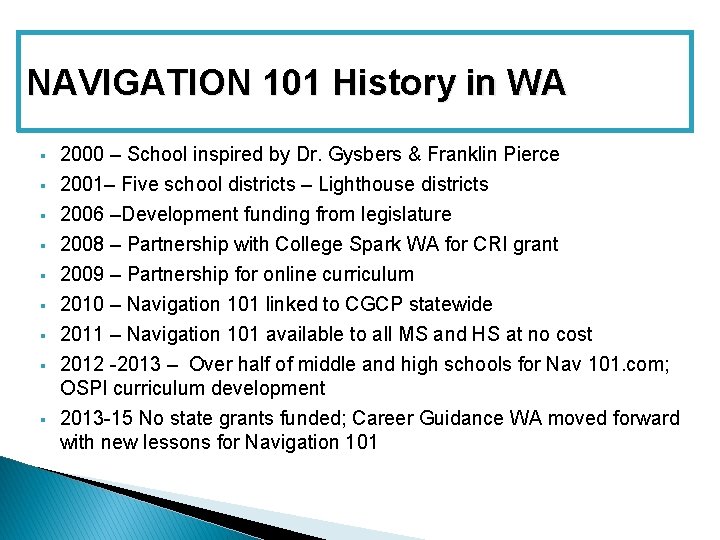
NAVIGATION 101 History in WA § § § § § 2000 – School inspired by Dr. Gysbers & Franklin Pierce 2001– Five school districts – Lighthouse districts 2006 –Development funding from legislature 2008 – Partnership with College Spark WA for CRI grant 2009 – Partnership for online curriculum 2010 – Navigation 101 linked to CGCP statewide 2011 – Navigation 101 available to all MS and HS at no cost 2012 -2013 – Over half of middle and high schools for Nav 101. com; OSPI curriculum development 2013 -15 No state grants funded; Career Guidance WA moved forward with new lessons for Navigation 101
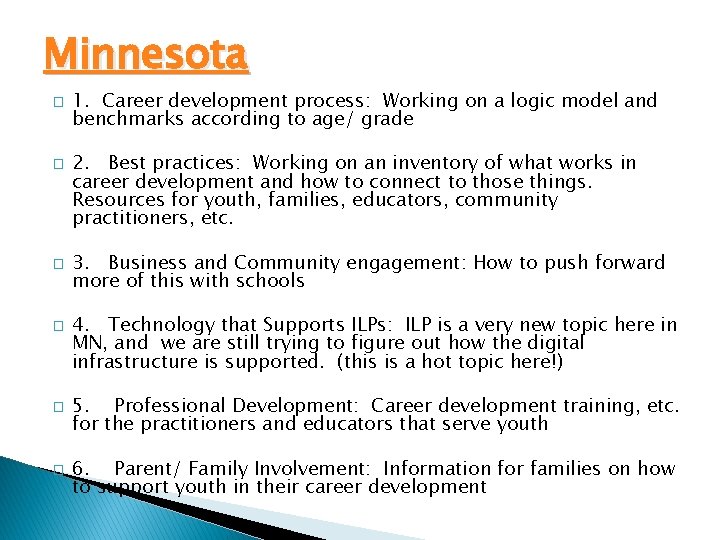
Minnesota � � � 1. Career development process: Working on a logic model and benchmarks according to age/ grade 2. Best practices: Working on an inventory of what works in career development and how to connect to those things. Resources for youth, families, educators, community practitioners, etc. 3. Business and Community engagement: How to push forward more of this with schools 4. Technology that Supports ILPs: ILP is a very new topic here in MN, and we are still trying to figure out how the digital infrastructure is supported. (this is a hot topic here!) 5. Professional Development: Career development training, etc. for the practitioners and educators that serve youth 6. Parent/ Family Involvement: Information for families on how to support youth in their career development
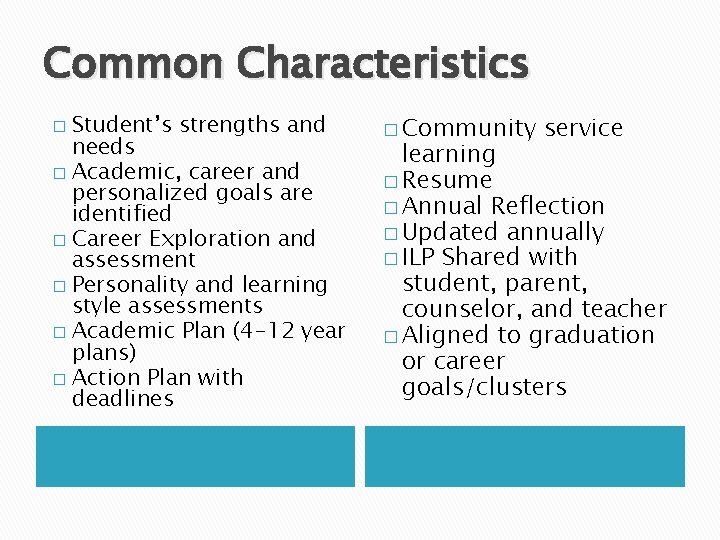
Common Characteristics Student’s strengths and needs � Academic, career and personalized goals are identified � Career Exploration and assessment � Personality and learning style assessments � Academic Plan (4 -12 year plans) � Action Plan with deadlines � � Community service learning � Resume � Annual Reflection � Updated annually � ILP Shared with student, parent, counselor, and teacher � Aligned to graduation or career goals/clusters
In Colorado
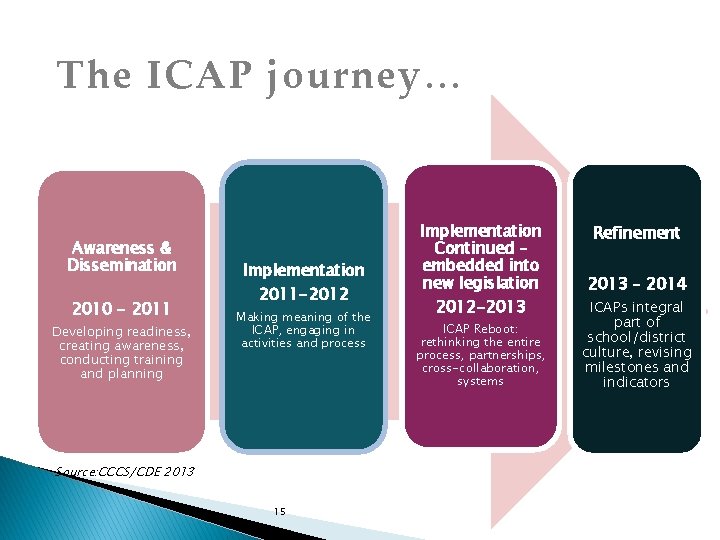
The ICAP journey… Awareness & Dissemination 2010 - 2011 Developing readiness, creating awareness, conducting training and planning Implementation 2011 -2012 Making meaning of the ICAP, engaging in activities and process Source: CCCS/CDE 2013 15 Implementation Continued – embedded into new legislation 2012 -2013 ICAP Reboot: rethinking the entire process, partnerships, cross-collaboration, systems Refinement 2013 – 2014 ICAPs integral part of school/district culture, revising milestones and indicators
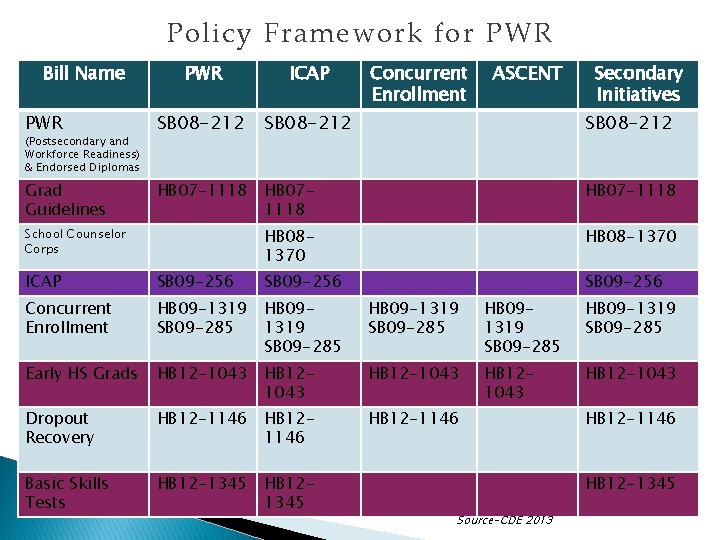
Policy Framework for PWR Bill Name PWR ICAP PWR SB 08 -212 Grad Guidelines HB 07 -1118 HB 081370 HB 08 -1370 SB 09 -256 (Postsecondary and Workforce Readiness) & Endorsed Diplomas School Counselor Corps Concurrent Enrollment ASCENT Secondary Initiatives ICAP SB 09 -256 Concurrent Enrollment HB 09 -1319 SB 09 -285 HB 091319 SB 09 -285 HB 09 -1319 SB 09 -285 Early HS Grads HB 12 -1043 HB 121043 HB 12 -1043 Dropout Recovery HB 12 -1146 Basic Skills Tests HB 12 -1345 HB 121345 16 HB 12 -1146 HB 12 -1345 Source-CDE 2013
In Colorado • CDE ICAP Webpage • CDE Rules • CCCS Webpage of 8 bizillion resources
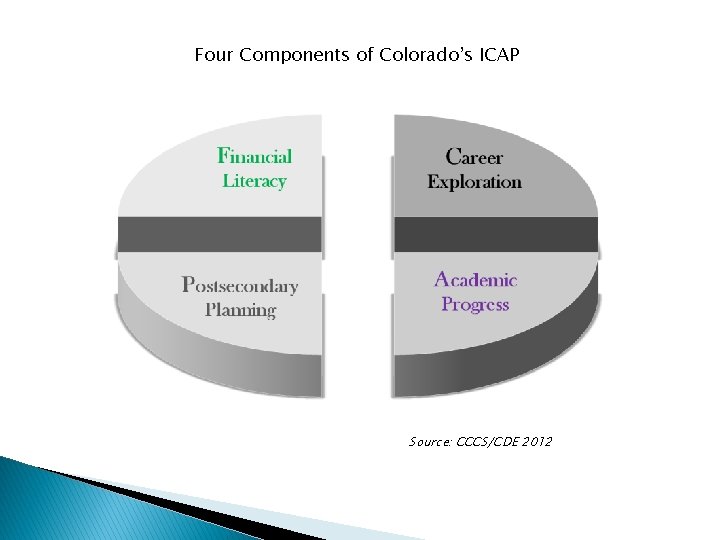
Four Components of Colorado’s ICAP Source: CCCS/CDE 2012
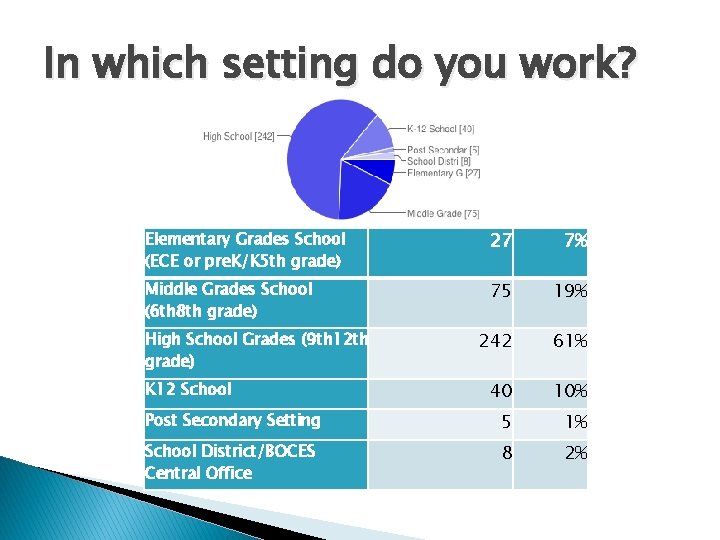
In which setting do you work? Elementary Grades School (ECE or pre. K/K 5 th grade) 27 7% Middle Grades School (6 th 8 th grade) 75 19% 242 61% 40 10% Post Secondary Setting 5 1% School District/BOCES Central Office 8 2% High School Grades (9 th 12 th grade) K 12 School
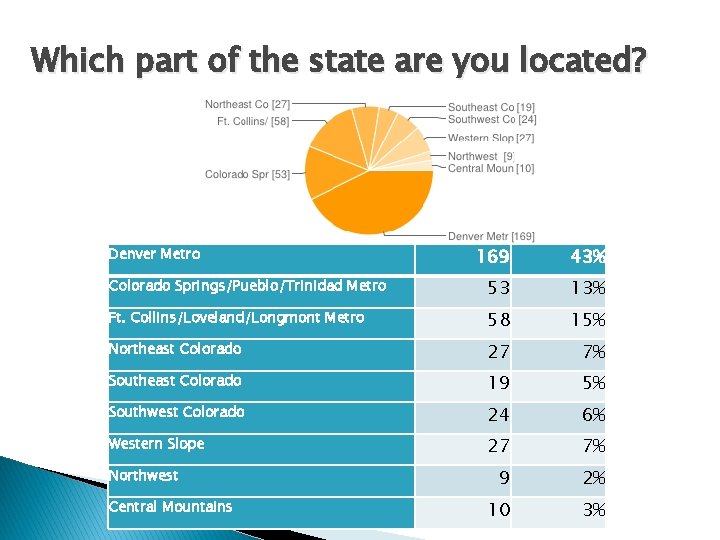
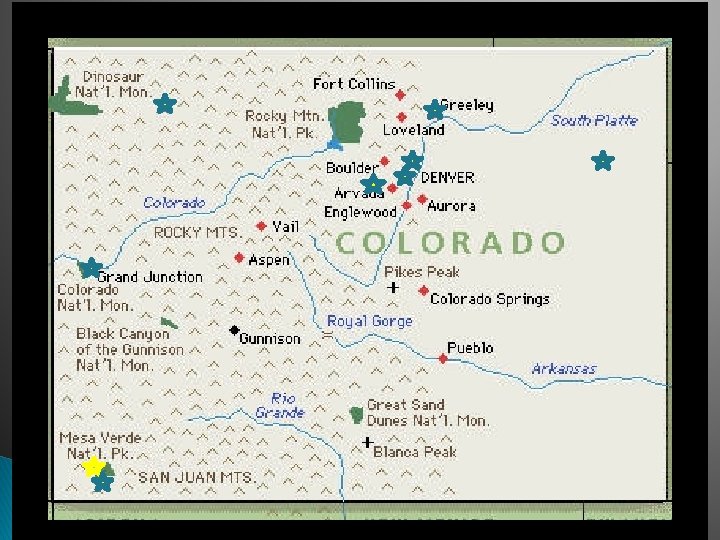
Which part of the state are you located? 169 43% Colorado Springs/Pueblo/Trinidad Metro 53 13% Ft. Collins/Loveland/Longmont Metro 58 15% Northeast Colorado 27 7% Southeast Colorado 19 5% Southwest Colorado 24 6% Western Slope 27 7% 9 2% 10 3% Denver Metro Northwest Central Mountains
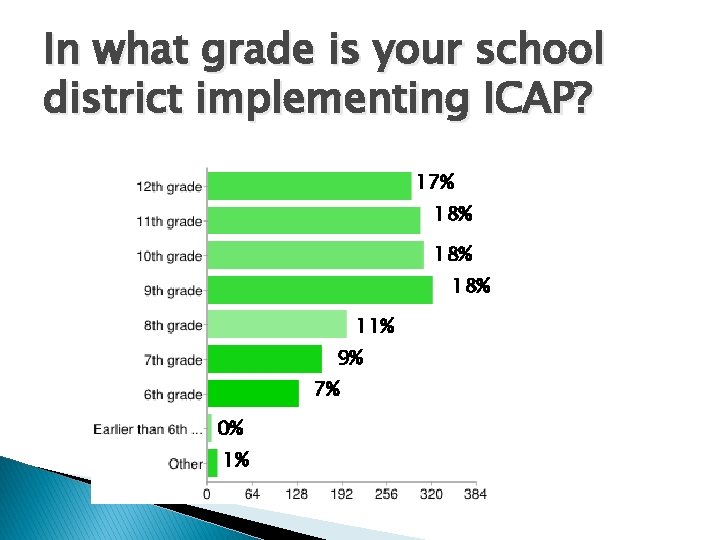
In what grade is your school district implementing ICAP? 17% 18% 18% 11% 9% 7% 0% 1%
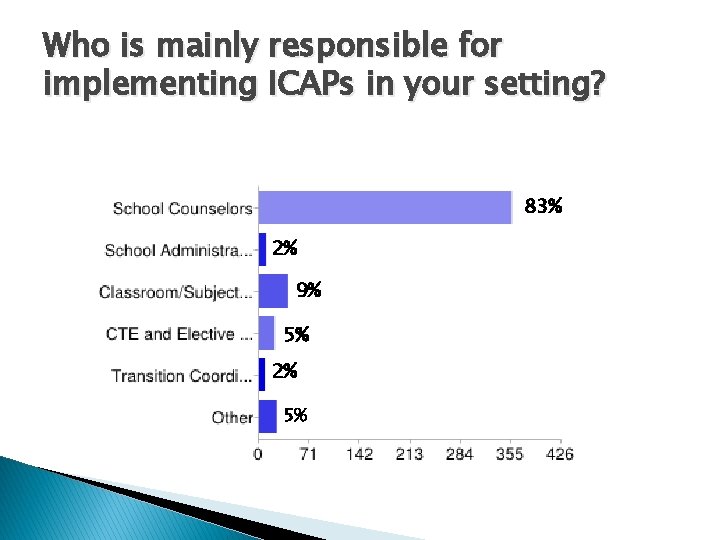
Who is mainly responsible for implementing ICAPs in your setting? 83% 2% 9% 5% 2% 5%
In your district, what is your level of ICAP implementation? 37% 46% 9% 4% 4%
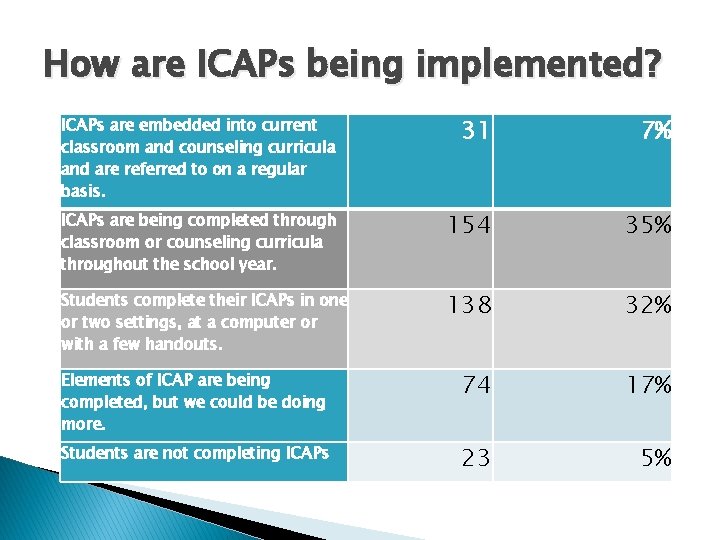
How are ICAPs being implemented? ICAPs are embedded into current classroom and counseling curricula and are referred to on a regular basis. 31 7% ICAPs are being completed through classroom or counseling curricula throughout the school year. 154 35% Students complete their ICAPs in one or two settings, at a computer or with a few handouts. 138 32% Elements of ICAP are being completed, but we could be doing more. 74 17% Students are not completing ICAPs 23 5%
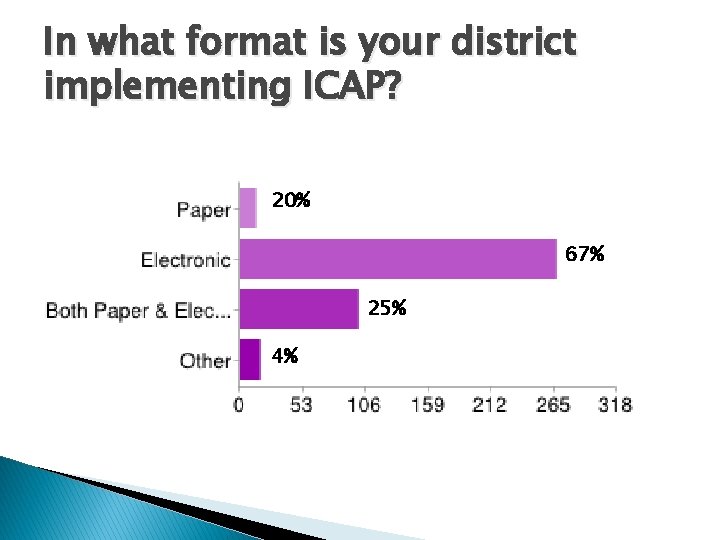
In what format is your district implementing ICAP? 20% 67% 25% 4%
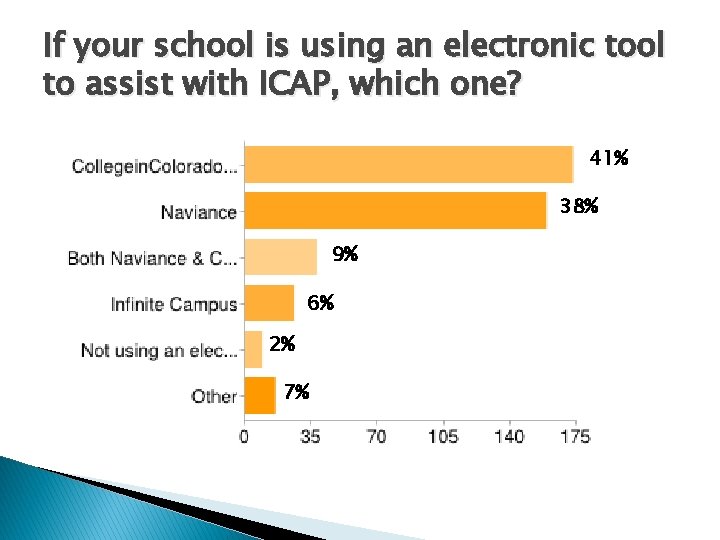
If your school is using an electronic tool to assist with ICAP, which one? 41% 38% 9% 6% 2% 7%
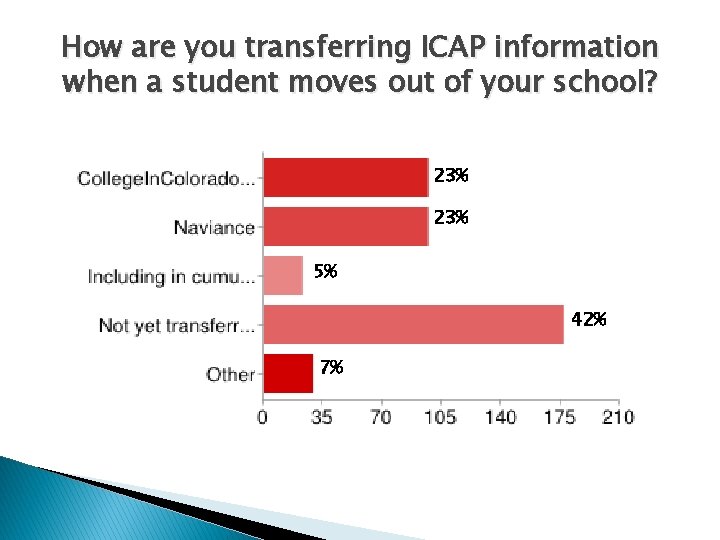
How are you transferring ICAP information when a student moves out of your school? 23% 5% 42% 7%
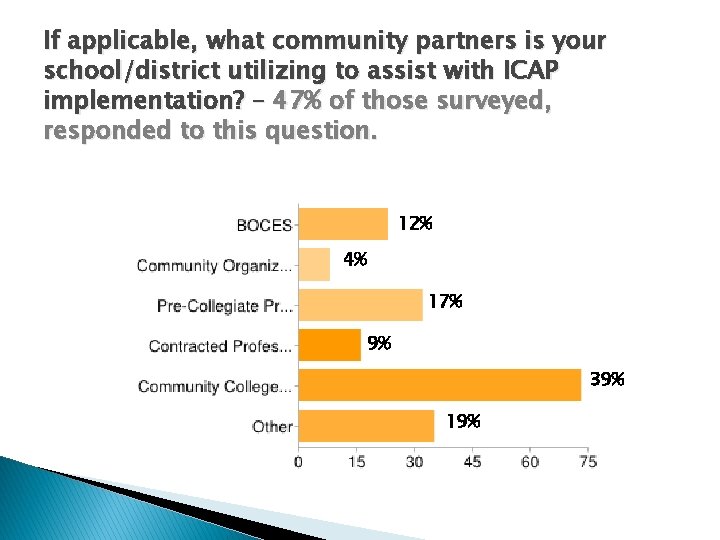
If applicable, what community partners is your school/district utilizing to assist with ICAP implementation? – 47% of those surveyed, responded to this question. 12% 4% 17% 9% 39% 19%
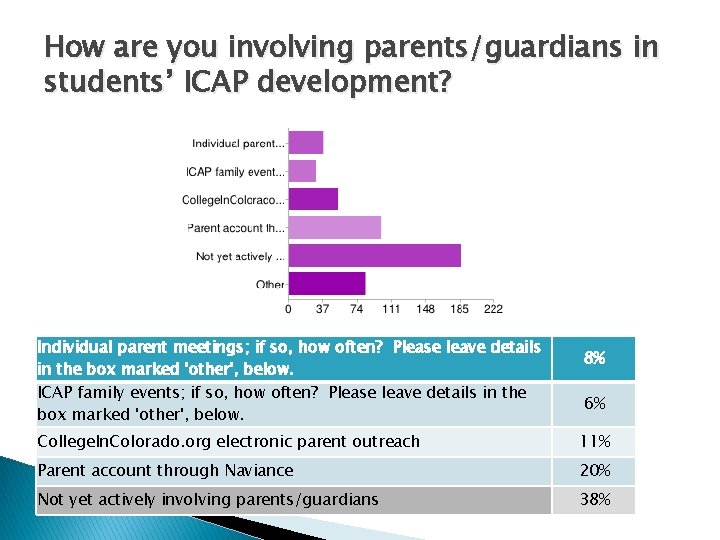
How are you involving parents/guardians in students’ ICAP development? Individual parent meetings; if so, how often? Please leave details in the box marked 'other', below. ICAP family events; if so, how often? Please leave details in the box marked 'other', below. 8% 6% College. In. Colorado. org electronic parent outreach 11% Parent account through Naviance 20% Not yet actively involving parents/guardians 38%
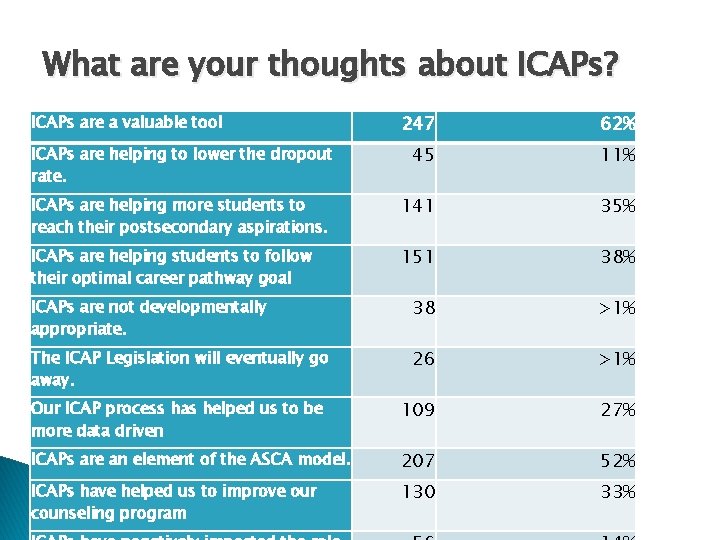
What are your thoughts about ICAPs? 247 62% ICAPs are helping to lower the dropout rate. 45 11% ICAPs are helping more students to reach their postsecondary aspirations. 141 35% ICAPs are helping students to follow their optimal career pathway goal 151 38% ICAPs are not developmentally appropriate. 38 >1% The ICAP Legislation will eventually go away. 26 >1% Our ICAP process has helped us to be more data driven 109 27% ICAPs are an element of the ASCA model. 207 52% ICAPs have helped us to improve our counseling program 130 33% ICAPs are a valuable tool
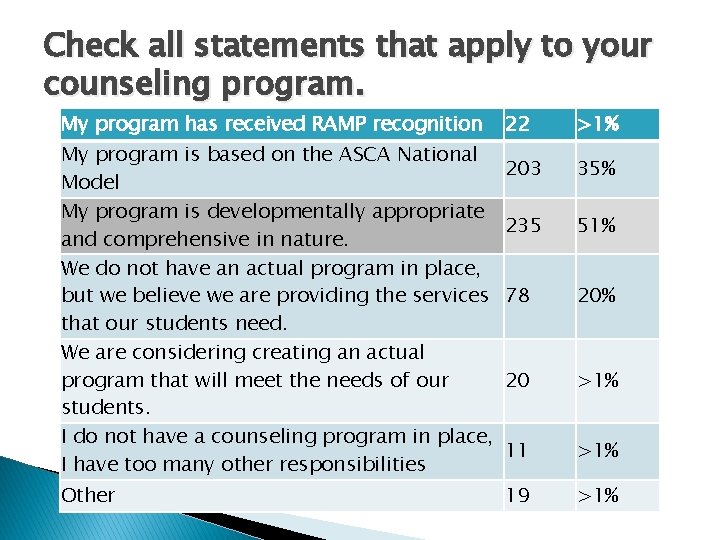
Check all statements that apply to your counseling program. My program has received RAMP recognition My program is based on the ASCA National Model My program is developmentally appropriate and comprehensive in nature. We do not have an actual program in place, but we believe we are providing the services that our students need. We are considering creating an actual program that will meet the needs of our students. I do not have a counseling program in place, I have too many other responsibilities Other 22 >1% 203 35% 235 51% 78 20% 20 >1% 11 >1% 19 >1%
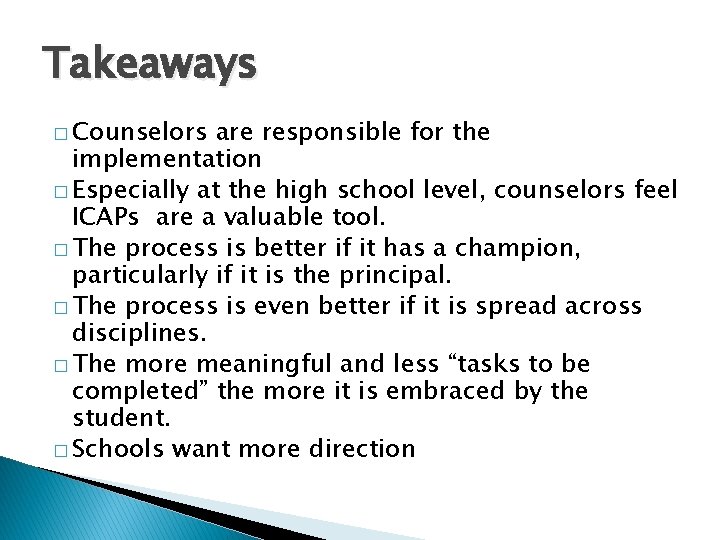
Takeaways � Counselors are responsible for the implementation � Especially at the high school level, counselors feel ICAPs are a valuable tool. � The process is better if it has a champion, particularly if it is the principal. � The process is even better if it is spread across disciplines. � The more meaningful and less “tasks to be completed” the more it is embraced by the student. � Schools want more direction
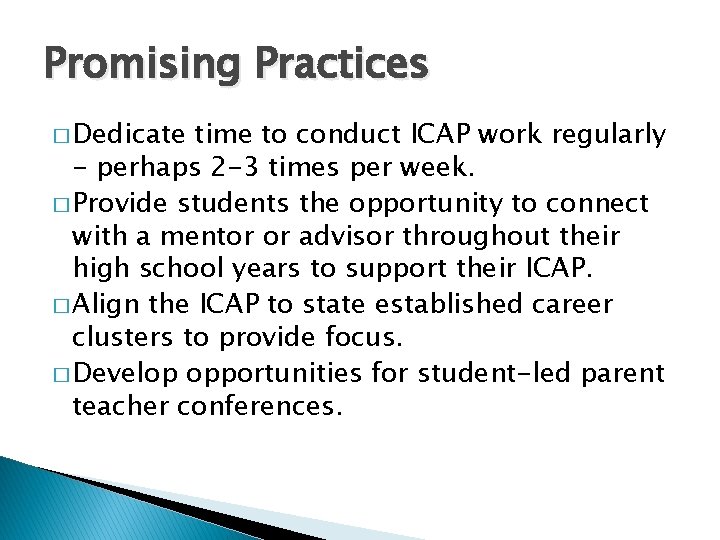
Promising Practices � Dedicate time to conduct ICAP work regularly - perhaps 2 -3 times per week. � Provide students the opportunity to connect with a mentor or advisor throughout their high school years to support their ICAP. � Align the ICAP to state established career clusters to provide focus. � Develop opportunities for student-led parent teacher conferences.
Promising Practices cont. � Involve all school staff, businesses, postsecondary institutions, community organizations, and parents in the delivery of the plan. � Think about the roles and functions of various stakeholders and how to engage them effectively. � Establish a key leadership group in each school and district to develop the plans and monitor progress.
Aiming for Meaning