
CDC Growth Charts 2000 Centers for Disease Control

![Calculating BMI with the Metric System Formula: weight (kg)/[height (m)]2 Calculation: [weight (kg)/ height](https://slidetodoc.com/presentation_image_h/92668e00094a5b6d3004bd11188e3b86/image-29.jpg "Calculating BMI with the Metric System Formula: weight (kg)/[height (m)]2 Calculation: [weight (kg)/ height")
![Calculating BMI with the English System Formula: weight (lb)/[height (in)]2 x 703 Calculation: [weight](https://slidetodoc.com/presentation_image_h/92668e00094a5b6d3004bd11188e3b86/image-30.jpg "Calculating BMI with the English System Formula: weight (lb)/[height (in)]2 x 703 Calculation: [weight")




- Slides: 47
CDC Growth Charts 2000 Centers for Disease Control and Prevention National Center for Chronic Disease Prevention and Health Promotion Division of Nutrition and Physical Activity Maternal and Child Nutrition Branch Revised June 2002
Training Objectives • Science behind development of growth charts • Rationale for including BMI-for-age • Using BMI-for-age as a screening tool
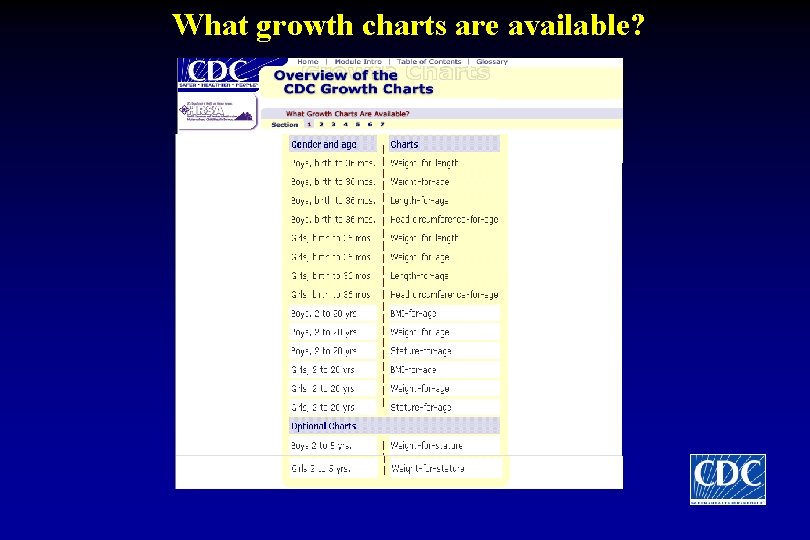
What growth charts are available?
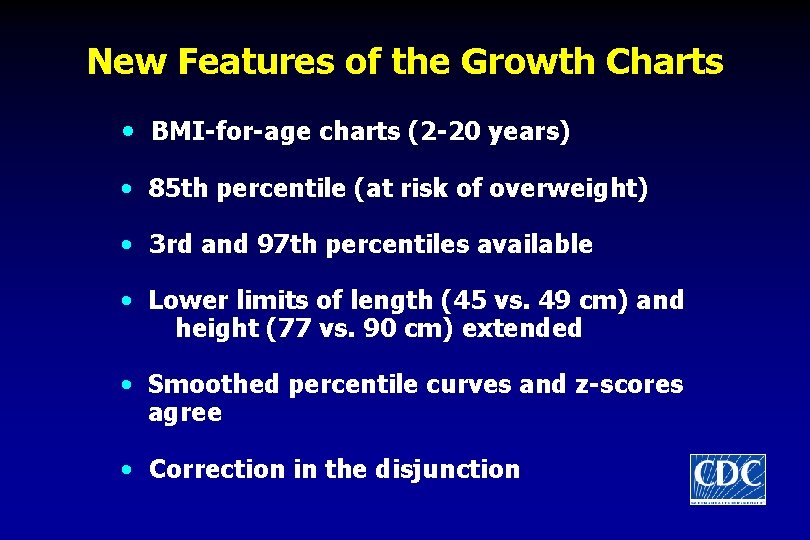
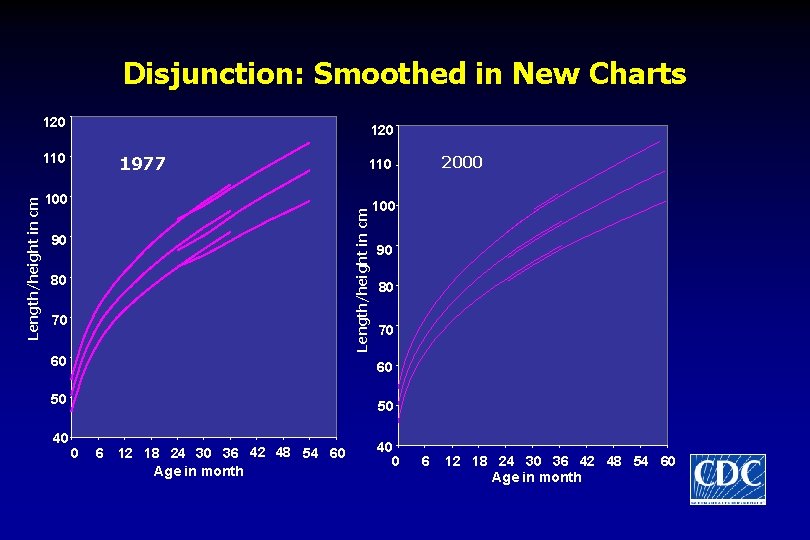
New Features of the Growth Charts • BMI-for-age charts (2 -20 years) • 85 th percentile (at risk of overweight) • 3 rd and 97 th percentiles available • Lower limits of length (45 vs. 49 cm) and height (77 vs. 90 cm) extended • Smoothed percentile curves and z-scores agree • Correction in the disjunction
Disjunction: Smoothed in New Charts 120 1977 100 90 80 70 60 60 50 50 40 0 6 12 18 24 30 36 42 48 54 60 Age in month 2000 110 Length/height in cm 110 40 0 6 12 18 24 30 36 42 48 54 60 Age in month
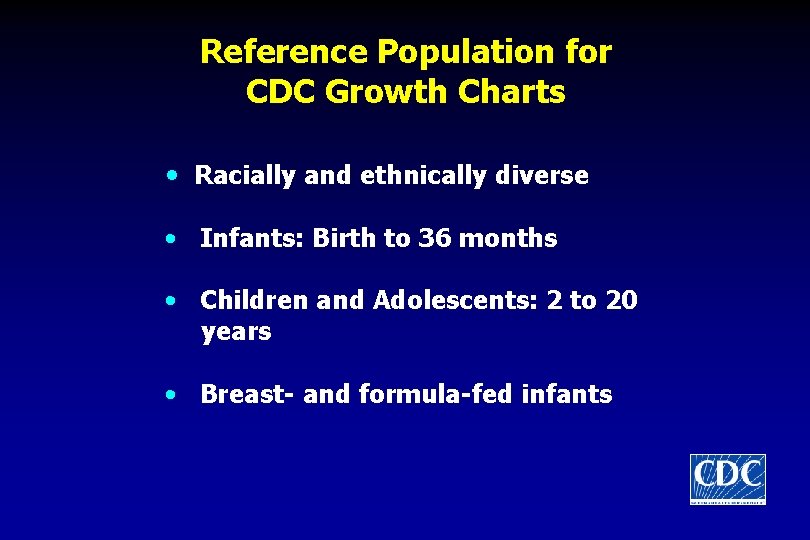
Reference Population for CDC Growth Charts • Racially and ethnically diverse • Infants: Birth to 36 months • Children and Adolescents: 2 to 20 years • Breast- and formula-fed infants
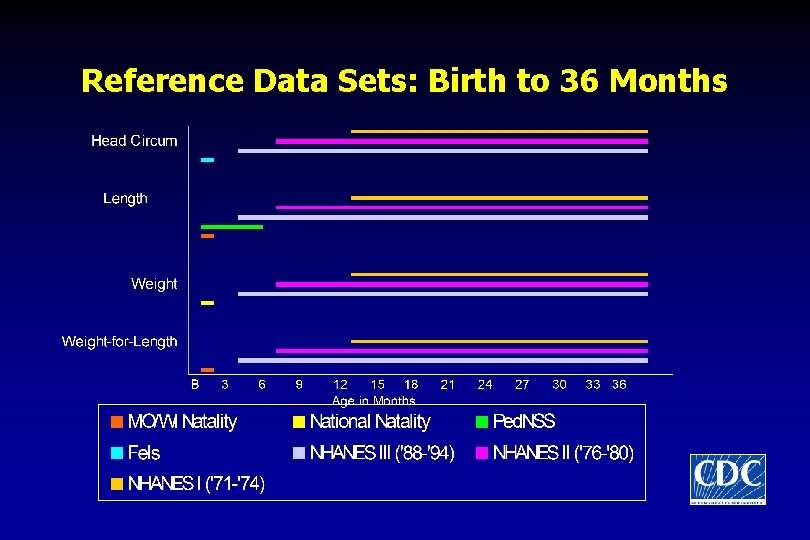
Reference Data Sets: Birth to 36 Months
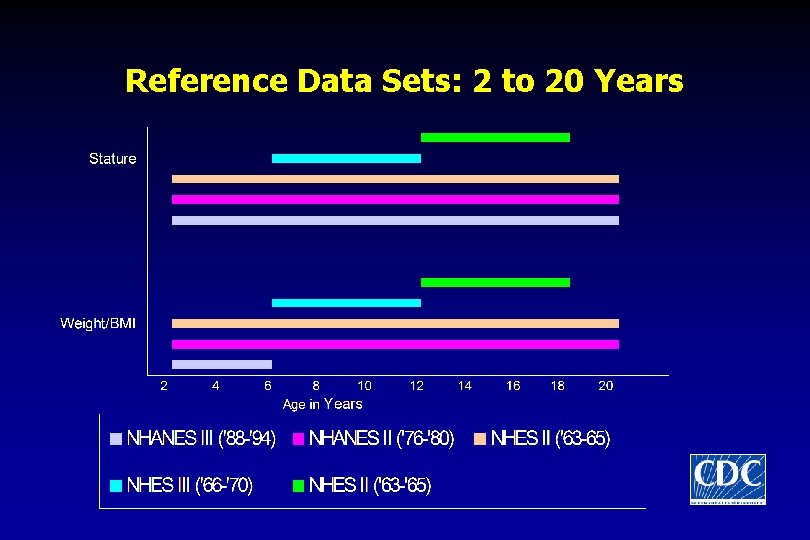
Reference Data Sets: 2 to 20 Years
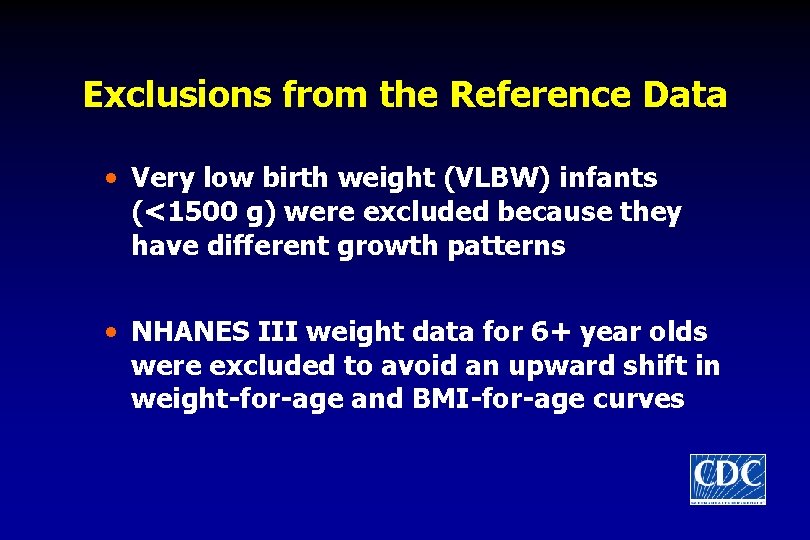
Exclusions from the Reference Data • Very low birth weight (VLBW) infants (<1500 g) were excluded because they have different growth patterns • NHANES III weight data for 6+ year olds were excluded to avoid an upward shift in weight-for-age and BMI-for-age curves
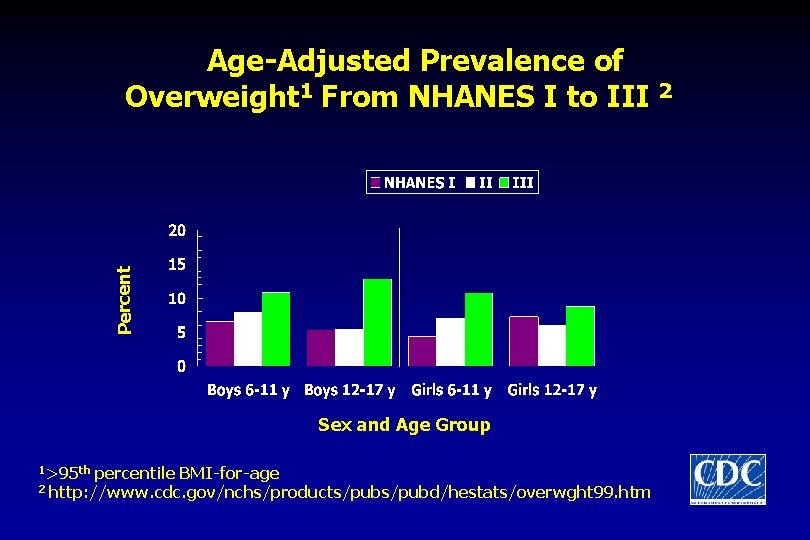
Percent Age-Adjusted Prevalence of Overweight 1 From NHANES I to III Sex and Age Group 1>95 th percentile BMI-for-age 2 http: //www. cdc. gov/nchs/products/pubd/hestats/overwght 99. htm 2
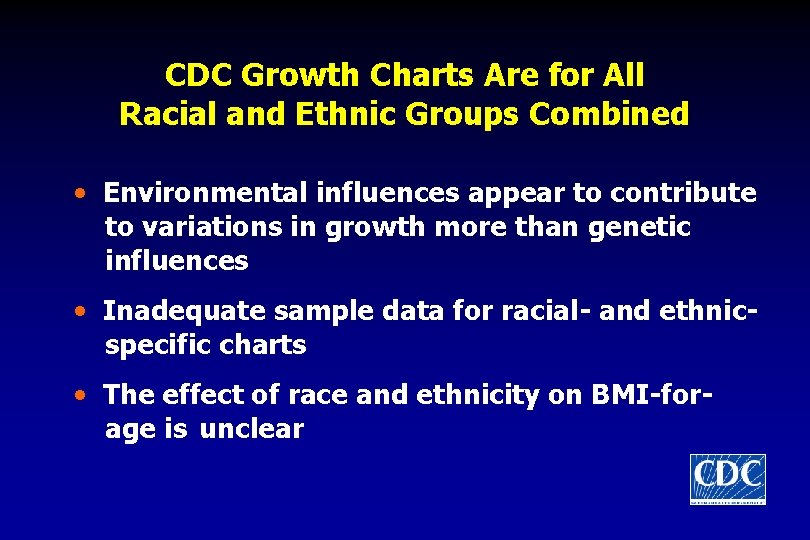
CDC Growth Charts Are for All Racial and Ethnic Groups Combined • Environmental influences appear to contribute to variations in growth more than genetic influences • Inadequate sample data for racial- and ethnicspecific charts • The effect of race and ethnicity on BMI-forage is unclear
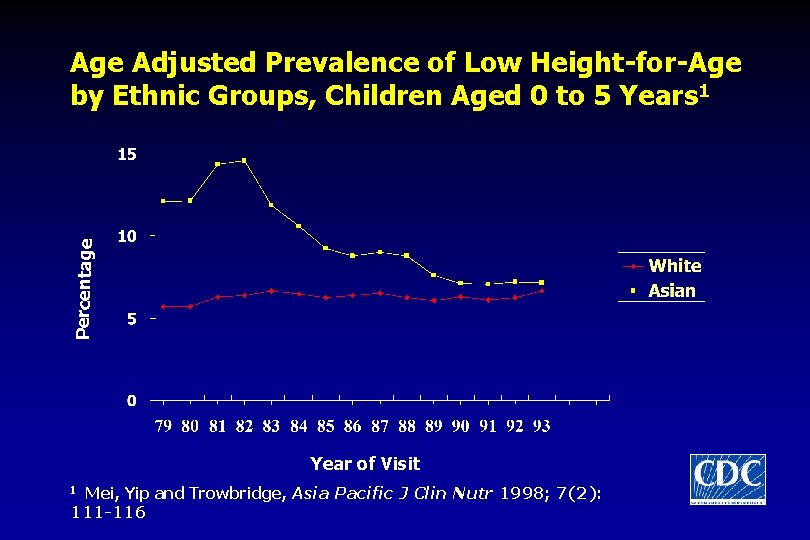
Percentage Adjusted Prevalence of Low Height-for-Age by Ethnic Groups, Children Aged 0 to 5 Years 1 Year of Visit Mei, Yip and Trowbridge, Asia Pacific J Clin Nutr 1998; 7(2): 111 -116 1
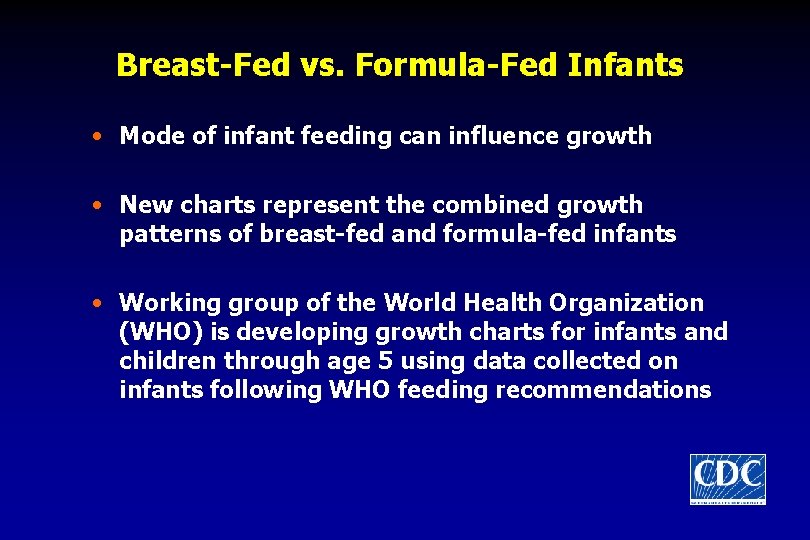
Breast-Fed vs. Formula-Fed Infants • Mode of infant feeding can influence growth • New charts represent the combined growth patterns of breast-fed and formula-fed infants • Working group of the World Health Organization (WHO) is developing growth charts for infants and children through age 5 using data collected on infants following WHO feeding recommendations
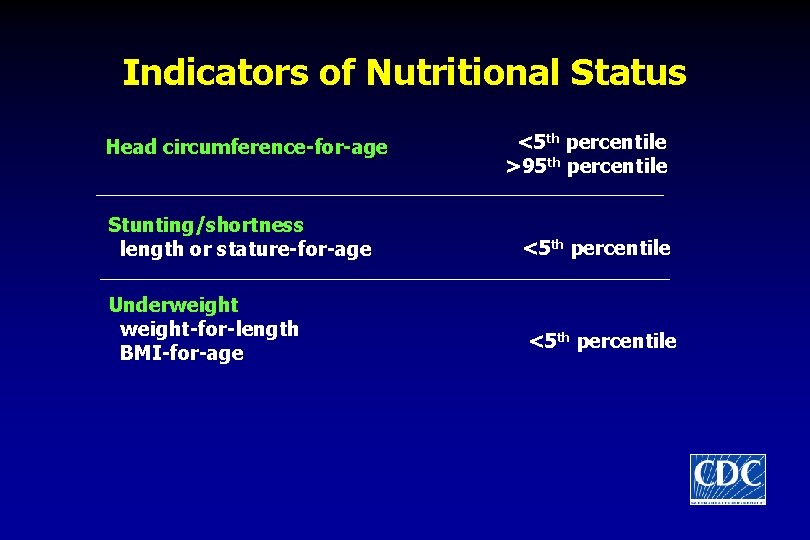
Indicators of Nutritional Status Head circumference-for-age Stunting/shortness length or stature-for-age Underweight-for-length BMI-for-age <5 th percentile >95 th percentile <5 th percentile
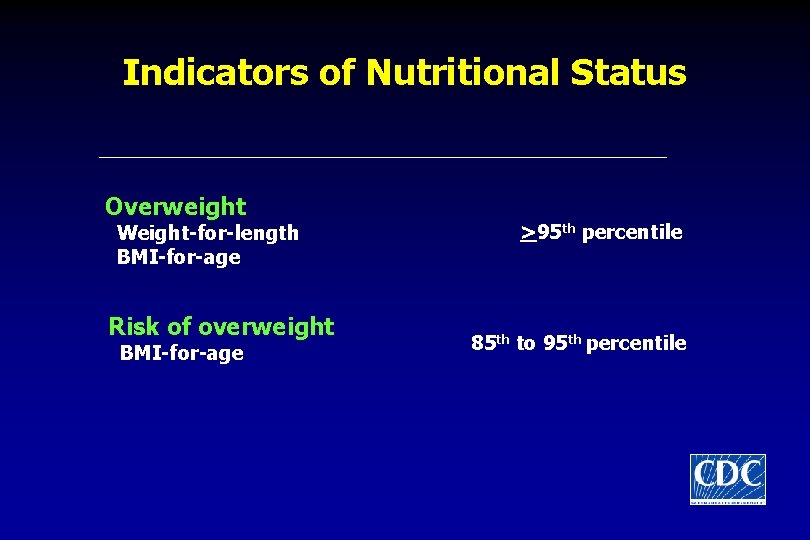
Indicators of Nutritional Status Overweight Weight-for-length BMI-for-age Risk of overweight BMI-for-age >95 th percentile 85 th to 95 th percentile
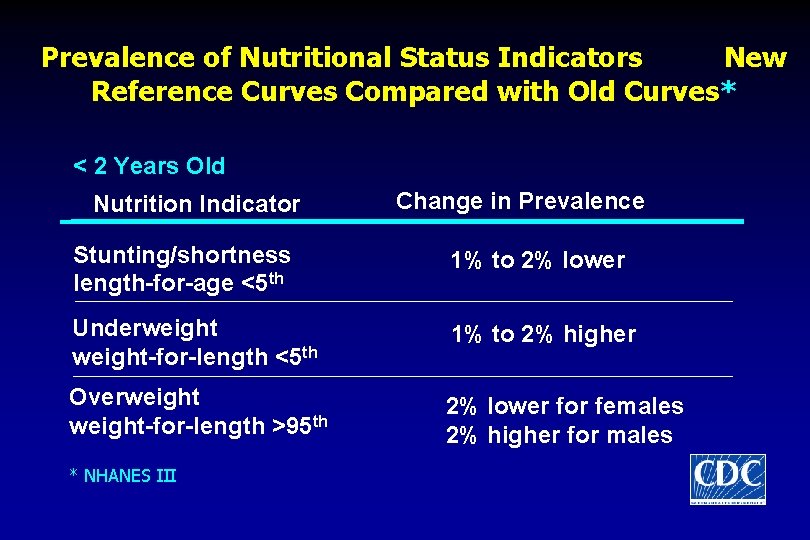
Prevalence of Nutritional Status Indicators New Reference Curves Compared with Old Curves* < 2 Years Old Nutrition Indicator Change in Prevalence Stunting/shortness length-for-age <5 th 1% to 2% lower Underweight-for-length <5 th 1% to 2% higher Overweight-for-length >95 th 2% lower for females 2% higher for males * NHANES III
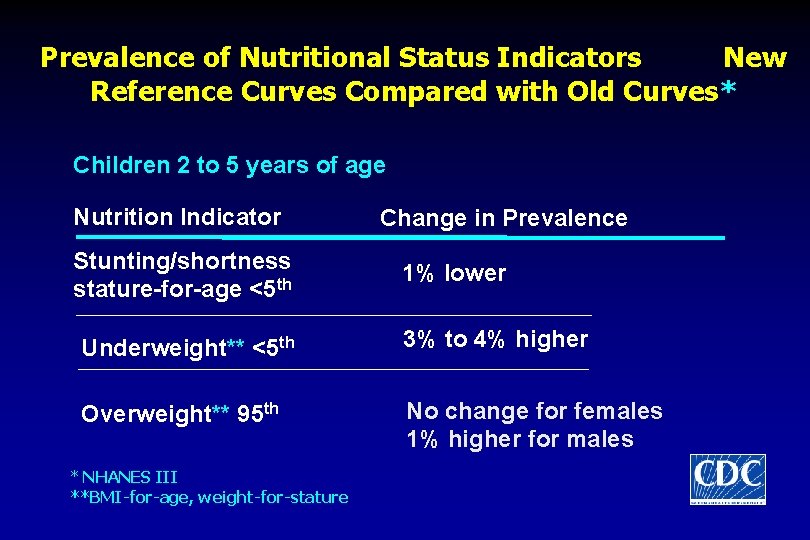
Prevalence of Nutritional Status Indicators New Reference Curves Compared with Old Curves* Children 2 to 5 years of age Nutrition Indicator Stunting/shortness stature-for-age <5 th Change in Prevalence 1% lower Underweight** <5 th 3% to 4% higher Overweight** 95 th No change for females 1% higher for males * NHANES III **BMI-for-age, weight-for-stature
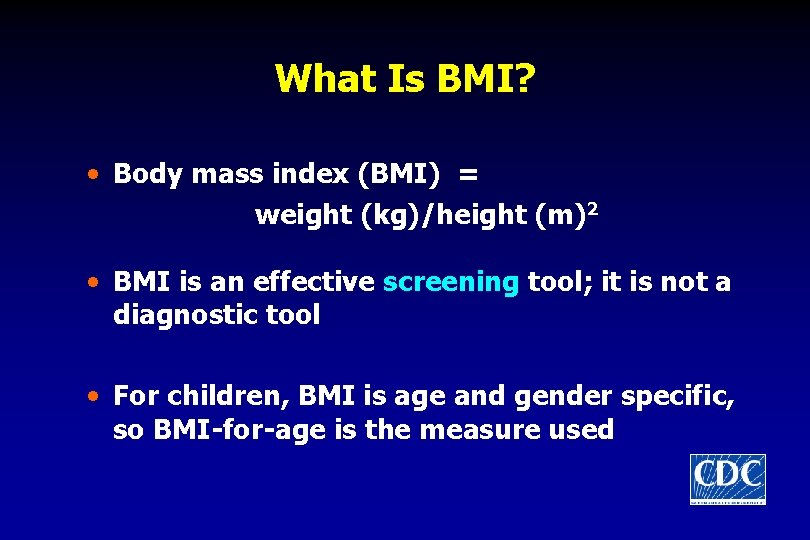
What Is BMI? • Body mass index (BMI) = weight (kg)/height (m)2 • BMI is an effective screening tool; it is not a diagnostic tool • For children, BMI is age and gender specific, so BMI-for-age is the measure used
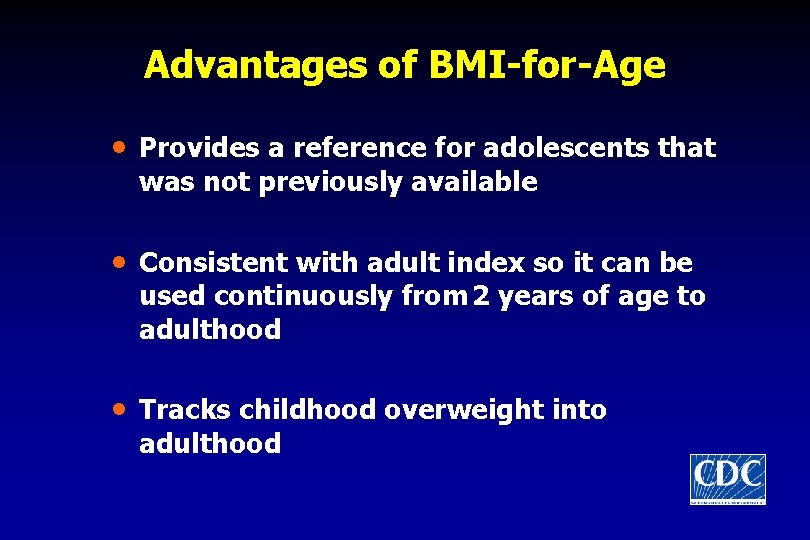
Advantages of BMI-for-Age · Provides a reference for adolescents that was not previously available · Consistent with adult index so it can be used continuously from 2 years of age to adulthood · Tracks childhood overweight into adulthood
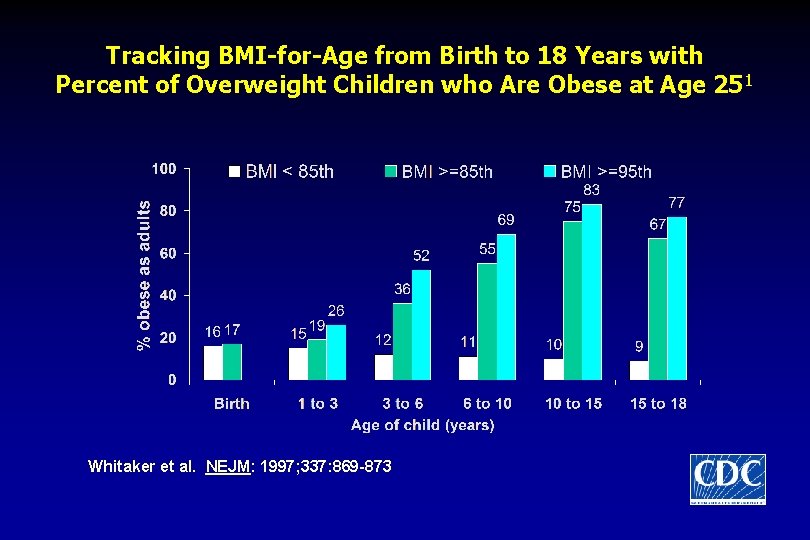
Tracking BMI-for-Age from Birth to 18 Years with Percent of Overweight Children who Are Obese at Age 25 1 Whitaker et al. NEJM: 1997; 337: 869 -873
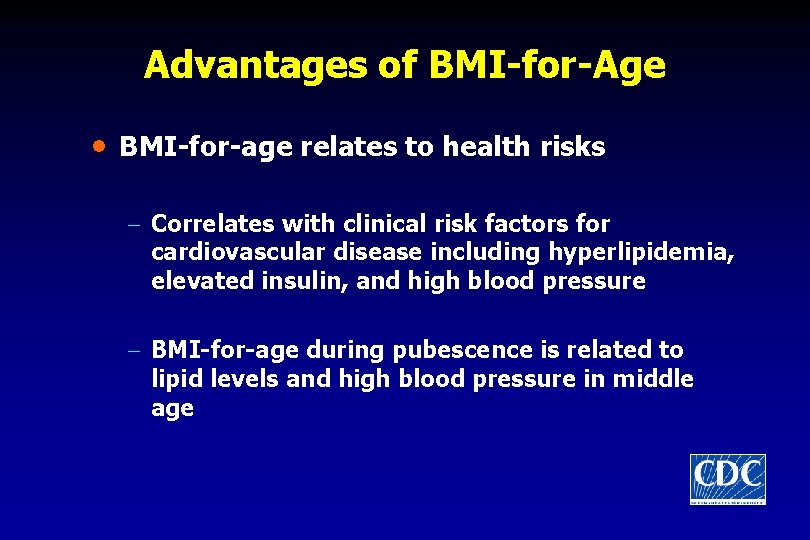
Advantages of BMI-for-Age · BMI-for-age relates to health risks - Correlates with clinical risk factors for cardiovascular disease including hyperlipidemia, elevated insulin, and high blood pressure - BMI-for-age during pubescence is related to lipid levels and high blood pressure in middle age
BMI-for-Age Compares Well with • Weight-for-stature measurements • Measures of body fat Mei et al. , Am J Clin Nutr 2002; 75: 978 -85. 1
Why Use BMI-for-Age? • Recommended by expert committees to evaluate overweight ØGuidelines for Overweight in Adolescent Preventive Services (Am J Clin Nutr 1994; 59: 307 -316) Ø Obesity Evaluation and Treatment: Expert Committee Recommendations (Pediatrics 1998 Sept; (102)3: e 29) Ø Assessment of Childhood and Adolescent Obesity: International Obesity Task Force (Am J Clin Nutr 1999, 70, suppl)
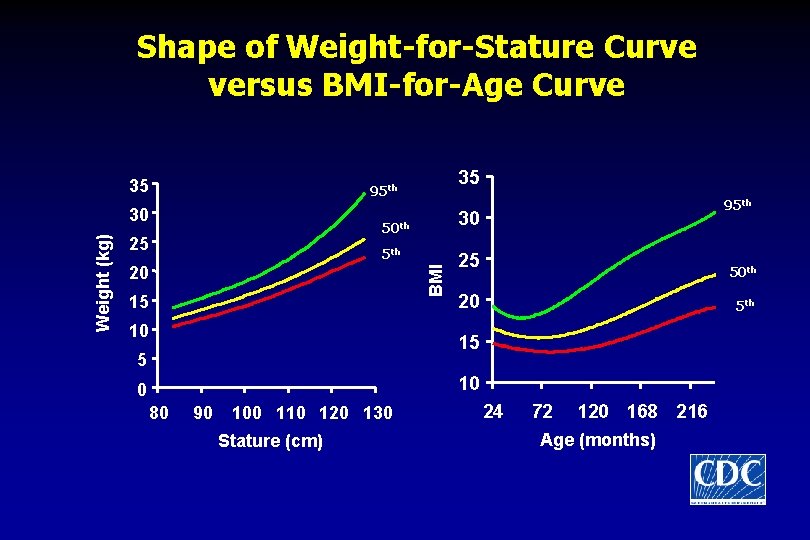
Shape of Weight-for-Stature Curve versus BMI-for-Age Curve 35 30 25 5 th 20 15 10 95 th 30 50 th BMI Weight (kg) 35 95 th 25 50 th 20 5 th 15 5 10 0 80 90 100 110 120 130 Stature (cm) 24 72 120 168 216 Age (months)
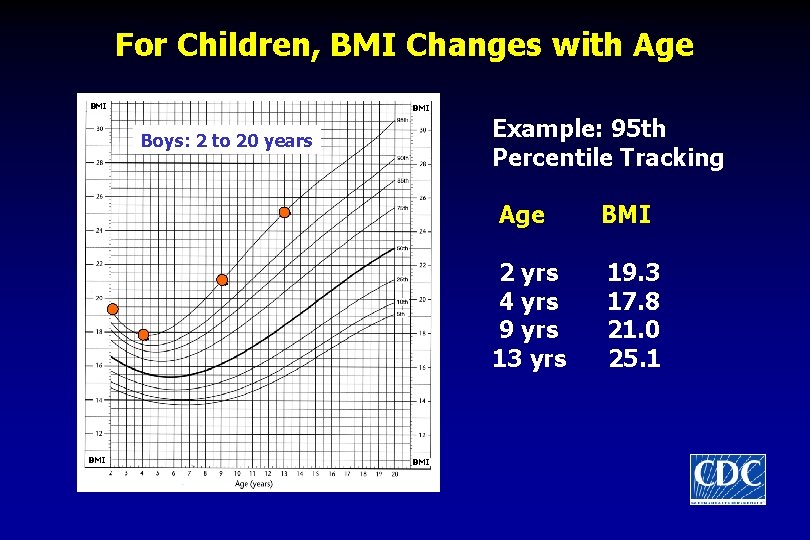
For Children, BMI Changes with Age BMI Example: 95 th Percentile Tracking Boys: 2 to 20 years BMI Age BMI 2 yrs 4 yrs 9 yrs 13 yrs 19. 3 17. 8 21. 0 25. 1
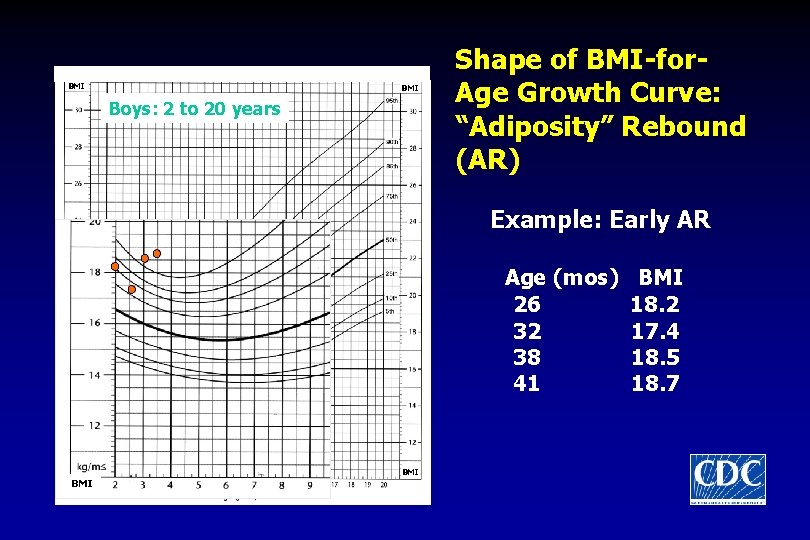
BMI Boys: 2 to 20 years Shape of BMI-for. Age Growth Curve: “Adiposity” Rebound (AR) Example: Early AR Age (mos) 26 32 38 41 BMI BMI 18. 2 17. 4 18. 5 18. 7
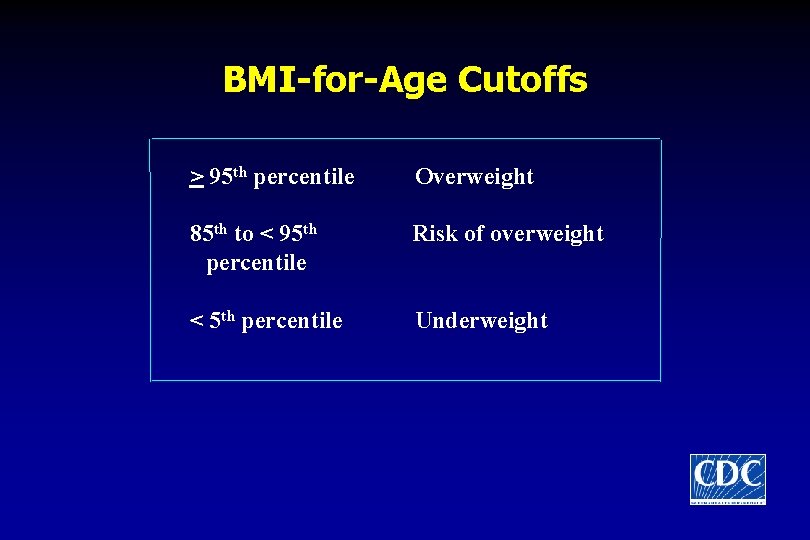
BMI-for-Age Cutoffs > 95 th percentile Overweight 85 th to < 95 th percentile Risk of overweight < 5 th percentile Underweight
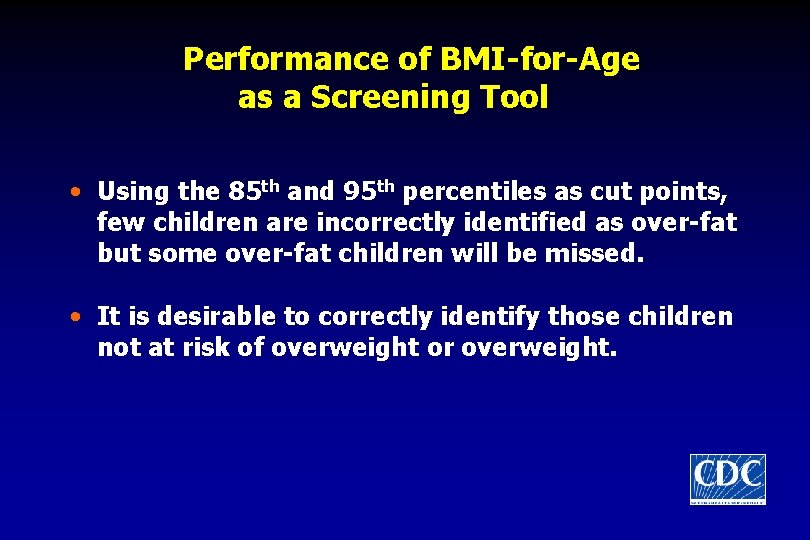
Performance of BMI-for-Age as a Screening Tool • Using the 85 th and 95 th percentiles as cut points, few children are incorrectly identified as over-fat but some over-fat children will be missed. • It is desirable to correctly identify those children not at risk of overweight or overweight.
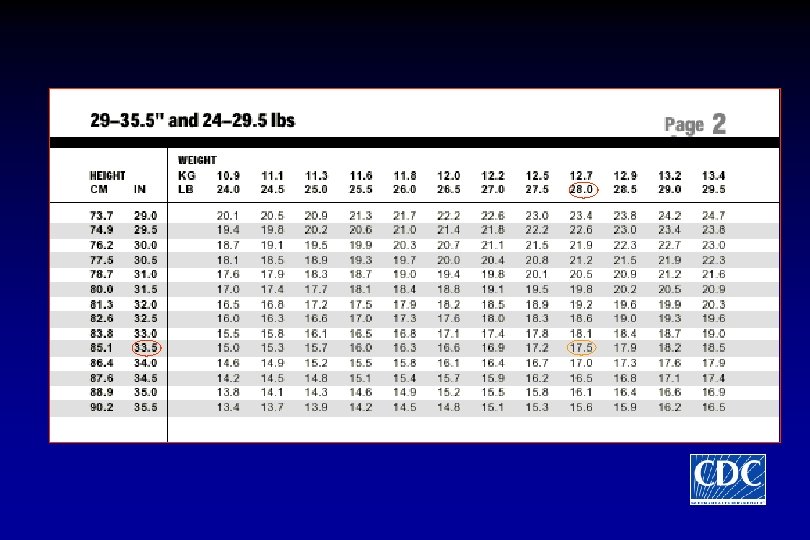
Calculating BMI with the Metric System Formula: weight (kg)/[height (m)]2 Calculation: [weight (kg)/ height (cm)] x 10, 000 Example: A child’s weight=16. 9 kg and height=105. 4 cm BMI = [16. 9 kg / 105. 4 cm] x 10, 000 = 15. 2
Calculating BMI with the English System Formula: weight (lb)/[height (in)]2 x 703 Calculation: [weight (lb)/height (in)] x 703 Example: A child’s weight = 37 pounds, 4 ounces and height = 41 1/2 inches (convert fractions to decimal value) BMI = [37. 25 lb / 41. 5 in] x 703 = 15. 2
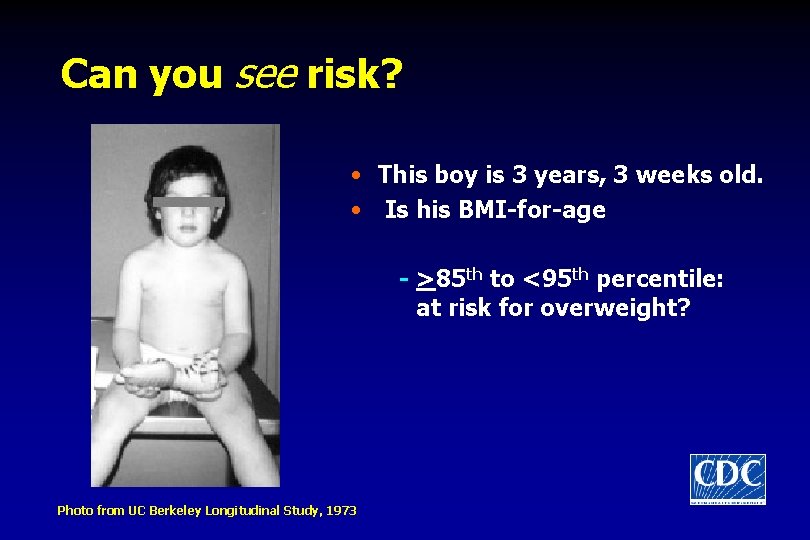
Can you see risk? • This boy is 3 years, 3 weeks old. • Is his BMI-for-age - >85 th to <95 th percentile: at risk for overweight? Photo from UC Berkeley Longitudinal Study, 1973
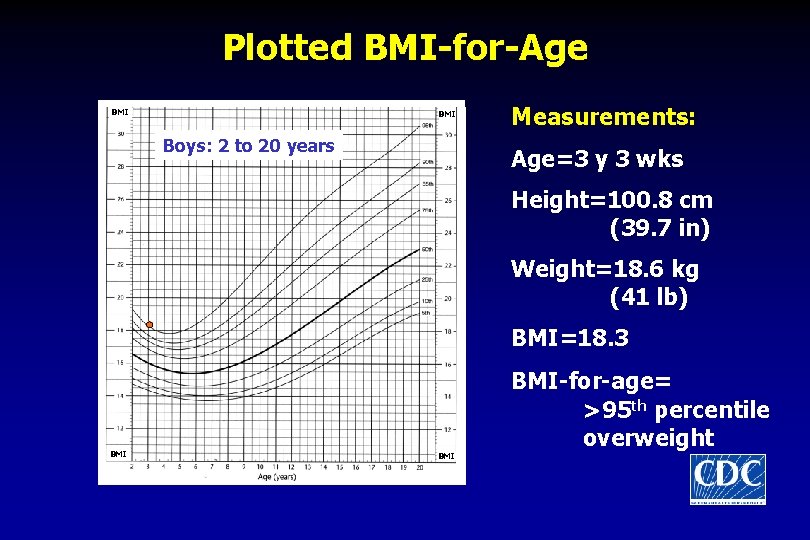
Plotted BMI-for-Age BMI Boys: 2 to 20 years Measurements: Age=3 y 3 wks Height=100. 8 cm (39. 7 in) Weight=18. 6 kg (41 lb) BMI=18. 3 BMI-for-age= >95 th percentile overweight BMI
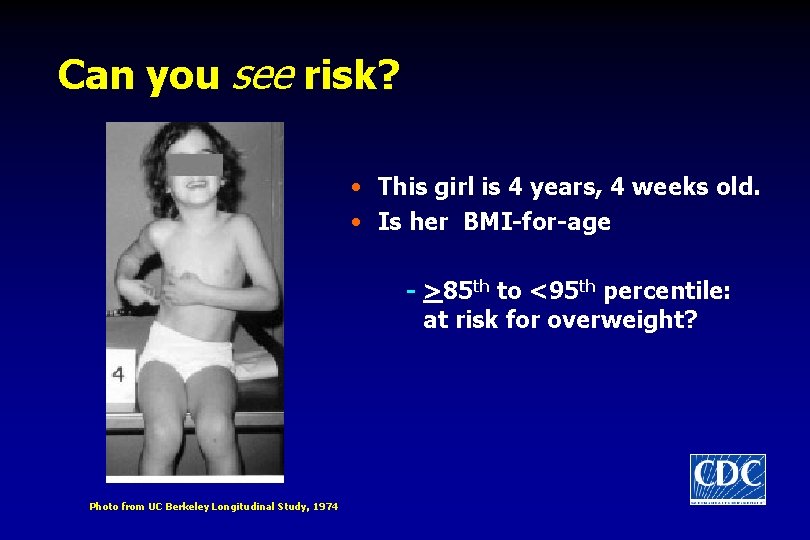
Can you see risk? • This girl is 4 years, 4 weeks old. • Is her BMI-for-age - >85 th to <95 th percentile: at risk for overweight? Photo from UC Berkeley Longitudinal Study, 1974
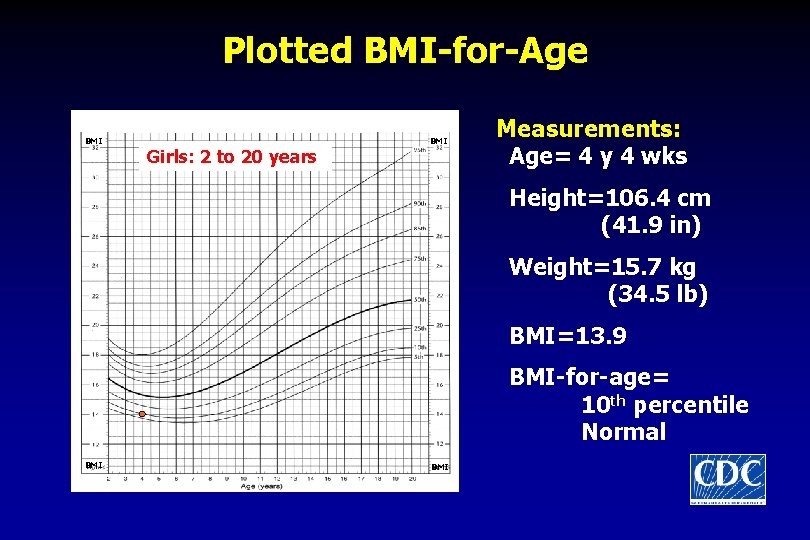
Plotted BMI-for-Age BMI Girls: 2 to 20 years BMI Measurements: Age= 4 y 4 wks Height=106. 4 cm (41. 9 in) Weight=15. 7 kg (34. 5 lb) BMI=13. 9 BMI-for-age= 10 th percentile Normal BMI
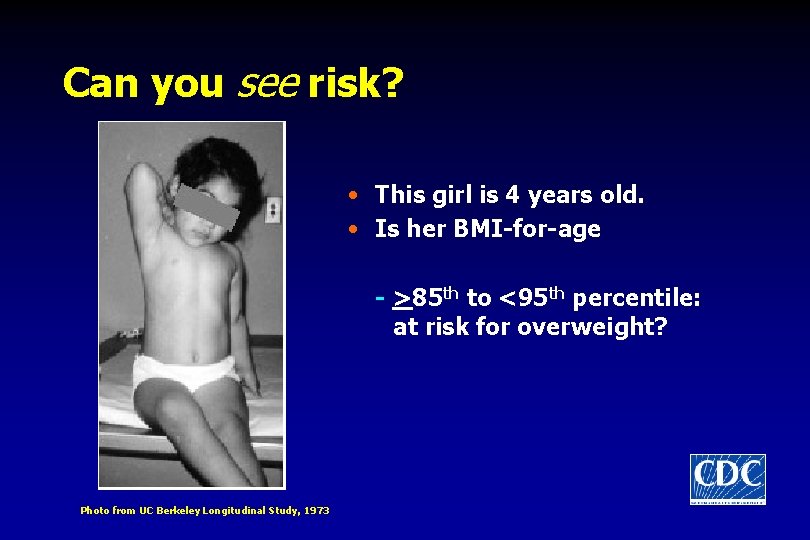
Can you see risk? • This girl is 4 years old. • Is her BMI-for-age - >85 th to <95 th percentile: at risk for overweight? Photo from UC Berkeley Longitudinal Study, 1973
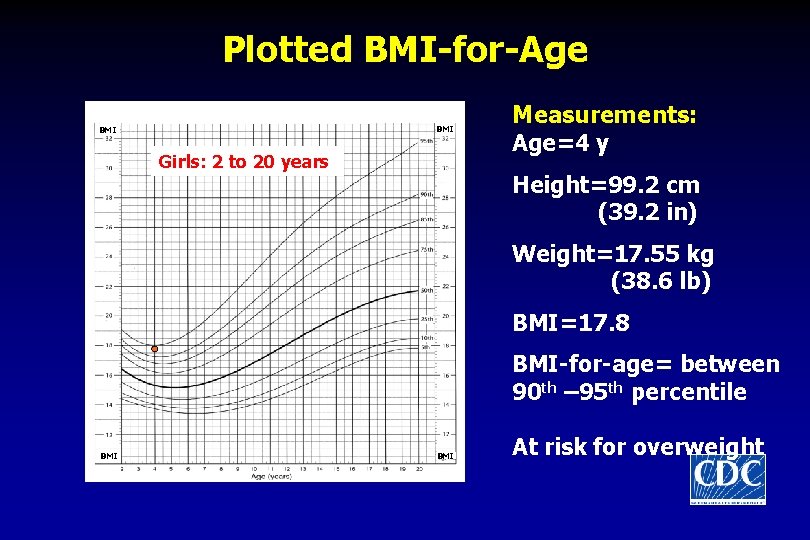
Plotted BMI-for-Age BMI Girls: 2 to 20 years Measurements: Age=4 y Height=99. 2 cm (39. 2 in) Weight=17. 55 kg (38. 6 lb) BMI=17. 8 BMI-for-age= between 90 th – 95 th percentile BMI At risk for overweight
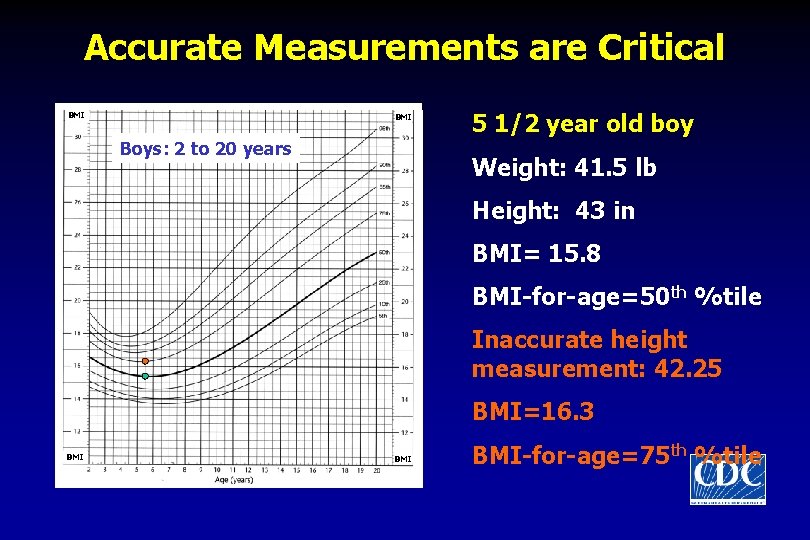
Accurate Measurements are Critical BMI Boys: 2 to 20 years 5 1/2 year old boy Weight: 41. 5 lb Height: 43 in BMI= 15. 8 BMI-for-age=50 th %tile Inaccurate height measurement: 42. 25 BMI=16. 3 BMI BMI-for-age=75 th %tile
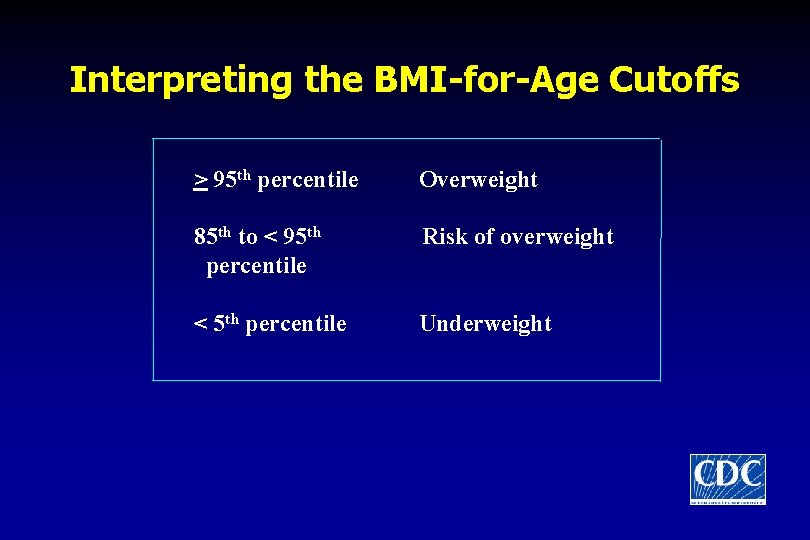
Interpreting the BMI-for-Age Cutoffs > 95 th percentile Overweight 85 th to < 95 th percentile Risk of overweight < 5 th percentile Underweight
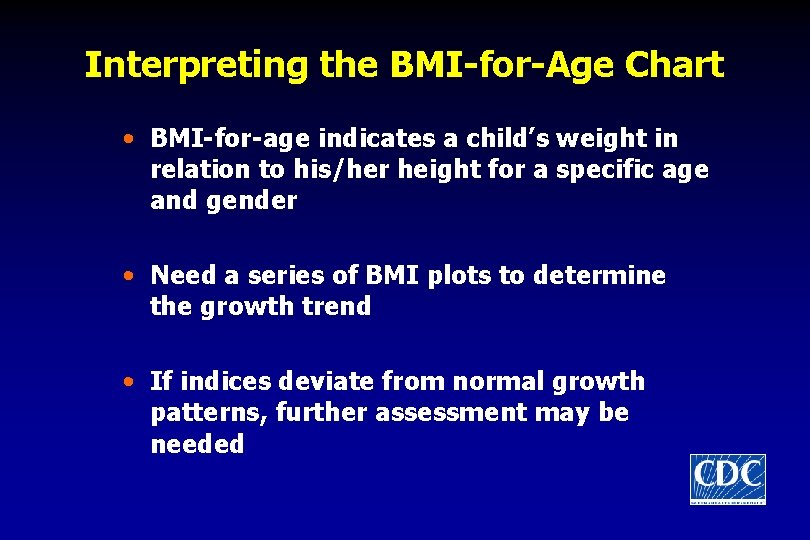
Interpreting the BMI-for-Age Chart • BMI-for-age indicates a child’s weight in relation to his/her height for a specific age and gender • Need a series of BMI plots to determine the growth trend • If indices deviate from normal growth patterns, further assessment may be needed
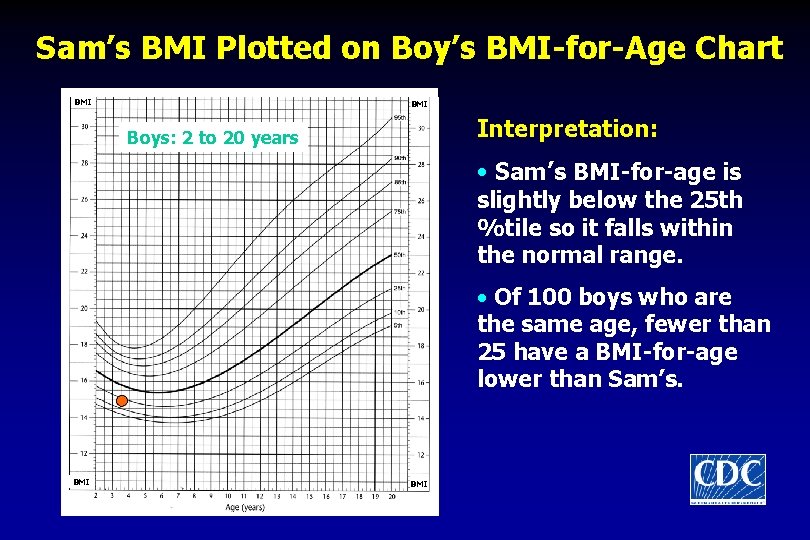
Example: “Sam” • • • Name: Sam Weight: 37 lb 4 oz (16. 9 kg) Height: 41. 5 inches (105 cm) Age: 3. 5 years BMI: 15. 2
Sam’s BMI Plotted on Boy’s BMI-for-Age Chart BMI Interpretation: Boys: 2 to 20 years • Sam’s BMI-for-age is slightly below the 25 th %tile so it falls within the normal range. • Of 100 boys who are the same age, fewer than 25 have a BMI-for-age lower than Sam’s. BMI
Summary of Using BMI-for-Age • BMI-for-age is the recommended method for screening overweight and underweight • For children, BMI is age and gender specific; for adults there are fixed cut points • Accurate and periodic measurements are important elements of any anthropometric screening
Steps to Plot BMI-for-Age • Obtain accurate weight and height measurements • Select the appropriate growth chart • Record the data • Calculate BMI • Plot measurements • Interpret plotted measurements
Please visit: http: //www. cdc. gov/growthcharts/ • For additional training materials related to the growth charts • For tools related to the growth charts • To download the growth charts
www. cdc. gov/growthcharts