
CD and DVD Drive 1 Compact DiscOptical Storage

- Slides: 28
CD and DVD Drive 1
Compact Disc/Optical Storage Technology • It is the electronic recording, storing, and playing back of audio, video, or text, in a digital form on a flat, round plastic storage medium called a disc. • Its called optical because the information on the disk is read by a laser in a CD-ROM drive • A laser is a device that generates an intense beam of coherent/consistent light. • CDs are circular discs that are 4. 75 inches (12 cm) in diameter 2
Types of Compact Disk Technology • CD – Compact Disk • DVD – Digital Versatile Disk • Blue Ray • CD, DVD and Blue Ray Disks are similar in composition and usage, however they differ in data storage capacity. 3
Compact Discs (CD) • Compact Disc was invented by James Russel in 1965. In 1982 the first CD recording ‘The Visitors’ by ABBA was recorded. • A CD stores data or audio which can be played in a regular CD player in your home or car. There are major two types : – CD-R (CD Recordable), which are the most popular can be written to only once. The content is permanently stored. – CD-RW (CD Rewritable). Rewritable discs can be erased and rewritten to repeatedly. – Both can store up to 700 MB of data or 80 min of audio. • CD-RW uses the laser power to melt the data layer so new data can be added 4
Other Types of CD Technologies • • CD-ROM Mini CD VCD Enhanced CD 5
CDROM • It describes all pre-recorded CDs that contain music. A recording of the music is burned onto the CD by the vendor and cannot be erased or changed. • A CD-ROM recording can be played on any standard CD player and contain 650 MB of storage 6
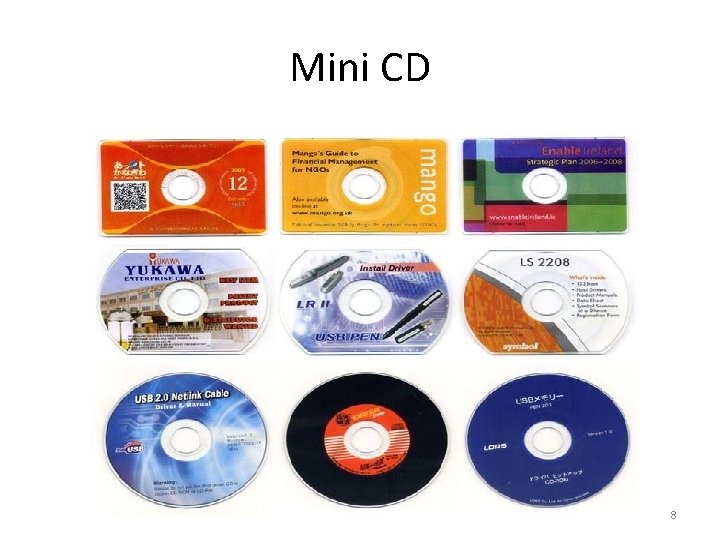
Mini CD • Its about 3 inches in diameter and hold a maximum of 24 minutes of music or 210 MB of data • The most common use of the mini CD format is for single song recording but are also used by businesses for adverts purposes • CD-R allows the user to record data or music once some hold as much as 80 minutes of music • CD-RW- Can be erased and reused. 7
Mini CD 8
Video Compact Disc (VCD) • VCD was introduced in 1993 by JVC, Philips, SONY and Matsushita. It is based on the CD-ROM format and is specifically designed to hold MPEG 1 video data and to include interactive capabilities. • MPEG is the standards for audio and video compression and transmission. • Although they have been superseded by other media, VCDs continue to be retailed as a low-cost video format. 9
Digital Versatile/Video Disc (DVD) • It is a digital optical disc storage format invented and co-developed by Sony, Philips, Toshiba, and Panasonic in 1995 • Its primary function is to store video, but just as easily records other data. • Like CDs, DVDs are either recordable or rewritable, but store a tremendous amount of data. . 10
DVD Types/Format • DVD+R (plus R) and DVD-R (dash R) – – These two are the record once formats. • DVD+RW and DVD-RW – – These are the rewritable formats and can be rewritten over 1000 times. • DVD-ROM – It is a read only compact disc that can hold a minimum of 4. 7 GB enough for a full length digital movie – One of the best features of DVD-ROM drives is that they are backwardcompatible with CD-ROMs. This means that DVD-ROM players can play old CD-ROMs and video CDs, as well as new DVD-ROMs. • DVD-RAM – Can be recorded and erased repeatedly but are compatible only with devices that support the DVD- RAM format. Discs can be rewritten 100, 000 times – It will only play back in a DVD-RAM drive. 11
Blu-Ray Disk (BD): • Blu ray is an optical disc format jointly developed by blu ray disc association, a group of the world’s leading consumer electronics and PC including Apple, LG, HP, Hitachi, Philips, Pioneer etc • It is the latest video disc developed to exceed the capacity of the DVD format and it got its name from a blue laser used when recording to and reading a disc. All the other DVD formats utilize a red laser. • It enables the storage of extremely large amounts of data and is primarily used for highdefinition content and comes in single and dual layer. 12
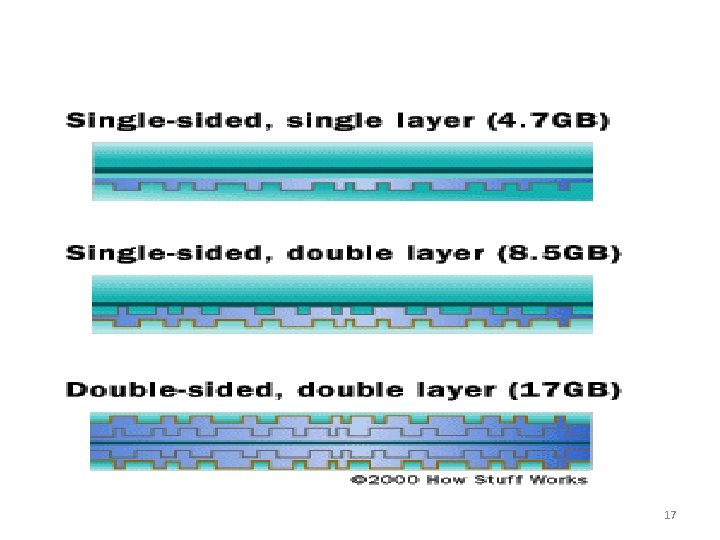
DVD Storage Capacity • The capacity of a DVD is the maximum amount of data it can store. This depends on the number of layers a disc has and whether or not it can be written to one or both sides. The following are the types of layers: – Single sided single layer – Double sided single layer – Single sided Double layer – Double sided double layer 13
DVD Storage Capacity • The original and still very popular is the singlesided, single layer (DVD-5). • Data is written to one side only and can hold 4. 7 GB of data or 2 hrs. of video. • Supported by DVD+/-R and DVD +/-RW formats 14
DVD Storage Capacity – Double-Sided Single Layer (DVD-10): Data can be written to both sides-like a cassette tape. Stores 8. 75 GB or about 4. 5 hrs of video. Also supported by DVD+/ -R and DVD +/-RW. – Single-Sided Double Layer (DVD-9): Records to one side but that one side has two layers built into it. Stores 8. 5 GB of data or 4 hrs. of video. Supported by DVD+R and DVD-R. They are normally termed DVD+R DL and DVD-R DL. – Double-Sided Double Layer (DVD-18): Stores 17 GB of data or over 8 hrs. of video. 15
DVD Storage Capacity • A Blue Ray disc with a single layer store up to 25 GB - that's 2 hrs. of hi-definition content or 13 hrs. of standard video. • Dual layer stores 50 GB, which is 4. 5 hrs of hi def video or 20 hrs of regular video. 16
17
Disk Drive/Burner/Writer • In order to play or record these formats a DVD burner/writer/drive is needed. In addition to a DVD burner, all these formats need some kind of burning software to write DVDs. • A burner is a software that enables the copying of music, video, and data unto a DVD. • Fortunately, most DVD writers support multiple formats. 18
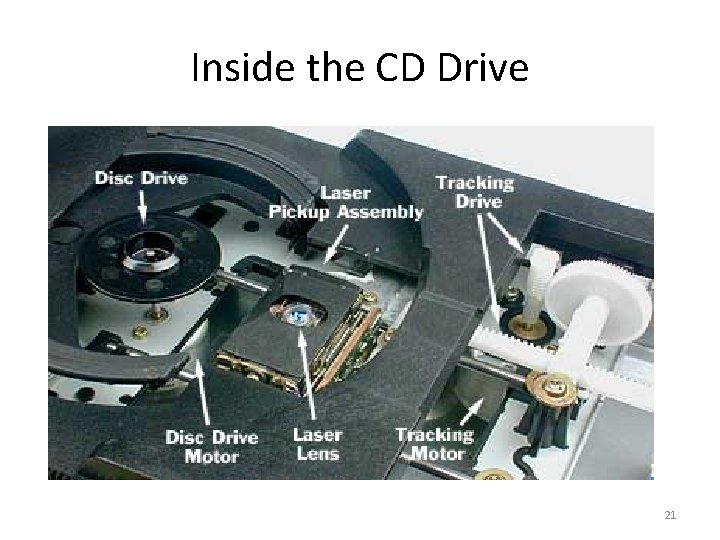
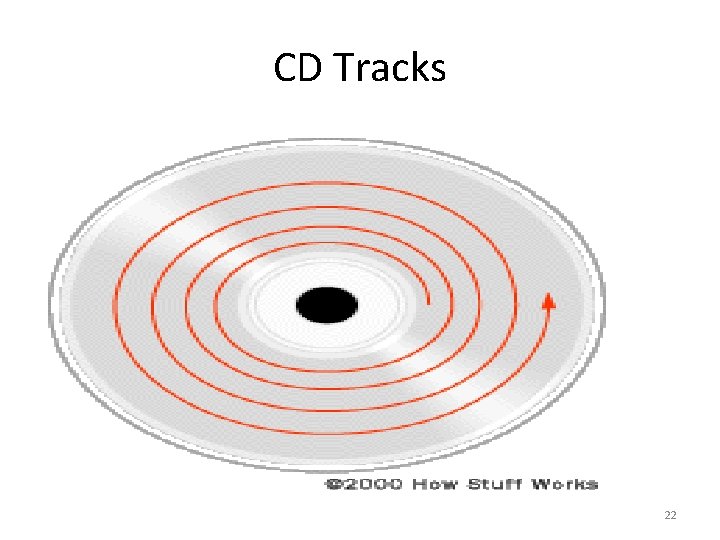
Components of a CD Player • A Drive Motor – It spins the disc and it is precisely controlled to rotate between 200 and 500 rpm depending on which track is being read. • A Laser and a Lens System – It focuses on reading the track. • The Tracking System – It moves laser assembly so that the laser's beam can follow the spiral track. 19
How the Drive Works • The disc is rotated by a drive system that regulates the speed of rotation so that data is read at the same speed regardless of the laser detector’s position. • This means that rotation speed decreases as the laser detector slowly travels from the centre to the periphery of the disc in order to maintain a constant rate of data acquisition • A beam is emitted by the laser and directed onto a single track on the disc. 20
Inside the CD Drive 21
CD Tracks 22
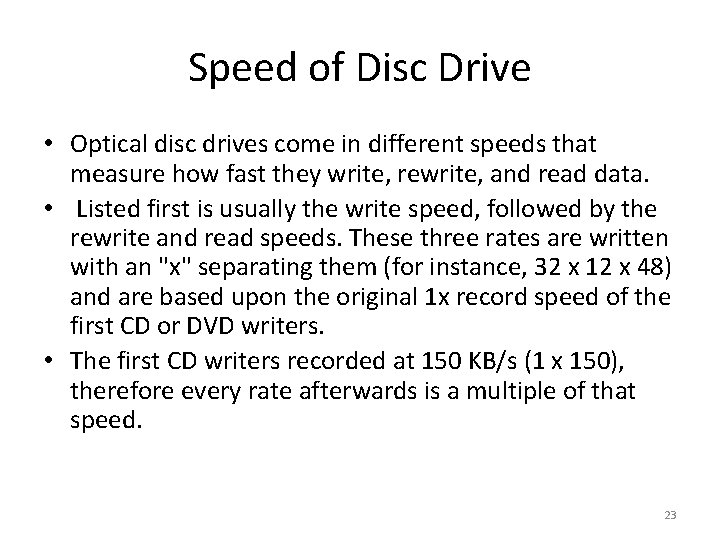
Speed of Disc Drive • Optical disc drives come in different speeds that measure how fast they write, rewrite, and read data. • Listed first is usually the write speed, followed by the rewrite and read speeds. These three rates are written with an "x" separating them (for instance, 32 x 12 x 48) and are based upon the original 1 x record speed of the first CD or DVD writers. • The first CD writers recorded at 150 KB/s (1 x 150), therefore every rate afterwards is a multiple of that speed. 23
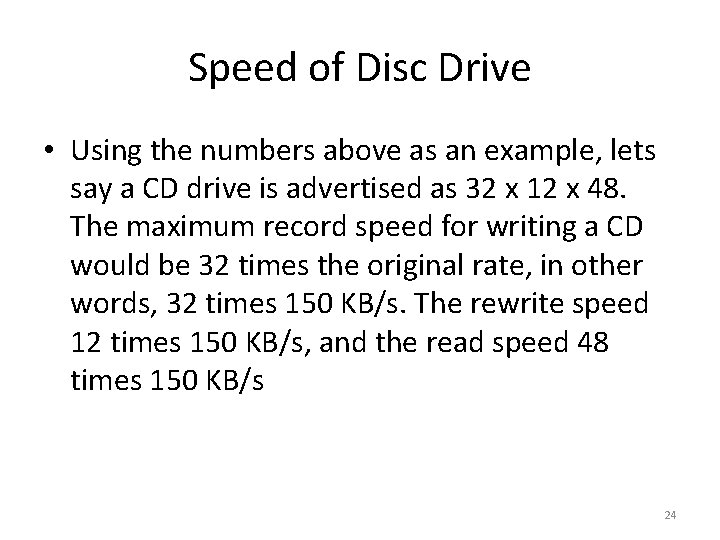
Speed of Disc Drive • Using the numbers above as an example, lets say a CD drive is advertised as 32 x 12 x 48. The maximum record speed for writing a CD would be 32 times the original rate, in other words, 32 times 150 KB/s. The rewrite speed 12 times 150 KB/s, and the read speed 48 times 150 KB/s 24
Video Compression • It is a reversible conversion (encoding) of video file to take less space than. • Software and hardware that can encode and decode are called decoders. Both combined to form a codec. • An uncompressed video produces an enormous amount of data 25
Video Compression • Uncompressed video file cause extreme high computational demands for managing the it. Fortunately, digital video is suitable for compression • Howeevr the higher the compression ratio, the lower the size and the lower the quality. 26
Video Compression Forma • Joint Photographic Expert Group (JPEG) is the format for compressing still image file especially taken by digital camera • Motion Picture Expert Group (MPEG) – Standard for encoding and compressing video images. – Video and sound on digital storage media (CDROM). • H. 263 Video telephony 27
END OF LECTURE 28